Language


Views: 222 Author: Yuhang Power Publish Time: 2026-06-19 Origin: Site
Content Menu
● What FPV Drone Propellers Actually Do
● How to Read FPV Propeller Numbers (The Fast Way)
● Prop Direction and Installation (Still the #1 Crash Reason)
● Key Factors When Choosing FPV Propellers
>> Size (Diameter) – Frame, Use Case, and Motor Range
>> Pitch – Speed vs Efficiency
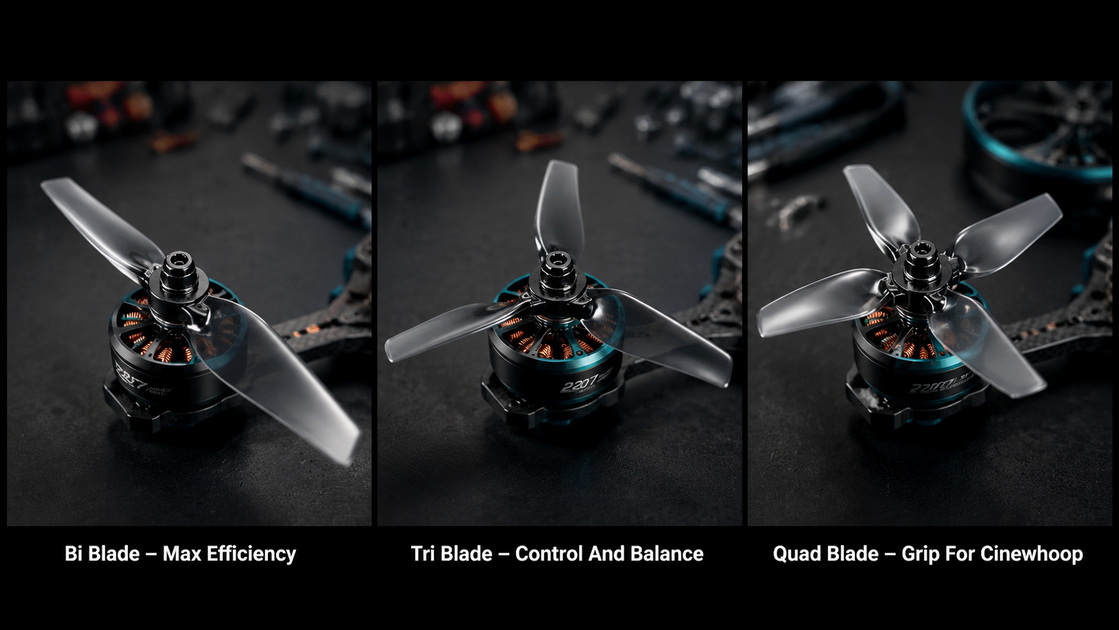
>> Blade Count – Grip, Control, and Current Draw
>> Material – Crash Behavior and Vibration
● Matching Propellers to Motors and Flying Style
>> Motor KV, Stator Size, and Prop Load
>> Thrust‑to‑Weight Ratio (TWR) – The Metric Most Pilots Ignore
>> Quick Matching Guide by Flying Style
● Noise, Frame Design, and Where You Fly
● Prop Mounting Types and Motor Compatibility
● Practical 5‑Inch FPV Setup Examples
● Indoor, Outdoor, Racing, and Long‑Range Prop Suggestions
>> Outdoor Micro FPV (2–4 Inch)
>> 5‑Inch Racing and Freestyle
● How to Install FPV Props Safely (Field‑Tested Steps)
● Common FPV Propeller Mistakes (And How to Avoid Them)
● Call to Action – Choose Props That Match Your Motors, Not Just Your Hype
● FAQs
>> 1. Which is better for FPV, 2‑blade or 3‑blade props?
>> 2. Are bigger propellers always better?
>> 3. What propellers should I use on a 5‑inch FPV drone?
>> 4. Can high‑pitch propellers damage my motors?
>> 5. How do I know if my props are installed the right way?
When pilots ask me why their quad feels underpowered, noisy, or hot after a prop change, the problem is almost always prop–motor mismatch, not the motor itself. In this guide, I'll walk you through FPV propellers the way we look at them as a motor manufacturer and OEM partner—from basic specs to practical matching tables, noise, and durability in real commercial use. [yuhangmotor]
I'll also show you where typical online tutorials stop short, and add deeper insights from mass production testing, long-term endurance runs, and customer feedback across drones, FPV racers, RC cars, gimbals, industrial fans, and robots. [yext]
At its core, a propeller converts motor torque + electrical power into thrust and control authority. When the props spin, they push air downward; once this force exceeds gravity, your drone lifts, accelerates, brakes, and turns based on tiny changes in RPM on each motor. [getfpv]
Because of this, prop choice has more impact on "feel" than almost any other component—change props and the same drone can feel smooth and cinematic, or twitchy and race-ready. [oscarliang]
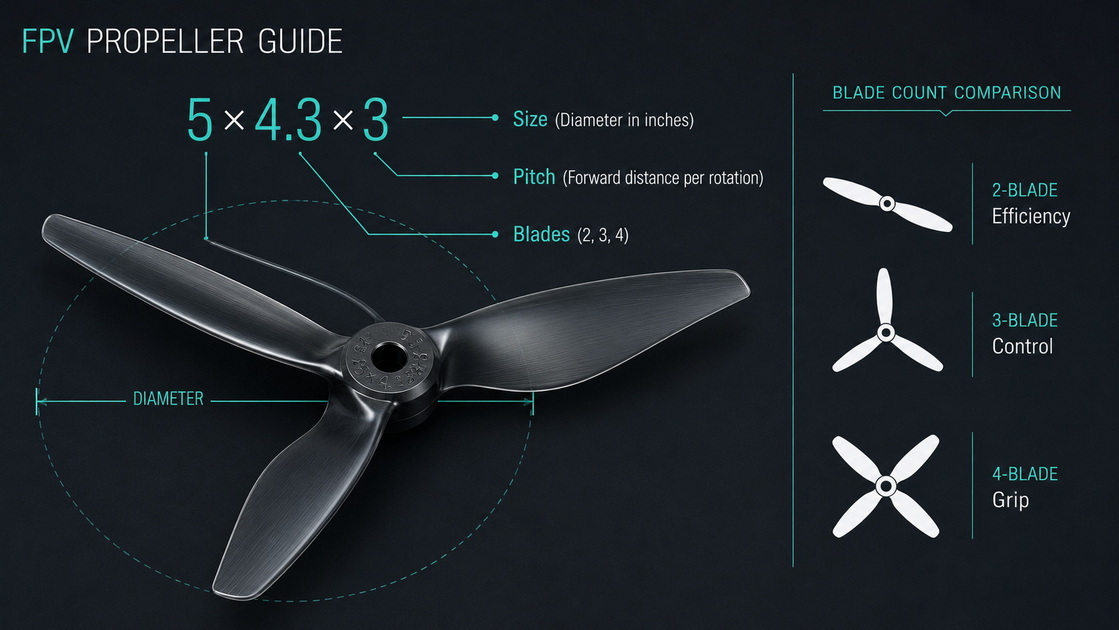
Most FPV props use a simple format: L × P × B, where:
- L = length (diameter) in inches
- P = pitch in inches
- B = blade count
Examples from real-world products: [getfpv]
- 5×4.3×3→ 5 inch diameter, 4.3 inch pitch, 3 blades
- 5140 tri-blade → 5.1 inch diameter, 4.0 inch pitch, 3 blades
- MEPS SPACE SZ4942 → 4.9 inch diameter, 4.2 inch pitch, typically tri‑blade for 5‑inch class builds [oscarliang]
Once you can read these numbers instantly, it becomes much easier to compare props and predict how they will behave on different motors and frames. [oscarliang]
Wrong prop direction is still one of the most common causes of flips on takeoff—even for experienced pilots. [getfpv]
- FPV frames normally use two CW and two CCW props arranged diagonally, so the opposite corners cancel torque. [oscarliang]
- The leading edge of the blade should meet the air first; most props are marked CW/CCW or have embossed text on the top side to guide you. [oscarliang]
Before the first flight on a new build, I always:
- Spin each prop by hand and confirm it pushes air downward.
- Double-check CW props are on CW motors, and CCW on CCW. [oscarliang]
If you document builds for customers or OEM partners, this is also a great spot to add a short installation video or GIF for user support.
Prop size should match frame size, motor stator, and mission profile. Here is a consolidated, practical table for modern FPV builds: [getfpv]
Recommended prop size, motors, and use case
| Frame size | Prop size | Motor range | Typical use case |
|---|---|---|---|
| 65 mm | 31 mm | 0702–0802 (1S) | Indoor tiny whoop |
| 75 mm | 40 mm | 0802–1103 (1–3S) | Indoor / light cinewhoop |
| 100–120mm | 2–3 inch | 1103–1404 | Micro freestyle, ultralight LR |
| 140 mm | 3.5 inch | 1404–2004 | Sub‑250g cinewhoop |
| 160 mm | 4 inch | 1507–1805 | Lightweight long range |
| 210 mm | 5 inch | 2207–2306 | Freestyle, racing, cinematic |
| 240 mm | 6 inch | 2208–2507 | Long range, endurance |
| 280 mm | 7 inch | 2507–2806.5 | Heavy long range builds |
| 300+ mm | 8–15 inch | 2808–3214+ | Endurance, heavy lift, film rigs |
Larger props: more lift and efficiency, but slower response, more torque demand, and potential vibration on flexible frames. [getfpv]
Smaller props: less thrust but very responsive, which many race and freestyle pilots prefer. [oscarliang]
Pitch is how far a prop would "screw" forward in one rotation, measured in inches. [getfpv]
- Low pitch
- Light load on the motor
- Smooth throttle, less propwash, better efficiency
- Great for freestyle, cinematic, and long‑range [oscarliang]
- High pitch
- More thrust and top speed
- Higher current draw and motor temps
- Ideal for racing and aggressive flying, but harsh on small batteries [getfpv]
As a rule of thumb, I tell new pilots: if motors come down too hot to touch, your pitch is probably too high for your KV and prop size. [getfpv]
Blade count controls how a quad "feels" in turns, especially on yaw and at lower RPM. [getfpv]
- 2‑blade (bi‑blade)
- Highest efficiency and longest flight time
- Less grip in corners, "looser" feel
- Great for long range and efficiency‑focused builds [getfpv]
- 3‑blade (tri‑blade)
- The best all‑rounder in FPV right now
- Strong grip and control for racing and freestyle
- Reasonable efficiency when matched well with motor KV [oscarliang]
- 4‑blade or more
- Maximum grip and low‑speed control
- Higher current draw and heat
- Common on cinewhoops or ducts carrying GoPros or heavier payloads [getfpv]
In real customer projects, we see tri‑blades dominate 5‑inch freestyle and race builds, while ducted cinewhoops tend to favor 4‑blade or 5‑blade props for ultra‑smooth low‑speed footage. [oscarliang]
Today's mainstream FPV props use reinforced plastics for a good balance of stiffness, cost, and survivability. [getfpv]
- Plastic (polycarbonate)
- Affordable, slightly flexible, crash‑friendly
- Ideal for training, racing, and everyday freestyle [oscarliang]
- Carbon fiber
- Very stiff, less vibration, precise control
- More brittle and expensive; better suited to experienced pilots and low‑crash scenarios [getfpv]
From a motor manufacturer's angle, overly stiff props on an unbalanced setup can transmit more vibration into the motor bearings, so we usually recommend high‑quality PC props with good balance for most users. [oscarliang]
Once a prop is mounted, motor RPM drops sharply because of air resistance. High KV motors try to spin faster, so if you put a large, aggressive prop on them, they draw huge current and run hot. [getfpv]
General rules:
- Large props → low KV motors with bigger stators for torque
- Small, light props → high KV motors for fast RPM changes [oscarliang]
Overheating doesn't just shorten flight time—it can damage winding insulation, cause shorts, and kill motors. That's exactly why in our OEM testing we always benchmark prop–motor–battery combinations together, not in isolation. [getfpv]
When I help a customer tune a build, the first number I look at is thrust‑to‑weight ratio:
- 1.0–1.5 : practically hover / endurance rigs
- 2.0 : relaxed cruising, cinematic, training
- 3.0 : strong freestyle with clean recovery power
- 4.0–5.0+ : race‑level punch and vertical climb [oscarliang]
A simple workflow:
1. Estimate all‑up weight (AUW) including battery.
2. Look up bench thrust data for your motor + prop + voltage, or use conservative estimates from trusted databases or manufacturer charts. [getfpv]
3. Multiply thrust per motor by 4, then divide by AUW to get TWR.
If the ratio is too low, choose higher pitch or slightly larger props (within frame clearance) or lower AUW; if it is too high for your flying style, drop pitch a bit to gain efficiency and cooler motors. [oscarliang]
Freestyle [oscarliang]
- 5 inch frame, 3‑blade, medium pitch (e.g. 5×4.3×3)
- Motor KV around 1700–1900KV on 6S
- Target TWR: 3:1–4:1
Racing [getfpv]
- 5 inch frame, 2–3 blade, higher pitch (5×4.5×3, 5×4.6×3)
- Motor KV often 1900–2100KV on 6S
- TWR typically 4:1 or above
Cinematic / Cinewhoop [getfpv]
- 3–4+ blades, lower pitch for smooth low‑speed control
- Ducted frames, focusing on control more than pure speed
- TWR in the 2:1–3:1 range
Long Range [oscarliang]
- 6–7 inch props, 2‑blade or efficient 3‑blade
- Low KV (1500–1700KV) and bigger batteries
- Aim for high efficiency at cruise throttle rather than maximum punch
These are the same patterns we use when we recommend prop pairs for our own FPV motors and OEM client builds. [oscarliang]
In 2026, noise is no longer just a comfort issue; it can limit where and when you can fly. [youtube]
Key drivers of prop noise:
- RPM – higher RPM = higher‑frequency "whine" [getfpv]
- Blade shape and width – wide blades give a deeper hum; thin blades sound sharper [getfpv]
- Ducting and frame – cinewhoops often sound louder because ducts amplify pressure waves [oscarliang]
That's why cinematic builds sometimes move to toroidal or specialized "quiet" props, which produce a softer sound profile at the cost of some efficiency. For commercial clients filming near people or indoors, we almost always test noise as part of the prop selection process. [youtube]
You can support this section with:
- A spectrogram screenshot comparing different props at the same throttle
- A short video clip demonstrating noise differences between open‑prop and ducted builds
Prop mounting systems must match your motor shaft and bell design. Mismatches cause wobble, broken hubs, and even in‑flight ejection. [getfpv]
- Prop nut (M5)
- Standard for 5‑inch and larger rigs
- Uses a self‑locking nut on an M5 threaded shaft [oscarliang]
- T‑mount
- Two M2 screws with a small locating shaft (1–1.5 mm)
- Common on 2–4 inch micro FPV motors and lightweight builds [getfpv]
- Press‑fit
- Push‑on hubs that rely on friction
- Common on tiny whoops and ultralight "toothpick" frames [oscarliang]
When we design a new FPV motor series, we decide early whether it targets M5 prop nuts, T‑mount, or both, because that affects shaft design, bell strength, and application range.
For most pilots, 5‑inch quads remain the sweet spot between agility and carrying capacity. [oscarliang]
Typical 5‑inch prop setups
| Build type | Motor KV | Recommended props |
|---|---|---|
| Freestyle | 1700–1900 KV | 5×4.3×3 tri‑blade |
| Racing | 1900–2100 KV | 5×4.5×3 / 5×4.6×3 |
| Long range | 1500–1700 KV | 5×3.5×2 bi‑blade |
| Cinematic | 1700–1800 KV | 5×3.8×3 smooth tri‑blade |
If you are tuning motors similar to 2207–2306 stators, this table offers a safe baseline before you start fine‑grained PID or RPM filtering changes. [oscarliang]
To make theory easier to apply, here's how we usually segment prop choices for different environments and use cases. [oscarliang]
- 31–40 mm props, often 3‑blade designs for better control in tight spaces
- Matched with 0802–1103 motors and small 1S/2S packs [getfpv]
- Durability and quick replacement matter more than ultimate efficiency
Here, clear close‑up product photos and simple dimension diagrams help users pick compatible props at a glance.
- 3–3.5 inch tri‑blades on 1404–1407 motors for agile but stable flight
- Great for sub‑250 g builds that still want strong control authority [getfpv]
We often see users combine HQ and Gemfan tri‑blades in this class for racing and light HD recording, depending on local availability and preferred flight feel. [oscarliang]
- 5 inch tri‑blade props with mid to high pitch are still the standard
- Freestyle tends to pick slightly lower pitch for smoother response
- Racing pushes higher pitch and lighter hubs for maximum acceleration [getfpv]
As a motor manufacturer, this class is where bearing quality, magnet strength, and stator design are most obviously exposed by prop changes, so we do a lot of R&D here.
- 6 and 7 inch bi‑blades or efficient tri‑blades
- Mid‑KV motors (for example 2806.5 class for 6–7 inch LR)
- Built for stable cruise, efficient current draw, and smooth footage [getfpv]
For OEM and B2B clients in mapping, inspection, or industrial monitoring, we often optimize around max cruise time at a fixed payload, not simply maximum static thrust. [yext]
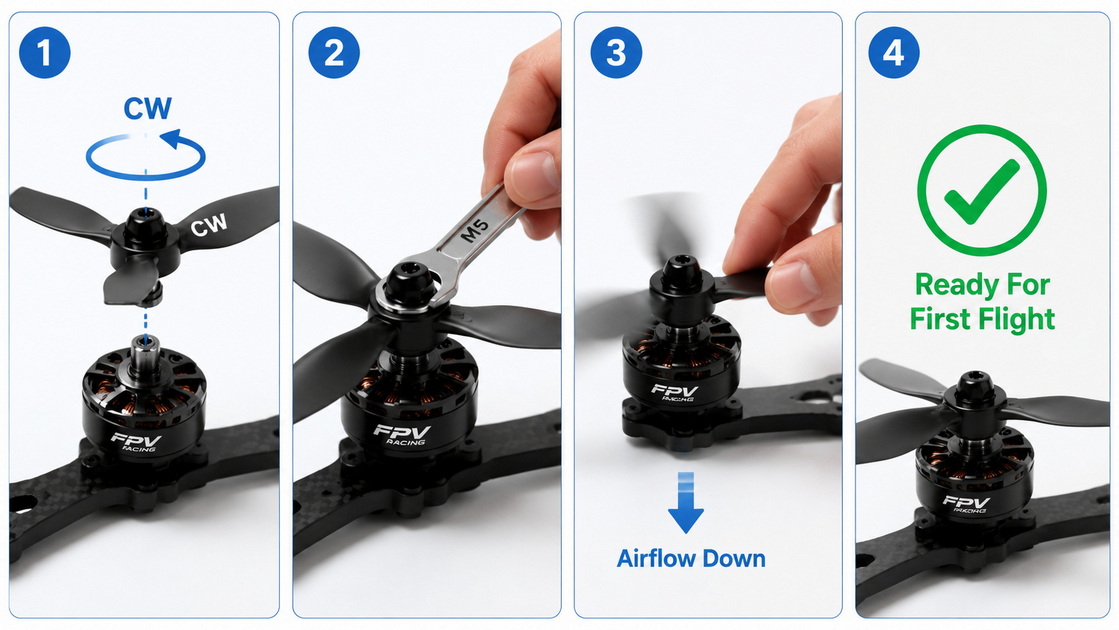
A clean install is as important as spec matching. Use this checklist before any maiden flight or motor swap: [oscarliang]
1. Check motor rotation in Betaflight or similar tools (CW vs CCW).
2. Identify prop top/bottom via glossy finish or embossed text.
3. Match prop type to motor direction (CW prop on CW motor).
4. Tighten nuts or screws firmly without over‑stripping.
5. Manually spin each prop and confirm it pushes air downward. [getfpv]
For UX, this section is perfect for:
- One step‑by‑step photo sequence
- One short embedded video demonstrating correct vs incorrect installation
Even advanced users fall into the same patterns we see in support tickets and warranty claims: [oscarliang]
- Using props that are too large or too aggressive for the motor KV and ESC → overheated motors and ESCs
- Choosing excessive pitch and then complaining about short flight times
- Mounting props in the wrong direction or upside down
- Continuing to fly on cracked or bent props, introducing vibration that can damage motors and cameras [getfpv]
From a manufacturer's side, we always recommend customers define a simple "prop health" rule (for example, replace after any visible chip or severe crash) to protect both motors and electronics over time.
If you already know your frame size, motor KV, and flying style, you can now select a prop that matches your real requirements instead of just following trends. [yext]
As a brushless motor and FPV power system manufacturer, we strongly recommend treating props as part of a system: test a few carefully chosen models, log current draw and motor temperature, and keep the one that gives you the best balance of control, efficiency, and reliability for your application. [oscarliang]
If you're planning a new FPV or industrial drone project and need OEM/ODM support, reach out with your target weight, environment, and flight profile—we can help you shortlist motor + prop + ESC combinations that are production‑ready.
2‑blade props are more efficient and offer longer flight times, but provide less grip and a looser feel, which suits long‑range or endurance builds. 3‑blade props provide better control and stability, making them the standard for racing and freestyle despite slightly higher current draw. [getfpv]
No. Bigger props can provide more thrust and efficiency for heavy or long‑range drones, but they respond more slowly, demand more motor torque, and can increase vibration on flexible frames. The "best" size depends on weight, motor KV, and flight goals. [oscarliang]
Most 5‑inch freestyle builds fly well on 5×4.3×3 or similar mid‑pitch tri‑blade props, while racers often push to 5×4.5×3 or 5×4.6×3 for more speed at the cost of efficiency. Always confirm motor KV and ESC limits before using very aggressive props. [getfpv]
Yes. If you combine high‑pitch props with high KV motors or undersized ESCs, current draw and heat can exceed design limits, damaging motor windings or electronics over time. Monitoring motor temperature after new prop changes is an essential safety step. [oscarliang]
Visually check that the shiny or embossed side faces up, match CW/CCW props to the correct motors, then spin them by hand to ensure each prop pushes air downward. If the quad flips immediately on takeoff, disarm and recheck direction before trying again. [getfpv]
1. MEPSKING Blog – "Tutorial Propellers: Choose Best suitable FPV Drone Propellers for Your FPV" (source article structure and examples). [oscarliang]
2. Oscar Liang – "How to Choose the Best Propellers for Your FPV Drone" (additional best‑practice insights on size, pitch, and blade count).[oscarliang]
3. GetFPV – "All about Multirotor Drone FPV Propellers" (foundational information on prop behavior and performance trade‑offs). [getfpv]
4. Yext – "How Google's E‑E‑A‑T Framework Impacts Brand Visibility" (guidance on using first‑party data, original research, and clear structure to build authority). [yext]
5. WB Coding School – "How To Write A Tech Blog That Reads Well" (UX and readability practices: headings, chunking, and revision). [wbscodingschool]


