Language


Views: 222 Author: Yuhang Power Publish Time: 2026-06-17 Origin: Site


Content Menu
● What A "Robotic Power Solution" Really Means
● Humanoid Robot Actuators: Powering Shoulders, Knees And Ankles
>> High‑Torque Joints With Human‑Like Dynamics
>> Real‑World Case: Bipedal Robotics Research
● Exoskeleton Actuators: Lightweight Power For Human Augmentation
>> Integrated Modules Versus QDD Solutions
>> AI‑Driven Exoskeletons In Practice
● Medical Robotics Motors: Quiet, Precise And Safe
● Gimbal Systems And Vision Platforms: Stabilization As A Power Problem
>> Hollow Gimbal Motors For Robotics
● Quadruped Robot Actuators: Torque Density For Dynamic Gaits
>> Smart Farming And Hybrid Actuation
● Wheel Robot Actuators: AMRs, AGVs And Rover Challenges
● Industrial Robot Actuators: Heavy Loads And Harsh Environments
● Underwater Thrusters: From 0–30 m To Deep‑Sea 350 m
● How Zhongshan Yuhang Power Complements These Robotic Power Solutions
● Practical Framework: How To Specify A Robotic Power Solution
● Suggested CTA For Robotics And OEM Buyers
● FAQ
When you look behind today's most impressive robots – from humanoid robots and AI exoskeletons to agricultural quadrupeds and underwater ROVs – you always find the same thing: carefully engineered robotic actuators and brushless motors that translate control algorithms into reliable motion. As an engineer working with FPV drone motors and robotic power systems at Zhongshan Yuhang Power, I see every day how the right motor and actuator architecture can decide whether a robot remains a lab demo or becomes a field‑proven product. [capow]
A true robotic power solution is more than a single motor model; it is a matched combination of actuator, reducer, driver, encoder and control strategy designed around a specific application such as humanoids, exoskeletons, medical devices or mobile robots. Instead of just selling motors, leading suppliers now provide application‑specific actuator families, reference designs and case studies that show performance in real robots. [china-bgmotor]
For B2B teams and system integrators, this shift is critical. It means you can:
- Shorten development cycles by starting from field‑tested actuator platforms. [youtube]
- Reduce integration risk because mechanics, torque density and thermal behavior are already proven. [advancedenergy]
- Focus engineering resources on control, perception and software, not on reinventing every motor. [capow]
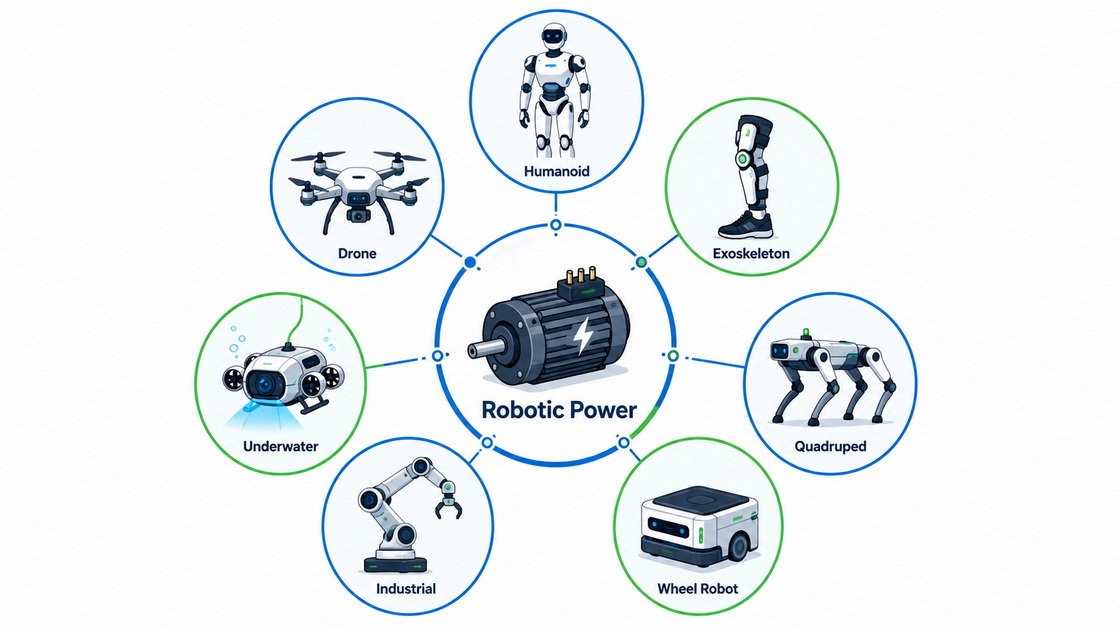
In humanoid robots, actuators must deliver high torque, fast response and wide joint range while remaining compact and lightweight. Solutions like the AK‑series humanoid actuators are designed for different joints: shoulders and hips for high‑torque, wide‑angle motion, elbows and knees for dynamic control, and wrists and ankles for precise, compact actuation. [youtube]
These actuators often integrate:
- High‑torque density outrunner or frameless motors. [ligpower]
- Precision reducers (harmonic or planetary gears). [youtube]
- High‑resolution encoders for accurate position and torque control. [advancedenergy]
From a design perspective, humanoid joints are where mechanical robustness, low backlash and thermal management all have to meet strict weight budgets. [capow]
CubeMars highlights how its AK70‑10 robotic actuators have been used in academic projects like Nathan Weiss's bipedal robot at Stellenbosch University, supporting agile legged locomotion with high‑efficiency torque control. Similar joint actuators appear in other research robots exploring dynamic walking, running and balance control, where consistent torque output is a prerequisite for advanced gait algorithms. [capow]
For integrators, these examples prove that commercially available humanoid actuators can move beyond demos and into serious R&D and pre‑product platforms. [youtube]
Exoskeletons demand high torque, low weight and smooth human‑robot interaction, often with long daily duty cycles. To support this, suppliers typically offer two main actuator architectures: [youtube]
- Integrated module motors – motor, reducer and driver combined in a compact unit for plug‑and‑play deployment. [youtube]
- QDD (Quasi‑Direct Drive) motors – integrated motor and reducer, with a separate driver, ideal for teams running custom control algorithms. [youtube]
Both approaches aim to reduce total system mass while providing the torque bandwidth needed for rehabilitation, gait assistance and strength augmentation. [advancedenergy]
One notable example is the AI‑driven lower‑limb exoskeleton developed by Georgia Tech, Stanford and the University of Pennsylvania, where AK80‑9 robotic actuators supply 9 Nm rated torque at 48 V while maintaining lightweight packaging (~485 g). The project, featured in Science Advances, uses sophisticated control algorithms that rely on precise torque control and low friction in the actuators. [capow]
Research on force estimation based on QDD technology goes further, showing how exoskeletons can infer interaction forces without additional force sensors, by leveraging the intrinsic dynamics of the actuator. For B2B exoskeleton developers, this means actuators are not just torque sources but also sensing elements within the control architecture. [advancedenergy]
Medical and rehabilitation devices place unique requirements on noise, smoothness and safety, alongside compact form factors. In this domain, robotic motors power rehab trainers, gait assistance devices and post‑surgical recovery systems where patient comfort and repeatable motion control are critical. [capow]
CubeMars showcases a project where a team led by a patient with muscular dystrophy developed an autonomous calf stretching device using their motors, providing a more convenient option for neuromuscular rehabilitation. Motors in such devices demand low cogging torque, fine control resolution and dependable operation over many thousands of cycles. [advancedenergy]
For OEMs in medical robotics, motor partners need not only technical capability but also quality management and traceability to support regulatory compliance. [futuremarketinsights]
Gimbal motors are another specialized segment of robotic power solutions. They need high stability, precise low‑speed control and minimal noise, often with large hollow shafts for cable routing. [advancedenergy]
The GL II series gimbal motors integrate hollow drives that simplify wiring and improve system reliability in rotating platforms and lightweight robotic arms. These motors have been used, for example, in RoboMaster engineering robots, where they stabilize vision systems and collection mechanisms in a competitive robotics environment. [youtube]
From a power‑solution perspective, gimbal systems prove that "low power" applications still benefit from high‑end motor engineering, especially when camera stability and pointing accuracy are commercially critical. [capow]
Quadruped robots – often called robot dogs – push actuators hard with frequent starts, stops, jumps and impacts. Motors for hip, knee and ankle joints must combine: [youtube]
- High torque density and peak torque. [ligpower]
- Excellent heat dissipation. [youtube]
- High‑bandwidth response for precise posture control. [capow]
In agriculture, a quadruped robot developed at the University of Minnesota uses CubeMars actuators to traverse cornfields, avoid obstacles, collect soil and crop data and perform inspection and sampling tasks. The project demonstrates how integrated motor solutions enable autonomous operations in rough outdoor environments. [capow]
Another project, Kemba, a quadruped from the University of Cape Town, combines electric and pneumatic actuators to balance dynamic behavior and precise control, again relying on robust motor units at key joints. These examples show how robotic power solutions directly influence real‑world mobility and data quality in smart agriculture and research. [capow]
Wheeled robots – AMRs, AGVs and planetary rover prototypes – rely on motors that can deliver continuous rotation, high torque and precise speed control over long operating hours. To meet these needs, robotic motor suppliers offer compact actuator solutions that support: [advancedenergy]
- High‑load payloads and long‑term stable operation. [youtube]
- Accurate low‑speed control for docking and manipulation tasks. [advancedenergy]
- Efficient thermal design to prevent overheating in dense chassis. [futuremarketinsights]
CubeMars highlights use cases such as Toronto MetRobotics and the Binghamton University Robotics Team competing in the University Rover Challenge, where their actuators power mobile platforms designed for Mars‑like terrains. These case studies help B2B buyers see how specific actuators perform in demanding robotics competitions and field tests. [capow]
In industrial robotics, actuators must support high torque, multiple mounting options and long, continuous duty cycles on CNC machines, logistics lines and overhead maintenance systems. Modular motor families with frameless torque designs allow integrators to embed motors directly into joints, customizing gearboxes and encoders as needed. [ligpower]
A strong example is the Gorilla Mk1 robot for overhead line maintenance in Australia, which uses RI80 V2.0 frameless torque motors to deliver the robust performance required for high‑voltage line inspection. In these scenarios, failure is not an option; thermal headroom, ingress protection and robust mechanical interfaces are non‑negotiable design points. [china-bgmotor]
Underwater robotics demands motors that endure pressure, corrosion and sealing challenges that do not exist on land. Specialized underwater thrusters are offered for depth ranges from 0–30 m (for electric paddleboards and RC boats) up to 0–350 m for ROVs, AUVs and underwater work platforms. [youtube]
Key features typically include:
- High‑protection (IP) ratings and corrosion‑resistant housings. [ligpower]
- Optimized propeller and motor matching for efficient thrust. [youtube]
- Stable performance despite variable temperature and water conditions. [futuremarketinsights]
This is exactly the type of environment where experienced motor OEMs like Zhongshan Yuhang Power, already supplying underwater robot motors and thrusters, add major value with custom sealing, material selection and long‑term reliability testing. [instagram]
While the CubeMars portfolio showcases a wide spectrum of robotic actuators and case studies, the underlying industry trend is the same: robotics teams want application‑specific, ready‑to‑integrate power solutions. [capow]
As Zhongshan Yuhang Power Technology Co., Ltd., we are positioned as a brushless motor and power‑system manufacturer focused on: FPV drone motors, fixed‑wing motors, high‑pressure fan motors, gimbal motors, aircraft, cleaning robots and underwater robots. [yrdrone]
For B2B clients, our value lies in:
- OEM/ODM customization – KV, torque, size, shaft, mounting, sealing and connector options tailored to your platform. [alibaba]
- Cross‑domain experience – applying lessons from drones and high‑speed FPV motors to robotic joints, gimbals and thrusters. [yrdrone]
- Complete power solutions – motor + ESC + propeller or reduction/gearbox matching, where needed, plus testing and validation. [futuremarketinsights]
In practice, that means you can start from a concept similar to those in the CubeMars case studies and rapidly co‑develop a customized motor set that fits your mechanical and performance envelope. [jkongmotor]
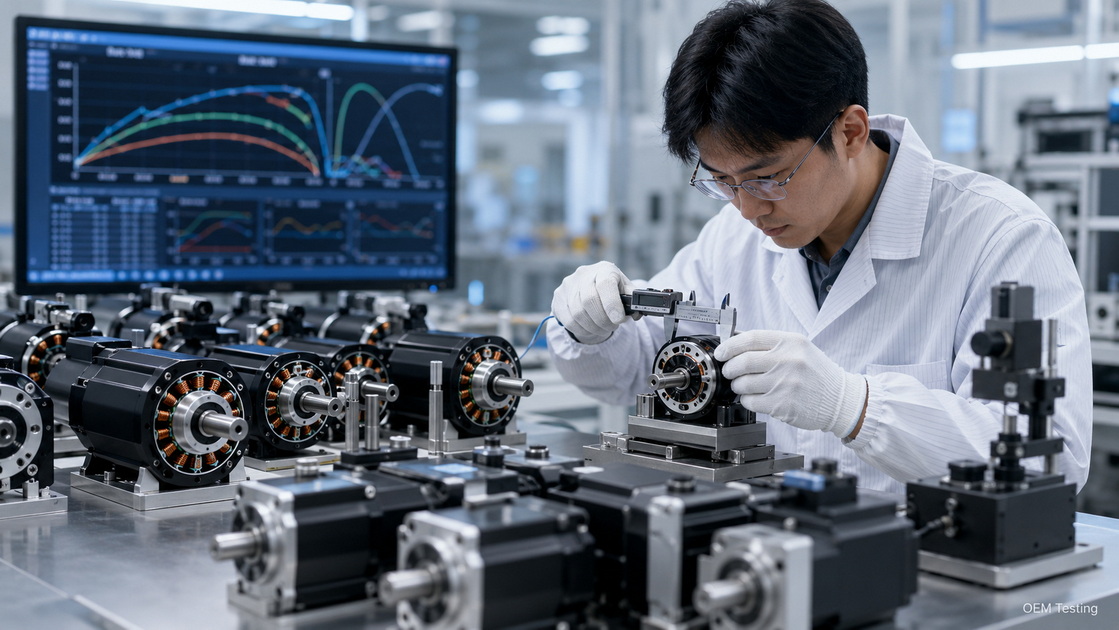
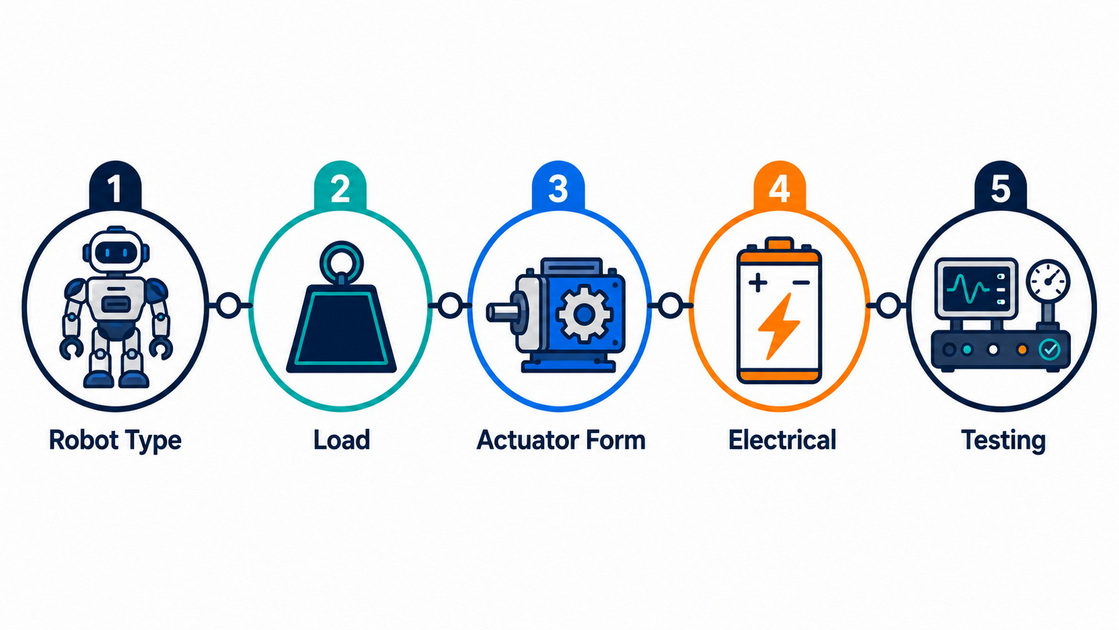
To turn these examples into a concrete process, here is a step‑by‑step framework we use when talking with robotics customers about new power‑system projects. [futuremarketinsights]
1. Define the robot type and mission
Humanoid, exoskeleton, medical device, quadruped, wheeled robot, industrial arm or underwater platform – plus key tasks and operating environment. [capow]
2. Quantify load and dynamics
Payload mass, desired speeds and accelerations, maximum slope or terrain roughness, and duty cycles (hours per day, peak versus continuous operation). [futuremarketinsights]
3. Select topology and form factor
Decide between integrated actuators, QDD units, frameless torque motors, gimbal motors or sealed thrusters. [ligpower]
4. Set electrical and control constraints
System voltage, available power budget, safety requirements, encoder interfaces and control bandwidth needed for your algorithms. [reddit]
5. Co‑design, prototype and validate
Work with a motor partner to iterate on motor, gearbox, driver and cooling; then validate using bench tests and field trials similar to the case studies cited above. [kdedirect]
Using this framework helps ensure that your robotic power solution is not just technically impressive, but also manufacturable, maintainable and economically viable. [china-bgmotor]
If you are developing humanoid robots, exoskeletons, service robots or underwater platforms and need a tailored brushless motor or actuator solution, contact Zhongshan Yuhang Power to discuss OEM and ODM options for your next‑generation robotic power system. [instagram]
1. What is a robotic power solution?
A robotic power solution is a matched combination of motors, actuators, reducers, drivers and control interfaces engineered for a specific robot type and mission profile, not just a single generic motor. [advancedenergy]
2. Why are application‑specific actuators important for humanoid and quadruped robots?
Humanoids and quadrupeds demand high torque density, low backlash and fast response; application‑specific actuators are optimized for these dynamics, reducing integration time and performance risk. [capow]
3. How do exoskeleton actuators differ from standard industrial motors?
Exoskeleton actuators prioritize low weight, smooth torque, backdrivability and safe human interaction, often using QDD or integrated modules rather than bulky industrial motors. [advancedenergy]
4. When should I work with a motor OEM/ODM for my robot project?
If you need non‑standard form factors, strict lifetime or environmental requirements, or plan to scale to volume production, working with an OEM/ODM like Zhongshan Yuhang Power is usually the best path. [jkongmotor]
5. What information should I prepare before contacting a robotic motor supplier?
Define robot type, payload, desired speeds, operating environment (temperature, dust, water, depth), system voltage and any certifications you must meet; this allows accurate motor and actuator proposals. [china-bgmotor]
1. CubeMars – "Motors for Robotic Applications" page (humanoid, exoskeleton, medical, quadruped, wheel, industrial and underwater solutions and case studies). [youtube]
2. Advanced Energy – "Robotics & Transport Power Supplies" (power system requirements for factory and warehouse automation robots). [advancedenergy]
3. CaPow – "Powering Your Robots: The Ultimate Guide to Efficient Energy Solutions" (trends in powering mobile robots and continuous operation concepts). [capow]
4. Future Market Insights and related industry sources – global motor and robotics powertrain trends and reliability considerations. [china-bgmotor]
5. Zhongshan Yuhang Power promotional and technical materials – FPV drone motor, gimbal and underwater robot power system offerings and OEM/ODM capabilities. [alibaba]


