Language


Views: 255 Author: Yuhang Power Publish Time: 2026-10-16 Origin: Site
Content Menu
● Understanding the Product Category Before Comparing Suppliers
● Why Consider Korea for Motor and Airflow-System Sourcing?
>> Industrial Cluster Advantages
>> Recent Industry and Export Context
● How This Shortlist Was Developed
>> Production and Quality Evidence
● Capabilities, Capacity, MOQ, and Certification
● 1. Zhongshan Yuhang Power Technology Co., Ltd.
>> Company Background and Main Markets
>> Company Background and Main Markets
● 3. DongKun Industrial and ManSeung Electric
>> Company Background and Main Markets
>> Company Background and Main Markets
>> Company Background and Main Markets
● Technical Buyer's Guide: What to Put in the RFQ
>> Define a Measurable Operating Point
>> Specify Materials as Controlled Items
>> Validate the Complete Assembly
● Compliance: What CE, RoHS, and ISO Actually Establish
>> CE Marking Is Not a Universal Motor Certificate
>> RoHS Concerns Restricted Substances
>> ISO Certification Concerns the Management System
● A Good Motor Test Can Hide a Poor Fan System
● Factory Verification, Sampling, and Logistics
>> Verify the Actual Production Site
>> Separate Capacity From Delivery Promises
>> Protect the Assembly During Transport
● FAQ
>> 1. How can I check whether a supplier's ISO certification is expired or suspended?
>> 2. Does a 24 V or 48 V motor need an EU Low Voltage Directive certificate?
>> 3. Can two suppliers be compared using maximum airflow and maximum pressure?
>> 5. Why can a motor pass inspection but vibrate after the impeller is installed?
Choosing an Educted Fan Motor supplier requires more than comparing motor dimensions, advertised speed, and unit price. Professional buyers need to establish whether a supplier can develop the correct motor and fan combination, validate performance under realistic operating conditions, control production changes, and support repeat orders.
A useful supplier assessment should therefore begin with four questions:
- Does the company manufacture the relevant product, or distribute adjacent motor technologies?
- Can its engineering team validate the complete motor, controller, and impeller assembly?
- Are its quality records and compliance documents applicable to the quoted model?
- Can it commit to a documented sampling process and a realistic production schedule?
This guide reviews five companies relevant to Korean motor and airflow-system sourcing, starting with Zhongshan Yuhang Power Technology Co., Ltd., a China-based customization option. The remaining companies are Korean manufacturers with differing strengths in fan motors, industrial blowers, and compact drive systems.
The central purchasing principle is application fit: a reputable geared-motor manufacturer is not automatically a qualified high-speed fan motor supplier.
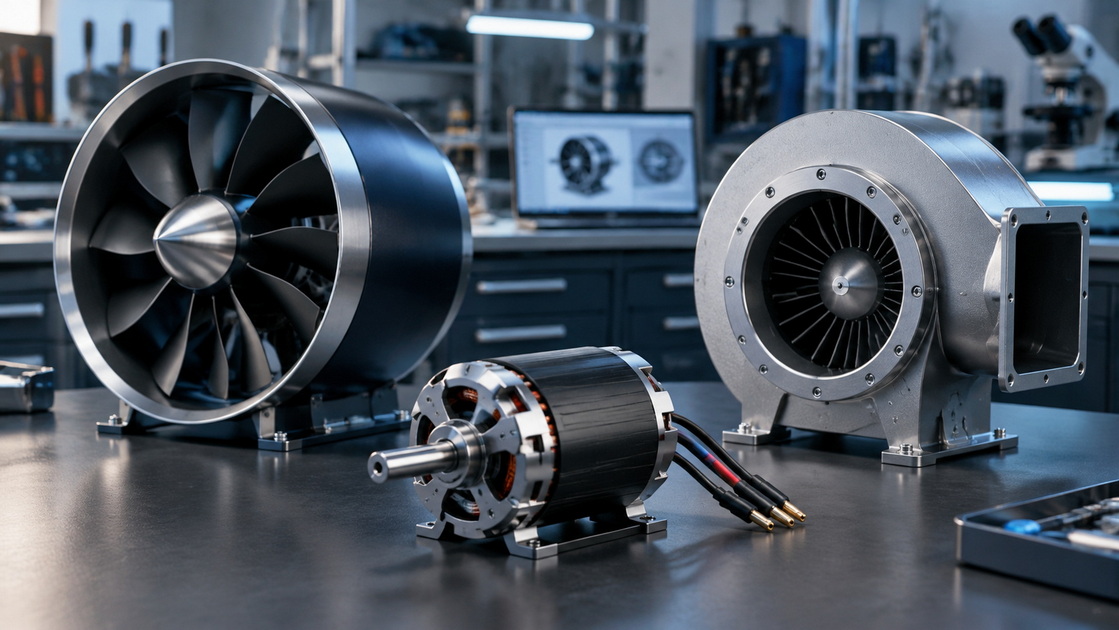
"Educted Fan Motor" is used here as the requested commercial search term. However, buyers should distinguish two different engineering categories rather than use the term as a complete technical specification.
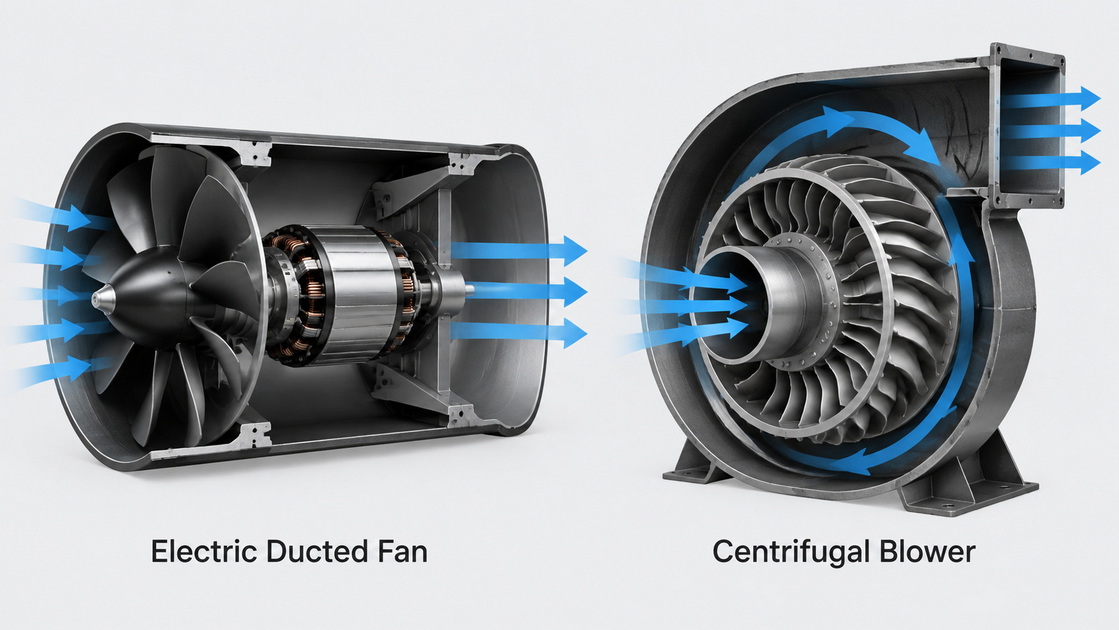
An electric ducted fan, commonly abbreviated as EDF, combines a motor with a fan operating inside a duct. Complete EDF propulsion systems can include a brushless motor, multi-blade rotor, housing, and airflow-guidance components. Manufacturers such as Schübeler describe integrated motors developed specifically for their ducted fan assemblies.
These products are relevant to aircraft and propulsion projects, where the procurement specification may emphasize thrust, installed weight, electrical input, and operating duration.
Centrifugal blowers serve a different airflow architecture and application set. Buyers evaluating these products normally need airflow and pressure performance at the intended operating point, rather than a thrust figure.
Fan performance must be considered together with system resistance. The operating point is the intersection of the fan performance curve and the system resistance curve, which determines the airflow delivered in the actual installation.
Accordingly, an RFQ should state whether the project requires:
- An EDF propulsion motor.
- A centrifugal blower motor.
- A complete motor and impeller assembly.
- A motor, controller, and housing package.
- A custom brushless motor for an existing fan design.
This distinction prevents suppliers from quoting technically different products against the same purchasing request.
South Korea offers an established industrial base in precision motors, machinery, electronics, and automation. Its sourcing advantage is broader engineering and manufacturing capability—not a publicly established production cluster specifically named "Educted Fan Motor."
KOTRA identifies Changwon as a major machinery and components center. Its published industrial-complex profile describes concentrations of machinery, electrical and electronic, and transportation-equipment businesses. These figures describe the wider industrial ecosystem, not the capacity of the suppliers reviewed below.
Gyeonggi-do also has a significant electronics-related industrial base. Invest KOREA identifies semiconductor company concentrations in the region, including equipment and materials activity. This provides useful context for Korea's engineering supply chain without proving specialist fan-motor capability at any individual factory.
Korea's Ministry of Trade, Industry and Resources reported that national exports reached USD 709.7 billion in 2025, up 3.8% year on year. Electrical equipment was among the categories reaching record export levels. These are national trade indicators, not dedicated fan-motor export statistics.
For adjacent automation demand, the International Federation of Robotics' World Robotics 2025 report recorded approximately 30,600 industrial robot installations in Korea during 2024, making the country the fourth-largest market by annual installations that year. The report supports the relevance of Korea's industrial automation ecosystem, but it does not measure EDF or centrifugal blower motor demand.
No verified public dataset reviewed for this guide isolates the Korean "Educted Fan Motor" market. Buyers should therefore avoid treating broad motor, robotics, or machinery figures as a direct market-size estimate.
This is a desk-researched supplier qualification guide, not a factory audit, laboratory comparison, or ranking based on measured product performance.
Zhongshan Yuhang Power Technology Co., Ltd. appears first because this article is prepared for the company. Its capabilities are evaluated using the same distinction between published evidence and project-specific claims applied to the other suppliers.
The strongest evidence is a relevant motor or blower product family supported by engineering documentation.
An adjacent product portfolio can justify an initial technical discussion, but not automatic inclusion on an approved supplier list.
For customized projects, ask suppliers to demonstrate their ability to address:
- Winding configuration and target operating speed.
- Voltage and current limits.
- Shaft and mounting geometry.
- Rotor and impeller compatibility.
- Controller matching.
- Thermal behavior.
- Assembly vibration and noise.
These are recommended qualification topics, not confirmed capabilities of every company listed.
Request records rather than broad statements about "strict quality control."
Useful evidence includes a process flow, incoming-material controls, traceability arrangements, end-of-line test coverage, calibration records, and a documented process for engineering changes.
Compare sample lead time, production lead time, reserved capacity, minimum order quantity, tooling ownership, and replacement arrangements separately.
A factory-wide output figure does not establish available capacity for a new custom motor.
| Company | Established | Relevant Product Position | Capacity Evidence | MOQ | Certification Evidence and Qualification Limits |
|---|---|---|---|---|---|
| Zhongshan Yuhang Power Technology Co., Ltd. | 2021 | Custom brushless motors and complete power-system development | Numerical production capacity not publicly verified | Project-specific quotation required | Current certificates and model-specific reports require direct review; OEM and ODM services are explicitly advertised. |
| SPG Co., Ltd. | 1991 | Precision motors, BLDC products, and fan-motor applications | Relevant line capacity not publicly verified | Model and customization dependent | Verify current factory certificates and exact fan-motor documentation; general motor availability does not establish EDF qualification. |
| DongKun Industrial / ManSeung Electric | 1973 for DongKun | Industrial fans, centrifugal blowers, ventilation, and small motors | Project-specific capacity not publicly verified | Product and order dependent | Confirm the actual motor technology; reviewed pages establish blower production, not universal BLDC availability. |
| GGM Co., Ltd. | 1979 | Compact AC, DC, and BLDC geared motors | American company page publishes 1,000 units/day and 250,000 units/year for a broad product grouping; not fan-motor-specific | Quotation required | Certificate validity and applicability require review; direct-drive high-speed fan suitability is not established. |
| DKM Co., Ltd. | 1983 predecessor; incorporated under DKM name in 2000 | Small precision motors and gearheads | Relevant fan-motor capacity not publicly verified | Quotation required | Publishes ISO 9001 and ISO 14001 documents; current status, site coverage, and quoted-product applicability require verification. |
Zhongshan Yuhang Power Technology Co., Ltd. states that it was established in 2021. LN-MOTOR is one of its brands.
The company describes its business as the production, research, development, and sale of brushless motors, with applications including drones, remote-controlled vehicles, gimbal imaging, aircraft, underwater robots, and other professional equipment. It markets complete power-system solutions to global customers, although a verified regional revenue breakdown is not published on the reviewed page.
Yuhang is based in Zhongshan, Guangdong, China. It is included as an overseas sourcing alternative for Korean buyers, not as a Korean manufacturer.
Its public description emphasizes customized development and control from design through production and testing. The company also states that its technical team has more than ten years of brushless motor manufacturing and design experience. That team-experience claim should remain distinct from the company's 2021 establishment date.
For smaller equipment brands, the potential value lies in discussing the entire power system rather than purchasing a catalog motor without integration support.
Relevant RFQ topics include:
- Adapting a motor to an existing impeller.
- Matching the motor to a selected controller.
- Changing mechanical interfaces.
- Developing an application-specific winding.
- Defining a repeatable test and acceptance process.
Yuhang explicitly advertises customized OEM and ODM services and complete power-system solutions. Its stated emphasis on customer-specific development makes it relevant to projects that cannot be addressed by a fixed catalog specification.
For procurement purposes, flexibility and communication efficiency should become measurable commitments. Request a named engineer, a drawing-review schedule, a revision log, and agreed response milestones.
The reviewed company page does not establish a numerical MOQ, audited monthly capacity, current certification package, or performance map for a specific fan assembly.
Evaluate its value position using total project cost, including development, samples, controller integration, inspection, and replacement provisions. Do not describe it as the lowest-cost supplier without comparable quotations.
SPG was founded in 1991 and is based in Incheon, South Korea. Public business information identifies precision control motors, BLDC fan motors, standard motors, and related drive products in its portfolio. Its international presence includes SPG USA.
The visible market coverage includes Korea and North America; a verified geographic sales breakdown was not established for this guide.
SPG is relevant because its documented portfolio includes fan-oriented motor products rather than only general industrial motors. Its product resources also cover BLDC motors, controllers, and other drive categories.
For buyers, this supports an initial discussion around established motor platforms, controller options, and repeat equipment integration.
The reviewed sources do not establish the full contractual scope of custom fan-motor development.
Ask SPG whether the selected product can support:
- Winding or speed changes.
- Shaft modifications.
- Mounting changes.
- Sensor and control-interface adjustments.
- Customer-specific testing.
- Long-term configuration control.
These are qualification questions, not confirmed standard services.
Do not assume that a BLDC fan motor is suitable for a high-speed EDF application.
Require the proposed model's operating envelope, mechanical interface, thermal limits, and controller requirements before placing it in the same comparison as a dedicated propulsion motor.
DongKun states that it was established in 1973 and began developing small AC motors before expanding into industrial fans, ventilators, and blowers. Its company introduction describes ManSeung Electric as a second factory established during that expansion.
The company also states that it has exported industrial fans, blowers, ventilators, and small AC motors to Japan for more than twenty years. This is supplier-published market history rather than an independently verified current sales distribution.
DongKun's product portfolio explicitly includes small centrifugal blowers. That makes it a more direct match for industrial airflow projects than a company offering only geared motion products.
It is worth evaluating when the buyer wants a complete blower arrangement rather than a standalone motor.
The reviewed pages establish manufacturing activity, but do not fully document custom-development terms.
Ask whether the company can accommodate changes to:
- Motor voltage and control method.
- Housing and mounting geometry.
- Inlet and outlet arrangement.
- Impeller specification.
- Noise targets.
- Customer-specific performance testing.
Its history includes AC motors. Buyers seeking a brushless DC solution must confirm the exact motor architecture of the quoted blower.
A centrifugal blower listing is not, by itself, evidence that the product uses a BLDC motor or is appropriate for aircraft propulsion.
GGM's Korean website identifies it as a small geared-motor specialist operating since 1979, with AC, DC, and BLDC products and exports to more than fifty countries.
Its trade profile names India, Japan, Malaysia, Taiwan, and the United States among its markets.
An American company page contains conflicting establishment wording, but its historical timeline and the Korean website support 1979. Buyers should use the legal entity's registration documents if the precise incorporation history matters contractually.
GGM is relevant to compact equipment and drive-system sourcing. Its documented product range provides a basis for evaluating standardized motor platforms and associated controls.
Its American company page publishes production figures of 1,000 units per day and 250,000 units annually for a broad grouping of standard motors, gearheads, and BLDC-related products. These figures are not a verified allocation for custom fan motors.
Project-specific customization needs confirmation. Request written details on modification limits, minimum order quantities, engineering charges, and whether a proposed design uses an existing motor platform.
GGM's established specialization is geared motors. The reviewed evidence does not establish a dedicated high-speed EDF product line.
Include it where the equipment specification aligns with its motor range, not simply because the project contains a fan.
DKM traces its origins to Daekyung Machinery Manufacturing, established in 1983. Its history records incorporation under the DKM name in January 2000 and a Singapore joint venture in 2008.
These sources establish Korean operations and an international business presence, but not a current country-by-country market breakdown.
DKM's documented specialization is small precision motors and gearheads. Its production description references precision-part selection and assembly processes.
It also publishes management-system certification documents. The available ISO 9001 document identifies a scope covering design, development, and manufacture of electric motors and generators; an ISO 14001 document is also published. Their present validity and site coverage still require checking.
The reviewed material does not establish an unrestricted custom EDF development service.
Buyers should distinguish:
- Selecting a standard motor.
- Modifying an existing configuration.
- Commissioning an entirely new motor.
- Obtaining a complete fan and controller assembly.
Ask DKM which of these it will contractually support.
DKM is an adjacent motor-sourcing option, not a verified specialist EDF manufacturer in this review. Do not infer high-speed fan qualification from management-system certification or general motor-manufacturing experience.
For a centrifugal blower, specify required airflow at a stated pressure—not airflow alone.
For a propulsion assembly, provide the required thrust, supply conditions, installation geometry, and operating duration.
In both cases, request the complete test conditions. Fan performance changes with the operating point, and actual installed performance depends on the interaction between the fan curve and system resistance.
A useful RFQ template is:
| Requirement | Information to Provide or Request |
|---|---|
| Electrical supply | Nominal voltage, full operating range, current limit |
| Performance | Airflow and pressure, or thrust, under stated conditions |
| Duty | Continuous, intermittent, acceleration, and overload requirements |
| Installation | Duct, housing, inlet, outlet, clearance, and mounting drawings |
| Environment | Ambient temperature, contamination, moisture, and exposure |
| Controller | Supplied by buyer or supplier; required interface and protections |
| Acceptance | Temperature, vibration, sound, electrical, and performance limits |
| Commercial terms | MOQ, lead time, tooling, change control, and warranty remedies |
"High-grade materials" is not a purchasing specification.
For a proposed design, ask the supplier to identify and control:
- Winding conductor and insulation system.
- Lamination material.
- Rotor magnet specification.
- Shaft material and finish.
- Bearing manufacturer and part number.
- Rotor-retention materials.
- Impeller material.
- Adhesives and protective coatings.
These are recommended bill-of-material controls. The appropriate grades depend on the design and should be justified by the supplier rather than selected solely for a stronger-looking marketing description.
Require written approval before substitutions to agreed critical components.
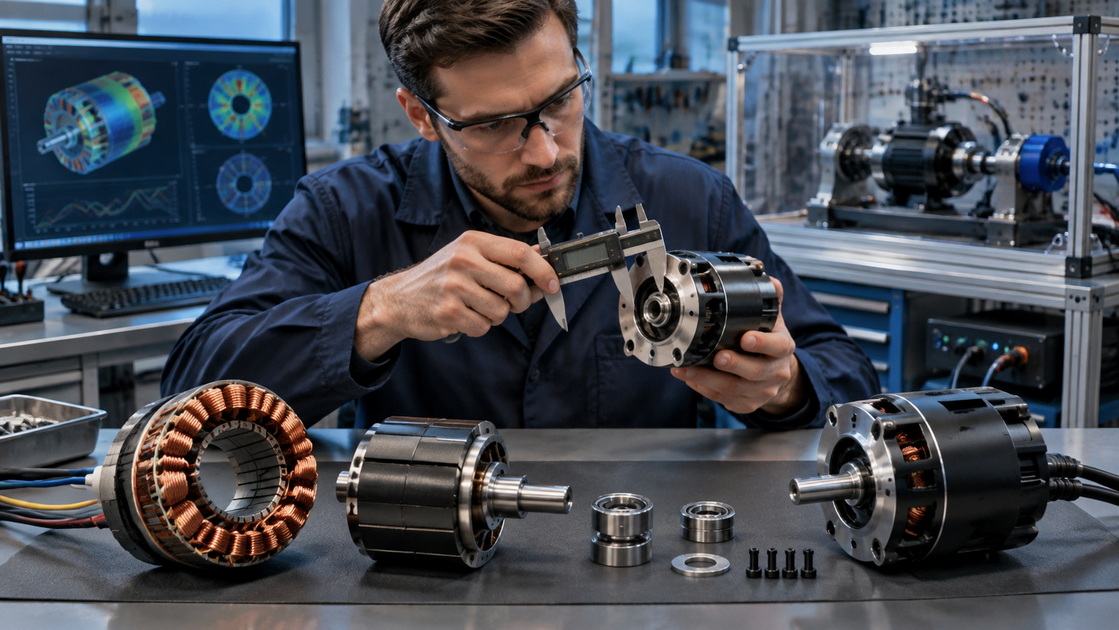
Separate component approval is not enough.
ebm-papst explains that separately balanced motor and fan components can produce an imbalanced assembled system when their tolerances align unfavorably. Its own approach treats the impeller, rotor, and stator as a complete assembly.
For a custom project, ask the supplier to define:
- What assembly is balanced.
- At which manufacturing stage balancing occurs.
- How vibration is measured.
- Whether final testing includes the intended impeller.
- What happens after an impeller or rotor change.
Do not prescribe a balancing grade without considering the design and application.
Determine the applicable legislation for the supplied item and final equipment.
The EU Low Voltage Directive covers electrical equipment within specified voltage ranges: 50–1,000 V AC and 75–1,500 V DC. A low-voltage battery-powered motor below the DC threshold is not automatically within that directive's voltage scope. This does not remove other potentially applicable obligations.
For an in-scope product, conformity assessment, technical documentation, and a declaration of conformity are central requirements. A certificate image should not replace review of those responsibilities.
The European Commission states that RoHS restricts ten substances in electrical and electronic equipment, subject to applicable scope rules and exclusions. It addresses substance restrictions, not motor efficiency, bearing life, or fan performance.
Request documentation tied to the actual materials and supplied configuration.
Check the legal entity, production site, scope, certificate number, issuer, and status.
IAF CertSearch provides company and certificate searches, including information about scope, locations, and certification status. A valid management-system certificate remains separate from proof that the quoted motor meets its technical specification.
One of the most useful checks is also easy to omit: ensure that the approved motor, controller, impeller, housing, and test setup describe the same system.
A supplier may provide convincing component data while leaving the installed operating point unresolved. For example, a free-air result does not establish the airflow delivered through the customer's filter, grille, or duct.
Likewise, a balanced motor and a balanced impeller do not automatically establish a well-balanced assembled product. Both concerns are supported by established fan-selection and assembly guidance.
Use a configuration-controlled acceptance record:
1. Identify the motor revision.
2. Identify the controller and its settings.
3. Identify the impeller and housing revision.
4. Record supply voltage and test conditions.
5. Attach performance, temperature, and vibration results.
6. Retain the approved physical sample.
7. Repeat agreed verification after relevant design changes.
The practical insight is simple: approve the system configuration, not just an attractive sample or a favorable motor datasheet.
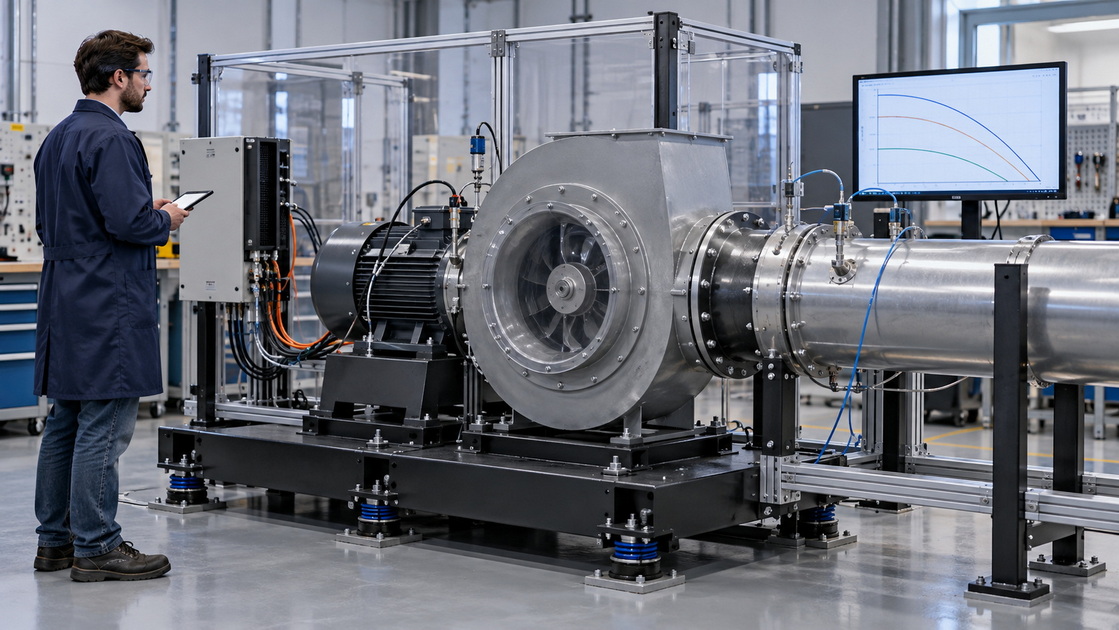
For each shortlisted manufacturer, request a live walkthrough or independent site assessment focused on the processes relevant to your order.
Useful checkpoints include winding, rotor assembly, inspection, balancing, electrical testing, final performance testing, and packaging.
If a process is outsourced, identify the subcontractor-control arrangements rather than assuming outsourcing is automatically unacceptable.
A proposed qualification sequence is:
- Engineering sample: establish fit and initial performance.
- Design-validation sample: test the complete intended configuration.
- Pilot batch: evaluate repeatability and inspection effectiveness.
- Production approval: release against an agreed specification and control plan.
Agree in advance on who pays for revisions, failed tests, and additional sample rounds.
Request the capacity available for your project, current production loading, long-lead components, and pilot-to-production timing.
Where bearings, magnets, controllers, or other specified components have procurement constraints, require early notification and a documented approval process for alternatives.
Set packaging requirements around the actual configuration.
Ask suppliers to prevent movement, shaft damage, connector damage, and inappropriate loading of delicate components. Electronic controllers may also require suitable handling and packaging controls.
Compare quotations using the same Incoterms rule and named place. A low unit price is not comparable with another quotation until freight, inspection, tooling, tax treatment, and replacement responsibilities are aligned.
Korea offers credible motor and airflow-system sourcing options, but the companies reviewed here do not represent five interchangeable EDF specialists.
SPG provides fan-motor and BLDC relevance. DongKun offers a more direct industrial blower portfolio. GGM and DKM merit consideration where their compact motor platforms align with the application. Zhongshan Yuhang Power Technology Co., Ltd. provides a China-based alternative for buyers seeking customized brushless motors and complete power-system discussions.
For buyers considering Yuhang, the next step is a structured technical inquiry: provide the motor category, voltage range, performance target, installation drawing, operating environment, annual quantity, and required approval schedule.
Obtain the full certificate and search by company name or certificate number in IAF CertSearch.
Check the exact legal entity, production site, scope, and current status. The system distinguishes statuses such as active, suspended, withdrawn, and expired. If the record is absent or inconsistent, contact the certification body directly rather than deciding authenticity from the PDF alone.
A 24 V or 48 V DC motor is below the directive's stated 75 V DC lower threshold. However, the assessment must consider the supplied equipment and relevant input or output voltage, including any associated power equipment.
Do not interpret "outside the LVD voltage range" as "no compliance obligations." Determine the applicable requirements for the actual motor, controller, power supply, and final product.
Not as if those values describe one operating condition.
Request the performance curve and identify the required airflow-pressure operating point. The fan and system curves together determine delivered performance. A supplier quoting only endpoints leaves the central selection question unanswered.
For EDF projects, use a similarly controlled comparison based on the complete assembly and stated test conditions.
Make the approved configuration contractually identifiable.
Attach the critical bill of materials, drawing revisions, sample identification, and acceptance criteria to the purchase agreement. Require a written engineering-change request before substitutions and define which changes trigger renewed testing.
Use pilot-batch and production checks to verify conformity. This is a proposed purchasing control; its effectiveness depends on the agreement, inspection coverage, and supplier execution.
Component-level approval does not establish complete-assembly balance.
Manufacturing tolerances can combine unfavorably when separately balanced components are assembled. Ask for final assembly testing and clarify whether the production balancing process includes the actual impeller. This distinction is explicitly addressed in ebm-papst's fan guidance.
1. Korea Ministry of Trade, Industry and Resources — "Korea's Annual Exports Reach New Highs in 2025," published January 2026. [english.motir.go]
2. International Federation of Robotics — World Robotics 2025 release, including Korean industrial robot installation figures for 2024. [ifr]
3. KOTRA / Invest KOREA — Changwon National Industrial Complex industry profile. [investkorea]
4. Invest KOREA — Semiconductor industry and regional cluster overview. [investkorea]
5. European Commission — Low Voltage Directive scope and voltage limits. [single-market-economy.ec.europa]
6. EUR-Lex — Electrical safety requirements for low-voltage electrical equipment. [eur-lex.europa]
7. European Commission — RoHS Directive overview and restricted substances. [environment.ec.europa]
8. IAF CertSearch — Certificate search and verification guidance. [iafcertsearch]
9. ebm-papst — Fan operating points, performance curves, and complete-assembly balancing guidance. [ebmpapst]
10. Schübeler — Integrated motor design for electric ducted fan systems. [schubeler]
11. Zhongshan Yuhang Power Technology Co., Ltd. — Company background, applications, and OEM/ODM services. [yuhangmotor]
12. SPG — Company and product information, including BLDC and fan-motor categories. [tradingview]
13. DongKun Industrial / ManSeung Electric — Company introduction and centrifugal blower category. [dongkun]
14. GGM — Korean company overview, export coverage, and published production information. [ggmamerica]
15. DKM — Company history and published management-system certification documents. [dkmmotor]


