Language


Views: 248 Author: Yuhang Power Publish Time: 2026-10-14 Origin: Site
Content Menu
● First Define the Product: Educted Fan Motor, Centrifugal Blower, or Aircraft EDF?
● Why Consider Japanese Motor and Fan Suppliers?
>> A Precision-Component Ecosystem Rather Than One Dedicated Fan Cluster
>> What Recent Industry Data Can—and Cannot—Tell Buyers
● Five Motor and Blower Suppliers to Evaluate
>> 1. Zhongshan Yuhang Power Technology Co., Ltd.: A China-Based Custom Motor Alternative
>> 2. SANYO DENKI: Centrifugal Fans for Demanding Equipment Cooling
>> 3. Nidec Corporation: Broad Motor and Blower Engineering
>> 4. Oriental Motor: Catalog-Based Industrial Blower Selection
>> 5. MinebeaMitsumi: Bearing Integration and Custom Fan Assemblies
● Capacity, MOQ, and Certification Evidence
● Technical Buying Guide for Educted Fan Motor Projects
>> Specify Materials by Performance, Not Marketing Labels
>> Evaluate the Installed Operating Point
>> Treat Compliance as a Product-and-Market Question
● An Often-Overlooked Sourcing Trap: Identical Part Numbers, Changed Internals
● How to Verify a Factory and Run a Sample Project
>> Logistics and Import Planning
● FAQ
>> 1. How Can I Check Whether a Supplier's ISO Certificate Is Expired or Suspended?
>> 2. Does a Japanese Brand Guarantee Japanese Manufacturing?
>> 3. What If a Supplier Will Not Disclose Its Complete Bill of Materials?
>> 4. Can a CE Document for the Motor Cover the Finished Fan System?
>> 5. How Can We Verify Capacity Before Placing a Large Order?
Finding reliable Educted Fan Motor manufacturers and suppliers in Japan requires more than comparing motor prices. Professional buyers need evidence of engineering capability, repeatable manufacturing quality, realistic production capacity, and dependable support when specifications change.
Japan offers established suppliers of precision motors, centrifugal blowers, and integrated cooling systems. However, these suppliers do not all serve the same application. A high-pressure electronics blower, an electric ducted fan for aircraft propulsion, and a standalone brushless motor require different evaluation methods.
This guide presents five sourcing candidates: four Japan-headquartered manufacturers and one China-based OEM/ODM alternative, Zhongshan Yuhang Power Technology Co., Ltd. The Chinese company appears first as a customization-focused option, not as a Japanese manufacturer. The order is not a verified market-share or product-quality ranking.
Our assessment prioritizes traceability: buyers should be able to connect a quotation, sample, test report, material specification, and production shipment to the same approved product configuration.
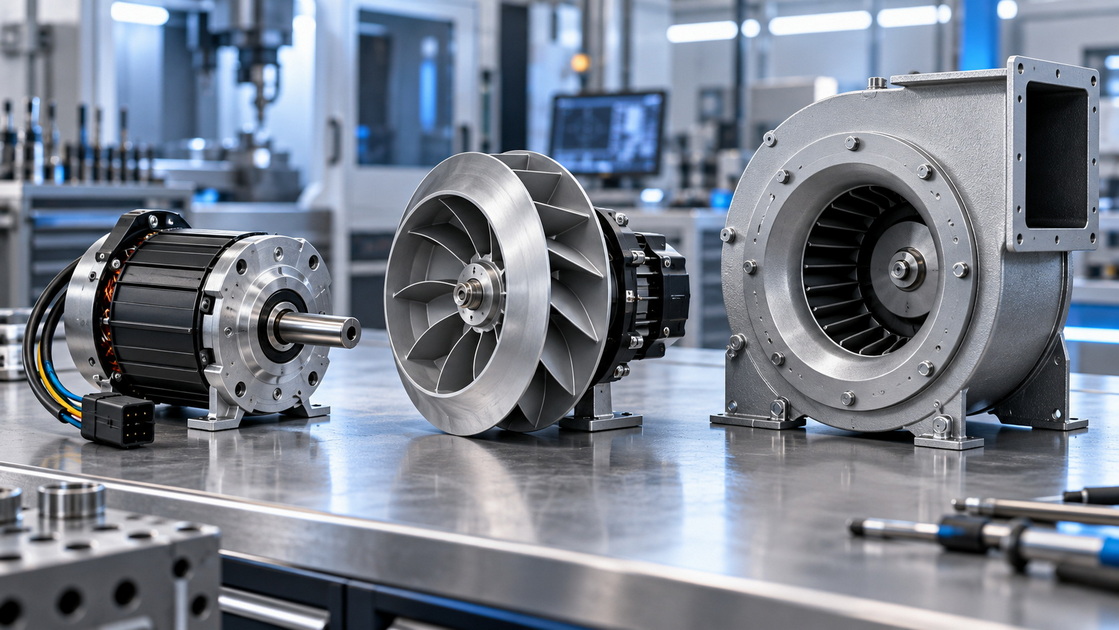
"Educted Fan Motor" is not a consistently standardized product category across the manufacturers reviewed. In supplier catalogs, relevant products may appear under brushless motors, centrifugal fans, DC blowers, high-pressure blowers, or electric ducted fan systems.
For this article, the term covers sourcing requirements involving brushless motors for centrifugal-fan and related airflow applications. Aircraft propulsion requirements are treated separately.
The distinction matters:
| Product category | Main function | Essential purchasing data |
|---|---|---|
| Standalone brushless fan motor | Drives a separately designed impeller | Torque-speed behavior, current, temperature, shaft and mounting dimensions |
| Integrated centrifugal blower | Produces airflow against system resistance | Pressure-flow curve, electrical input, noise, control interface |
| Aircraft electric ducted fan | Produces propulsion thrust | Thrust, current, system mass, rotor integrity, ESC compatibility |
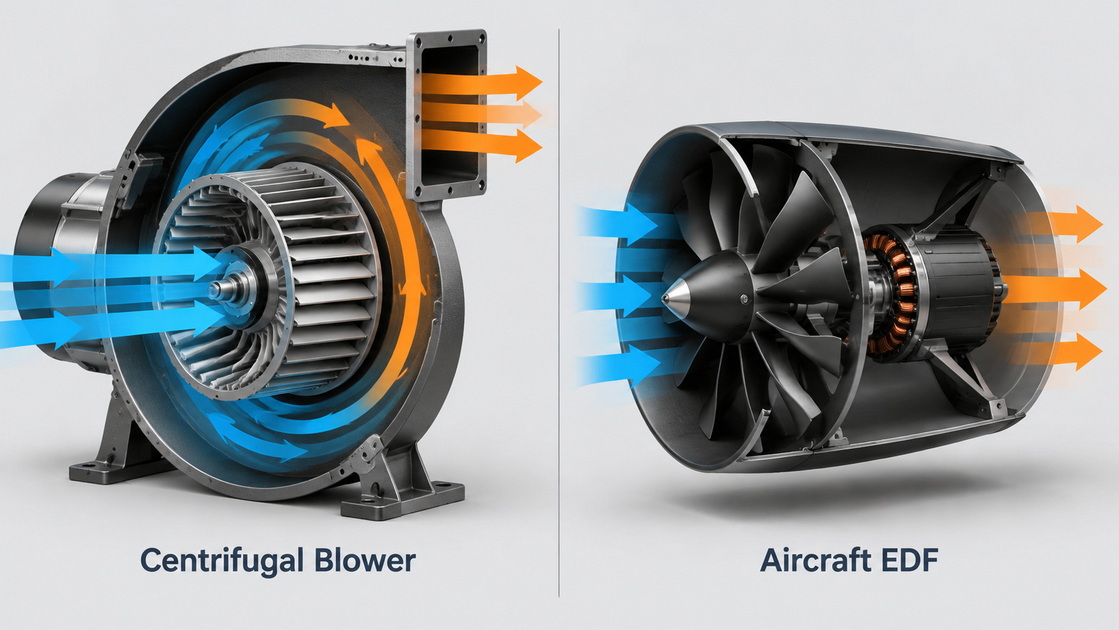
Centrifugal fans discharge air perpendicular to the inlet direction. They are useful where pressure is needed to move air through restrictive equipment or ductwork. An aircraft EDF is not automatically a centrifugal blower, even though both use a motor and enclosed airflow path.
Before sending inquiries, specify whether you need a motor alone, a motorized impeller, or a complete blower assembly.
Japan's advantage is distributed across motor engineering, bearings, electronics, and industrial equipment.
Nidec's origins and headquarters are in Kyoto. MinebeaMitsumi's registered head office is in Nagano, and its history began with miniature ball bearings. SANYO DENKI has manufacturing history in Ueda, Nagano, alongside its Tokyo headquarters. These locations illustrate an interconnected precision-manufacturing ecosystem—not a formally established "Educted Fan Motor cluster."
For buyers, the practical opportunity is access to companies that combine mechanical and electrical expertise. That does not mean every component is manufactured in Japan. Verify the actual production site and country of origin for each ordered model.
A May 2026 report summarizing Japan Electrical Manufacturers' Association data states that FY2025 shipments of general-purpose industrial electrical equipment reached ¥745.8 billion, up 6.9% year over year. Rotating and drive equipment accounted for ¥301.0 billion, up 3.0%. These are broad electrical-equipment categories, not an Educted Fan Motor market estimate.
JEMA's official statistics portal provides FY2025 and FY2026 shipment datasets and notes that monthly figures may be revised. Japan Customs also provides official trade statistics searchable by commodity and country. Neither resource should be presented as a dedicated market-size report for this loosely defined product category.
Use these sources to understand the surrounding industrial market. Use supplier-specific evidence to judge available capacity and delivery reliability.
Founded in 2021, Zhongshan Yuhang Power Technology Co., Ltd. operates from Zhongshan, Guangdong, China. LN-MOTOR is one of its brands.
Its company profile describes brushless motor development, production, and sales for drones, remote-controlled vehicles, gimbals, aircraft, underwater robots, and other professional equipment. It also states that its technical team has more than ten years of motor design and manufacturing experience. This is team experience, not the company's operating age.
Core strengths:
- A stated focus on customized brushless motor development.
- OEM and ODM services for global customers.
- Power-system solutions spanning multiple equipment categories.
- Claimed internal control over design, production, and testing.
OEM/ODM fit: buyers developing a custom motor rather than purchasing an established Japanese blower assembly.
For smaller brands, its customization-oriented model makes it a candidate worth evaluating for cost-sensitive development. However, competitive pricing, low MOQs, rapid communication, and short lead times must be demonstrated through quotations and sample projects; they are not independently established by the company profile.
Ask for a project-specific engineering proposal covering winding options, shaft geometry, mounting interfaces, controller compatibility, and test responsibilities. Regional sales shares, verified capacity, and current certificates were not established from the reviewed page.
SANYO DENKI was founded in August 1927 and incorporated in December 1936. Its San Ace centrifugal fan range addresses cooling applications requiring high airflow and static pressure.
Core strengths:
- Published centrifugal-fan product information.
- Motor, circuit, and impeller development for airflow efficiency.
- PWM speed control on compatible models.
- Applications including servers, storage equipment, heat exchangers, industrial equipment, and medical equipment.
OEM/ODM fit: equipment manufacturers seeking an integrated cooling product with documented operating characteristics.
Its public product information supports a stronger fit for industrial cooling than for aircraft propulsion. Buyers needing connector changes, environmental protection, firmware behavior, or a new mechanical envelope should obtain written confirmation of available customization.
Do not assume that every catalog product can be redesigned or private-labeled. Confirm the responsible sales entity, manufacturing plant, tooling ownership, and engineering-change process.
Nidec was established on July 23, 1973, in Kyoto. Its business includes small precision motors, automotive motors, industrial motors, and related products.
The company's fan and blower portfolio includes centrifugal blowers. Its published development priorities include airflow, static pressure, efficiency, noise, and vibration.
Core strengths:
- Extensive motor-application coverage.
- A broad fan and blower portfolio.
- Relevance to computers, appliances, cooling, ventilation, and other motor-driven equipment.
- Multiple group businesses addressing different technical requirements.
OEM/ODM fit: buyers needing application-specific motor or blower engineering, provided the relevant group company accepts the project.
The central purchasing challenge is routing. "Nidec" identifies a large group, not one universal factory or product team. Establish which legal entity supplies the product, where it is manufactured, and who owns design approval.
Group scale does not establish capacity reserved for your model. Request a plant-specific ramp plan and escalation contacts.
Oriental Motor traces its history to 1885, with incorporation represented in its 1885–1950 corporate chronology. Its development history emphasizes standardized motors and international support.
Its centrifugal-fan offering includes AC-input MB blowers and DC-input MBD blowers. Published MBD-series specifications include frame sizes from 80 to 160 millimeters and maximum static pressure up to 372 Pa. These are range-level figures; individual models have different performance curves.
Core strengths:
- Clearly organized catalog products.
- AC and DC blower alternatives.
- Industrial applications involving cooling, drying, and ducted airflow.
- A purchasing approach suited to standardized component selection.
OEM/ODM fit: equipment integration around an existing product platform.
Oriental Motor is particularly relevant when a catalog blower satisfies the requirement without extensive redesign. Its published history identifies semiconductor equipment, medical equipment, and other industrial applications.
For a fully bespoke motor, verify willingness and commercial conditions before treating the company as an ODM development partner.
MinebeaMitsumi was established on July 16, 1951. Its history began with miniature ball bearings, and its current product portfolio includes DC fans, high-power motorized impellers, and high-pressure blowers.
Core strengths:
- In-house bearing capabilities.
- Fan and blower offerings for industrial, communications, mobility, medical, and office-equipment applications.
- Published customization examples.
- Integrated fan assembly development.
OEM/ODM fit: customers needing application-specific fan motors, impellers, casings, connectors, or environmental resistance.
Its automotive fan page explicitly describes custom designs and integrated units. It reports an annual production track record exceeding 17 million units for automotive fan motors supplied worldwide. That figure is not the production capacity of its centrifugal-blower range or capacity available to a new customer.
Its technical FAQ also explains that many delivered products are customized under confidentiality agreements. Buyers should therefore expect some specifications to remain unavailable without an authorized project relationship.
The table distinguishes disclosed information from facts requiring direct confirmation.
| Supplier | Main sourcing fit | Product-specific capacity evidence | MOQ | Certification position |
|---|---|---|---|---|
| Zhongshan Yuhang | Customized brushless motors and power systems | Not established from reviewed profile | Obtain written quote | Current plant and product documents must be requested |
| SANYO DENKI | Integrated industrial centrifugal cooling fans | Available capacity not established from reviewed pages | Model and customization dependent; confirm | Verify ordered model approvals and supplying-site certificates |
| Nidec | Broad motor and blower applications | Group scale does not establish model availability | Confirm with responsible group entity | Verify legal entity, plant, certificate scope, and product |
| Oriental Motor | Standardized industrial blowers | Available capacity not established from reviewed pages | Confirm distributor and factory terms | Check exact catalog model and intended destination |
| MinebeaMitsumi | Custom fans and integrated assemblies | Over 17 million automotive fan motors annually; not blower capacity | Project-specific confirmation required | Selected high-pressure blowers have published cTUVus information; verify exact model |
MinebeaMitsumi's published approval information names the 60DCF and 70DCF high-pressure blower families. It should not be generalized to every product.
An undisclosed MOQ is not a low MOQ. An undisclosed production figure is not evidence of insufficient capacity. Both are commercial questions to resolve before supplier approval.
A material specification should address:
- Winding conductor and insulation requirements.
- Magnet grade and temperature limits, where applicable.
- Bearing type, lubrication, and operating conditions.
- Shaft material, dimensions, and runout limits.
- Impeller material and allowable temperature.
- Corrosion protection and environmental exposure.
- Balance acceptance criteria for the rotating assembly.
Statements such as "premium copper" or "high-temperature magnets" are incomplete without measurable requirements.
Make the specification application-specific. A lightweight aircraft fan and a continuously operating industrial blower should not automatically share the same material priorities.
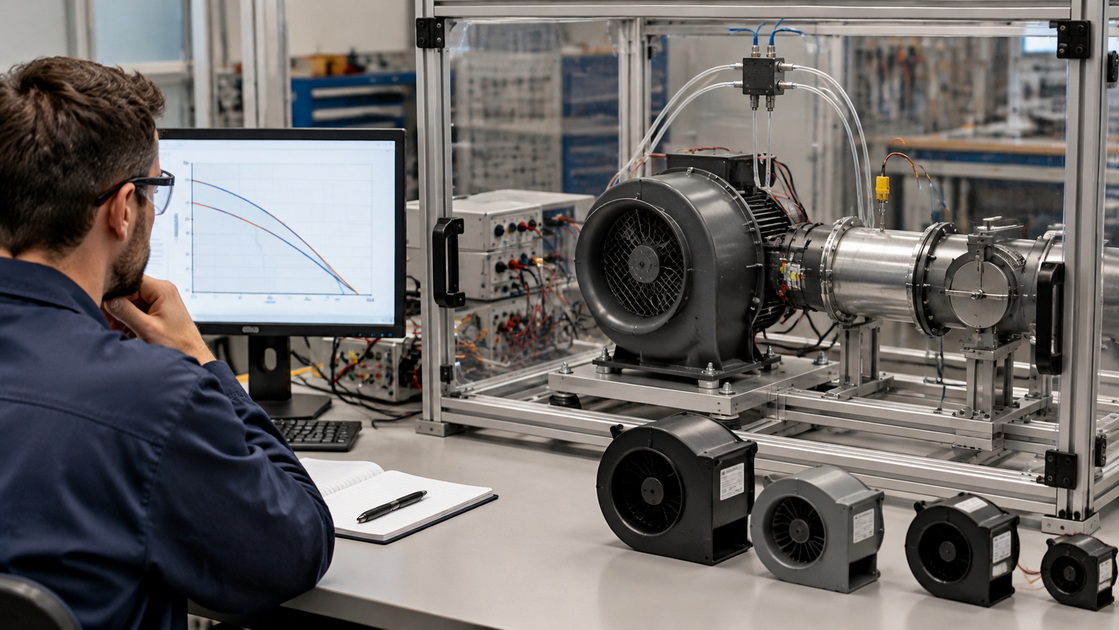
An integrated blower should be selected using its pressure-flow curve, not maximum free-air flow alone.
Oriental Motor and SANYO DENKI both emphasize static-pressure capability for restrictive airflow paths. This matters because filters, ducts, heat exchangers, and compact enclosures change the operating requirement.
Request measurements at the intended operating voltage, inlet condition, outlet restriction, ambient temperature, and control setting. Record whether reported power includes controller losses.
For aircraft EDF projects, request propulsion-specific evidence instead. An electronics-cooling fan curve does not establish flight suitability.
CE marking is not a universal factory certificate. It applies only where relevant harmonized European rules require it. The manufacturer must identify applicable requirements, assemble supporting documentation, and issue the appropriate declaration of conformity.
Similarly, establish whether RoHS requirements apply to the supplied item and intended market. A generic document bearing a company name is not enough: connect the evidence to the exact product and revision.
Separate three questions:
1. Does the manufacturing site hold an appropriate management-system certificate?
2. Does the ordered product satisfy applicable requirements?
3. Does the final assembled machine satisfy its own obligations?
A component supplier's documentation does not automatically establish compliance of the buyer's complete equipment.
A useful procurement precaution is to avoid approving only the exterior dimensions and headline performance.
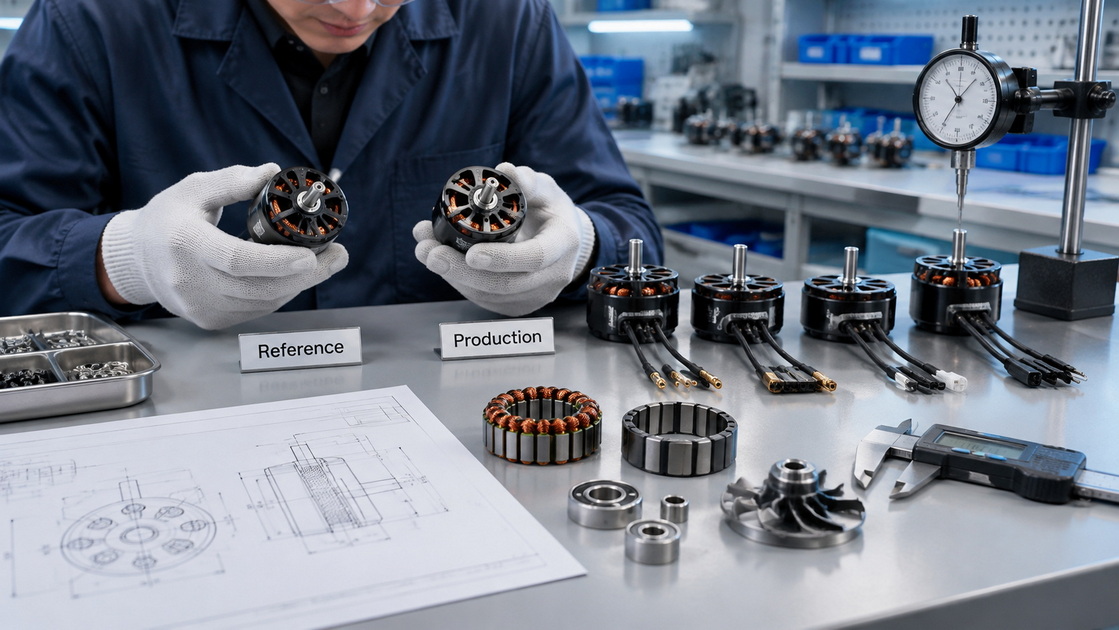
A motor can retain its mounting pattern and nominal rating while changes occur in bearings, winding insulation, magnet grade, impeller material, or embedded control electronics. Such changes may affect noise, temperature, service life, or compatibility even if an initial sample passes a short test.
This is a risk-control recommendation, not an allegation against the listed suppliers.
Before production approval:
- Freeze a controlled drawing and agreed critical-material specification.
- Identify restricted substitutions.
- Require advance product-change notification.
- Retain reference samples and test records.
- Define which changes trigger requalification.
- Establish incoming checks that can detect meaningful variation.
The overlooked issue is continuity between the approved sample and later production—not simply whether the first sample performs well.
Confirm the legal entity, payment beneficiary, manufacturing address, and production responsibilities.
Request current certificates, a process flow, calibration records, sample inspection reports, and corrective-action examples. A factory walkthrough should show relevant equipment and operations, not only finished inventory.
For delivery reliability, request historical performance for comparable orders and distinguish standard lead time from reserved production availability.
Use a staged approval process:
1. Issue a controlled requirements document.
2. Review the supplier's proposed design and test plan.
3. Evaluate multiple engineering samples.
4. Test sustained operation under realistic conditions.
5. Approve a pilot lot.
6. Release production against agreed acceptance limits.
Record sample revisions. A redesigned sample should not inherit approval automatically.
Confirm Incoterms, country of origin, packaging protection, customs classification, and the party responsible for import clearance.
Japan Customs publishes tariff schedules and searchable trade statistics, but a motor-only shipment and a complete blower assembly may require different classification analysis. Obtain classification advice for the actual item rather than copying a code from another supplier's invoice.
For international shipments, protect shafts, connectors, bearings, and exposed electronic assemblies. Specify packaging and inspection requirements in the purchase order.
Japan offers credible sourcing options for centrifugal blowers, integrated cooling fans, and precision motor systems. SANYO DENKI, Nidec, Oriental Motor, and MinebeaMitsumi deserve evaluation for different application needs—not interchangeable treatment.
Zhongshan Yuhang Power Technology Co., Ltd. provides a China-based alternative for customized brushless motor and power-system projects. Its fit should be established through technical discussions, quotations, and sample validation.
To begin an OEM or ODM inquiry with Yuhang, provide your required airflow and pressure—or propulsion thrust—along with voltage, operating duration, installation dimensions, environmental conditions, forecast volume, and target cost. Request a written development scope and validation plan before committing to tooling or production.
Search by company name or certificate details in IAF CertSearch, then compare the legal entity, site address, standard, scope, and status with the supplied document. The platform supports verification of accredited certificates and status changes. If verification remains unresolved, contact the issuing certification body rather than accepting the PDF alone.
No. Establish the manufacturing location and declared origin of the specific item. Brand headquarters, contracting entity, production site, and country of origin are separate purchasing facts. Request documentary confirmation in the quotation and shipping paperwork.
Confidentiality can be legitimate, especially for customized assemblies. Negotiate a controlled specification identifying performance-critical materials, prohibited substitutions, and change-notification obligations. Full commercial disclosure is not always necessary, but adequate change control is.
Not automatically. Determine the requirements applicable to the component and complete equipment. European guidance makes the manufacturer responsible for the whole product, including supplied components. Review the final assembly's documentation and conformity obligations separately.
Request a model-specific capacity plan covering tooling, bottlenecks, test-station throughput, material lead times, and competing demand. Validate it through a pilot order and ramp milestones. Company revenue, employee count, or unrelated product output does not prove available capacity for your program.
1. [Zhongshan Yuhang Power Technology Co., Ltd. — About Us]. Source for establishment year, LN-MOTOR brand relationship, applications, team experience, and stated OEM/ODM capabilities. These are company-published statements. [yuhangmotor]
2. [SANYO DENKI — Corporate Outline] and [San Ace Centrifugal Fans]. Sources for corporate dates, product characteristics, applications, and compatible PWM control. [products.sanyodenki]
3. [Nidec — Company Profile] and [Fans & Blowers]. Sources for founding date, business coverage, and blower development priorities. [nidec]
4. [Oriental Motor — Corporate History] and [Centrifugal Fans and Blowers]. Sources for company history, catalog positioning, and MB/MBD product specifications. [orientalmotor]
5. [MinebeaMitsumi — Company Profile], [Fan Motors], and [Automotive Fan Motors]. Sources for establishment, product coverage, selected approval information, customization, and automotive fan production track record. [minebeamitsumi]
6. [MinebeaMitsumi — Fan Motor FAQ]. Source for confidentiality limitations affecting customized-product information. [product.minebeamitsumi]
7. [JEMA — General-Purpose Industrial Electrical Equipment Shipment Statistics]. Official association source for FY2025/FY2026 datasets and revision notices. [jema-net.or]
8. [Automation Newspaper — FY2025 JEMA Shipment Results, May 15, 2026]. Secondary industry report supplying the ¥745.8 billion and ¥301.0 billion figures quoted above; these are broad categories, not dedicated fan-motor market data. [automation-news]
9. [Japan Customs — Trade Statistics], [Statistics Search], and [Tariff Schedule]. Official government resources for trade analysis and classification research. [customs.go]
10. [European Union — CE Marking Requirements]. Official guidance on applicability, technical documentation, declarations, and manufacturer responsibility. [europa]
11. [IAF CertSearch — Accredited Certification Verification]. Resource for checking certificate identity, accreditation, validity, and status. [iafcertsearch]


