Language


Views: 245 Author: Yuhang Power Publish Time: 2026-10-13 Origin: Site
Content Menu
● Brushless Drone Motor vs Brushed Drone Motor
● How Brushed and Brushless Drone Motors Work
>> Brushed Drone Motors: Mechanical Switching
>> Brushless Drone Motors: Electronic Switching
● Drone Motor Efficiency: Compare the Complete Propulsion System
>> Why "Brushless Is Always More Efficient" Is Too Simple
>> Motor Efficiency and Thrust Efficiency Are Different
● Thrust, Acceleration, and FPV Flight Performance
>> Maximum Thrust Is Only One Selection Criterion
>> KV Does Not Describe Motor Power
● Durability, Maintenance, Heat, and Noise
>> Brushless Motors Remove Brush Wear, Not Every Failure Mode
>> Cooling Must Match the Mission
>> Brushless Does Not Mean Silent
● Purchase Price vs Total Cost of Ownership
● Which Motor Type Fits Your Drone?
>> Brushed Motors for Simple Miniature Aircraft
>> Brushless Motors for FPV and Professional UAVs
● Test Equal Thrust, Not Equal Throttle
>> A Practical Six-Step Evaluation
● Why Equal-Thrust Testing Changes the Decision
● OEM and ODM Procurement: What Buyers Should Request
>> 1. Is a Brushless Drone Motor Better Than a Brushed Drone Motor?
>> 2. Can I Replace a Brushed Drone Motor With a Brushless Motor?
>> 3. Does a Brushless Motor Always Increase Flight Time?
>> 4. Do Brushless Drone Motors Need Maintenance?
>> 5. Is Higher KV Better for FPV Drones?
Choosing a brushless drone motor vs brushed drone motor is ultimately a decision about the aircraft you want to build. Brushless propulsion usually suits demanding FPV, payload, and professional UAV applications. Brushed propulsion remains useful for inexpensive miniature drones where simplicity and low initial cost matter more than service life.
The key difference is commutation: how the motor switches current to keep its rotor turning. Brushed motors do this mechanically. Brushless motors use electronic control.
At Zhongshan Yuhang Power Technology Co., Ltd., our business focuses on developing and manufacturing brushless motors and customized power-system solutions. However, a useful comparison should explain where both technologies fit—not assume that every aircraft needs the most sophisticated motor.
This guide compares construction, efficiency, thrust, maintenance, control, and ownership costs. It also provides a practical testing framework for buyers evaluating drone motor suppliers.
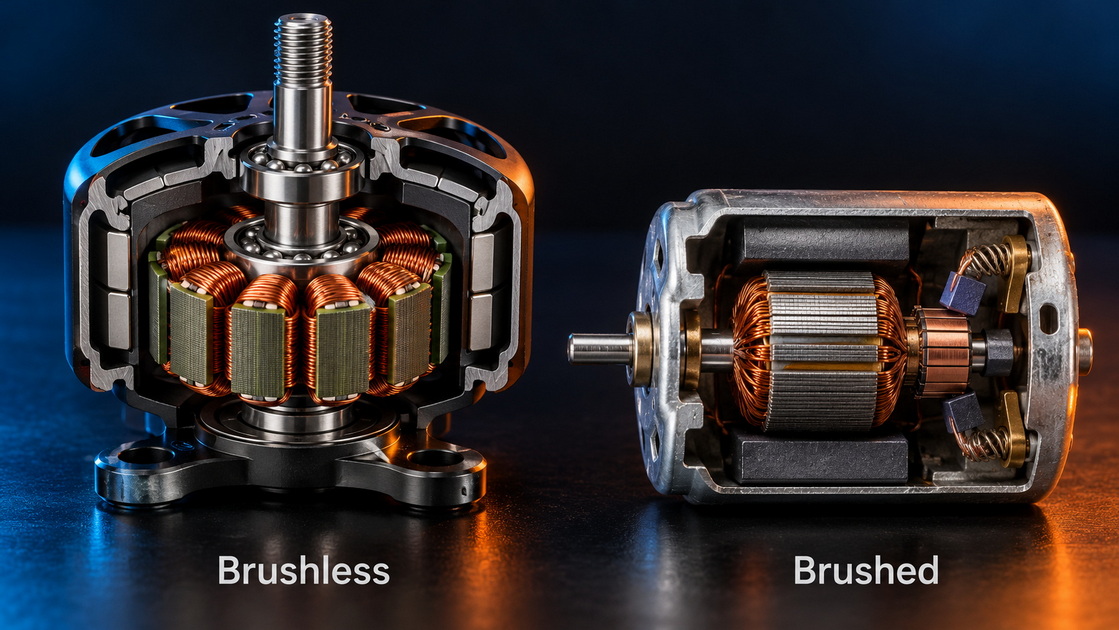
| Comparison factor | Brushed drone motor | Brushless drone motor |
|---|---|---|
| Current switching | Brushes and mechanical commutator | Electronic switching through a controller |
| Typical construction | Permanent-magnet stator and wound rotor | Wound stator and permanent-magnet rotor |
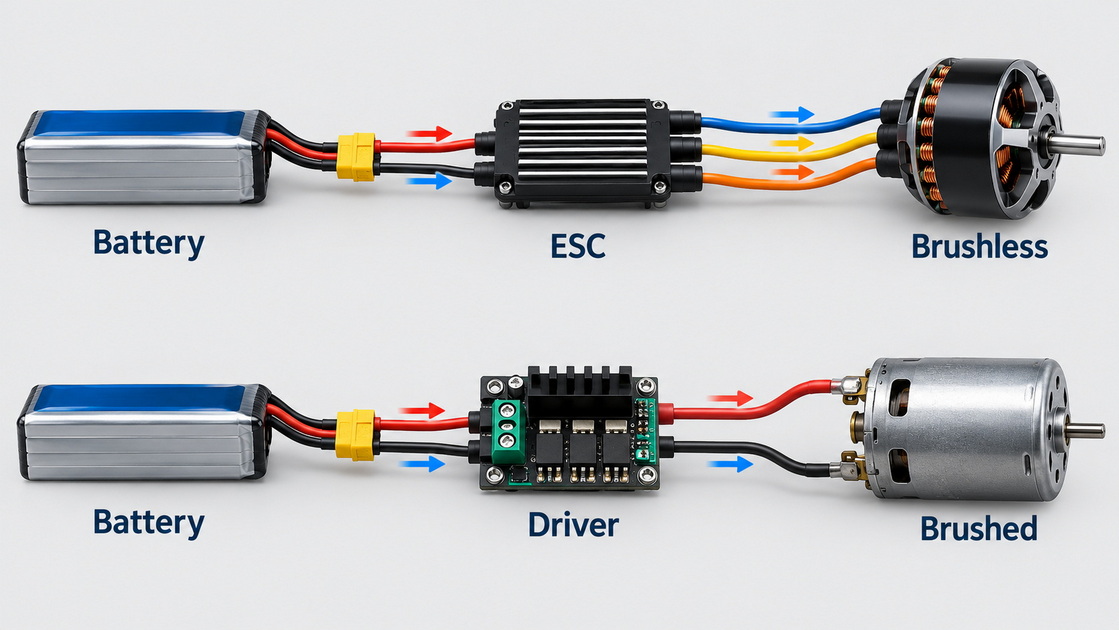
| Control hardware | Relatively simple brushed motor driver | Compatible three-phase electronic speed controller |
| Common application fit | Small, inexpensive drones | FPV, camera, payload, and professional drones |
| Wear mechanism | Brushes, commutator, and bearings | Bearings and other mechanical components |
| Performance potential | Suitable for modest propulsion demands | Well suited to demanding propulsion systems |
| Efficiency | Depends on design and operating point | Depends on design, controller, and operating point |
| Initial system cost | Usually lower for basic miniature systems | Usually higher because of motor and controller requirements |
| Maintenance | Brush wear can require motor replacement | No brush replacement, but inspection remains necessary |
| Upgrade compatibility | Requires a brushed-compatible driver | Requires a brushless-compatible ESC |
These are selection tendencies, not guaranteed specifications. Compare actual motor-and-propeller test results before approving a production design.
A conventional brushed DC motor transfers current to its rotating windings through brushes touching a commutator. As the rotor turns, the commutator changes the energized winding connections.
This arrangement makes basic operation straightforward. A suitable DC supply can rotate the motor, while a switching driver controls average power and speed.
Many small brushed drone motors use coreless construction. Their lightweight winding structure can support low rotor inertia and compact packaging.
The trade-off is physical contact. Brushes and commutators wear, create friction, and can generate electrical interference through arcing. In miniature sealed motors, replacing the complete motor is often more practical than servicing its internal parts.
A brushless DC motor removes the brush-and-commutator interface. Its controller energizes the stator phases in a sequence that produces a rotating magnetic field.
Many FPV motors use an outrunner layout: the outer rotor bell carries permanent magnets and rotates around the stator.
A compatible electronic speed controller, or ESC, manages phase switching. Sensorless controllers determine rotor position indirectly, commonly using electrical measurements and back electromotive force.
Electronic control adds complexity, but it also provides opportunities to optimize acceleration, torque delivery, and operating efficiency.
Brushless motors eliminate brush-contact losses. However, they still experience winding resistance, magnetic losses, bearing friction, and controller losses.
Brushed motors also vary considerably. Specialist coreless designs can achieve excellent efficiency. Manufacturer comparisons show that some ironless brushed motors outperform certain brushless alternatives at particular operating points.
Consequently, a universal claim such as "brushless motors improve efficiency by 30%" is not credible without identifying the compared products and test conditions.
For drone development, compare:
- Battery voltage under load.
- Propeller diameter, pitch, and blade count.
- Required thrust.
- Motor temperature.
- ESC configuration.
- Complete propulsion-system mass.
The relevant question is which system consumes less battery power while meeting your aircraft's requirements.
Motor efficiency compares mechanical output power with electrical input power:
A propulsion test may instead report grams of thrust per watt. That metric includes the propeller's contribution and is not a motor-efficiency percentage.
This distinction matters when comparing supplier datasheets. A high grams-per-watt result may reflect an effective propeller match rather than an inherently superior motor.
Flight endurance also depends on battery energy, aircraft mass, aerodynamics, and mission behavior. Motor technology alone cannot establish flight time.
Brushless propulsion is generally the more practical choice for demanding FPV builds because it supports capable motor-and-controller combinations without brush wear.
Nevertheless, neither motor type generates thrust independently. The motor turns a propeller, and the propeller produces aerodynamic force.
A useful performance comparison therefore includes:
- Thrust at the intended operating voltage.
- Current at sustained flight loads.
- Short-duration peak thrust.
- Temperature rise.
- Throttle response.
- Propeller and mounting compatibility.
For a camera drone, predictable hovering behavior may matter more than maximum thrust. For an FPV racing drone, acceleration and repeated load changes become more important.
Motor KV expresses approximate unloaded speed per applied volt. It is not a direct measurement of torque, thrust, or power capacity.
A higher-KV motor is not automatically a better drone motor. With an unsuitable propeller or battery voltage, it may draw excessive current or operate outside its thermal limits.
Compare KV alongside winding design, motor dimensions, rated voltage, propeller load, and measured performance. Treat isolated KV comparisons as incomplete.
Brushless motors have no brushes to replace, but bearings, shafts, windings, magnets, and electrical connections remain vulnerable.
FPV crashes can bend shafts or damage bearings. Dust, moisture, and foreign objects can affect both motor types. High temperature can damage insulation or magnets.
Brushed motors introduce additional wear at the brush-and-commutator interface. Their useful life depends on current, speed, duty cycle, environment, and construction.
Avoid assigning a universal lifespan to either drone motor category. Industrial motor lifetime figures should not be presented as guarantees for crash-prone FPV equipment.
A motor that survives a brief bench run may still overheat during sustained operation.
Propeller airflow, ambient temperature, installation geometry, and loading all influence cooling. Exterior temperature also does not perfectly represent winding temperature.
Request sustained-load thermal evidence, not just peak-thrust figures. Specify the test duration and environmental conditions.
Brushed motors can generate contact noise and electrical interference. Brushless systems eliminate brush arcing but still produce switching-related interference, mechanical vibration, and electromagnetic noise.
Propellers also contribute substantial noise. Controller strategy matters: sinusoidal control and field-oriented control can reduce torque ripple in suitable implementations.
Good balancing, wiring, filtering, and controller selection remain important whichever technology you choose.
Brushed propulsion often offers lower initial cost in basic miniature aircraft. Brushless systems usually need more sophisticated electronics and may cost more upfront.
However, purchase price is only part of the commercial calculation.
An OEM buyer should also consider:
- Replacement motors and service labor.
- Aircraft downtime.
- Battery energy consumed per mission.
- Controller cost and integration effort.
- Spare-parts availability.
- Batch consistency and warranty exposure.
Brushless propulsion can justify its initial cost when brush wear, demanding loads, or frequent operation become important.
Conversely, a low-cost educational drone used occasionally may not benefit enough to justify a more expensive system. The right choice minimizes cost while meeting the required service level.
Consider brushed drone motors when the project prioritizes:
- Low acquisition cost.
- Compact, lightweight construction.
- Modest thrust requirements.
- Simple electronics.
- Acceptable replacement frequency.
Confirm that the expected duty cycle does not make replacement costs disproportionate.
Consider brushless drone motors when the project requires:
- Repeated acceleration and demanding maneuvers.
- Greater propulsion capability.
- Frequent operation.
- Payload-specific optimization.
- Reduced brush-related maintenance.
- Customized motor-and-controller integration.
Brushless technology offers a strong development platform, but the selected motor still needs evidence that it meets the mission.
Comparing two motors at "50% throttle" can produce misleading results. Different controllers, firmware, motors, and propellers may translate that command into different speeds and thrust levels.
A more useful comparison starts with equal required thrust.
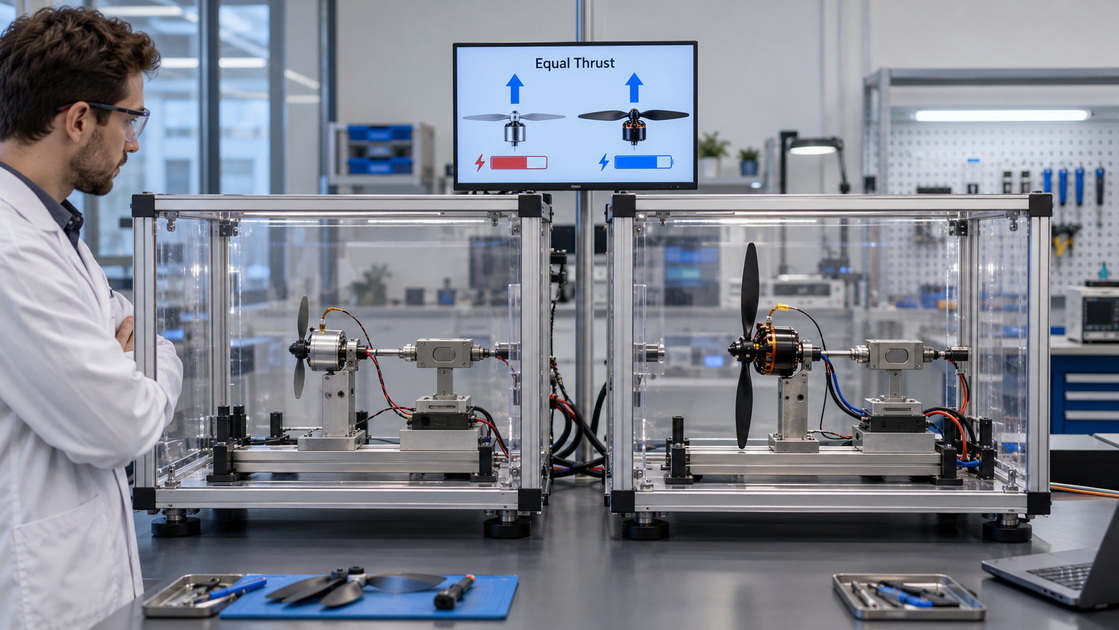
1. Define takeoff mass, payload, rotor count, and mission profile.
2. Calculate the approximate thrust required per rotor for level hovering.
3. Select safe, compatible motor, propeller, battery, and controller combinations.
4. Measure voltage, current, thrust, RPM, and temperature across relevant loads.
5. Compare electrical power at equivalent thrust points.
6. Validate the preferred system in controlled flight trials.
Use guarded test equipment and appropriate operating procedures. Never approach a rotating propeller to take measurements.
If different propellers are necessary, label the results as complete propulsion-system comparisons. Do not attribute every improvement to the motor alone.
Consider a hypothetical quadcopter with a takeoff mass of 800 grams. In steady, level hover, each of its four rotors must provide approximately 200 grams-force of thrust.
Suppose two proposed systems reach that point:
| Illustrative result | System A | System B |
|---|---|---|
| Thrust per rotor | 200 gf | 200 gf |
| Electrical power per rotor | 30 W | 25 W |
| Combined propulsion power | 120 W | 100 W |
| Thrust per electrical watt | 6.67 gf/W | 8.00 gf/W |
System B requires less propulsion power at this operating point.
These figures are an educational example, not measured product data or company performance claims. They also do not prove that System B offers proportionally longer flight time: battery behavior, aircraft mass, electronics, and maneuvering must be included.
The lesson is straightforward. Match the required work first, then compare the energy needed to perform it.
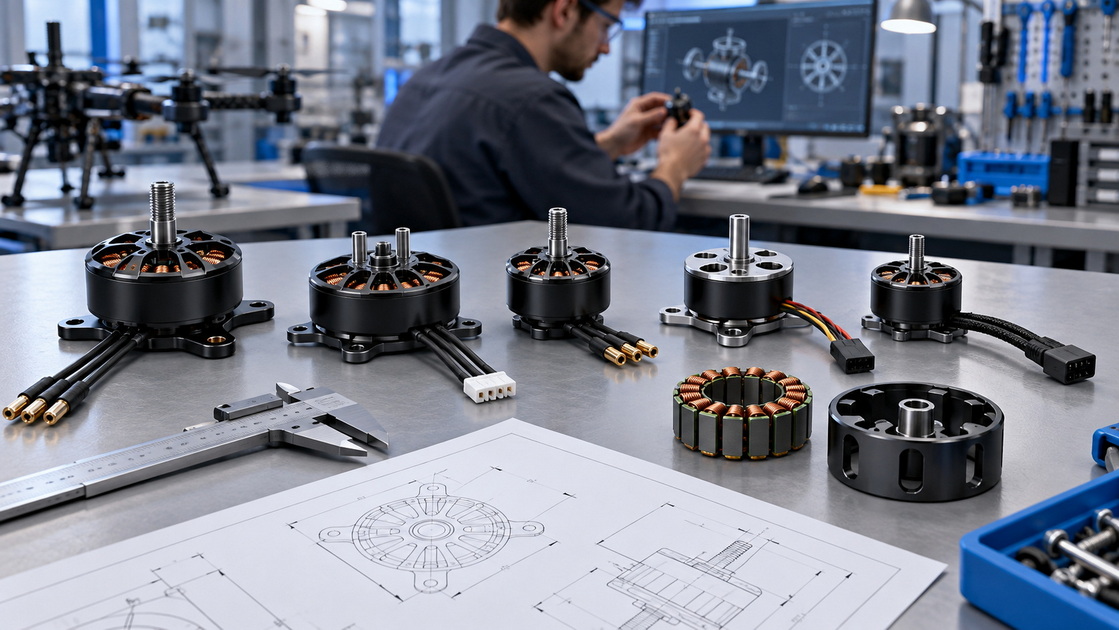
A drone motor supplier should help you evaluate integration, not simply provide a catalog price.
For a brushless drone motor OEM or ODM project, prepare:
- Aircraft mass, payload, and mission duration.
- Battery voltage range.
- Propeller dimensions and installation constraints.
- Required thrust and acceleration behavior.
- Ambient temperature and environmental exposure.
- Mounting dimensions, connectors, and cable requirements.
- Target cost, order volume, and acceptance criteria.
Then request traceable test conditions, thrust-current curves, thermal results, and relevant dimensional drawings.
For production approval, evaluate multiple samples rather than one selected motor. Agree on measurable acceptance limits and change-control procedures.
Custom windings, shafts, mounting arrangements, and electrical interfaces should follow a documented specification. Customization has value only when its intended benefits are verified.
Usually for demanding FPV and professional applications. However, brushed motors can remain appropriate for inexpensive miniature drones with modest loads. Choose against mission requirements, not the category name alone.
Not as a simple drop-in replacement. You normally need compatible ESCs, suitable control outputs, electrical capacity, mounting arrangements, and propellers. Recheck aircraft mass and flight-controller configuration.
No. Endurance improves only when the complete system performs the mission more efficiently without offsetting penalties. Motor mass, propeller selection, battery energy, and flight behavior all matter.
Yes. Inspect bearings, shafts, fasteners, wiring, and contamination after use, particularly following impacts. The absence of brushes removes one wear mechanism; it does not eliminate maintenance.
Not automatically. Higher KV raises unloaded speed potential at a given voltage. Actual performance depends on propeller load, winding characteristics, cooling, battery voltage, and ESC compatibility.
1. [maxon — "Brushed vs. Brushless DC Motors"]. Manufacturer discussion of construction, operating life, and efficiency exceptions involving ironless brushed motors. Industrial lifespan examples are not used as drone lifetime guarantees. [maxongroup]
2. [Monolithic Power Systems — "Brushless Vs Brushed DC Motors: When and Why to Choose One Over the Other"]. Supports the explanations of mechanical and electronic commutation, contact wear, controller requirements, torque ripple, and noise. [monolithicpower]
3. [Texas Instruments — "Motor-Control Considerations for Electronic Speed Control in Drones"]. Engineering reference covering drone ESC architecture, motor-control topology, battery voltage, efficiency, and sensorless control. [ti]
4. [Texas Instruments — "TIDA-00916: Sensorless High-Speed FOC Reference Design for Drone ESC"]. Demonstrates sensorless field-oriented control for UAV propulsion and explains its implementation-specific dynamic and torque-ripple benefits. [ti]
5. [Tyto Robotics — "How to Measure Brushless Motor and Propeller Efficiency"]. Supports the measurement framework and distinction between motor efficiency and thrust-per-watt system metrics. [tytorobotics]
6. [Tyto Robotics — "How to Increase Drone Flight Time and Lift Capacity"]. Explains why motor-propeller matching and measured operating points matter when evaluating propulsion efficiency. [tytorobotics]


