Language


Views: 251 Author: Yuhang Power Publish Time: 2026-10-09 Origin: Site
Content Menu
● What Does 2207 Mean, and Why Does Propeller Size Matter?
● Best Propeller Size for 2207 Motors
>> Five-Inch vs Six-Inch Props on 2207 Motors
● Propeller Pitch: Choosing Between Smooth Control and Higher Load
>> Lower Pitch for Smooth Flying
● Two-Blade vs Three-Blade Propellers for 2207 Motors
>> Which Blade Count Should You Start With?
● Matching 2207 Motor KV With 4S and 6S Batteries
● Published Test Data: Similar Prop Sizes Can Produce Different Loads
>> Compare Equal Thrust, Not Only Equal Throttle
● A Practical Testing Procedure for 2207 Motor Propeller Selection
>> Step 1: Establish an Approved Baseline
>> Step 2: Change One Variable at a Time
>> Step 3: Record Useful Measurements
>> Step 4: Validate the Mission
● OEM and ODM Insight: Specify the Power System, Not Just the Motor
● Final Recommendation for Your 2207 FPV Build
>> 1. Can 2207 Motors Run Six-Inch Propellers?
>> 2. Is 5×4.3×3 a Good Propeller for 2207 Motors?
>> 3. Are Two-Blade Props Better for Flight Time?
>> 4. Does Higher Pitch Always Make an FPV Drone Faster?
>> 5. Can I Use Seven-Inch Props on a 2207 Motor?
The best propeller size for most 2207 FPV motors is 5-inch, with a moderate-pitch, three-blade propeller such as 5×4.3×3 providing a practical starting point for freestyle and general-purpose flying. A 5.1-inch propeller can also be suitable when the frame provides sufficient clearance. Six-inch propellers deserve consideration for selected cruising builds, but they require closer attention to motor KV, battery voltage, current draw, and responsiveness.
My recommendation is to choose the propeller around the complete aircraft—not the motor label alone. The right combination should deliver the control, efficiency, and thermal margin your application needs.
This guide compares propeller diameter, pitch, and blade count from a power-system selection perspective. It combines published technical guidance with manufacturer test data; it does not present those external measurements as proprietary testing by Zhongshan Yuhang Power Technology Co., Ltd.
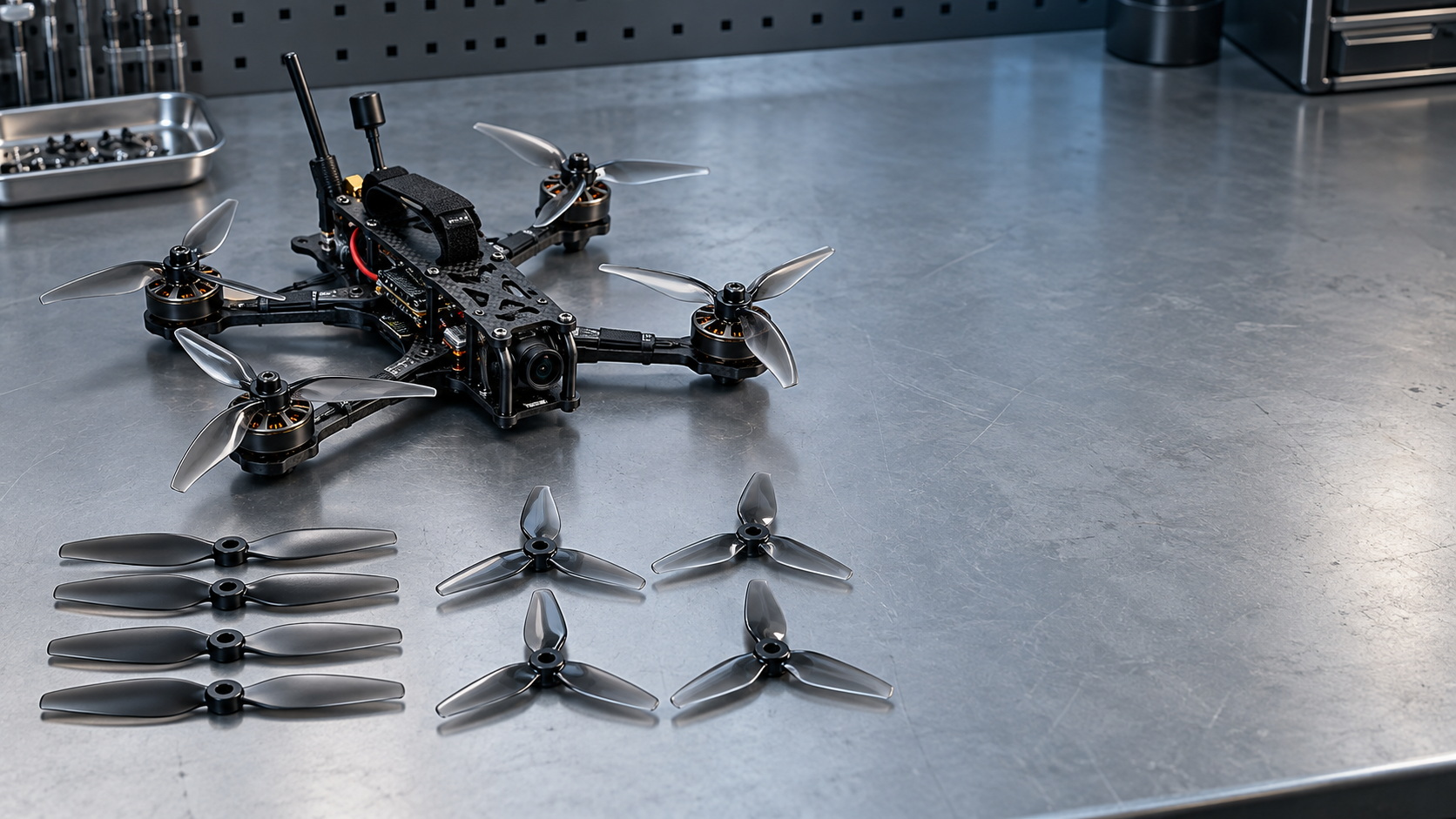
In conventional FPV motor naming, "2207" describes a stator approximately 22 mm in diameter and 7 mm tall. It does not specify the motor's external dimensions, KV, maximum current, or an approved propeller size. Those details depend on the individual design.
This distinction matters because two 2207 motors can behave differently with the same propeller.
Motor construction, winding characteristics, battery voltage, and propeller geometry influence the operating result. Diameter and pitch alone cannot reliably predict thrust, current consumption, or efficiency.
Before choosing propellers for 2207 motors, identify:
- The exact motor model and KV.
- The manufacturer's supported battery voltage.
- Frame clearance and propeller mounting compatibility.
- Aircraft weight, including battery and payload.
- ESC capability and intended flight style.
Treat the motor designation as a starting category, not a compatibility certificate.
Five-inch propellers are the strongest default because established FPV component combinations pair them with 2207 motors for both freestyle and racing. Six-inch combinations also exist, but typically use different KV ranges and require system-level validation.
| Propeller diameter | Best considered for | Main advantage | Main limitation |
|---|---|---|---|
| 4-inch | Specialized compact builds | Lower propeller inertia and potentially faster RPM changes | A 2207 motor may add unnecessary weight compared with common smaller-motor configurations |
| 5-inch | General freestyle and racing | Established balance of control, thrust, and component compatibility | Pitch and blade design still need matching |
| 5.1-inch | Compatible five-inch-class frames | Additional design options without a major size change | Clearance cannot be assumed |
| 6-inch | Selected cruising or larger-frame builds | Potential efficiency and thrust benefits | Greater rotational inertia and more demanding motor matching |
| 7-inch | Purpose-built larger aircraft | Larger propeller disc | Common configurations generally use substantially larger motors |
These are selection tendencies, not guaranteed performance rankings. Published component tables commonly associate four-inch builds with smaller motors, five-inch builds with 2207-class motors, and seven-inch builds with larger motors such as 2806–2808.
For freestyle, I would begin with five-inch props. Larger props have greater rotational inertia, which can make rapid RPM changes harder for a motor originally selected around a five-inch application. This matters during sharp corrections and aggressive maneuvering.
Six-inch props are not automatically wrong for 2207 motors. Oscar Liang's component table includes 2207 among suggested six-inch motor sizes. However, an appropriate combination must also account for KV, voltage, aircraft weight, and the specific propeller.
The useful question is therefore not "Can a 2207 spin a six-inch prop?" It is "Can this particular motor drive this propeller throughout the intended mission without unacceptable current, heat, or handling compromises?"
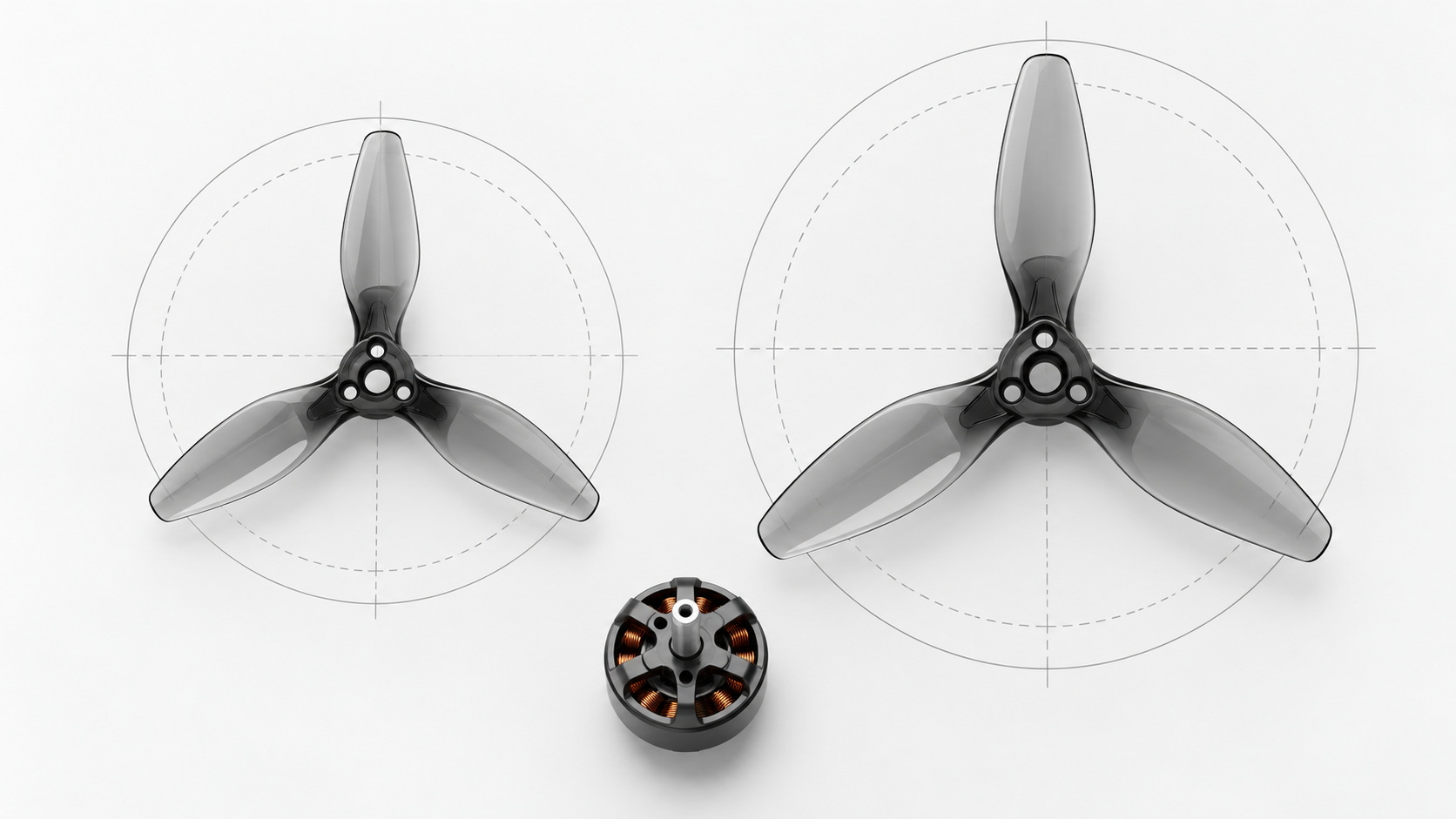
A designation such as 5×4.3×3 normally means:
- 5-inch diameter.
- 4.3-inch nominal pitch.
- Three blades.
Pitch describes theoretical forward advance per revolution. It is not a promise of actual travel through air or aircraft speed.
Lower-pitch props generally require less torque and allow quicker RPM changes. They can be useful for controlled cinematic movement, practice, and setups where responsiveness matters more than maximum speed potential.
For example, Oscar Liang identifies the HQ 5.1×2.5×3 as a cinematic option and the HQ 5×4.3×3 V2S as an all-rounder. These are useful shortlist candidates, not evidence that either is universally best for every 2207 motor.
Higher-pitch props can support greater thrust and speed potential, but generally demand more torque. If the power system cannot maintain RPM effectively, the additional load may undermine responsiveness rather than improve performance.
My selection approach is to start with a moderate-pitch propeller and increase load only when testing identifies a clear benefit.
Also compare blade shape and area. Two props with similar printed dimensions can produce different results because their geometry differs.
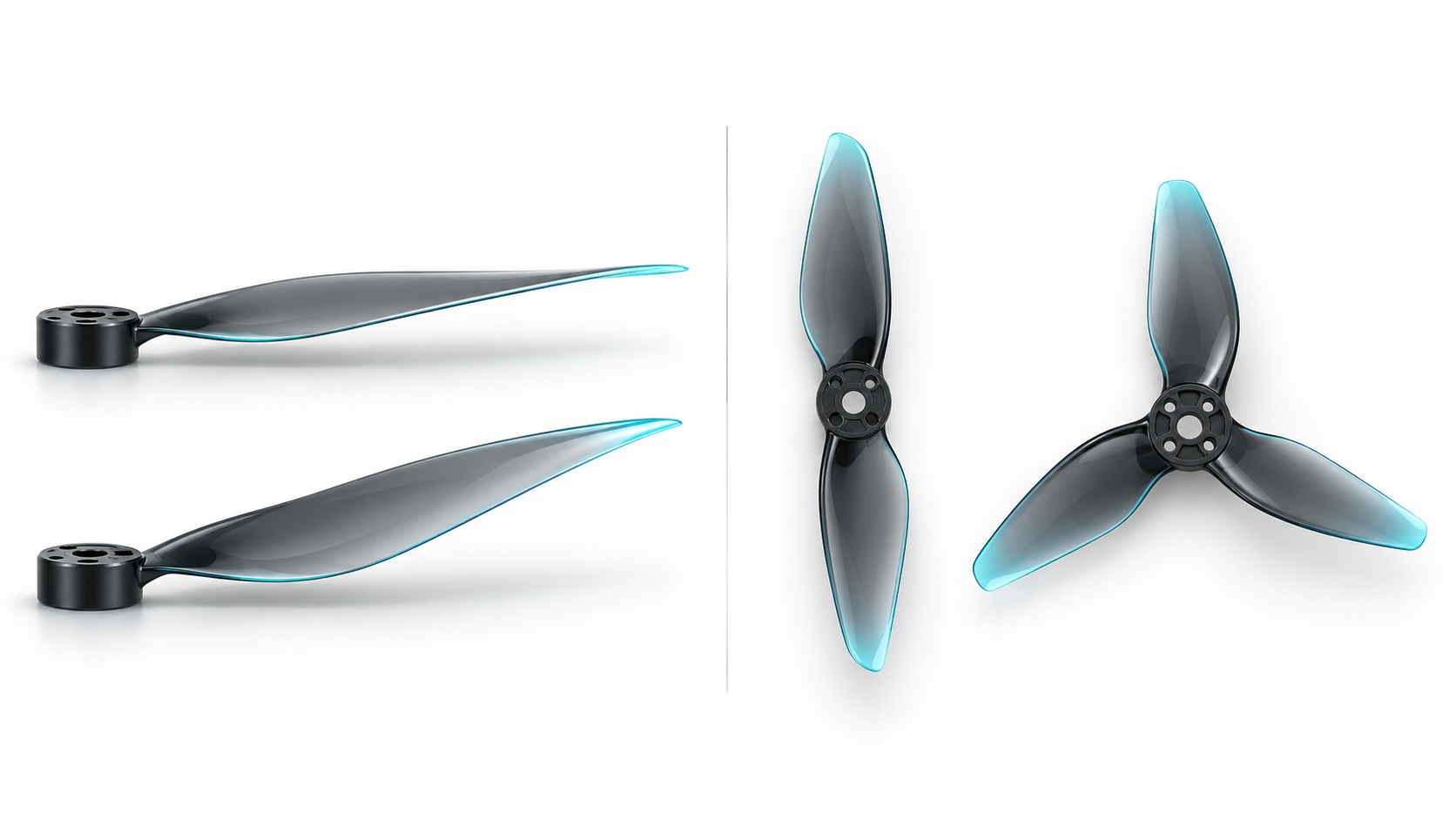
Blade count changes the selection tradeoff even when diameter remains the same.
| Configuration | Typical priority | Potential advantage | Tradeoff |
|---|---|---|---|
| Two blades | Cruising and endurance | Generally lower drag and good efficiency | Usually less grip than comparable tri-blades |
| Three blades | Freestyle and racing | Balanced thrust, grip, and control | Usually greater load than comparable bi-blades |
| Four or more blades | Specialized compact applications | More blade area within a restricted diameter | Greater torque demand and efficiency penalties |
These tendencies depend on the full blade design and operating condition. A lightweight tri-blade should not be assumed to consume more power than every available bi-blade simply because it has an extra blade.
For an ordinary five-inch freestyle build using 2207 motors, start with three blades. This is an established configuration with broad propeller availability.
For an endurance-focused project, include a two-blade candidate in your tests. Judge it by energy use during the actual flight profile—not by a universal percentage improvement in flight time.
There is no defensible fixed endurance gain that applies to every motor, propeller, battery, and aircraft combination.
Propeller selection cannot be separated from voltage and KV.
Published component guidance lists approximately 2300–2700KV for five-inch, 4S freestyle combinations and 1700–2100KV for five-inch, 6S freestyle combinations using motors including 2207. These are broad build suggestions, not manufacturer approvals for every motor in those ranges.
| Battery configuration | Published five-inch freestyle KV range | Sensible propeller selection approach |
|---|---|---|
| 4S | 2300–2700KV | Begin with an approved moderate-load five-inch prop |
| 6S | 1700–2100KV | Begin with an approved moderate-load five-inch prop |
| Specialized racing | May differ from freestyle ranges | Use exact motor data and mission-specific testing |
The motor's own voltage specification takes priority.
For example, the F60PRO V product page specifies 25.2V for its 1750KV version and 16.8V for its 2550KV version. The product family's "4–6S" description should not be interpreted as permission to run every winding option on every listed battery configuration.
Manufacturer thrust tables provide a useful reality check.
The following measurements come from the T-HOBBY F60PRO V 1750KV product page. This motor has a 2207.5 stator designation, so the results illustrate a nearby motor class—not measured performance for a Yuhang 2207 model.
| Propeller | Throttle | Voltage | Current | Static thrust | Electrical power |
|---|---|---|---|---|---|
| T-HOBBY T5147-3 | 60% | 25.1V | 13.7A | 910.7g | 342.4W |
| Gemfan GF 51466-3 | 60% | 25.1V | 13.2A | 877.6g | 330.2W |
| T-HOBBY T5147-3 | 100% | 24.8V | 40.5A | 1882.5g | 1002.8W |
| Gemfan GF 51466-3 | 100% | 24.8V | 37.7A | 1829.2g | 935.5W |
All values are manufacturer-published static measurements.
The T5147-3 produced more thrust at these operating points, but also consumed more current and power. Neither propeller "wins" independently of the application.
The table also shows why motor and ESC limits deserve careful interpretation. The product lists peak current and maximum power with a ten-second qualification. Those figures are not continuous-duty ratings.
Equal-throttle comparisons show how two combinations respond to the same command. They do not directly establish which uses less energy to perform the same task.
For efficiency selection, my recommendation is to compare electrical power at matched thrust points, then verify the result during representative flight.
Static testing remains only part of the evaluation. Incoming airflow and aircraft speed change propeller behavior, so a thrust-stand result cannot guarantee flight endurance or top speed.
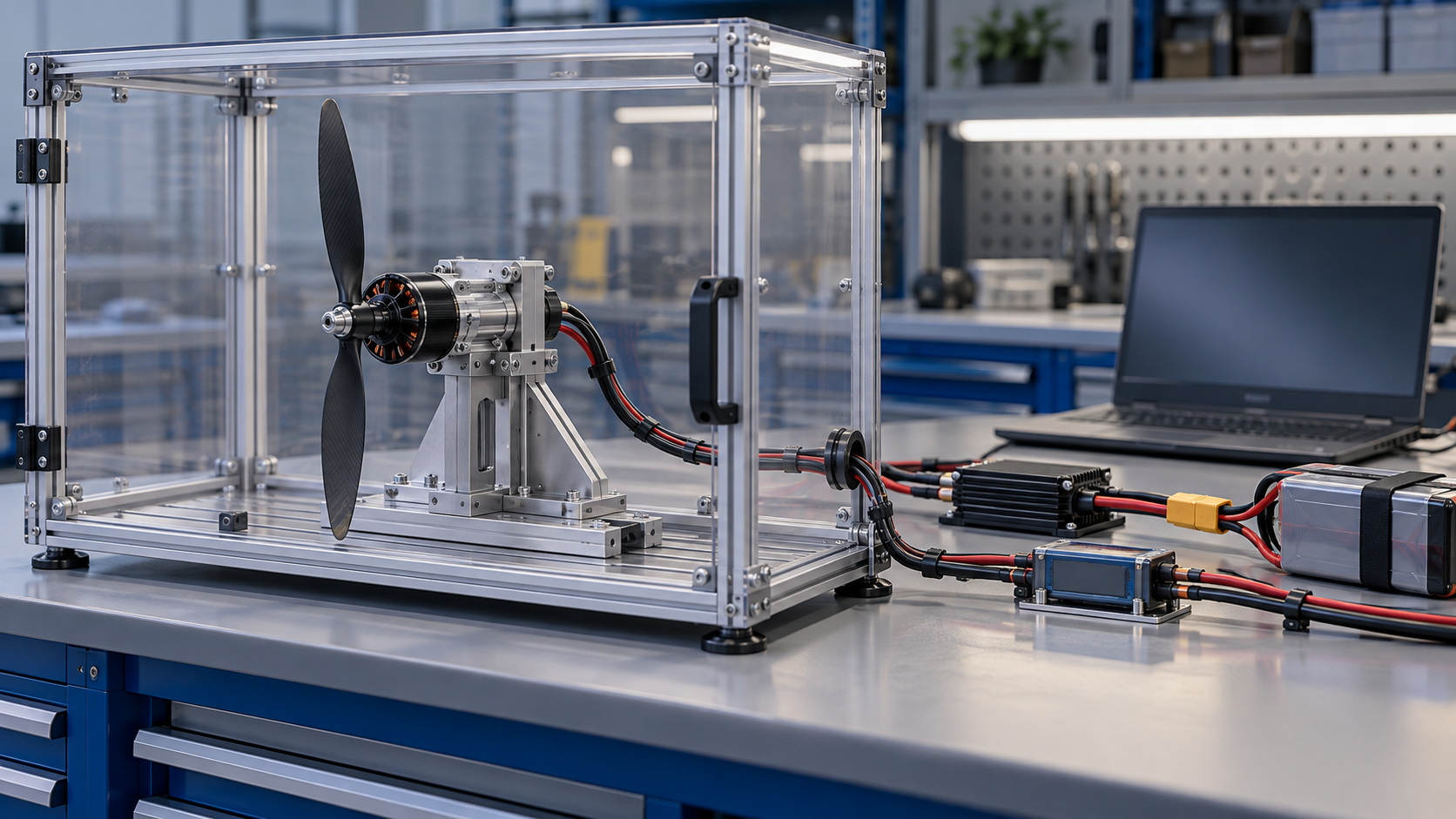
The following is a proposed evaluation workflow, not a claim of testing already completed by Yuhang.
Start with the motor manufacturer's recommended propeller and voltage. Confirm diameter clearance, hub fit, fastening requirements, and motor rotation before testing.
Compare a baseline prop with one lower-load candidate and one higher-load candidate.
Keep the motor, ESC settings, battery condition, payload, and test duration consistent. Otherwise, differences may be caused by the test setup rather than the propeller.
For a controlled evaluation, record:
- Current and voltage under load.
- Thrust at several operating points.
- Electrical power at matched thrust.
- Temperature trend during representative operation.
- Vibration, control response, and visible propeller condition.
Use a secured, appropriately guarded thrust-testing fixture. Do not hand-hold a running aircraft. Remove propellers for routine motor-direction and configuration checks.
Fly a repeatable route or maneuver sequence with comparable batteries and conditions.
For racing, prioritize controllability and repeatable performance. For cruising, compare energy consumption over a consistent route. For cinematic work, assess footage quality alongside power use.
Changing propellers can affect vibration and tuning, so review flight logs before attributing every handling difference to aerodynamic efficiency.
For a commercial drone project, "2207 motor with five-inch propeller" is an incomplete purchasing specification.
A more useful engineering brief defines:
| Requirement | Information to provide |
|---|---|
| Aircraft configuration | Frame geometry and available clearance |
| Operating weight | Battery, camera, payload, and accessories |
| Mission | Racing, freestyle, cruising, or filming |
| Electrical system | Voltage, ESC, battery capability, and connectors |
| Performance objectives | Required control response and operating duration |
| Acceptance criteria | Current, temperature, vibration, and repeatability requirements |
This prevents a common comparison error: evaluating suppliers by peak thrust while overlooking the operating conditions that produced it.
Zhongshan Yuhang Power Technology Co., Ltd. provides brushless motor development, manufacturing, and OEM/ODM services according to the company background supplied for this article.
For a customized FPV motor project, request a review of the motor, propeller, ESC, battery, and duty cycle together. Where available, sample-specific test records are more useful than generic claims about the entire 2207 category.
For most pilots, a moderate-pitch five-inch tri-blade is the right baseline. Choose a 5.1-inch version only after checking frame clearance. Consider six-inch props when the aircraft and motor specification support them and testing confirms acceptable performance.
For commercial buyers, the next step is a documented power-system evaluation.
Send Zhongshan Yuhang Power Technology Co., Ltd. your motor KV target, battery voltage, frame clearance, aircraft weight, payload, and flight requirements to discuss a suitable standard motor or customized OEM/ODM solution.
Yes, selected configurations can. Published component guidance includes 2207 motors in six-inch builds. However, suitability depends on the exact motor, KV, voltage, propeller, and operating load.
It is a reasonable all-round starting point for compatible five-inch systems. Oscar Liang recommends an HQ propeller of this size as an all-rounder, but exact motor compatibility still requires verification.
They are generally worth testing for endurance because they tend to offer lower drag. Actual flight-time improvement depends on aircraft weight, speed, battery, and the specific propeller geometry.
No. Higher pitch increases load, and the motor must still maintain sufficient RPM. Aircraft drag, thrust, and operating conditions also influence speed.
Do not treat seven-inch props as a routine substitution. Common seven-inch configurations use larger motors, and increased propeller inertia can compromise responsiveness on motors selected for smaller props.
1. Oscar Liang. "How to Choose the Best Propellers for Your FPV Drone: Beginner's Guide and Recommendations."
Supports: The relationships between propeller diameter, pitch, blade count, rotational inertia, motor load, and responsiveness, along with selected five-inch propeller recommendations. The article's comparisons of lower-pitch versus higher-pitch props and two-blade versus three-blade props primarily draw on this source. [oscarliang]
2. Oscar Liang. "How to Choose FPV Drone Motors."
Supports: FPV motor construction, the meaning of motor size designations such as 2207, and the relationships between motor dimensions, KV, and application requirements. This source supports the explanation that "2207" identifies stator dimensions rather than guaranteeing a particular current rating, power rating, or propeller compatibility. [oscarliang]
3. Oscar Liang. "Lookup Table: Motor & Prop Sizes, KV, Battery Cell Count, and Weight."
Supports: Common combinations of propeller diameter, motor size, KV, battery cell count, and intended flight application. The article's suggested KV ranges for five-inch 4S and 6S configurations, together with its comparisons of four-inch, six-inch, and seven-inch builds, primarily draw on this table. These combinations are selection guidelines, not substitutes for the specific motor manufacturer's approved configurations. [oscarliang]
4. LIGPOWER / T-HOBBY. "F60PRO V 2207.5 FPV Racing Motor 4–6S (1750–2550KV)."
Supports: F60PRO V specifications, voltage conditions for different KV versions, published propeller test results, and time-qualified peak current and power ratings. The article's data table uses the manufacturer's published measurements for the 1750KV version with T5147-3 and GF 51466-3 propellers.
Scope limitation: These are manufacturer-published static measurements for a 2207.5 motor—not test results for a Yuhang 2207 motor. They do not directly establish flight endurance, aircraft speed, or continuous-duty capability. [ligpower]
5. GetFPV Learn. "All About Multirotor Drone FPV Propellers."
Supports: Basic interpretation of propeller specifications and the influence of diameter, pitch, and blade configuration on multirotor applications. This source provides supporting context for five-inch tri-blade propellers as a common FPV configuration. [getfpv]
6. LIGPOWER. "Drone Propeller Types Explained: Key Differences."
Supports: Differences in aerodynamic load and efficiency associated with propeller blade count. This source supports the explanation that adding blades does not necessarily improve efficiency. [ligpower]
7. LIGPOWER. "FPV Drone Motors for Racing & Freestyle."
Supports: The influence of motor–propeller matching on current consumption, performance, and flight characteristics. This source provides supporting context for checking the exact motor's recommended propeller and voltage configuration. [ligpower]


