Language


Views: 258 Author: Yuhang Power Publish Time: 2026-09-30 Origin: Site


Content Menu
● Why Source for the Saudi Market?
● How This Supplier Shortlist Was Selected
● Six Suppliers and Sourcing Leads
>> 1. Zhongshan Yuhang Power Technology Co., Ltd. — Custom Brushless-Motor Candidate
>> 2. Systemair Saudi Arabia — Locally Made Ventilation Products
>> 3. Saudi Fan Industries — Certified Ventilation-Fan Lines
>> 4. United Electrical Supplies Factory Co. — Saudi Duct-Fan Lead
>> 5. ebm-papst Middle East FZE — Regional EC and Centrifugal-Fan Source
>> 6. Schübeler Technologies — International EDF Benchmark
● Supplier Comparison for Procurement Teams
● Engineering Checks Before You Compare Quotes
● Buyer's Guide: From Sample to Shipment
● The Underreported Production Trap
>> 1. How can I check whether a supplier's ISO certificate has expired?
>> 2. Is an AMCA-listed ventilation fan suitable for an aircraft EDF project?
>> 3. Can I accept a CE or RoHS logo instead of test documents?
>> 4. How do I verify capacity and MOQ before a repeat order?
>> 5. What should be tested on an EDF sample before approval?
Procurement teams searching for an Educted Fan Motor supplier in Arabia need to answer a question before comparing prices: do they need an electric ducted fan (EDF) propulsion motor for an aircraft, or a motorized duct or centrifugal fan for ventilation? Both move air, but they serve different engineering requirements. A supplier qualified for an HVAC installation is not automatically qualified to deliver an aircraft propulsion unit.
This guide uses "Arabia" to mean Saudi Arabia and suppliers serving its market. It evaluates potential partners through verifiable product information, engineering fit, quality documentation, customization scope, and delivery planning. It does not claim that every company below manufactures EDF motors in Saudi Arabia, nor does the list represent audited market-share rankings.
For buyers seeking a long-term partner, the most useful early questions are practical: Who designs the motor? Who builds and balances the rotating assembly? What is tested before shipment? Can the supplier reproduce an approved sample at production scale? A certificate, a polished catalog, or a fast quotation answers only part of that assessment.
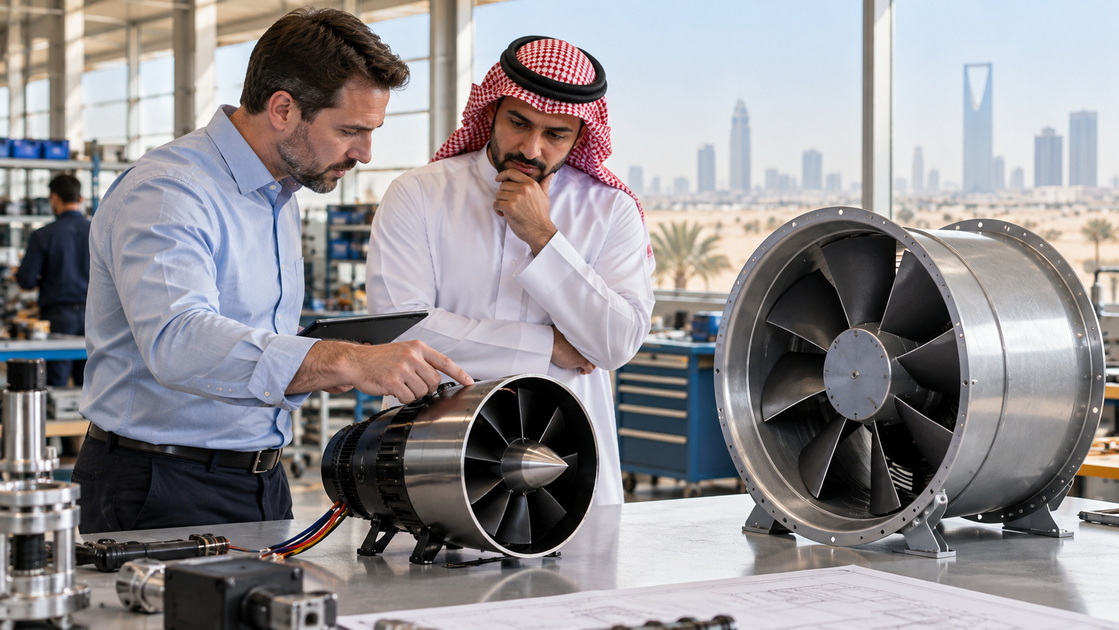
Saudi Arabia has an established industrial and import ecosystem, but broad manufacturing growth should not be mistaken for proof of a mature domestic EDF-motor cluster. DataSaudi reports that the country's manufacturing-sector exports reached SAR 504.0 billion in 2025, up 12.4% year on year. That figure covers manufacturing as a whole—not electric ducted fan motors. It provides market context, not an EDF production count.
A separate August 2026 MarketsandMarkets report estimates Saudi Arabia's overall UAV propulsion market at USD 62.9 million in 2025, projecting approximately USD 100 million by 2030. Its scope spans multiple propulsion technologies and components. Buyers should not present those figures as the size of the Saudi EDF-motor segment.
For procurement, the relevant sourcing picture is therefore mixed. Saudi-based ventilation manufacturers can support local HVAC projects and service requirements. International propulsion specialists can supply aircraft-oriented technology. Cross-border brushless-motor manufacturers may support custom development and production. The right route depends on the end product, the required local service model, and the applicable import rules.
The companies below are research leads, not prequalified or independently audited factories. Each has publicly identifiable operations or products relevant to at least one of three paths: brushless propulsion motors, Saudi-made duct or centrifugal fans, or regional EC fan supply.
The screening framework is intentionally stricter than a typical name-only list:
1. Product fit: Does the published range address EDF propulsion, brushless motors, EC ventilation, or centrifugal duct fans? These categories are labeled separately.
2. Engineering capability: Can the supplier discuss winding, rotor matching, thermal limits, vibration, and testing for the proposed application?
3. Quality evidence: Are model-specific test reports, traceability procedures, and applicable certificates available for review?
4. Production readiness: Can the company substantiate capacity, minimum order quantity (MOQ), lead time, and change control for the exact project?
5. Market access: Can the buyer and supplier identify Saudi product classification, import documentation, and any applicable conformity route before shipment?
6. Commercial continuity: Is there a workable process for sampling, technical feedback, production approval, and replacement parts?
Verification status matters: Public websites can establish a product direction or company profile. They generally cannot verify a plant's current monthly output, a negotiated MOQ, a factory's live certificate status, or its ability to meet your drawing. Those items remain due-diligence tasks.
Location and role: Zhongshan, Guangdong, China; an overseas manufacturing candidate for Saudi buyers, not a Saudi factory. The company states that it was established in 2021 and focuses on brushless-motor research, development, production, and sales. Its published applications include drones, RC vehicles, aircraft, gimbal systems, and underwater robots, alongside customized OEM and ODM services.
Where it may fit: A small or medium-sized brand seeking a brushless-motor development partner can approach Yuhang with a defined fan, aircraft, or appliance brief. Its stated emphasis on in-house design, production, testing, and customized solutions makes it a relevant candidate for evaluation, particularly when a buyer values direct engineering communication rather than choosing only from a fixed catalog.
What to verify: The company profile does not, by itself, establish a model-specific EDF qualification, a Saudi installation, a confirmed MOQ, or a certified monthly capacity. Ask whether Yuhang can supply the motor only or a validated motor-and-fan assembly. Request the proposed model's drawings, test conditions, traceable samples, and production plan. "Cost-effective" should be tested through a complete landed-cost quotation, not asserted from a profile page.
Established: 2021. Main markets: The company describes serving global customers; a market-by-market breakdown is not publicly verified on the cited page. OEM/ODM scope: Published as customized brushless-motor and power-system solutions; EDF-specific scope requires project confirmation.
Location and role: Riyadh, Saudi Arabia; ventilation-system manufacturer, not a verified RC-aircraft EDF-motor maker. Systemair describes a Saudi facility on approximately 13,000 m⊃2; of land, with a 9,000 m⊃2; factory. Its Saudi-made range includes circular duct fans with AC or EC motors and centrifugal roof-fan products.
Where it may fit: Procurement teams specifying local ventilation equipment, duct installations, building services, or related after-sales support should investigate Systemair's Saudi portfolio. Its published account says Saudi-made products primarily serve Saudi Arabia, the UAE, Qatar, and other Middle Eastern markets.
What to verify: Confirm that the exact model meets the required airflow, static pressure, operating temperature, and project standard. Do not substitute its HVAC product data for aircraft thrust or flight-performance data. Ask which product and process changes it can support; a broad factory-customization or OEM promise is not established for every model.
Established: Systemair's Saudi facility is publicly described, but a founding year for the Saudi legal entity is not confirmed in the cited page. Main markets: Saudi Arabia and the wider Middle East. OEM/ODM scope: Model-specific customization must be confirmed by quotation.
Location and role: Al Khobar, Saudi Arabia; a ventilation-fan manufacturer. AMCA International's product directory lists Saudi Fan Industries and identifies certified axial and centrifugal product lines, including roof, wall, and inline fan models. That is useful third-party evidence for the listed models, not a blanket certification of every product the company may sell.
Where it may fit: This is a sourcing lead for commercial or industrial airflow projects that require documented fan performance. Buyers can begin with the exact AMCA-listed model and check whether its published duty point matches their installation.
What to verify: Obtain the current catalog and confirm that certification still applies to the proposed model and configuration. Ask for the factory's present output, production lead time, available modifications, and any subcontracted components. AMCA's listing does not show that the company makes small aircraft EDF motors.
Established: Not reliably confirmed in the cited product directory. Main markets: A Saudi location is confirmed; a detailed export-market breakdown is not. OEM/ODM scope: Confirm directly for the chosen model and project.
Location and role: Riyadh, Saudi Arabia; a duct- and ventilation-fan sourcing lead. Its company site identifies it as a ventilation-fan manufacturer, while its published duct-fan range includes circular inline centrifugal and EC-motor inline duct-fan categories.
Where it may fit: Buyers sourcing ducted airflow solutions for facilities, equipment rooms, or industrial ventilation may find relevant local product categories here. A Saudi-based point of contact may also simplify site-specific discussions.
What to verify: Request a current legal registration, factory address confirmation, model datasheet, airflow and static-pressure curve, and evidence of which processes occur at the Riyadh facility. Public product categories do not establish an aircraft-grade EDF capability, production capacity, or a fixed MOQ.
Established: Not verified from the cited company pages. Main markets: Saudi-market presence is evident; other principal markets are not verified. OEM/ODM scope: Request a written response against the buyer's drawings and quantities.
Location and role: Dubai, United Arab Emirates; a regional supplier serving the Middle East, not a Saudi-based factory. The ebm-papst group says it was founded in 1963. Its Middle East operation publishes EC plug fans and AC/EC centrifugal fans for ventilation and related applications.
Where it may fit: Buyers prioritizing a broad EC-fan product range, control integration, and regional technical support can assess its available models. The group also describes engineering support for applications not covered by standard products.
What to verify: Identify the actual factory of origin for the quoted item, its lead time into Saudi Arabia, the customization pathway, and the documentation attached to that SKU. Regional presence must not be represented as Saudi manufacture. EC centrifugal-fan experience also does not automatically qualify a product for aircraft propulsion.
Established: Group founded in 1963; the cited page does not establish the Middle East entity's founding year. Main markets: Middle East, including HVAC and commercial refrigeration applications. OEM/ODM scope: Engineering collaboration is described at group level; project terms require confirmation.
Location and role: Germany; an international EDF specialist, included as a technical benchmark and potential overseas supply lead, not an Arabian manufacturer. Schübeler states it was founded in 1997 and publishes integrated-motor ducted fans, fans with exchangeable motors, and motors developed for ducted-fan applications.
Where it may fit: Aircraft and research buyers needing an established EDF product range can use its published designs to frame questions about fan diameter, motor integration, test evidence, and customization. Its materials describe matching a fan system to airframe and flight requirements.
What to verify: Confirm commercial availability, Saudi delivery arrangements, the exact product's technical limits, MOQ, and any project-specific engineering work. Published EDF expertise is not proof that a particular system satisfies a buyer's endurance or operating-environment requirement.
Established: 1997. Main markets: The cited sources describe RC and specialist propulsion applications, but do not provide a verified country-by-country sales split. OEM/ODM scope: Product and project-specific customization should be confirmed directly.
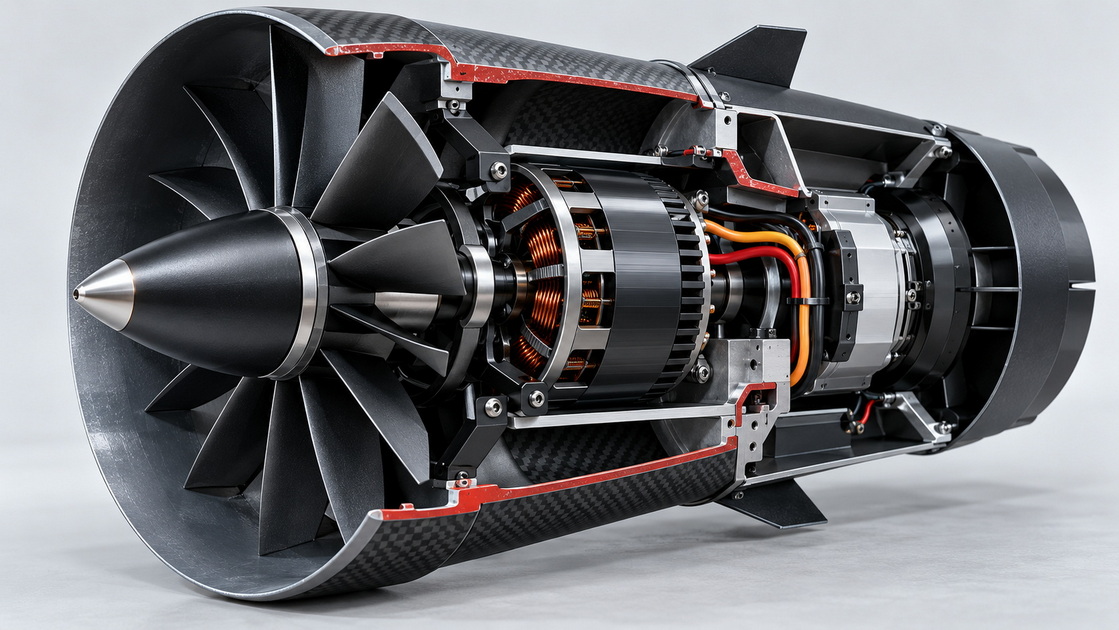
| Company | Sourcing role | Capacity evidence | MOQ evidence | Certification or compliance evidence |
|---|---|---|---|---|
| Zhongshan Yuhang Power Technology | Chinese brushless-motor and OEM/ODM candidate | Not publicly verified for the proposed EDF model | Request quotation | Request current company and model-specific documents |
| Systemair Saudi Arabia | Saudi-made HVAC and duct-fan source | Facility size published; unit output not stated | Request quotation | Some product-specific standards or certifications described; verify the quoted model |
| Saudi Fan Industries | Saudi ventilation-fan manufacturer | Not publicly verified in the cited directory | Request quotation | AMCA lists specified fan models |
| United Electrical Supplies Factory Co. | Saudi duct-fan sourcing lead | Not publicly verified | Request quotation | Request model-specific evidence |
| ebm-papst Middle East FZE | UAE-based regional EC/centrifugal-fan source | Not publicly verified for Saudi-bound SKU | Request quotation | Request documentation for the exact model and origin |
| Schübeler Technologies | German EDF specialist and benchmark | Not publicly verified for the requested order | Request quotation | Request current product-specific test and conformity documents |
Do not read "not publicly verified" as "no capacity" or "no certification." It means this review did not find defensible figures or certificates that could be assigned to the buyer's proposed item. Factory area, a corporate certificate, and a certified fan model measure different things.
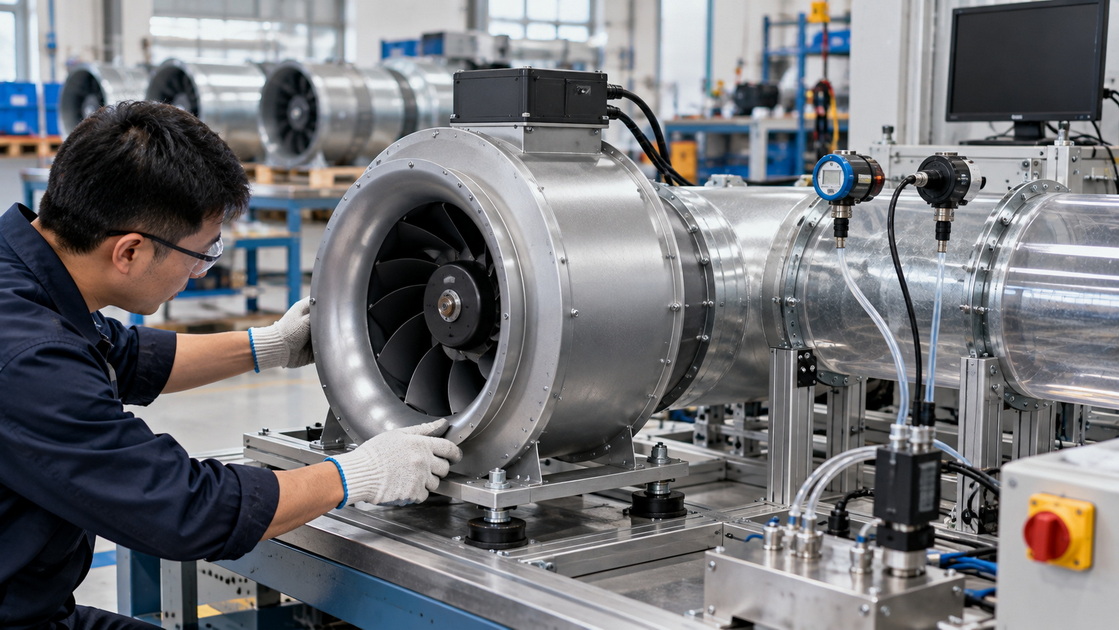
The phrase "Educted Fan Motor" should be converted into a precise specification in every request for quotation. For aircraft, define an electric ducted fan propulsion motor or complete EDF assembly. For ventilation, define an EC/BLDC motorized duct fan or centrifugal fan. This prevents suppliers from quoting physically similar-looking, but functionally unsuitable, equipment.
For an EDF propulsion project, specify battery voltage, fan diameter, rotor geometry, target thrust, input power, operating duration, allowable mass, installation envelope, and cooling conditions. Compare results from the complete motor–rotor–shroud–ESC system. A free-spinning motor speed or isolated component rating cannot establish installed thrust.
For a centrifugal ventilation project, start with required airflow and static pressure at the actual duty point. Then review electrical input, noise, control method, installation space, temperature range, and maintenance access. An airflow figure without its associated pressure is an incomplete basis for selection.
Across both categories, ask suppliers to document material grades and assembly processes rather than accepting vague phrases such as "premium magnets" or "aerospace aluminum." Specify the relevant housing, shaft, bearings, insulation, coatings, and impeller material. Request production controls for winding, bonding, rotor balancing, final inspection, and revision tracking.
CE and RoHS require careful wording. The European Commission explains that CE marking is a manufacturer's declaration under applicable EU rules; it does not mean that an EU authority has approved the product. RoHS addresses restricted substances in electrical and electronic equipment within its scope. Neither label substitutes for performance testing, and applicability depends on the product and destination market.
For Saudi shipments, establish the correct product classification and conformity route before dispatch. SASO describes several product and consignment conformity certificates. Whether a particular standalone motor, assembled fan, or finished appliance needs a specific Saudi process should be checked against its classification and applicable regulation; a generic claim that every motor needs the same certificate is not reliable.
1. Issue one controlled specification. Give every bidder the same drawing, application, target duty point, voltage, operating conditions, quantities, and destination. Separate mandatory requirements from preferred features.
2. Check the legal entity and actual factory. Match the quotation, company registration, invoice entity, manufacturing address, and bank beneficiary. A sales office and a production site may be in different countries.
3. Verify certificates independently. For an ISO claim, check the certificate number, legal name, address, scope, issuing body, and live status. IAF CertSearch provides a way to review accredited-certificate details; contact the issuer if a record is unclear.
4. Order documented samples. Identify each sample by drawing revision, motor or fan model, component bill, and test report. Agree in advance which measurements determine acceptance.
5. Approve a production reference. Retain a signed or otherwise controlled "golden sample," but also approve its drawings, materials, test limits, and allowable substitutions.
6. Audit the proposed production process. Ask where winding, machining, assembly, balancing, and final testing take place. Verify capacity against an actual proposed order schedule.
7. Plan Saudi logistics early. Agree on the Incoterm, packaging, country of origin, invoice description, tariff classification, importer responsibilities, and any required conformity documents before the goods leave the factory.
A quotation should distinguish sample lead time, production lead time after approval, and transit time. "Delivery in four weeks" is not actionable if the starting point and shipping responsibility remain undefined.
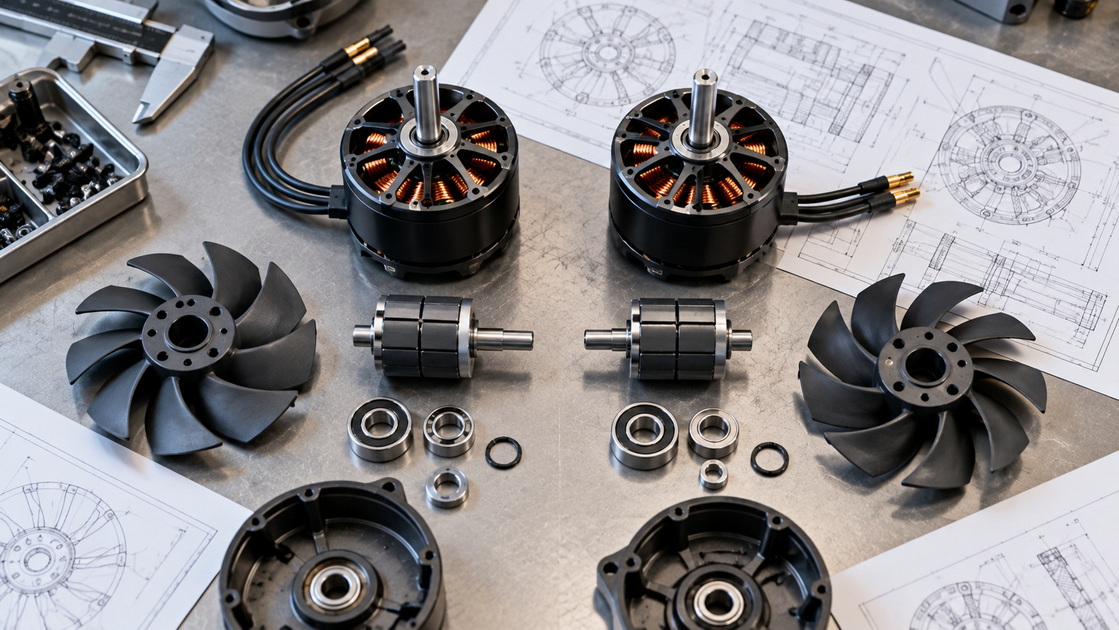
One particularly costly sourcing error is approving a sample by KV, RPM, or headline airflow alone, while leaving the rotating assembly's production revision uncontrolled. A later batch can retain the same advertised motor rating but use a different rotor, impeller material, bearing, adhesive, or balancing process. The buyer may not notice the change in a catalog, yet vibration, noise, current draw, or thermal behavior can change.
This is a procurement risk to control, not an allegation against any company on this list. A practical purchase order should freeze the approved drawing and critical bill-of-materials items, require written approval for substitutions, and state how balancing and finished-unit tests are recorded. For an EDF assembly, compare complete-system thrust and electrical input under repeatable conditions. For a ventilation fan, compare airflow and pressure at the agreed duty point.
The same discipline helps prevent material substitution. Do not accept "equivalent grade" without a defined equivalence rule. Specify which material changes require new samples, which require new testing, and who pays for requalification.
Saudi buyers can find local ventilation-fan capacity, regional EC-fan access, and international EDF or brushless-motor partners. They should not be treated as interchangeable. Start by defining whether the project calls for aircraft thrust or ducted ventilation. Then shortlist suppliers against the exact performance, documentation, production, and delivery requirements of that application.
For a custom brushless-motor or power-system project, send Zhongshan Yuhang Power Technology Co., Ltd. your drawing, voltage, fan or impeller specification, target performance, annual volume, and Saudi delivery requirements. Request a written feasibility assessment, sample plan, model-specific test scope, MOQ, and production lead time before committing to a long-term agreement.
Request the certificate number and the exact certified legal entity. Search its current status, scope, location, certification body, and accreditation details through IAF CertSearch. If a record is missing or ambiguous, ask the issuing certification body for direct confirmation. An ISO 9001 certificate for one site should not be assumed to cover another site or every product.
No such conclusion follows from the listing. AMCA's directory identifies certified performance for specified ventilation-fan models. Aircraft EDF qualification requires application-specific evidence for the motor, rotor, duct, controller, installation, and operating conditions.
No. For applicable EU rules, ask for the relevant declaration of conformity and supporting technical documentation. Assess RoHS evidence against the actual materials and product scope. A printed logo alone does not prove suitability or establish a Saudi import approval.
Ask for a written monthly-capacity statement tied to the exact product, the proposed order schedule, available test-station throughput, and the split between in-house and outsourced processes. Confirm MOQ by configuration: a standard motor, custom winding, new tooling, and private-label package may each have different commercial terms.
Test the complete intended configuration, not only the motor. Record the battery or supply voltage under load, input current, power, thrust, temperature, vibration, and test duration. Keep the rotor, duct, ESC, measurement method, and ambient conditions documented so a production batch can be compared with the approved sample.
1. [Zhongshan Yuhang Power Technology Co., Ltd., "About Us"]. Company-stated founding year, applications, and OEM/ODM scope; not independent verification of capacity or EDF-specific certification. [yuhangmotor]
2. [DataSaudi, "Manufacturing"]. Official Saudi manufacturing-sector export context for 2025; not an EDF-motor market statistic. [datasaudi]
3. [MarketsandMarkets, "Saudi Arabia UAV (Drone) Propulsion Market (2025–2030)"]. August 2026 estimate for the broader UAV propulsion market, not EDF motors alone. [marketsandmarkets]
4. [Systemair Saudi Arabia, "Celebrating Saudi-Made Manufacturing Excellence"]. Facility dimensions, local product categories, and stated regional markets. [systemair]
5. [AMCA International, "Saudi Fan Industries: Certified Products"]. Third-party directory of specified ventilation-fan models. [amca]
6. [United Electrical Supplies Factory Co., "Duct Fans"] and ["Duct Fan Product Category"]. Saudi company and published duct-fan product categories. [unitedfactorysa]
7. [ebm-papst Middle East, company and product overview]. Group founding date, Dubai regional location, and EC/centrifugal-fan categories. [ebmpapst]
8. [Schübeler Technologies, "RC Products"] and ["The Jet Effect"]. EDF product categories, founding year, and system-matching context. [schubeler]
9. [Saudi Standards, Metrology and Quality Organization, "Certificates of Conformity"]. Official description of Saudi conformity-certificate types. [saso.gov]
10. [IAF CertSearch, "Verify Certificates Instantly"]. Certificate-status and scope verification method. [iafcertsearch]
11. [European Commission, "CE Marking"] and ["RoHS Directive"]. Official explanations of EU product-conformity responsibilities and restricted-substance rules. [single-market-economy.ec.europa]
12. [Flite Test, "How to Use an EDF"]. Introductory description of the aircraft-oriented electric ducted fan configuration. [flitetest]


