Language


Views: 256 Author: Yuhang Power Publish Time: 2026-09-23 Origin: Site
Content Menu
● What Is a Drone Flight Controller?
● How Does a Drone Flight Controller Work?
>> Sensors Used by a Drone Flight Controller
>> From Sensor Data to Motor Commands
● Why Is the Flight Controller Important for Drone Performance?
>> Flight Stability and Safety
>> Flight Feel and FPV Responsiveness
● Flight Controller, ESC, and Brushless Motor Relationship
>> What the Flight Controller Does
>> What the Brushless Motor Does
● Why Motor RPM Telemetry Matters for FPV Drones
>> Benefits of RPM-Based Filtering
● Main Types of Drone Flight Controllers
● How to Choose the Right Flight Controller
>> 1. Define the Flight Mission
>> 2. Check Processor and Firmware Compatibility
>> 3. Count UARTs and Required Connections
>> 4. Verify Power and BEC Requirements
>> 5. Match the FC to the Motor and ESC System
● Basic Flight Controller Setup Checklist
>> Step 1: Install and Secure the FC
>> Step 2: Update Firmware and Configure the Board
>> Step 3: Configure the Receiver
>> Step 4: Set Flight Modes and Failsafe
>> Step 5: Confirm Motor Order and Direction
>> Step 6: Conduct a Conservative First Flight
● Common Flight Controller Problems and Their Root Causes
● Build Better UAV Power Systems With Yuhang Power Technology
● FAQ
>> 1. What is the main function of a drone flight controller?
>> 2. Does a flight controller control brushless motors directly?
>> 3. What is DShot in FPV drones?
>> 4. Why does my FPV drone vibrate or shake?
>> 5. Do I need GPS on an FPV drone?
A drone flight controller is the onboard computer that keeps an aircraft stable and converts pilot, mission, or navigation commands into precise motor outputs. For FPV drones, camera platforms, fixed-wing aircraft, underwater robots, and other intelligent devices, the flight controller must work as part of a complete system with the ESC, brushless motors, propellers, battery, sensors, and mechanical structure.
At Zhongshan Yuhang Power Technology Co., Ltd., we develop and manufacture FPV drone motors, brushless motors, and customized propulsion solutions for UAVs, FPV racing drones, RC cars, high-speed fans, gimbal cameras, aircraft, robotic vacuum cleaners, underwater robots, and other professional equipment. From our engineering perspective, stable flight does not come from a flight controller alone. It comes from the correct interaction between the flight controller, ESC, motor, propeller, power supply, and frame.
This guide explains what a drone flight controller does, how it communicates with the power system, how to select the right FC for different UAV projects, and how motor selection affects tuning, stability, vibration, efficiency, and flight performance.
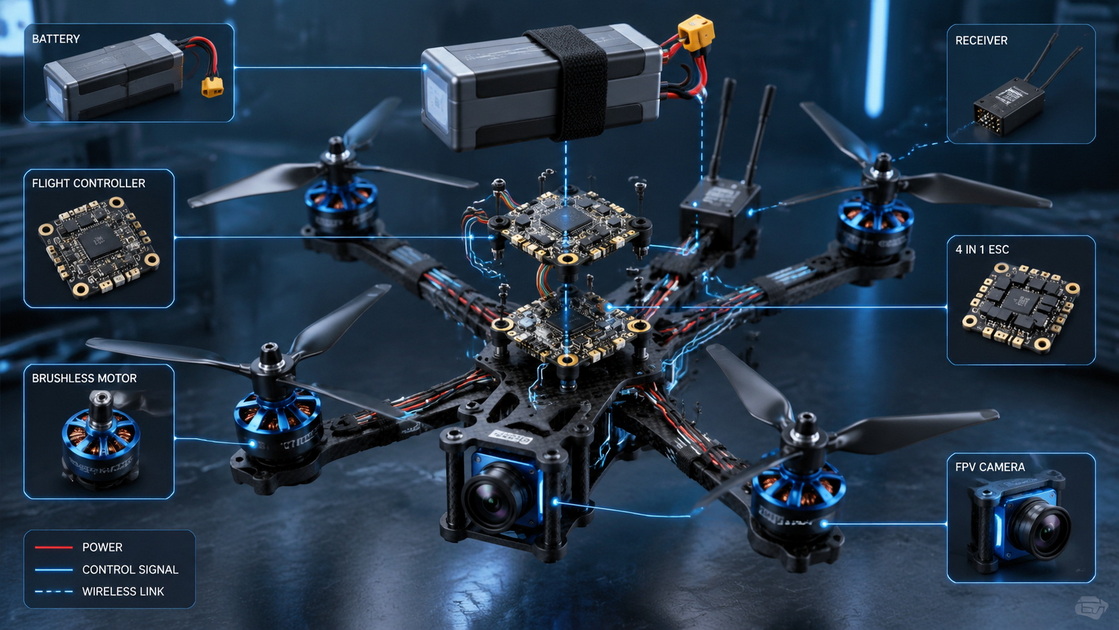
A drone flight controller, often called an FC, is an embedded computing board that monitors the aircraft's movement and continuously adjusts motor output to keep the drone flying as intended.
The flight controller receives information from onboard sensors and user or autonomous-flight commands. It then calculates the required corrections and sends control signals to the electronic speed controllers. The ESCs regulate power to the brushless motors, and the motors drive the propellers to generate lift, thrust, roll, pitch, and yaw movement.
A simplified control path is:
Receiver / GPS / Sensors→Flight Controller→ESC→Brushless Motors→Propellers
A flight controller is therefore not a simple signal pass-through device. It operates as a closed-loop control system: it compares the drone's actual motion with the desired motion, calculates the difference, and adjusts the motors in real time.
For example, when wind pushes a quadcopter to the right, the flight controller detects the disturbance through its sensors. It then changes the speed of specific motors to restore the intended attitude or trajectory.
PX4 describes this general architecture as a pipeline from sensors, RC input, and autonomous flight control through to motor or servo actuator control. Its flight stack includes estimation and control functions for multirotor, fixed-wing, and VTOL platforms.
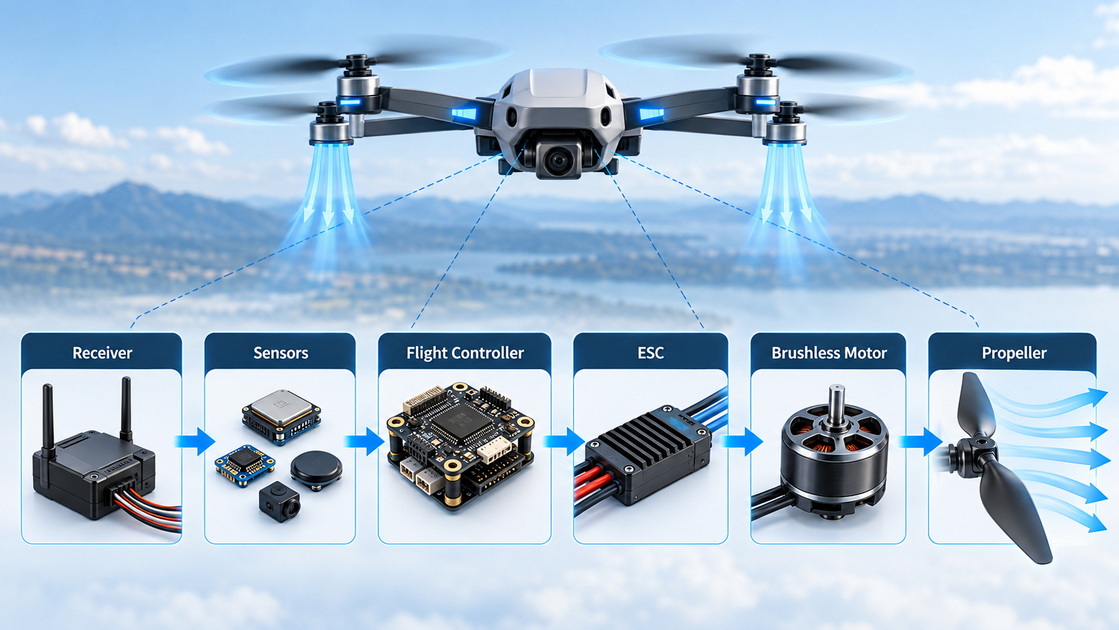
A modern flight controller typically follows a repeated control process:
1. Sense the drone's motion and environment.
2. Estimate the aircraft's orientation, velocity, altitude, or position.
3. Calculate the correction required to meet the pilot or mission command.
4. Command the ESCs and motors to produce the required thrust and torque.
5. Repeat the control loop continuously during flight.
This continuous feedback cycle is what allows a drone to hover, turn, resist vibration, maintain altitude, follow a GPS route, or react sharply to FPV pilot stick inputs.
The most important sensor system is usually the inertial measurement unit, or IMU. An IMU commonly includes a gyroscope and accelerometer.
- Gyroscope: Measures rotational speed around the roll, pitch, and yaw axes.
- Accelerometer: Measures linear acceleration and can help identify the gravity reference.
- Magnetometer: Functions as a digital compass for heading information.
- Barometer: Helps estimate altitude through air-pressure changes.
- GPS module: Provides location, ground speed, and navigation support.
- Optical flow or vision sensors: Help support position estimation in specific environments.
- Airspeed sensor: Often used on fixed-wing aircraft for better speed and energy control.
PX4 identifies a gyroscope, accelerometer, magnetometer, and barometer as minimum required sensors in its core concept documentation, while additional sensors can expand navigation and autonomous-control capability.
Raw sensor readings alone are not enough. The flight controller must process and combine them to estimate the aircraft's true state.
For example:
- The gyro responds quickly to angular motion.
- The accelerometer helps correct attitude drift over time.
- GPS can contribute global position information.
- A barometer supports altitude estimation.
- Filtering helps remove vibration-related sensor noise.
The controller compares the estimated aircraft state with a target state. That target may come from an FPV pilot's stick movement, a self-level mode, a GPS position-hold command, or an automated mission.
The flight controller then uses control algorithms—commonly including PID-based control loops—to calculate the necessary corrections. It distributes these corrections across the motors through a process often called motor mixing.
If a quadcopter needs to roll left, the FC changes the output of specific motors. This creates an imbalance in thrust that tilts the aircraft in the desired direction.
The flight controller is central to flight stability, but its real-world performance depends on the complete propulsion and mechanical system.
A powerful processor cannot fully compensate for a poor motor-propeller match, damaged propellers, excessive frame resonance, unstable ESC signals, poor solder joints, or an incorrectly installed FC.
The FC helps maintain controlled flight by making constant corrections to motor output. It also supports important safety functions, such as:
- Arming and pre-arm safety checks
- Signal-loss failsafe behavior
- Low-battery warnings
- Motor-output limits
- GPS rescue or return-to-home functions
- Geofencing or flight-boundary features on supported systems
- Sensor monitoring and error detection
For professional or industrial platforms, the reliability requirements are often higher. Redundant sensors, redundant GPS, power monitoring, and carefully configured failsafe behavior can be essential.
ArduPilot notes that some autopilot platforms support redundant IMUs and GPS systems for applications that need a higher level of sensor redundancy.
For an FPV racing or freestyle drone, a flight controller must process inputs quickly and consistently. Pilots typically prioritize:
- Low perceived control latency
- Predictable stick response
- Strong propwash handling
- Smooth cornering
- Precise throttle control
- Stable video feed
- Effective vibration filtering
- Reliable motor synchronization
In this situation, the FC, ESC, motor, and propeller cannot be selected independently. A high-KV FPV motor with aggressive propellers may produce fast response, but it may also create more vibration, current draw, and motor noise. The flight controller must receive clean sensor data and maintain stable PID control under these conditions.
The most important system relationship in a multirotor drone is:
Flight Controller→ESC→Brushless Motor→Propeller Thrust
The FC decides the requested motor output. The ESC interprets the control signal and switches battery power to drive the brushless motor. The motor turns the propeller, producing thrust.
The flight controller determines:
- Which motor should speed up or slow down
- How much thrust is required
- How to stabilize roll, pitch, and yaw
- How to react to pilot commands
- How to respond to sensor data
- When to activate safety or failsafe functions
The ESC supplies controlled electrical power to the brushless motor. It translates the FC's command into rapid switching of current through the motor windings.
DShot is a widely used digital protocol for communication between a flight controller and ESC. Betaflight describes DShot as a protocol that sends a target throttle value from the FC to the ESC, which then drives the motors accordingly.
The brushless motor converts electrical energy into mechanical rotation. Its performance affects:
- Thrust output
- Throttle response
- Propeller acceleration
- Power efficiency
- Motor temperature
- Flight time
- Noise and vibration
- Flight-controller tuning requirements
At Yuhang Power Technology, we consider motor selection an important input to FC performance. A well-matched motor provides stable torque, consistent RPM behavior, acceptable operating temperature, and a vibration profile that can be managed by the FC's filtering system.
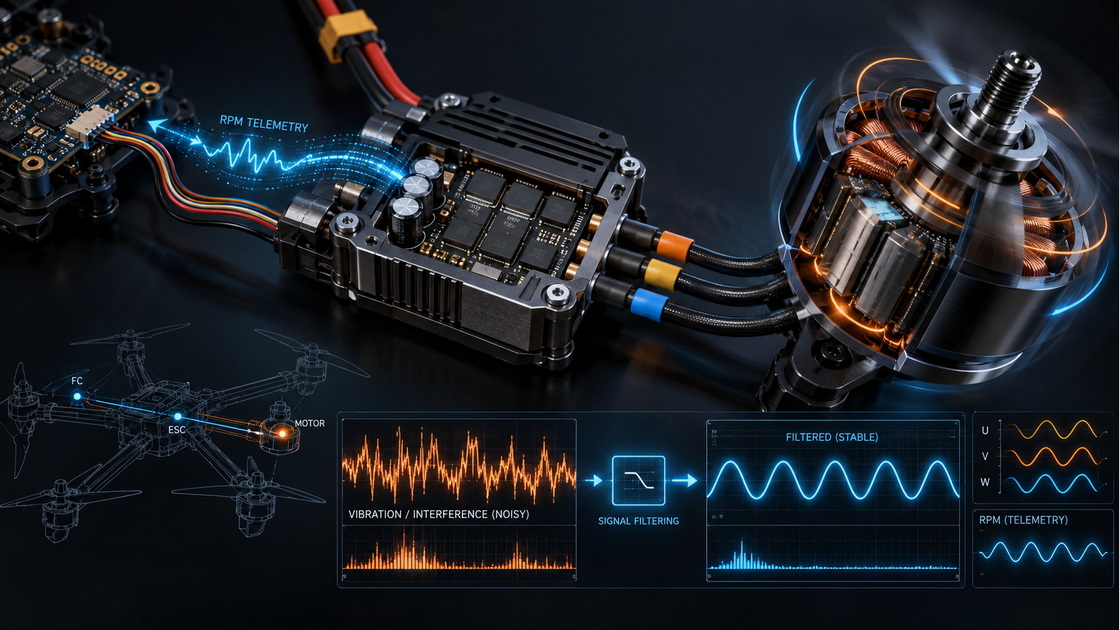
Modern FPV systems can use bidirectional DShot to send motor RPM information back to the flight controller through the same signal wire used for motor control.
This matters because the FC can use motor-speed data to identify vibration frequencies more accurately. It can then apply dynamic notch filtering around those frequencies instead of relying only on broad static filters.
Betaflight states that bidirectional DShot allows ESCs to report RPM telemetry to the FC. The flight controller can use this information for RPM filtering, dynamically targeting motor-noise frequencies and their harmonics.
- Cleaner gyro data
- Reduced motor-noise interference
- Improved propwash control
- More confident PID tuning
- Better video quality in vibration-sensitive FPV systems
- Lower risk of oscillation caused by excessive noise
- Potentially smoother flight behavior
However, RPM filtering is not a substitute for good hardware. Bent propellers, loose motor screws, damaged bearings, unbalanced propellers, and a flexible frame should be fixed mechanically before increasing filter complexity.
Expert insight: A clean mechanical system gives the flight controller cleaner data. Cleaner data allows more effective tuning. Better tuning supports smoother flight and more efficient use of the motor-propeller system.
Different aircraft require different FC features. The best flight controller is not necessarily the one with the highest processor specification. It is the one that matches the mission, airframe, firmware ecosystem, input/output requirements, and power-system design.
| Drone Type | Main Flight Controller Priorities | Motor and Power-System Priorities |
|---|---|---|
| FPV Racing Drone | Low latency, high gyro rate, responsive tuning, DShot support | High thrust, rapid RPM change, lightweight motor design |
| FPV Freestyle Drone | Smooth flight feel, strong vibration filtering, OSD, reliable tuning | Balanced thrust, durability, controllable torque, propwash recovery |
| Long-Range FPV Drone | GPS support, reliable failsafe, power monitoring, efficient cruise tuning | Efficiency, moderate current draw, stable cruising performance |
| Camera Drone | Hover stability, GPS, altitude hold, payload integration | Low vibration, efficient thrust, smooth response |
| Industrial Multirotor | Redundancy, telemetry, mission automation, sensor integration | Reliability, thermal management, payload-capable thrust |
| Fixed-Wing UAV | Servo outputs, navigation, airspeed support, autonomous missions | Motor-propeller efficiency, sustained power, thermal stability |
| Underwater Robot | Waterproof integration, thruster mixing, sensor input, tether support | Corrosion resistance, sealed design, bidirectional thrust capability |
Choosing a flight controller should begin with the aircraft's purpose, not with a component list.
Ask these questions first:
- Is the aircraft for FPV racing, freestyle, long-range flight, aerial photography, inspection, mapping, cargo, or research?
- Does it require GPS navigation or return-to-home?
- Does it need autonomous missions?
- Will it use digital HD video, analog FPV, telemetry radios, or companion computers?
- Is low latency more important than automation?
- Does the system need redundancy?
- What payload, range, flight time, and environmental conditions are expected?
An FPV freestyle drone may prioritize rapid response and smooth handling. An industrial inspection aircraft may prioritize stable hover, data logging, GPS reliability, payload control, and redundant sensors.
Common FC firmware ecosystems prioritize different applications.
| Firmware Ecosystem | Typical Strengths | Common Applications |
|---|---|---|
| Betaflight | FPV response, PID tuning, filtering, racing and freestyle workflow | FPV racing, freestyle, compact multirotors |
| iNav | Navigation-oriented features with fixed-wing and multirotor support | Long-range FPV, GPS-assisted aircraft |
| ArduPilot | Advanced autopilot features, vehicle flexibility, mission capability | Industrial UAVs, research platforms, multirotors, fixed-wing aircraft |
| PX4 | Open-source architecture, robotics integration, autonomous systems | Research, commercial development, autonomous UAV platforms |
PX4's architecture supports estimation, guidance, navigation, control algorithms, and hardware integration for multiple airframe types.
A flight controller can appear capable on paper but become difficult to use if it lacks enough UARTs or physical connection options.
Plan connections for:
- Receiver
- GPS module
- Digital video transmitter
- Analog video transmitter control
- Telemetry radio
- ESC telemetry
- Compass
- Rangefinder
- Camera control
- LED controller
- Companion computer
- External sensors
For a simple FPV build, fewer ports may be enough. For a long-range or industrial drone, UART availability can become a critical selection factor.
The FC may include regulated power outputs such as 5V or 9V BEC rails. Check whether these outputs can safely supply the connected receiver, GPS, video transmitter, camera, LEDs, or other peripherals.
Do not assume that every 5V or 9V output has the same current capability. Excessive current draw, poor grounding, voltage drop, or incorrect wiring can cause instability, video noise, FC resets, or damaged peripherals.
Before finalizing the build, confirm:
- Supported ESC communication protocol
- DShot compatibility
- Bidirectional DShot support if RPM filtering is required
- Motor pole count for RPM calculations
- Battery voltage and current capability
- ESC continuous and burst current rating
- FC mounting pattern and physical space
- Motor KV and propeller selection
- Expected vibration level of the frame and propulsion system
For FPV systems using RPM filtering, Betaflight documentation notes that the ESC must support DShot and suitable bidirectional DShot functionality.
Correct setup is as important as hardware selection. Perform bench testing without propellers installed whenever motors may be activated.
Mount the FC in the correct orientation. If the board orientation is different from the aircraft's forward direction, configure the orientation in firmware.
Use vibration-aware mounting where appropriate, but avoid overly soft mounting that can allow excessive movement or create tuning problems.
Install compatible firmware, connect the configurator, and verify communication with the FC.
Confirm:
- Firmware target
- Board orientation
- Sensor detection
- Battery-voltage monitoring
- Current-sensor settings
- Blackbox logging if available
Set the receiver protocol, channel mapping, endpoints, and switch assignments.
Before proceeding, confirm that roll, pitch, yaw, and throttle directions are correct in the configuration software.
Configure:
- Arm switch
- Flight modes
- Angle or horizon modes if needed
- GPS rescue or return-to-home where supported
- Signal-loss failsafe
- Low-voltage warning
- Maximum arming angle
- Pre-arm safety checks
Failsafe configuration must match the airframe and operating environment. A GPS rescue mode may be suitable for certain long-range builds but should never be treated as a substitute for careful test flights and responsible operating procedures.
With propellers removed:
1. Open the motor test function.
2. Identify each motor position.
3. Verify the software motor order matches the physical aircraft.
4. Check motor rotation direction.
5. Confirm the correct propeller orientation before installation.
Incorrect motor order, motor direction, or propeller direction can cause immediate loss of control during takeoff.
For the first flight:
- Choose a clear and safe test area.
- Start with a short hover test.
- Check motor temperature after landing.
- Inspect for vibration, oscillation, or unusual sound.
- Review logs when available.
- Re-check fasteners, propellers, and wiring.
- Adjust PID and filter settings only after confirming mechanical condition.
| Symptom | Possible Causes | Practical First Checks |
|---|---|---|
| Drone flips on takeoff | Incorrect motor order, motor direction, propeller orientation, FC orientation | Verify FC direction, motor map, motor spin direction, prop installation |
| Drone shakes or oscillates | Damaged props, frame resonance, loose parts, excessive PID gain, noisy gyro data | Replace props, tighten hardware, inspect motor bearings, check filtering |
| Poor FPV video quality | Electrical noise, poor grounding, excessive vibration, power-system interference | Check capacitor, wiring, motor condition, camera/VTX power source |
| Motor overheating | Propeller overload, high PID demand, damaged bearing, inadequate cooling | Check prop choice, tune, bearing condition, ESC settings |
| GPS rescue is unreliable | Poor GPS lock, incorrect setup, bad antenna placement, unsuitable test location | Verify satellite count, compass setup, failsafe parameters, test gradually |
| FC resets during throttle punch | Voltage sag, weak BEC, poor solder joints, excessive current draw | Check battery health, capacitor, power wiring, BEC current capacity |
A reliable drone requires a coordinated system—not isolated components. The FC provides the command logic, but the propulsion system must respond accurately and efficiently.
Zhongshan Yuhang Power Technology Co., Ltd. supports customers with brushless motor and UAV power-system solutions for FPV drones, multirotors, RC vehicles, high-speed fans, gimbal cameras, fixed-wing aircraft, robot vacuums, underwater robots, and other specialized equipment.
Our OEM and ODM support can help customers evaluate:
- Brushless motor KV and stator-size selection
- Thrust and efficiency targets
- Propeller compatibility
- ESC and flight-controller integration
- Thermal-management requirements
- Vibration and noise considerations
- Custom winding, shaft, housing, mounting, and cable requirements
- Prototype testing and scalable production needs
Whether you are building a high-thrust FPV platform, a stable camera drone, a long-endurance UAV, or a custom robotic propulsion system, selecting the motor system early can reduce design iterations and improve final product performance.
A drone flight controller reads sensor and pilot-command data, estimates the aircraft's motion, calculates corrections, and sends commands to ESCs so the brushless motors produce the thrust required for stable flight, maneuvering, and supported autonomous functions.
No. In most drone systems, the flight controller sends a command signal to the ESC. The ESC then controls the electrical power delivered to the brushless motor. The typical chain is Flight Controller → ESC → Motor → Propeller.
DShot is a digital communication protocol between the flight controller and ESC. It sends target throttle information from the FC to the ESC. Bidirectional DShot can also return motor RPM telemetry to the FC, supporting advanced RPM-based filtering.
Common causes include bent or damaged propellers, loose hardware, worn motor bearings, a cracked frame, poorly secured wiring, unsuitable FC mounting, excessive PID gain, or noisy gyro data. Inspect mechanical causes before making major software tuning changes.
GPS is not required for manual FPV flight. However, it can support functions such as position hold, navigation, return-to-home, and GPS rescue when the FC firmware and aircraft configuration support those features.
1. [What Is a Drone Flight Controller? A Beginner's Guide — YR Drone] — Original article reviewed and expanded for content structure, technical depth, flight-controller selection, propulsion-system integration, and practical setup guidance. [yrdrone]
2. [PX4 Architectural Overview — PX4 Documentation] — Overview of PX4's flight stack, estimation, guidance, navigation, control, hardware integration, and the sensor-to-actuator control pipeline. [docs.px4]
3. [PX4 Basic Concepts — PX4 Documentation] — Description of common sensors, actuator outputs, motors, servos, ESCs, and FC output configuration. [docs.px4]
4. [Controller Diagrams — PX4 Documentation] — Technical reference for filtering, control-loop structure, and flight-controller control architecture. [docs.px4]
5. [DShot — Betaflight Documentation] — Explanation of DShot communication between flight controllers and electronic speed controllers. [betaflight]
6. [DShot RPM Filtering — Betaflight Documentation] — Documentation covering bidirectional DShot telemetry, ESC-reported RPM data, dynamic notch filtering, and required compatibility. [betaflight]
7. [Choosing an Autopilot — ArduPilot Documentation] — Reference on autopilot hardware selection and support for sensor redundancy in relevant applications. [ardupilot]


