Language


Views: 267 Author: Yuhang Power Publish Time: 2026-09-19 Origin: Site
Content Menu
● 1404 vs 1505 FPV Motor: Core Differences
● When a 1404 FPV Motor Is the Better Choice
>> Best use cases for 1404 motors
● When a 1505 FPV Motor Is the Better Choice
>> Best use cases for 1505 motors
>> Why 1505 adds useful headroom
● Torque, KV, and Propeller Matching
>> Practical matching principle
>> Example: 3.5-inch freestyle decision
● Thrust Is Important, but Efficiency Is More Useful
● Expert Test Method: How to Compare 1404 and 1505 Motors Fairly
>> Recommended bench-test process
>> Data table template for OEM evaluation
● 1404 vs 1505: Which Motor Should You Choose?
● OEM and ODM Motor Customization Considerations
>> Customization parameters to define early
● FAQ
>> 1. Is a 1505 motor always more powerful than a 1404 motor?
>> 2. Can I use 1505 motors on a 3-inch FPV drone?
>> 3. Is a 1404 motor suitable for a 3.5-inch FPV drone?
>> 4. How do I select the correct KV for a 1404 or 1505 motor?
>> 5. What is more important: maximum thrust or efficiency?
Choosing between a 1404 FPV motor and a 1505 FPV motor is not simply a question of "smaller versus larger." The right choice depends on your propeller diameter and pitch, battery voltage, target all-up weight, flight style, cooling conditions, and the thrust reserve required by the final aircraft.
For lightweight 3-inch builds, efficient cinematic platforms, and responsive micro freestyle drones, a 1404 motor can be an excellent choice. For heavier 3–4-inch FPV drones, aggressive freestyle, higher-pitch props, or payload-bearing applications, a 1505 FPV motor generally provides more torque margin and more sustained-power capability. As a manufacturer of brushless propulsion systems, Zhongshan Yuhang Power Technology Co., Ltd. evaluates this decision as a complete system question—not as a motor-size comparison in isolation.
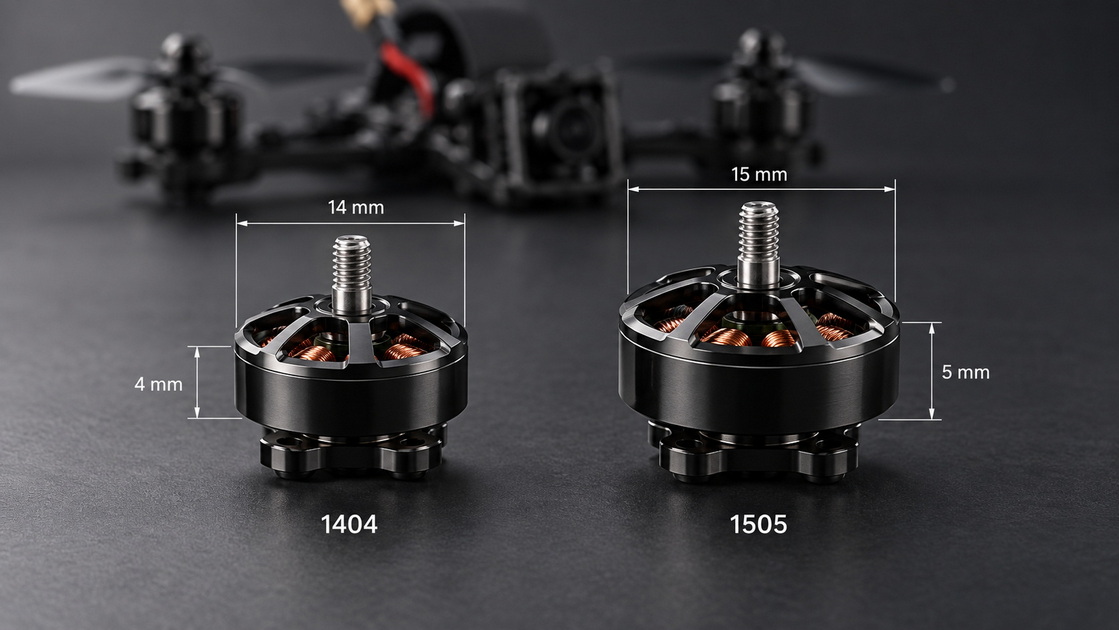
FPV motor model numbers normally identify stator diameter × stator stack height in millimeters.
| Motor Size | Stator Diameter | Stator Height | Relative Stator Volume | General Character |
|---|---|---|---|---|
| 1404 | 14 mm | 4 mm | Smaller | Lighter, agile, efficient in lightweight builds |
| 1505 | 15 mm | 5 mm | Larger | Higher torque potential, stronger under load |
A 1404 motor uses a 14 mm stator diameter and 4 mm stator height. A 1505 motor uses a 15 mm stator diameter and 5 mm stator height. Although the numerical difference looks small, the practical effect can be significant.
The stator cross-sectional area rises with the square of diameter, while stack height adds more active magnetic and copper volume. As a simplified geometry comparison:
Relative stator volume∝π×(D/2)2×H
Using this simplified calculation, a 1505 stator has approximately 43% more geometric stator volume than a 1404 stator:
152×5/142×4≈1.43
This does not mean that every 1505 motor produces exactly 43% more thrust. Magnet grade, winding design, air gap, stator lamination, bearing quality, propeller, voltage, ESC settings, and thermal management all affect actual results. However, the larger stator generally gives the 1505 platform more potential to generate torque and sustain power with demanding propellers.
The best way to compare a 1404 motor and a 1505 motor is across the full propulsion system: mechanical mass, torque demand, propeller load, electrical current, flight behavior, and heat.
| Comparison Factor | 1404 FPV Motor | 1505 FPV Motor | Why It Matters |
|---|---|---|---|
| Stator size | 14 × 4 mm | 15 × 5 mm | 1505 has more active stator volume |
| Motor weight | Usually lower | Usually higher | Every gram affects micro-drone handling |
| Torque reserve | Moderate | Higher potential | Important for higher-pitch or larger props |
| Throttle response | Very quick on light builds | Stronger under prop load | Depends on rotor design and tune |
| Suitable prop range | Often 2.5–3.5 inches | Often 3–4 inches | Actual prop match varies by KV and design |
| Payload tolerance | Better for ultralight aircraft | Better for heavier systems | Matters for cameras, ducts, and custom hardware |
| Sustained load | Best when correctly matched | Usually more forgiving | Useful for aggressive freestyle or heavier platforms |
| Thermal margin | Can become limited with overload | Typically greater potential | Cooling, current, and prop selection remain critical |
| Typical use | Lightweight freestyle, cinewhoop, toothpick | Heavier 3-inch, 3.5-inch, compact 4-inch freestyle | Build purpose should drive selection |
A 1404 motor is not automatically "weak," and a 1505 motor is not automatically "better." A carefully designed 1404 with suitable KV, magnet configuration, and propeller may outperform a poorly matched 1505 system in flight time, control feel, or thermal efficiency.
The more useful question is:
Can the motor provide enough thrust, torque, and cooling margin for the intended aircraft at the throttle range where it will actually fly?
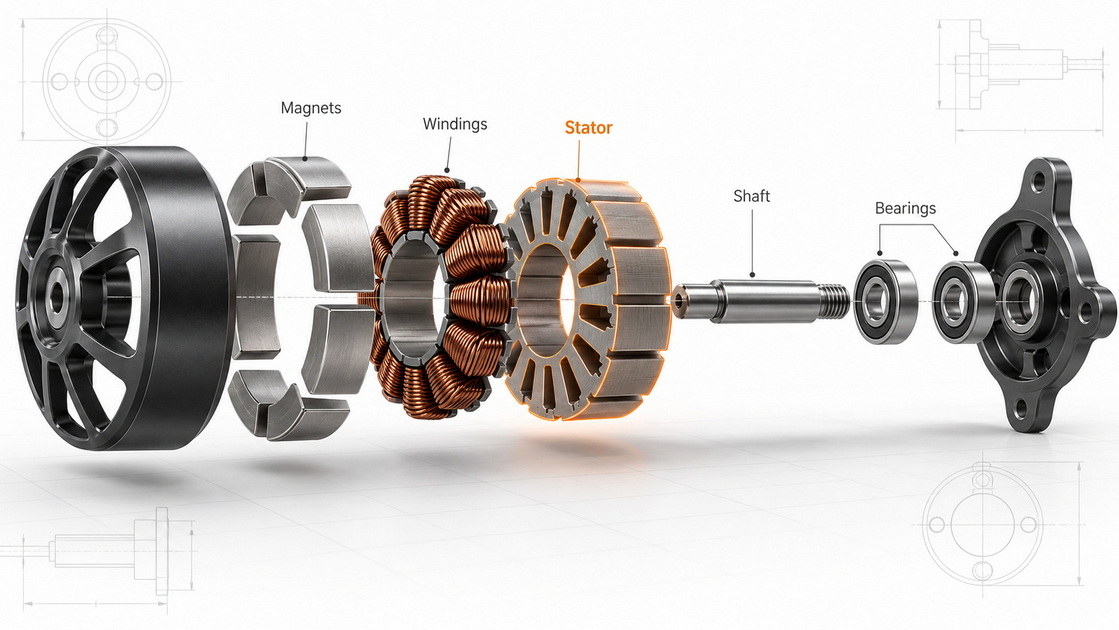
A 1404 FPV motor is usually selected when the builder wants to preserve a low all-up weight while retaining enough punch for 3-inch-class propellers. It is commonly associated with small freestyle quads, lightweight 3-inch builds, compact cinewhoops, toothpick-style drones, and certain long-range micro platforms.
- Lightweight 3-inch freestyle FPV drones
- Sub-250 g builds, where every component must be weight-conscious
- Smooth cinematic micro drones
- Compact cinewhoops using appropriately selected duct and prop combinations
- Efficiency-focused cruising builds
- Small OEM drone platforms with controlled payload and duty-cycle requirements
A smaller motor can reduce total propulsion-system mass. On a four-motor quadcopter, even a small per-motor weight reduction can affect the final takeoff weight, inertia, flight time, and required hover throttle.
For example, consider two otherwise similar 3-inch drones:
- Build A uses four lighter 1404 motors
- Build B uses four heavier 1505 motors
- Both use the same battery, flight controller, frame, and camera
If Build A is sufficiently light and its props do not overload the motors, it may feel more agile and efficient during relaxed flying. It may also reach a lower hover throttle position, depending on the propeller and total system design.
However, this advantage disappears if the aircraft becomes too heavy for the 1404 motor. An overloaded 1404 setup may require high average throttle, create excess current draw, increase motor temperatures, and leave too little thrust reserve for recovery maneuvers.
When specifying a 1404 motor for an FPV drone, focus on:
1. All-up weight, including battery, camera, antenna, propeller guards, GPS, and payload.
2. Propeller load, including diameter, blade count, pitch, and material stiffness.
3. KV matched to battery voltage, rather than choosing KV independently.
4. Continuous current capability of the motor and ESC.
5. Motor temperature after realistic flight, not only short bench tests.
6. Mounting standard and shaft compatibility with the selected frame and propeller.
For many 3-inch platforms, commonly published selection guides place 1404 motors in the lightweight 3-inch to 3.5-inch category, with the final KV choice dependent on 3S, 4S, or other battery configurations.
A 1505 FPV motor is usually the stronger option when the aircraft needs more torque reserve. This may include a heavier 3-inch freestyle drone, a 3.5-inch platform with aggressive tri-blade props, a compact 4-inch build, or a system carrying ducts, action cameras, lighting modules, communication equipment, or industrial payload components.
- Heavy 3-inch freestyle drones
- 3.5-inch FPV quads with higher-pitch or tri-blade props
- Compact 4-inch freestyle platforms
- Ducted FPV drones with increased aerodynamic load
- High-speed micro racing builds
- Custom OEM/ODM aircraft requiring extra thrust margin
- Small inspection or robotics platforms where payload changes are expected
The 1505 motor's larger diameter and taller stator stack generally provide more electromagnetic working volume. In practical terms, this can help the motor maintain RPM when the propeller load rises.
A higher-load propeller may come from:
- A larger prop diameter
- A higher propeller pitch
- A three-blade or four-blade design
- A stiffer propeller material
- A duct or guard system
- Higher air density or challenging maneuvering conditions
- Additional airframe weight
For an FPV pilot, this may translate into stronger acceleration, more confident recovery after dives, improved punch-out authority, and reduced sensitivity to sudden load changes. For an OEM customer, it may translate into better power-system resilience when the drone carries different camera modules, sensors, or protective structures.
Industry motor-selection guides commonly position 1505-class motors as a stronger option for 3–4-inch micro freestyle and heavier compact builds, although the correct pairing still depends on KV, battery voltage, propeller selection, and target weight.
Motor size alone never tells the whole story. A 1404 4500KV motor and a 1505 2500KV motor are designed for very different system conditions. The relationship among KV, battery voltage, propeller size, pitch, and stator torque determines whether the setup runs efficiently and safely.
KV describes a motor's theoretical no-load rotational speed per volt:
No-load RPM≈KV×Voltage
For example, a 4000KV motor connected to a 16 V battery would have an approximate no-load speed of:
4000×16=64,000 RPM
This is not the real loaded RPM in flight. Under propeller load, RPM drops due to resistance, current draw, voltage sag, and motor characteristics.
A useful general principle is:
- Higher KV tends to suit smaller or lighter propeller loads.
- Lower KV tends to better control RPM and current when using larger or more demanding propellers.
- Larger stators generally tolerate more torque demand than smaller stators.
- High-pitch and multi-blade props may provide more grip and thrust, but they also require more torque and may raise current draw.
A motor-propeller matching guide from T-Motor notes that KV is defined as no-load RPM per volt and recommends checking motor and ESC temperatures, current draw, and flight performance after changing a propulsion setup.
Imagine a 3.5-inch FPV drone with:
- 4S LiPo battery
- Tri-blade propeller
- HD camera
- TPU accessories
- GPS module
- Protective frame elements
This aircraft may be physically flyable with 1404 motors, but the system can become more demanding as final weight and propeller pitch increase. If post-flight checks show hot motors, high average throttle, poor recovery authority, or insufficient punch-out, moving to a 1505 platform may be more appropriate than simply increasing KV.
Increasing KV alone can raise RPM potential, but it does not create the same torque reserve as a larger stator. It can also increase current draw and thermal stress if the propeller remains too demanding.
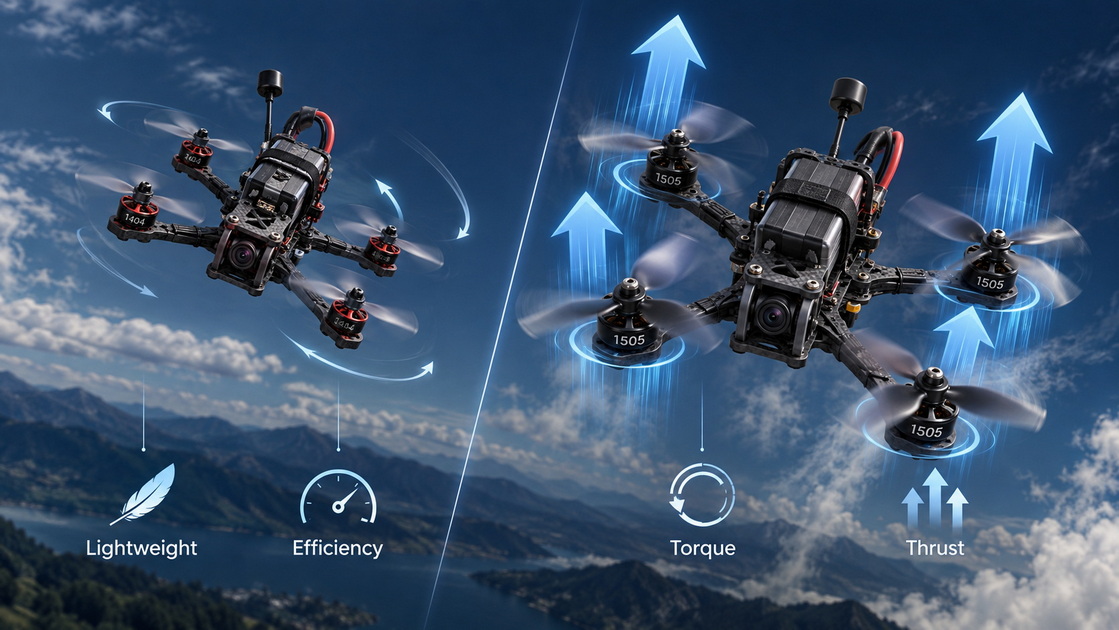
Many buyers look first at maximum thrust. Peak thrust matters, especially for racing, freestyle recovery, and payload lift. But it should not be the only performance metric.
A reliable FPV motor comparison should examine:
- Peak thrust
- Thrust-to-weight ratio
- Thrust per watt
- Current draw
- Motor temperature
- ESC temperature
- Battery voltage sag
- Throttle position during hover and cruising
- Repeatability after multiple runs
The formula for multicopter thrust-to-weight ratio is:
TWR=Maximum thrust per motor×number of motors/All-up weight
For example, a quad with four motors producing 500 g maximum thrust each has a total theoretical maximum thrust of 2,000 g. If the drone weighs 500 g including the battery:
TWR=2000/500=4:1
That 4:1 ratio may be suitable for many freestyle applications, but it does not guarantee the best flight time, tuning quality, or motor temperature. A high-thrust setup can still be inefficient if it draws excessive current at the throttle range used most often.
For cruising and endurance-oriented aircraft, efficiency in the 30% to 50% throttle region can matter more than an impressive full-throttle number.
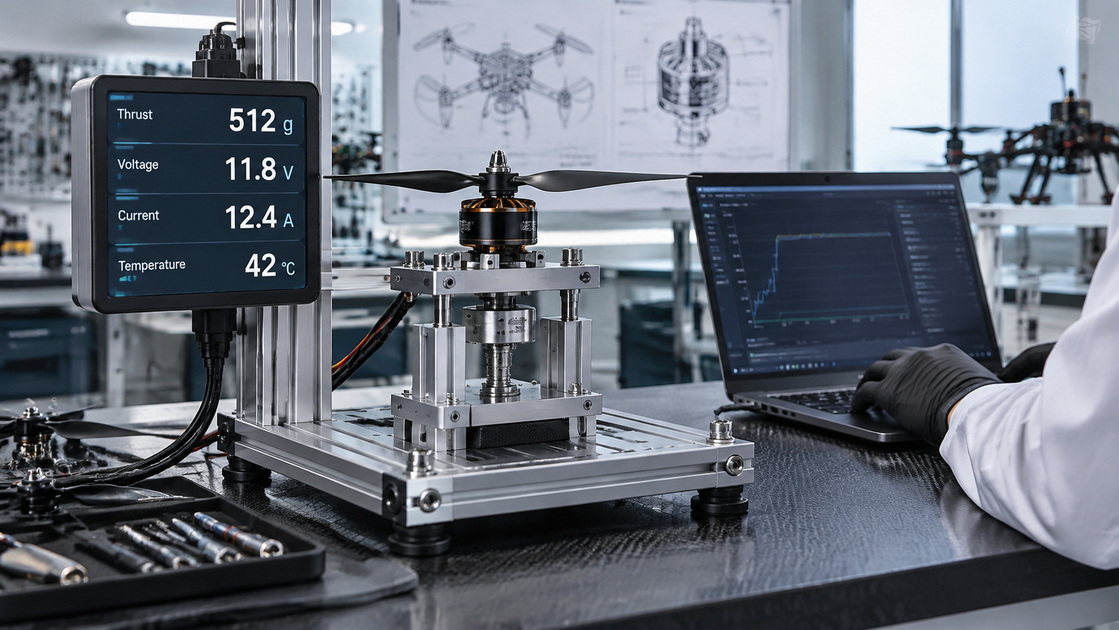
At Zhongshan Yuhang Power Technology Co., Ltd., a meaningful comparison should use controlled test conditions. Comparing thrust data from different websites, props, batteries, test rigs, and ambient temperatures can lead to incorrect conclusions.
1. Use the same propeller model for both motors whenever mechanically appropriate.
2. Use the same battery type and cell count with comparable state of charge.
3. Use the same ESC protocol and settings, including PWM frequency and timing.
4. Record voltage, current, thrust, RPM, and motor temperature at fixed throttle points.
5. Test multiple throttle levels, such as 25%, 50%, 75%, and 100%.
6. Allow cooling time between runs so heat does not distort results.
7. Repeat each test to identify data consistency.
8. Perform a real flight test after bench testing, because airflow and dynamic prop loading differ in the air.
A thrust stand with a load cell can record thrust alongside voltage and current, enabling power and efficiency calculations.
| Test Point | Voltage | Current | Input Power | Thrust | Efficiency | Motor Temperature |
|---|---|---|---|---|---|---|
| 25% throttle | V | A | W | g | g/W | °C |
| 50% throttle | V | A | W | g | g/W | °C |
| 75% throttle | V | A | W | g | g/W | °C |
| 100% throttle | V | A | W | g | g/W | °C |
Use:
Input Power=Voltage×Current
Efficiency=Thrust/Input Power
This test structure helps buyers compare the performance they actually need. A 1505 may win in maximum thrust, while a 1404 may be more efficient at a lower thrust point. The correct motor is the one that best serves the aircraft's intended operating range.
Use the following decision guide before selecting a motor specification.
| Your Priority | Better Starting Point | Reason |
|---|---|---|
| Lowest possible build weight | 1404 | Helps maintain a lighter propulsion system |
| Lightweight 3-inch FPV build | 1404 | Often well matched to low-mass 3-inch aircraft |
| Smooth cinematic micro drone | 1404 or 1505 | Choose based on ducts, camera weight, and prop load |
| Heavy 3-inch freestyle | 1505 | More torque reserve under load |
| 3.5-inch aggressive freestyle | 1505 | Better starting point for demanding props and weight |
| Compact 4-inch FPV platform | 1505 | More suitable than 1404 in many cases |
| Long-range efficiency build | 1404 or 1505 | Select from actual cruise-current and thrust data |
| Payload or OEM customization | 1505 | More margin for changing system mass |
| High-pitch or multi-blade props | 1505 | Greater torque potential is valuable |
| Sub-250 g target | 1404 | Weight savings may be decisive |
- Your design is a light 3-inch or small cinewhoop platform.
- You prioritize low weight, agile handling, and efficient cruising.
- The propeller is modest in diameter and pitch.
- Your final all-up weight remains within the motor's intended operating range.
- Bench and flight tests show acceptable motor and ESC temperatures.
- Your 3-inch build is heavy or uses an HD camera and accessories.
- You are building a 3.5-inch or compact 4-inch FPV drone.
- You use high-pitch, tri-blade, or otherwise demanding propellers.
- You need stronger acceleration and recovery reserve.
- You are developing an OEM/ODM product that needs payload flexibility.
For drone brands, integrators, and professional equipment manufacturers, the "best" motor is often not an off-the-shelf 1404 or 1505 configuration. It is a motor optimized around the full application.
Zhongshan Yuhang Power Technology Co., Ltd. can support customized brushless motor development for FPV drones, RC vehicles, high-speed fans, gimbal cameras, aircraft, robotic vacuum systems, underwater robots, and other specialized equipment.
- Stator size: 1404, 1505, or another diameter/height combination
- KV winding: Matched to battery voltage and propeller load
- Magnet grade and arc: Influences torque behavior and efficiency
- Stator lamination thickness: Affects electrical loss at high RPM
- Bearing specification: Important for durability, smoothness, and radial load
- Shaft design: Diameter, material, retention method, and prop mounting
- Mounting pattern: Must fit the target frame or equipment housing
- Wire length and connector type: Supports production assembly requirements
- Bell material and structural design: Balances strength, weight, and cooling
- Surface finish and logo options: Supports private-label OEM programs
- Quality-control standards: Include balancing, electrical testing, and endurance checks
For a professional OEM project, share the following information with the motor supplier: airframe drawing, target all-up weight, propeller specification, battery voltage, expected flight time, duty cycle, environmental temperature, target thrust, ESC rating, and annual volume forecast.
A motor supplier can then help validate whether 1404 or 1505 is the more reliable foundation—and whether a custom winding or mechanical adjustment is needed.
The 1404 vs 1505 FPV motor comparison comes down to a trade-off between minimum weight and usable torque reserve.
A 1404 FPV motor is an effective solution for lightweight 3-inch drones, compact cinewhoops, and efficiency-focused builds where every gram matters. A 1505 FPV motor is better suited to heavier 3-inch platforms, 3.5-inch freestyle drones, compact 4-inch designs, higher-load props, and applications that require more dependable thrust margin.
Do not choose only by stator code or peak-thrust advertising. Evaluate the entire system: propeller, voltage, KV, aircraft weight, target flight style, current draw, temperature, and real-world throttle range.
Need a 1404, 1505, or fully customized FPV drone motor solution? Contact Zhongshan Yuhang Power Technology Co., Ltd. with your frame size, propeller, battery configuration, target weight, and performance goals. Our engineering team can help develop a brushless power system tailored to your FPV drone, professional UAV, robotic platform, or OEM/ODM project.
Not always in every condition, but a 1505 generally has more stator volume and greater torque potential. Actual performance depends on KV, winding, magnet design, propeller, battery voltage, ESC settings, and test conditions. A well-matched 1404 can be the better option for a very light aircraft.
Yes. A 1505 motor can work very well on a 3-inch drone, especially when the build is heavy, uses an HD camera, has protective accessories, or is intended for aggressive freestyle. The added motor weight must be justified by the extra torque and thrust reserve.
It can be, particularly on a lightweight 3.5-inch build with carefully selected props and KV. However, a 1505 or other larger motor class is often a safer starting point when the drone is heavy, uses tri-blade high-pitch props, or needs strong freestyle performance.
Start with your battery voltage and propeller load. Higher battery voltage generally requires a lower KV for a similar propeller size. Then verify the selection through thrust data, current draw, motor temperature, and real flight testing. Avoid choosing KV based only on another pilot's setup because weight and propellers may differ.
Both matter, but the priority depends on the application. Racing and aggressive freestyle benefit from strong peak thrust and recovery authority. Long-range, cruising, and commercial platforms often benefit more from efficiency at normal throttle. Compare grams of thrust per watt at several throttle points rather than relying only on full-throttle thrust.
1. Unmanned Systems Technology. "[Motor & Propeller Matching for Drone Propulsion Systems]." Discusses thrust requirements, propeller selection, battery configuration, RPM, torque, current, and power calculations for UAV propulsion matching. [unmannedsystemstechnology]
2. Mepsking. "[What Size Motor Do I Need for My FPV Quad?]." Explains the stator-dimension naming convention and gives general motor-size guidance for 3-inch and 3.5–4-inch FPV builds. [mepsking]
3. LIGPOWER. "[How to Choose a 1404 Brushless Motor for FPV Builds]." Provides application positioning for 1404, 1505, and 1604 motor classes in lightweight FPV and micro-freestyle configurations. [ligpower]
4. UAV Model. "[FPV Drone Motor Selection Guide: Size, KV, and Thrust Explained]." Covers thrust-to-weight ratio, motor size, KV, battery selection, and example applications for micro FPV platforms. [blog.uavmodel]
5. T-Motor. "[Drone Motor and Propeller Matching Guide: KV, Size & Efficiency]." Explains KV, propeller matching, current monitoring, temperature checks, and practical flight validation. [shop.tmotor]
6. Rotorama. "[Motors]." Explains the four-digit motor stator naming convention, motor torque implications, and general motor/propeller recommendations. [rotorama]
7. Oscar Liang. "[Lookup Table: Motor & Prop Sizes, KV, Battery Cell Count, and Weight]." Provides practitioner-oriented reference ranges for prop size, motor class, KV, battery cells, and typical build weights. [oscarliang]
8. Zbotic. "[Drone Motor Testing: Thrust Stand Build Guide]." Describes test-stand measurement of thrust, efficiency, and KV using load-cell-based methods. [zbotic]
9. Tanzj. "[Drone Propeller Thrust Testing Rig]." Describes recording thrust, voltage, and current for propulsion-system evaluation. [tanzj]


