Language


Views: 233 Author: Yuhang Power Publish Time: 2026-09-14 Origin: Site
Content Menu
● What Is the Longest Flight Time for a Drone?
● Longest Flight Time Drones by Category
● Consumer Drones With Long Flight Time
>> DJI Mavic 4 Pro: Up to 51 Minutes
>> DJI Air 3S: Up to 45 Minutes
● Enterprise Multirotors for Inspection and Public Safety
>> DJI Matrice 350 RTK: Up to 55 Minutes
>> Heavy-Lift Multirotors: Endurance Under Payload
● VTOL and Fixed-Wing Drones for Multi-Hour Endurance
>> Autel Dragonfish Series: Up to 179 Minutes
>> Why Fixed-Wing Platforms Fly Longer
● The Engineering Factors That Determine Drone Flight Time
>> Battery Energy Versus Total Weight
>> Motor and Propeller Matching
>> Mechanical Quality and Thermal Control
● How to Plan Real-World Drone Endurance
>> A Practical Mission-Planning Method
>> Maintenance Steps That Protect Flight Time
● Choosing a Drone Motor Supplier for Long-Endurance Projects
>> Questions OEM Buyers Should Ask
>> 1. What drone has the longest flight time?
>> 2. Are manufacturer flight-time claims realistic?
>> 3. Why do VTOL drones fly longer than multirotors?
>> 4. Can changing drone motors increase flight time?
>> 5. What is the best motor KV for a long-endurance drone?
When buyers search for the drones with the longest flight time, they often see one number repeated: the manufacturer's maximum flight-time claim. That number is useful, but it is not a mission plan.
A drone advertised for 51 minutes will not necessarily deliver 51 minutes while filming in wind, carrying accessories, climbing, hovering, or returning safely with a battery reserve. For professional users, the better question is not simply, "Which drone flies the longest?" It is:
Which drone and propulsion architecture can complete my payload, route, weather, safety-reserve, and operating-cost requirements?
This guide compares long-endurance drones by mission category, explains what flight-time figures really mean, and shows how battery design, airframe aerodynamics, brushless drone motors, propellers, and payload weight work together.
For drone manufacturers, integrators, and OEM buyers, it also provides a practical framework for choosing or developing a long-endurance UAV propulsion system.
Editorial note: Flight-time figures below are manufacturer-rated maximums unless otherwise specified. Actual endurance varies with payload, wind, temperature, altitude, flight profile, battery age, and required landing reserve.
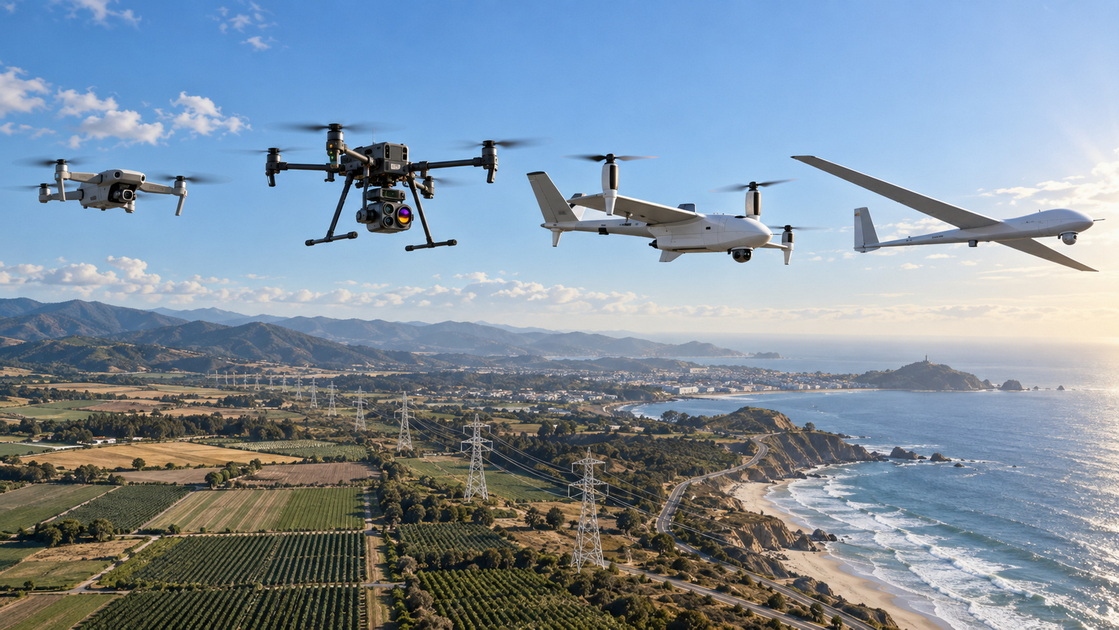
The answer depends on drone type.
A compact camera drone may fly for approximately 40 to 50 minutes under ideal conditions. An enterprise multirotor may approach 55 minutes without a payload. In contrast, industrial VTOL and fixed-wing platforms can remain airborne for two hours or more because wings produce lift more efficiently during cruise.
The core distinction is simple:
- Multirotors use propellers to create lift continuously, including during hover.
- Fixed-wing aircraft use forward airspeed and wing lift during cruise.
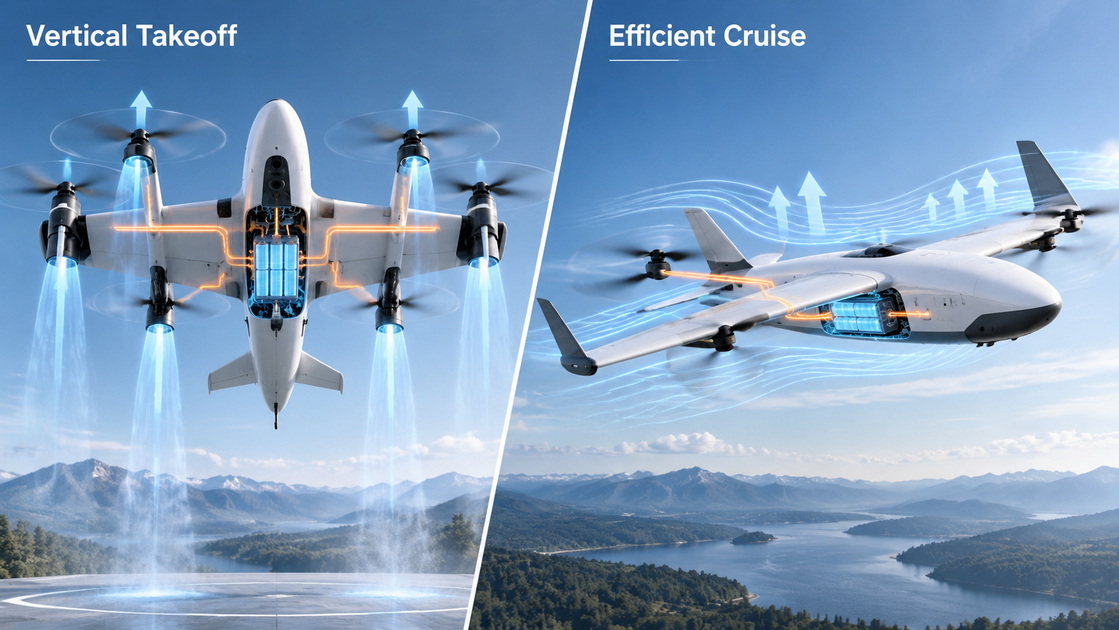
- VTOL fixed-wing drones combine vertical takeoff capability with efficient wing-borne cruise.
This is why a drone with four or six powerful motors is not automatically the best platform for long-distance coverage. In many inspection, mapping, corridor-survey, and coastal-monitoring missions, a fixed-wing or VTOL configuration can cover dramatically more ground per battery cycle.
| Drone category | Typical rated endurance | Best application | Primary endurance limitation |
|---|---|---|---|
| Consumer camera drone | 40–51 minutes | Travel filming, photography, site scouting | Compact battery capacity and wind exposure |
| Enterprise multirotor | 42–55 minutes | Inspection, public safety, surveying | Payload weight and hover power demand |
| Heavy-lift multirotor | 18–30 minutes with payload | Delivery, industrial cargo, lifting | High all-up weight and continuous thrust demand |
| Industrial VTOL UAV | 2–3 hours | Pipeline patrol, coastlines, long corridors | Transition efficiency, payload, operating environment |
| Electric fixed-wing UAV | 3–4+ hours | Large-area mapping and BVLOS missions | Launch/recovery requirements and mission regulations |
The best long-flight-time drone is therefore the one that matches the mission. A real-estate videographer, a powerline inspection team, and a BVLOS mapping operator should not evaluate endurance using the same benchmark.
The DJI Mavic 4 Pro is among the most prominent consumer-oriented drones for maximum flight time. DJI lists a maximum flight time of 51 minutes under controlled test conditions. Its compact foldable design and integrated camera system make it relevant for creators, travel photographers, real-estate teams, and lightweight commercial content production.
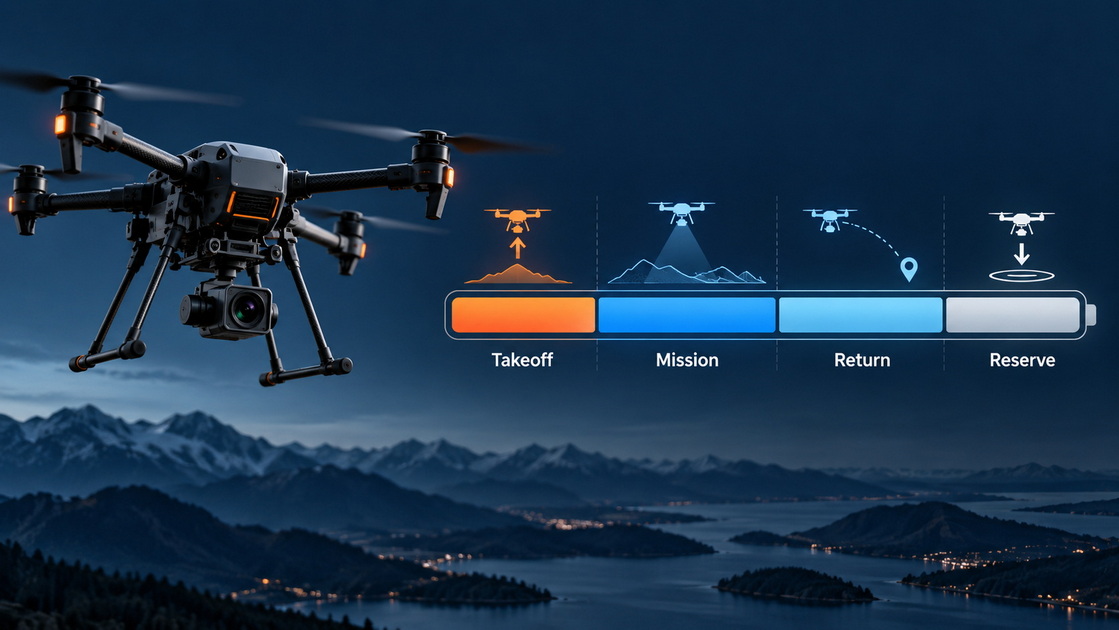
However, professional operators should avoid treating 51 minutes as usable production time. Video recording, wind correction, climbing, return-to-home planning, obstacle avoidance, and battery reserve reduce the available mission window. In one independent review, typical photography and video flights ended around 37 minutes when the aircraft initiated return-to-home at a 15% battery level.
Best for:
- Professional travel and landscape photography
- Property marketing and location scouting
- Lightweight visual inspections
- Long-duration recreational flights
Procurement consideration: A consumer drone may offer excellent nominal endurance, but it is not automatically suitable for industrial payloads, repeatable fleet maintenance, custom sensors, or specialized operating environments.
The DJI Air 3S targets users who want a more portable platform while maintaining strong camera capability and extended flight time. It is a practical choice for creators and small commercial teams that prioritize mobility.
For content capture, it is often better to plan multiple shorter flights than to use the entire battery in one mission. This approach gives pilots a larger safety reserve and reduces the risk that wind or an unexpected detour compromises a landing.
The DJI Matrice 350 RTK is a benchmark enterprise multirotor for demanding inspection, public-safety, mapping, and search-and-rescue work. DJI specifies up to 55 minutes of maximum flight time. Importantly, DJI states that this measurement was taken with no payload, in a windless environment, at approximately 8 m/s, until battery level reached zero.
That disclosure is valuable because it illustrates how professional buyers should read every flight-time specification.
The M350 RTK supports multiple gimbal payloads and is designed for operations where reliability, positioning capability, payload flexibility, and workflow continuity matter as much as headline endurance. DJI also highlights its IP55 rating and enterprise-oriented propulsion and protection design.
Best for:
- Powerline, telecom tower, and solar-site inspections
- Search and rescue
- Thermal imaging
- LiDAR and photogrammetry workflows
- Public-safety and emergency response operations
What to verify before purchase:
1. Expected payload mass, including mounting hardware and cables
2. Minimum battery reserve policy for your operation
3. Typical wind conditions at the operating site
4. Battery cycle life and charging workflow
5. Flight time with the exact camera, LiDAR, or thermal payload installed
Heavy-lift drones serve a different purpose. They may fly for fewer minutes than camera drones, but they generate much higher thrust and carry meaningful cargo or specialized equipment.
In this category, propulsion matching becomes especially important. A motor that is efficient at a light hover condition may not be efficient at a high continuous-load condition. Engineers must evaluate the whole system:
- Brushless motor KV and torque characteristics
- Propeller diameter, pitch, material, and stiffness
- ESC current capacity and control response
- Battery voltage and discharge capability
- Airframe rigidity and vibration behavior
- Ambient temperature and cooling airflow
A reliable heavy-lift design does not optimize for peak thrust alone. It balances continuous thrust, thermal headroom, vibration control, motor efficiency, and safe redundancy.
The Autel Dragonfish series demonstrates why VTOL platforms are important in long-endurance UAV planning. Autel states that the series can provide up to 179 minutes of flight time and up to 45 km range under its specified conditions.
Its configuration allows vertical launch and landing while using wing-borne flight for efficient cruise. This architecture is particularly useful where runways are unavailable but the mission requires coverage beyond the practical range of a multirotor.
Best for:
- Pipeline and railway corridor inspections
- Coastal surveillance
- Environmental monitoring
- Large-area reconnaissance
- Long-distance infrastructure patrols
The engineering reason for this endurance advantage is not simply a larger battery. During forward flight, the wing generates much of the lift. The propulsion system no longer needs to devote all of its power to holding the aircraft in the air.
A multirotor must constantly push air downward to remain airborne. A fixed-wing UAV uses aerodynamic lift as it moves forward. At an efficient cruise speed, this can greatly reduce energy consumption per kilometer traveled.
For mission planners, that changes the performance question from "How long can it hover?" to "How much area or route length can it cover safely per battery?"
For example:
- A multirotor may be preferable for close-range tower inspection because it can hover precisely.
- A VTOL fixed-wing UAV may be preferable for a 50 km pipeline corridor because it can cruise efficiently over distance.
- A pure fixed-wing UAV may be preferable for wide-area agricultural or topographic mapping where launch and recovery logistics are available.
Battery size matters, but it is not the whole story. At Yuhang Power, we view long endurance as a system-level result, not a single motor specification.
A larger battery stores more energy, but it also adds mass. More mass requires more lift. More lift requires more current. Eventually, adding battery capacity provides diminishing returns.
The goal is not the largest battery. It is the best energy-to-weight balance for the intended mission.
The relationship between the brushless motor and propeller strongly affects endurance.
A poor match can cause:
- Excessive current draw
- Low thrust efficiency
- Motor overheating
- Unstable throttle response
- Higher vibration
- Shorter battery life
- Reduced real-world flight time
For long-endurance multirotors, engineers often prioritize efficient low-to-mid-throttle performance rather than extreme high-RPM output. In contrast, an FPV racing drone may prioritize fast throttle response, power density, and burst performance.
KV indicates the approximate no-load RPM per volt. It should not be treated as a standalone quality measurement.
As a general design principle:
- Lower-KV motors are often paired with larger propellers and higher-voltage systems for efficient, stable lift in larger UAVs.
- Higher-KV motors are common in smaller FPV builds that use smaller propellers and demand rapid RPM changes.
- The correct choice depends on battery voltage, propeller size, frame size, target thrust, payload, ESC capability, and duty cycle.
For OEM projects, buyers should request test data for the actual operating combination—not only a motor catalog specification.
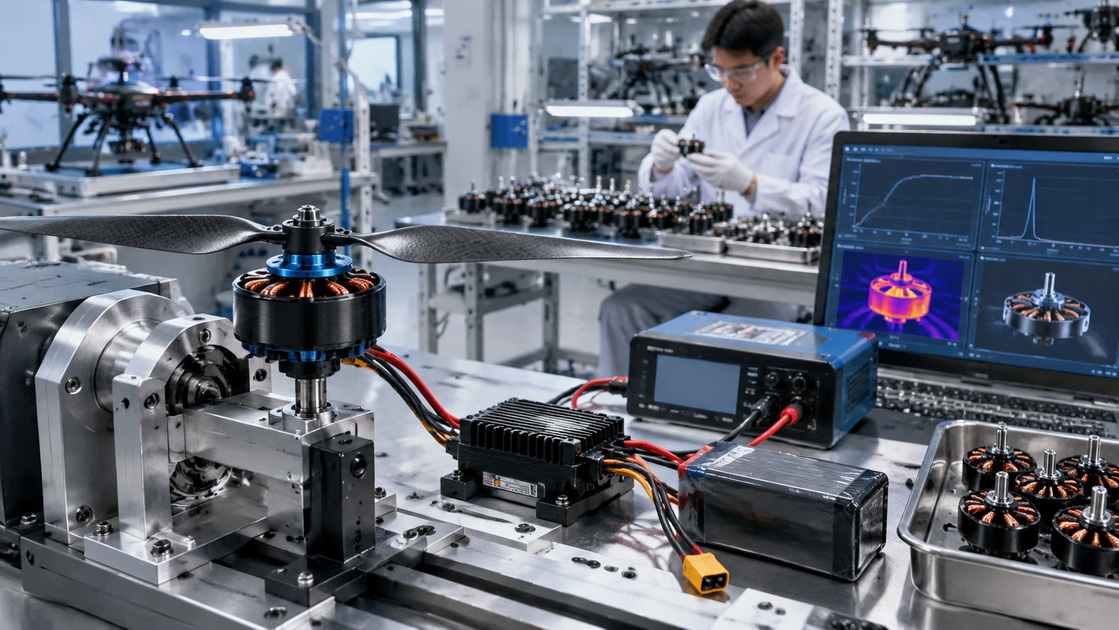
Long missions expose weaknesses that short bench tests may not reveal. Bearing quality, rotor balance, magnet retention, stator lamination, winding consistency, shaft tolerance, and heat dissipation all affect durability and electrical efficiency.
A motor may generate sufficient thrust during a short test but still become unsuitable for a continuous industrial mission if it accumulates heat, develops vibration, or loses efficiency under sustained load.
Do not schedule a mission using the advertised maximum flight time. Instead, calculate a conservative operational flight window.
1. Start with the official maximum flight-time specification.
2. Subtract time for payload weight and mounting accessories.
3. Account for expected wind, especially headwind during the return leg.
4. Consider cold-weather battery performance and battery age.
5. Reserve enough energy for return-to-home, diversion, and safe landing.
6. Validate the result through flight tests using the actual payload and flight profile.
A useful operational rule is to plan for less than the maximum published time, then refine the estimate after repeated real-world flights. The correct buffer depends on local regulations, weather, mission risk, and aircraft operating procedures.
- Inspect propellers for cracks, chips, warping, and imbalance
- Check motor bearings for roughness, noise, axial play, or increased drag
- Keep motors, vents, and cooling paths free from dust and debris
- Monitor battery internal resistance, cell balance, and charge cycles
- Replace damaged wiring, loose connectors, and overheated ESC components
- Record flight time, temperature, current draw, and payload for each mission profile
These actions improve more than endurance. They also support operational consistency, predictive maintenance, and safer fleet management.
For drone brands, integrators, and industrial-equipment developers, the motor supplier should be involved early in the platform design process.
A capable brushless drone motor manufacturer should help match the motor, propeller, ESC, frame, battery, and duty cycle—not simply ship a generic motor based on dimensions.
- Can the supplier provide thrust and efficiency curves for the intended propeller and voltage?
- Can the motor winding, KV, shaft, mounting pattern, cable length, or connector be customized?
- What bearing, magnet, balancing, and quality-control standards are used?
- Is continuous-load thermal data available?
- Can the supplier support prototype samples before mass production?
- Can the supplier assist with FPV drones, RC vehicles, gimbals, underwater robots, high-speed fans, aircraft, and robotic-drive applications?
Zhongshan Yuhang Power Technology Co., Ltd. develops and manufactures FPV drone motors and other brushless motor solutions for UAVs, FPV drones, RC vehicles, gimbal cameras, high-speed fans, aircraft, robotic cleaning equipment, underwater robots, and specialized power-system applications. Our team supports OEM and ODM projects where motor performance must match the real operating environment—not just a catalog number.
The longest flight time drone is not always the drone with the highest published number. Consumer multirotors can deliver exceptional flexibility for filming and lightweight work. Enterprise multirotors add payload support and operational reliability. VTOL and fixed-wing UAVs provide the most compelling option when a mission requires hours of endurance or long-distance coverage.
For any UAV platform, flight time is ultimately determined by a complete energy-and-propulsion system: battery, motor, propeller, ESC, airframe, payload, weather, and flight profile.
If you are developing a new FPV, multirotor, VTOL, robotic, or custom electric-drive product, start with application requirements and real test conditions. Then select the propulsion system accordingly.
The answer depends on the category. Consumer camera drones can reach approximately 50 minutes under controlled conditions, while industrial VTOL and fixed-wing UAVs can fly for two hours or more. Autel lists up to 179 minutes for its Dragonfish series, while DJI lists up to 51 minutes for the Mavic 4 Pro.
They are valid as controlled maximum figures, but they should not be used as a guaranteed field-flight result. DJI's Matrice 350 RTK, for example, lists 55 minutes under a no-payload, windless, controlled flight condition. Real missions include payload, wind, maneuvering, reserve power, and environmental variables.
VTOL drones can transition from rotor-borne vertical flight to wing-borne forward flight. During cruise, wings create aerodynamic lift, reducing the continuous power demand compared with a multirotor that must rely on propellers for lift at all times.
Yes, but only when the new motor is properly matched to the propeller, ESC, battery voltage, airframe, and mission profile. A motor change alone can reduce endurance if KV, torque, propeller load, or thermal characteristics are mismatched.
There is no single best KV. The correct KV depends on the aircraft size, battery voltage, propeller diameter and pitch, target payload, desired cruise condition, and required thrust margin. Long-endurance systems often benefit from a carefully matched motor-and-propeller combination optimized for efficient cruise or hover rather than maximum burst power.
1. DJI. "[DJI Mavic 4 Pro Specifications]." Accessed September 2026. Official specification page listing a maximum flight time of 51 minutes.
2. DJI. "[DJI Mavic 4 Pro]." Accessed September 2026. Official product page describing the Mavic 4 Pro's 51-minute flight-time claim and O4+ transmission features.
3. DJI Enterprise. "[Matrice 350 RTK Specifications]." Accessed September 2026. Official maximum flight-time specification and test-condition disclosure.
4. DJI Enterprise. "[DJI Matrice 350 RTK]." Accessed September 2026. Official enterprise product information, including IP55 protection and maximum flight-time claim.
5. Autel Robotics. "[Dragonfish Series]." Accessed September 2026. Official product information citing up to 179 minutes of flight time and a 45 km transmission range under specified conditions.
6. Space.com. "[DJI Mavic 4 Pro Drone Review]." May 13, 2025. Independent field-review context describing typical photo/video flight duration before return-to-home.
7. Yuhang Power. "[FPV Drone Motors and Robotics Actuators: How to Choose the Right Partner for Your Power System]." Accessed September 2026. Manufacturer guidance on use-case definition, performance curves, validation, and OEM/ODM evaluation.
8. Yuhang Power. "[FPV Drone Motor]." Accessed September 2026. Company product and OEM/ODM capability page.


