Language


Views: 257 Author: Yuhang Power Publish Time: 2026-09-16 Origin: Site
Content Menu
● 2204 vs 2207 Motor: Quick Comparison
● 2204 Motor: Benefits for Lightweight FPV Builds
>> Advantages of a 2204 FPV Motor
>> Best Applications for 2204 Motors
>> Where 2204 Motors Can Struggle
● 2207 Motor: Why It Remains a 5-Inch Standard
>> Advantages of a 2207 FPV Motor
>> Best Applications for 2207 Motors
>> Where 2207 Motors Can Be Excessive
● Motor Weight: Why Four Motors Change the Decision
>> The Lightweight Build Trade-Off
● KV Rating: The Factor You Cannot Ignore
>> Important Warning: Do Not Select KV by Guesswork
● Propeller Matching: The Most Important Real-World Test
>> Practical Motor-and-Prop Pairing Guidance
● Thrust-to-Weight Ratio: A Better Way to Choose
>> Expert Insight: Compare Mid-Throttle Thrust, Not Only Maximum Thrust
● Heat, Durability, and Manufacturing Quality
● 2204 vs 2207: Which Is Better for Your Build?
● OEM and ODM Motor Selection Support
● FAQ
>> 1. What does 2204 mean on an FPV motor?
>> 2. What does 2207 mean on an FPV motor?
>> 3. Can I use 2204 motors with 5-inch propellers?
>> 4. Are 2207 motors better for freestyle?
>> 5. Should I choose higher KV for more FPV drone speed?
When comparing a 2204 motor vs 2207 motor for a lightweight FPV drone build, the better option depends on what "lightweight" means for your aircraft. A sub-250 g long-range quad, a 4-inch ultralight cruiser, and a stripped-down 5-inch freestyle build may all be called lightweight, but they place very different demands on the motor, propeller, battery, ESC, and frame.
In most cases, a 2204 FPV motor is the better choice when the goal is to reduce motor mass, lower rotational inertia, and build an efficient lightweight 4-inch or gentle 5-inch aircraft. A 2207 FPV motor is generally the stronger option when a lightweight build still needs powerful 5-inch freestyle performance, sharp recovery authority, propwash resistance, or high thrust-to-weight ratio.
As a Chinese brushless motor manufacturer focused on FPV drone motors and complete power-system solutions, Zhongshan Yuhang Power Technology Co., Ltd. works with drone, FPV, RC car, gimbal, fan, robotic, underwater, and OEM/ODM customers. From an engineering and production perspective, the most important point is simple: motor size alone does not determine flight performance. You must match the motor's stator size, KV rating, battery voltage, propeller, all-up weight, ESC capability, and intended flight style.
This guide explains the real-world difference between 2204 and 2207 motors, provides a selection framework for lightweight FPV builds, and helps OEM buyers choose a practical brushless motor configuration.
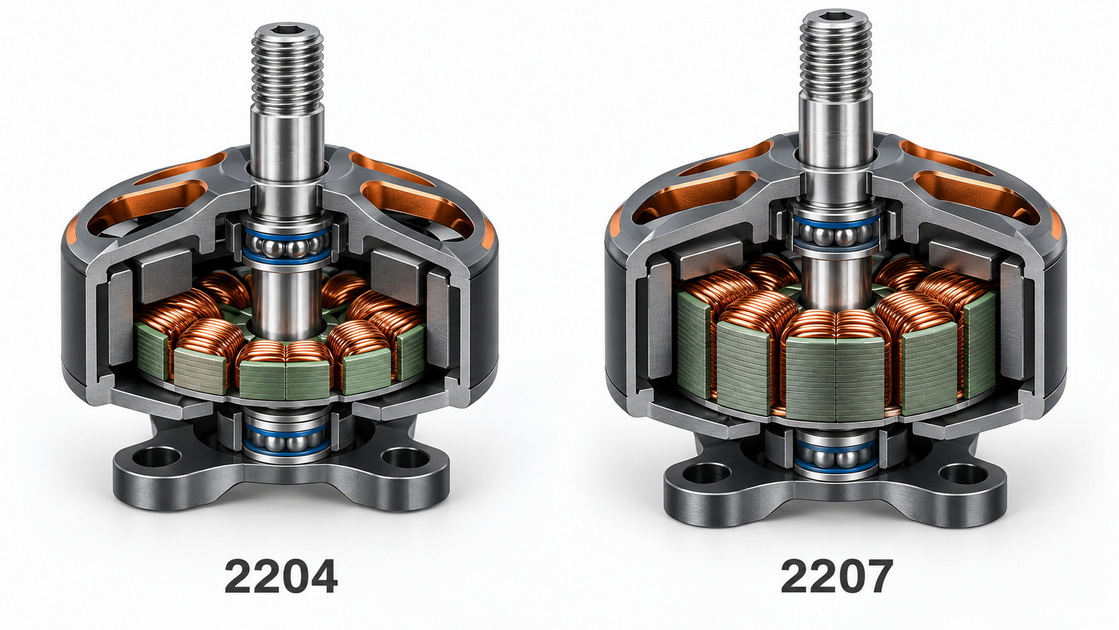
The four-digit motor designation describes the dimensions of the motor's stator.
- 2204 motor: approximately 22 mm stator diameter and 4 mm stator height
- 2207 motor: approximately 22 mm stator diameter and 7 mm stator height
Both motors have the same nominal 22 mm stator diameter. The major difference is stator height. A 2207 motor has a stator that is 3 mm taller than a 2204 motor.
This may appear to be a small dimensional change, but it has a meaningful effect on stator volume, torque capability, current demand, heat capacity, motor weight, and suitability for different propeller loads.
FPV motor-sizing guides generally explain motor naming in this way: the first two digits indicate stator width or diameter in millimeters, while the final two digits indicate stator height. Therefore, a 2207 motor represents a 22 mm diameter by 7 mm tall stator.
The stator is the fixed laminated steel core around which copper windings are placed. In a brushless motor, stator size helps determine how much electromagnetic force the motor can generate and how well it can manage a propeller load.
A larger stator volume can generally support more torque and sustained power, assuming comparable magnet design, winding, cooling, bearing quality, air-gap control, and manufacturing consistency.
Using the simple cylinder-volume relationship:
Stator Volume≈π×r2×h
A 2204 motor has an estimated stator volume of approximately:
π×112×4≈1,520 mm3
A 2207 motor has an estimated stator volume of approximately:
π×112×7≈2,661 mm3
This means that, using nominal stator dimensions, a 2207 motor has roughly 75% more stator volume than a 2204 motor.
That extra volume does not automatically mean 75% more thrust. Actual thrust depends on KV, battery voltage, propeller, ESC settings, motor construction, and test conditions. But it explains why 2207 motors are typically more capable of driving demanding 5-inch propeller loads.
| Feature | 2204 FPV Motor | 2207 FPV Motor | Practical Effect |
|---|---|---|---|
| Nominal stator size | 22 mm × 4 mm | 22 mm × 7 mm | The 2207 has more stator volume |
| Estimated stator volume | About 1,520 mm³ | About 2,661 mm³ | The 2207 has roughly 75% more nominal volume |
| Motor weight | Usually lower | Usually higher | 2204 supports lower all-up weight |
| Torque potential | Lower | Higher | 2207 handles more demanding prop loads |
| Suitable prop range | Often 3.5-inch to 5-inch, depending on KV and design | Typically 5-inch, depending on KV and design | Match the motor to the propeller load |
| Typical flight style | Lightweight cruising, efficient builds, mild freestyle | Freestyle, racing, acro, aggressive 5-inch flying | 2207 provides more recovery authority |
| Current demand | Often lower with comparable prop and setup | Can be higher, especially with aggressive propellers | ESC and battery must be matched |
| Heat tolerance | Less thermal mass | More thermal mass and power capacity | 2207 often handles sustained load better |
| Throttle feel | Smooth and lower-inertia | Strong, responsive, more authoritative | Flight style matters |
| Best lightweight use case | Ultralight 4-inch or carefully designed 5-inch build | Lightweight 5-inch performance build | Choose according to mission |
A 2204 brushless motor can be a smart option for builders who want to reduce aircraft mass without moving to a very small motor class.
Compared with a 2207 motor, a 2204 motor commonly has a lighter stator, lower overall motor weight, and lower rotating mass. On a quadcopter, even a few grams saved per motor can meaningfully reduce total dry weight.
For example, saving 5 g per motor across four motors reduces the quad's mass by 20 g before accounting for the effect on mounting hardware and build choices. For a sub-250 g FPV drone, long-range build, or lightweight 4-inch quad, that saving may be significant.
- Lower motor weight can support a lighter all-up build
- Lower rotating mass may support quick motor response in suitable setups
- Often better suited to modest propeller loads
- Can work well for smooth cruising and efficient flight profiles
- Potentially lower battery and ESC demand with compatible propeller and KV selection
- Useful for lightweight 4-inch FPV drones
- Can be used for carefully optimized lightweight 5-inch builds
- May help builders achieve regulatory weight targets in markets where those limits matter
A 2204 motor is often worth considering for:
- Lightweight 4-inch freestyle drones
- 4-inch long-range FPV drones
- Ultralight 5-inch builds with conservative propeller selection
- Smooth cinematic flying without heavy payloads
- Cruising and exploration platforms
- Lightweight racing concepts where low mass is prioritized
- DIY and OEM projects that need a compact 22 mm stator platform
A 2204 motor may not be the best choice for aggressive 5-inch freestyle when paired with high-pitch tri-blade propellers, heavy action cameras, thick LiPo batteries, or demanding maneuvering.
In these cases, the motor may need to work close to its limits. That can increase current draw, heat, voltage sag, and the risk of poor throttle recovery.
A lightweight motor is only beneficial if it can control the propeller effectively. If the motor is undersized for the propeller and all-up weight, the quad may feel soft, inefficient, or inconsistent during sharp throttle changes.
The 2207 FPV motor is widely associated with 5-inch freestyle and racing builds because it combines a 22 mm stator diameter with a taller 7 mm stator.
The larger stator volume supports more torque and stronger power delivery. In practical terms, that can help a quad accelerate faster, recover from dives more confidently, resist propwash better, and maintain control during aggressive flips, rolls, split-S maneuvers, and high-throttle exits.
Several FPV motor guides identify 2207 as a common motor size for 5-inch builds. A recent motor-selection guide describes 2207 as a modern default for 5-inch freestyle, while recommending KV selection based on the battery cell count and propeller choice.
- Higher torque capability for 5-inch propellers
- Stronger acceleration and throttle authority
- Better suitability for aggressive freestyle and racing
- More practical for heavier 5-inch builds
- Better ability to handle higher-pitch or tri-blade propellers
- Greater thermal capacity for demanding flight conditions
- Stronger recovery during fast direction changes
- Better option for carrying an action camera on a performance-focused quad
A 2207 motor is commonly suitable for:
- 5-inch freestyle FPV drones
- 5-inch racing drones
- Lightweight 5-inch builds that still require high power
- Action-camera-equipped freestyle quads
- Aggressive acro flying
- Freestyle drones using modern 6S battery systems
- OEM drone designs requiring a proven 5-inch power class
Typical component-selection tables place 2207 motors within the 5-inch freestyle category. For 4S systems, motor KV is often listed around 2,300–2,700 KV; for 6S systems, approximately 1,700–2,100 KV is often used as a starting range. These figures are not universal specifications and should always be verified using the motor manufacturer's thrust data for the selected propeller.
A 2207 motor can be unnecessary if your aircraft is intended only for slow cruising, indoor filming, low-noise exploration, or very light 3-inch to 4-inch propeller configurations.
Using an oversized motor can add weight and may encourage an overly aggressive power system. That can shorten flight time, require larger batteries and ESCs, and reduce the advantages of an ultralight build.
The goal is not to install the largest motor possible. The goal is to install the smallest motor that reliably delivers the required thrust, torque, flight control, and thermal performance.
When comparing 2204 and 2207 motors, buyers should evaluate the total quadcopter system rather than a single motor.
A difference of only several grams per motor becomes more important across four motors:
Total Motor Weight Difference=4×Weight Difference Per Motor
If a selected 2207 motor weighs 7 g more than a 2204 alternative, the total motor-related weight increase is:
4×7=28 g
For a 700 g 5-inch FPV drone, 28 g may be manageable. For a 250 g lightweight build, it is substantial.
However, this calculation must be balanced against power. If the lighter 2204 motors force the builder to use a smaller propeller, lower-pitch propeller, or more conservative battery setup, the finished drone may lose too much performance.
The correct decision depends on whether you value:
- Lower all-up weight
- Longer cruise efficiency
- Smoother handling
- Quiet operation
- High thrust-to-weight ratio
- Aggressive punch-outs
- Fast recovery after dives
- Action-camera carrying capability
- Racing acceleration
- Better performance in wind
For a lightweight long-range machine, lower weight and efficient cruise can matter more than maximum thrust.
For a lightweight freestyle machine, high power authority may still be the priority. In that case, a 2207 motor can be the better lightweight choice because it lets a relatively light frame maintain strong control under demanding flight conditions.
A comparison of 2204 vs 2207 motors is incomplete without discussing KV.
KV is the motor velocity constant, commonly described as the approximate no-load RPM per volt applied. A higher-KV motor is designed to rotate faster at a given voltage, while a lower-KV motor is generally matched with higher battery voltage or larger propeller loads.
A simplified relationship is:
No-Load RPM≈KV×Battery Voltage
For instance, a 2,400 KV motor connected to a nominal 4S LiPo battery of 14.8 V has a theoretical no-load speed of approximately:
2,400×14.8=35,520 RPM
Actual loaded RPM is lower because the propeller creates aerodynamic load and the electrical system has losses. A practical guide estimates loaded RPM at roughly 80–85% of the no-load KV-times-voltage value, although the real result changes with propeller, battery condition, and throttle position.
The following ranges are general planning references. They are not substitutes for manufacturer test data.
| Motor Class | Battery System | Typical Starting KV Range | Common Application |
|---|---|---|---|
| 2204 | 4S | Approximately 2,400–3,500 KV | Lightweight 4-inch and optimized 5-inch builds |
| 2204 | 6S | Approximately 1,700–2,500 KV | Efficient lightweight applications, depending on propeller |
| 2207 | 4S | Approximately 2,300–2,700 KV | 5-inch freestyle and racing |
| 2207 | 6S | Approximately 1,700–2,100 KV | 5-inch freestyle, racing, and high-performance builds |
For 5-inch freestyle, published component guides commonly list 2207 or similar 22xx motors with about 2,300–2,700 KV on 4S and 1,700–2,100 KV on 6S.
A high-KV motor combined with too many battery cells and too aggressive a propeller can create excessive current draw and heat. This may overload the motor, ESC, battery, wiring, or connectors.
Conversely, a low-KV motor on too few battery cells may not produce enough RPM or thrust for the selected propeller.
Before selecting motors, confirm:
- Battery voltage and cell count
- Propeller diameter
- Propeller pitch
- Blade count
- Expected all-up weight
- ESC continuous and burst-current ratings
- Battery discharge capability
- Motor thrust-test data
- Motor temperature after real flight testing
A 2204 or 2207 motor does not operate independently. The propeller is the load that determines how hard the motor must work.
A larger diameter propeller, higher pitch, additional blades, or stiffer prop design can increase thrust potential, but it can also increase current demand and heat.
For a lightweight build, an efficient bi-blade or low-pitch tri-blade propeller may help reduce load and improve cruising efficiency. For aggressive freestyle, a more responsive tri-blade propeller may offer stronger grip and control, but it can increase electrical demand.
An FPV motor selection guide advises builders to select the frame class first, then battery voltage, flight style, and finally review manufacturer thrust tables at intended propeller and voltage combinations. It also recommends ensuring that the selected setup produces enough mid-throttle thrust for the all-up weight.
| Build Goal | Recommended Direction | Why |
|---|---|---|
| Lightweight 4-inch cruiser | 2204 motor, moderate KV, efficient 4-inch propeller | Prioritizes lower mass and efficient flight |
| Ultralight 5-inch explorer | 2204 motor, conservative KV, low-load 5-inch propeller | Can work when all-up weight is controlled carefully |
| Lightweight 5-inch freestyle | 2207 motor, 6S-compatible KV, durable tri-blade propeller | Maintains strong recovery and maneuver authority |
| 5-inch racing | 2207 motor, higher-performance KV range, responsive propeller | Supports acceleration and rapid direction changes |
| Heavy action-camera 5-inch build | 2207 motor or larger, based on thrust data | Helps compensate for payload and aerodynamic drag |
Instead of selecting a motor only by size, calculate a reasonable thrust-to-weight ratio.
Thrust-to-Weight Ratio=Total Maximum Thrust/All-Up Weight
For example, if a quad weighs 600 g ready to fly and its four motors together produce 4,800 g of maximum thrust:
4,800/600=8:1
An 8:1 thrust-to-weight ratio generally supports strong freestyle performance. A lower ratio may be suitable for calm cruising, while racing and aggressive acro usually benefit from greater available power.
Published FPV build guidance suggests at least a 4:1 thrust-to-weight ratio for a lightweight 3-inch platform and identifies about 8:1 or above as a target for a typical 5-inch freestyle build. These are practical rules of thumb, not universal certification standards.
Many product listings highlight maximum thrust at 100% throttle. That figure is useful, but it does not fully predict the flight experience.
For lightweight builds, review thrust and efficiency data at 40–60% throttle as well. This is where many cruise and controlled-flight maneuvers occur.
A motor setup can show excellent peak thrust but still be inefficient in the middle of the throttle range. Conversely, a lower-power motor may feel efficient during cruise but lack enough reserve thrust to recover from a dive, handle wind, or carry a camera.
When evaluating 2204 and 2207 motors, ask the supplier for a complete thrust table that includes:
- Propeller model
- Battery voltage
- Throttle percentage
- Thrust
- Current
- Input power
- Efficiency
- Motor temperature, if available
- Test duration and ambient conditions
Motor size affects thermal capacity, but it does not guarantee reliability. A well-designed 2204 motor can outperform a poorly manufactured 2207 motor in a suitable application.
When sourcing FPV drone motors for OEM, ODM, or private-label projects, examine the complete motor architecture:
- Stator lamination material and thickness
- Copper winding quality and fill rate
- Magnet grade and retention method
- Bell material and machining tolerance
- Shaft material and diameter
- Bearing brand and specification
- Air-gap consistency
- Wire insulation quality
- Solder-joint quality
- Dynamic balancing
- Propeller-mounting design
- Cooling path
- Quality-control testing
- Thrust-test consistency between production batches
A motor running at an unsuitable propeller load can overheat regardless of its nominal size. Overheating can damage windings, degrade magnets, reduce bearing life, and produce inconsistent performance.
For an OEM project, the supplier should validate the actual motor-and-propeller combination rather than only providing a generic motor specification.
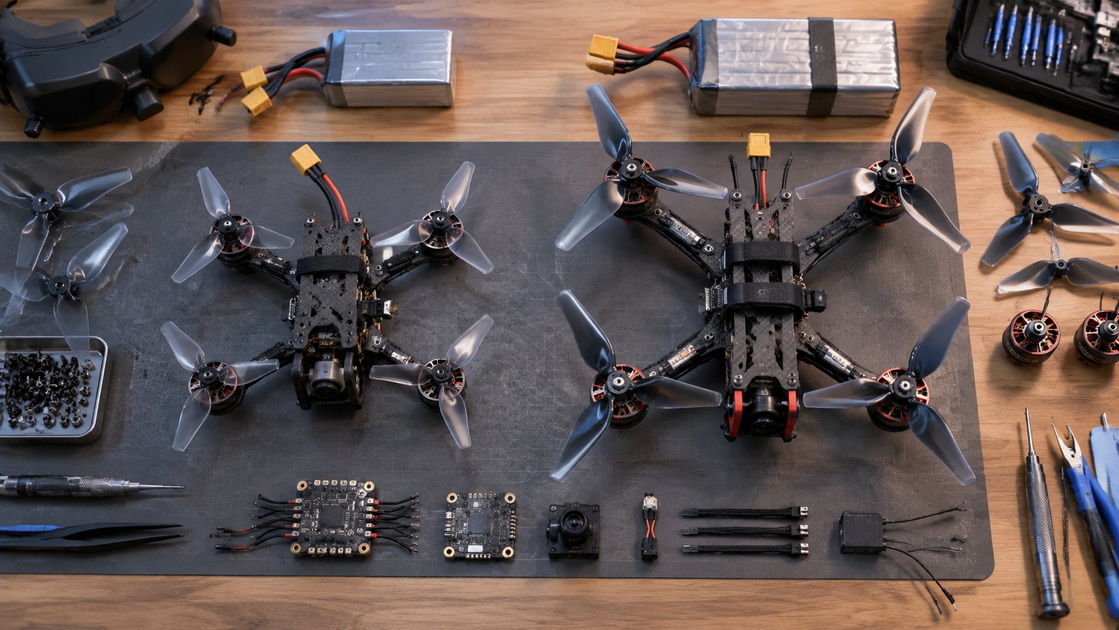
Choose a 2204 motor if your main objective is an efficient, low-mass drone and you are prepared to control total aircraft weight, propeller load, payload, and flight style.
Choose a 2207 motor if your build uses 5-inch propellers and needs confident torque, powerful acceleration, high thrust reserve, or aggressive freestyle and racing performance.
| Your Requirement | Better Starting Choice | Reason |
|---|---|---|
| Lightweight 4-inch FPV drone | 2204 | Lower motor mass and appropriate power potential |
| Sub-250 g efficiency-focused build | 2204 | Helps reduce all-up weight, subject to full power-system testing |
| Ultralight 5-inch cruiser | 2204 or 2207 | Depends on all-up weight, propeller load, and wind requirements |
| Lightweight 5-inch freestyle quad | 2207 | Better torque and recovery authority |
| 5-inch drone with action camera | 2207 | Better reserve power for payload and maneuvering |
| Aggressive acro or racing | 2207 | Stronger power delivery for demanding prop loads |
| Quiet, smooth, low-throttle cruising | 2204 | Often easier to optimize for lower power demand |
| Custom OEM FPV platform | Test both configurations | Choose based on validated thrust, efficiency, temperature, and flight results |
For an OEM or ODM FPV drone project, the most reliable approach is to start with an application brief rather than ordering motors based only on 2204 or 2207 naming.
Zhongshan Yuhang Power Technology Co., Ltd. can support customized brushless motor development and power-system selection for FPV drones, RC vehicles, high-power fans, camera gimbals, aircraft, robotic vacuum cleaners, underwater robots, and other professional equipment.
To evaluate the best FPV motor configuration, provide:
- Drone frame size and arm length
- Target propeller diameter, pitch, and blade count
- Battery type and voltage
- Target all-up weight
- Payload requirement
- Flight style or mission profile
- Required flight time
- ESC current rating
- Desired KV range
- Mounting pattern
- Shaft and propeller-mounting requirements
- Target production quantity
- Brand, color, packaging, and private-label requirements
A proper engineering review can identify whether a 2204, 2207, or another stator configuration will deliver the best balance of power, weight, efficiency, and durability.
For the direct question—2204 vs 2207 motor: which is better for lightweight builds?—the answer is conditional.
A 2204 motor is generally better for true lightweight builds where low weight, efficiency, and modest propeller loading are the priority. It is especially relevant for 4-inch platforms and carefully optimized lightweight 5-inch designs.
A 2207 motor is better for lightweight 5-inch builds that still demand high-performance freestyle capability. It adds weight, but its stronger torque and thrust reserve can create a more confident, controllable aircraft—particularly with tri-blade props, 6S batteries, action cameras, and aggressive flight styles.
A 2204 FPV motor usually has a nominal stator diameter of 22 mm and a stator height of 4 mm. The first two digits identify the stator diameter, while the final two digits identify its height.
A 2207 motor usually has a nominal 22 mm stator diameter and 7 mm stator height. The taller stator provides more volume than a 2204 motor, which generally supports higher torque and more demanding propeller loads.
Yes, in some lightweight 5-inch builds. However, success depends on KV, battery voltage, propeller pitch, blade count, all-up weight, ESC rating, and the motor's validated thrust data. A 2204 may be less suitable than a 2207 for heavy or aggressive 5-inch setups.
Usually, yes. The 2207 format is widely used for 5-inch freestyle because its larger stator volume can support stronger torque, better acceleration, and more control with demanding 5-inch propellers.
Not automatically. Higher KV increases theoretical RPM per volt, but it must match battery voltage and propeller load. Excessively high KV with too many battery cells or an aggressive propeller can increase current draw and overheating risk.
1. Rotor Tech HQ. "[FPV Drone Motor Selection Guide: How to Choose]." Explains stator-size naming, motor KV selection, propeller matching, and 2207 motor use in 5-inch FPV freestyle builds. [rotortechhq]
2. Oscar Liang. "[Lookup Table: Motor and Prop Sizes, KV, Battery Cell Count, and Weight]." Provides practical motor, KV, battery, propeller, and dry-weight ranges for common FPV aircraft classes. [oscarliang]
3. UAV Model. "[FPV Motor Sizing Guide: Stator Volume, KV Selection, and Thrust-to-Weight Ratio]." Discusses stator volume, motor sizing, propeller load, KV selection, and practical thrust-to-weight targets. [blog.uavmodel]
4. UAV Model. "[FPV Motor KV Selection: Voltage, Prop Size, and Flight Style Tradeoffs]." Covers the relationship among KV, battery voltage, loaded RPM, propeller selection, motor heating, and ESC configuration. [blog.uavmodel]
5. UAV Model. "[FPV Drone Motor Selection: KV, Size, Thrust, and Efficiency]." Provides a step-by-step FPV motor-selection process and emphasizes reviewing manufacturer thrust data with the intended propeller and battery voltage. [blog.uavmodel]
6. Betaflight. "[PID Tuning Guide]." Provides tuning context for FPV flight performance, including motor timing considerations for freestyle and racing applications. [betaflight]


