Language


Views: 243 Author: Yuhang Power Publish Time: 2026-10-26 Origin: Site
Content Menu
● Arabia's FPV Motor Market: Local Procurement, International Manufacturing
>> Where the Relevant Manufacturing Clusters Are
● How This Shortlist Was Built
● Capacity, MOQ, and Certification Visibility
● 1. Zhongshan Yuhang Power Technology Co., Ltd.: A Customization-Focused Candidate
>> Company Background and Market Focus
>> Core Strength and OEM/ODM Relevance
● 2. T-MOTOR: Broad Propulsion Experience and Dedicated FPV Lines
>> Company Background and Market Focus
>> Core Strength and OEM Scope
● 3. iFlight: Motors Within an Integrated FPV Ecosystem
>> Company Background and Market Focus
>> Core Strength and Customization Position
● 4. HOBBYWING: A Candidate for Motor-and-Controller Coordination
>> Company Background and Market Focus
>> Core Strength and OEM/ODM Position
● 5. Axisflying: Freestyle-Oriented Product Positioning
>> Company Background and Market Focus
>> Core Strength and OEM/ODM Position
● Technical Buyer's Guide: What to Put in an FPV Freestyle Motor Specification
>> Define the Application Before Selecting the Motor
>> Translate Material Claims Into Controlled Requirements
>> Compare Performance Under the Same Conditions
● The Overlooked Procurement Trap: An Approved Sample Is Not an Approved Production Process
>> Check Replacement-Part Compatibility as Well
● Factory Verification, Sampling, and Delivery Planning
>> Step 1: Verify the Manufacturing Role
>> Step 2: Use a Staged Sample Process
>> Step 3: Assess Capacity at Model Level
>> Step 4: Define the Landed-Cost Basis
● Match Documents to the Product and Destination
● FAQ
>> 1. How Can We Verify Whether a Supplier's ISO Certificate Has Expired?
>> 2. Can We Approve a Motor Based on Its CE and RoHS Documents Alone?
>> 3. How Can We Detect Material Substitution After Approving Samples?
>> 4. How Do We Verify a Claimed Production Capacity Without Visiting Every Month?
>> 5. How Should We Compare Two Motors With the Same Size and KV Rating?
Choosing an FPV freestyle motor supplier for Arabia requires more than comparing KV ratings, advertised thrust, and unit prices. Professional buyers need a partner that can maintain material consistency, document production quality, support replacement demand, and deliver the same approved specification across repeat orders.
The most useful supplier assessment therefore begins with five questions:
- Can the company demonstrate its manufacturing role and engineering capabilities?
- Are quality procedures and any claimed certifications independently verifiable?
- Can production motors reproduce the performance of approved samples?
- Are customization responsibilities, production capacity, and lead times documented?
- Can the supplier support the documentation required for the destination market?
This guide treats "Arabia" as the Arabian Peninsula, with particular attention to Saudi Arabia and neighboring Gulf markets. It distinguishes manufacturers serving regional buyers from factories physically located in the region. The five companies below are China-based manufacturers or propulsion brands shortlisted for procurement evaluation—not a verified ranking of Arabian motor factories.
Zhongshan Yuhang Power Technology Co., Ltd. commissioned this article and appears first. Company descriptions draw on publicly available information; no independent factory visits, comparative endurance tests, or supplier audits were conducted for this guide.
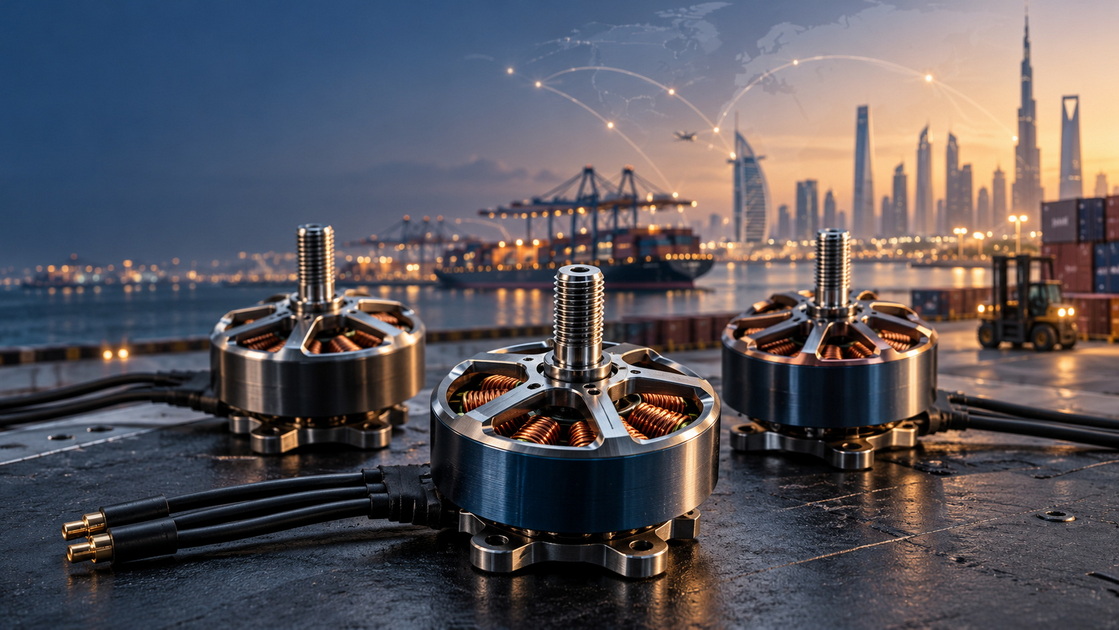
Saudi Arabia and neighboring Gulf countries are developing broader drone markets, but growth in commercial aviation, industrial inspection, and autonomous systems should not be confused with a mature local manufacturing base for freestyle motors.
IMARC estimates Saudi Arabia's commercial drone market at USD 388.5 million in 2025. Its market overview also identifies reliance on imported hardware as a supply-chain challenge. This figure covers commercial drones broadly; it is not a measurement of FPV freestyle motors or recreational FPV demand.
For procurement teams, the practical implication is to separate three different supplier roles:
1. A motor manufacturer controls relevant production processes and can potentially support engineering changes.
2. A regional distributor provides local stock, invoicing, replacement handling, and potentially simpler replenishment.
3. A systems integrator selects motors alongside frames, electronic speed controllers, batteries, and other components.
Local purchasing can simplify service and stock management. Direct factory purchasing can provide a clearer route to product customization. Neither channel automatically guarantees better consistency.
The manufacturing cluster most relevant to this shortlist is in China, rather than an established Arabian freestyle-motor production cluster.
Zhongshan Yuhang operates in Zhongshan, while iFlight is headquartered in Huizhou. iFlight specifically identifies access to Greater Bay Area suppliers, raw materials, and technical talent as an operational advantage. HOBBYWING is based in Shenzhen and identifies a Huizhou subsidiary producing precision brushless motors and matching controllers. T-MOTOR is headquartered in Nanchang.
These locations help explain why an Arabian procurement strategy may combine Chinese manufacturing with regional inventory and customer support. Buyers should evaluate the actual supply arrangement rather than interpreting a local sales address as proof of local production.
The companies were selected for their documented connection to brushless propulsion, identifiable FPV product offerings or customization capabilities, and relevance to professional purchasing.
This is a shortlist, not a claim that one company outperforms every competitor.
| Evaluation area | Evidence buyers should request | Why it matters |
|---|---|---|
| Manufacturing identity | Business registration, factory address, process overview, subcontracting declaration | Distinguishes production capability from trading activity |
| Engineering capability | Drawings, winding specifications, test plans, change-control procedures | Shows whether customization extends beyond labeling |
| Quality control | Incoming inspection, winding checks, balancing records, final test criteria | Supports repeat-order consistency |
| Material traceability | Controlled specifications for magnets, wire, bearings, shafts, and bell materials | Reduces substitution risk |
| Capacity and delivery | Model-specific output, current loading, bottleneck explanation, production schedule | Converts broad capacity claims into usable commitments |
| Compliance documentation | Applicable declarations, laboratory reports, certificate scope, destination requirements | Prevents unrelated documents from being accepted as product evidence |
| Commercial support | Sample terms, MOQ, warranty handling, spare-part policy, communication responsibilities | Helps assess the total cost of a long-term relationship |
Public information does not establish comparable model-level production capacity, custom-order MOQs, or current certification coverage for all five suppliers. Those gaps are disclosed below rather than filled with estimated figures.
| Manufacturer or brand | Founded | Principal purchasing focus | Model-specific production capacity | MOQ position | Certification position |
|---|---|---|---|---|---|
| Zhongshan Yuhang Power Technology Co., Ltd. / LN-MOTOR | 2021 | Customized brushless propulsion and OEM/ODM development | Not publicly verified | Obtain separate terms for samples, standard production, and custom development | Current factory certificates and model-specific compliance documents require verification |
| T-MOTOR | 2009 | FPV motors and broader UAV propulsion | Not publicly verified on a comparable FPV-model basis | Obtain wholesale and custom-project quotation | Management-system claims appear on some product pages; exact entity, site, scope, and current validity require verification |
| iFlight | 2014 | FPV motors within an integrated aircraft and component ecosystem | Not publicly verified | Retail listings exist; wholesale and customization MOQs require quotation | Exact-model documents and manufacturing-site certification require verification |
| HOBBYWING | 2005 | Motor-and-controller propulsion systems | Not publicly verified for the specific freestyle motor requested | Obtain project-specific quotation | Obtain applicable factory and product documentation for the proposed configuration |
| Axisflying | 2021 | Freestyle-oriented motors and FPV components | Not publicly verified | Retail catalog exists; private-label and custom MOQs require quotation | Current certificates and exact-model test documentation require verification |
Founding dates and product positioning are supported by company information. T-MOTOR's management-system references should not be interpreted as blanket certification of every FPV motor.
Established in 2021, Zhongshan Yuhang Power Technology Co., Ltd. develops, manufactures, and sells brushless motors. LN-MOTOR is one of its brands. Its published application coverage includes drones, remote-controlled vehicles, gimbal imaging, aircraft, underwater robots, and other professional equipment. The company states that it provides complete power-system solutions and customized OEM and ODM services for global customers.
Its company profile also states that its technical team has more than ten years of brushless-motor manufacturing and design experience. That is a statement about team experience, not the age of the company. Public information does not identify a verified country-by-country sales breakdown.
Yuhang's documented positioning centers on customized development rather than only standardized catalog sales. Its profile describes control across research, design, production, and testing. This makes it a relevant candidate for buyers who need to discuss motor specifications directly with a development-oriented supplier.
For smaller and developing brands, the potential value lies in combining engineering access with a manageable commercial relationship. However, affordability, communication speed, and order flexibility should be treated as evaluation objectives—not assumed advantages without a quotation and sample project.
A useful initial inquiry should ask Yuhang to distinguish between:
- Existing motors supplied under the customer's branding.
- Modifications to KV, leads, connectors, mounting details, or appearance.
- Changes requiring new winding development, mechanical design, or tooling.
- Complete propulsion matching involving the motor, controller, and propeller.
The company publishes broad OEM/ODM availability, but the feasibility, cost, MOQ, and validation requirements of each requested modification need written confirmation.
Request an engineering response to a defined application brief, not only a price list. Compare the completeness of its technical questions, proposed testing, sample schedule, and change-control terms.
Yuhang is particularly worth evaluating when the purchasing goal is a cost-conscious, customized product for a smaller brand. Final selection should depend on measured sample performance, documented quality controls, and a commercially acceptable production agreement.
Founded in 2009 and headquartered in Nanchang, T-MOTOR develops UAV propulsion systems, including motors, electronic speed controllers, and propellers. Its published positioning serves global UAV customers across multiple applications.
Its FPV catalog includes dedicated freestyle products. Public listings identify models such as the F40 PRO IV 2306.5 and F60 Pro V 2207.5, while a separate FPV propulsion page advertises custom OEM services.
T-MOTOR is a relevant candidate for buyers seeking a recognizable propulsion brand with both FPV-specific products and broader system experience.
The procurement distinction is important: the availability of OEM services does not mean every retail freestyle motor can be freely redesigned or privately labeled. Buyers should ask which product platform supports their proposed project and which engineering team owns its validation.
Ask for:
- The exact FPV model and revision being quoted.
- Test conditions behind published performance curves.
- Customization boundaries and engineering charges.
- Replacement-bell and spare-part availability.
- The legal entity and factory named in any certification documents.
Some T-MOTOR product pages refer to management-system certification. Buyers should obtain the actual certificate and verify its scope rather than transferring a claim from one product family to another.
iFlight was founded in 2014 and is headquartered in Huizhou. Its published business covers FPV aircraft and applications including imaging, racing, freestyle flying, entertainment, and education, with an international customer orientation.
Its motor catalog includes XING2 2207 and XING2 2306 options, including variants identified for 4S and 6S applications.
iFlight's main procurement relevance is its integrated FPV ecosystem. Buyers sourcing motors alongside aircraft or other components can evaluate a more unified product platform rather than assembling every subsystem from unrelated vendors.
However, the sources reviewed do not establish an unrestricted private-label motor program. A broad branded catalog should not be interpreted as evidence that custom winding designs, exclusive mechanical changes, or third-party branding are available.
For branded distribution, confirm channel authorization, regional warranty handling, and replenishment arrangements.
For an OEM inquiry, obtain written answers on:
- Whether private labeling is permitted.
- Whether technical customization is offered.
- Who owns any resulting drawings or tooling.
- Whether the proposed motor differs from the retail version.
- How specification changes are communicated.
iFlight is a useful candidate for businesses that value an established FPV platform, but custom-development availability remains a project-specific question.
Founded in 2005, Shenzhen HOBBYWING Technology Co., Ltd. develops brushless propulsion systems across remote-control models, drones, and other applications. Its company information describes a precision-motor and controller production subsidiary in Huizhou.
HOBBYWING also maintains an FPV propulsion category covering brushless motors and electronic speed controllers. Its broader market coverage includes international customers, although the reviewed sources do not provide an Arabian sales breakdown.
HOBBYWING is relevant when the procurement problem involves the interaction between a motor and its controller—not simply the motor's advertised thrust.
For example, a buyer developing a complete propulsion package should require the supplier to define the motor configuration, controller settings, operating limits, and validation conditions together.
The reviewed sources establish propulsion-system development and manufacturing activity, but they do not establish a universal private-label freestyle-motor offering. OEM/ODM scope, exclusivity, and minimum commercial commitments need direct confirmation.
Ask for the proposed motor-and-controller combination, test setup, operating restrictions, and responsibility for investigating field failures.
A supplier's experience in industrial propulsion or other remote-control applications should not replace testing for the intended freestyle aircraft. Validate the exact product combination under the expected duty cycle.
Jiangxi Axisflying Development Co., Ltd. states that it was established in 2021 and focuses on FPV technology development, intelligent manufacturing, and industrial applications. Its international-facing catalog includes motors, aircraft, and other FPV components.
Its published motor range includes the AE2207 V2 for five-inch freestyle and cinematic applications, as well as other freestyle-oriented designs. The company also advertises a modular AF2406 motor with a quick-swap concept.
Axisflying is relevant for buyers comparing purpose-positioned freestyle motors and different approaches to serviceability.
Its catalog provides a useful starting point for application matching. Nevertheless, published product specialization does not establish custom-manufacturing capacity or private-label availability.
The sources reviewed do not verify a standard OEM/ODM program with defined modification options, MOQs, or exclusivity terms.
For any serviceable or modular design, evaluate more than the advertised replacement speed. Ask how replacement parts are identified, whether tolerances are controlled across production batches, and whether repaired assemblies require additional inspection.
For a custom project, confirm the engineering scope and replacement-part commitment before selecting the platform.
A purchasing specification should make competing offers comparable. Descriptions such as "premium magnets," "high-quality bearings," or "powerful freestyle performance" are not adequate acceptance criteria.
The following checklist is a proposed procurement framework, not a statement that every shortlisted company offers each option.
Include:
- Aircraft size and intended all-up weight.
- Propeller diameter, pitch, blade count, and manufacturer.
- Battery configuration and expected operating voltage.
- Controller model and relevant settings.
- Expected flight style and throttle duty cycle.
- Ambient operating conditions.
- Weight, mounting, shaft, and cable constraints.
- Target service life and acceptable replacement cost.
A specification that omits the propeller and controller leaves too much room for inconsistent performance comparisons.
| Component | Incomplete supplier description | More useful purchasing requirement |
|---|---|---|
| Magnets | “High-grade magnets” | Declared grade, temperature designation, coating, retention method, and traceability |
| Windings | “Premium copper” | Conductor specification, insulation system, winding configuration, and inspection criteria |
| Bearings | “Imported bearings” | Manufacturer, exact part number, fit requirements, and substitution-approval process |
| Bell | “Aerospace aluminum” | Declared alloy, drawing revision, machining requirements, and inspection method |
| Shaft | “High-strength shaft” | Material, dimensions, retention design, and runout acceptance criteria |
| Finished motor | “Precisely balanced” | Defined balancing method, acceptance limit, and lot-record requirements |
Avoid demanding a prestigious-sounding material without explaining the operational requirement. The goal is a stable, testable design—not a collection of impressive material labels.
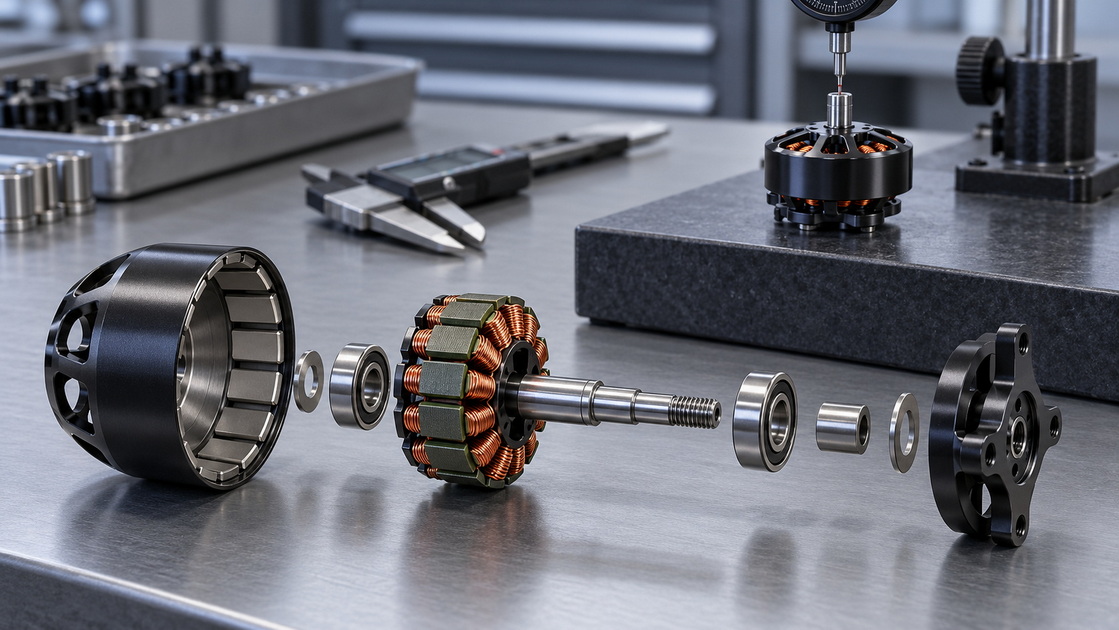
Require suppliers to identify the test conditions behind their data. At minimum, request:
- Actual test voltage and voltage under load.
- Exact propeller.
- Controller and settings.
- Test duration and throttle sequence.
- Ambient temperature.
- Motor temperature measurement method.
- Thrust, electrical input, and rotational-speed records where available.
- Whether the tested unit came from ordinary production or a development build.
Treat peak output and sustained operating performance as separate evaluation questions. A single maximum-thrust figure is not a complete purchasing decision.
One important risk is approving a good sample without controlling how later units are built.
A supplier may propose a change to a bearing, magnet, adhesive, winding arrangement, or machining source after sample approval. Even when the external model number stays unchanged, the buyer needs a way to assess whether the change affects the approved product.
This is a procurement risk to control, not an allegation against any company in this guide.
A practical prevention system includes:
1. An approved drawing revision.
2. A controlled bill of materials.
3. Retained reference samples.
4. Written approval before critical substitutions.
5. Production-lot identification.
6. Agreed electrical, mechanical, and performance acceptance tests.
7. Periodic destructive inspection where commercially justified.
The key contractual question is not merely, "Will you supply this model?" It is, "What changes may you make without notifying us?"
For freestyle products, buyers should also define how replacement bells, shafts, or other service parts remain compatible with motors already sold.
Request a revision-identification system and a policy covering cross-batch compatibility. Otherwise, a business may have spare parts in stock without knowing which production version they fit.
Ask the supplier to identify which operations it performs internally and which it subcontracts.
A live factory review should follow the actual process flow rather than only showing finished inventory. Relevant areas include material receiving, winding, assembly, inspection, balancing, testing, and packaging.
Confirm that the contracting entity, receiving bank account, factory identity, and certification documents are consistent.
A practical starting plan is:
- Engineering evaluation: a small group of motors for dimensional, electrical, and bench checks.
- Aircraft validation: complete matched sets plus spares.
- Pilot production: a limited order made through the intended production process.
- Repeatability check: additional samples from a later lot.
For illustration, a buyer might begin with six engineering samples, follow with several aircraft sets, and then approve a 50–100-unit pilot order. These are suggested planning quantities, not supplier MOQs or universal testing requirements.
Include destructive inspection only where justified by project risk, cost, and available technical competence.

Do not accept a general monthly-output statement as proof of availability for a specific custom motor.
Request:
- Capacity for the quoted model.
- Current production loading.
- Component procurement lead times.
- Constraints affecting custom winding or machining.
- Time reserved for inspection and rework.
- A production schedule tied to the purchase order.
Separate development time, production time, export preparation, transit, and destination clearance.
Compare quotations using the same Incoterm and scope.
Ask whether the quotation includes packaging, export documentation, freight, insurance, destination charges, taxes, and customs handling. Require protective packaging appropriate to the motor's finish and mechanical components.
A standalone motor shipment and a complete kit containing batteries or wireless equipment should be reviewed as different shipment configurations. Obtain classification and transport advice for the actual contents rather than copying documentation from a previous order.
Buyers should keep three questions separate:
1. Does the factory operate under a verifiable management system?
2. Does the exact product have the required technical evidence?
3. Does the shipment satisfy the destination's import requirements?
An ISO management-system certificate does not answer all three.
For Saudi Arabia, SASO describes SABER services for product registration, conformity documentation for products subject to technical regulations, and shipment certificates. Buyers should have the importer or an accepted conformity-assessment body determine the applicable route for the exact motor or kit before dispatch.
When a supplier offers CE- or RoHS-related documentation, ask which exact model, materials, standards, and intended market it covers. Do not accept a generic folder of documents as a substitute for a product-specific compliance review.
A Saudi import review should also remain distinct from permissions to operate an aircraft. A motor purchase alone does not establish that a completed FPV drone may be flown in a particular location.
For Arabian buyers, the strongest procurement strategy is to match the supplier's role to the business requirement.
- Evaluate Zhongshan Yuhang when customized brushless development and direct OEM/ODM discussion are priorities.
- Evaluate T-MOTOR when comparing dedicated FPV products alongside broader propulsion capabilities.
- Evaluate iFlight when an integrated FPV product ecosystem is important.
- Evaluate HOBBYWING when motor-and-controller coordination is central to the project.
- Evaluate Axisflying when comparing freestyle-oriented designs and serviceability concepts.
These are starting points for qualification, not substitutes for sample testing or factory verification.
To begin a project with Zhongshan Yuhang Power Technology Co., Ltd., submit the intended aircraft configuration, propeller, battery, performance targets, annual demand, branding requirements, and destination market.
Search the exact certificate number and legal company name through IAF CertSearch. Review the certificate's current status, certified scope, issuing certification body, accreditation body, and covered locations. The platform distinguishes active, suspended, withdrawn, and expired certificates.
Do not rely on the expiration date shown in an emailed image alone. If a record cannot be reconciled with the supplier's claim, contact the issuing certification body before approval.
No. First establish what those documents cover and whether they are applicable to the supplied configuration and destination.
Then separately evaluate product performance, manufacturing consistency, and shipment requirements. For Saudi-bound goods, review the applicable conformity route through the importer and relevant assessment body; a supplier's European-market paperwork should not be treated as a complete Saudi import assessment. SASO's published SABER process distinguishes product conformity and shipment documentation.
Use a controlled bill of materials, retained samples, lot traceability, and a written engineering-change agreement.
Define checks that can identify meaningful differences: dimensions, weight, electrical measurements, performance under a fixed setup, and selected teardown inspections. Where a critical material cannot be verified through routine inspection, agree on supplier traceability records or appropriate independent testing before production.
Ask the supplier to explain capacity for the exact model, including available equipment, bottlenecks, component lead times, current loading, and inspection resources.
Then test the claim through a pilot order and documented milestone reporting. A credible capacity discussion should connect the quoted output to a production plan rather than relying only on a factory-wide headline number.
Include delivery reporting and escalation procedures in the supply agreement.
Use a common test plan rather than assuming identical labels mean identical behavior.
Hold the propeller, voltage, controller settings, test sequence, and temperature-measurement method constant. Compare the resulting operating data, mechanical fit, repeatability across units, and post-test condition.
For a commercial decision, include replacement availability, specification control, warranty procedures, and landed cost alongside performance.
1. Zhongshan Yuhang Power Technology Co., Ltd., "About Us"—company founding, LN-MOTOR brand, technical-team background, applications, and OEM/ODM positioning. [yuhangmotor]
2. IMARC Group, "Saudi Arabia Commercial Drones Market"—2025 market estimate and imported-hardware context; not an FPV freestyle-motor market measurement. [imarcgroup]
3. T-MOTOR, official corporate and FPV product information—founding, location, propulsion focus, and custom OEM positioning. [uav-en.tmotor]
4. iFlight, official company profile and motor catalog—founding, Greater Bay Area location, application focus, and XING motor offerings. [iflight]
5. HOBBYWING, official company information and FPV propulsion category—founding, manufacturing background, motors, and controllers. [hobbywing]
6. Axisflying, official company profile and product catalog—founding and freestyle-motor positioning. [axisflying]
7. Saudi Standards, Metrology and Quality Organization, "Products Tracking"—official SABER product-conformity and shipment-documentation overview. [saso.gov]
8. IAF CertSearch, official certificate-verification services and guidance—accredited management-system certificate validation. [iafcertsearch]


