Language


Views: 245 Author: Yuhang Power Publish Time: 2026-10-19 Origin: Site
Content Menu
● Coreless Motor vs Brushless Motor
● How Brushed Coreless Motors Work
>> Advantages for Small Drones
● How Brushless Motors Work in Small Drones
>> Advantages for FPV Applications
● Performance Comparison: Thrust, Response, and Payload
>> Thrust Depends on the Matched System
>> Low Inertia Does Not Automatically Mean Better Flight Response
>> Payload Must Include the Power System
● Efficiency and Flight Time: Avoid the Automatic Winner
>> Measure Useful Flight Performance
● Modern Micro Brushless Motors Change the Comparison
● Durability, Maintenance, and Ownership Cost
● Can You Upgrade a Coreless Drone to Brushless Motors?
● A Practical Five-Step Motor Qualification Process
>> 2. Freeze the Test Configuration
>> 3. Test Several Operating Points
>> 5. Approve the Production Definition
● Comparing Different Weight and Test Bases
● Choosing a Development Partner for Small Drone Motors
>> 1. Is a coreless motor always brushed?
>> 2. Which motor gives a small drone longer flight time?
>> 3. Are brushless motors suitable for tiny indoor drones?
>> 4. Can I connect a brushless motor to a brushed motor output?
>> 5. How should an OEM buyer compare motor lifetime?
The coreless motor vs brushless motor decision for small drones usually comes down to purchase cost, propulsion performance, service life, and control-system complexity. Small brushed coreless motors remain useful for inexpensive indoor aircraft. Brushless motors are generally the stronger starting point for performance-oriented FPV drones and products intended for frequent operation.
However, the terminology needs clarification. "Coreless" describes a motor's magnetic construction, while "brushless" describes its commutation method. A brushless motor can also have an ironless winding.
In this guide, "coreless motor" means the miniature brushed coreless DC motor commonly associated with small drones. The comparison is therefore between that design and the compact brushless motors used in modern micro aircraft.
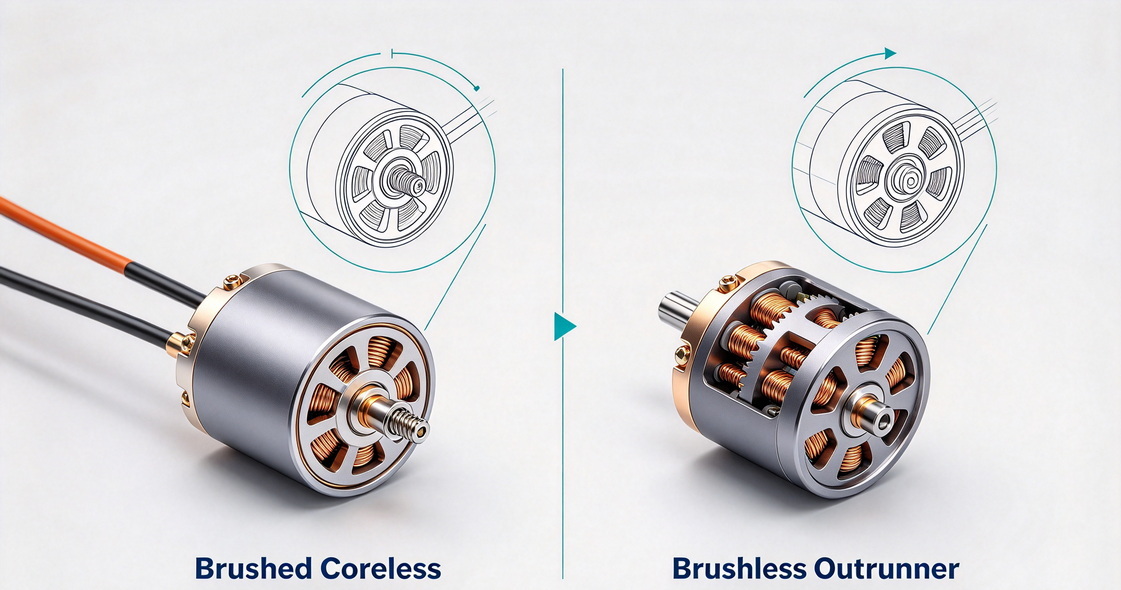
| Selection factor | Brushed coreless motor | Brushless drone motor |
|---|---|---|
| Commutation | Mechanical brushes and commutator | Electronic controller |
| Typical connection | Two motor wires | Three motor-phase wires |
| Construction | Lightweight, self-supporting rotor winding | Common FPV designs use a wound stator and rotating magnet assembly |
| Control hardware | Usually simpler power-switching circuitry | Requires compatible brushless ESC channels |
| Wear considerations | Brushes, commutator, and shaft support | Bearings or bushings, plus mechanical and electrical stresses |
| Initial system cost | Often lower for basic miniature aircraft | Often higher, depending on integration and quantity |
| Performance potential | Suitable for modest propulsion requirements | Broad options for racing, freestyle, and demanding micro builds |
| Efficiency | Operating-point dependent | Operating-point dependent |
| Best purchasing approach | Evaluate replacement frequency and loaded performance | Match motor, propeller, battery, ESC, and aircraft weight |
Neither column guarantees a better aircraft. The appropriate choice depends on the mission and the quality of the implementation.
A brushed coreless motor uses a lightweight rotor winding without a conventional laminated iron rotor core. The winding forms a self-supporting structure around the magnetic assembly.
Brushes contact a segmented commutator, switching current as the rotor turns.
Removing the iron rotor core reduces rotating inertia. This can support rapid acceleration and smooth operation without the cogging associated with some iron-core designs.
These motors also work with relatively simple drive electronics. In a miniature quadcopter, the flight-control electronics typically regulate each motor through power-switching circuitry.
For a basic indoor trainer, that simplicity can support a compact, economical design.
The brushes and commutator are wearing components. Their operating life depends on current, speed, vibration, temperature, and the specific construction.
Do not apply industrial brushed-motor lifetime figures directly to inexpensive drone motors. Different loads, materials, and duty cycles make such comparisons unreliable.
A motor that still rotates may also deliver less useful performance than a fresh unit. Qualification should therefore assess loaded operation, not merely whether the shaft turns.
A brushless motor relies on electronic commutation. An ESC switches the motor phases to maintain rotation and regulate output.
Many FPV motors use an outrunner arrangement: the magnet-carrying outer rotor turns around the wound stator. Brushless construction is not limited to this arrangement, but it is important in compact drone propulsion.
Brushless motors eliminate brush and commutator wear. They also offer a wide selection of stator sizes, windings, shaft arrangements, and mounting options.
This gives developers more flexibility when matching a motor to:
- Propeller diameter and loading.
- Battery voltage.
- Target aircraft mass.
- Required maneuvering authority.
- Thermal limits.
- Mechanical integration.
A brushless motor requires compatible control electronics. Incorrect electrical matching or unsuitable ESC settings can cause poor starting, excessive current, or unstable operation.
"Brushless" also does not mean indestructible. Shaft damage, worn supports, contamination, winding overheating, and rotor damage remain possible.
Not every miniature brushless motor uses ball bearings. Some lightweight models use bushings, so purchasing specifications should identify the actual support arrangement.
Maximum thrust is not a motor-only property.
It depends on the propeller, supply voltage, current capability, motor characteristics, and installation. Comparing two motors with different propellers and batteries tells little about their relative suitability.
For useful procurement data, request performance across several operating points—not only maximum throttle.
Include hover-equivalent loading and short-duration maneuvering demands.
Brushed coreless motors benefit from low rotor inertia. However, aircraft response also depends on propeller inertia, available torque, controller behavior, and battery voltage under load.
A compact brushless system can provide excellent micro-drone performance despite using a different rotor arrangement.
Avoid choosing by construction alone. Evaluate how quickly the complete system changes thrust under representative conditions.
A more powerful motor may require a different controller, larger battery, stronger frame, or heavier wiring.
Those additions can consume the apparent payload advantage.
Compare complete takeoff mass, including camera, receiver, guards, connectors, and battery. A motor upgrade only helps if the resulting aircraft meets the mission more effectively.
Brushless motors are often associated with efficiency, but it is inaccurate to say they always outperform brushed coreless motors.
An ironless brushed design avoids rotor iron losses, while brush contact and winding losses remain. Brushless designs have their own electrical, magnetic, mechanical, and controller losses.
The balance depends on the particular motor and operating point.
For small drones, evaluate:
1. Electrical power required at representative thrust.
2. Complete aircraft mass.
3. Battery voltage sag.
4. Temperature during the intended duty cycle.
5. Flight time under a repeatable mission.
A motor with better peak efficiency may still produce a shorter flight if the aircraft becomes heavier or operates outside that efficient region.
Higher KV should not be treated as a promise of longer flight time or greater useful thrust.
The assumption that brushless motors are necessarily too heavy for tiny drones is outdated.
BETAFPV's published 0702 II family specifications list approximately 1.45–1.55 g per motor for selected versions. The exact figure depends on the model, support arrangement, and whether wiring and connectors are included.
This does not establish that those motors outperform every brushed alternative. It demonstrates that brushless options exist within very small aircraft weight budgets.
The practical lesson is to compare current, configuration-specific specifications. Do not build a purchasing decision around an old distinction between "light brushed" and "heavy brushless."
Also avoid directly comparing dimensional labels. A brushed motor's can dimensions and a brushless motor's stator designation describe different features.
Low initial cost can be attractive for entry-level products.
However, repeated motor replacement introduces additional costs:
- Replacement components.
- Repair labor.
- Troubleshooting.
- Product downtime.
- Customer support and returns.
For frequently used training fleets, replacement frequency may matter more than a small purchase-price difference.
Removing brush wear can improve lifecycle suitability, but mechanical damage and overheating still affect reliability.
Assess shaft alignment, bearing or bushing condition, mounting integrity, and performance consistency after representative use.
For procurement, define acceptable degradation over a test interval rather than asking for a universal lifetime guarantee.
Usually, this is not a direct motor swap.
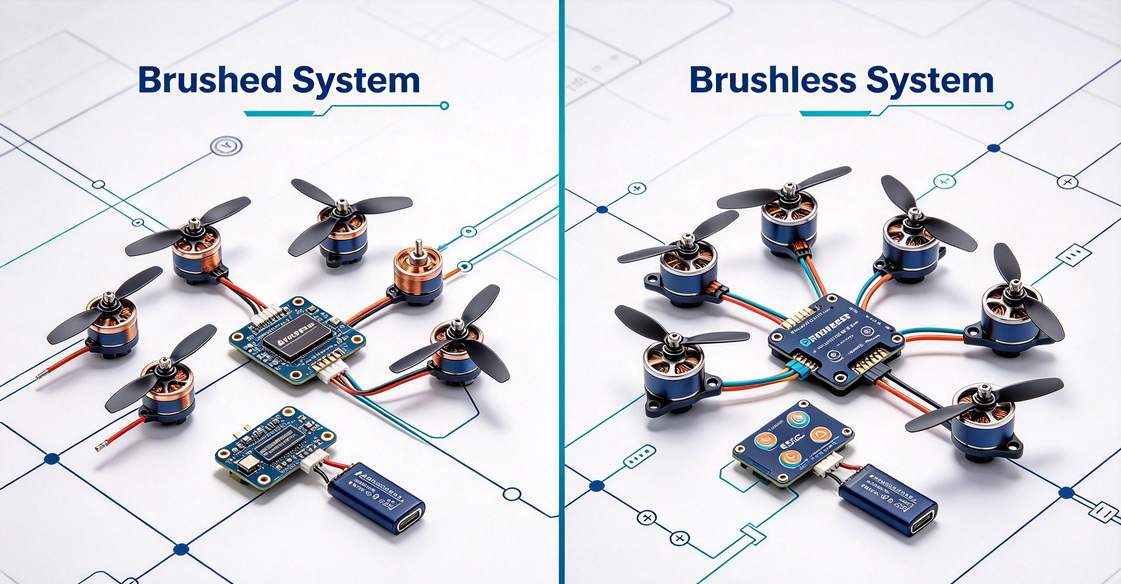
A brushed flight controller typically does not provide the three-phase drive required by brushless motors. Conversion may require:
- A brushless-compatible flight controller or ESC arrangement.
- Different motor mounts.
- Suitable propellers and hubs.
- Revised wiring and connectors.
- A compatible battery configuration.
- Updated control settings.
The resulting weight and cost can outweigh the value of the conversion.
For an existing low-cost aircraft, replacement with the original motor type may be more practical. For a new product platform, evaluate both architectures before freezing the frame and electronics.
Record takeoff mass, intended flight environment, payload, desired endurance, and expected operating frequency.
An indoor educational drone and a micro freestyle aircraft can have similar dimensions but very different propulsion requirements.
Identify the exact motor, propeller, controller, battery, wiring, and connector arrangement.
Record voltage at the relevant measurement point. Different supply conditions can invalidate a comparison.
Measure current, electrical power, thrust, temperature, and vibration where practical.
Include sustained mission-relevant operation as well as short bursts. Conduct rotating-propeller testing with suitable guarding and procedures.
One unusually strong sample should not determine a production specification.
Compare several units and repeat measurements after representative use. Look for variation and degradation, not just the highest result.
Document winding, shaft, support arrangement, connector, inspection criteria, and permitted substitutions.
Link approved samples to a controlled specification so later deliveries remain comparable.
Two suppliers can publish accurate figures that are still unsuitable for direct comparison.
One may quote motor weight without wires. Another may include a connector. One thrust test may use a different propeller or a fresher battery.
My procurement rule is simple: normalize the comparison before ranking the suppliers.
Use the same:
- Included-component weight basis.
- Propeller specification.
- Supply conditions.
- Test duration.
- Measurement method.
- Temperature limits.
For an ultralight drone, seemingly small differences in wires, connectors, and mounting hardware can affect the final design decision.
Zhongshan Yuhang Power Technology Co., Ltd. is a China-based brushless motor manufacturer serving drone, RC, robotics, and other equipment applications.
The company describes integrated development, production, and sales capabilities, together with customized OEM and ODM services.
For small-drone projects, begin with an application brief rather than a request for "more power." Ask Yuhang to assess motor dimensions, winding options, shaft requirements, propeller compatibility, electrical limits, and sample testing.
Custom brushed coreless motor production should not be assumed from its brushless motor positioning.
Brushed coreless motors remain a practical option for simple, cost-sensitive miniature drones. Brushless motors generally offer a stronger development path for demanding FPV performance, repeated operation, and broader customization.
The decisive comparison is the complete aircraft: performance, mass, thermal behavior, service requirements, and delivered cost.
No. Coreless or ironless describes construction, while brushed or brushless describes commutation. This article compares miniature brushed coreless motors with common brushless drone motors, not every possible motor architecture.
Neither type guarantees longer endurance. Compare complete aircraft mass, mission power consumption, usable battery energy, and operating temperature under the same flight profile.
Yes. Current miniature brushless products demonstrate suitability for very lightweight builds. Check the complete motor, controller, frame, and battery combination rather than motor weight alone.
Not directly. A brushless motor requires electronic phase commutation from a compatible controller. A typical brushed motor output does not provide that function.
Define the load, duty cycle, environment, sample quantity, and failure criteria. Evaluate performance degradation as well as complete failure. Avoid accepting an unsupported lifetime figure without a matching test protocol.
1. Maxon. "Brushed vs. Brushless DC Motors." November 13, 2024. Technical source for commutation differences, controller requirements, wear mechanisms, and why efficiency should not be generalized across all brushed and brushless designs. Its industrial lifetime figures were not transferred to miniature drone motors. [maxongroup]
2. Maxon. "BLDC Motors With Ironless or Iron Core Winding." Manufacturer documentation demonstrating that brushless motors can use either ironless or iron-core construction, supporting the distinction between construction and commutation terminology. [maxongroup]
3. Maxon. "Highly Efficient Brushed DC Motors." Technical source for ironless rotor construction, low inertia, and operation without electronic commutation. [maxongroup]
4. Maxon. "DC Motor and EC Motor—Key Information." Engineering reference covering operating-point characteristics, thermal limits, winding heating, and commutator wear at high speeds. Numerical industrial operating limits were not adopted as specifications for small drone motors. [maxongroup]
5. Motion Control Tips. "What Are Coreless DC Motors?" October 9, 2018. Technical explanation of self-supporting rotor windings, reduced inertia, brush arrangements, and cogging characteristics. [motioncontroltips]
6. BETAFPV. "0702 II Brushless Motors." Official product specifications supporting the cited model-dependent weight range and distinctions between ball-bearing and bushing versions. Listed weights depend on the exact variant, wiring, and connector basis. Manufacturer performance claims are not independent comparative testing. [betafpv]
7. BETAFPV. "Motors" and "0702 Brushless Motors." Product references illustrating brushed and brushless micro-drone offerings and the effect of connectors on published motor mass. [betafpv]
8. Oscar Liang. "How to Build a Tiny Whoop From Scratch for Only $130." Practical reference illustrating integrated brushless flight-control electronics, three motor-phase connections, and complete-build weight considerations. [oscarliang]
9. Zhongshan Yuhang Power Technology Co., Ltd. "About Us." Official company source for brushless motor development, manufacturing, application areas, and OEM/ODM positioning. The project brief additionally supplied company context. Custom-project feasibility and performance require direct confirmation; no independent factory audit or comparative motor testing was performed for this article. [yuhangmotor]


