Language


Views: 231 Author: Yuhang Power Publish Time: 2026-10-15 Origin: Site


Content Menu
● What Is the Difference Between Outrunner and Inrunner Motors?
>> Outrunner Drone Motor: The Outer Bell Rotates
>> Inrunner Drone Motor: The Rotor Turns Inside
● Outrunner vs Inrunner Drone Motor
● Torque, KV, and RPM: What Actually Determines Performance?
>> Why Outrunners Often Suit Direct-Drive Propellers
>> Why Inrunners Often Suit High-Speed Loads
>> What Motor KV Does—and Does Not—Tell You
● Which Motor Is More Efficient for a Drone?
>> Compare Equal Thrust, Not Equal Throttle
● Cooling, Durability, and Maintenance
>> Outrunner Cooling Depends on Airflow and Installation
>> Inrunner Cooling Benefits from a Stationary Housing
● Which Motor Is Better for Each Drone Application?
>> FPV Racing and Freestyle Drones
>> Long-Range and Payload Multirotors
>> Ducted Fans and Specialized Aircraft
● A Practical Five-Step Motor Selection Process
>> 1. Define the Flight Requirement
>> 2. Establish Propeller or Fan Constraints
>> 3. Match Voltage, KV, and Controller Capability
>> 4. Test Representative Operating Points
>> 5. Evaluate Integration and Repeatability
● Three Engineering Insights Buyers Often Overlook
>> 1. Rotor Inertia Is Only Part of Throttle Response
>> 2. A Better Peak Number Can Hide a Worse Mission Result
>> 3. Fair Comparisons Must Include the Installation
● OEM and ODM Considerations for Brushless Motor Projects
>> 1. Is an outrunner better than an inrunner for FPV drones?
>> 2. Are inrunner motors more efficient?
>> 3. Can an inrunner drive a drone propeller directly?
>> 4. Does lower KV mean more thrust?
>> 5. Which motor type lasts longer?
An outrunner is usually the better choice for direct-drive FPV drones and conventional multirotors. An inrunner becomes more attractive when the application requires high shaft speed, a narrow motor body, or integration with a ducted fan or gearbox. The outrunner vs inrunner drone motor decision ultimately depends on the propeller, operating speed, cooling arrangement, and flight requirements—not motor construction alone.
For aircraft developers and equipment manufacturers, this distinction matters commercially. A motor that produces impressive peak power may still deliver disappointing endurance, excessive temperatures, or difficult mechanical integration.
At Zhongshan Yuhang Power Technology Co., Ltd., our focus covers brushless motors and power-system solutions for drones, FPV aircraft, RC vehicles, high-speed fans, gimbals, cleaning robots, underwater robots, and other professional equipment. From a manufacturer's perspective, the right comparison starts with the complete application rather than an isolated motor specification.
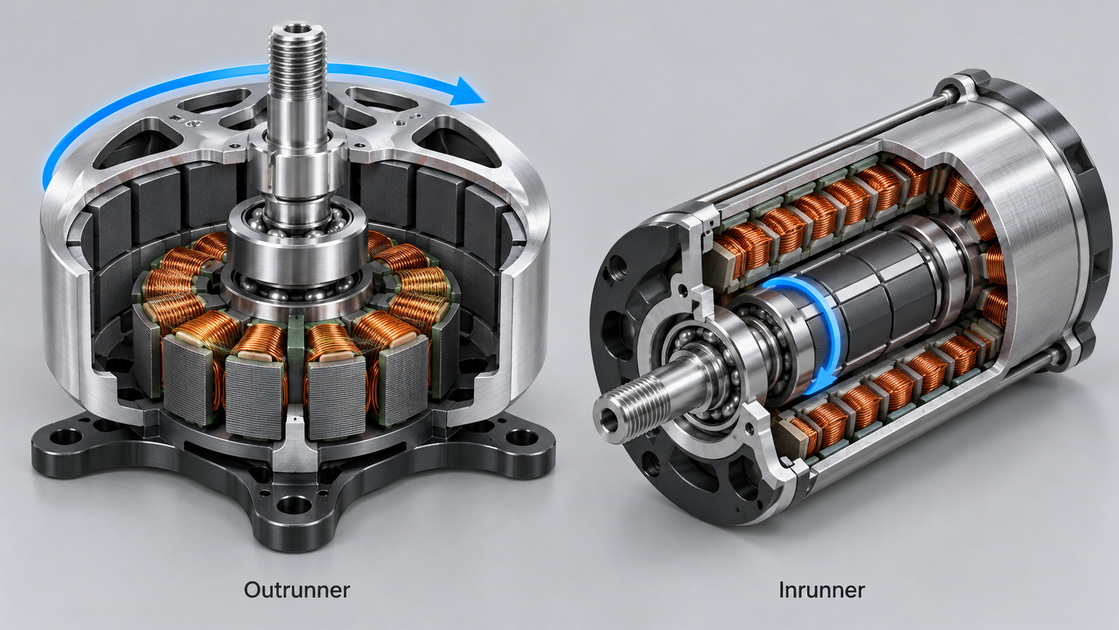
Both designs use electromagnetic interaction between stationary windings and a rotating magnetic assembly. Their fundamental difference is where the rotor sits.
In a conventional outrunner brushless motor, the stator and its windings sit inside the motor. Permanent magnets attach to an outer bell that rotates around the stator.
The larger effective rotor radius provides useful leverage for generating torque. This makes the architecture well suited to turning propellers directly without a reduction gearbox.
However, the rotating bell needs clearance. Nearby wiring, guards, and mounting structures must remain outside its operating envelope.
An inrunner places the rotor inside the stator. Its outer housing stays stationary while the internal rotor drives the shaft.
This arrangement can support a slender package, low rotor inertia, and high-speed operation. The stationary housing also provides a practical interface for mounting and conductive cooling.
These are design tendencies, not universal guarantees. Winding configuration, magnetic design, bearings, and cooling can substantially change the performance of either architecture.
| Comparison factor | Outrunner motor | Inrunner motor |
|---|---|---|
| Rotating component | External bell and connected shaft | Internal rotor and shaft |
| Typical package | Wider, often shorter | Narrower, often longer |
| Common design strength | Torque at moderate speed | High-speed operation and compact diameter |
| Direct propeller drive | Often a natural fit | Requires careful speed–torque matching |
| Rotor inertia | Often higher | Often lower |
| Cooling approach | Airflow and mounting-path conduction | Housing conduction and airflow |
| Mechanical clearance | Must accommodate rotating bell | Stationary housing simplifies enclosure integration |
| Typical drone application | FPV multirotors and larger propeller systems | Selected ducted fans and specialized propulsion |
| Efficiency | Depends on operating point and losses | Depends on operating point and losses |
| Main selection risk | Assuming greater torque guarantees endurance | Assuming higher RPM guarantees useful thrust |
The table describes common configurations. It should not replace a supplier's performance curves or application testing.
Torque is the turning effort available at the shaft. A propeller requires sufficient torque to maintain its target speed under aerodynamic load.
Outrunners place the magnetic interaction farther from the rotation axis. This geometry supports useful torque production at moderate speeds, explaining their strong fit with direct-drive propulsion.
Nevertheless, diameter alone does not establish torque capability. Stack length, magnetic loading, winding resistance, current, and thermal limits also matter.
Many inrunners use a relatively small rotor radius, which can reduce rotor inertia and suit high-speed operation.
That becomes useful when the load requires substantial RPM rather than substantial torque at low speed. A suitably designed ducted fan is one example.
However, an inrunner is not automatically the best motor for every ducted fan. Fan diameter, blade geometry, target speed, and cooling still determine the appropriate motor.
KV describes approximate no-load speed per applied volt. It does not indicate motor quality, efficiency, or maximum power.
For example, a 1,700 KV motor supplied with 22.2 V has an approximate no-load speed of 37,740 RPM. Actual loaded speed will be lower and depends on the propeller and electrical losses.
Lower KV corresponds to a higher torque constant under consistent measurement conventions. It does not automatically mean greater maximum torque, because allowable current and temperature remain limiting factors.
My preferred comparison is therefore torque at the required speed—not KV in isolation.
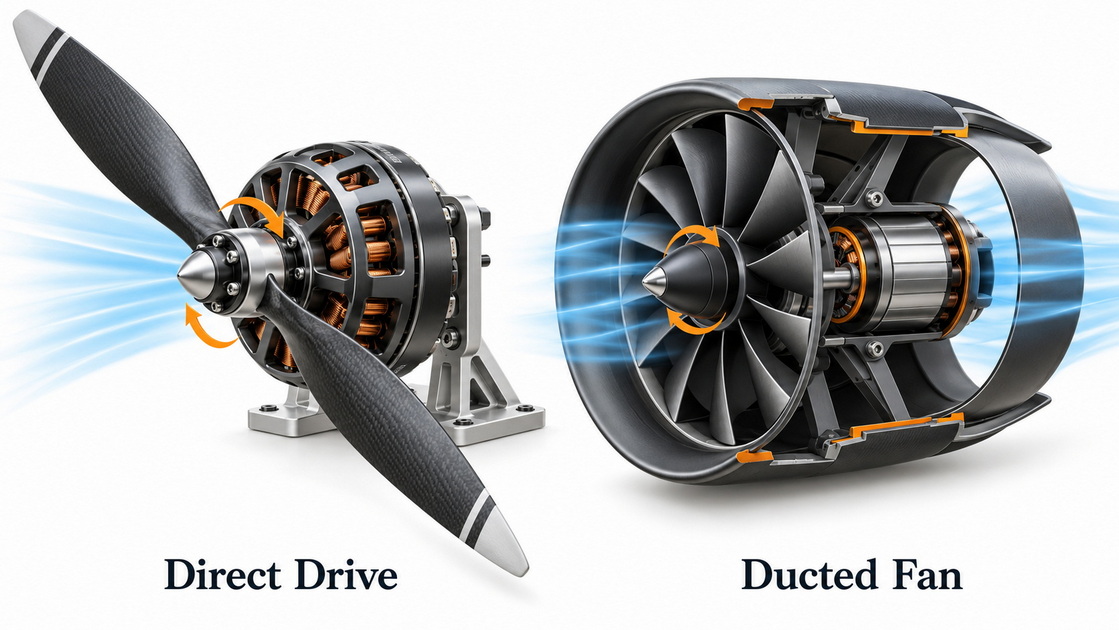
Neither architecture wins every efficiency comparison.
Motor efficiency compares mechanical shaft power with electrical input power. Drone propulsion performance also depends on the propeller, controller, wiring, and battery operating conditions.
A motor can operate efficiently while driving a poorly matched propeller. Conversely, an excellent propeller cannot compensate for a motor operating far outside its efficient range.
For a meaningful comparison, evaluate candidate systems at the same required thrust.
Record:
- Electrical voltage and current.
- Propeller diameter and pitch.
- Rotational speed.
- Thrust and shaft torque.
- Motor and controller temperatures.
- Ambient conditions and test duration.
Equal throttle percentages are not equivalent operating points. Different motor–controller combinations can produce different speeds and thrust at the same command.
For endurance-focused aircraft, prioritize the hover and cruise regions. For aggressive FPV flight, also examine burst demand, recovery behavior, and sustained temperatures.
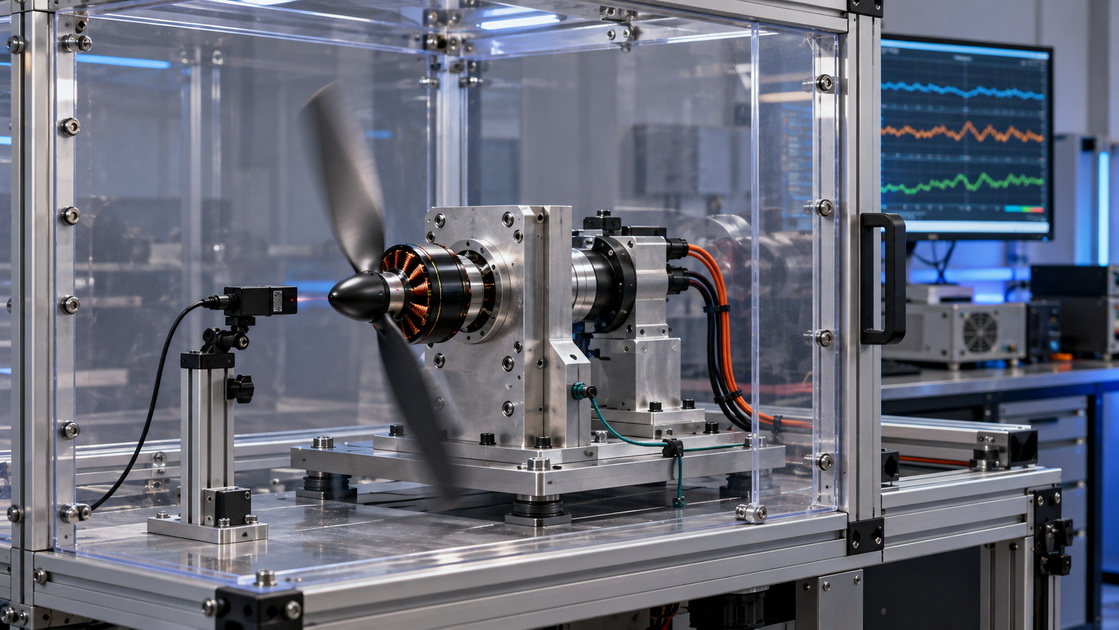
An open outrunner can expose internal components to moving air, but cooling effectiveness depends on bell design, airflow direction, mounting, and aircraft layout.
Open construction also increases exposure to dust, grit, and moisture. A rotating bell can suffer impact damage or become obstructed by debris.
Do not assume every outrunner runs cooler simply because its construction looks more open.
An inrunner's stator sits near the outer housing, creating opportunities to conduct heat into a mount, heatsink, or cooling jacket.
That can simplify integration in an enclosed machine. However, a stationary housing does not guarantee adequate cooling. Poor thermal contact or insufficient airflow can still create excessive temperatures.
For either architecture, verify continuous operation under representative installation conditions. A brief thrust test does not establish a reliable continuous rating.
Also, distinguish moisture resistance from underwater suitability. Submerged operation requires application-specific materials, bearing arrangements, electrical protection, and corrosion evaluation.
An outrunner is generally the practical starting point for conventional propeller-driven FPV aircraft.
Its direct-drive suitability helps avoid gearbox mass and complexity. Selection should then focus on propeller load, battery voltage, current requirements, weight, and mechanical durability.
Do not rank motors by peak thrust alone. Excessive current demand can compromise the controller, battery, and usable flight time.
For larger direct-drive propellers, an appropriately sized outrunner is often the stronger candidate.
The priority shifts toward efficient operation at the expected payload and flight profile. A motor optimized for short bursts may be unsuitable for prolonged hover.
Compare electrical power at the actual thrust requirement and confirm adequate thermal margin.
An inrunner deserves consideration when the design requires high speed or a narrow motor body inside a duct.
An outrunner may still work well where its speed range, rotor clearance, and mounting suit the fan assembly.
Select the motor around the fan's operating requirements rather than choosing the architecture first.
An inrunner combined with a reduction gearbox can drive a larger propeller at lower speed.
This broadens the available motor choices, but adds components, mass, mechanical losses, and maintenance considerations. Compare the complete geared system against a direct-drive alternative.
Document maximum takeoff mass, payload, flight duration, operating altitude, and ambient temperature.
For a multirotor, estimate hover thrust per motor from total weight and rotor count. Then define additional thrust capability around maneuvering, control authority, and mission requirements.
Identify the available diameter, blade clearance, noise constraints, and mechanical speed limit.
This helps establish the likely torque–speed operating region before choosing a motor.
Check the complete battery voltage range rather than nominal voltage alone.
Confirm controller current capability, electrical-speed compatibility, and suitable operating settings. A higher battery voltage does not automatically make an existing motor–propeller combination safer or more efficient.
Measure hover, expected cruise, sustained high load, and short-duration peak demand.
Use equivalent test conditions and record temperatures over time. Where practical, validate the final aircraft rather than relying exclusively on isolated bench results.
Review shaft fit, mounting dimensions, wire routing, balance, bearings, and assembly tolerances.
For production purchasing, ask how samples and subsequent batches will be checked against the agreed specification.
An inrunner's lower rotor inertia can support rapid motor acceleration. However, the attached propeller also contributes rotational inertia.
Controller behavior, available torque, propeller loading, and the operating point influence the response of the complete system.
Consequently, "lower rotor inertia" does not automatically translate into faster aircraft response. Test the assembled propulsion system.
Consider two hypothetical motors that both satisfy maximum-thrust requirements.
If one consumes less electrical power during the aircraft's dominant flight condition, it may support better endurance even if its peak output is lower.
This is an illustrative comparison, not a product test result. Its practical lesson is to weight performance according to mission duration, rather than selecting the highest headline figure.
Comparing a bare inrunner with a complete outrunner propulsion assembly can be misleading.
Include any gearbox, cooling hardware, adapter, protective structure, and additional wiring required by each option.
The most useful procurement metric is the performance of the installed system—not the motor by itself.
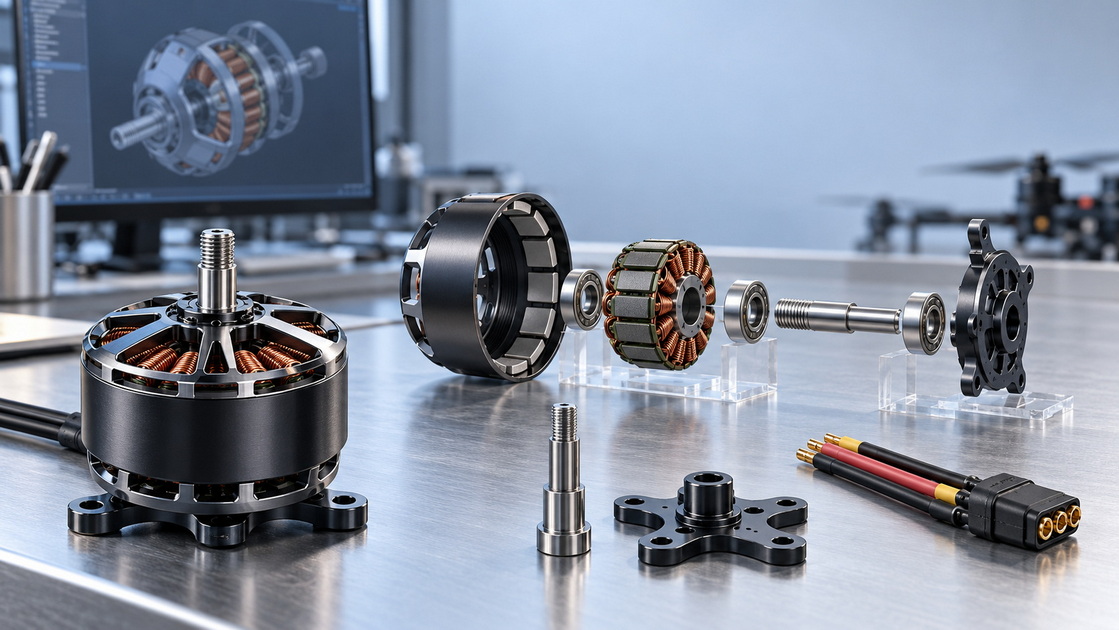
Customization should begin with an application brief rather than a request for "more power."
Useful inputs include:
- Required torque, speed, thrust, and duty cycle.
- Battery voltage and controller details.
- Propeller, fan, or mechanical-load specifications.
- Dimensional and mounting constraints.
- Ambient conditions and cooling provisions.
- Target service life and acceptance criteria.
At Zhongshan Yuhang Power Technology Co., Ltd., our OEM and ODM discussions can address brushless motor requirements across aerial, ground-based, and other professional equipment.
Depending on project feasibility, customization discussions may cover winding specifications, shaft configuration, mounting interfaces, wiring, and environmental protection. Each change should be validated against the intended operating conditions.
For your next propulsion project, send our team your aircraft weight, propeller or fan specifications, battery voltage, dimensional limits, and target duty cycle. These details provide a practical foundation for comparing suitable motor configurations.
Usually, for conventional direct-drive FPV multirotors. Outrunners offer a useful combination of torque delivery and propeller integration. Specialized high-speed or ducted applications may justify an inrunner.
Not inherently. Efficiency depends on motor design, operating speed, torque, temperature, and controller behavior. Compare measured performance at equivalent load points.
Yes, provided its torque–speed characteristics suit the propeller. A gearbox becomes relevant when the motor's preferred operating speed is too high for the intended propeller.
No. Lower KV indicates a different speed constant and torque constant relationship. Actual thrust depends on voltage, propeller characteristics, available current, and operating limits.
Neither architecture guarantees longer life. Bearing quality, balance, contamination, temperature, mechanical loading, and installation all influence durability.
1. maxon. "Power Density in Robotics: A Question of Torque." Explains external-rotor leverage, torque production, and rotor-inertia trade-offs. [maxongroup]
2. maxon. "Brushless DC Motors." Describes brushless motor configurations, internal-rotor designs, torque density, and dynamic performance. [maxongroup]
3. Tyto Robotics. "How to Choose the Right Motor and Propeller for Your Drone." Covers propulsion matching, voltage, KV, torque, and propeller operating requirements. [tytorobotics]
4. Tyto Robotics. "How to Measure Brushless Motor and Propeller Efficiency." Explains electrical input, shaft output, thrust measurements, and propulsion-system efficiency. [tytorobotics]
5. Tyto Robotics. "Database of Drone Motors, Propellers & ESCs." Describes available propulsion measurements and comparison parameters. [tytorobotics]


