Language


Views: 242 Author: Yuhang Power Publish Time: 2026-10-07 Origin: Site
Content Menu
>> Diameter Is Only One Variable
● 5 Inch vs 6 Inch Performance
>> Thrust and Current: Published Evidence
>> Handling, Heat, and Integration
● Validate Your FPV Power System
>> A Repeatable Comparison Procedure
>> OEM and ODM Buying Criteria
>> 1. Can a 2207 Motor Use 6-Inch Props?
>> 2. Are 5-Inch Props Better for Freestyle?
>> 3. Will 6-Inch Props Increase Flight Time?
>> 4. Should I Change Motor KV?
>> 5. Can I Keep My Existing ESC?
Choosing a 2207 motor with 5 inch vs 6 inch props is not simply a choice between agility and more thrust. Propeller diameter changes aerodynamic load, current demand, and the demands placed on the entire FPV power system. Published testing shows that a larger propeller can deliver more thrust while drawing disproportionately more current.
My recommendation is to treat 5-inch props as the starting point for a conventional freestyle or racing build. Consider 6-inch props when the frame accommodates them and testing confirms acceptable current, temperature, and mission efficiency—not because larger automatically means better.
This guide takes an engineering-led selection approach. It combines established propeller relationships with a published comparison, while separating measured results from design recommendations.
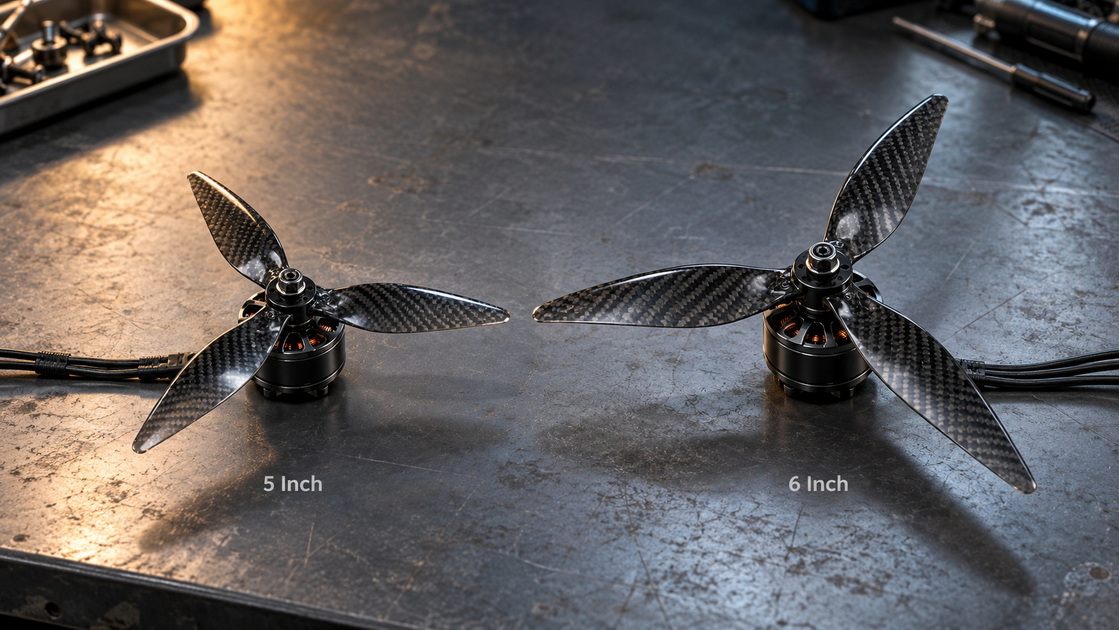
In common FPV motor naming, 2207 describes a stator approximately 22 mm in diameter and 7 mm tall. It identifies a motor size class, not a guaranteed thrust output or maximum safe propeller diameter.
Motors sharing that designation can still differ in winding, KV, construction, and performance. Consequently, "2207 compatible" is not enough information to approve a propulsion system.
For product context, TMOTOR markets its closely related 2207.5 F60PRO V specifically for 5-inch FPV drones, with multiple KV options. That is evidence of a particular product's intended application—not proof that every 2207-class motor should use the same propeller.
Before comparing props, identify:
- The exact motor model and KV.
- Battery cell count and operating voltage.
- Propeller diameter, pitch, blade count, and mass.
- ESC specifications and cooling conditions.
- Aircraft weight and intended flight profile.
These details turn a general motor-size comparison into a useful purchasing decision.
A 5045 tri-blade and a 6042 tri-blade differ in both diameter and nominal pitch. Comparing them can answer a practical build question, but it does not isolate diameter alone. Those are the two propeller descriptions used in the published example discussed below.
For a more controlled comparison, choose props from the same design family where possible. Record their mass, geometry, and pitch-to-diameter ratio.
Research by Dantsker and colleagues found that pitch changes affect thrust and power coefficients. Their 2022 study examined larger APC propellers, so its numerical results should not be presented as direct 5-inch or 6-inch FPV measurements. Its value here is the underlying aerodynamic relationship.
The selection lesson is specificity: evaluate the complete motor–propeller combination, not diameter in isolation.
A 6-inch propeller is only 20% larger in diameter than a 5-inch propeller, but its swept disk area is 44% larger:
A6/A5=(6/5)2=1.44
That calculation describes geometry, not a guaranteed increase in thrust.
Standard propeller relationships express thrust and shaft power as:
T=CTρn2D4
P=CPρn3D5
Here, \(n\) is rotational speed, \(D\) is diameter, and the coefficients depend on the propeller and operating conditions. These relationships are documented in the UIUC-associated research.
If speed, air density, and coefficients were unchanged, the diameter terms would imply approximately 2.07 times the thrust and 2.49 times the shaft power.
Those are conditional scaling calculations, not expected test results. A real motor may slow under additional load, and propeller coefficients will not necessarily remain constant.
The practical warning is clear: do not assume that a 20% diameter increase creates only a 20% increase in power demand.
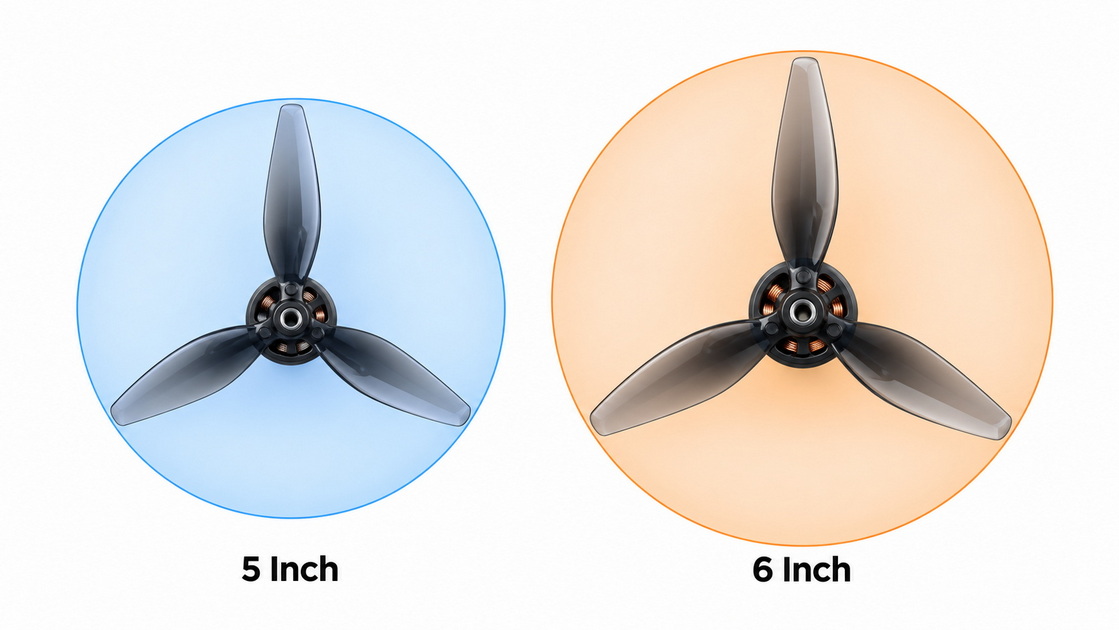
The following table provides a decision framework rather than universal performance specifications. Validate the tendencies against the exact motor, propeller, battery, and aircraft.
| Selection factor | 2207 with 5-inch props | 2207 with 6-inch props |
|---|---|---|
| Starting application | Conventional racing or freestyle evaluation | Larger-frame cruising or mission-specific evaluation |
| Propeller load | Lower diameter-related load, other factors equal | Higher diameter-related load, other factors equal |
| Maximum thrust | Must be measured | May increase, but is not guaranteed |
| Electrical demand | Establishes the comparison baseline | Requires renewed current and thermal checks |
| Control response | Evaluate with the selected propeller mass and tune | Reassess response and tune after the change |
| Endurance | Depends on whole-aircraft energy consumption | Cannot be inferred from diameter alone |
| Mechanical fit | Requires appropriate frame clearance | Requires greater clearance and fit verification |
| Approval basis | Exact manufacturer data plus validation | Exact manufacturer data plus validation |
The load distinction follows established diameter scaling; the thrust and current caution is also illustrated by the independent comparison below.
TheMechNinja published a DIY test of a Racerstar 2207-class 2500KV motor using 5-inch and 6-inch tri-blade props. Its reported results were:
| Reported measurement | 5-inch 5045 tri-blade | 6-inch 6042 tri-blade |
|---|---|---|
| Thrust | 690 g | 900 g |
| Current | 23.12 A | 34.30 A |
| Electrical power | 261 W | 352 W |
| Static thrust per watt | 2.64 g/W | 2.55 g/W |
All values above are reproduced from the source, not measured by Zhongshan Yuhang Power Technology Co., Ltd.
Calculated from those figures, the 6-inch combination produced approximately 30% more thrust while drawing approximately 48% more current. Reported static thrust per watt was slightly lower.
However, this is illustrative evidence, not a specification for your build. The article uses inconsistent BR/BB motor naming, employs a DIY spring-balance fixture, and acknowledges battery-related uncertainty. The propellers also differ in pitch.
My interpretation is therefore narrow: this example demonstrates why additional thrust must be assessed alongside current and power. It does not establish a universal 2207 motor limit.
The important question for cruising is not "Which prop produces the most thrust?" It is "Which complete aircraft consumes less energy while completing the same mission?"
Compare combinations at equal thrust, rather than equal throttle percentage. A larger prop may produce more thrust at the same command, making a throttle-only comparison misleading.
Static thrust per watt is useful for screening, but it is not flight time. The UIUC database includes both static and advancing-flow measurements, reinforcing the distinction between stationary testing and operation in moving air.
For an endurance evaluation, record:
- Aircraft takeoff mass.
- Battery condition and usable energy.
- Cruise speed and route.
- Energy consumed over that route.
- Remaining battery reserve.
- Motor and ESC temperature after landing.
Do not claim longer endurance until repeated flight tests support it.
For freestyle and racing, I would evaluate response before chasing maximum static thrust. Include throttle recovery, cornering behavior, vibration, and consistency near the end of a battery pack.
Propeller diameter alone does not describe rotational inertia. Propeller mass and how that mass is distributed also matter. Accordingly, do not assume every lightweight 6-inch prop behaves like every heavy 6-inch tri-blade.
For electrical approval, monitor temperature as well as current. A combination that survives a short thrust burst has not necessarily demonstrated suitability for repeated climbs or sustained operation.
Mechanical fit deserves a separate check. Verify propeller-to-frame, propeller-to-wire, and neighboring-propeller clearance. Include blade flex and frame movement in the assessment rather than checking only a stationary assembly.
Treat these as validation requirements, not as reasons to reject every 6-inch configuration.
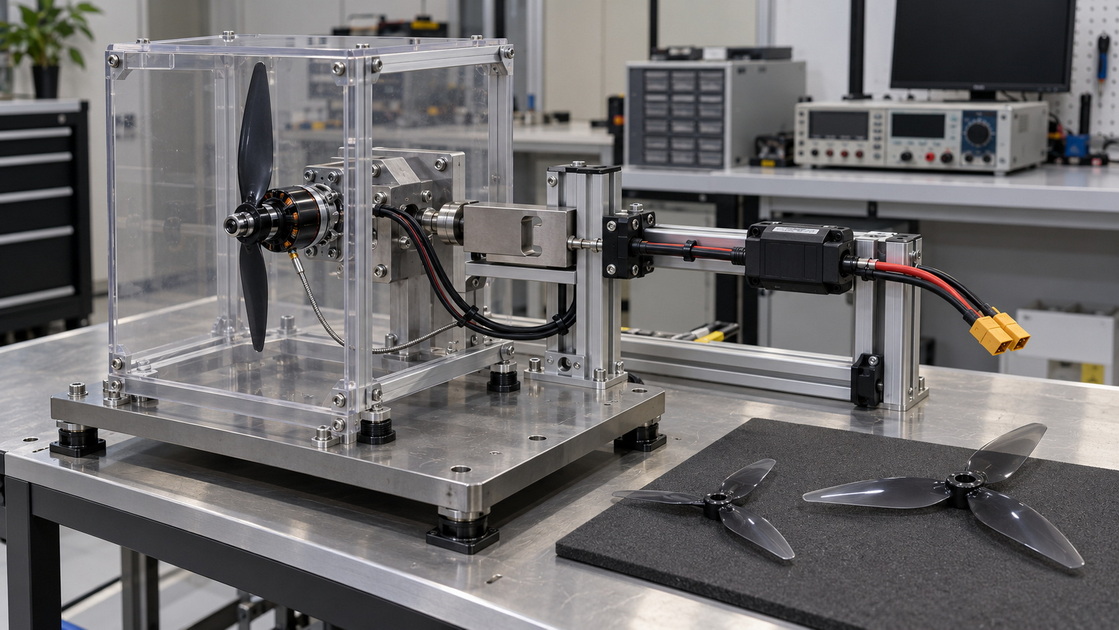
A useful test should produce a decision, not simply an impressive peak-thrust figure.
1. Define the mission. State whether the priority is racing response, freestyle control, cruising energy use, or payload capability.
2. Identify the exact motor, battery, ESC, and both propellers. Record firmware and settings.
3. Check manufacturer limits before energizing the system. Confirm voltage compatibility, mounting, and mechanical clearance.
4. Use a secured, calibrated thrust fixture with appropriate guarding, remote control, and an exclusion zone. Disconnect power before changing props.
5. Establish the 5-inch baseline. Record thrust, loaded voltage, current, input power, and temperature under documented conditions.
6. Test the 6-inch prop incrementally. Stop for abnormal vibration, rapidly increasing temperature, or any component limit.
7. Compare both configurations at matched thrust points, including the thrust needed for the intended mission.
8. Conduct controlled flight trials only after the bench evaluation passes. Repeat the route with comparable batteries and conditions.
There is no universal full-throttle duration or temperature limit suitable for every 2207 motor. Use limits appropriate to the actual components and test equipment.
For reporting, calculate electrical input power as:
Pinput=Vloaded×I
Then calculate static thrust per watt from measured thrust and input power. Keep this separate from the shaft power used in aerodynamic coefficient equations.
A useful report includes complete operating conditions. UIUC's published database, for example, documents measurement methods and distinguishes thrust measurement from torque measurement.
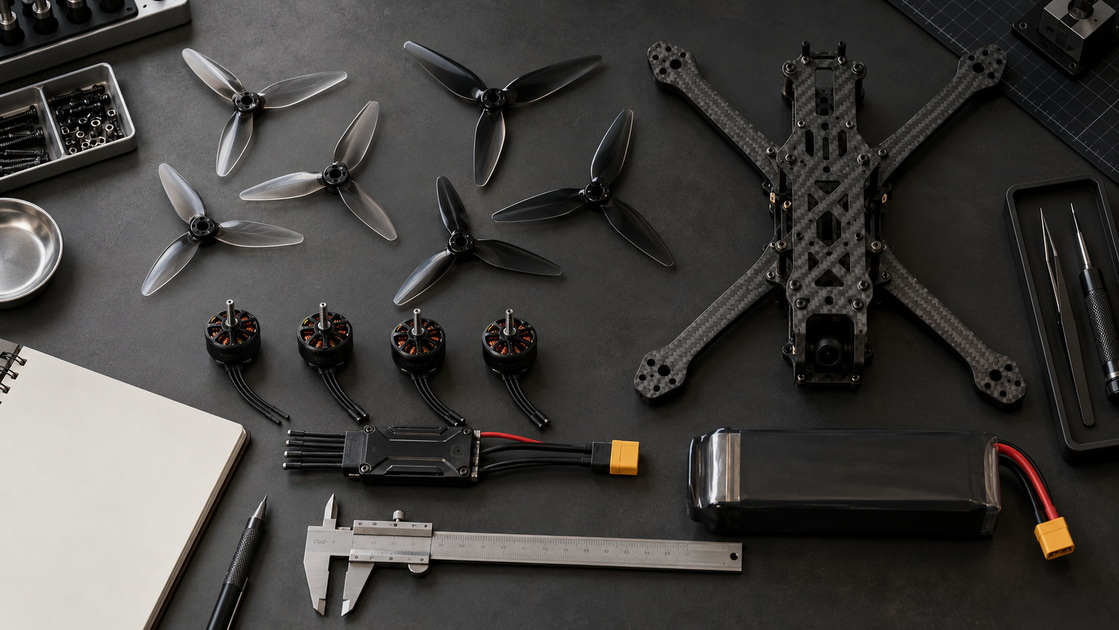
For OEM buyers, my recommendation is to specify an operating envelope, not simply request "a 2207 motor for 6-inch props."
A practical request for quotation should include:
- Intended aircraft and mission.
- All-up weight and payload range.
- Battery voltage range.
- Exact propeller models or permitted alternatives.
- Continuous and burst thrust requirements.
- Current and temperature acceptance limits.
- Mounting, shaft, connector, and dimensional requirements.
- Sample validation and production change-control requirements.
Ask for test curves rather than only a maximum-thrust number. Require the voltage, propeller, test duration, and measurement conditions alongside every performance claim.
Also distinguish predicted data from measurements. APC explains that its published performance files are generated using proprietary analysis software based on actual propeller geometry. Those files are useful for comparison, but they should not be relabeled as physical tests of your FPV motor.
Zhongshan Yuhang Power Technology Co., Ltd. provides brushless-motor development, manufacturing, and OEM/ODM services, according to the company background supplied for this article.
For a project inquiry, send your aircraft weight, battery specification, proposed props, and flight objectives. Request a discussion of candidate motor configurations and the validation evidence needed before production approval.
Contact Zhongshan Yuhang Power Technology Co., Ltd. to discuss your FPV motor requirements and a mission-specific OEM or ODM evaluation.
Some configurations can, but the size designation alone does not establish compatibility. The published Racerstar example operated with a 6-inch prop, yet it cannot approve a different motor, voltage, or propeller. Check exact limits and validate the combination.
They are a sensible starting point for conventional 5-inch builds. However, "better" depends on propeller mass, motor behavior, aircraft weight, and tuning. Evaluate control response and repeatability instead of deciding from diameter alone.
Not necessarily. In the published comparison, the 6-inch prop produced more maximum thrust but slightly lower static thrust per watt. That result does not predict cruise endurance; measure energy consumption over comparable flights.
Do not prescribe a KV change from propeller diameter alone. Compare manufacturer-supported voltage, KV, and propeller combinations, then test the candidate setup. KV is one selection variable, not an independent guarantee of efficiency.
Possibly, but reassess it. The larger prop may change current demand, as the independent test illustrates. Compare measured demand with the ESC manufacturer's ratings and operating conditions; a successful brief burst is insufficient evidence for sustained use.
1. Dantsker, Caccamo, Deters, and Selig — [Performance Testing of APC Electric Fixed-Blade UAV Propellers]
Supports the theoretical relationships between propeller thrust, shaft power, diameter, and rotational speed. Its measurements should not be presented as direct test results for the 5-inch and 6-inch FPV configurations discussed in this article. [m-selig.ae.illinois]
2. University of Illinois Urbana-Champaign — [UIUC Propeller Database]
Provides background on propeller performance evaluation, static and advancing-flow testing, thrust and torque measurements, and aerodynamic coefficients. [m-selig.ae.illinois]
3. TheMechNinja — [FREE Thrust Test Rig | Racerstar 2500KV Motor Thrust Test]
Source of the article's reported 5-inch versus 6-inch thrust, current, power, and static thrust-per-watt figures. The DIY fixture, inconsistent motor naming, and testing limitations make this an illustrative comparison—not a specification for Zhongshan Yuhang products. [themechninja]
4. TMOTOR — [F60PRO V 2207.5 Brushless Racing Motor for 5 Inch FPV Drones]
Supports the stated positioning of this specific 2207.5 motor for 5-inch FPV drones. It does not establish compatibility requirements for every 2207-class motor. [t-hobby]
5. APC Propellers — [Performance Data]
Explains performance predictions generated from propeller geometry using analysis software. Supports the distinction between calculated propeller data and physical testing of a complete motor–propeller combination. [apcprop]
6. UAVMODEL — [FPV Motor Sizing Guide: Stator Volume, KV Selection, and Thrust-to-Weight Calculation]
Provides industry background on the common meaning of the 2207 designation and motor sizing. The article does not adopt this source's categorical minimum-motor-size claim for 6-inch propellers. [blog.uavmodel]


