Language


Views: 246 Author: Yuhang Power Publish Time: 2026-10-03 Origin: Site
Content Menu
● What Does KV Mean in an FPV Drone Motor?
● 2550KV vs 2750KV: Side-by-Side Comparison
● Why a 7.8% KV Increase Can Feel Much Larger in Flight
● Why 4S and 6S Change the Decision
● Propeller Choice: The KV Decision Is Not Complete Without It
>> Lower-Pitch and Lighter Props
>> Higher-Pitch and Heavier Props
>> Practical Propeller Test Plan
● Stator Size Matters as Much as KV
● Expert Selection Framework for Racing Pilots and OEM Buyers
>> Choose 2550KV as Your Starting Point If:
>> Choose 2750KV as Your Starting Point If:
>> Reconsider Both Options If:
● The Most Useful Metric: Thrust per Watt, Not KV Alone
● A Benchmark Test Protocol for OEM and Product Teams
● Why Zhongshan Yuhang Power Technology Co., Ltd. for Custom FPV Motor Projects?
>> 1. Is 2750KV faster than 2550KV for an FPV racing drone?
>> 2. Is 2550KV or 2750KV better for a 4S 5-inch FPV drone?
>> 3. Can I run a 2550KV or 2750KV 5-inch FPV motor on 6S?
>> 4. Does higher KV always produce more thrust?
>> 5. How do I know if my FPV motors are overheating?
For a typical 4S 5-inch racing drone, the choice between a 2550KV vs 2750KV motor is a real performance trade-off. A 2750KV FPV motor generally produces a more aggressive throttle response and higher unloaded RPM potential, while a 2550KV motor usually provides a wider thermal and current-draw margin with the same propeller and battery.
Neither KV is universally "better." The correct FPV drone motor depends on the full power system: stator size, propeller diameter and pitch, battery voltage, ESC current rating, all-up weight, track style, ambient temperature, and pilot throttle habits. For a 4S racing build, both 2550KV and 2750KV commonly sit inside the conventional 5-inch motor-KV range; for a 6S build, both are generally too high unless the entire propeller and power-system setup is specifically engineered around lower load.
Technical safety note: A motor KV comparison is not an instruction to use a given battery or propeller. Always follow the motor manufacturer's published operating limits, verify ESC and battery current capability, use a smoke stopper for new builds, and inspect motor temperature after the first flights.
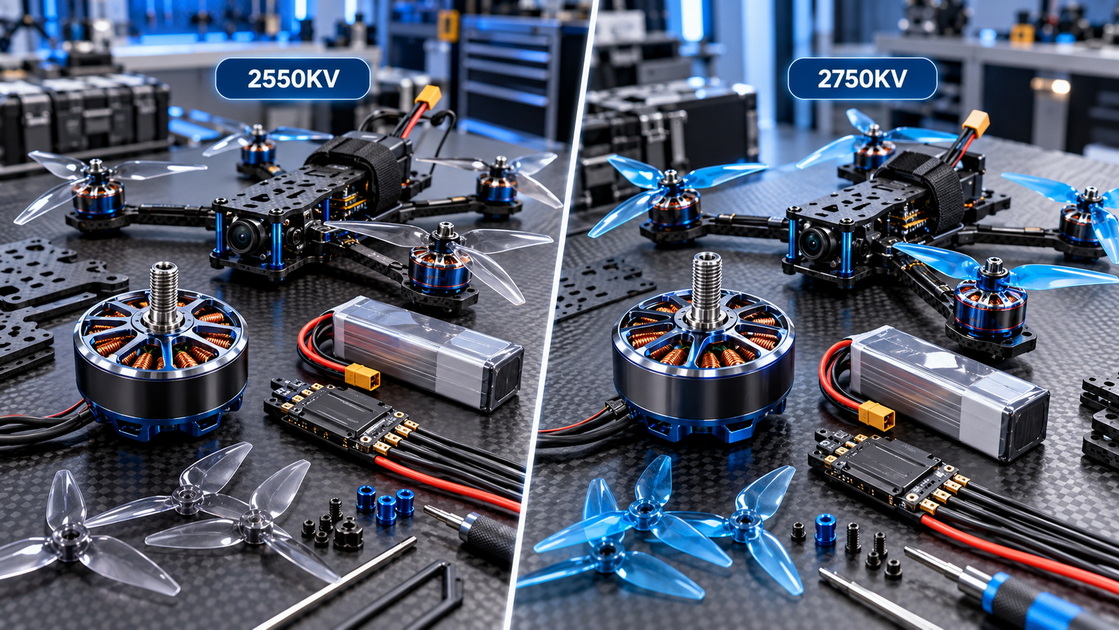
Choose a 2550KV motor when you want a more balanced 4S racing or freestyle power system, especially if you use heavier 5-inch propellers, higher-pitch props, warm-weather flying, long throttle bursts, or a build with limited ESC and battery-current headroom.
Choose a 2750KV motor when you want a more explosive 4S racing feel, sharper acceleration, and higher RPM potential with a lightweight build, carefully selected propeller, good cooling, and an ESC-plus-battery combination that can safely handle higher current demand.
The 2750KV motor has approximately 7.8% more KV than a 2550KV motor:
(2750−2550)/2550×100=7.84%
That may sound small, but it can have a meaningful effect because propeller load rises rapidly with RPM. Under similar conditions, thrust is approximately related to the square of rotational speed, while required power rises roughly with the cube of rotational speed. This is why a modest KV increase can produce a noticeably stronger top-end feel while also increasing current draw and heat.
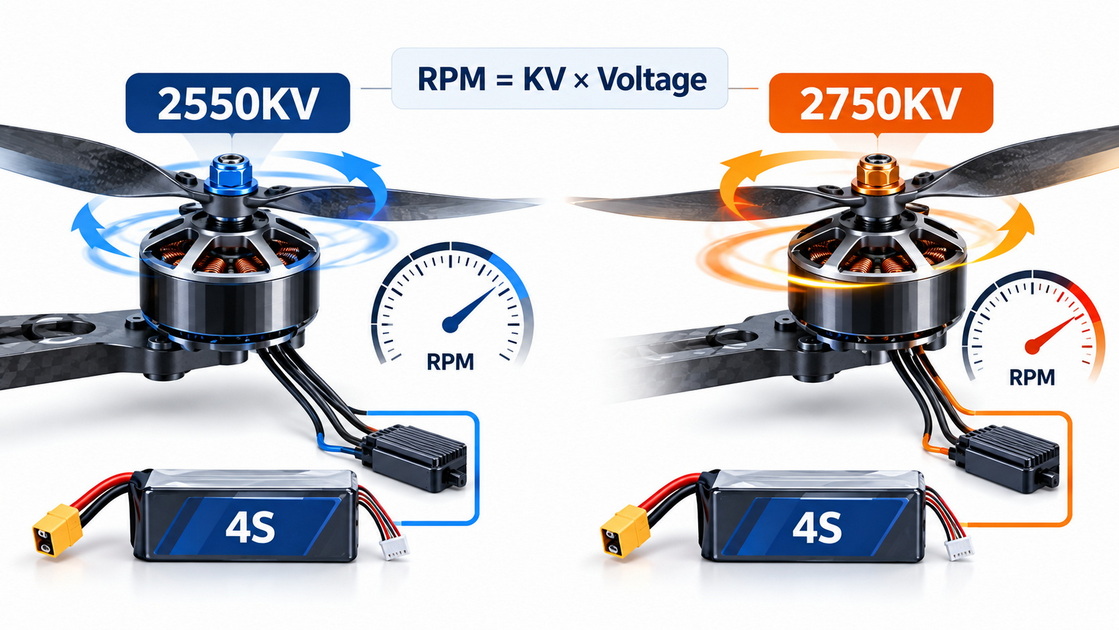
KV means revolutions per minute per volt under no load. It does not mean "kilovolts," and it does not directly indicate motor power, torque, quality, or efficiency.
The no-load motor-speed estimate is:
No-load RPM=KV×Battery Voltage
Using a fully charged 4S LiPo battery at 16.8 V:
| Motor KV | Theoretical No-Load RPM at 16.8 V |
|---|---|
| 2550KV | 42,840 RPM |
| 2750KV | 46,200 RPM |
These figures are theoretical. Once a propeller is fitted, aerodynamic load reduces actual RPM. Battery voltage also falls under load, and ESC timing, motor resistance, propeller choice, temperature, and throttle position all influence the real result.
Still, the comparison is useful: on the same fully charged 4S pack, a 2750KV motor has an unloaded RPM potential that is approximately 3,360 RPM higher than a 2550KV motor.
Industry FPV motor-selection guidance consistently emphasizes that KV must be evaluated together with battery cell count, propeller size, stator dimensions, and intended flight style. Higher-KV motors generally spin faster and draw more current, while the correct system match must be verified through thrust and current data rather than KV alone.
| Factor | 2550KV FPV Motor | 2750KV FPV Motor |
|---|---|---|
| Best starting application | 4S 5-inch racing, freestyle, balanced performance | 4S 5-inch racing, lightweight aggressive builds |
| RPM potential on 4S | High | Higher |
| Throttle feel | Strong, controllable, broader usable range | More immediate, sharper, more aggressive |
| Peak-speed potential | High | Potentially higher with matched prop and battery |
| Current draw | Usually lower with the same setup | Usually higher with the same setup |
| Motor and ESC heat | Generally easier to manage | Higher thermal risk if over-propped |
| Battery stress | More forgiving | Requires stronger current-delivery capability |
| Propeller tolerance | Better margin with high-pitch or heavier props | Often benefits from lower-pitch or lighter props |
| Flight time | Often slightly better under comparable flying conditions | Often shorter under similar use because of higher current demand |
| Best pilot profile | Racers seeking balance, consistency, and repeatable laps | Racers prioritizing acceleration, exit speed, and peak aggression |
| 6S suitability | Usually unsuitable for a standard 5-inch setup | Usually unsuitable for a standard 5-inch setup |
A general FPV rule of thumb places 4S 5-inch motors in roughly the 2200KV–2700KV range, while 6S 5-inch builds are more commonly paired with lower KV, often around 1700KV–2100KV. The exact recommendation varies by motor size, propeller, and flying style.
The difference between 2550KV and 2750KV is not simply a linear "7.8% more speed" comparison.
A propeller's aerodynamic load increases rapidly as RPM rises:
Thrust∝RPM2
Power Demand∝RPM3
These are simplified relationships, not complete motor-test equations. Actual performance also depends on prop geometry, air density, ESC behaviour, voltage sag, and motor efficiency.
However, they explain a practical observation from racers: a slightly higher-KV motor can feel substantially more aggressive near the top of the throttle range, yet it can also punish an inadequate battery, overloaded ESC, or high-pitch propeller more severely.
Example: If all other variables were equal and the 2750KV motor could sustain the full 7.8% RPM increase, simplified scaling suggests:
1.07842≈1.16
Potential thrust could increase by roughly 16%.
1.07843≈1.25
Required aerodynamic power could rise by roughly 25%.
In reality, the system will not necessarily achieve those exact values because voltage sag, motor resistance, propeller limitations, and ESC current limits intervene. The lesson is not to predict thrust from a formula—it is to understand why high-KV choices need real bench-test validation.
Battery voltage has a large effect on motor RPM. A fully charged 6S LiPo battery reaches 25.2 V, which is 1.5 times the voltage of a fully charged 4S pack.
| Setup | 2550KV Theoretical No-Load RPM | 2750KV Theoretical No-Load RPM |
|---|---|---|
| 4S at 16.8 V | 42,840 RPM | 46,200 RPM |
| 6S at 25.2 V | 64,260 RPM | 69,300 RPM |
This is why 2550KV and 2750KV motors are normally discussed for 4S builds, not standard 6S 5-inch builds. Applying 6S voltage to a motor intended for a 4S high-KV setup can push RPM, current, heat, and mechanical load beyond a safe operating range.
Manufacturers and FPV technical sources consistently advise using lower KV as cell count and propeller load increase. High KV is generally paired with lower voltage and smaller or lighter props; lower KV is generally more suitable for higher-voltage and larger-prop systems.
A 2550KV motor with an aggressive 5.1 × 4.6 propeller can draw more current than a 2750KV motor with a low-pitch 5.0 × 3.0 propeller. The motor, propeller, battery, and ESC form one system.
Lower-pitch, lighter props generally reduce load. They can be useful for:
- 2750KV racing builds
- Hot climates
- Tight courses with rapid throttle changes
- Builds where motor temperature is already high
- ESCs with limited current margin
- Pilots who prioritize response without excessive top-end amp draw
Higher-pitch or heavier props generally demand more torque and current. They can be useful for:
- 2550KV builds seeking stronger mid-to-top-end drive
- Open-course racing
- Freestyle with more sustained throttle
- Larger stator motors with sufficient torque reserve
- Builds with robust ESC and battery-current capability
But pairing a small stator, high-KV motor with a high-load prop can create excessive current draw, motor heat, and ESC stress. FPV motor-selection guidance warns that smaller high-KV motors driving larger or higher-pitch props can overload the system.
Do not buy a large quantity of props based on a single online recommendation. Test two or three candidate propellers under controlled conditions:
1. Start with the motor manufacturer's recommended propeller range.
2. Install a smoke stopper for initial bench checks.
3. Test hover and moderate throttle first.
4. Perform short, controlled full-throttle bursts only in a safe environment.
5. Land and check motor temperature carefully.
6. Review blackbox data for current spikes, voltage sag, and throttle behaviour.
7. Compare flight time, heat, and lap consistency—not only subjective speed.
8. Reject combinations that create excessive heat, oscillation, or current stress.
KV tells you the motor's no-load RPM-per-volt constant. It does not tell you how much torque the motor can sustain under a real propeller load.
A motor described as 2207 2550KV and a motor described as 2306 2550KV can feel very different because their stator geometry differs:
- The first two digits represent stator diameter in millimetres.
- The last two digits represent stator height in millimetres.
- Larger stator volume can generally support more torque, though magnet design, winding, air gap, bearings, and cooling also matter.
For racing drones, a larger or more torque-oriented stator can carry a higher-load prop more effectively. A lighter motor can improve agility and reduce all-up weight, but may have less thermal reserve during repeated high-throttle runs.
When comparing 2550KV vs 2750KV motors, make the comparison fair:
- Same stator size
- Same propeller
- Same battery voltage
- Same ESC
- Same test environment
- Same throttle points
- Same cooling conditions
Comparing KV alone across different motor sizes is not a controlled test.
Use this decision sequence rather than choosing by KV number alone.
- You are building a 4S 5-inch quad
- You use medium-to-high pitch 5-inch props
- Your build is not extremely light
- You want a broader margin for battery and ESC current
- You race in warm conditions
- You prefer predictable throttle control over maximum punch
- You fly tracks with longer throttle sections
- You need a dependable all-round OEM configuration
- You are building a lightweight 4S 5-inch race quad
- You want strong acceleration and an aggressive top-end feel
- You use a carefully selected low-to-medium-load propeller
- You have an ESC and battery with verified current headroom
- You are prepared to evaluate motor temperatures and blackbox logs
- Your track rewards quick exits, direction changes, and rapid speed recovery
- You accept potentially shorter flight time and higher system stress
- You are building a standard 6S 5-inch quad
- Your propeller exceeds the motor manufacturer's recommendations
- Your ESC current rating is uncertain
- Your battery shows heavy voltage sag
- Your motors already run hot with a lower-KV setup
- Your all-up weight is significantly above a typical racing build
- You need endurance, cinematic stability, or long-range efficiency more than top-end racing response
A motor's efficiency should be evaluated using measured thrust and electrical power:
Efficiency=Thrust in grams/Power in watts
where:
Power=Voltage×Current
For example, a motor-prop combination producing 1,000 g of thrust while consuming 500 W has an efficiency of:
1,000/500=2.0 g/W
Compare the 2550KV and 2750KV combinations at practical throttle points—such as 25%, 50%, 75%, and 100%—rather than only at maximum thrust. Racing rarely happens at a constant 100% throttle, and a motor that is efficient only at one extreme point may not deliver the best lap-to-lap result.
Thrust-test guidance recommends recording thrust, current, power, and g/W across throttle positions. It also warns that a high-load propeller can cause overcurrent and overheating, potentially damaging motor or ESC components.

For manufacturers, drone brands, and serious builders, the most credible KV comparison uses a controlled test protocol.
| Test Variable | Control Requirement |
|---|---|
| Motor | Same motor series and stator size; compare only 2550KV and 2750KV winding variants |
| Battery | Same pack model, cell count, capacity, and state of charge |
| ESC | Same ESC and firmware configuration |
| Propeller | Same model, diameter, pitch, material, and condition |
| Test stand | Rigid mount with calibrated thrust sensor |
| Test points | 25%, 50%, 75%, and 100% throttle |
| Run duration | Consistent short duration with cooling intervals |
| Measurements | Thrust, voltage, current, power, RPM if available, motor temperature |
| Environment | Record ambient temperature and airflow |
| Acceptance review | Compare g/W, peak current, heat, vibration, and repeatability |
This testing approach prevents false conclusions. It also creates credible data for product pages, OEM project discussions, and power-system integration.
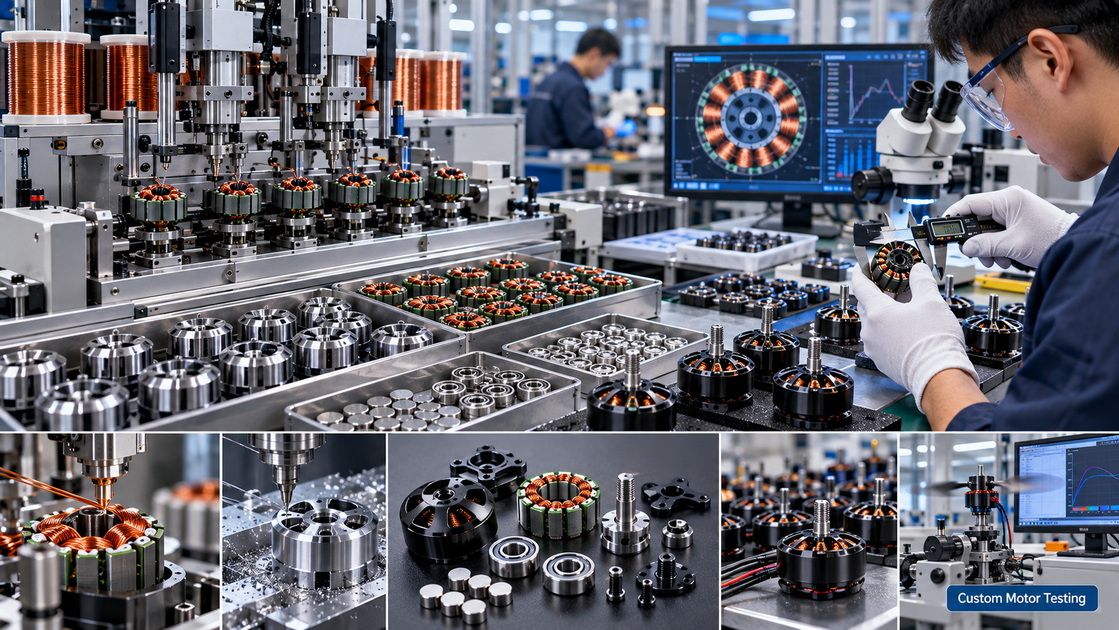
Zhongshan Yuhang Power Technology Co., Ltd. develops, manufactures, and supplies brushless motor systems for FPV drones, racing drones, RC cars, high-power fans, gimbal cameras, aircraft, robot vacuums, underwater robots, and other professional equipment.
For FPV drone brands, racing teams, and equipment integrators, the company can support custom motor projects that consider the whole power system—not only the KV label:
- Custom KV winding selection for the target voltage and propeller range
- Stator-dimension selection based on torque, weight, and cooling requirements
- Motor-shaft, bell, bearing, and mounting customization
- Connector, wire-length, and cable-specification options
- Prototype and sample evaluation before volume orders
- OEM and ODM branding support
- Power-system consultation for motor, propeller, ESC, and battery compatibility
- Application support for drones, RC vehicles, robotics, gimbals, fans, and other brushless-motor applications
For an OEM racing-drone project, the best specification is normally determined by measured thrust data, temperature behaviour, system current, and flight testing—not by choosing the highest KV value available.
For a 4S 5-inch racing drone, 2550KV is often the more balanced choice when you need controllable power, better thermal margin, and flexibility with moderate-to-higher-load propellers. 2750KV can be the better performance choice for lightweight racing builds that prioritize acceleration and top-end response—but only when the propeller, ESC, battery, cooling, and pilot setup can handle the extra current demand.
Do not select a motor based on KV alone. Compare stator size, winding, test data, propeller load, battery voltage, current draw, thrust per watt, motor temperature, and real-flight behaviour.
On the same voltage, motor size, propeller, and load conditions, a 2750KV motor has a higher no-load RPM potential than a 2550KV motor. In a real drone, whether it produces better race performance depends on the propeller, battery voltage sag, ESC capability, stator size, weight, heat, and track layout.
Both can be suitable for a 4S 5-inch build. A 2550KV motor is usually a more balanced starting point, especially for heavier props or warmer conditions. A 2750KV motor may better suit a lightweight racing setup that uses an appropriate propeller and has strong current-delivery capability.
Usually, no—not for a standard 5-inch configuration. Both KV ratings produce very high RPM potential on a 6S battery. Standard 6S 5-inch builds more commonly use lower-KV motors, often around 1700KV–2100KV, depending on propeller, motor size, and desired performance.
No. KV describes no-load RPM per volt, not guaranteed thrust. Thrust depends on the entire motor-prop-battery system, including stator torque, propeller design, voltage, current delivery, ESC settings, and aerodynamic load. Always use motor thrust-test data for the exact propeller and voltage.
After a short, controlled flight, land safely and check motor temperature carefully. Motors that are too hot to touch comfortably may indicate an overloaded propeller, excessive PID oscillation, incorrect filtering, unsuitable KV-to-voltage pairing, damaged bearings, poor cooling, or an electrical issue. Review blackbox data and manufacturer limits before continuing.
1. [How to Choose FPV Drone Motors — Oscar Liang] — Technical guide covering KV as no-load RPM per volt, battery-voltage matching, propeller selection, current draw, stator size, and common 4S/6S KV ranges. [oscarliang]
2. [FPV Motor Sizes Guide — LIGPOWER] — Guidance on stator dimensions, voltage, propeller pitch, current draw, heat, and matching motor, ESC, battery, and propeller systems. [ligpower]
3. [Drone Motor Size Chart and Selection Guide — T-Motor] — Overview explaining why KV must be evaluated with propeller size, battery voltage, and total aircraft weight. [shop.tmotor]
4. [Choosing the Right KV for Your Drone — Pyrodrone] — FPV motor-KV explanation and typical 5-inch 4S and 6S KV ranges. [pyrodrone]
5. [FPV Motor Thrust Testing and Selection Guide — UAVMODEL Insights] — Thrust-test concepts, measurement of thrust, current, and g/W, and warning about high-load propeller overcurrent and overheating. [blog.uavmodel]
6. [FPV Motor KV Efficiency Testing — UAVMODEL Insights] — Example protocol for comparing motor thrust, current, power, efficiency, and real-flight energy use at controlled throttle points. [blog.uavmodel]


