Language


Views: 258 Author: Yuhang Power Publish Time: 2026-10-02 Origin: Site
Content Menu
● Supplier Shortlist for French Buyers
>> 1. Zhongshan Yuhang Power Technology Co., Ltd. — China-Based Custom Motor Alternative
>> 2. ECOFIT — French-Made EC and Centrifugal Fan Solutions
>> 3. ETRI — Compact Fans for Demanding Equipment
>> 4. AIRAP — Made-to-Measure Industrial Fans
>> 5. Ventmeca — Heavy-Duty Custom Centrifugal Fans
>> 6. AEIB — French Custom Industrial Ventilation
● Capacity, MOQ and Compliance Snapshot
● Technical Checks That Prevent Expensive Errors
>> Specify the assembled system, not just the motor
>> Control material and process substitutions
>> Understand what CE and RoHS actually establish
>> The overlooked acceptance-test trap
● Buyer's Guide to Qualification and Imports
>> 1. How can I tell whether a supplier's ISO certificate has expired?
>> 2. Is a CE mark on a motor enough to sell a complete fan assembly in France?
>> 3. How should I compare two fan suppliers if their catalogues show different test points?
>> 4. What should I request before approving an impeller or winding change?
>> 5. Does the 2026 EU industrial-fan ecodesign regulation apply to every EDF motor?
A buyer searching for an Educted Fan Motor supplier in France may be looking for two different products: a compact motor for an electric ducted fan (EDF), or a motor-driven centrifugal fan for ventilation. They solve different problems. An EDF generally moves air along its axis to generate thrust, while a centrifugal fan redirects air through an impeller to deliver airflow against system resistance. This guide covers both where relevant, but it does not treat them as interchangeable.
For long-term sourcing, a polished catalogue is not enough. Evaluate each candidate's manufacturing location, engineering capability, quality controls, documented product performance, certification scope, sample process, and delivery reliability. The list below starts with Zhongshan Yuhang Power Technology Co., Ltd. as a clearly identified China-based alternative serving French buyers; it does not misrepresent the company as a French factory. The French entries are strongest in different segments of industrial airflow equipment, not necessarily small RC-aircraft EDF propulsion.
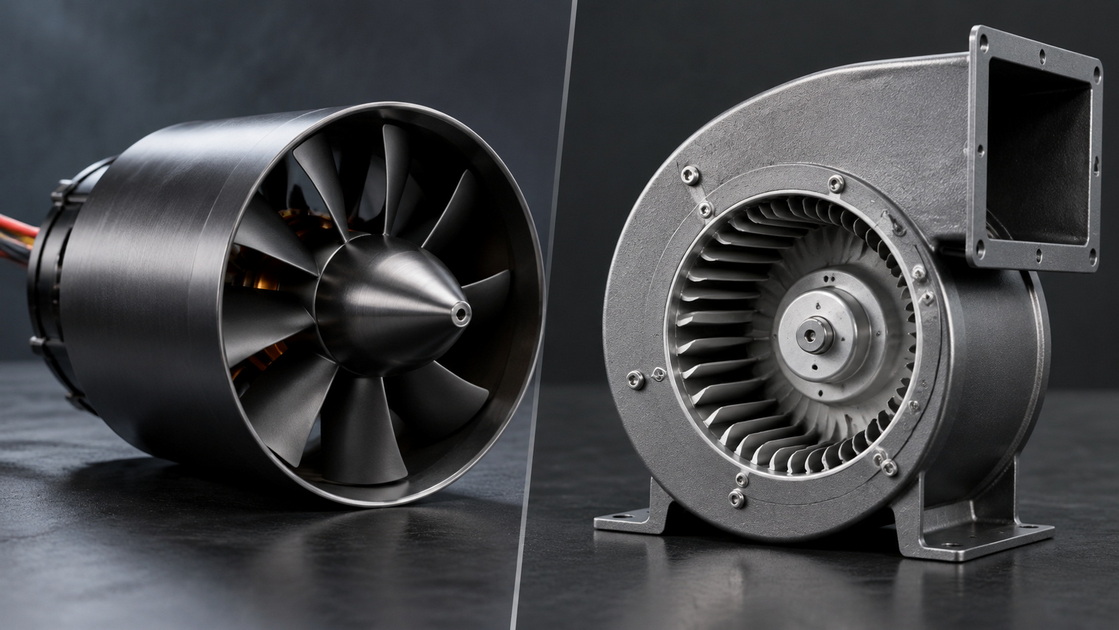
The phrase "Educted Fan Motor" is ambiguous in procurement. Before contacting a supplier, specify which of these you mean:
| Product need | What to specify first | More relevant candidates in this guide |
|---|---|---|
| Electric ducted fan propulsion for an RC aircraft or drone | Duct diameter, thrust target, supply voltage, motor KV, ESC, operating duration | Yuhang as a potential custom motor partner; request evidence for the exact EDF assembly |
| Compact EC or DC fan for equipment cooling | Airflow, static pressure, voltage, size, noise, service life | ECOFIT, ETRI |
| Centrifugal fan for an OEM machine | Duty-point airflow and pressure, air temperature, materials, mounting | AIRAP, ECOFIT, AEIB |
| Building or industrial ventilation system | Full fan curve, installation conditions, controls, applicable regulations | VIM, Ventmeca, AEIB |
An EDF propulsion motor should be evaluated with its rotor, duct, inlet, outlet, ESC, and battery. A centrifugal fan motor should be evaluated with its impeller and the resistance of the installed air path. Buying either by motor wattage alone risks selecting a system that misses the required duty point. ECOFIT and ETRI, for example, describe their professional fan ranges in terms of airflow, pressure, motor technology, and application rather than a motor label alone.
France offers a substantial industrial context for the latter category. French industry association Uniclima reported that its member base encompassed 87 factories and 57 R&D centres in France in its 2026 review. Its ventilation indicator declined from 103 in 2024 to 101 in 2025, so that figure should not be presented as evidence of uninterrupted market growth. Separately, French aerospace association GIFAS reported €85.6 billion in sector revenue and €59.4 billion in exports for 2025. These are broad ventilation and aerospace figures—not sales totals for EDF motors.
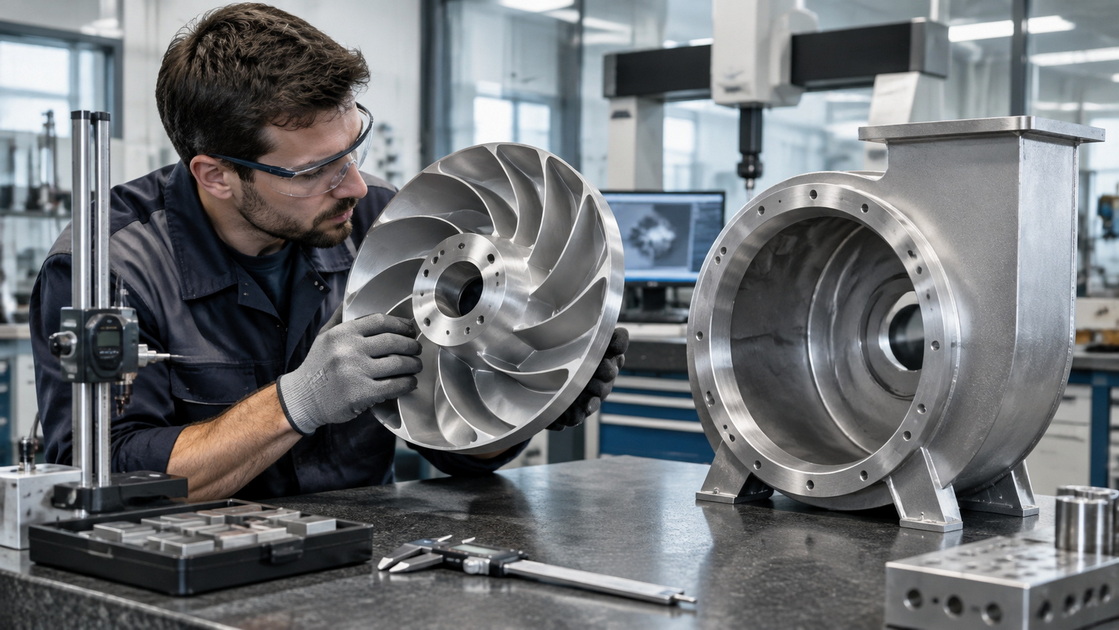
This is an application-based shortlist, not an independently audited ranking. Companies were included where a company or brand source described relevant motor, fan, or custom-engineering capabilities. Priority went to a verifiable product range, a stated manufacturing or engineering location, identifiable application markets, and enough public information to explain when a buyer should—or should not—approach the supplier.
No comparable public dataset was found for every company's production capacity, minimum order quantity (MOQ), certification status by product, or on-time delivery rate. Those fields are marked "Request quote" or "Verify" rather than filled with estimates. Established years below refer to the company or brand history stated by the cited source; they do not establish how long a particular factory has made the exact product you need.
The list has six entries. ECOFIT and ETRI are distinct brands within Rosenberg Vendôme, not two independent manufacturing groups. This distinction matters if a buyer is assessing supplier concentration.
Established: 2021. Location: Zhongshan, Guangdong, China. Relevant markets: The company states that its brushless motors are used in drones, remote-controlled vehicles, gimbal equipment, aircraft, and underwater robots, and that it serves global customers. Customization: Its company profile states that it provides complete power-system solutions and OEM/ODM services.
Yuhang belongs first in this guide as an export-oriented option for French buyers, not as a manufacturer located in France. It is potentially relevant when a small or midsize brand needs to discuss a brushless motor around its own voltage, mechanical envelope, control requirements, or propulsion-system concept. Its published profile emphasizes customer-specific design, R&D, production, and testing.
Its fit should be established through an engineering enquiry, not assumed from the company's general brushless-motor capability. For an EDF project, ask whether Yuhang can supply the motor alone or a validated motor–rotor–duct–ESC combination, and request the associated thrust, current, temperature, vibration, and endurance data. For a centrifugal-fan application, request an airflow–pressure curve for the assembled fan. The publicly reviewed company profile does not establish a particular EDF motor's performance, a company-wide MOQ, an independently verified low-price advantage, or a specific French compliance approval.
Best starting point: A buyer needing to explore a custom brushless-motor project with an overseas manufacturing partner, while retaining responsibility for technical and compliance verification.
Brand established: 1976, according to Rosenberg Vendôme. Location: The brand's fans are designed and manufactured by Rosenberg Vendôme in France. Relevant markets: HVAC, refrigeration, air treatment, equipment cooling, data centres, and other industrial ventilation applications. Customization: ECOFIT describes development tailored to customer dimensions, materials, electrical performance, and application requirements.
ECOFIT offers single- and double-inlet centrifugal fans, backward-curved fans, axial fans, and motors. Its EC range combines a permanent-magnet motor with electronic control; its site identifies control options including 0–10 V and PWM. That makes it a strong candidate when a buyer needs a compact, controllable fan assembly rather than a standalone high-speed EDF propulsion motor.
Best starting point: A French-made centrifugal or EC fan for integration into an OEM product. Ask for the exact operating curve, control interface, dimensional drawing, and documentation for the proposed model—not a blanket assurance that all catalogue items have the same approvals.
Brand origin: 1945. Location: ETRI is a Rosenberg Vendôme brand designed within the French business. Relevant markets: Its sources identify aeronautics, rail, defence, marine, data centres, electrical equipment, and industrial cooling. Customization: ETRI describes technical support and model-dependent options such as tachometer output, alarm signals, protection ratings, and connectors.
ETRI lists AC, DC, EC, and 400 Hz products, including compact axial and centrifugal fans. It is especially worth investigating when installation space, vibration exposure, electrical interface, or operating environment makes a catalogue fan difficult to integrate. Its product range should not, however, be described as a catalogue of RC-jet EDF propulsion systems.
Best starting point: Compact professional cooling and embedded ventilation. Ask which requested features are standard, which require development work, and which are supported by testing on the exact proposed model.
Established: 1937. Location: France. Relevant markets: AIRAP identifies industrial-equipment manufacturers, HVAC installers, rail, industrial ovens, water treatment, and other equipment sectors. Customization: It describes fans and components made to drawing or to a project specification, including special materials and constructions.
AIRAP's range includes industrial fans, turbines, centrifugal and helical components, and specialist equipment. Its site specifically discusses high-temperature work, corrosion-resistant materials or treatments, and application-specific execution. These capabilities make it more relevant to a machine builder with an unusual operating environment than to a buyer seeking a small EDF motor for a model aircraft.
Best starting point: A French-built industrial fan or turbine requiring unusual materials, temperature capability, or mechanical integration. Request evidence for the particular specification; do not infer that every AIRAP product carries every specialist approval mentioned on its website.
Established: 1946, according to its company history. French location: Ventmeca lists its European division in Beauvais. Relevant markets: Heavy industrial air and gas movement. Customization: The company describes made-to-order centrifugal fan arrangements, single- and double-stage blowers, and integration with electric motors or other drives.
Ventmeca is a different scale of proposition from a compact brushless EDF motor. Its published custom-fan page describes heavy-duty centrifugal equipment for applications involving high pressure, corrosive gases, abrasive materials, or elevated temperatures. That makes it a useful shortlist entry for industrial plant projects, but generally not a direct substitute for a miniature fan motor.
Best starting point: A project-engineered centrifugal fan with demanding mechanical or process conditions. Establish the design duty point and scope of supply before comparing its quotation with compact-fan vendors.
Established: A founding year was not confirmed from the reviewed company product page; request the current company-registration extract if corporate age matters to your qualification process. Location: AEIB says it manufactures made-to-measure ventilation systems in its workshops in France. Relevant markets: Civil and military industrial ventilation, including extraction and filtration of dusty or gaseous air. Customization: Its site describes project-specific fan and ventilation-system development.
AEIB lists high-performance centrifugal fans and other industrial ventilation equipment. It also states that its ventilation equipment includes ATEX-certified products. ATEX suitability must be verified by the exact product marking, documentation, and intended hazardous zone, rather than assumed for its entire range.
Best starting point: A custom French ventilation assembly where the air stream, installation, or hazardous-area requirements make a standard fan unsuitable.
The table separates publicly described capability from information a buyer still needs to obtain. "Verify" is not a negative assessment: capacity, MOQ, and certificates often depend on the model and contract. Likewise, a brand's market focus does not demonstrate that a specific product is certified.
| Supplier | Main sourcing focus | Public production-capacity figure for the proposed product | Public MOQ for the proposed product | Certification or compliance evidence to request |
|---|---|---|---|---|
| Zhongshan Yuhang | Custom brushless motor and power-system enquiry | Not verified; request monthly capacity by model | Request quote | Relevant factory certificate, component material declarations, and product-level EU compliance assessment |
| ECOFIT | EC and centrifugal fans | Not verified by proposed model; request production plan | Request quote | Exact-model EU declaration and applicable ErP documentation |
| ETRI | Compact AC, DC, EC, and specialist fans | Not verified by proposed model | Request quote | Exact-model documentation for the required application and market |
| AIRAP | Industrial and made-to-measure fans | Request project capacity and lead-time evidence | Request quote | Product-specific declarations and any claimed special-application approvals |
| Ventmeca | Heavy-duty engineered centrifugal fans | Request project schedule and workshop allocation | Request quote | Documentation applicable to the assembled fan and installation |
| AEIB | Custom industrial ventilation | Request project capacity and fabrication schedule | Request quote | Exact-model certification and, where relevant, ATEX marking and supporting documents |
There is no defensible "highest-capacity" or "lowest-MOQ" winner in this public comparison. A purchasing team should issue the same request for quotation (RFQ) to each relevant candidate and compare written responses against one technical specification.
For a centrifugal fan, define airflow at a stated static-pressure duty point, not simply maximum free-air airflow. Request the complete performance curve and identify the proposed motor, impeller, housing, and controller. ECOFIT explicitly distinguishes axial and centrifugal fan functions and points buyers to airflow and pressure as selection variables.
For an EDF propulsion system, define the duct and rotor, supply voltage, target thrust, expected operating duration, ESC, and allowable temperature. A motor that fits the duct physically may still be unsuitable when its electrical and thermal load is measured in the completed assembly.
A familiar procurement failure is approving one sample and receiving production units made with a different impeller material, bearing, magnet, winding, adhesive, or surface treatment. The risk is not always visible at goods-in inspection.
Include a bill of materials (BOM) revision and approved critical-component list in the purchase agreement. Require written approval before substitutions. For high-speed rotating assemblies, add measurable limits for vibration, balance, noise, electrical input, and temperature rise. Ask how rejected units are identified and kept out of accepted stock. These are proposed buyer controls, not claims that any supplier above has made substitutions.
A generic "CE certificate" is a weak substitute for identifying the EU rules applicable to the finished product. EU guidance says CE marking is required only where relevant harmonised legislation mandates it; the manufacturer must identify applicable requirements, assemble supporting technical documentation, and draw up an EU declaration of conformity. The EU does not operate a central body that simply grants a universal CE certificate. A component and the finished machine may also have different compliance responsibilities.
The EU RoHS Directive restricts ten substances in covered electrical and electronic equipment. Ask for declarations and material evidence relevant to the actual product and its intended use; do not assume a generic supplier statement resolves the compliance position of an assembled machine.
As of 24 July 2026, revised EU ecodesign rules apply to covered fans driven by motors with electric input power between 125 W and 500 kW, subject to the regulation's scope and exceptions. Whether a particular EDF or centrifugal assembly falls within those rules requires a product-specific assessment. Do not assume that every small propulsion fan or every motor-only shipment is covered.
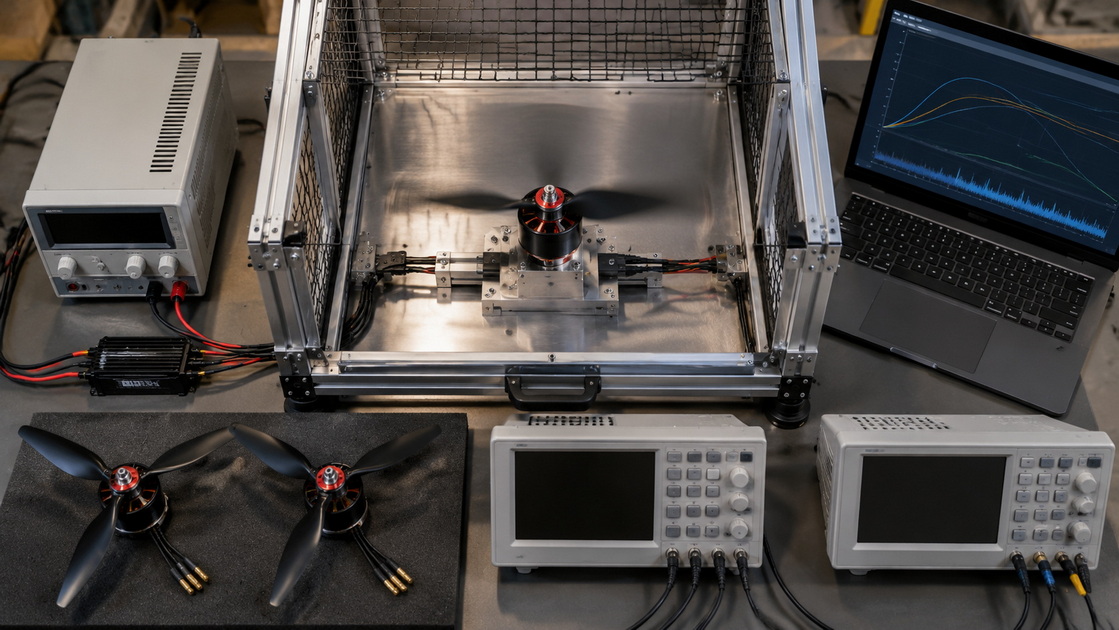
An experienced buyer should ask whether the supplier's "final test" uses the production impeller and the customer's operating configuration. A motor tested without its actual fan load can pass electrical inspection while the delivered assembly misses its airflow or thrust target, runs hot, or vibrates excessively.
Put the test configuration in the contract: approved rotor and housing revision, input voltage, controller settings, ambient conditions, measurement points, test duration, sample size, and pass/fail limits. Retest when a critical component or firmware setting changes. This is a practical procurement recommendation, not a claim that every supplier currently follows—or fails to follow—this procedure.
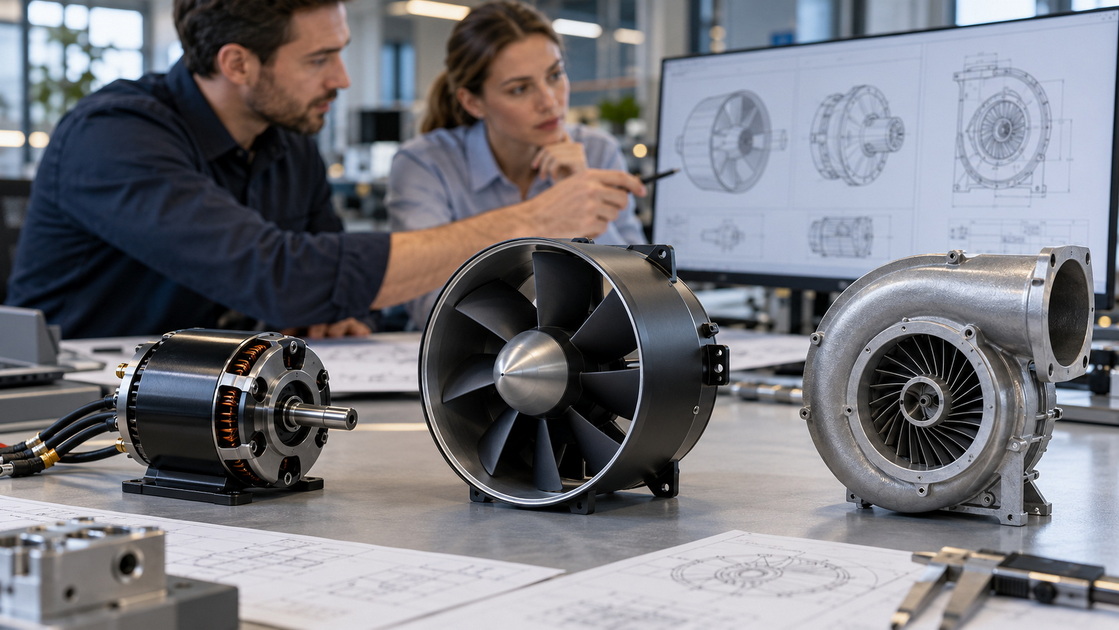
1. Send one clear RFQ. State whether you need an EDF propulsion motor, complete EDF, centrifugal fan motor, or complete blower. Include drawings, duty point, annual forecast, pilot quantity, target markets, and required documentation.
2. Verify the legal entity and factory. Check the company name on its quotation against registration documents, factory address, invoice, and any quality-system certificate. Establish whether design, winding, assembly, and final testing occur at the quoted site.
3. Check certificates independently. For an ISO certificate, compare its company name, scope, site, issuing body, and status with or the issuing certification body's register. A certificate covering one activity or location should not be presented as proof for another.
4. Approve staged samples. Consider an initial engineering sample, a revised pre-production sample, and a production-lot sample. Keep a signed specification and record every approved change.
5. Audit repeatability. Request production test records, calibration arrangements, nonconforming-product controls, and a realistic monthly delivery plan. A good prototype does not demonstrate stable series output.
6. Resolve import details before shipment. Confirm the importer of record, Incoterms, packaging, spare-parts arrangements, warranty process, and customs classification. The European Commission's Access2Markets guidance states that the tariff code determines which duties and import requirements to check; classify the actual product rather than reusing a code for a different fan or motor assembly.
For a French buyer comparing a local specialist with a China-based custom-motor partner, calculate the landed and lifecycle cost rather than only the unit quotation. Include tooling, testing, freight, duties where applicable, inventory cover, failed-unit handling, and engineering communication. Neither geographic location nor a low initial quote establishes the better long-term value.
The right supplier depends first on the type of fan system. ECOFIT and ETRI are pertinent to compact, controllable professional fans; AIRAP, Ventmeca, and AEIB address differing industrial ventilation needs. Zhongshan Yuhang is a China-based alternative for buyers exploring customized brushless motors and power-system work—not a French manufacturer or a verified substitute for every company on this list.
If your project calls for a custom motor, send Yuhang an RFQ with the fan or duct drawing, operating voltage, target airflow–pressure point or thrust, controller details, forecast volume, and required test and compliance documents. Ask for a written feasibility assessment and sample plan before discussing production pricing.
Request the full certificate and check its legal entity, site, activity scope, certificate number, issuing body, and current status through IAF CertSearch or the issuer's register. A PDF bearing a future expiry date is not enough on its own if certification has since been suspended or withdrawn.
Not necessarily. Identify the legislation applicable to the finished product and determine who has manufacturer responsibilities when the motor is integrated, modified, or sold under another brand. Review the relevant technical file and EU declaration rather than assuming that a component marking covers the assembly.
Issue one duty-point specification and request curves at comparable voltage, speed, airflow, and pressure—or, for an EDF, comparable voltage, duct configuration, and thrust conditions. Ask each supplier to identify the test standard and setup. Comparing unrelated maximum values is not a fair technical evaluation.
Request a controlled revision notice, the reason for the change, updated drawings and BOM, material information, and comparative electrical, performance, thermal, and vibration results. Approve a revised sample before authorising the changed production lot.
No blanket answer is appropriate. The regulation concerns fans within its stated scope, including the 125 W to 500 kW input-power range, and contains definitions and exceptions. Determine whether the product being placed on the EU market is a covered fan, an integrated fan, a motor component, or an excluded application before making a compliance claim.
1. [Zhongshan Yuhang Power Technology Co., Ltd., About Us] — Company founding year, location, stated applications, and OEM/ODM offering. [yuhangmotor]
2. [Rosenberg Vendôme, Company and Brand Overview] — ECOFIT and ETRI ownership, brand history, and application markets. [en.rosenberg-vendome]
3. [ECOFIT, Industrial Fan and EC Motor Overview] — French manufacturing, product types, control options, and customization. [en.ecofit]
4. [ETRI, Professional Fan Range] — Motor technologies, applications, and customization examples. [etrinet]
5. [AIRAP, French Industrial Fan Manufacturer] — Founding year, French manufacturing, materials, and custom-fan activities. [airap]
6. [Ventmeca, Custom Industrial Fans] — French division and heavy-duty centrifugal-fan capabilities. [ventmecafans]
7. [AEIB, Industrial Fan Manufacturing] — French workshops, custom equipment, and stated ATEX capability. [aeib]
8. [Uniclima, 2025 Results and 2026 Outlook] — French ventilation-sector indicator and association footprint. [uniclima]
9. [GIFAS, French Aerospace Industry 2025 Results] — Sector revenue and export context; not an EDF motor market estimate. [gifas]
10. [European Commission, New Ecodesign Rules for Industrial Fans] — July 2026 application date and general scope. [energy.ec.europa]
11. [European Commission, RoHS Directive] — Restricted substances and electrical-equipment context. [environment.ec.europa]
12. [Your Europe, CE Marking Guidance] — Product-level conformity and manufacturer responsibilities. [europa]
13. [IAF CertSearch] — Verification of accredited management-system certificates. [iafcertsearch]
14. [European Commission, Access2Markets Tariff Guidance] — Product classification and tariff checks. [trade.ec.europa]


