Language


Views: 244 Author: Yuhang Power Publish Time: 2026-10-05 Origin: Site
Content Menu
● What Does KV Mean in a Drone Motor?
● Low KV vs High KV Drone Motor: Quick Comparison
● What Is a Low KV Drone Motor?
>> Advantages of Low KV Motors
>> Limitations of Low KV Motors
● What Is a High KV Drone Motor?
>> Advantages of High KV Motors
>> Limitations of High KV Motors
● How Battery Voltage Changes the Best KV Choice
● Propeller Size Is Just as Important as KV
>> Example: 5-Inch FPV Motor Selection
● A Practical Motor KV Selection Process
>> 2. Choose the Propeller Range
>> 4. Check Motor Size and Thermal Capacity
● KV Is Not a Direct Measure of Power
● Common Low KV and High KV Mistakes
● When to Choose Low KV vs High KV Motors
● FAQ
>> 1. Is a higher KV drone motor always faster?
>> 2. Can I use a 6S battery with a high KV motor?
>> 3. Does low KV mean high torque?
>> 4. What KV motor is best for a 5-inch FPV drone?
>> 5. What happens if the KV is too high for my propeller?
Choosing between a low KV drone motor and a high KV drone motor is not about deciding which one is universally better. It is about matching motor speed characteristics with your battery voltage, propeller size, aircraft weight, flight style, and target application.
For FPV drones, RC aircraft, gimbal platforms, underwater robots, racing quadcopters, industrial UAVs, and other brushless-powered equipment, KV selection affects RPM, current draw, thrust response, temperature, flight time, and system reliability. A poorly matched motor KV can cause overheating, inefficient flight, weak throttle response, or excessive battery stress. A well-matched propulsion system delivers smoother control and more dependable power.
At Zhongshan Yuhang Power Technology Co., Ltd., we work with FPV drone motors and other brushless motor solutions for demanding equipment. From compact FPV builds to customized OEM and ODM propulsion projects, our engineering focus is always the same: make the motor, propeller, ESC, battery, and mechanical load work as one system.
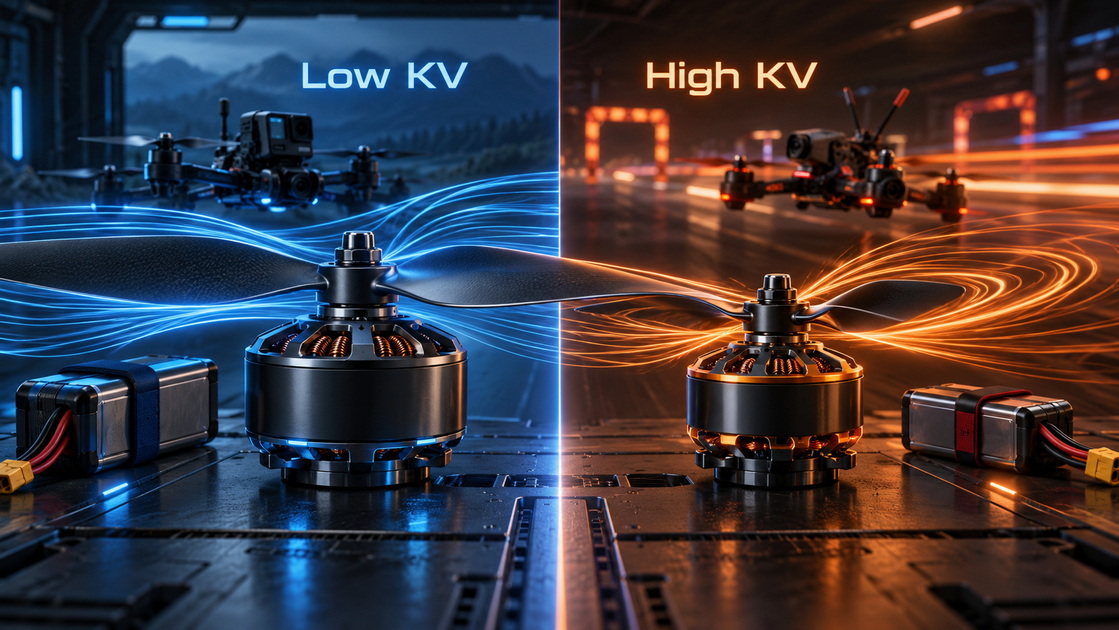
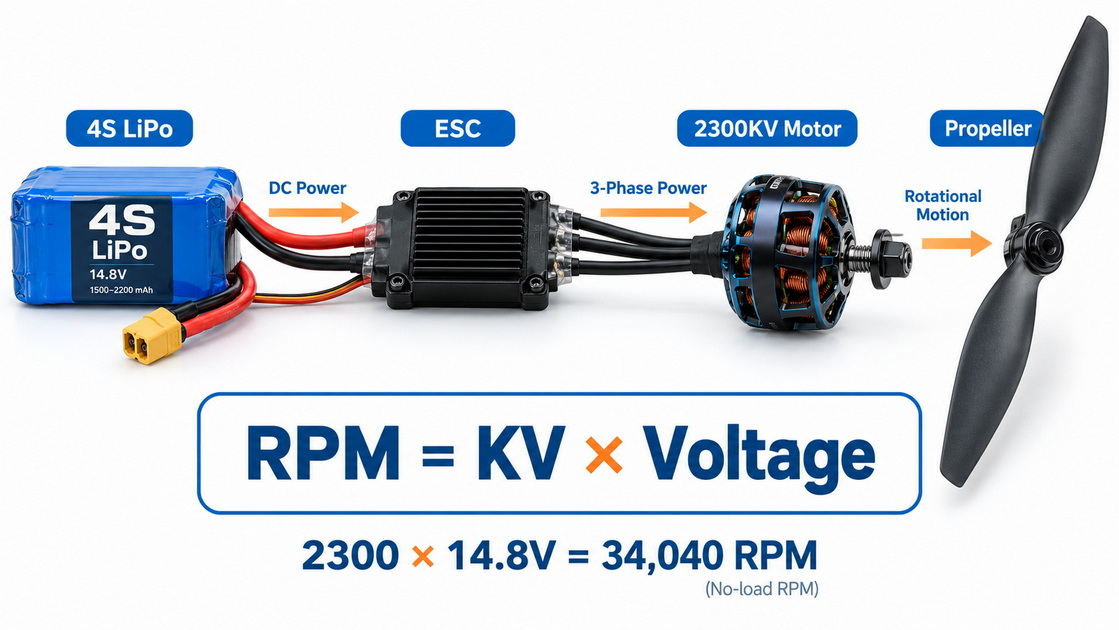
KV does not mean kilovolts. In brushless motor terminology, KV means the theoretical number of revolutions per minute a motor will turn for every volt applied, measured with no propeller or other load attached.
The basic formula is:
No Load RPM=KV Rating×Voltage
For example, a 2300KV FPV drone motor running on a 4S LiPo battery with a nominal voltage of 14.8V has a theoretical no-load speed of:
2300×14.8=34,040 RPM
This does not mean the motor will maintain 34,040 RPM in real flight. Once a propeller is installed, air resistance and propeller load reduce RPM. Battery voltage sag, ESC timing, motor temperature, propeller pitch, and flying conditions also affect actual performance.
Still, KV is one of the most useful starting points for selecting a brushless motor.
High KV motors are designed to reach higher RPM per volt. They are often used with smaller propellers and lower-voltage battery setups.
Low KV motors produce lower RPM per volt. They are often paired with larger propellers, higher-voltage battery packs, and applications that need controlled thrust and longer operating time.
The table below gives beginners a practical overview of the main differences.
| Feature | Low KV Drone Motor | High KV Drone Motor |
|---|---|---|
| Typical RPM per volt | Lower | Higher |
| Typical propeller match | Larger diameter or higher-load propellers | Smaller and lighter propellers |
| Battery voltage match | Often higher voltage, such as 6S, 8S, or 12S | Often lower voltage, such as 2S, 3S, or 4S |
| Torque per amp | Generally higher in comparable motor designs | Generally lower in comparable motor designs |
| Current demand | Often lower for a comparable thrust target | Often higher under aggressive load |
| Flight character | Smooth, controlled, efficient | Fast, sharp, aggressive |
| Common use | Long-range, cinematic, heavy-lift, larger UAVs | Racing FPV, lightweight freestyle, small RC vehicles |
| Heat risk | Lower when matched correctly | Can rise quickly with excessive prop load |
| Propeller preference | Larger, slower-turning propellers | Smaller, faster-turning propellers |
| Main advantage | Efficiency and load-handling potential | Rapid RPM response and speed potential |
The key point is simple: KV must never be selected alone. A motor's stator size, winding design, magnet strength, cooling, propeller, battery voltage, ESC rating, and intended load are equally important.
A 1404 4000KV motor and a 2306 4000KV motor may share the same KV rating, but they are not interchangeable. Their physical size, torque capacity, current capability, and suitable propeller ranges can be very different.
A low KV drone motor turns fewer RPM for each volt supplied. In a comparable motor platform, it generally has a higher torque constant, meaning it can generate more torque per amp of current.
This makes low KV motors useful for applications that require a propeller with more aerodynamic load.
Typical low KV ranges may include:
- 380KV to 900KV for large multirotors, agricultural drones, aerial platforms, and larger RC aircraft
- 900KV to 1500KV for some 6S to 12S long-range drone systems and medium-to-large propellers
- 1500KV to 2100KV for many 5-inch or 6-inch FPV drones using 6S batteries
- Below 1000KV for heavy-lift, industrial, and large-propeller propulsion applications
Low KV does not automatically mean slow. A low KV motor supplied by a higher-voltage battery can still reach substantial RPM.
For example:
- 1700KV motor on 6S nominal voltage:
1700×22.2=37,740 RPM
- 2500KV motor on 4S nominal voltage:
2500×14.8=37,000 RPM
These two setups can have similar theoretical no-load RPM. However, their current draw, voltage behavior, efficiency profile, propeller compatibility, and practical feel can still differ significantly.
A properly selected low KV brushless motor can provide several benefits:
- Better compatibility with larger propellers
- More controlled throttle behavior
- Lower current demand in many high-voltage configurations
- Potentially longer flight time
- Reduced voltage sag when compared with a similar-power lower-voltage setup
- Good performance for cruising, long-range, mapping, and cinematic flight
- Suitable torque characteristics for heavier loads
For a larger UAV, a low KV motor allows the aircraft to produce useful thrust without forcing the propeller to rotate at excessively high RPM.
Low KV motors are not ideal for every project.
Potential limitations include:
- Less explosive throttle response in lightweight racing setups
- Reduced top-end RPM on the same battery voltage
- Poor results when paired with very small propellers
- Sluggish flight if the motor is too low KV for the intended propeller and battery
- Possible loss of agility in high-speed FPV racing applications
A low KV motor should not be chosen merely because it sounds more efficient. It must still generate enough RPM and thrust for the aircraft's weight, frame size, and operating conditions.
A high KV drone motor spins faster for every volt applied. It is commonly selected for smaller propellers, lower-voltage battery packs, compact racing drones, micro FPV platforms, and applications that benefit from fast RPM changes.
Typical high KV ranges may include:
- 2500KV to 3000KV for 5-inch FPV drones using 4S batteries
- 3000KV to 4500KV for 3-inch and 4-inch FPV builds
- 4500KV to 8000KV for micro drones, tiny whoops, and lightweight indoor FPV systems
- Above 8000KV for very small propellers and specialized micro propulsion applications
High KV does not guarantee better speed. It only indicates a higher no-load RPM per volt. Real-world speed depends on propeller pitch, propeller diameter, airframe drag, aircraft weight, battery discharge capability, and motor load.
High KV FPV drone motors are popular because they can provide:
- Fast throttle response
- High RPM potential
- Strong acceleration with small propellers
- Responsive handling for racing and freestyle
- Good compatibility with compact, lightweight frames
- Quick changes in motor speed during flips, rolls, and rapid direction changes
- Strong performance in small RC vehicles and compact ducted-fan systems
For a 3-inch or 5-inch FPV racing drone, a high KV motor can make the quad feel more immediate and aggressive. The motors can accelerate the propellers quickly, helping pilots recover from maneuvers and maintain speed through technical courses.
High KV systems require careful setup. When a high KV motor is paired with too much voltage, too large a propeller, or too aggressive a prop pitch, current can rise rapidly.
Potential problems include:
- Motor overheating
- ESC overheating
- Excessive battery current draw
- Short flight times
- Battery voltage sag
- Premature propeller or motor wear
- Desync risk if ESC settings and motor load are poorly matched
A high KV motor should never be treated as a simple upgrade for more power. Power comes from the full propulsion system, not KV alone.
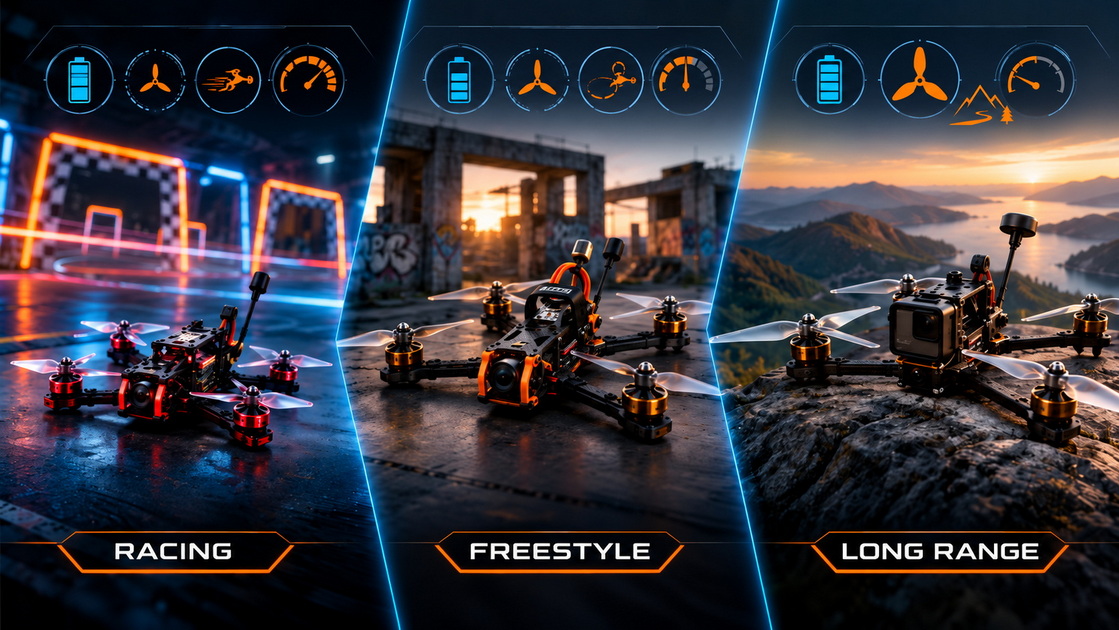
Battery voltage is one of the most important factors in KV selection.
A higher-voltage battery can achieve a target motor RPM with less current than a lower-voltage system producing comparable power. Since electrical power is calculated as:
Power=Voltage×Current
a higher-voltage setup can often reduce the current required for the same power level. Lower current can reduce stress on battery leads, connectors, ESCs, and internal battery resistance.
This is why many 5-inch FPV pilots use lower KV motors on 6S rather than high KV motors on 4S.
| FPV Configuration | Typical Motor KV Range | Typical Battery | Typical Use |
|---|---|---|---|
| 5-inch 4S freestyle | 2300KV–2800KV | 4S LiPo | Responsive freestyle and racing |
| 5-inch 6S freestyle | 1600KV–2100KV | 6S LiPo | Smooth power delivery and efficiency |
| 3-inch 4S quad | 3000KV–4500KV | 4S LiPo | Lightweight freestyle and fast cruising |
| Micro FPV drone | 6000KV–12000KV | 1S–2S LiPo | Indoor or ultra-light outdoor flight |
| Long-range multirotor | 700KV–1500KV | 6S–12S LiPo | Efficient cruising and larger props |
| Heavy-lift UAV | 300KV–800KV | 12S or higher | Large propeller and payload systems |
These are starting ranges, not universal rules. Final selection must be verified through motor thrust testing, propeller testing, temperature checks, and real application trials.
A propeller is not a passive accessory. It is a major aerodynamic load. The motor must generate enough torque to spin it efficiently without excessive heat or current draw.
In general:
- Larger propellers need lower KV motors
- Higher-pitch propellers create more load
- Smaller propellers can tolerate higher KV
- Heavier aircraft need more thrust, not simply higher KV
- Ducts, guards, and enclosed airflow designs can change the required motor setup
A high KV motor spinning a large, high-pitch propeller may draw too much current. A low KV motor driving a tiny propeller may fail to provide the responsive performance expected from a racing aircraft.
Consider two common 5-inch FPV propulsion approaches.
| System | Option A | Option B |
|---|---|---|
| Motor | 2500KV 2306 motor | 1800KV 2306 motor |
| Battery | 4S LiPo | 6S LiPo |
| Theoretical nominal RPM | 37,000 RPM | 39,960 RPM |
| Flight style | Aggressive 4S freestyle | Smooth, efficient 6S freestyle |
| Key concern | High current draw with aggressive props | Requires compatible 6S battery and ESC |
| Suitable propeller approach | Moderate 5-inch props | Moderate 5-inch props with controlled load |
Although the theoretical RPM figures are similar, the systems behave differently. The 6S low KV configuration may offer lower current for comparable power delivery, while the 4S high KV setup can feel sharp and familiar for pilots who prefer high-RPM response.
The right choice depends on how the aircraft will be flown, how much weight it carries, and how much thermal margin the propulsion system has.
Beginners often choose a motor by reading a single product specification. A more reliable approach is to define the complete propulsion system first.
Start with the actual mission.
Ask:
- Is the project an FPV racing drone, cinematic drone, long-range UAV, RC car, fan system, or underwater robot?
- Does it need fast acceleration, long runtime, quiet operation, high payload capacity, or stable low-speed control?
- Will it operate indoors, outdoors, underwater, in hot weather, or in dusty industrial conditions?
An FPV racing drone and a camera gimbal platform have very different motor requirements.
Determine:
- Propeller diameter
- Blade count
- Pitch
- Material
- Target thrust
- Maximum current
- Noise constraints
A larger propeller generally favors lower KV. A small racing propeller can support higher KV.
Choose the battery cell count based on the desired power level, weight, component availability, and runtime target.
Higher-voltage systems often use lower KV motors. Lower-voltage systems often use higher KV motors to reach the required RPM.
KV does not tell you the motor's full power capability.
You also need to evaluate:
- Stator diameter and height
- Motor weight
- Winding resistance
- Magnet design
- Shaft strength
- Bearing quality
- Cooling path
- Recommended current limit
- Recommended propeller range
A compact 1404 motor and a larger 2806.5 motor serve completely different propulsion needs, even if their KV ratings look similar.
For an OEM or ODM project, testing is essential.
Measure:
- Static thrust
- Current draw
- Motor temperature
- ESC temperature
- Battery voltage sag
- Efficiency in grams per watt
- Flight time or operating time
- Vibration level
- Noise level
- Response under rapid throttle changes
Bench testing is useful, but it is not enough. The final application may introduce airflow restrictions, payload changes, duct losses, water resistance requirements, or continuous-duty thermal conditions that are not visible in a short static test.

One of the most common beginner mistakes is believing that a higher KV rating automatically means a more powerful motor.
That is not correct.
KV measures speed per volt under no load. It does not directly measure maximum wattage, torque output, cooling performance, thrust, or motor durability.
A larger low KV motor can generate far more usable thrust than a tiny high KV motor. For example, a low KV 35XX-class motor turning a large propeller can support a substantial UAV load, while a high KV micro motor may only be suitable for a small 2-inch FPV propeller.
When comparing motors, evaluate the entire specification set:
- KV rating
- Stator size
- Motor weight
- Maximum current
- Recommended voltage
- Recommended propeller
- Thrust data
- Efficiency data
- Bearing and shaft design
- Thermal performance
- Application duty cycle
For professional equipment, the best motor is the one that reaches the required thrust and control response with a safe thermal margin and stable operating efficiency.
Avoid these common selection errors:
1. Using high KV motors with excessive battery voltage.
This can push motor RPM and current beyond safe limits.
2. Installing oversized propellers on high KV motors.
The motor may overheat quickly, especially during repeated full-throttle use.
3. Choosing KV without checking stator size.
KV alone does not tell you whether the motor can handle the intended load.
4. Ignoring battery discharge capability.
A battery must safely supply the required current without severe voltage sag.
5. Ignoring ESC current rating and firmware settings.
ESCs need adequate current headroom and appropriate timing for the motor.
6. Assuming low KV always creates more total thrust.
Low KV can provide favorable torque characteristics, but total thrust still depends on motor size, voltage, propeller, and system power.
7. Skipping temperature tests.
A setup may look acceptable on paper but fail after several minutes of real operation.
Choose a low KV drone motor when your project needs:
- Larger propellers
- Higher battery voltage
- Longer flight time
- Smooth throttle response
- Efficient cruising
- Heavy-lift capability
- Long-range flight
- Stable camera platforms
- Industrial UAV or OEM propulsion systems
Choose a high KV drone motor when your project needs:
- Small propellers
- Lower-voltage battery packs
- Fast RPM changes
- Rapid acceleration
- Compact FPV racing performance
- Lightweight freestyle agility
- Micro drone propulsion
- Small RC vehicle or fan applications
For customized systems, the best solution may involve a tailored KV, stator size, winding configuration, shaft design, cable length, mounting pattern, or waterproofing level. This is especially important for commercial UAVs, robotic equipment, underwater systems, high-speed fans, and specialized OEM equipment.
Low KV and high KV drone motors are not competing products. They are different tools for different propulsion requirements.
A low KV motor is often the better choice for larger propellers, higher-voltage power systems, longer operating time, and controlled thrust. A high KV motor is often the better choice for compact props, sharp FPV response, rapid acceleration, and lightweight high-speed applications.
The correct decision comes from matching motor KV, stator size, battery voltage, propeller load, ESC capability, aircraft weight, and operating environment. Instead of asking, "Should I use low KV or high KV?" ask, "What propulsion system will deliver the required thrust, efficiency, and reliability for my specific application?"
For FPV drone motors, UAV propulsion systems, RC vehicle motors, high-speed fan motors, gimbal applications, and custom brushless motor development, Zhongshan Yuhang Power Technology Co., Ltd. can support OEM and ODM projects with application-focused motor selection and customized power-system solutions. Share your target voltage, propeller size, load, target thrust, and operating conditions to develop a more suitable motor configuration.
Not always. A higher KV motor has higher theoretical RPM per volt, but actual drone speed also depends on battery voltage, propeller size, propeller pitch, aircraft weight, drag, and available power. A well-matched low KV motor on a higher-voltage battery can also produce high RPM and strong flight performance.
It may be possible, but it can be risky if the motor and propeller are not selected correctly. Higher voltage increases potential motor RPM. To use 6S safely, pilots often select a lower KV motor, reduce propeller load, or apply a motor-output limit. Always check motor temperature, current draw, and ESC capability.
For otherwise comparable motor designs, lower KV is associated with a higher torque constant, meaning more torque per ampere. However, total available torque also depends on motor size, winding resistance, magnet design, cooling, voltage, and current capacity.
For many 5-inch builds, 2300KV–2800KV is a common starting range for 4S batteries, while 1600KV–2100KV is commonly used for 6S batteries. The best choice depends on motor size, propeller, pilot style, aircraft weight, and desired flight behavior.
The motor may draw excessive current, overheat, damage the ESC, reduce battery life, or create unstable flight performance. A high KV motor should generally be paired with an appropriately small and low-load propeller.
1. Power Motor. "[What Does KV Mean in Drone Motors?]" Accessed October 2026.
2. Oscar Liang. "[How to Choose FPV Drone Motors]" Accessed October 2026.
3. Oscar Liang. "[Testing 6S Mini Quad With High KV Motors]" Accessed October 2026.
4. Source Robotics. "[Motor Constants KV, Kt, Ke, Km Explained]" Accessed October 2026.
5. Grepow. "[An In-Depth Guide to Drone Motors]" Accessed October 2026.
6. Mechtex. "[Understanding the Relationship Between KV Rating and Drone Performance]" Accessed October 2026.
7. Things in Motion. "[Common Misconceptions With Brushless Motors]" Accessed October 2026.


