Language


Views: 246 Author: Yuhang Power Publish Time: 2026-10-01 Origin: Site
Content Menu
● What Does Motor KV Mean on 6S?
● 1750KV vs 2000KV: Key Differences
>> Thrust and throttle response
>> Propeller, ESC, and battery compatibility
● What Published Bench Data Shows
● How to Run a Fair 6S A/B Test
● Which Motor Fits Your Build?
>> Camera-equipped 5-inch freestyle
>> Aggressive freestyle or racing
>> 6-inch or endurance-focused aircraft
● What OEM and ODM Buyers Should Request
>> 1. Is 2000KV too high for a 6S FPV drone?
>> 2. Is 1750KV always more efficient than 2000KV?
>> 3. Which KV gives longer 6S flight time?
>> 4. Can I use the same 5-inch propeller on both motors?
>> 5. Does a motor-output limit make 2000KV identical to 1750KV?
Choosing between a 1750KV vs 2000KV motor for 6S FPV is not simply a choice between efficiency and speed. The right motor depends on your propeller, aircraft weight, ESC capacity, battery, and flying style. For many 5-inch builds, 1750KV is a sensible starting point for smooth freestyle and camera-equipped flying. A 2000KV motor may suit pilots seeking stronger top-end response—provided the complete power system has been tested under load. Neither KV rating guarantees a particular thrust figure or flight time.
This guide compares the two ratings as parts of a complete propulsion system. The RPM figures below are theoretical calculations, not measured flight results. The published bench-test example comes from an independent reviewer; it is not a test conducted by Zhongshan Yuhang Power Technology Co., Ltd.
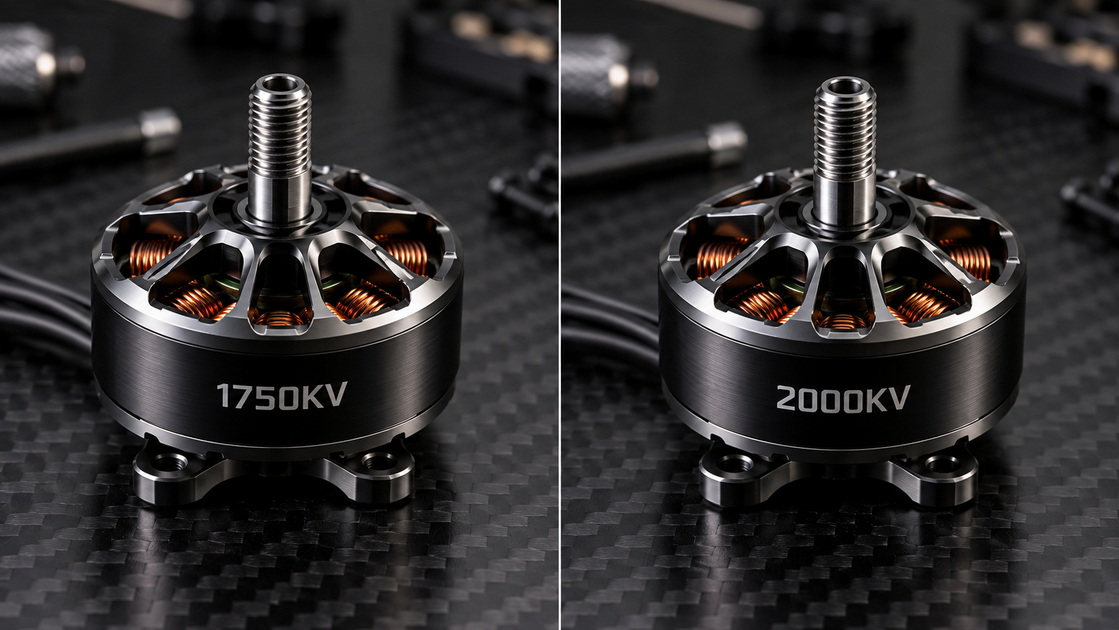
Motor KV expresses approximate no-load revolutions per minute per volt. It is not a kilovolt rating, a thrust rating, or a direct measure of quality. A conventional 6S LiPo battery is approximately 22.2 V at nominal voltage and 25.2 V when fully charged. Multiplying KV by voltage gives a useful no-load RPM estimate, but a propeller, electrical losses, and battery voltage sag change the speed achieved in operation.
| Theoretical no-load estimate | 1750KV motor | 2000KV motor |
|---|---|---|
| At 22.2 V nominal | 38,850 rpm | 44,400 rpm |
| At 25.2 V fully charged | 44,100 rpm | 50,400 rpm |
| Difference at nominal voltage | — | 5,550 rpm, approximately 14.3% |
The calculation shows that 2000KV has approximately 14.3% greater no-load speed potential at the same voltage. It does not show that a 2000KV aircraft will produce 14.3% more thrust, fly 14.3% faster, or use 14.3% more battery energy. Those outcomes depend on the motor, propeller, and operating conditions together.
A useful mental model is that KV describes one characteristic of the motor, while the propeller determines much of the work the motor must do. Changing from a light, moderate-pitch propeller to a demanding high-pitch propeller can alter current draw substantially without changing the KV printed on the motor. That is why a motor specification should always be read alongside its tested propeller and voltage.
| Decision factor | 1750KV on 6S | 2000KV on 6S |
|---|---|---|
| No-load speed potential | Lower | Approximately 14.3% higher at equal voltage |
| Common 5-inch priority | Controlled power delivery and manageable propeller load | Stronger high-end response, if the propeller is suitable |
| Current and heat | Often easier to manage within the same motor family and propeller setup | May require more electrical and thermal margin under the same load |
| Propeller starting point | Moderate-pitch 5-inch propeller, subject to testing | Light or moderate-pitch 5-inch propeller; test demanding props carefully |
| Likely use case | Smooth freestyle, camera-equipped flying, mixed use | Aggressive freestyle or racing-oriented setup |
| Critical purchasing check | Measured thrust at the intended aircraft weight | Measured current, temperature, and ESC/battery headroom |
These are selection tendencies, not guaranteed performance rankings. A 1750KV motor and a 2000KV motor from different product lines may also have different stator dimensions, winding resistance, weights, and construction. To isolate the effect of KV, compare variants of the same motor platform using the same voltage and propeller.
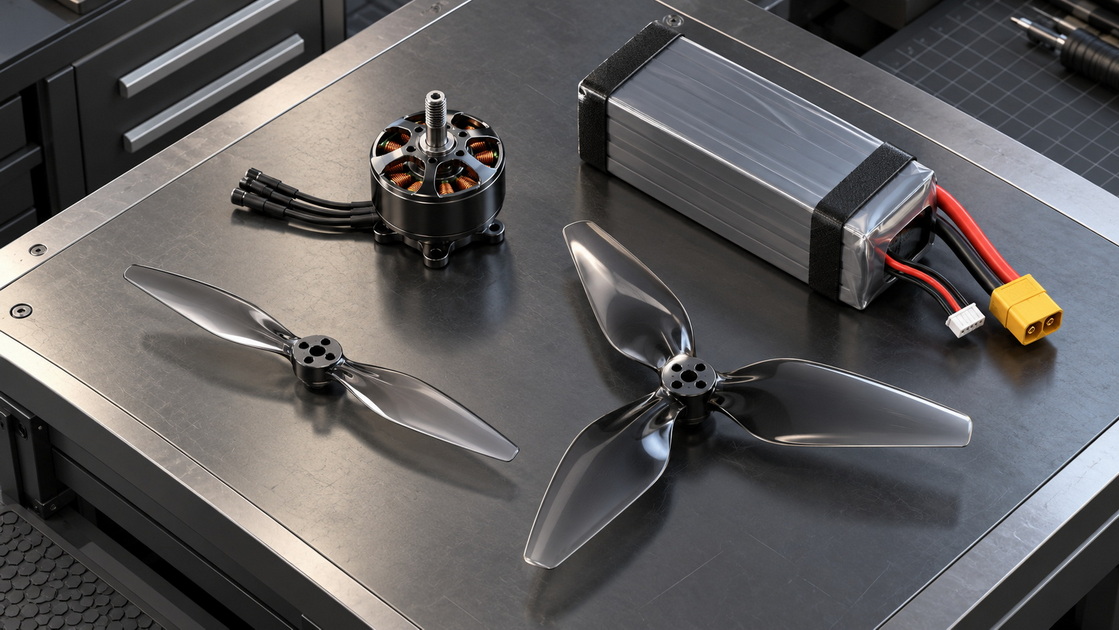
A properly matched 2000KV motor has more no-load RPM potential and may feel more responsive toward the top of the throttle range. That can appeal to pilots who want rapid acceleration out of turns or strong recovery after a dive. The benefit must be judged against the current required to drive the selected propeller.
Higher KV alone does not guarantee more usable thrust. If a demanding propeller causes high current draw or battery sag, the expected performance advantage may shrink. Conversely, a well-matched 1750KV motor can deliver substantial thrust for a 5-inch aircraft. Compare measured thrust and electrical input together rather than relying on either KV or maximum thrust in isolation.
For a camera-equipped quad, make the decision using its all-up weight: the frame, battery, camera, propellers, and every other component in flying configuration. A motor that performs well on a light build may feel different when the aircraft carries additional payload.
It is tempting to call 1750KV the "efficient option" and 2000KV the "powerful option." That shorthand is convenient but incomplete. Efficiency depends on where the motor operates and which propeller it drives. The useful comparison is often grams of measured thrust per watt of electrical input at a comparable thrust level.
For example, if two motor-propeller combinations produce the same thrust, the one requiring fewer measured watts at that operating point is more electrically efficient in that test. A full-throttle efficiency figure may not describe a pilot who spends most of a flight cruising at moderate throttle.
No responsible comparison can promise that 1750KV will extend flight time by a fixed number of minutes. Battery capacity, aircraft weight, wind, propeller choice, and pilot inputs all matter. For a meaningful field comparison, use the same battery class and aircraft configuration, then review energy use and flight time over repeatable routes.
Current and temperature deserve as much attention as thrust. A setup can appear impressive during a brief acceleration but prove unsuitable for repeated hard flying if the motor or ESC becomes too hot. Published current figures should therefore be read together with their test voltage, propeller, and test conditions.
Within the same motor family and on the same propeller, a 2000KV option may need more electrical and thermal headroom at high output. That is a reason to verify the data, not a claim that every 2000KV motor runs hotter than every 1750KV motor. Design and propeller differences can reverse simple assumptions.
Propeller diameter, pitch, blade count, and mass affect motor loading. On a 6S system, changing the propeller can alter the electrical demand even when every other component stays the same. Begin with the exact motor manufacturer's approved voltage and recommended propeller options. Then examine the measured current for the combination you intend to fly.
Check the entire power path:
- Confirm that the motor and ESC are specified for the intended 6S setup.
- Check the ESC's continuous and burst current definitions against measured demand.
- Consider battery performance and voltage sag, not just its printed capacity.
- Inspect connectors, wiring, cooling, and propeller condition.
- Treat software output limits as supplementary controls, not evidence that an otherwise unvalidated combination is safe.
An independent DroneHiTech review tested a T-Motor F60 Pro IV 1750KV motor on 6S with an HQ 5×4 tri-blade propeller. At the table's 2000 µs throttle point, the review reported 1,646 gf of thrust, 36.14 A, 24.57 V, and 888 W. The reviewer used a bench power supply initially set to 25.2 V and identified the ESC used in the test. Those conditions matter when interpreting the result.
This is a useful illustration of what a detailed test record can provide. It is not a Yuhang motor specification, a guaranteed in-flight result, or a direct 1750KV-versus-2000KV test. The review's other tested motor version was 2550KV on 4S, so comparing their headline numbers would change both KV and battery configuration. It would not isolate the difference between 1750KV and 2000KV on 6S.
There is also a practical lesson in the voltage reading. Although the power supply was initially set to 25.2 V, the cited measurement records 24.57 V. When reviewing a supplier's thrust chart, request the voltage measured at each data point, not merely the nominal battery label or initial supply setting.
What to take away: A complete thrust curve for each candidate motor—tested at the same voltage and with the same propeller—is more useful than two isolated maximum-thrust claims.
If you can source 1750KV and 2000KV windings built on the same motor platform, a controlled test can answer questions that general buying guides cannot. Motor-test resources such as Mini Quad Test Bench demonstrate the value of examining motor-and-propeller data across operating points rather than focusing solely on a peak figure.
1. Match the hardware. Hold stator geometry, ESC model, ESC settings, propeller model, mounting, and supply method constant. Record each motor's mass and rated voltage.
2. Record the operating conditions. Measure input voltage, current, watts, thrust, and RPM if available. Note ambient conditions and motor temperature at comparable points.
3. Compare equal output. Compare the watts needed to produce the same measured thrust. Also compare equal throttle commands, but do not treat throttle percentage as a substitute for equal thrust.
4. Repeat the measurements. Use comparable test durations and cooling intervals. Discard suspect readings caused by damaged propellers, loose mounting, or abnormal vibration.
5. Validate in flight. Use the intended aircraft and 6S pack. Review current spikes, voltage sag, temperatures, vibration, and flight time during similar flights.
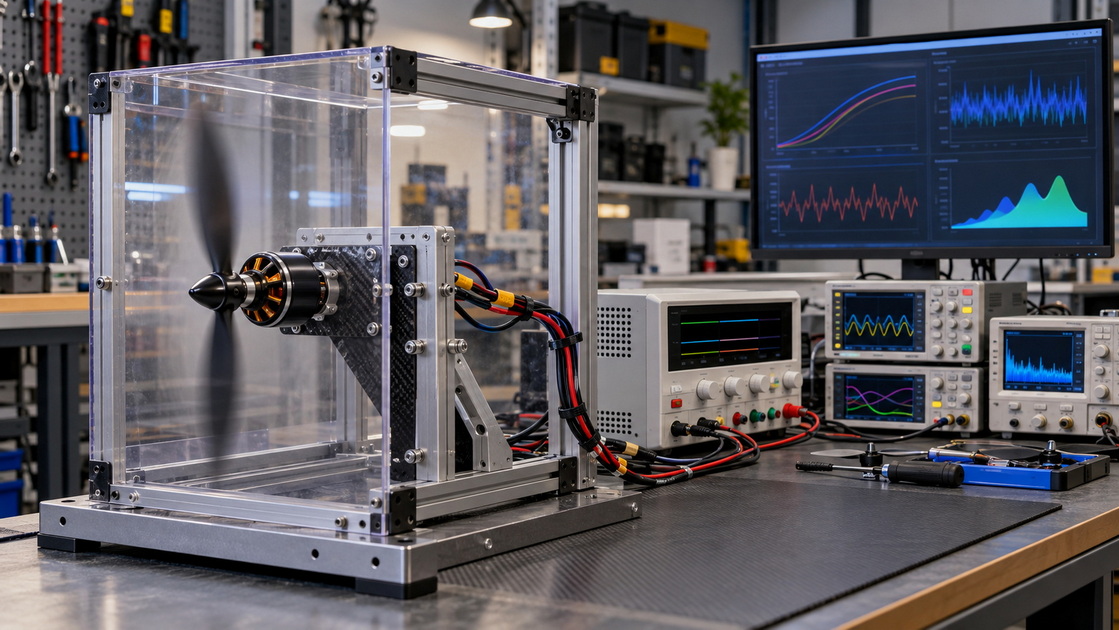
A spinning propeller presents an injury hazard. Use a secure test rig, appropriate guarding where feasible, and the motor and ESC suppliers' stated limits. Bench data helps narrow the choice, but it does not replace flight validation on the finished aircraft.
Start by evaluating 1750KV if your priorities are smooth power delivery and a manageable path to the thrust your loaded aircraft requires. Choose the propeller and assess its measured performance with the camera and intended battery included in your weight estimate. Oscar Liang's motor-selection guide identifies 1750KV as a useful 6S option for cinematic or endurance-oriented flying.
That does not rule out 2000KV. If your camera-equipped build needs more top-end response, evaluate a tested 2000KV motor-propeller combination and confirm that current draw, temperatures, and battery behavior remain acceptable. The mission—not the label—should decide.
Consider 2000KV when high-RPM response is a priority. Match it with a propeller tested on that specific motor and inspect more than its maximum thrust. A setup that delivers a strong initial burst but suffers noticeable voltage sag or thermal issues may be a poor match for repeated hard use.
For this build, the most useful supplier information is a series of measurements: thrust, current, input voltage, and power over the operating range. It lets you see what happens before the single highest-throttle reading.
Do not assume that either rating is automatically appropriate for a larger propeller. Motor-selection guidance generally moves toward lower-KV choices as propeller diameter and sustained load increase. A 2000KV motor on a demanding 6-inch propeller especially calls for explicit manufacturer approval and test evidence. A particular 1750KV combination might work, but a different winding or motor size may be a better engineering choice.
For endurance use, compare electrical input at the thrust required to carry the actual aircraft. Peak thrust remains relevant for control and recovery, but it should not be the only purchasing metric.
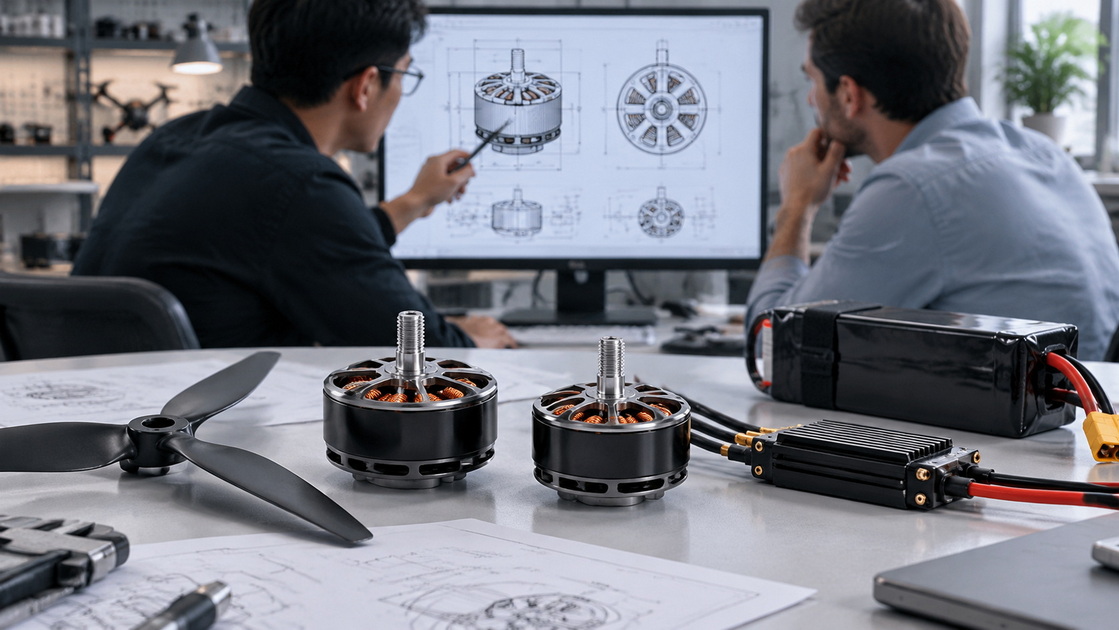
For a manufacturer or integrator, the useful deliverable is a repeatable propulsion specification, not simply "1750KV" or "2000KV" printed on a motor. Zhongshan Yuhang Power Technology Co., Ltd. can discuss motor, propeller, ESC, and battery matching in the context of the customer's stated flight profile and OEM/ODM needs. That describes the company background supplied for this article; it is not a claim that a specific Yuhang model has achieved any of the third-party results above.
When requesting a quotation or custom design, ask for:
- Rated battery configuration and approved propeller options.
- Stator dimensions, motor mass, mounting pattern, and shaft or propeller interface.
- Clearly defined continuous and short-duration operating limits.
- Thrust, current, voltage, and power curves for the proposed motor–propeller–6S combination.
- Test conditions, including supply method, ambient temperature, run duration, and sample count.
- Agreed acceptance criteria and a retesting plan if the winding or propeller changes.
These details make competing proposals easier to evaluate. They also help prevent a purchase decision based on KV alone.
Not necessarily for a properly specified 5-inch setup. Confirm that the exact motor supports the intended 6S use and that the selected propeller keeps current and temperature within validated limits. KV alone cannot certify compatibility.
No. A 1750KV winding may be a conservative starting point within a given motor family, but efficiency depends on the motor, propeller, voltage, and operating thrust. Compare measured thrust per watt at similar output rather than assuming that lower KV always wins.
Neither guarantees longer flight time. Compare the electrical energy used during similar flights with the same aircraft configuration and battery class. Propeller choice, weight, conditions, and pilot behavior can change the result.
Using the same propeller helps create a controlled comparison if both motor specifications permit it and the test can be conducted safely. Verify current draw and temperature before assuming that a propeller acceptable on the 1750KV version is equally suitable for the 2000KV version.
No. Software limiting does not change the motor's physical winding or turn the two motors into identical hardware. It should not replace validation of motor, propeller, ESC, and battery compatibility.
1. [LIGPOWER, "The Ultimate FPV Drone Motors Guide 2025"]. Motor selection, propeller loading, voltage, and current considerations. [ligpower]
2. [Oscar Liang, "How to Choose FPV Drone Motors"]. KV, motor construction, propeller matching, and application-based selection. [oscarliang]
3. [DroneHiTech, "T-Motor F60 Pro IV Review and Thrust Test"]. Independent 1750KV/6S bench-test data and conditions. [dronehitech]
4. [LIGPOWER, "FPV Motors KV Rating Explained"]. Explanation of KV and the importance of loaded testing. [ligpower]
5. [MEPSKING, "FPV Basics"]. Reference for 6S nominal and fully charged voltages. [mepsking]
6. [Mini Quad Test Bench, "Motor Data Explorer"]. Examples of motor-and-propeller data presented across operating conditions. [miniquadtestbench]
7. [Oscar Liang, "How to Slow Down FPV Drone Using Throttle Scale in Betaflight"]. Background on software-based throttle and output controls. [oscarliang]


