Language


Views: 261 Author: Yuhang Power Publish Time: 2026-10-11 Origin: Site
Content Menu
● 1404 Motor with 2.5 Inch vs 3 Inch Propellers
● What Does "1404 Motor" Actually Mean?
>> Stator dimensions do not define complete performance
>> KV and battery voltage determine the operating context
● Thrust and Efficiency: Why 3-Inch Propellers Have an Advantage to Explore
>> A 3-inch propeller provides 44% more swept area
>> Greater disk area can improve hover efficiency
>> Smaller diameter does not guarantee lower consumption
● Responsiveness, Freestyle, and Smooth Flight
>> When 2.5-inch propellers make sense
>> When 3-inch propellers make sense
● Current Draw, Motor Temperature, and Component Reliability
>> Larger propellers can increase electrical stress
>> Evaluate temperature over the intended duty cycle
● Propeller Pitch and Blade Count Can Change the Result
>> Diameter is only one selection variable
>> A practical first-test strategy
● Which Propeller Would I Evaluate First?
>> Lightweight 3-inch cruising quad
>> Heavier micro build with digital video
● A Repeatable Test Procedure for 1404 Motor Propeller Selection
>> Step 1: Define the aircraft and mission
>> Step 2: Establish mechanical compatibility
>> Step 3: Compare equal-thrust operating points
>> Step 4: Validate repeatable flight performance
● OEM and ODM Considerations for FPV Motor Projects
>> 1. Can a 1404 motor run both 2.5-inch and 3-inch propellers?
>> 2. Are 3-inch propellers always more efficient?
>> 3. Will 2.5-inch propellers keep my motor cooler?
>> 4. What KV should I choose for a 1404 motor?
>> 5. Is a 1404 motor suitable for a 3-inch freestyle drone?
Choosing a 1404 motor with 2.5 inch vs 3 inch propellers means balancing compactness, thrust, electrical load, and flight efficiency. Both combinations can work, but neither is automatically better. A lightweight, open-propeller cruiser and a compact, ducted cinewhoop place different demands on the same motor size.
My starting point for this comparison is simple: matching matters more than diameter alone. Select the propeller around the aircraft's weight, available clearance, motor KV, battery voltage, and intended flight profile.
This guide takes an engineering-led approach. Published specifications establish compatibility examples, while aerodynamic principles explain the trade-offs. The recommendations are selection guidelines—not claimed flight-test results from Zhongshan Yuhang Power Technology Co., Ltd.
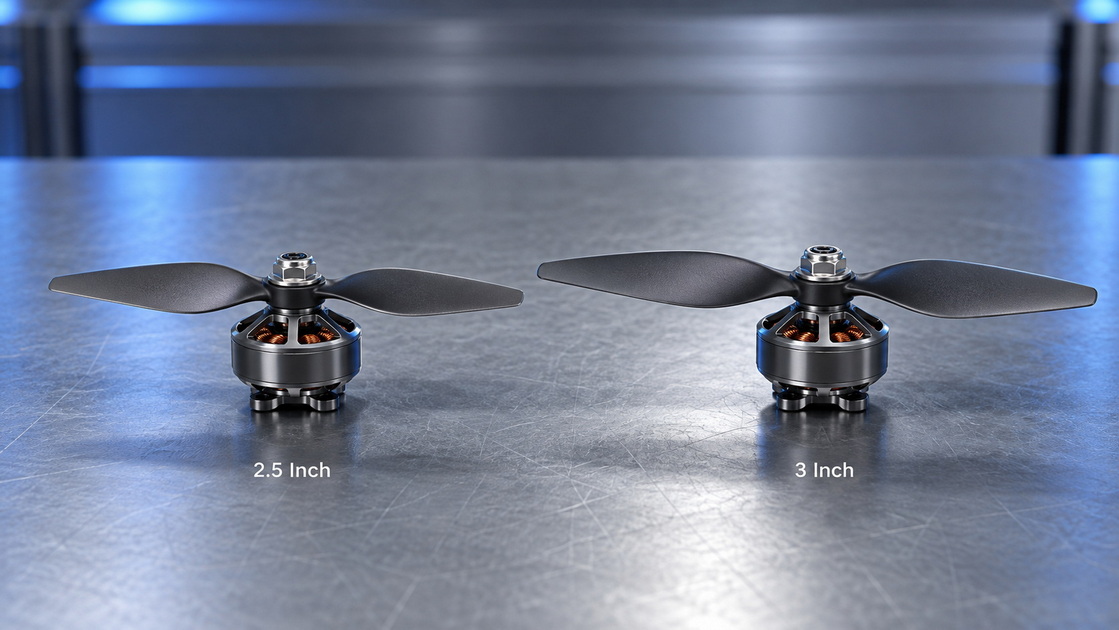
For a lightweight aircraft with adequate clearance, a modest-pitch 3-inch propeller is often the stronger starting point for evaluating cruise performance and payload capability. A 2.5-inch propeller is worth considering when compact dimensions, duct compatibility, or reduced propeller load are priorities.
| Comparison factor | 1404 motor with 2.5-inch props | 1404 motor with 3-inch props |
|---|---|---|
| Propeller diameter | 63.5 mm | 76.2 mm |
| Swept area per propeller | Approximately 31.7 cm² | Approximately 45.6 cm² |
| Main advantage | Compact packaging | More swept area |
| Motor loading | Often lower with comparable blade designs | Often higher with comparable blade designs |
| Efficiency opportunity | Suitable for compact, lightweight builds | Potential advantage at equal thrust |
| Response | Lower propeller inertia may help | Depends on motor torque and propeller mass |
| Typical applications | Compact micro builds and compatible cinewhoops | Lightweight freestyle and cruising builds |
| Main limitation | Less disk area for supporting aircraft weight | Greater clearance and load-management requirements |
These are directional comparisons. A high-pitch 2.5-inch tri-blade can load a motor more heavily than a low-pitch 3-inch bi-blade.
In common FPV motor naming, "1404" indicates a stator approximately 14 mm in diameter and 4 mm tall. It does not describe the motor's external dimensions, shaft diameter, mounting pattern, or maximum safe current.
Two 1404 brushless motors can behave differently because of their winding configuration, magnets, air gap, bearings, cooling, and construction.
For a purchasing decision, I would therefore compare complete specifications rather than assume that every 1404 motor is interchangeable.
KV describes approximate unloaded rotational speed per volt. It is not a direct measurement of thrust or power.
Increasing voltage or KV generally increases the speed a motor attempts to reach. Installing a propeller introduces aerodynamic load, reducing actual RPM and increasing current demand.
Published compatibility examples illustrate the available range:
- BETAFPV specifies its 1404 3800KV motor for 3S–4S operation and lists several compatible 3-inch propellers.
- T-MOTOR describes its F1404 family as suitable for 2.5–4-inch builds, with 3-inch applications highlighted.
These examples confirm that both diameters are plausible. They do not validate every combination of voltage, pitch, blade count, and aircraft weight.
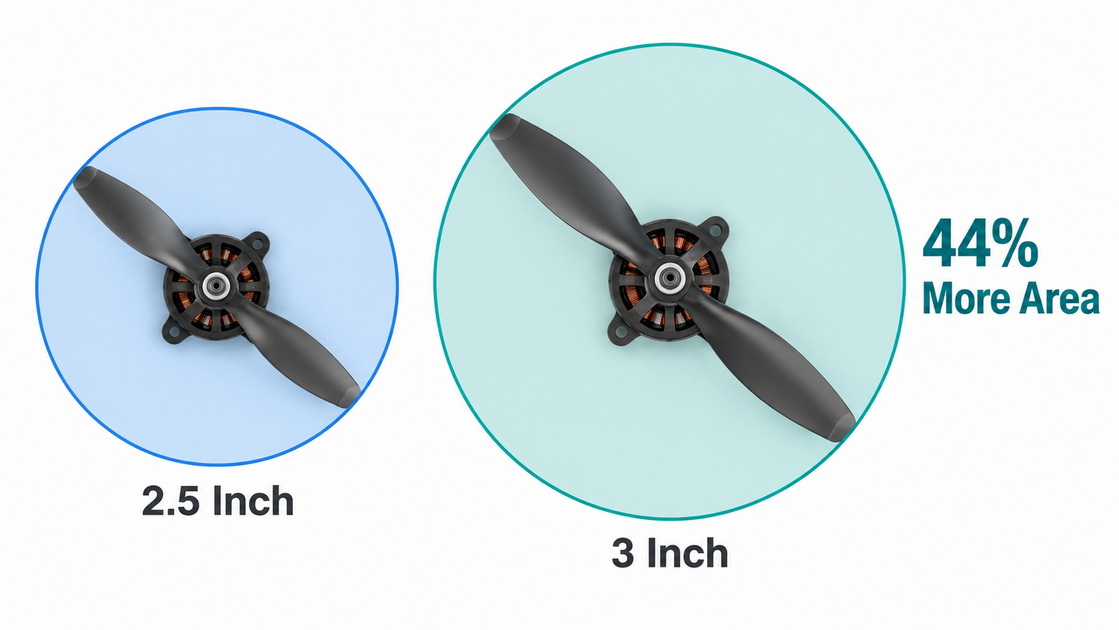
Propeller disk area increases with the square of diameter:
A=π(D/2)2
The area ratio is therefore:
(3/2.5)2=1.44
A 3-inch propeller sweeps 44% more area than a 2.5-inch propeller. This is a geometric calculation—not a prediction of 44% more thrust.
Actual thrust depends on RPM, blade geometry, air density, and the motor's ability to sustain the required torque.
Propellers generate thrust by accelerating air. A larger disk provides an opportunity to move more air with a smaller velocity increase for the same thrust.
Under ideal momentum theory, this reduces the induced-power requirement. Real propellers also experience blade drag, tip losses, and installation effects, so the complete aircraft must still be tested.
This explains why a 3-inch setup can be attractive for lightweight cruising. However, an oversized battery, inefficient blade design, or heavily loaded motor can erase that advantage.
A 2.5-inch propeller may require less torque at a comparable RPM and blade design. Nevertheless, supporting the same aircraft weight may require it to rotate faster.
The useful comparison is electrical power at equal thrust—not current at equal throttle percentage.
For flight-time decisions, compare average battery power during the same flight task. Maximum-throttle figures alone reveal little about efficient cruising.
Smaller, lighter propellers can have less rotational inertia, allowing quicker RPM changes when the motor and control system are appropriately matched.
That makes 2.5-inch props a reasonable candidate for compact builds prioritizing tight packaging and precise maneuvering. However, propeller mass matters: a heavy 2.5-inch tri-blade is not automatically more responsive than a lightweight 3-inch bi-blade.
Ducts also change airflow and aircraft behavior. A ducted 2.5-inch cinewhoop should not be treated as equivalent to an open-propeller 2.5-inch quad.
A well-matched 3-inch propeller can provide useful thrust reserve for recovery maneuvers, outdoor cruising, and carrying additional equipment.
That reserve is especially relevant when a digital video system or battery increases all-up weight. But selecting a more aggressive propeller can also increase current and temperature.
My preference would be to evaluate a moderate-pitch propeller first, then increase blade loading only when measurements show a genuine need.
Holding other factors broadly comparable, increasing diameter usually increases the torque needed to rotate the propeller.
Possible consequences include:
- Higher motor and battery current.
- Greater winding heating.
- More battery voltage sag.
- Increased ESC loading.
- Reduced efficiency when the motor operates beyond a favorable load range.
These effects become particularly important when combining high KV, higher voltage, aggressive pitch, and three or more blades.
A 1404 motor should not be considered compatible with an aggressive 3-inch propeller simply because another 1404 model supports that diameter.
A short throttle burst and several minutes of loaded operation are different thermal conditions.
Check temperature after a repeatable flight or bench sequence. Use the motor manufacturer's limits and a consistent measurement method rather than a universal "safe to touch" rule.
Abnormal heating should trigger a review of propeller loading, cooling, mechanical friction, flight-controller settings, and electrical compatibility.
A useful 2.5-inch vs 3-inch propeller comparison must also control or document:
- Pitch and blade shape.
- Number of blades.
- Propeller mass and material.
- Hub dimensions and mounting system.
- Intended RPM range.
Higher pitch can increase load and change performance across the flight-speed range. Additional blades can provide more blade area within a restricted diameter, but they also alter drag and torque requirements.
Neither characteristic guarantees better efficiency.
For an open-propeller aircraft, begin with a conservative propeller recommended for the exact motor.
Then compare a second candidate that changes one major variable where possible. For example, evaluate another diameter within a similar blade family rather than simultaneously changing diameter, pitch, blade count, and battery voltage.
This makes the results easier to interpret and reduces guesswork.
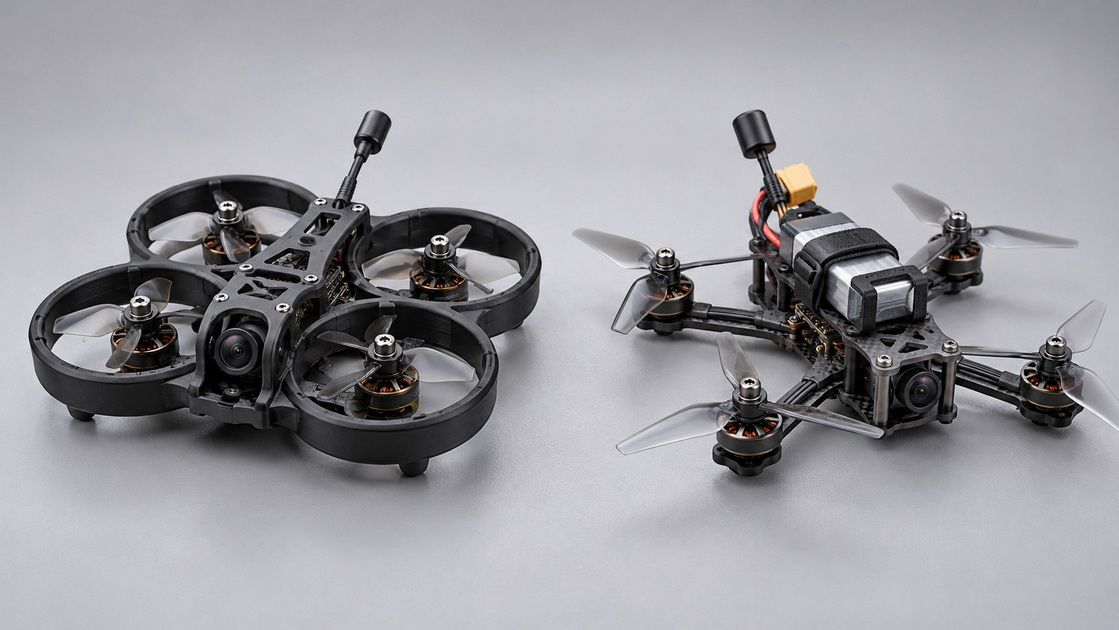
I would start by evaluating a low- or moderate-pitch 3-inch propeller with a motor-approved battery configuration.
The objective is efficient thrust at the actual cruise condition, not the highest static thrust reading.
Keep battery mass under control. More capacity can extend endurance, but the additional weight also raises required thrust.
I would first check frame and duct compatibility, including propeller clearance and hub attachment.
A protected propeller system may impose packaging requirements that outweigh the aerodynamic appeal of a larger diameter. Evaluate the assembled propulsion system, because open-air motor data may not represent ducted performance.
I would assess whether the 1404 motor has adequate sustained-load capability before selecting either diameter.
A 3-inch propeller may improve thrust capability, but it can also overload an unsuitable winding. A heavily loaded aircraft may require a larger motor rather than a more aggressive propeller.
These are engineering scenarios, not documented customer case studies.
Record all-up weight, battery specification, frame clearance, video equipment, and expected flight style.
Include the battery and payload in the weight measurement.
Confirm shaft diameter, propeller attachment, mounting-hole pattern, and screw length.
Ensure that mounting screws cannot contact motor windings. Check for interference between the propeller, frame, ducts, and cables.
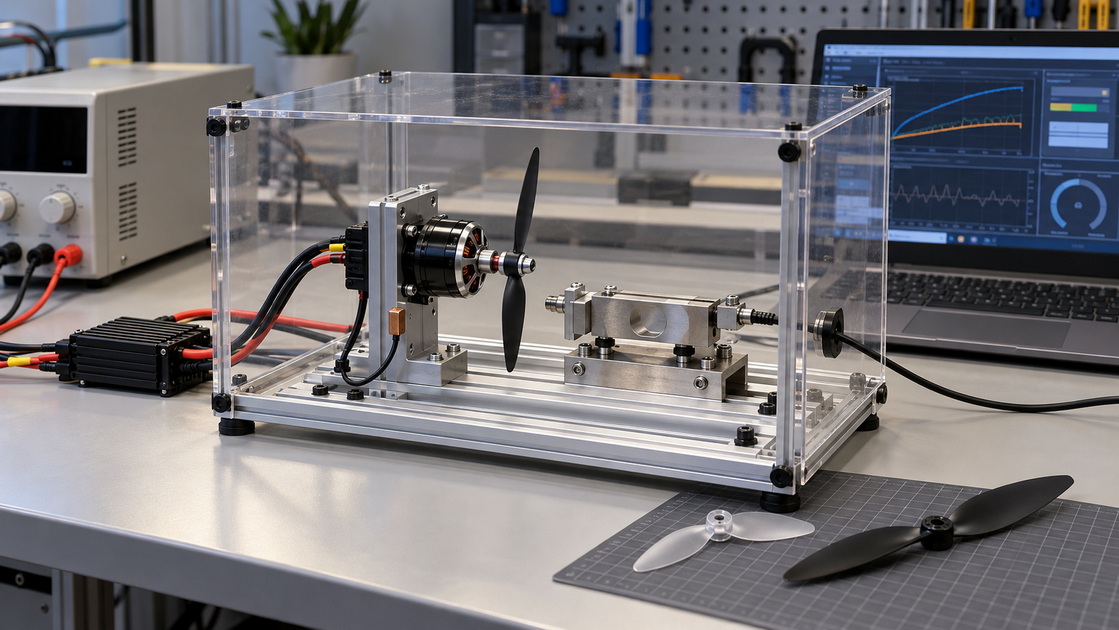
On a guarded thrust stand, measure both candidates at the same supply voltage and ambient conditions.
Record:
| Measurement | Why it matters |
|---|---|
| Thrust | Confirms lift capability |
| Voltage and current | Establish electrical input power |
| RPM, if available | Helps explain loading differences |
| Motor and ESC temperature | Reveals thermal behavior |
| Thrust per watt | Supports efficiency comparison |
Compare efficiency near the thrust each motor needs to support the aircraft, then examine higher-load conditions separately.
Use the same battery type, flight profile, payload, and landing criterion. Alternate test order to reduce bias from changing conditions.
Inspect logged voltage sag, average consumption, handling, and post-flight temperature. A single flight is not enough to establish a reliable endurance difference.
For Zhongshan Yuhang Power Technology Co., Ltd., the useful customer discussion starts with the intended propulsion system—not an isolated motor size.
An OEM or ODM inquiry should include:
1. Target all-up weight and payload.
2. Preferred propeller models, including pitch and blade count.
3. Battery cell count and operating-voltage range.
4. Required thrust, flight duration, and duty cycle.
5. Frame, shaft, mounting, and wiring constraints.
6. Environmental conditions and validation requirements.
The resulting specification should distinguish burst performance from sustained operation. It should also define how sample acceptance will be measured.
For commercial production, repeatable current, temperature, and mechanical quality are more valuable than an unexplained peak-thrust number.
Some models can. Confirm the exact motor's voltage rating, recommended propellers, shaft compatibility, and operating limits. The 1404 designation alone is insufficient.
No. They provide more disk area, which creates an efficiency opportunity. Propeller geometry, motor loading, aircraft weight, and flight conditions determine whether that opportunity becomes a measurable benefit.
They may reduce loading under comparable conditions. However, high pitch, additional blades, excessive aircraft weight, or higher required RPM can still produce substantial heating.
Choose KV together with battery voltage and the exact propeller. Published 3800KV and other F1404 options illustrate available combinations, but no single KV is ideal for every 2.5-inch or 3-inch aircraft.
It can be suitable for a lightweight build. Heavier aircraft or demanding sustained maneuvers may require greater motor capability. Validate thrust reserve and temperature with the intended battery and propeller.
1. [Oscar Liang — How to Choose FPV Drone Motors]. Supports stator-size terminology, KV interpretation, and motor–propeller–battery matching principles. [oscarliang]
2. [BETAFPV — 1404 3800KV Brushless Motors]. Provides the cited 3S–4S specification and compatible 3-inch propeller examples. These specifications apply to that product, not every 1404 motor. [betafpv]
3. [T-MOTORHOBBY — F1404 Tiny Trainer Build/Micro Long Range Motor]. Provides manufacturer-described 2.5–4-inch applications and highlighted 3-inch use. [tmotorhobby]
4. [NASA Glenn Research Center — Propeller Thrust]. Supports the relationship between propeller disk area, pressure change, and thrust. The 44% area comparison is calculated from the stated diameters. [grc.nasa]
5. [NASA Glenn Research Center — Propeller Analysis]. Supplies the momentum-theory basis for discussing airflow and larger-disk efficiency opportunities; it does not establish measured micro-drone performance. [grc.nasa]
6. [APC Propellers — Engineering]. Explains how diameter, pitch, blade geometry, RPM, and torque interact in propeller performance. [apcprop]
7. [Oscar Liang — How to Choose the Best Propellers for FPV Drone]. Supports propeller terminology and the recommendation to consult motor–propeller thrust testing. [oscarliang]


