Language


Views: 246 Author: Yuhang Power Publish Time: 2026-10-23 Origin: Site
Content Menu
● Drone Motor vs Gimbal Motor at a Glance
>> The Motor, Propeller, ESC, and Battery Work Together
● What Does a Gimbal Motor Do?
>> Stabilization Depends on the Complete Axis
● Speed, KV, and Torque: Understanding the Real Difference
>> KV Describes Speed per Volt, Not Quality
>> Torque Depends on More Than Winding Choice
● Windings, Resistance, and Controller Compatibility
>> Why a Propulsion Motor Can Damage a Gimbal Controller
● Smoothness, Cogging, and Vibration
>> Cogging Torque Is Not the Same as Torque Ripple
● Thermal Performance: Why Holding Still Can Generate Heat
>> Cooling Assumptions Must Match Installation
● Mechanical Design and Load Requirements
>> Why Payload Weight Alone Is Insufficient
● The Motors Interact Through the Structure
>> Diagnose the Disturbance Before Increasing Motor Size
● Can You Use a Drone Motor as a Gimbal Motor?
● How to Qualify Drone Motors and Gimbal Motors
>> Propulsion Motor Acceptance Checks
>> Gimbal Motor Acceptance Checks
● OEM and ODM Requirements for Yuhang Motor Projects
>> 1. Are drone motors and gimbal motors both brushless?
>> 2. Does a gimbal motor always have lower KV?
>> 3. Can a regular drone ESC control a camera gimbal?
>> 4. Why does a stationary gimbal motor become hot?
>> 5. Which motor type is more efficient?
The main difference between a drone motor and a gimbal motor is their operating purpose. A drone propulsion motor spins a propeller to generate thrust. A gimbal motor applies controlled torque to stabilize or position a camera, sensor, or other payload.
Both can use brushless permanent-magnet technology, and both may have an outer-rotor design. However, similar construction does not make them interchangeable. Their windings, operating speeds, thermal conditions, feedback requirements, and controllers can differ substantially.
For equipment manufacturers, the drone motor vs gimbal motor decision should begin with the required motion, not the appearance of the motor.
At Zhongshan Yuhang Power Technology Co., Ltd., our stated scope covers brushless motor development, production, power-system solutions, and OEM/ODM services. From this manufacturing perspective, the most useful comparison considers the complete propulsion system or positioning axis—not an isolated motor specification.
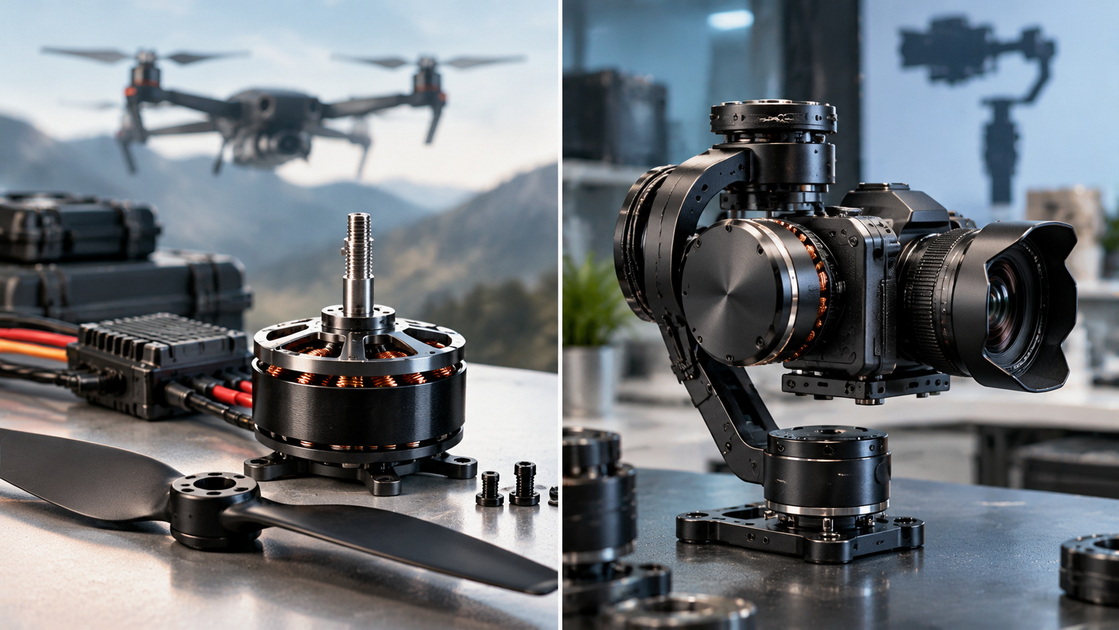
In this article, "drone motor" means a propulsion motor, particularly one used in an FPV drone or conventional multirotor. A drone can also carry separate gimbal motors.
| Comparison point | Drone propulsion motor | Gimbal motor |
|---|---|---|
| Primary task | Rotate a propeller to produce thrust | Stabilize or position a payload |
| Typical movement | Sustained rotation with speed changes | Controlled positioning, reversals, and holding |
| Main performance measures | Thrust, current, RPM, efficiency, temperature | Torque smoothness, tracking error, settling, temperature |
| Controller | Propulsion ESC | Compatible gimbal or servo controller |
| Feedback | Often sensorless motor commutation | IMU feedback; encoder feedback may also be used |
| Mechanical priority | Propeller interface, balance, rotor retention | Axis integration, bearings, cable routing, stiffness |
| Cooling conditions | May benefit from propeller airflow | Often limited airflow inside an assembly |
| Common purchasing mistake | Selecting by KV alone | Selecting by payload weight alone |
These are typical tendencies, not universal design rules. Large industrial propulsion motors and advanced stabilized platforms can use more specialized arrangements.
A brushless drone motor converts electrical energy into shaft power. The propeller then converts part of that power into aerodynamic thrust.
For an FPV quadcopter, the propulsion system must also respond to rapid commands. Acceleration, braking behavior, propeller inertia, and controller compatibility affect how the aircraft responds.
The motor cannot be evaluated independently of its load.
A useful propulsion assessment includes:
- Motor size and winding.
- Battery operating voltage.
- Propeller diameter, pitch, and blade configuration.
- ESC current capability and settings.
- Aircraft mass.
- Required operating duration.
- Cooling and installation conditions.
A published maximum-thrust figure is incomplete without the test voltage, propeller, current, and duration.
Likewise, a motor that produces impressive short bursts may be unsuitable for sustained operation at the same load.
A gimbal motor applies torque around an axis to control the orientation of a payload.
A camera stabilizer may need to keep the image steady while its supporting platform moves. An inspection system may need to point a sensor accurately and settle quickly after a command.
The motor therefore needs more than the ability to rotate.
Important components include:
- Payload and its center of gravity.
- Motor and bearing arrangement.
- Position or orientation feedback.
- Controller and tuning.
- Structural stiffness.
- Cable routing.
- Available heat dissipation.
Some gimbals use motor-mounted encoders. Others rely on different sensing and control arrangements. An encoder should not be assumed to be included simply because the product is called a gimbal motor.
Motor KV is commonly expressed in RPM per volt. As a first approximation:
n0≈KVV
Here, n0is approximate no-load speed and V is applied voltage. Actual behavior depends on the drive and motor characteristics.
Loaded propeller speed will generally be lower than the no-load estimate.
FPV propulsion motors often operate at comparatively high speeds, but not all drone motors have high KV. Large propellers and higher-voltage systems may use much lower-KV windings.
Therefore, "low KV" does not automatically identify a gimbal motor.
Within an appropriate operating range:
T≈KTI
Here, KT is the torque constant and I is the corresponding torque-producing current.
Buyers must confirm current conventions before comparing suppliers. Phase current, battery current, peak current, and RMS current are not interchangeable.
Changing the winding can alter the relationship between speed and current. It does not automatically increase the motor's thermally sustainable torque.
Small conventional gimbal motors often use windings different from those in similarly sized FPV propulsion motors.
However, resistance is not a universal dividing line. Advanced current-controlled gimbal systems can use designs that differ from traditional camera-gimbal arrangements.
Some gimbal controller designs expect a particular winding-resistance range. Connecting a low-resistance propulsion motor can exceed their electrical limits.
The safe selection process is to match:
- Supply voltage.
- Winding resistance and inductance.
- Continuous and peak current.
- Pole count.
- Commutation method.
- Feedback arrangement.
- Controller protection limits.
Do not transfer one controller manufacturer's resistance recommendation to every other product.
Similarly, a standard propulsion ESC is generally not a substitute for a precision positioning controller. Compatibility must be established at the system level.
A drone motor and a gimbal motor can both produce vibration, but the consequences differ.
In propulsion, rotor or propeller imbalance can affect the airframe, bearings, sensors, and image quality.
In a gimbal axis, torque disturbances can directly affect low-speed movement and pointing stability.
Cogging torque arises from the interaction between the rotor magnets and a slotted stator, even without commanded current.
Torque ripple during powered operation can also involve electromagnetic design, commutation, current control, and other effects.
A "low cogging" claim therefore does not fully describe controlled-motion quality.
Ask for the measurement method, load conditions, and supporting plots. For gimbal applications, evaluate small movements and reversals—not only a smooth-looking continuous rotation demonstration.
A gimbal motor can consume current while holding a stationary payload against an external torque.
At zero speed, mechanical output power is zero, but winding losses can remain. Copper loss follows:
Pcopper=∑I2phase,rmsRphase
This is why "the motor barely moves" is not evidence of a light thermal duty.
A propulsion motor tested in strong airflow may operate differently when airflow is restricted.
A gimbal motor enclosed inside a compact housing may depend heavily on conduction through its mount.
Request continuous ratings with stated ambient temperature, mounting conditions, and permitted winding temperature. Do not compare a short-duration peak rating with another supplier's continuous rating.
Propulsion motors must accommodate the propeller interface and loads associated with rotation, thrust, and maneuvers.
Gimbal motors must fit a positioning mechanism with suitable axis support and stiffness. Some are supplied as complete assemblies; frameless kits may supply only rotor and stator.
The buyer must know which bearings, sensors, and supports remain outside the motor supplier's scope.
Two cameras with the same mass can impose different demands if their mass distribution differs.
For a simplified axis:
Trequired=Jα+Timbalance+Tfriction+Tdisturbance
Rotational inertia J, acceleration α, imbalance, and disturbances all matter.
A well-balanced payload reduces static gravity torque around the relevant axis. It does not eliminate the torque needed for acceleration or disturbance rejection.
A propulsion system and camera gimbal may pass separate bench tests yet perform poorly together.
Propeller imbalance, frame resonance, flexible mounts, and cable forces can transmit disturbances into the stabilized payload.
The resulting image vibration is not automatically evidence that the gimbal motor is too small.
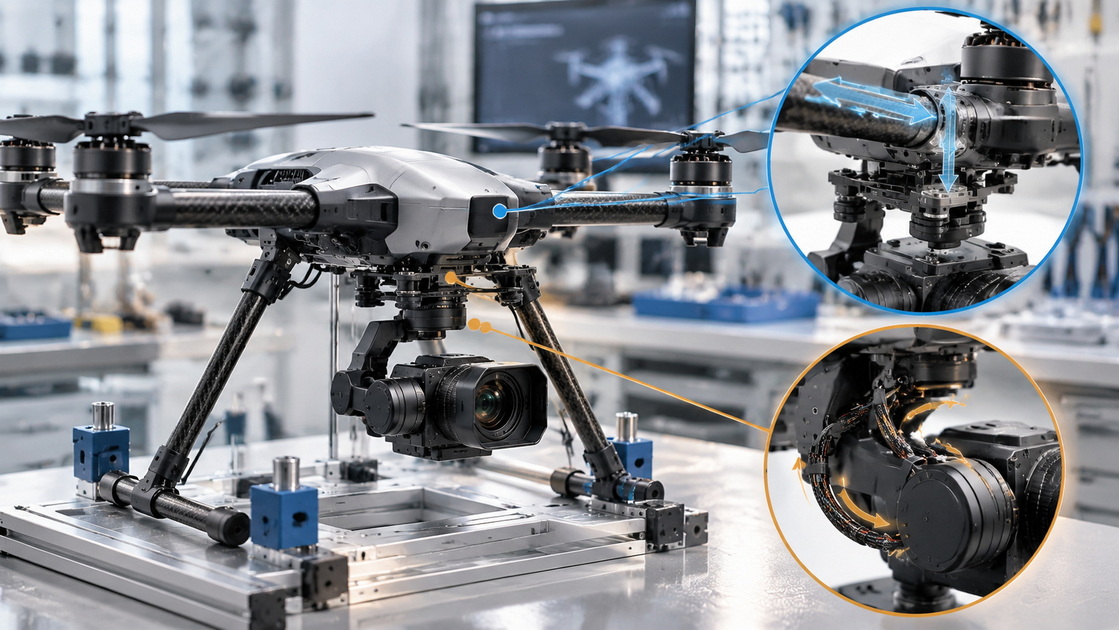
Use a staged assessment:
1. Test propulsion balance and vibration.
2. Check structural mounting and camera attachment.
3. Evaluate the gimbal with representative wiring.
4. Compare behavior with propulsion inactive and active.
5. Review controller settings and measured response.
Blindly increasing control gains or motor size can leave the underlying disturbance unresolved.
This system-level check is particularly valuable for imaging drones and inspection platforms.
Sometimes a brushless motor can be repurposed, but it should be treated as an engineering development project rather than a direct replacement.
It must satisfy electrical, thermal, mechanical, feedback, and low-speed performance requirements.
Rewinding may change electrical characteristics. It does not automatically correct cogging, bearing behavior, rotor inertia, structural fit, or thermal limitations.
The reverse substitution is equally uncertain. A motor designed for a positioning axis may not provide an appropriate propeller mount, speed capability, cooling arrangement, or rotor retention.
For a commercial product, select against a validated specification instead of assuming that three motor wires indicate interchangeability.
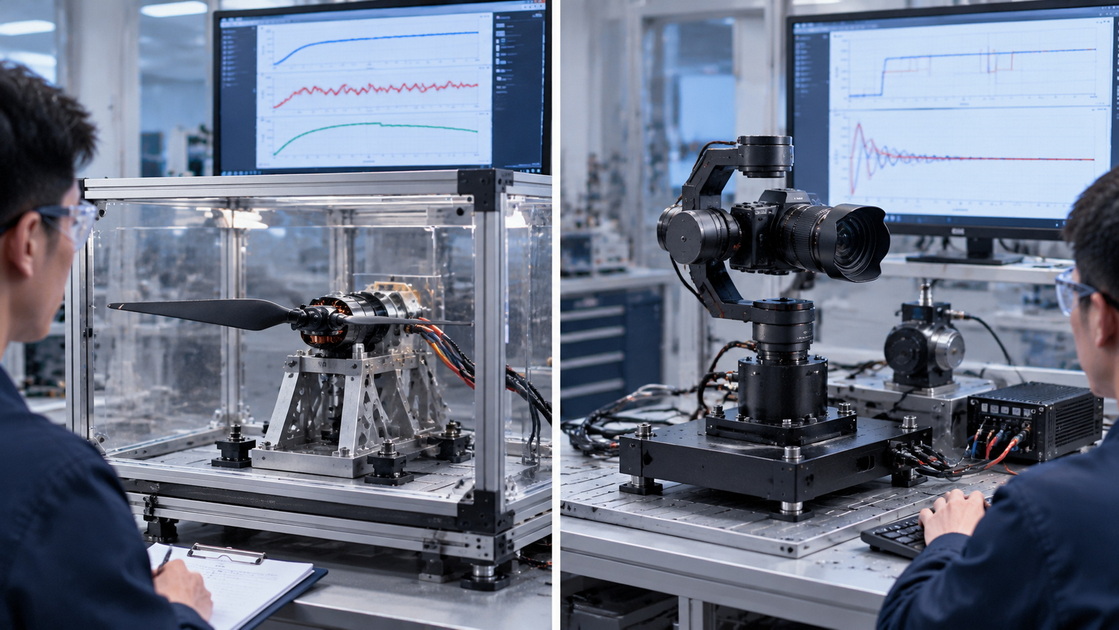
Test with the intended propeller and compatible power system. Record:
- Thrust.
- RPM.
- Voltage and current.
- Temperature over time.
- Dynamic response.
- Vibration.
- Relevant operating duration.
Use suitable guarding and qualified personnel for powered propeller testing.
Thrust per electrical watt can help compare operating points, but it is not the same as motor conversion efficiency.
Evaluate:
- Continuous and peak torque.
- Low-speed motion.
- Position tracking and settling.
- Reversal behavior.
- Holding temperature.
- Cable-induced disturbances.
- Performance with the intended controller and payload.
For both categories, retain the tested configuration and drawing revision. A hand-selected sample should not silently become the acceptance standard for an undocumented production design.
Zhongshan Yuhang Power Technology Co., Ltd. serves multiple brushless motor applications according to its supplied company background, including FPV drones, gimbal cameras, robotics, and other professional equipment.
That breadth makes a clear application brief especially important.
For a propulsion inquiry, provide aircraft mass, propeller, battery voltage, thrust targets, flight profile, and quantity.
For a gimbal inquiry, provide payload geometry, inertia estimate, axis arrangement, motion targets, feedback preference, installation space, and duty cycle.
For either project, clarify customization, tooling, testing, change notification, packaging, and delivery responsibilities. Application-specific feasibility and performance should be confirmed through a technical proposal and representative samples.
A drone propulsion motor is selected around propeller performance. A gimbal motor is selected around smooth, controlled payload motion.
Shared brushless technology does not remove the differences in winding, controller compatibility, cooling, feedback, or mechanical integration.
They commonly are, particularly in modern multirotor propulsion and direct-drive camera stabilization. Brushless construction alone does not establish interchangeability.
No. That can be a useful tendency in some product classes, but operating voltage, motor size, winding, and controller architecture vary. Select from complete specifications.
Not as a general drop-in solution. A gimbal requires suitable control of torque and orientation, with compatible sensing and motor characteristics.
Holding torque can require current even without rotation. Poor balance, friction, cable forces, or unsuitable settings can increase the thermal demand.
There is no meaningful universal winner. Compare propulsion at required thrust points and gimbal operation at its actual torque, motion, and holding duty.
1. Tyto Robotics. [Drone Testing Equipment]. Supports measuring thrust, torque, RPM, voltage, and current, and evaluating the complete propulsion combination under representative conditions. [tytorobotics]
2. Tyto Robotics. [Brushless Motor Testing]. Background on motor test measurements and efficiency assessment. [tytorobotics]
3. maxon. [Motor Data and Operating Ranges]. Technical background on torque constants, current, continuous operation, and heat-dissipation-dependent ratings. [maxongroup]
4. maxon Support. [Motor Constants]. Explains speed and torque constants and distinguishes winding-dependent characteristics from motor capability. [support.maxongroup]
5. maxon Support. [Motor Data and Simulation]. Supports the importance of temperature, installation, tolerances, and control-loop conditions when interpreting motor data. [support.maxongroup]
6. BaseCam Electronics. [SimpleBGC]. Documents controller-specific warnings against using unsuitable low-resistance propulsion motors. Its numerical resistance recommendations are not treated as universal gimbal requirements. [basecamelectronics]
7. BaseCam Electronics. [SimpleBGC Controller Configuration Guide]. Supports the importance of balance, friction, temperature, pole-count configuration, and controller tuning. [basecamelectronics]
8. BaseCam Electronics. [Using Encoders With SimpleBGC 32 Controllers]. Demonstrates that motor resistance selection and feedback requirements depend on controller capability and configuration. [basecamelectronics]


