Language


Views: 284 Author: Yuhang Power Publish Time: 2026-10-21 Origin: Site
Content Menu
● Drone Motor vs RC Plane Motor: What Is Actually Different?
>> Shared Technology Does Not Guarantee Interchangeability
>> The Aircraft Creates Different Demands
● Drone Motor vs RC Plane Motor Comparison Table
● Can You Use a Drone Motor on an RC Plane?
>> Check the Propeller Before Choosing the Battery
>> Confirm the Complete Mounting Arrangement
● Can You Use an RC Plane Motor on a Drone?
>> Weight and Response Need Evaluation
>> Avoid Mixing Unmatched Propulsion Units
● KV and Voltage: Why Similar RPM Is Not Enough
>> Equal KV Does Not Mean Equal Capability
● ESC Compatibility: More Than Voltage and Current
>> Separate Communication From Motor Operation
>> Braking and Receiver Power Need Separate Checks
● Static Thrust vs Flight Performance: Compare the Right Evidence
● How to Test a Motor Swap Safely
>> Step 1: Create a Compatibility Record
>> Step 2: Inspect With the Propeller Removed
>> Step 3: Use an Appropriate Test Fixture
>> Step 4: Measure the Actual Combination
>> Step 5: Validate the Installed Aircraft
● When a Motor Swap Is Not Worth Pursuing
● OEM and ODM Projects: Specify the Mission First
>> 1. Can I Use a 2207 FPV Motor on a Small RC Plane?
>> 2. Can I Keep the Same Propeller After Changing Motors?
>> 3. Does a Higher-Wattage Motor Automatically Improve Performance?
>> 4. Can an FPV ESC Power My Plane's Servos?
>> 5. Is Matching Maximum Static Thrust Enough?
Can You Swap Them? Yes—you can sometimes swap a drone motor and an RC plane motor, provided the motor, propeller, battery, ESC, mounting arrangement, and cooling conditions work together. However, matching the bolt pattern or KV rating alone does not establish a safe replacement.
The drone motor vs RC plane motor comparison is primarily about application requirements, not two completely different motor technologies. Many electric multirotors and RC airplanes use three-phase brushless motors. Their intended operating conditions, mechanical interfaces, and control requirements can differ considerably.
The deciding factor is compatibility across the complete propulsion system.
At Zhongshan Yuhang Power Technology Co., Ltd., our recommendation for a proposed substitution is to start with the aircraft's requirements, examine the component specifications, and validate the combination through controlled testing—not assume that a familiar motor size guarantees success.
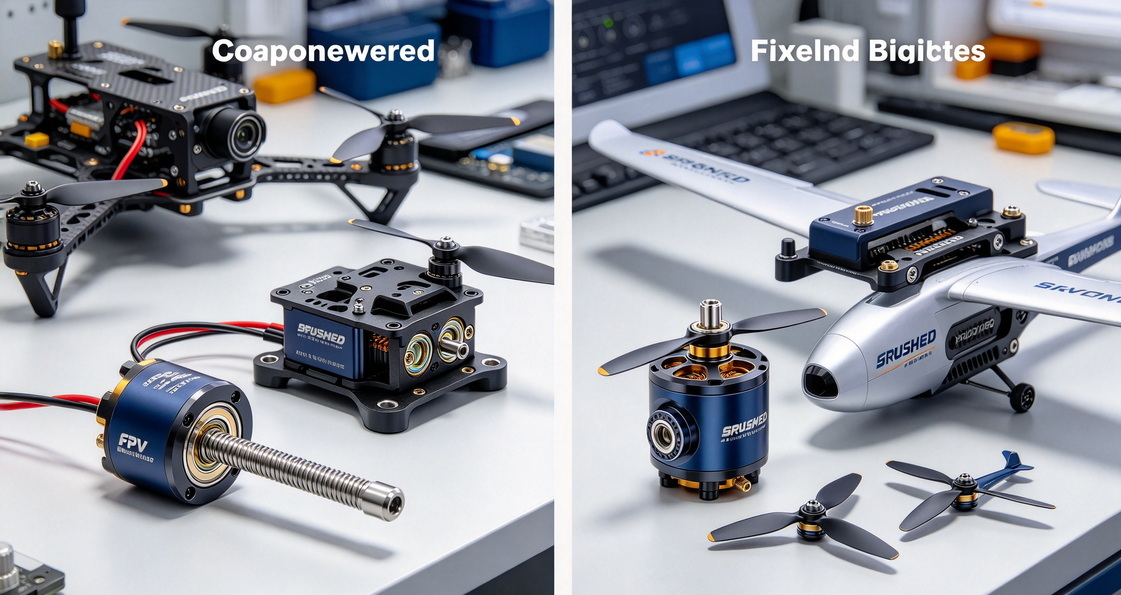
In this article, "drone motor" primarily means a brushless propulsion motor used on a multirotor, including FPV aircraft. "RC plane motor" means an electric propulsion motor used on a fixed-wing model—not an internal-combustion engine.
This distinction matters because some drones are fixed-wing aircraft themselves.
Both applications can use brushless outrunner motors. Their specifications may include:
- KV rating.
- Recommended battery voltage.
- Maximum current.
- Motor dimensions and weight.
- Propeller recommendations.
- Mounting and shaft details.
However, two motors with similar headline specifications may differ in winding resistance, rotor inertia, bearing arrangement, cooling, and allowable operating duration.
Evaluate the exact model rather than relying on its product category.
A multirotor normally depends on continuous powered thrust to remain airborne. Its controller also changes motor output to manage attitude.
A fixed-wing aircraft primarily obtains lift from its wings during forward flight. Propulsion requirements vary across launch, climb, cruise, aerobatics, and landing.
Neither application is automatically easier on a motor. A demanding airplane climb or enclosed installation can create substantial thermal stress.
| Selection factor | Multirotor and FPV applications | Electric RC plane applications |
|---|---|---|
| Main propulsion role | Lift and attitude control | Forward propulsion |
| Control priorities | Reliable startup and suitable thrust response | Suitable throttle response and mission performance |
| Propeller arrangement | Multiple units, often using opposite rotations | Commonly one propeller; other layouts exist |
| Mechanical interface | Often direct propeller mounting on the rotor | May use an adapter, spinner, or folding hub |
| Cooling conditions | Depend on rotor flow, installation, and flight | Depend on cowling, airflow, and operating condition |
| Electrical integration | Often flight-controller-managed ESCs | ESC may also supply receiver and servo power |
| Validation priority | Hover efficiency, thrust reserve, dynamic response | Launch, climb, cruise, and thermal performance |
These are application tendencies, not universal construction rules.
Yes, when the motor can drive a suitable airplane propeller within its electrical, mechanical, and thermal limits.
This can be worth evaluating for compact aircraft, flying wings, and projects where a lightweight motor fits the design.
A motor that performs well with a small FPV propeller may be overloaded by a larger airplane propeller.
Diameter, pitch, blade count, and blade geometry all affect the load. Changing one variable can require changes elsewhere in the system.
Do not assume that a motor's maximum advertised power is available with any propeller.
Use manufacturer-supported combinations where available. Otherwise, establish a conservative test configuration with the motor supplier.
Check:
- Motor-mount strength and bolt engagement.
- Shaft or threaded adapter dimensions.
- Propeller-hub seating and clearance.
- Retention method and rotation direction.
- Spinner compatibility, where applicable.
- Clearance between mounting screws and windings.
A propeller adapter that physically fits may still be unsuitable for the expected speed or loading.
Avoid improvised drilling or clamping arrangements unless the component manufacturer explicitly permits them.
Sometimes. A suitably matched airplane motor can drive a multirotor propeller, but it must meet the aircraft's control and sustained-load requirements.
A heavier motor changes aircraft mass and required hover thrust. Its rotor and propeller characteristics may also influence transient response.
That does not mean every airplane motor responds slowly. It means the complete propulsion unit must be evaluated rather than classified by its label.
For a multirotor conversion, measure steady-state performance and assess whether the motor–propeller–ESC combination responds appropriately to controller commands.
Do not replace one motor with a substantially different model simply because both produce similar maximum static thrust.
Their response, current consumption, and behavior across the operating range may differ.
For a production design, specify matched propulsion units and document the approved configuration.
KV describes an approximate no-load speed relationship, usually expressed in revolutions per minute per volt.
A useful first estimate is:
No-load RPM≈KV×V
For illustration, a 1000KV motor supplied with 15 V has an approximate no-load speed of 15,000 RPM.
This is not its guaranteed propeller-loaded speed, and it says nothing by itself about safe torque, current, or temperature.
Two 1000KV motors can have different sizes, winding characteristics, cooling, and operating limits.
Likewise, reducing battery voltage to obtain a lower speed does not automatically make an unsuitable motor–propeller combination acceptable.
My practical advice is to compare measured operating points: voltage, current, RPM, thrust, and temperature with the intended propeller.
Motor compatibility does not override the propeller manufacturer's speed limit.
APC, for example, publishes different suggested RPM limits for different propeller families. Its current guidance uses:
- Thin Electric propellers: 150,000 divided by diameter in inches.
- Multi-Rotor propellers: 105,000 divided by diameter in inches.
For a 10-inch propeller, those formulas correspond to 15,000 RPM and 10,500 RPM respectively.
These are APC-specific guidelines, not universal limits for every brand. Always check the current instructions for the exact propeller.
The important lesson is that two props with the same diameter can have different permitted operating speeds.
When evaluating a swap, check both expected loaded RPM and relevant overspeed conditions. Do not use the motor's no-load calculation as proof that a propeller installation is acceptable.
The electronic speed controller must suit the motor and the aircraft's control system.
An ESC must understand the incoming control signal and operate the motor reliably.
Check:
- Supported command protocol.
- Voltage and current ratings.
- Startup behavior.
- Timing and firmware settings.
- Motor electrical-speed limits.
- Relevant telemetry support.
- Behavior during signal loss.
Do not assume that a controller protocol alone guarantees reliable commutation under load.
Multirotor active braking is not necessarily the same function as an airplane ESC's propeller-stop brake.
A folding-propeller aircraft may need an appropriate stop behavior, while a multirotor needs control behavior suited to its flight controller.
Also check power distribution. Many FPV ESC arrangements do not provide the regulated receiver and servo supply expected in a conventional RC airplane.
Confirm whether a suitable BEC or separate regulator is required. Motor compatibility does not solve avionics power requirements.
Static thrust testing is useful, but it does not reproduce every operating condition.
A multirotor's hover requirement differs from a plane's forward-flight operating point. Incoming airflow changes propeller behavior.
Propulsion-testing guidance therefore distinguishes static measurements from dynamic evaluation.
For a fixed-wing conversion, assess more than maximum thrust:
- Launch or takeoff performance.
- Sustained climb.
- Cruise power consumption.
- Operating temperature.
- Expected forward-speed behavior.
For a multirotor, examine hover power, control margin, transient response, and sustained-load temperature.
Static grams of thrust per watt can describe one test point. It is not a complete ranking of aircraft efficiency.
Document the motor, propeller, ESC, battery, connectors, and mounting hardware.
Record electrical limits, propeller RPM limits, and thermal requirements before energizing the system.
Verify mechanical clearance, secure connections, direction of rotation, and control behavior.
Perform ESC calibration or configuration without a propeller, following the relevant manufacturer and flight-controller instructions.
Conduct loaded tests on a securely mounted propulsion stand with suitable protection and exclusion distances.
Keep people clear of the propeller plane. Do not hold the motor or aircraft by hand for powered propeller testing.
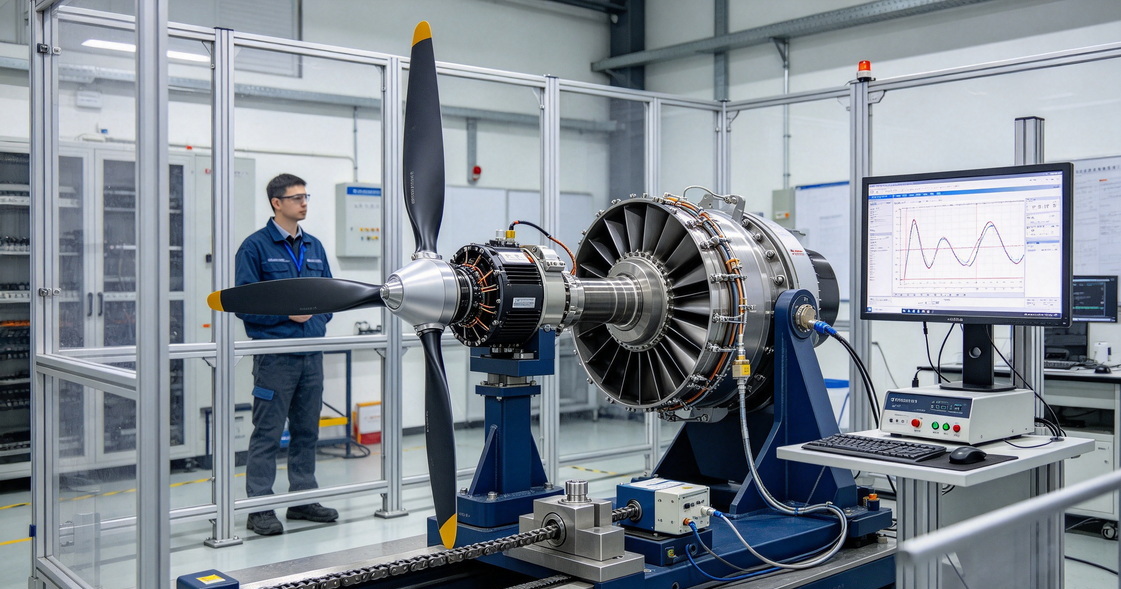
Record voltage, current, RPM, thrust, and temperature under defined conditions.
Increase loading cautiously within documented limits. Stop for abnormal vibration, loss of synchronization, loosening, or unexpected heating.
A housing-temperature reading may not represent the winding's hottest point.
A successful open-bench test does not establish adequate cooling inside a cowling.
Complete installation checks and controlled flight evaluation under applicable operating rules. Reassess balance and control settings before flight.
Choose a more appropriate motor when:
- Suitable performance data cannot be obtained.
- The intended propeller exceeds documented limits.
- Mechanical retention requires uncertain modifications.
- Cooling cannot be demonstrated.
- The ESC is unsuitable for the motor or controls.
- Added weight undermines aircraft requirements.
- Production repeatability cannot be maintained.
A low purchase price can become expensive when it creates repeated testing, damaged components, or unreliable performance.
Zhongshan Yuhang Power Technology Co., Ltd. provides brushless-motor development and manufacturing services, including OEM and ODM support, according to the company background supplied for this article.
For a useful technical discussion, submit:
- Aircraft type and target mass.
- Propeller constraints.
- Battery configuration.
- Thrust and operating-duration requirements.
- Installation and cooling conditions.
- Mounting and connector requirements.
- Controller arrangement.
- Target quantity and documentation needs.
Ask for recommendations tied to your application and a validation plan. Do not treat a catalog motor's performance as evidence for a modified version.
A drone motor can sometimes power an RC plane, and an RC plane motor can sometimes suit a multirotor. Neither substitution should be approved from KV, dimensions, or advertised wattage alone.
The reliable approach is to match the entire propulsion system and validate its operating conditions.
Potentially. The designation does not establish suitable propeller loading or installation compatibility. Confirm the exact model, KV, voltage, mounting, propeller, and thermal performance.
Only if the replacement can drive it safely. Check its RPM limit, current draw, attachment method, rotation, and clearance. Reusing the propeller does not eliminate testing.
No. Added weight and mismatched operating characteristics can offset the potential benefit. Compare aircraft-level performance rather than maximum power alone.
Not necessarily. Check whether it includes a suitable BEC and whether its output supports the complete servo and receiver load. Otherwise, an appropriate separate supply is required.
No. It does not establish equal efficiency, thermal endurance, response, or forward-flight performance. Compare the operating range and intended mission.
1. [Tyto Robotics — Drone Lesson Plan and Motor/Propeller Laboratory Courseware]. Educational material covering KV, motor efficiency, and propeller behavior. [tytorobotics]
2. [Unmanned Systems Technology — "Motor & Propeller Matching for Drone Propulsion Systems," May 2026]. Technical overview of voltage, KV, torque, propeller loading, and static versus dynamic testing. [unmannedsystemstechnology]
3. [APC Propellers — RPM Limits]. Manufacturer-specific formulas used for the 10-inch propeller examples; these are not universal industry limits. [apcprop]
4. [APC Propellers — Technical Support Advisories]. Product-family distinctions, multirotor applications, and rotation conventions. [apcprop]
5. [ArduPilot — Electronic Speed Controller Calibration]. Propeller-removal precautions and distinctions among relevant ESC settings. [ardupilot]
6. [ArduPilot — Connect ESCs and Motors]. Motor connection, control-system integration, and BEC considerations. [ardupilot]
7. [Tyto Robotics — Drone Testing Equipment and Applications]. Measurement of thrust, torque, RPM, voltage, and current for propulsion characterization. [tytorobotics]
8. [APC Propellers — Engineering]. Propeller performance information across rotational speeds and forward-flight conditions. [apcprop]


