Language


Views: 278 Author: Yuhang Power Publish Time: 2026-10-17 Origin: Site
Content Menu
● Sensorless vs Sensored Brushless Motor at a Glance
● How Sensorless Brushless Motors Work
>> Why Startup Needs Special Attention
>> Sensorless Does Not Mean Sensor-Free
● How Sensored Brushless Motors Work
>> Feedback Resolution Matters
>> More Feedback Does Not Automatically Mean Better Flight
● Sensorless vs Sensored Is Not the Same as Six-Step vs FOC
● Which Motor Architecture Fits Different Drone Applications?
>> Drone Gimbals and Positioning Mechanisms
>> Unusual or Specialized Loads
● Efficiency, Weight, Reliability, and Total Cost
>> Efficiency Requires a Fair Comparison
>> Weight Must Be Assessed at System Level
>> Reliability Involves Different Failure Modes
>> Compare Development Cost, Not Just Motor Price
● Restarting a Rotor That Is Already Moving
>> What to Include in Validation
● Can Sensorless Motors Operate at Zero or Very Low Speed?
● A Practical Qualification Plan for Drone Manufacturers
>> 2. Identify the Control Architecture
>> 3. Request a Matched Hardware Proposal
>> 4. Test Representative Conditions
>> 5. Control Production Changes
● How Yuhang Power Can Support OEM and ODM Development
● FAQ
>> 1. Does a sensored motor always start more smoothly?
>> 2. Can a sensored motor run with a sensorless ESC?
>> 3. Does FOC require rotor-position sensors?
>> 4. Will position sensors increase drone flight time?
>> 5. Is motor telemetry the same as rotor-position feedback?
For most conventional FPV propulsion projects, a sensorless brushless motor and compatible electronic speed controller are a practical starting point. Sensored systems deserve consideration when the application requires reliable rotor-position feedback at standstill, controlled low-speed operation, or demanding restart behavior.
However, the sensorless vs sensored brushless motor decision should not be reduced to "lighter versus smoother." Performance depends on the motor, ESC, control algorithm, propeller, electrical supply, and operating conditions working together.
My recommendation is to prioritize system compatibility. A well-matched sensorless propulsion system can outperform a poorly integrated sensored alternative—and the reverse is equally possible.
This guide explains the differences, highlights common specification mistakes, and provides a qualification framework for drone manufacturers and OEM buyers.
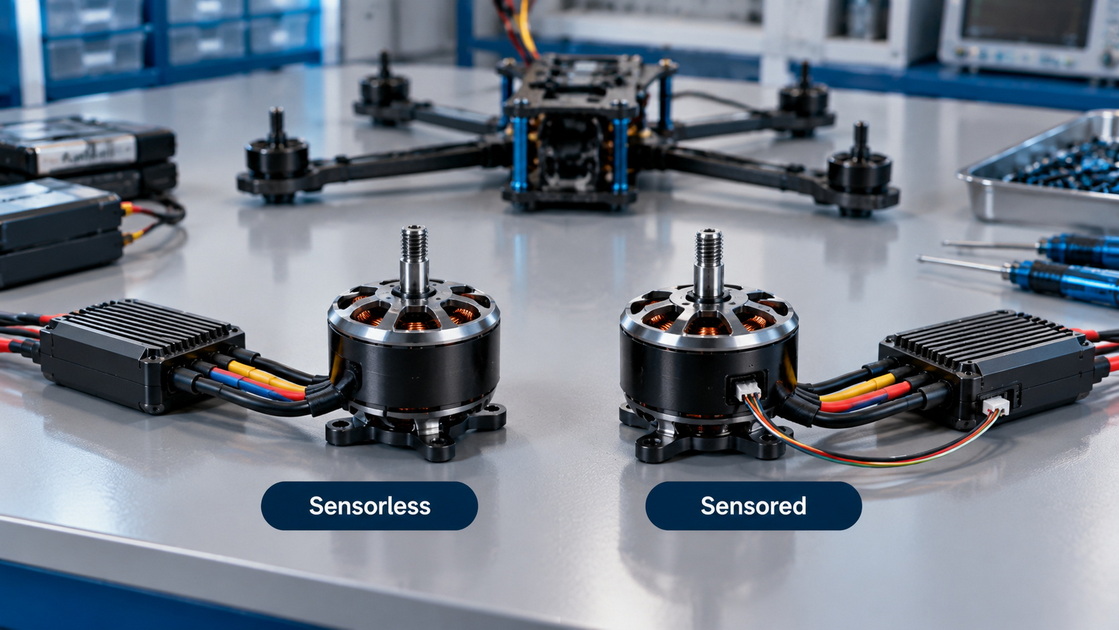
Both systems use electronic control to energize the motor phases. The main difference is how the controller obtains rotor-position information.
| Comparison Point | Sensorless System | Sensored System |
|---|---|---|
| Rotor-position information | Estimated from electrical measurements or other motor-response information | Obtained from Hall sensors, an encoder, or another position sensor |
| Standstill operation | Conventional back-EMF methods require a startup strategy | Position feedback is available without relying on generated back-EMF |
| Low-speed behavior | Depends strongly on the estimation method and tuning | Can support controlled low-speed operation with a suitable controller |
| Wiring | No dedicated rotor-position sensor harness | Additional sensor power, signals, or communications |
| Integration | Requires compatible estimation and startup behavior | Requires compatible sensor interface and calibration |
| Failure considerations | Estimation and synchronization problems | Sensor, wiring, calibration, and controller problems |
| Efficiency | Depends on the complete system | Depends on the complete system |
| Purchasing priority | Verify operating envelope and transitions | Verify feedback compatibility and operating envelope |
Neither architecture guarantees higher thrust, longer flight time, or better reliability.
A conventional sensorless controller estimates rotor position using electrical behavior rather than a dedicated rotor-position sensor.
One common method detects back electromotive force, or back-EMF, generated as the motor rotates. More advanced controllers can estimate position using measured currents, calculated voltages, and motor models.
Back-EMF amplitude depends on rotational speed. At standstill, a conventional back-EMF method cannot obtain useful position information from rotation-generated voltage.
The controller therefore needs a startup approach before transitioning to its normal estimation method.
This transition matters because a motor that runs well at steady speed may still start inconsistently under a particular load.
A sensorless ESC may still measure current, bus voltage, phase voltage, or temperature.
"Sensorless" generally means that dedicated rotor-position feedback is not required. It does not mean the controller operates without measurements.
This distinction helps procurement teams interpret supplier descriptions accurately.
A sensored system uses dedicated feedback to identify rotor position.
Common options include:
- Hall-effect sensors.
- Magnetic or optical encoders.
- Resolvers in suitable applications.
For compact brushless systems, Hall sensors provide a relatively simple position-feedback approach.
Three Hall sensors commonly divide an electrical revolution into six commutation sectors.
That is useful information, but it is not equivalent to a high-resolution encoder.
An encoder-based system may support finer position information, although the practical benefit depends on the controller, installation, calibration, and application.
Do not specify "sensored" without identifying what kind of sensor is required and why.
Rotor-position feedback can support motor control, but it does not replace the flight controller's attitude sensing or navigation functions.
Likewise, a motor-position sensor does not directly establish propeller thrust.
Buyers should keep propulsion feedback, aircraft stabilization, and navigation requirements separate.
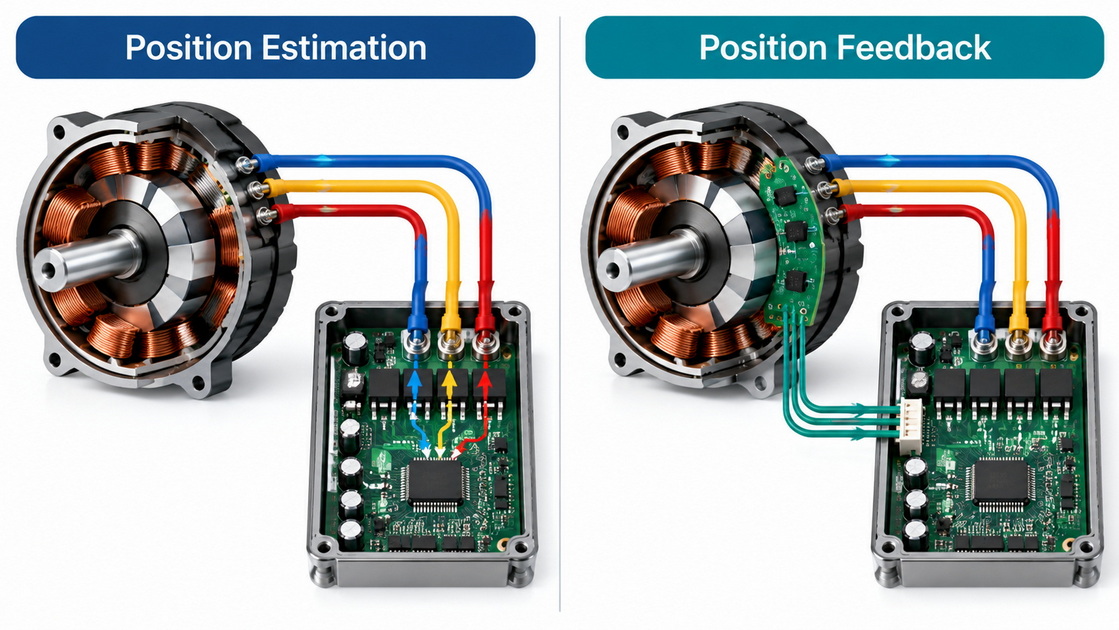
This is one of the most important distinctions in a drone motor comparison.
Sensor architecture describes how rotor position is obtained.
Commutation and control architecture describe how electrical power is applied.
Both sensored and sensorless systems can use field-oriented control, commonly called FOC. Six-step control can also use Hall feedback or sensorless back-EMF detection.
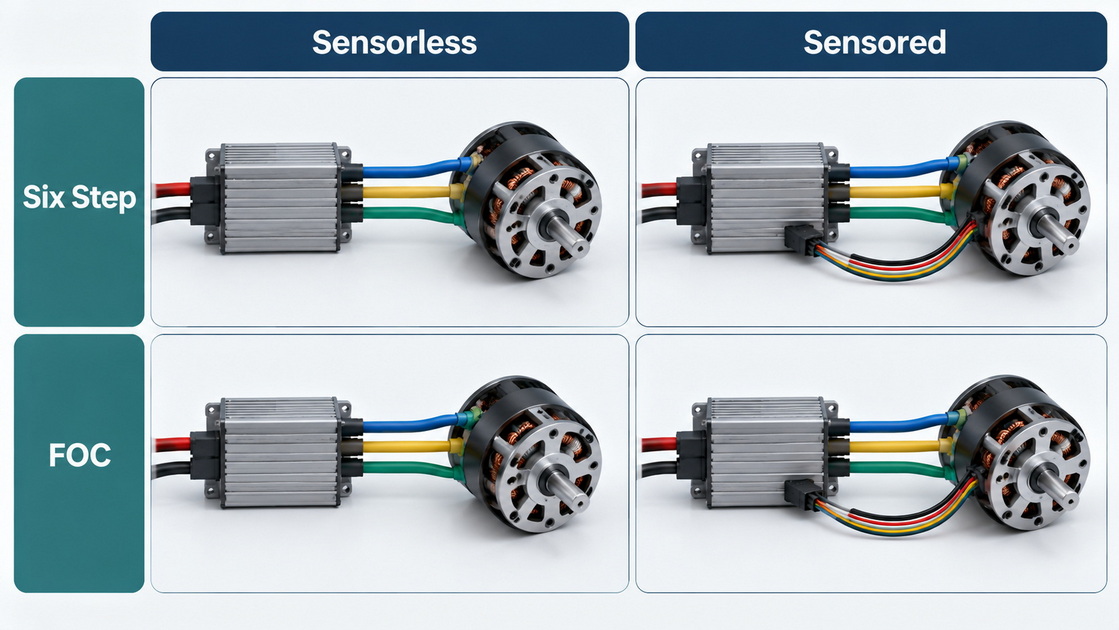
FOC controls motor current relative to the rotor's magnetic orientation.
It can support controlled torque production and smooth operation when implemented appropriately.
However, "FOC" does not automatically establish a measurable flight-time improvement.
Texas Instruments and Microchip both publish drone ESC reference designs using sensorless FOC. These demonstrate that sensorless control and advanced current control are compatible.
Request separate answers for:
1. Rotor-position feedback or estimation method.
2. Startup method.
3. Commutation or current-control method.
4. Speed-control strategy.
5. Protection functions.
6. Validated motor and propeller combinations.
A product description that says only "advanced FOC ESC" leaves important questions unresolved.
For conventional FPV propulsion, sensorless integration offers a straightforward architecture without a dedicated position-sensor harness.
However, rapid throttle changes, propeller loading, electrical limits, and controller settings still require validation.
Do not select an FPV drone motor solely by size and KV.
Industrial aircraft should be evaluated against their mission profile.
If the propulsion system spends most of its operating time within a well-characterized speed range, sensorless control may be suitable.
If the application requires unusual low-speed behavior, frequent restarts, or tightly controlled transitions, compare alternative feedback architectures through testing.
A gimbal motor performs a different task from a propulsion motor.
Slow movement and position holding may justify dedicated position feedback, but this does not imply that the aircraft's propeller motors need the same architecture.
Specify each subsystem independently.
Variable-pitch mechanisms, experimental propulsion assemblies, and other specialized systems may have requirements unlike ordinary fixed-pitch FPV propulsion.
In these cases, begin with the operating envelope rather than assuming that a familiar hobby configuration will transfer successfully.
There is no universal percentage advantage for sensorless or sensored control.
Compare complete systems using the same:
- Propeller.
- Supply conditions.
- Thrust targets.
- Cooling arrangement.
- Ambient conditions.
- Measurement method.
For propulsion, electrical input at defined thrust points is usually more informative than an isolated no-load result.
Sensor feedback can add components and wiring.
However, total mass also includes the controller, connectors, protection, mounting, and any changes needed to satisfy the performance requirement.
Request the actual proposed assembly mass rather than assuming a fixed weight penalty.
Removing position sensors eliminates certain components and connections. It does not eliminate estimation or synchronization failures.
Adding feedback provides information but creates requirements for signal integrity, calibration, and fault handling.
The stronger design is the one whose failure modes have been identified and tested for the mission.
Include:
- Motor and ESC.
- Sensor hardware where applicable.
- Engineering integration.
- Firmware support.
- Testing.
- Production calibration.
- Replacement and service arrangements.
A cheaper component can become expensive if it requires extensive troubleshooting or redesign.
A stationary startup test is not enough.
Airflow can rotate a propeller before the ESC begins driving it. The rotor may already be turning in the commanded direction or in the opposite direction.
Motor-control literature identifies this as flying-start or windmilling detection.
The controller needs an appropriate response to the initial state.
A supplier demonstration that shows only a clean start from rest does not establish performance under airflow-driven rotation.
This is particularly relevant when the mission or aircraft design can produce such conditions.
Within an appropriately guarded test environment, evaluate:
- Stationary startup.
- Startup with initial forward rotation.
- Response to initial reverse rotation.
- Low-supply conditions.
- Hot restart.
- Relevant load variations.
These are proposed qualification conditions, not instructions for unrestricted in-flight restart testing.
Define safe test procedures and acceptance limits before execution.
Some can, using methods beyond conventional back-EMF detection.
High-frequency injection and initial-position-detection techniques can extract position information from suitable motor responses.
However, suitability depends on motor characteristics and controller implementation. Microchip specifically discusses such techniques in connection with salient motors, particularly interior permanent-magnet designs.
Do not assume that every FPV outrunner supports reliable zero-speed sensorless control.
Ask the supplier to demonstrate the required behavior using the exact proposed hardware.
The useful distinction is not "sensorless cannot start." It is that different sensorless methods have different limits.
Specify aircraft configuration, propeller, supply range, operating duration, expected thrust, environment, and restart requirements.
Document whether the proposal uses back-EMF detection, an observer, Hall feedback, an encoder, or another method.
Also identify the startup and transition strategy.
The motor and ESC should be evaluated together.
Ask for relevant motor parameters, controller limits, firmware identification, and integration requirements.
Measure performance across the intended operating envelope, including relevant transients and temperature conditions.
Use guarded propulsion test equipment and qualified personnel.
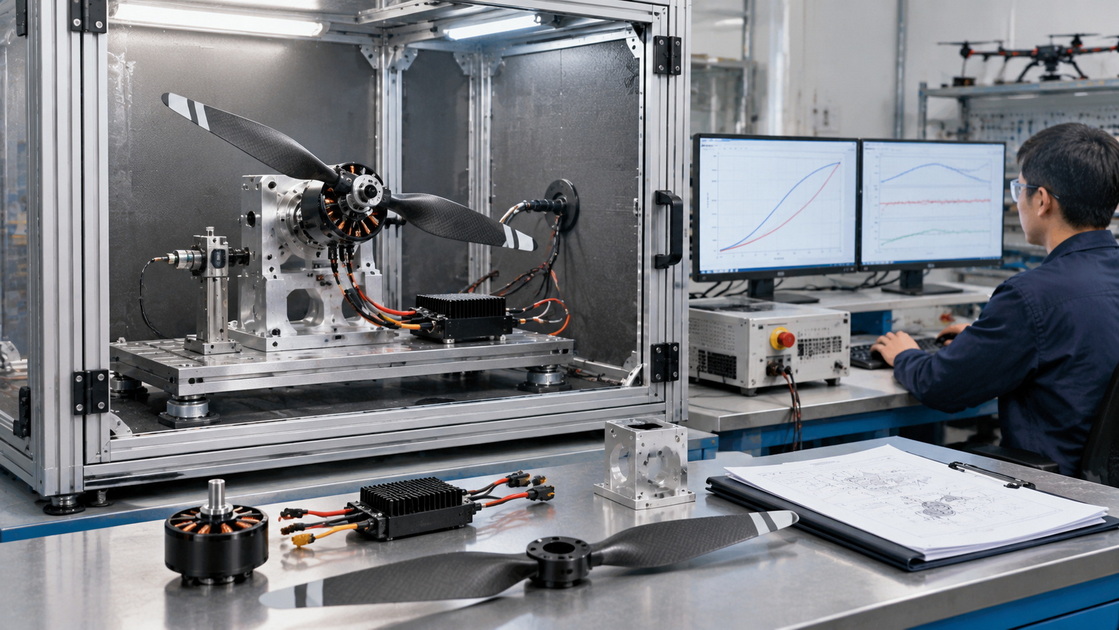
Identify the approved motor, controller, firmware, sensor arrangement, and propeller configuration.
Require notification before changes that could affect the validated behavior.
A successful engineering prototype does not automatically qualify every future production revision.
Zhongshan Yuhang Power Technology Co., Ltd. describes its business as brushless motor development, production, and complete power-system support.
Its published application coverage includes drones, RC vehicles, gimbals, aircraft, cleaning robots, and underwater robots. It also advertises OEM, ODM, and customized development.
For a drone project, a useful inquiry should include:
- Target application and mission.
- Required motor dimensions.
- Supply range.
- Propeller and thrust requirements.
- Operating duration.
- Existing ESC or control platform.
- Feedback requirements.
- Annual volume and qualification schedule.
Ask Yuhang to distinguish established capabilities from proposed development.
In particular, custom motor services should not be interpreted as confirmation that every Hall, encoder, or sensorless-control option is already available.
Request a written integration plan, sample specification, test responsibilities, and change-control arrangement.
Sensorless brushless systems are a practical starting point for conventional FPV propulsion. Sensored systems merit evaluation when dedicated position feedback provides a defined application benefit.
Neither label replaces system testing.
Start with operating conditions, distinguish feedback from control algorithms, and validate startup, steady operation, transitions, and relevant fault responses.
Not automatically. Feedback can support controlled startup, but results depend on sensor alignment, controller compatibility, current control, and load.
Some can operate without using their feedback, provided the electrical and control requirements are compatible. Do not assume universal interchangeability or retained low-speed benefits.
No. Both sensored and sensorless FOC exist. The important question is how position is obtained across the required operating range.
There is no universal improvement. Compare the actual propulsion systems at representative thrust points and mission conditions.
No. Telemetry can report operating information without providing the type of position feedback required for sensored commutation. Confirm exactly what signals are available and how they are used.
1. Texas Instruments — "Brushless DC Motor Commutation Using Hall-Effect Sensors." Technical explanation of Hall feedback, back-EMF, and conventional low-speed limitations. [ti]
2. Microchip Technology — "Motor Control Algorithms." Comparison of sensored and sensorless control, FOC, and high-frequency-injection methods. [microchip]
3. Texas Instruments — TIDA-00916, drone ESC reference design using sensorless FOC. Its reported results apply to that reference implementation, not every drone motor. [ti]
4. Microchip Technology — Drone 3S ESC reference design. Example of FOC-based drone propulsion development. [microchip]
5. Microchip Technology — AN901, "Using the dsPIC30F for Sensorless BLDC Control." Technical basis for startup, flying-start detection, and windmilling considerations. [ww1.microchip]
6. Texas Instruments — "Sensorless Trapezoidal Control of BLDC Motors." Explanation of back-EMF detection and commutation principles. [ti]
7. Texas Instruments — "Trapezoidal Control of BLDC Motors Using Hall Effect Sensors." Technical basis for Hall-sector feedback. [ti]
8. Microchip Technology — "Sensorless Field Oriented Control of a PMSM." Explanation of current and voltage-based estimation and startup requirements. [ww1.microchip]
9. Yuhang Power — Company overview covering brushless motor applications, complete power-system solutions, and OEM/ODM services. Supplier-published descriptions are not independent verification of a specific proposed configuration. [yuhangmotor]


