Language


Views: 236 Author: Yuhang Power Publish Time: 2026-10-27 Origin: Site
Content Menu
● Heavy Lift Drone Motor vs FPV Drone Motor at a Glance
● What Is a Heavy Lift Drone Motor?
>> Sustained Performance Matters More Than a Headline Thrust Figure
>> FPV Includes More Than Freestyle
● 1. Motor Size, KV, and Torque
>> Lower KV Does Not Automatically Mean Greater Power
>> Compare Complete Designs, Not One Number
● 2. Propeller Size, Efficiency, and Flight Behavior
>> Why Heavy Lift Systems Often Use Larger Propellers
>> Why Compact FPV Systems Favor Responsiveness
● 3. Continuous Operation, Thermal Limits, and Durability
>> Separate Peak Ratings From Mission Ratings
>> A Material Rating Is Not a Motor Operating Limit
● 4. Battery Voltage and Controller Compatibility
● 5. Turning Payload Requirements Into Motor Requirements
● 6. Static Thrust vs Mission Energy
● 7. Identical Labels, Different Builds
● How to Validate a Heavy Lift or FPV Motor in Six Steps
>> Step 1: Define the Aircraft
>> Step 2: Define the Duty Cycle
>> Step 3: Shortlist Complete Combinations
>> Step 4: Reproduce Bench Conditions
>> Step 5: Validate on the Aircraft
>> Step 6: Check Repeatability
● OEM and ODM Support From Zhongshan Yuhang
● FAQ
>> 1. Can an FPV Motor Be Used on a Heavy Lift Drone?
>> 2. Is a Lower-KV Motor Always More Efficient?
>> 3. Does Maximum Thrust Determine Payload Capacity?
>> 4. Can the Same Motor Use Different Propellers?
>> 5. What Should an OEM Buyer Request Before Sample Approval?
A heavy lift drone motor and an FPV drone motor may both use brushless technology, but they usually solve different engineering problems. Heavy lift propulsion prioritizes payload capacity, sustained operation, and efficient thrust. FPV propulsion often prioritizes rapid response, compact packaging, and maneuverability.
For aircraft developers and purchasing managers, the choice affects more than motor size. It influences propeller selection, battery architecture, controller requirements, maintenance, and operating cost.
My starting point for evaluating either category is mission: what must the aircraft carry, how must it fly, and for how long? Selecting a motor before answering those questions often creates avoidable compromises.
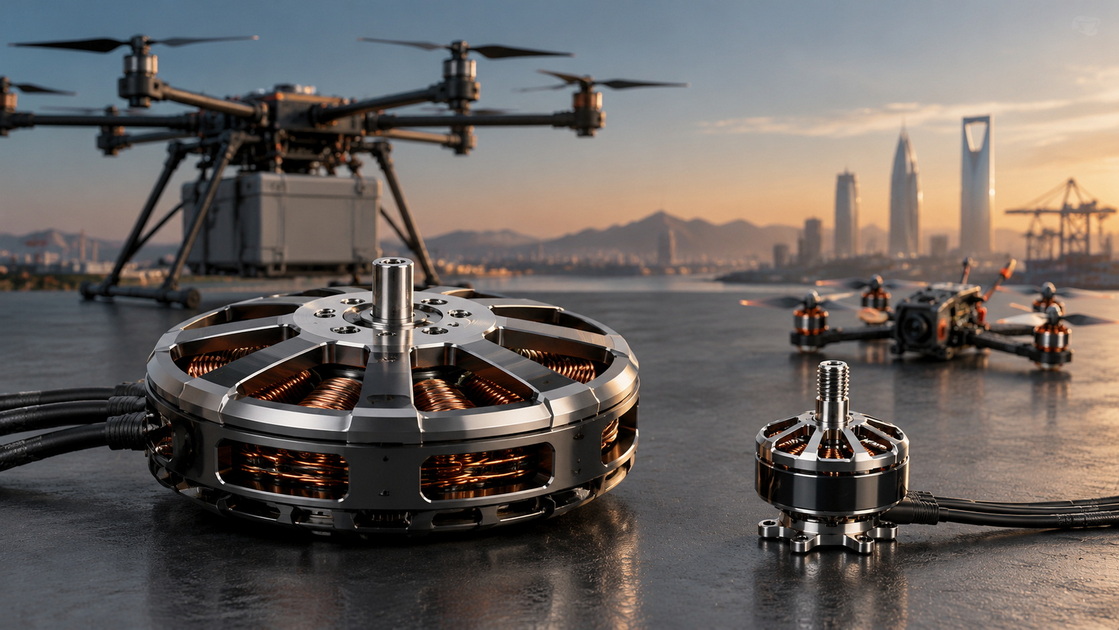
These categories overlap. FPV describes a first-person-view operating method, not a standardized motor class. An FPV aircraft can also carry a substantial payload.
In this comparison, "FPV drone motor" primarily means the compact motors commonly used in freestyle and racing aircraft.
| Comparison Point | Heavy Lift Drone Motor | FPV Drone Motor |
|---|---|---|
| Main objective | Carry substantial aircraft and payload weight | Support responsive, agile flight |
| Typical design direction | Larger diameter and higher torque capability | Compact construction and low rotating inertia |
| Speed constant | Often lower KV | Often higher KV |
| Propeller approach | Larger propellers where the airframe permits | Smaller propellers suited to compact aircraft |
| Performance priority | Sustained thrust and mission efficiency | Acceleration and rapid thrust changes |
| Main validation concern | Loaded operation and thermal stability | Dynamic response, current demand, and durability |
| Purchasing emphasis | Reliability and lifecycle cost | Performance, weight, replacement cost, and availability |
These are design tendencies, not universal limits. Evaluate the actual motor–propeller–controller combination.
A heavy lift drone motor is selected to support an aircraft carrying substantial total mass, including its battery, structure, equipment, and payload.
Applications may include cargo transport, agricultural work, industrial inspection, and large camera platforms. However, there is no single motor-size threshold that defines every heavy lift aircraft.
A motor capable of producing high thrust briefly may not sustain the aircraft's required operating point for an entire mission.
The useful purchasing questions are:
- What thrust does each motor provide during normal flight?
- What electrical input does that operating point require?
- How does temperature develop over the intended duty cycle?
- What reserve remains for maneuvering and disturbances?
Maximum thrust belongs in the specification, but it should not dominate the decision.
A compact FPV drone motor drives aircraft designed for pilot-controlled maneuvering through a live video feed.
Freestyle and racing motors must respond to frequent throttle changes while fitting small, lightweight frames. Their construction may emphasize crash resistance and replaceable components.
The familiar "2207" designation generally describes a stator approximately 22 mm in diameter and 7 mm in height. It does not specify complete motor dimensions or guarantee a particular thrust output.
Cinematic, long-range, and payload-carrying FPV aircraft may require different motor characteristics from racing builds.
A motor selected for rapid freestyle maneuvers is not automatically appropriate for sustained camera-carrying work. Describe the aircraft's duty cycle rather than relying on the FPV label alone.
KV expresses a motor's speed constant, commonly stated in revolutions per minute per volt. It relates speed to back electromotive force; it is not a direct power rating.
As a simplified no-load estimate:
Speed≈KV×Voltage
Actual loaded speed depends on propeller torque, current, electrical losses, and controller operation.
Torque and speed constants are related, but comparisons require consistent definitions and units. A low-KV winding does not independently prove greater torque capacity, better cooling, or longer service life.
Consider two published examples:
| Published Specification | Heavy Lift Example | Compact FPV Example |
|---|---|---|
| Product | T-MOTOR U8 II Pro KV100 | iFlight XING2 2207 |
| KV | 100 | 1855 or 2755 |
| Listed weight, including wires | 287 g | 31.6 g |
| Listed overall dimensions | Approximately 87.3 × 29.55 mm | Approximately 29.08 × 32.6 mm |
| Propeller context | Published testing includes a 27 × 8.8-inch propeller | Compact FPV application; match the exact propeller and variant |
These examples illustrate different design priorities. They are not a controlled comparison, and their maximum power or thrust figures should not be ranked without matching test conditions.
Ideal rotor theory links hover power to thrust, air density, and rotor disk area:
Pi=T3/2/√2ρA
Here, Pi is ideal induced power, T is thrust, ρ is air density, and A is disk area.
At equal thrust and air density, increasing disk area reduces ideal induced power.
However, this does not mean the largest possible propeller always produces the best aircraft. Real designs must accommodate blade losses, airframe clearance, structural weight, rotor interaction, and control requirements.
Freestyle aircraft need rapid thrust changes. Propeller inertia, motor torque, controller behavior, and aircraft weight all influence the response.
A larger motor may provide more torque while also adding mass. A heavier propeller may resist acceleration even when static thrust looks attractive.
For dynamic aircraft, evaluate the complete system rather than assuming that more peak thrust always improves handling.
A motor's advertised peak current or maximum wattage is incomplete without a permitted duration and test conditions.
Request:
- Ambient temperature.
- Propeller and controller configuration.
- Supply voltage under load.
- Test duration and throttle sequence.
- Temperature measurement location.
- Cooling conditions.
- Post-test inspection criteria.
Heavy lift buyers should emphasize sustained loaded operation. Freestyle buyers should also reproduce repeated acceleration and deceleration rather than testing only at steady throttle.
A winding-insulation temperature rating does not establish a safe temperature for bearings, magnets, adhesives, or the complete assembly.
Likewise, crash-resistant construction does not establish environmental protection. Ask for evidence covering the exact assembly and operating conditions.
The motor, battery, electronic speed controller, and propeller form one propulsion system.
Changing voltage without reconsidering KV and propeller load can produce an unsuitable operating point. Changing the propeller can also alter current demand substantially.
Before approving a configuration, confirm:
1. The permitted battery voltage range.
2. The motor variant and winding specification.
3. Controller voltage and current capability.
4. Relevant controller settings.
5. Propeller compatibility.
6. Cable, connector, and installation requirements.
Higher voltage can reduce current for the same electrical power, but it does not automatically improve total system efficiency. Evaluate controller losses, motor operation, battery mass, and practical installation constraints together.
Suppose a proposed hexacopter has a total takeoff mass of 18 kg.
In a simplified, evenly loaded hover, six motors must each provide approximately 3 kgf of thrust.
If the design team adopts an illustrative maximum static thrust-to-weight target of 2:1, the corresponding target becomes approximately 6 kgf per motor.
That target is not a universal safety rule. The appropriate reserve depends on aircraft dynamics, operating conditions, architecture, and applicable requirements.
The next step is more important than the arithmetic: inspect the performance curve around 3 kgf, not only at 6 kgf.
Ask whether the selected motor can sustain the expected operating point within temperature limits and battery constraints.
Also, a 2:1 maximum-thrust target does not establish safe flight after a motor failure. That requires separate aircraft-level analysis and validation.
A thrust table is useful, but its grams-per-watt figure is not a complete mission-efficiency measurement.
It does not directly include:
- Battery and structural mass.
- Forward-flight operating conditions.
- Maneuvering demand.
- Auxiliary electrical loads.
- Rotor interference.
- Reserve energy requirements.
For a heavy lift project, compare energy required for the payload and route.
For freestyle, compare useful flight duration alongside handling and thermal behavior.
A motor with an attractive isolated bench result can still produce a less suitable aircraft after installation.
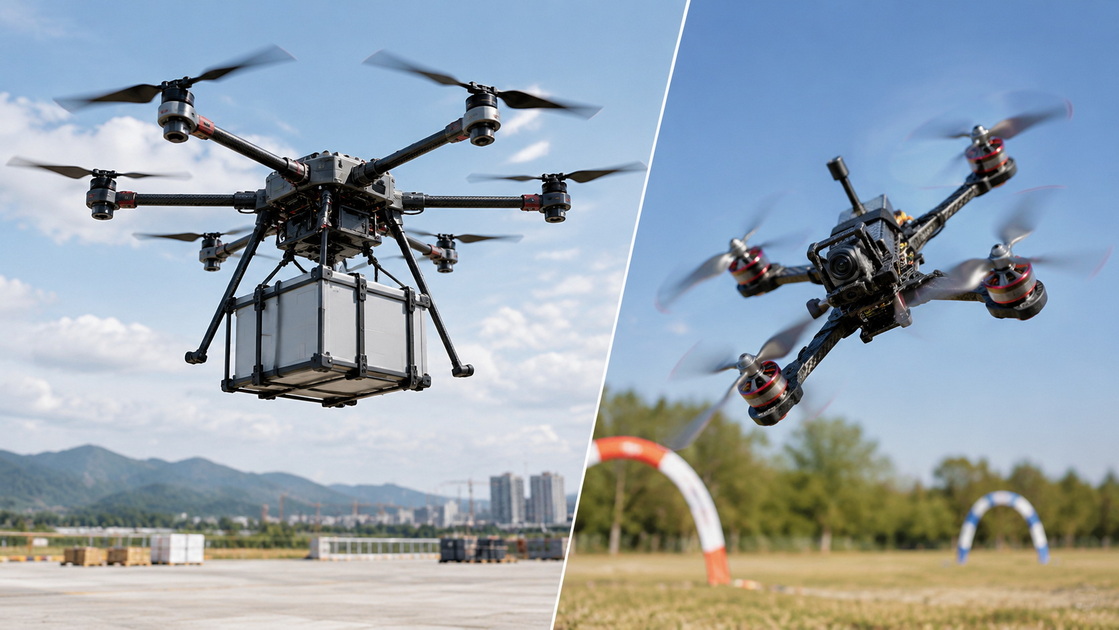
Two motors can share a size designation and KV rating while differing in bearings, winding details, magnets, balancing, and mechanical tolerances.
This is a configuration-control risk, not an allegation against any particular supplier.
For OEM production, approve more than the model name. Establish:
- A controlled drawing and bill of materials.
- Retained reference samples.
- Approved critical component specifications.
- Production-lot traceability.
- Written substitution rules.
- Repeatable acceptance tests.
My recommendation is to approve the production definition alongside the sample. Otherwise, a successful prototype may not adequately define what subsequent orders must contain.
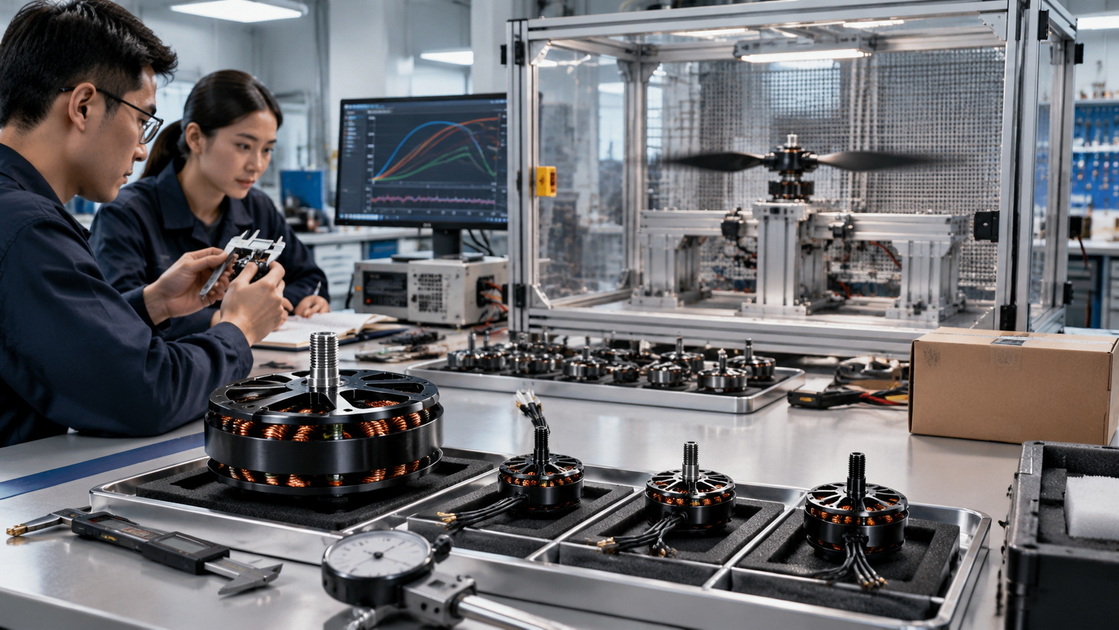
Record takeoff mass, payload, rotor count, propeller clearance, flight duration, and operating environment.
Separate hover, climb, cruise, maneuvering, and short peak-demand periods.
Compare motors with their intended propellers, controllers, voltage, and installation conditions.
Use consistent instrumentation and document test settings. Guard rotating propellers and keep personnel outside the test area.
Bench approval should be followed by controlled aircraft testing, including vibration, current, temperature, and handling assessment.
Evaluate multiple units and, where practical, more than one production lot before committing to larger orders.
Zhongshan Yuhang Power Technology Co., Ltd. develops, manufactures, and sells brushless motors and offers customized OEM and ODM services.
Its stated application coverage extends beyond FPV aircraft to equipment including remote-controlled vehicles, gimbal systems, and underwater robots.
For a drone project, the useful first discussion is whether an existing platform meets the requirement or whether the application needs further development.
Ask the engineering team to confirm feasible modifications, validation responsibilities, development charges, production MOQ, and delivery milestones.
Customization should solve a defined problem—not merely add a logo to an unvalidated configuration.
Choose a heavy lift drone motor when the aircraft requires sustained payload-carrying performance and an appropriately matched propulsion architecture.
Choose a compact FPV drone motor when the application prioritizes agile handling, low mass, and responsive thrust changes.
For overlapping applications, let measured mission requirements decide.
Potentially, if the complete propulsion system meets the aircraft's thrust, thermal, endurance, and reliability requirements. The FPV label alone does not establish suitability.
No. KV is a speed constant. Efficiency depends on the motor design and operating point, including torque, speed, current, cooling, and controller losses.
No. Available payload depends on total aircraft mass, usable operating thrust, control reserve, energy capacity, structure, and mission conditions.
Sometimes, but each combination needs validation. A propeller change can alter current, temperature, response, and mechanical loading.
Request drawings, configuration details, test conditions, acceptance criteria, change-control terms, and a clear definition of the intended production build.
1. [maxon — Motor Constants]. Definitions and relationships involving speed and torque constants. [support.maxongroup]
2. [maxon — Motor Data and Simulation]. Interpreting motor operating characteristics. [support.maxongroup]
3. [Georgia Institute of Technology — Hover Performance Prediction Methods]. Actuator-disk theory, disk loading, and ideal hover power. [sankar.gatech]
4. [T-MOTOR — U8 II Pro Specifications]. Published dimensions, weight, KV, and propeller test conditions. [uav-en.tmotor]
5. [iFlight — XING2 2207 Motor Specifications]. Published KV variants, weight, dimensions, and construction details. [shop.iflight]
6. [Zhongshan Yuhang Power Technology Co., Ltd. — Company Profile]. Company activities, application coverage, and OEM/ODM positioning. [yuhangmotor]


