Language


Views: 272 Author: Yuhang Power Publish Time: 2026-09-13 Origin: Site
Content Menu
● 2207 vs 2205 Motor at a Glance
>> Why 2 mm Makes a Real Difference
>> Better Fit for Aggressive 5-Inch Freestyle
>> Potential Thermal Advantages
>> Lower Rotational and Aircraft Mass
>> More Appropriate for Moderate Prop Loads
● Torque, KV, and Propeller Matter More Than Size Alone
>> Understand KV Before Choosing
>> Propeller Choice Can Reverse the Result
● Real-World Selection Scenarios
>> Scenario 1: Lightweight 5-Inch Racing Quad
>> Scenario 2: HD Freestyle Build With Action Camera
>> Scenario 3: Smooth Long-Range or Cruise-Oriented 5-Inch Build
● How to Compare Motors Like an Engineer
>> Expert Checklist for Manufacturers
● Is a 2207 Motor Always Better?
>> Choose a 2205 Motor If You Prioritize
>> Choose a 2207 Motor If You Prioritize
● Build a Matched FPV Power System
● FAQ
>> 1. What is the main difference between a 2205 and 2207 FPV motor?
>> 2. Is a 2207 motor better for a 5-inch FPV drone?
>> 3. Does a bigger FPV motor always produce more thrust?
>> 4. Which KV should I use for a 2207 motor?
>> 5. Is a 2205 motor good for freestyle FPV?
When builders compare a 2207 vs 2205 motor, the question is usually not whether the 2207 is more powerful—it often is—but whether that additional stator height creates a better FPV drone overall. For a 5-inch FPV quad, the right choice depends on the complete propulsion system: propeller load, KV rating, battery voltage, aircraft weight, ESC capability, cooling, tuning, and the pilot's preferred flying style.
From a motor manufacturer's engineering perspective, "bigger" should never be treated as an automatic upgrade. A 2207 FPV motor has a 22 mm stator diameter and 7 mm stator height, while a 2205 motor uses the same 22 mm diameter with a 5 mm stator height. That apparently small 2 mm difference increases theoretical stator volume by 40%, which can increase torque potential—but it also commonly adds motor mass, current demand, thermal load, and cost. The best motor is the one that delivers the required thrust and response with the least unnecessary system penalty.
Quick answer: Choose a 2207 motor when you need stronger prop control, aggressive freestyle authority, fast recovery after dives, or higher-load 5-inch performance. Choose a 2205 motor when keeping the quad light, efficient, and agile matters more than maximum punch.

Both motors belong to the popular 22XX brushless FPV motor family. They are frequently used on 5-inch racing, freestyle, and lightweight FPV drone builds, but they serve different build priorities.
| Feature | 2205 Motor | 2207 Motor | What It Means for Pilots |
|---|---|---|---|
| Stator diameter | 22 mm | 22 mm | Both share the same stator width |
| Stator height | 5 mm | 7 mm | The 2207 has a taller stator |
| Theoretical stator volume | About 1,901 mm³ | About 2,661 mm³ | The 2207 has 40% more theoretical stator volume |
| Torque potential | Moderate | Higher | 2207 can better control demanding props |
| Typical motor weight | Usually lower | Usually higher | Four motors can noticeably affect dry weight |
| Current draw potential | Usually lower | Usually higher | Battery and ESC selection become more important |
| Typical character | Light, lively, efficient | Powerful, planted, authoritative | Match the motor to the intended flight feel |
| Common use | Lightweight 5-inch, older race builds, efficient setups | Modern 5-inch freestyle, racing, heavier payload builds | Neither is universally “best” |
The stator-size convention is straightforward: the first two digits identify the stator diameter, while the second two identify stator height in millimeters. Therefore, 2205 means 22 mm × 5 mm, and 2207 means 22 mm × 7 mm.
A motor stator can be approximated as a cylinder:
Stator volume=πr2h
Using that simplified comparison:
- 2205: π×112×5≈1,901 mm3
- 2207: π×112×7≈2,661 mm3
That is a 40% increase in theoretical stator volume. In practical motor design, this extra magnetic and copper-winding area can support more torque. However, actual performance still varies substantially with magnet grade, air gap, lamination thickness, winding method, bearing quality, bell design, KV, propeller, ESC settings, and manufacturing precision. Stator volume is a valuable starting point—not a complete performance specification.
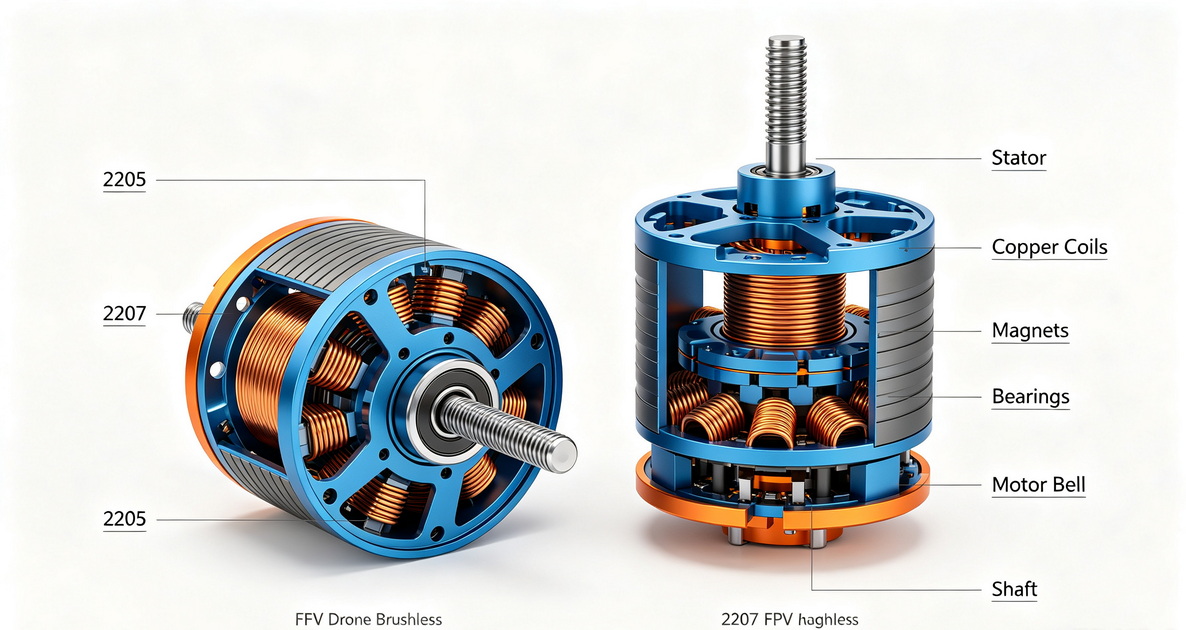
A 2207 motor is not simply a 2205 motor with extra height. With a properly engineered magnetic circuit and winding design, the taller stator can provide stronger torque delivery. For FPV pilots, torque matters because it helps the motor accelerate and decelerate the propeller more decisively.
A 2207 FPV motor is often a good choice for a 5-inch quad running:
- Higher-pitch tri-blade propellers
- Heavier and more durable propellers
- Aggressive freestyle propellers
- Heavy digital FPV systems
- Action-camera payloads
- High-speed racing setups
- Builds that must recover quickly after a dive or sharp direction change
A high-torque setup can change propeller RPM more quickly. In flight, that may translate to more immediate throttle response, better control authority through prop wash, and a more confident feel during rapid punch-outs, split-S maneuvers, sharp reversals, and recovery from hard dives.
Larger stators generally increase torque capability and can spin heavier props more effectively, but that benefit comes with higher current demand.
Modern 5-inch freestyle quads often carry more than a bare analog racing build. A digital VTX, HD camera, GPS, buzzer, stronger frame, larger battery, and action camera can all raise all-up weight. A 2207 motor can offer useful thrust and torque reserve when the quad must lift additional mass without feeling underpowered.
Industry guidance commonly places 2205–2208 motors within the 5-inch category, while many current 5-inch freestyle setups use 2207-class motors due to their balance of torque and responsiveness.
Thermal design deserves more attention than it receives in many motor comparisons. The true operating limit of a brushless motor is rarely a single printed voltage number. In real use, heat and current are the key concerns.
A motor that is over-propped, over-KV'd, poorly ventilated, or pushed continuously at high throttle can generate excessive heat. Heat can weaken magnetic performance, stress winding insulation, reduce efficiency, and shorten bearing life over time. Proper stator design, airflow, bell geometry, high-temperature magnets, winding quality, and balanced rotating parts all affect durability.
For OEM and ODM FPV motor projects, this is why a manufacturer should validate motor performance with the target propeller, voltage, ESC protocol, and intended duty cycle—not only with a no-load RPM figure.
The 2205 motor remains highly relevant. It is not an inferior choice; it is often the more disciplined engineering choice when the aircraft does not need the additional torque and mass of a 2207.
A lighter motor reduces more than static takeoff weight. FPV motors sit at the ends of the frame arms, far from the quad's center of gravity. Their mass contributes to rotational inertia during flips, rolls, and rapid attitude changes.
This means a lighter 2205 setup can make a well-designed quad feel quick, nimble, and less physically demanding to redirect. That advantage may be especially meaningful for:
- Lightweight 5-inch racing builds
- Sub-250 g-oriented builds using smaller propulsion systems
- Pilots using low-pitch propellers
- Efficient cruising configurations
- Builds where every gram is carefully managed
- Entry-level FPV projects with conservative battery and ESC specifications
Motor weight should be evaluated as a system-level performance factor, not only as a line item on a parts list. Heavier motors at the four corners can reduce perceived responsiveness during fast maneuvers.
If a quad uses a lightweight 5-inch propeller, has a modest all-up weight, and does not need repeated high-throttle maneuvers, a well-built 2205 motor may already provide enough torque. Installing a substantially larger motor in this situation can create diminishing returns.
The key question is not, "Can a 2207 produce more thrust?" It usually can. The better question is:
Will the specific quad, propeller, battery, and flight style use that extra torque efficiently?
If the answer is no, a 2205 can reduce weight and electrical stress without compromising the intended mission.
A 2205 motor may offer a more manageable electrical profile when paired with an appropriate KV and propeller. It can reduce the likelihood of excessive current spikes, battery voltage sag, hot motors, and overloaded ESCs—particularly on cost-sensitive or compact builds.
That does not mean every 2205 is more efficient than every 2207. Efficiency must be measured with a specified motor, propeller, voltage, and throttle point. The same motor can perform very differently with two different propellers.
The most common mistake in a 2207 vs 2205 motor comparison is treating stator size as the only meaningful specification. It is not.
A 2207 1750KV motor on 6S, a 2207 2500KV motor on 4S, and a 2205 2300KV motor on 4S can have radically different current draw, temperature behavior, thrust profiles, and flight feel.
KV describes the approximate unloaded RPM per volt. A 2000KV motor supplied with 24 V would theoretically spin near 48,000 RPM without a propeller. In real flight, the propeller's aerodynamic load reduces RPM substantially.
For 5-inch FPV platforms, common starting ranges include:
| Battery Setup | Typical 5-Inch KV Direction | General Effect |
|---|---|---|
| 4S LiPo | Higher KV, often roughly 2300–2800KV | Higher RPM potential and more aggressive current demand |
| 6S LiPo | Lower KV, often roughly 1600–2100KV | Comparable power with lower KV and potentially lower voltage sag |
| 6S efficiency-focused build | Lower end of the suitable KV range | Better cruise behavior and lower heat risk with suitable props |
| 4S race-oriented build | Higher end of the suitable KV range | Sharp acceleration, but requires careful current management |
These are starting points, not universal rules. For 5-inch builds, guidance commonly places 6S KV around 1600–2100KV and 4S KV around 2300–2800KV; the final choice must match propeller load and flight intent.
A 2205 with a lightweight, lower-pitch propeller can feel excellent and efficient. A 2207 with an aggressive, heavy, high-pitch propeller can deliver incredible grip—but may run hot if the KV, battery, or ESC are mismatched.
Before selecting either motor, define:
1. Frame and propeller diameter.
2. Expected takeoff weight, including battery, HD system, GPS, action camera, and accessories.
3. Battery voltage and capacity.
4. Target flight style, such as racing, freestyle, cinematic cruising, or mixed use.
5. Preferred propeller style, including blade count, pitch, material, and weight.
6. ESC continuous-current capacity, with appropriate margin.
7. Motor temperature limit after real flight testing.
The correct engineering sequence is frame size → propeller size → motor stator size → KV → tested propulsion system.
The following examples show why a bigger motor is not always the better motor.
A pilot builds a low-mass 5-inch race quad with a light frame, compact electronics, a minimal camera system, and lightweight tri-blade props.
Recommended direction: A quality 2205 motor can be an excellent fit, especially when the selected KV and propeller deliver sufficient thrust without excessive current draw.
Why it works:
- Less motor mass supports rapid directional changes.
- The propeller does not demand extreme torque.
- Battery energy can be used more efficiently.
- The quad may feel more agile in technical race sections.
A pilot builds a durable 5-inch freestyle quad with a digital video system, GPS, a strong frame, a 6S LiPo, and an action camera.
Recommended direction: A 2207 motor is typically the safer performance choice.
Why it works:
- The aircraft is heavier.
- The propellers may be more durable and higher pitch.
- Strong torque helps maintain authority during freestyle moves.
- Thrust reserve improves recovery after dives and hard throttle transitions.
A pilot prioritizes flight time, low cruising current, smooth camera footage, and predictable throttle control.
Recommended direction: Either size can work, but a carefully matched lighter 2205 or efficient 2207 with lower KV may be preferable depending on payload and prop size.
The decision should come from thrust-stand data at the intended cruising throttle—not a maximum-thrust claim.
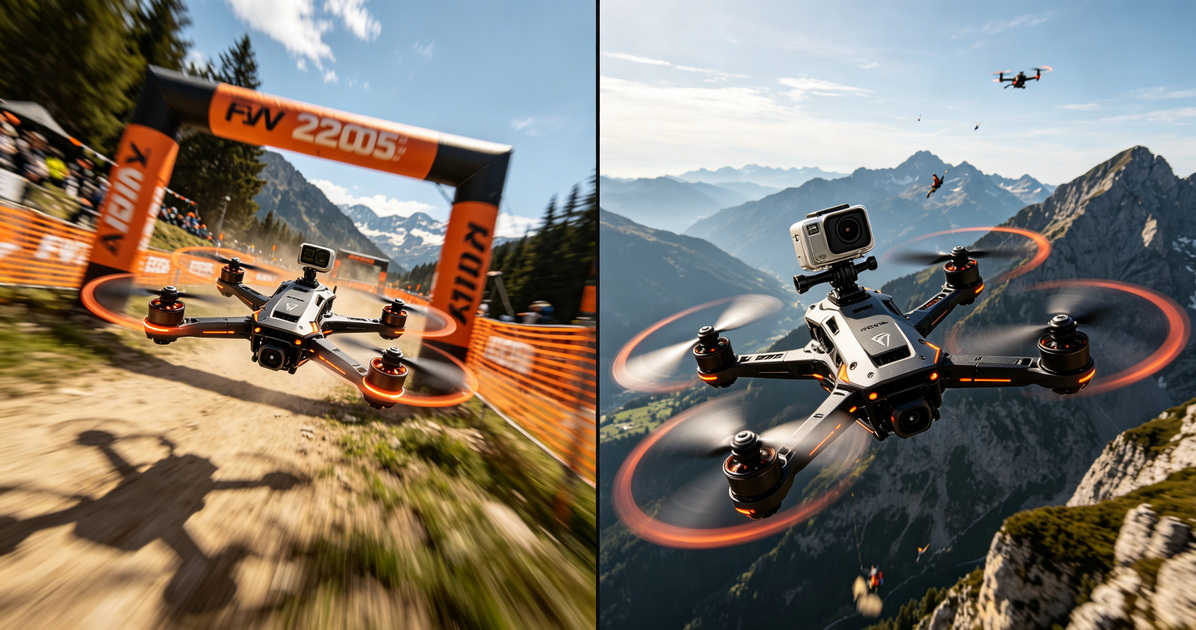
A trustworthy FPV motor comparison requires controlled testing. Avoid comparing a 2205 motor tested on one propeller and battery against a 2207 motor tested on a different setup.
Use the same:
- Battery voltage and battery condition
- ESC and firmware configuration
- Propeller model, pitch, blade count, and condition
- Motor mounting method
- Throttle measurement increments
- Ambient temperature and airflow conditions
- Test equipment and calibration procedure
Evaluate these figures at multiple throttle points:
| Metric | Why It Matters |
|---|---|
| Thrust | Shows lifting and acceleration potential |
| Current draw | Determines battery and ESC stress |
| Electrical power | Indicates energy demand |
| Efficiency in g/W | Shows thrust produced per watt |
| RPM | Helps explain propeller loading behavior |
| Motor temperature | Reveals thermal risk under sustained load |
| Motor weight | Influences total mass and flight dynamics |
| Vibration | Affects filtering, flight-controller performance, and video quality |
A propulsion test database can be filtered by motor properties and performance metrics such as thrust, torque, RPM, voltage, current, electrical power, and efficiency. It also illustrates why component-level claims are less useful than test results for a complete motor-propeller-ESC system.
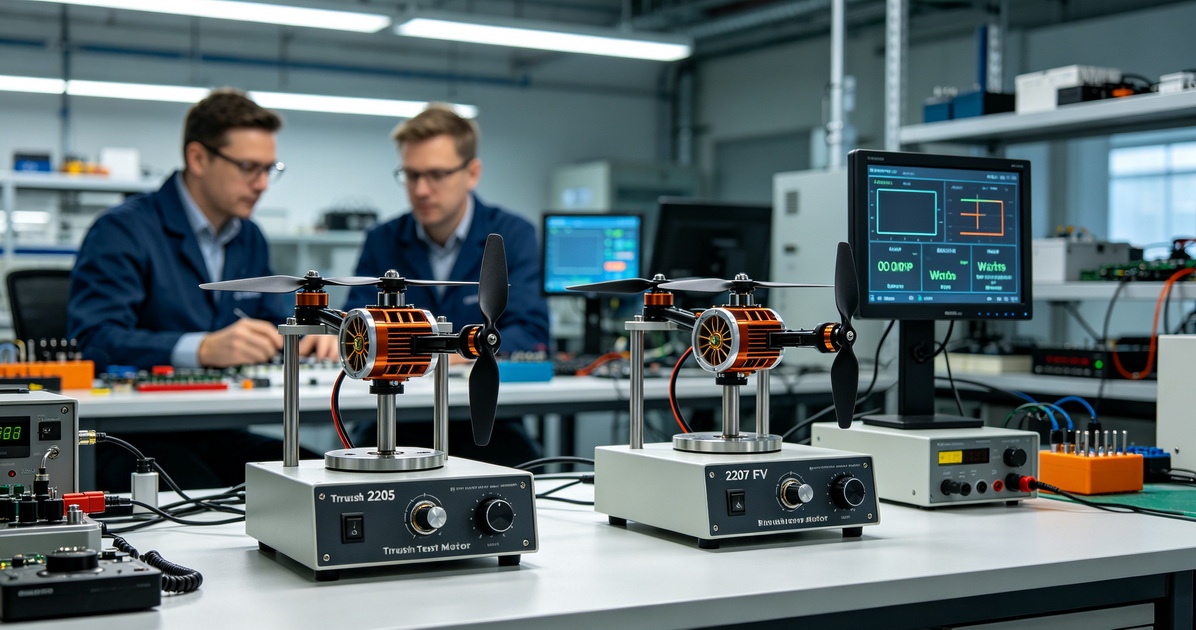
For a Chinese FPV motor manufacturer offering OEM and ODM services, the most valuable customer-facing data is not just "maximum thrust." A professional product package should include:
- Motor dimensions and weight with wire length stated
- KV options and recommended battery range
- Recommended propeller size and pitch range
- Thrust table with propeller and voltage identified
- Current and power at multiple throttle points
- Efficiency data in g/W
- Temperature observations after controlled runs
- Shaft size, mounting pattern, and screw guidance
- Magnet grade, bearing specification, and stator lamination details
- Quality-control process for bell balance, bearing smoothness, and winding consistency
This level of documentation supports buyer confidence, enables safer system matching, and demonstrates the practical expertise expected from a serious brushless motor supplier.
No. A 2207 motor is better only when its additional torque capability supports the actual needs of the FPV aircraft.
A 2207 can be the stronger choice for demanding 5-inch freestyle, heavy payloads, aggressive propellers, and pilots who want immediate authority. Yet it can also impose unnecessary mass and electrical demand on a lightweight build where a 2205 already performs efficiently.
The better buying decision is based on the complete propulsion system, not the motor code alone.
- Low all-up weight
- Fast, light handling
- Moderate propeller loads
- Efficiency-focused flying
- Compact or cost-conscious 5-inch builds
- A setup with modest payload requirements
- Reduced motor mass at the ends of the frame arms
- Strong torque reserve
- Aggressive freestyle performance
- Fast RPM changes and prop control
- High-pitch or heavier 5-inch propellers
- HD video systems and action-camera payloads
- Powerful 4S or 6S propulsion systems
- Better authority through hard maneuvers and dive recovery
At Zhongshan Yuhang Power Technology Co., Ltd., we view the motor as one part of a complete power solution—not as an isolated component. Whether your project needs a lightweight 2205 FPV drone motor, a powerful 2207 brushless motor, or a fully customized OEM/ODM propulsion package, the best result comes from matching the motor to the propeller, battery, ESC, aircraft weight, cooling requirements, and application target.
For professional FPV drones, racing quads, RC vehicles, high-power fans, gimbal cameras, aircraft, robotic cleaners, and underwater robotic systems, our engineering team can help evaluate the motor specification, KV range, winding configuration, shaft design, mounting interface, and performance-testing requirements.
The primary difference is stator height. Both have a 22 mm stator diameter, but the 2205 has a 5 mm stator height and the 2207 has a 7 mm stator height. The 2207 therefore has approximately 40% more theoretical stator volume, which can support higher torque potential when the design and operating conditions are comparable.
A 2207 motor is often an excellent choice for aggressive 5-inch freestyle, racing, and heavier HD builds because it can provide stronger propeller control and torque reserve. However, it is not automatically better for lightweight or efficiency-focused builds, where a 2205 may provide sufficient power with lower mass.
Not necessarily in a useful real-world comparison. Thrust depends on the motor, KV, battery voltage, propeller, ESC, throttle level, temperature, and tuning. A larger stator can increase torque potential, but an incorrectly matched propeller or KV can cause high current draw, heat, and poor efficiency.
For a typical 5-inch build, 6S setups often use lower KV options around 1600–2100KV, while 4S builds commonly use higher KV options around 2300–2800KV. The exact choice depends on the propeller, all-up weight, intended flight style, and manufacturer test data.
Yes. A high-quality 2205 motor can work well for lighter freestyle builds, especially with sensible propeller selection and a moderate payload. For heavier HD freestyle quads or pilots seeking maximum punch and recovery authority, a 2207 may be the more suitable direction.
1. Oscar Liang. "[How to Choose FPV Drone Motors]." Covers motor-size notation, stator volume, torque, KV, propeller matching, motor weight, efficiency, thermal considerations, and 5-inch motor-selection guidance. [oscarliang]
2. TYTO Robotics. "[Database of Drone Motors, Propellers & ESCs]." Explains performance-test metrics and comparison methods for thrust, torque, RPM, current, electrical power, and efficiency across propulsion systems. [tytorobotics]
3. VitroidFPV. "[Stator Volume Calculator]." Explains the XXYY motor-size convention and the cylinder-based stator-volume comparison method. [vitroidfpv]
4. UAVModel. "[FPV Motor Thrust Testing and Selection Guide]." Discusses propulsion-test variables such as thrust, current, voltage, efficiency, and the importance of evaluating the full motor-propeller system. [blog.uavmodel]
5. Firefly FPV. "[FPV Motor Sizes Explained: 1404, 2207, 2807 and More]." Provides an overview of FPV motor size notation and common use cases for 2207 motors in 5-inch freestyle builds. [fireflyfpv]


