Language


Views: 242 Author: Yuhang Power Publish Time: 2026-09-20 Origin: Site
Content Menu
● How Does a Quadcopter Drone Fly?
>> Why Two Motors Spin Clockwise and Two Spin Counterclockwise
>> The Five Basic Quadcopter Movements
● Main Components of a Quadcopter Drone
>> 4. Electronic Speed Controllers
● Key Features of Quadcopter Drones
>> Vertical Takeoff and Landing
● Types of Quadcopters by Design and Application
>> Quadcopter Frame Configurations
>> Quadcopter Categories by Use
● Professional Applications of Quadcopter Drones
>> Aerial Photography and Cinematic FPV
>> Mapping, Surveying, and Construction
>> Agriculture and Environmental Monitoring
>> Search, Rescue, and Public Safety
● How to Choose the Right Quadcopter Motor System
>> Step 1: Define the Aircraft Mission
>> Step 2: Calculate the Required Thrust Margin
>> Step 3: Match Motor Size, KV, and Propeller
>> Step 4: Validate Through Bench and Flight Testing
● OEM and ODM Quadcopter Motor Solutions
>> Customization Options for Brushless Drone Motors
● Quadcopter Safety and Regulatory Considerations
>> 1. What is the difference between a quadcopter and a drone?
>> 2. How does a quadcopter stay stable in the air?
>> 3. What type of motor does a quadcopter use?
>> 4. Can a quadcopter fly if one motor fails?
>> 5. How long can a quadcopter drone fly?
A quadcopter drone is an unmanned aircraft that uses four independently controlled motors and propellers to lift, hover, turn, and move through the air. Its combination of vertical takeoff, precise hovering, compact structure, and responsive control has made the quadcopter one of the most widely used UAV configurations for FPV flying, aerial imaging, inspection, mapping, public safety, and custom industrial applications.
For engineers, drone brands, and professional equipment developers, however, a quadcopter is more than a four-propeller aircraft. It is an integrated propulsion system in which the brushless drone motor, propeller, ESC, battery, frame, flight controller, and payload must work together. A mismatch in any one part can reduce thrust, create vibration, shorten flight time, or cause overheating.
At Zhongshan Yuhang Power Technology Co., Ltd., we develop and manufacture FPV drone motors and other brushless motor solutions for UAVs, FPV racing drones, RC vehicles, high-speed fans, gimbal cameras, aircraft, robotic vacuum systems, and underwater robotics. This guide explains how quadcopters work, how to select the right components, where quadcopter drones are used, and what OEM and ODM buyers should evaluate before developing a custom drone project.
A quadcopter drone, also called a quadcopter UAV or quadrotor drone, is a type of unmanned aerial vehicle with four motors and four propellers. Each motor sits on an arm extending from a central frame. When viewed from above, the aircraft commonly has an X-shaped, H-shaped, or less commonly a plus-shaped layout.
The word "drone" is broad. It can describe many kinds of unmanned aircraft, including:
- Fixed-wing UAVs
- Quadcopters
- Hexacopters
- Octocopters
- Hybrid VTOL aircraft
- Single-rotor helicopters
- Delivery drones
- FPV racing drones
A quadcopter is therefore a specific type of drone. All quadcopters are drones, but not all drones are quadcopters.
The four-motor layout is popular because it provides an effective balance between structural simplicity, controllability, payload flexibility, and cost. Unlike a traditional helicopter, a quadcopter does not depend on a complex swashplate mechanism or variable-pitch rotor system to control movement. Instead, it changes the speed of individual brushless motors to adjust thrust and attitude.
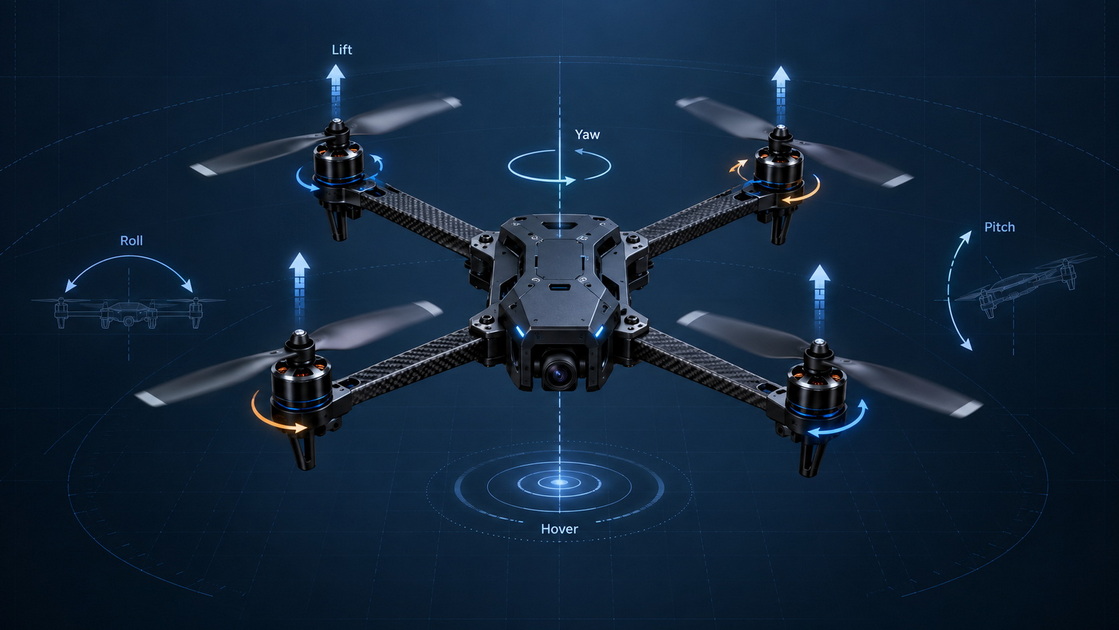
A quadcopter creates lift when its propellers rotate and push air downward. According to Newton's third law of motion, the downward airflow generates an upward reaction force that lifts the aircraft.
The drone's flight controller constantly monitors sensor data and adjusts motor speed many times per second. Its gyroscope and accelerometer help the aircraft detect changes in tilt, rotation, acceleration, and orientation. The flight controller then sends commands to the ESCs, which regulate power to each brushless motor.
A quadcopter normally uses two clockwise-rotating propellers and two counterclockwise-rotating propellers.
This arrangement is essential because every spinning motor creates torque. If all four motors rotated in the same direction, the drone body would rotate in the opposite direction. By using opposite motor directions, the torque forces cancel each other during stable flight.
The result is a controlled, stable platform that can hover and maneuver without a tail rotor.
| Flight Movement | Motor-Speed Change | Result |
|---|---|---|
| Hover | All four motors produce equal thrust | The drone remains at approximately the same altitude and position |
| Climb and descent | All motors speed up or slow down together | The drone rises or descends |
| Pitch | Front and rear motor thrust changes | The drone tilts forward or backward |
| Roll | Left and right motor thrust changes | The drone tilts left or right |
| Yaw | Clockwise and counterclockwise motor pairs change relative speed | The drone rotates around its vertical axis |
For example, to move forward, the rear motors usually increase speed while the front motors reduce speed slightly. The aircraft pitches forward, directing part of its total thrust forward while still producing enough vertical lift to remain airborne.
This is why motor response time matters. Fast, consistent brushless motor response improves drone control, especially in FPV racing, freestyle flying, dynamic filming, and precision industrial missions.

Every quadcopter uses the same basic functional chain:
Battery→ESC→Brushless Motor→Propeller→Thrust
The flight controller coordinates this chain by converting pilot input or autonomous mission data into precise motor-speed commands.
The frame is the drone's structural platform. It holds the motors, electronics, battery, camera, landing gear, antennas, and payload.
Common frame materials include:
- Carbon fiber: Lightweight, rigid, and widely used in FPV drones and professional UAVs
- Injection-molded plastic: Common in consumer and toy drones
- Aluminum alloys: Used in selected industrial structures and component mounts
- Composite materials: Used where strength, weight, and vibration resistance must be balanced
The frame's wheelbase—the diagonal distance between motors—helps determine compatible propeller size. A compact frame may suit 2-inch or 3-inch propellers, while larger frames can support 5-inch, 7-inch, 10-inch, or larger propulsion systems.
A quadcopter has one motor per arm. Most modern FPV and professional quadcopters use brushless DC motors, commonly called BLDC motors.
Brushless motors are preferred because they offer:
- High power-to-weight ratio
- Fast throttle response
- Long service life when correctly designed
- Low maintenance compared with brushed motors
- Good efficiency at high RPM
- Precise electronic speed control
Motor specifications often use a four-digit stator code, such as 1404, 1505, 2207, or 2806.5. The first two digits generally identify stator diameter, while the second two identify stator height in millimeters. This stator geometry affects torque potential, weight, thermal behavior, and propeller compatibility.
For example:
| FPV Motor Size | Typical Application | General Characteristic |
|---|---|---|
| 1103 to 1404 | Tiny whoops, 2-inch to lightweight 3-inch drones | Low mass and quick response |
| 1404 to 1505 | 3-inch to 3.5-inch FPV drones | Balance of efficiency and thrust |
| 2004 to 2207 | 4-inch to 5-inch freestyle and racing drones | Strong acceleration and propeller control |
| 2306 to 2806.5 | 5-inch to long-range and larger FPV platforms | Higher torque and heavier propeller support |
Motor selection should never depend on stator size alone. The correct choice requires consideration of KV rating, battery voltage, propeller diameter, pitch, blade count, aircraft weight, duty cycle, and required thrust reserve.
The propeller converts motor RPM and torque into thrust. It is one of the most important components in the entire drone propulsion system.
A propeller is commonly specified by:
- Diameter: The total width of the propeller
- Pitch: The theoretical distance the propeller would move forward in one rotation
- Blade count: Two-blade, three-blade, four-blade, or more
- Material: Plastic, polycarbonate, reinforced composite, carbon fiber, and others
- Rotation direction: Clockwise or counterclockwise
A larger, higher-pitch, or multi-blade propeller usually creates more aerodynamic load. It may produce stronger grip or thrust, but it also requires more motor torque and can increase current draw.
This is why propellers must be matched carefully to the motor and battery. A motor-propeller mismatch can lead to poor flight time, high motor temperature, reduced responsiveness, and ESC overload.
An electronic speed controller, or ESC, regulates electrical power from the battery to the motor.
The ESC receives a throttle command from the flight controller and creates the timed three-phase electrical signals that rotate the brushless motor. In a quadcopter, builders may use:
- Four individual ESCs, one for each motor
- A compact 4-in-1 ESC, containing four ESC circuits on one board
For FPV drones, ESC selection should consider:
- Continuous current rating
- Burst current rating
- Battery voltage compatibility
- Firmware protocol
- PWM frequency
- Cooling conditions
- Motor and propeller current demand
A higher ESC current rating does not automatically make a system more powerful. It provides electrical headroom, but the motor, battery, wiring, and propeller system must also safely handle the load.
The flight controller is the quadcopter's electronic brain. It reads pilot commands and sensor data, then makes rapid corrections to stabilize the aircraft.
Typical onboard sensors include:
- Gyroscope
- Accelerometer
- Barometer
- Magnetometer
- GPS or GNSS receiver
- Compass
- Optical-flow sensor
- Camera or vision sensor in advanced systems
In an FPV drone, the flight controller helps maintain control during fast turns, flips, rolls, dives, and sudden throttle changes. In a professional UAV, it may also manage waypoint missions, geofencing, return-to-home, position hold, and automated inspection routes.
Lithium-polymer batteries, usually called LiPo batteries, are widely used in FPV and high-performance quadcopters because they can supply high current in a compact package.
Battery voltage is commonly described by cell count:
| Battery Type | Nominal Voltage | Typical Use |
|---|---|---|
| 2S LiPo | 7.4 V | Tiny drones and light micro builds |
| 3S LiPo | 11.1 V | Smaller FPV drones and entry-level systems |
| 4S LiPo | 14.8 V | Common for 3-inch to 5-inch FPV drones |
| 6S LiPo | 22.2 V | High-performance freestyle and racing drones |
| 8S and higher | 29.6 V+ | Heavy-lift, industrial, and specialized UAV platforms |
The battery affects not only flight time but also motor speed, current demand, voltage sag, and heat. A higher-voltage system may reduce current for the same power requirement, but it must use motors, ESCs, capacitors, and wiring designed for that voltage.
Quadcopters remain popular because their design offers practical advantages for both casual and professional users.
A quadcopter can take off and land vertically. It does not need a runway, catapult, or large launch area.
This makes it practical for:
- Rooftop inspection
- Construction-site documentation
- Forest search operations
- Offshore equipment surveys
- Urban videography
- Emergency response
Unlike fixed-wing drones, a quadcopter can maintain a stationary position in the air. This capability is critical when a drone must inspect a specific point on a bridge, tower, pipeline, solar panel, or building façade.
Hover stability depends on more than GPS. It also depends on low vibration, correct motor balance, efficient propellers, responsive ESCs, sensor calibration, and well-tuned flight-control parameters.
Quadcopters can rapidly change direction, rotate in place, and fly through confined spaces. FPV quadcopters are especially known for their speed and agility.
This makes them valuable for:
- Racing
- Freestyle flying
- Indoor inspection
- Cinematic tracking shots
- Emergency assessment
- Confined-space navigation
The same basic quadcopter architecture can scale from a palm-sized indoor drone to a heavy-lift industrial UAV. Designers can change motor size, propeller diameter, frame strength, battery capacity, and payload systems to fit a specific mission.
However, a quadcopter has an important limitation: in a conventional four-motor setup, the failure of one motor, ESC, propeller, or major connection usually prevents controlled flight. Missions requiring higher redundancy may require a hexacopter or octocopter platform.
| Frame Configuration | Design Characteristic | Common Use |
|---|---|---|
| X Configuration | Four arms form an X shape | FPV, consumer drones, industrial UAVs |
| H Configuration | Parallel arms with a larger central body area | Camera platforms and custom payload builds |
| Plus Configuration | One motor faces forward | Educational and legacy designs |
| Ducted Configuration | Propellers are protected by ducts or guards | Cinewhoops and indoor inspection drones |
The X configuration is the most common because it provides balanced handling and allows a front-facing camera to sit between the front arms.
| Quadcopter Type | Common Size Range | Typical Application |
|---|---|---|
| Tiny Whoop | 65 mm to 85 mm | Indoor flight and beginner practice |
| Micro FPV Drone | 2-inch to 3-inch | Lightweight racing, cinematic flying, compact freestyle |
| Freestyle FPV Drone | 3-inch to 5-inch | Acrobatic flying and action-camera content |
| Long-Range FPV Drone | 4-inch to 7-inch | Distance flying and exploration |
| Camera Drone | 250 g to 1 kg+ | Photography, video, and content creation |
| Industrial Quadcopter | 1 kg to 4 kg+ | Inspection, mapping, public safety, agriculture |
| Heavy-Lift Drone | 4 kg+ | Professional payloads, LiDAR, spraying, logistics |
A quadcopter's ability to hover, launch vertically, and carry cameras or sensors makes it suitable for many commercial and industrial missions.
Camera drones and FPV quadcopters have changed how companies capture aerial content. Real-estate companies, film teams, sports-event organizers, tourism brands, and industrial marketers use drones to obtain perspectives that are difficult or expensive to capture from the ground.
FPV drones add a dynamic perspective. Their compact frames, high thrust-to-weight ratios, and manual control can create fast, immersive footage through tight spaces, around structures, and close to moving objects.
Quadcopters can inspect assets such as:
- Power lines
- Wind turbines
- Communication towers
- Bridges
- Solar arrays
- Pipelines
- Industrial roofs
- High-rise façades
For these missions, stable hovering and low vibration are as important as maximum speed. Motor quality, propeller balance, ESC reliability, and efficient thermal design all influence image quality and mission reliability.
Quadcopters with high-resolution cameras, RTK GNSS systems, and suitable mapping software can collect images for orthomosaics, 3D models, volumetric measurements, and site-progress reports.
The quadcopter is especially valuable at smaller or complex sites where vertical takeoff, close-range imaging, and position hold are more useful than long fixed-wing endurance.
Drones can help growers and agricultural service teams monitor crop stress, irrigation conditions, pest damage, drainage, and field variability. Multispectral cameras can identify changes not easily visible in standard RGB images.
For spraying and heavy payload work, designers must carefully calculate thrust margin, battery capacity, total weight, motor cooling, and redundancy. Depending on the payload and risk profile, a larger multirotor configuration may be more appropriate than a quadcopter.
Public-safety teams use quadcopters with thermal cameras, zoom cameras, spotlights, loudspeakers, and live video links to assess emergency scenes and search difficult terrain. NIST has supported research and challenge programs focused on improving UAS capability for first-responder search-and-rescue operations.
For these applications, reliability is mission-critical. The propulsion system must tolerate changing weather, payload weight, rapid deployment, long hover periods, and repeated flight cycles.

A reliable quadcopter begins with correct propulsion-system matching. In practical engineering work, the right motor is selected only after the designer defines the aircraft's mission and complete component set.
Start with the job the aircraft must perform.
Ask these questions:
1. Is the drone designed for racing, freestyle, filming, inspection, mapping, delivery, or another task?
2. What is the target all-up weight, including the battery and payload?
3. What flight time is required?
4. Does the drone need high-speed acceleration, stable hovering, or long-distance efficiency?
5. Will the drone operate in ducts, in hot environments, or at high altitude?
6. What safety or redundancy requirements apply?
A quadcopter needs more total thrust than its own weight. The exact ratio depends on the mission.
Thrust-to-Weight Ratio=Maximum Thrust of Four Motors/All-Up Weight
For a smooth camera platform, a lower thrust-to-weight ratio may be workable. For freestyle or racing, a much higher ratio provides faster acceleration, stronger recovery after dives, and more responsive maneuvering.
For example, if a 700 g quadcopter uses four motors that each generate 600 g of maximum thrust:
600×4/700=3.43:1
This means the aircraft has a theoretical maximum thrust-to-weight ratio of approximately 3.4:1. Final selection still requires current, temperature, flight-time, and control testing.
A useful practical rule is:
- Small propellers and lightweight aircraft generally use smaller motors and may use higher KV.
- Larger propellers, higher pitch, more blades, or heavier aircraft need more torque and often use larger stators and/or lower KV.
- Higher battery voltage usually requires a lower KV motor for a similar propeller load.
- A motor must be tested with the final propeller, not only judged from its datasheet.
Motor-propeller matching resources emphasize that performance should be checked through current draw, temperature, thrust, and efficiency rather than relying only on a motor's advertised KV or maximum thrust.

A professional motor evaluation should record:
- Battery voltage
- Current draw
- Input power
- Thrust
- Motor temperature
- ESC temperature
- RPM, if available
- Vibration level
- Flight time
- Hover throttle
- Post-flight bearing condition
Bench testing helps compare motor and propeller combinations under controlled conditions. Flight testing confirms how the system behaves with actual airflow, dynamic loading, vibration, and pilot input.
For drone brands, system integrators, and robotics manufacturers, standard motors may not fully meet a project's requirements. OEM and ODM development makes it possible to optimize motor performance around the final product rather than forcing the product to fit a generic motor.
Zhongshan Yuhang Power Technology Co., Ltd. supports brushless motor customization for FPV drones, UAV platforms, RC cars, high-speed fans, gimbal camera systems, aircraft, robotic vacuum cleaners, and underwater robots.
- Stator diameter and height
- KV winding
- Magnet grade and arc design
- Copper-wire specification
- Shaft diameter and shaft material
- Bearing type and bearing durability
- Motor-bell structure
- Mounting-hole pattern
- Cable length and connector options
- Surface finish and private-label logo
- Propeller mounting system
- Thermal design and cooling optimization
- Quality-control and endurance-test requirements
A practical OEM discussion should begin with the final application—not simply a request for "a drone motor." A motor supplier can provide more accurate recommendations when the customer shares the target frame size, propeller model, battery voltage, all-up weight, payload, required flight time, expected working environment, and production volume.
For FPV drone applications, a successful motor design balances low weight, rapid response, torque, efficiency, cooling, and mechanical durability.
Safe drone operation requires more than selecting good motors and batteries. Pilots and operators must follow their local aviation regulations, airspace restrictions, registration rules, and remote-identification requirements.
In the United States, many commercial small-UAS operations fall under FAA Part 107. The FAA states that Part 107 pilots must register each drone used under Part 107, and the remote pilot in command must hold or be supervised by someone holding a Remote Pilot Certificate.
The FAA also states that operators must avoid manned aircraft, maintain visual line of sight, avoid careless or reckless operation, and comply with applicable restrictions on operations over people and in controlled airspace.
Remote ID is generally required for drones that require FAA registration unless they are operated in a recognized identification area or meet another applicable exception.
Rules vary by country, mission type, aircraft weight, payload, and operating environment. Always check the current requirements from the civil aviation authority in the country where the drone will be flown.
A quadcopter drone is a four-motor UAV designed to generate lift and control movement through precisely coordinated propeller thrust. Its vertical takeoff ability, stable hovering, compact structure, and scalable design make it useful for FPV flying, aerial imaging, inspection, mapping, public safety, agriculture, and many other professional missions.
For the best results, do not treat the motor as an isolated part. The brushless drone motor, propeller, ESC, battery, frame, and payload must be engineered as one propulsion system.
Zhongshan Yuhang Power Technology Co., Ltd. provides FPV drone motors and custom brushless motor solutions for drone manufacturers, UAV integrators, industrial-equipment developers, and OEM/ODM customers.
A drone is a general term for an unmanned aircraft system. A quadcopter is one type of drone that uses exactly four motors and four propellers. Fixed-wing UAVs, hexacopters, octocopters, and hybrid VTOL aircraft are also drones, but they are not quadcopters.
A flight controller uses data from sensors such as gyroscopes and accelerometers to detect changes in orientation. It continuously changes the speed of individual motors through the ESCs to correct tilt, maintain hover, and respond to pilot commands.
Most modern quadcopters use brushless DC motors because they offer high efficiency, rapid response, strong power-to-weight performance, and reduced maintenance compared with brushed motors. The motor must be correctly matched with the propeller, battery voltage, ESC, and aircraft weight.
A conventional quadcopter usually cannot maintain controlled flight after the loss of one motor because the aircraft loses balanced thrust and torque control. Applications that require propulsion redundancy may use a hexacopter or octocopter instead.
Flight time varies widely. FPV drones often fly for only several minutes because of high-power maneuvering. Consumer camera drones may fly much longer, while enterprise platforms can use larger battery systems. Actual endurance depends on battery capacity, aircraft weight, motor efficiency, propeller design, wind, temperature, payload, and flight style.
1. YAHREE. "[What Is a Quadcopter Drone? Features and Uses]." Original article reviewed and restructured for this enhanced guide; source for the core quadcopter definition, four-rotor flight explanation, component overview, drone categories, and primary use cases. [yrdrone]
2. Unmanned Systems Technology. "[Motor & Propeller Matching for Drone Propulsion Systems]." Reference for propulsion-system matching concepts, including motor, propeller, battery, torque, current, and power considerations. [unmannedsystemstechnology]
3. T-Motor. "[Drone Motor and Propeller Matching Guide: KV, Size & Efficiency]." Reference for KV interpretation, propeller matching, performance testing, current monitoring, and temperature verification. [shop.tmotor]
4. Rotorama. "[Motors]." Reference for the common four-digit brushless motor stator naming convention and its connection to motor size and torque characteristics. [rotorama]
5. Federal Aviation Administration. "[Certificated Remote Pilots Including Commercial Operators]." Reference for U.S. registration, Remote ID, and Remote Pilot Certificate information. [faa]
6. Federal Aviation Administration. "[Small Unmanned Aircraft Systems Regulations Part 107]." Reference for commercial small-UAS operating requirements, visual line-of-sight expectations, registration, and pilot-certification rules. [faa]
7. National Institute of Standards and Technology. "[NIST Prize Challenge Launches Research for Unmanned Aircraft in Search and Rescue]." Reference for search-and-rescue and public-safety UAS research context. [nist]
8. Electronic Code of Federal Regulations. "[14 CFR Part 107 Small Unmanned Aircraft Systems]." Reference for current U.S. regulatory text covering small-UAS operation and preflight safe-operation requirements. [ecfr]


