Language


Views: 247 Author: Yuhang Power Publish Time: 2026-09-22 Origin: Site


Content Menu
● Understanding 1404 and 1804 FPV Motor Sizes
● 1404 vs 1804 Motor: Quick Comparison Table
● Why the Sub-250g Target Changes Motor Selection
>> A Useful Weight-Budget Formula
● 1404 Motor Performance for Sub-250g FPV Drones
>> Main Benefits of a 1404 FPV Motor
>> Limitations of the 1404 Motor
● 1804 Motor Performance for Sub-250g FPV Drones
>> Main Benefits of an 1804 FPV Motor
>> Limitations of the 1804 Motor
● 1404 vs 1804: Thrust, Torque, and Flight Feel
>> Thrust-to-Weight Ratio Matters More Than Peak Thrust
● KV, Battery Voltage, and Propeller Matching
>> Avoid These Common OEM Design Errors
● Practical Test Protocol for Motor Selection
>> Step 1: Build Comparable Test Platforms
>> Step 4: Select by Mission, Not Marketing
● Which Motor Should You Choose?
>> 1. Is a 1404 motor good for a sub-250g FPV drone?
>> 2. Is an 1804 motor more powerful than a 1404 motor?
>> 3. What propeller size works with 1404 motors?
>> 4. Can I use 1804 motors on a 3-inch FPV drone?
>> 5. Does a higher KV motor always make an FPV drone faster?
Choosing between a 1404 motor and an 1804 motor is one of the most consequential decisions in a sub-250g FPV drone build. Both are compact brushless motor sizes suited to small FPV platforms, but they create distinctly different outcomes in thrust reserve, flight time, throttle response, propeller compatibility, battery selection, and the ability to stay below a 250 g all-up weight target.
For lightweight 2.5-inch, 3-inch, and 4-inch FPV drones, the best choice is not automatically the larger motor. A 1404 FPV drone motor usually supports a lighter, more efficient build with lower rotational mass. An 1804 FPV motor adds stator volume and torque potential, which can improve recovery, punch-out authority, and handling of heavier propellers or payloads—but can also make a sub-250g build harder to achieve.
At Zhongshan Yuhang Power Technology Co., Ltd., we approach motor selection as a complete propulsion-system decision. Motor size must work with the propeller, KV rating, battery voltage, ESC current capacity, frame stiffness, target takeoff weight, and flight mission. This guide explains how to make that decision for B2B drone brands, OEM buyers, system integrators, and FPV product developers.
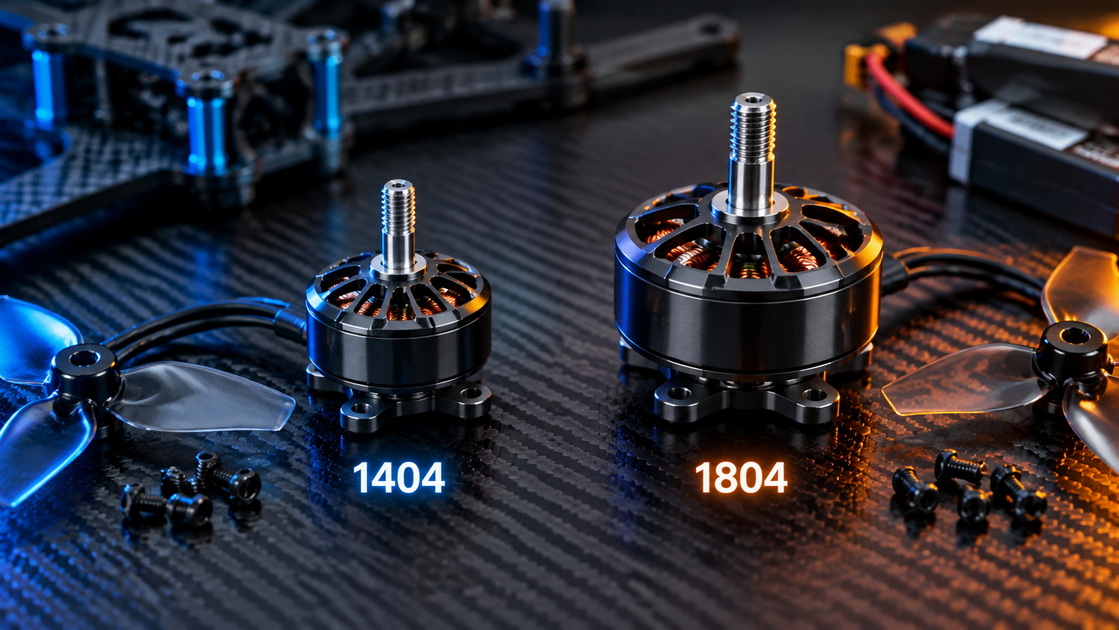
FPV motor names use a common stator-dimension convention:
- The first two digits indicate stator diameter
- The final two digits indicate stator stack height
Therefore:
- A 1404 motor has an approximately 14 mm stator diameter and 4 mm stator height.
- An 1804 motor has an approximately 18 mm stator diameter and 4 mm stator height.
The 1804 motor has a larger stator diameter and therefore more stator volume than the 1404. That difference generally enables more electromagnetic torque potential, assuming comparable design quality, magnet type, winding configuration, air gap, motor weight, and cooling characteristics.
However, the motor-size code is only a starting point. Two 1404 motors from different manufacturers can perform very differently because of variations in:
- Stator lamination thickness and material
- Magnet grade, size, and arc design
- Winding turns and copper fill
- KV rating
- Bell geometry and bearing quality
- Shaft diameter and mounting pattern
- Motor weight
- Propeller choice
- ESC timing and firmware settings
A reliable motor selection process should always compare complete test data—not just the four-digit stator label.
| Feature | 1404 FPV Motor | 1804 FPV Motor | Practical Effect for Sub-250g Builds |
|---|---|---|---|
| Stator size | 14 mm × 4 mm | 18 mm × 4 mm | 1804 has greater stator diameter and volume |
| Typical drone category | Lightweight 2.5-inch to 4-inch builds | 3-inch to 4-inch performance builds | Application overlap is possible |
| Typical build focus | Long-range, cruising, toothpick, cinewhoop, lightweight freestyle | Freestyle, higher-thrust 4-inch, heavier micro platforms | Flight mission should guide the choice |
| Motor mass | Usually lower | Usually higher | Four motors can add meaningful weight to a sub-250g build |
| Torque reserve | Lower than 1804 in comparable design conditions | Higher potential torque reserve | Important for prop loading and aggressive maneuvers |
| Propeller compatibility | Often 3-inch to lightweight 4-inch props | Often 3-inch to 4-inch props, depending on KV and motor design | Propeller load must stay within motor and ESC limits |
| Efficiency priority | Strong for lightweight, low-disc-load systems | Can be efficient, but requires careful system matching | Bigger is not always better |
| Crash recovery and punch-out | Sufficient for light builds | Often stronger for heavier or more aggressive builds | More torque can improve maneuver recovery |
| Ease of remaining under 250 g | Usually easier | Often more difficult | Total takeoff weight includes battery and accessories |
| Best buying approach | Weight-first design | Power-reserve-first design | Match the motor to the intended product position |
For many 3-inch FPV builds, 14xx to 15xx motors are common, while 1804 is frequently positioned as a balanced option for compact 4-inch freestyle platforms.
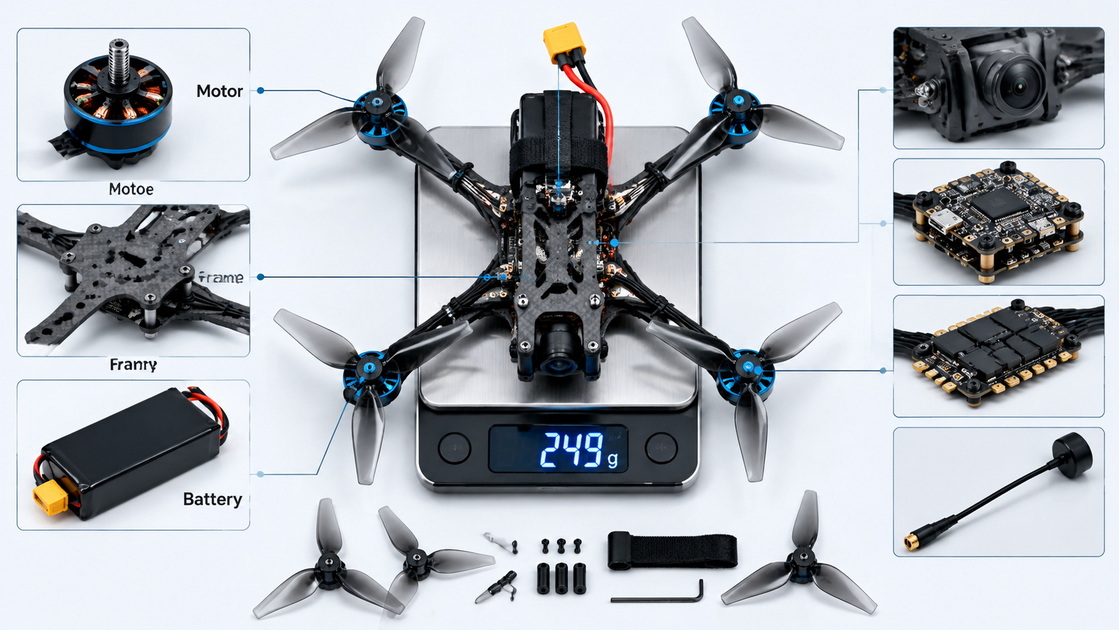
The term sub-250g FPV drone refers to a drone with an all-up takeoff weight below 250 grams, including the battery, camera system, antenna, propellers, action-camera mount, and any other attached equipment.
In the United States, drones that weigh 0.55 lb or less—commonly described as under 250 g—are generally exempt from FAA registration only when operated under the recreational exception. Drones used under Part 107 must be registered regardless of weight.
For FPV product design, the larger issue is not only regulation. Weight affects flight performance directly.
Every gram added to the airframe changes the propulsion requirement. A heavier motor may provide more torque, but it also increases:
- Total aircraft mass
- Inertia during flips and rolls
- Required hover throttle
- Energy demand during climbs
- Battery load
- Risk of crossing the 250 g target once a battery and camera are installed
A four-motor difference of only 2 g per motor adds 8 g to the aircraft before considering heavier wires, larger ESC requirements, or the need for a larger battery. In a 249 g build, that amount can decide whether the product remains in its intended category.
Before selecting motors, calculate the available motor budget:
Motor Budget=249 g−(Frame+FC/ESC+FPV System+Battery+Props+Accessories)
Then divide the remaining mass by four.
For example, if all non-motor components total 205 g, the total allowance for four motors is only 44 g. That leaves an average of 11 g per motor—and no practical reserve for wire length, solder, fasteners, or manufacturing variation. This calculation helps OEM teams avoid a common development mistake: designing a promising prototype that becomes overweight after final assembly.
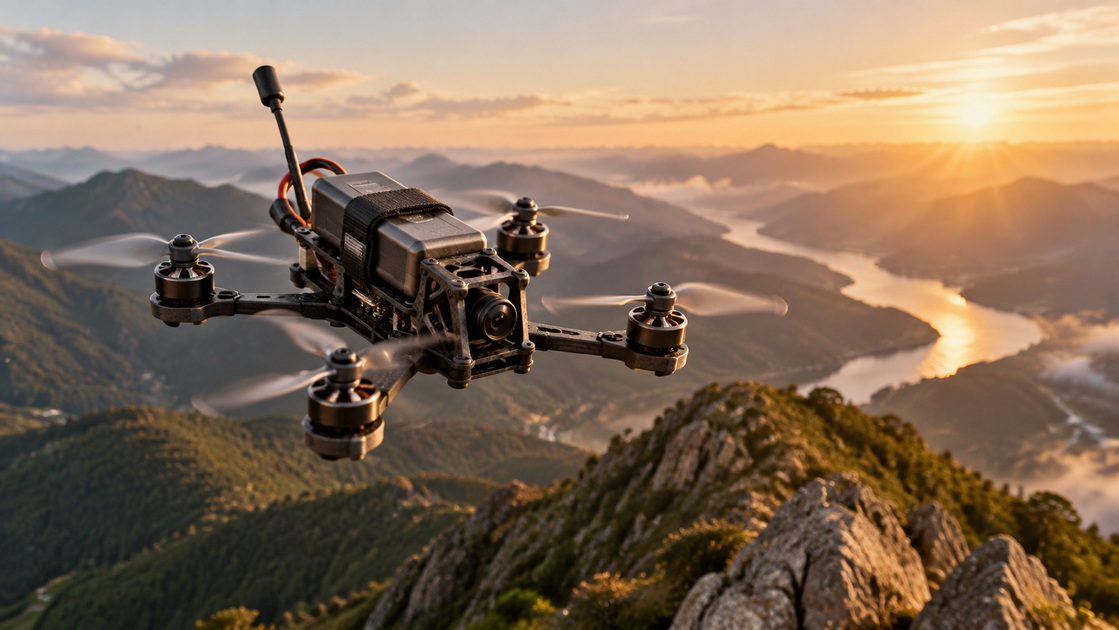
A 1404 brushless motor is a strong choice when the project's first priority is low all-up weight. It is commonly used in lightweight 3-inch and 4-inch toothpick, long-range, cinewhoop, and compact freestyle configurations.
For example, T-Motor positions its F1404 series for 2.5-inch to 4-inch FPV builds, with 3-inch to 4-inch propeller compatibility and 4S or 6S battery options depending on the KV version and overall setup. An example of a commercial sub-250g cinewhoop uses 1404 4600KV motors with a 4S 650mAh battery to reach an all-up weight of approximately 248 g.
- Lower motor weight supports a tighter sub-250g weight budget.
- Lower rotational inertia can help a lightweight quad feel nimble and responsive.
- Good efficiency potential when paired with an appropriate lightweight propeller.
- Suitable for 3-inch and lightweight 4-inch builds when KV and battery voltage are matched correctly.
- Lower propulsion-system mass may allow more budget for an HD camera, GPS, buzzer, or higher-capacity battery.
- Useful for long-range and cruising builds where smooth throttle control matters more than extreme burst thrust.
A well-known lightweight 4-inch long-range FPV example uses 1404 2750KV motors with lightweight 4-inch two-blade propellers. Its published all-up weight is approximately 242 g with a 4S 650mAh battery. The reviewer attributes much of the configuration's success to the low aircraft mass and the motor-propeller pairing rather than motor size alone.
The same characteristics that make 1404 motors attractive for weight-sensitive builds can become limitations in demanding flight conditions.
A 1404 motor may be less suitable if the drone needs to:
- Carry a full-size action camera
- Use heavy, high-pitch, or aggressive tri-blade props
- Recover quickly from deep dives or hard freestyle moves
- Fly in high wind with a high payload
- Use a heavily protected cinewhoop frame
- Maintain strong acceleration at a higher all-up weight
A 1404 can still perform these tasks in some designs, but the system needs a carefully matched KV rating, propeller, battery, and cooling path. Exceeding its thermal and current envelope can reduce motor life and create inconsistent flight behavior.
An 1804 FPV motor increases stator diameter from 14 mm to 18 mm while retaining a 4 mm stator height. This design direction typically provides more torque potential, which can be valuable for pilots or product teams that prioritize authority, recovery, and propeller control over the lowest possible aircraft mass.
For compact FPV platforms, 1804 motors are commonly associated with 3-inch to 4-inch builds. T-Motor markets an 1804 motor for 3-inch, 3.5-inch, and 4-inch FPV applications, while industry motor-selection guidance describes 1804 as a balanced choice for many 4-inch freestyle configurations.
- Greater torque potential than a 1404 motor in comparable design conditions.
- Better authority with more demanding propellers, subject to KV, battery, and current limits.
- Stronger recovery potential after fast direction changes, dives, and freestyle maneuvers.
- More useful thrust reserve for heavier 4-inch platforms.
- Potentially better thermal headroom when a correctly designed motor operates within its specified load range.
- More flexible for performance-oriented product positioning where users expect stronger throttle response.
For a 4-inch FPV drone intended for active freestyle rather than endurance cruising, an 1804 can be a logical option. Its additional torque can help maintain propeller RPM under load and create a more confident feel during rapid maneuvers.
The first limitation is mass. A larger motor usually weighs more, and that additional weight occurs at the ends of the drone's arms. This can increase rotational inertia and reduce the ultra-light handling advantages that attract pilots to sub-250g FPV platforms.
The second limitation is system demand. A more powerful motor does not create useful performance if the battery cannot supply the required current, the ESC is underspecified, the propeller is poorly matched, or the flight controller tune is not adapted.
An 1804 build may also need:
- A higher-current ESC
- More robust battery connectors and wiring
- A battery with adequate discharge capability
- Stronger arms and hardware
- A more carefully optimized weight budget
- More attention to motor cooling and temperature testing
For a lightweight cruising platform, these trade-offs can reduce flight-time benefits rather than improve them.
It is tempting to assume that an 1804 motor always produces more usable thrust. In many equal-system comparisons, it likely can produce more torque and support greater propeller load. But the real-world outcome depends on the full propulsion system.
The following factors influence thrust and flight feel:
| System Variable | Why It Changes the Result |
|---|---|
| KV rating | Higher KV increases no-load RPM per volt but may increase current draw and heat under load |
| Battery voltage | A 4S or 6S system changes motor RPM potential and current behavior |
| Propeller diameter | Larger props move more air but require more torque |
| Propeller pitch | Higher pitch can increase speed potential but raises motor load |
| Blade count | Tri-blade props usually create more grip and load than comparable bi-blade props |
| Propeller weight | Heavier props have greater rotational inertia and can reduce response |
| ESC settings | Timing, PWM frequency, demag compensation, and current limits affect behavior |
| Drone weight | Higher takeoff mass requires more thrust for hover, acceleration, and recovery |
| Flight environment | Wind, altitude, temperature, and maneuver style change real power demand |
Propeller selection is especially important. Lighter propellers can improve responsiveness because lower rotational inertia allows the motor to change RPM more quickly. Larger or heavier propellers demand more torque and energy.
For a sub-250g FPV drone, a better performance metric is the thrust-to-weight ratio:
Thrust-to-Weight Ratio=Total Maximum Static Thrust/All-Up Weight
A quad that weighs 245 g and produces 1,200 g of total static thrust has a theoretical 4.9:1 ratio. A heavier 275 g quad with 1,400 g of thrust has a 5.1:1 ratio. The second drone has more absolute thrust, but it is no longer sub-250g and may not deliver proportionally better endurance or agility.
Static thrust tests are useful, but they do not fully predict flight performance. In forward flight, airflow changes propeller behavior, and available thrust can differ materially from static test-stand results.
A motor-size comparison without a KV discussion is incomplete.
KV describes the approximate no-load RPM per volt applied to the motor. It does not directly measure torque, power, quality, or efficiency. A higher-KV motor spins faster at a given voltage, while a lower-KV motor is usually paired with a higher-voltage battery or a larger propeller load.
For sub-250g FPV designs, common patterns include:
| Build Direction | Typical Motor Strategy | Propulsion Goal |
|---|---|---|
| Lightweight 3-inch 4S | 1404 with moderate-to-high KV | Fast response and low system weight |
| 4-inch long-range 4S | 1404 with lower KV and light bi-blade props | Endurance and efficient cruising |
| 4-inch freestyle 4S | 1804 with suitable KV and durable tri-blade props | Stronger recovery and punch-out |
| Compact 6S build | Lower-KV motor matched to 6S | Maintain practical RPM while reducing current for a given power demand |
Published FPV motor guidance places 1404–1804 motors broadly in the 3-inch propeller, 4S, and 3,000–3,800KV category, but exact choices must be confirmed using the motor manufacturer's propeller-thrust table and electrical limits.
1. Selecting the motor before defining the weight budget
Start with target takeoff weight, battery, FPV system, and propeller size.
2. Using KV as the only performance metric
KV must be evaluated with stator size, winding, propeller load, voltage, and thermal capacity.
3. Copying another drone's motor setup without matching its geometry
Frame mass, prop design, camera system, and battery all change the result.
4. Treating static thrust as guaranteed in-flight thrust
Static test data supports comparison, but it is not a complete flight model.
5. Ignoring motor temperature after a full battery cycle
A setup that feels powerful for 30 seconds may still be thermally unsafe over a complete flight.
6. Leaving no manufacturing margin below 250 g
A nominal 249 g design can cross the threshold due to production variation, accessories, different battery lots, or user-added equipment.
For drone brands, distributors, and OEM customers, the best way to choose between 1404 and 1804 is to test both configurations with controlled variables.
Use the same:
- Frame geometry
- Flight controller and ESC
- FPV system
- Battery type and capacity
- Propeller diameter and blade count where feasible
- Firmware and PID baseline
- Camera and accessory payload
The motor should be the primary changed variable.
Measure:
- Motor weight
- Peak current
- Peak power
- Static thrust
- Thrust per watt
- Motor temperature after defined runs
- ESC temperature
- Vibration level
Perform repeatable flights and document:
- All-up weight
- Hover throttle percentage
- Flight time to a defined battery-voltage cutoff
- Maximum motor temperature
- Punch-out feel
- Recovery after dive maneuvers
- Cruise efficiency
- Propeller damage resistance
- Pilot evaluation of control precision
Choose 1404 if the test result shows a meaningful benefit in flight time, weight margin, and smooth handling. Choose 1804 if the added motor mass produces a meaningful increase in control authority, temperature margin, or payload capability without pushing the aircraft outside its intended weight category.
Choose a 1404 FPV motor when your product or drone build prioritizes:
- Keeping a genuine sub-250g all-up weight
- 3-inch, toothpick, lightweight cinewhoop, or long-range configurations
- Efficient cruising with lightweight props
- A lower-mass propulsion system
- Room in the weight budget for an HD camera, GPS, or larger battery
- Smooth, agile handling rather than maximum burst power
Choose an 1804 FPV motor when your project prioritizes:
- A 3-inch to 4-inch performance build
- Stronger throttle response under propeller load
- Freestyle recovery and maneuver authority
- More thrust reserve for a heavier compact platform
- Better support for demanding propeller configurations
- A product position focused on responsiveness rather than the lowest possible takeoff mass
For OEM drone development, a dual-version strategy can be commercially effective. One version can use 1404 motors for a long-range or lightweight sub-250g model. A second version can use 1804 motors for a more powerful freestyle configuration, with clear disclosure that the latter may need a different battery, ESC, or weight classification.
The 1404 vs 1804 motor decision should be based on the complete propulsion system and the final flight mission.
A 1404 motor is typically the smarter starting point for brands developing efficient, lightweight, and genuinely sub-250g FPV drones. It supports a disciplined weight budget and can deliver excellent real-world performance when paired with the correct KV, battery, and lightweight propeller.
An 1804 motor is often more appropriate when a compact FPV drone needs extra torque reserve, stronger recovery, and more aggressive 4-inch flight characteristics. Its benefits are real, but only if the airframe, battery, ESC, and final all-up weight can support them.
Zhongshan Yuhang Power Technology Co., Ltd. provides FPV drone motors and complete brushless propulsion-system solutions for FPV drones, RC vehicles, high-speed fans, gimbal cameras, aircraft, robotic vacuum systems, underwater robots, and other professional equipment. We support OEM and ODM customization, including motor size, KV rating, winding configuration, shaft design, cable length, mounting pattern, performance targets, and application-specific testing.
Yes. A 1404 motor is often a strong choice for sub-250g 3-inch and lightweight 4-inch FPV drones because its lower mass helps preserve the aircraft's weight budget. It is especially suitable for toothpick, long-range, lightweight freestyle, and compact cinewhoop designs when KV, propeller, battery, and payload are properly matched.
An 1804 motor has a larger stator diameter and more stator volume than a 1404 motor, so it generally has greater torque potential in comparable designs. However, actual thrust and usable power depend on KV, battery voltage, propeller load, motor construction, ESC settings, and thermal limits.
Many 1404 motors are used with 3-inch and lightweight 4-inch propellers. T-Motor, for example, lists 3-inch to 4-inch propeller compatibility for its F1404 series. Always follow the motor manufacturer's official thrust table and recommended propeller limits for the precise KV model.
Yes, 1804 motors can be used on some 3-inch FPV builds, particularly when stronger acceleration and freestyle performance are desired. However, the motor may add weight and may require a battery, ESC, and propeller setup that makes the finished aircraft less suitable for a strict sub-250g target.
No. Higher KV increases approximate no-load RPM per volt, but speed and acceleration depend on the full system: battery voltage, propeller diameter and pitch, motor torque, aircraft weight, aerodynamic drag, ESC settings, and current capability. An incorrect high-KV and propeller combination can cause excessive current draw and overheating.
1. [Federal Aviation Administration, "How to Register Your Drone"] — Used for the U.S. recreational registration exception for drones that weigh 0.55 lb or less and are flown under the recreational exception. [faa]
2. [Federal Aviation Administration, "Do I Need to Register My Drone and If So, How Do I Register?"] — Used to clarify that Part 107 drone operations require registration, including aircraft under 250 g. [faa]
3. [T-Motor, "F1404 Brushless Long Range Motor for Micro FPV Drones"] — Used for example F1404 application guidance, including stated compatibility with 2.5-inch to 4-inch FPV builds, 3-inch to 4-inch propellers, and 4S/6S configurations. [shop.tmotor]
4. [T-Motor, "P1804 FPV Drone Freestyle Motor"] — Used for an example of commercial 1804 positioning for 3-inch, 3.5-inch, and 4-inch FPV applications. [shop.tmotor]
5. [Oscar Liang, "Flywoo Explorer LR: Awesome 4-inch Long Range BNF Drone"] — Used for the published example of a 4-inch sub-250g platform using 1404 2750KV motors, light 4-inch bi-blade props, and a 4S 650mAh battery. [oscarliang]
6. [Oscar Liang, "SpeedyBee Bee25: Best Sub-250g DJI O3 Cinewhoop"] — Used for the published example of a 1404 4600KV-powered cinewhoop reaching approximately 248 g with a 4S 650mAh battery. [oscarliang]
7. [Oscar Liang, "How to Choose the Best Propellers for FPV Drone"] — Used for the discussion of propeller inertia, motor response, static thrust, and differences between bench-test and in-flight performance. [oscarliang]
8. [Mepsking, "What Size Motor Do I Need for My FPV Quad?"] — Used for general motor-size, frame-size, propeller-size, KV, and battery guidance for 3-inch FPV platforms. [mepsking]
9. [LIGPOWER, "The Ultimate FPV Drone Motors Guide 2025"] — Used for general 1404–1804, 3-inch, 4S, and KV-range context. [ligpower]
10. [UAV Model, "FPV Drone Motor Science: Stator Size, KV, and Thrust Explained"] — Used for broader context regarding motor sizing and common applications for 3-inch to 4-inch FPV drone motor categories. [blog.uavmodel]


