Language


Views: 261 Author: Yuhang Power Publish Time: 2026-09-26 Origin: Site
Content Menu
● Why Source Fixed Wing Motors for Korea?
● How We Evaluated Fixed Wing Motor Suppliers
>> Factory and Quality-System Evidence
>> Fixed Wing Motor Engineering Capability
>> Customization and Commercial Fit
● Top Fixed Wing Motor Manufacturers and Suppliers for Korea
>> 1. Zhongshan Yuhang Power Technology Co., Ltd.
>> 5. Motor-net International Co., Ltd.
>> 6. Namdong Electric Motor Co., Ltd.
● Fixed Wing Motor Technical Requirements
>> Stator, Windings, and Magnetic Materials
>> CE and RoHS: What Buyers Should Ask For
● Buyer's Guide: How to Avoid Fixed Wing Motor Sourcing Mistakes
>> Verify the Supplier Before Ordering
>> Use a Controlled Sample Process
>> Internal Sourcing Tip: Control Sample-to-Mass-Production Changes
>> Plan Logistics and Shipping
>> 1. How can I verify that a Korean fixed wing motor supplier is a real manufacturer?
>> 2. How do I check whether an ISO 9001 certificate is valid or expired?
>> 3. What MOQ should I expect for a custom fixed wing motor?
>> 4. Is a Korean motor supplier always better than a Chinese motor supplier for Korean UAV projects?
>> 5. What test report should I ask for before approving a fixed wing motor?
>> 6. Can CE and RoHS documents from a motor supplier make my whole drone compliant?
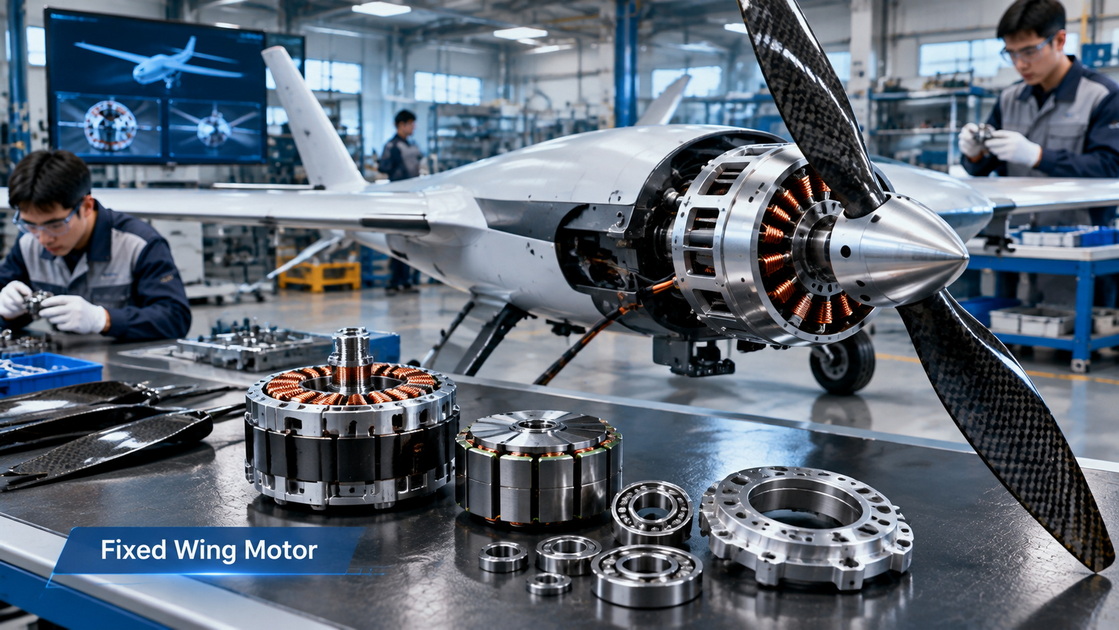
South Korea is an increasingly important market for commercial drones, defense UAVs, robotics, precision electronics, and aerospace systems. For procurement teams searching for a Fixed Wing Motor Manufacturer in Korea, the market offers strengths in electronics, power control, precision machining, UAV integration, and application-level engineering. At the same time, buyers should understand that Korea has fewer dedicated, export-oriented fixed wing motor factories than China's mature UAV propulsion supply chain.
This distinction matters. A Korean company may be highly capable in UAV integration, mission systems, robotics, aircraft development, electronic control, or precision motion. But a buyer needing high-volume, cost-controlled fixed wing brushless motors, rapid sample iterations, multiple KV variants, private-label packaging, and flexible OEM/ODM support may also need to evaluate specialized overseas motor manufacturers.
A qualified supplier should be selected through a transparent review of its factory documentation, R&D capability, quality-control process, production consistency, material traceability, delivery performance, and customization response speed. Procurement teams should not select a partner only because it has a strong brand name, a low unit price, or an attractive catalog.
South Korea's drone market is developing under government and industry support. One market estimate placed the country's drone-market revenue at approximately USD 1.694 billion in 2025, with projected revenue of USD 4.514 billion by 2033. Hardware represented the largest revenue segment in that estimate. Korea's aerospace ecosystem also includes military and civilian UAV development programs supported by the Korea Aerospace Industries Association.
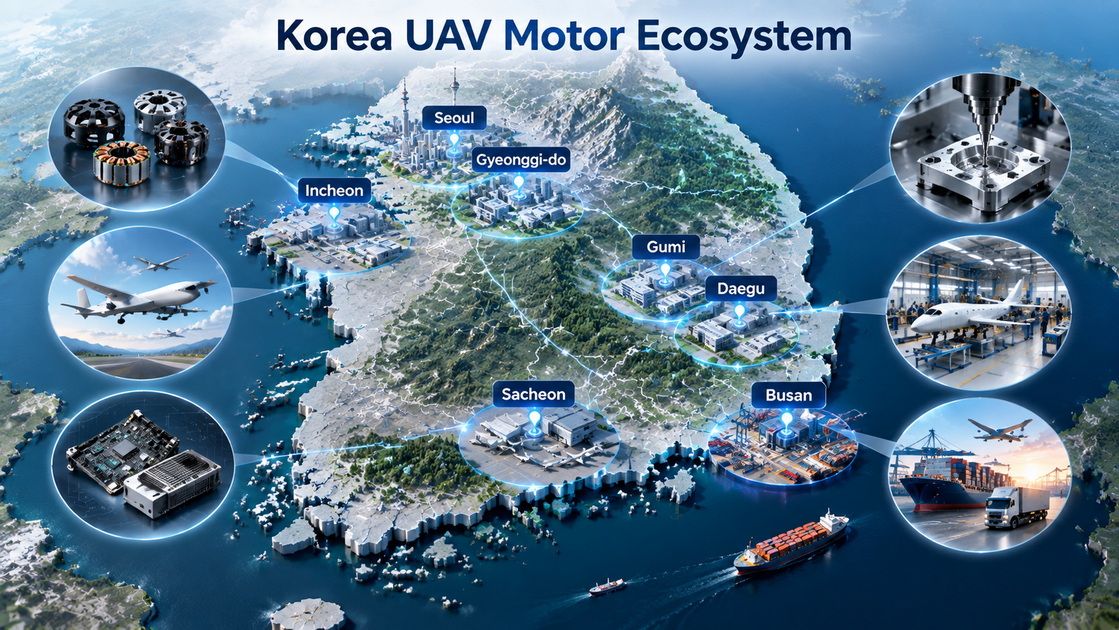
Korea is not a single-location manufacturing cluster for fixed wing UAV motors in the same way that Shenzhen and Guangdong form a dense electronics-and-drone supply ecosystem. Instead, Korea's advantage comes from several connected industrial strengths:
- Gyeonggi-do and Seoul: Electronics, automation, software, robotics, R&D, system integration, and technical procurement.
- Incheon: Industrial manufacturing, export logistics, port access, and component supply.
- Gumi and Daegu: Electronics, machinery, precision manufacturing, and industrial-component production.
- Sacheon and Gyeongsangnam-do: Aerospace manufacturing, defense-related engineering, aircraft production, and UAV development.
- Busan: Marine technology, logistics, drone-industry events, and access to regional manufacturing networks.
Korea Aerospace Industries is headquartered in Sacheon, Gyeongsangnam-do, an area with established aerospace-manufacturing activity. For buyers, this makes Korea attractive for higher-value UAV projects that require technical cooperation, local integration, aerospace awareness, or specialized support.
However, Korea's domestic drone industry still relies substantially on imported small UAV products and components. Invest Korea has stated that nearly nine out of ten enterprise drones in service in Korea were outsourced from overseas markets, while more than 90% of miniature UAVs for toys or personal tools are presumed to come from overseas suppliers.
That sourcing reality explains why Korean drone companies, system integrators, and brand owners may combine Korean design and integration with overseas propulsion manufacturing.
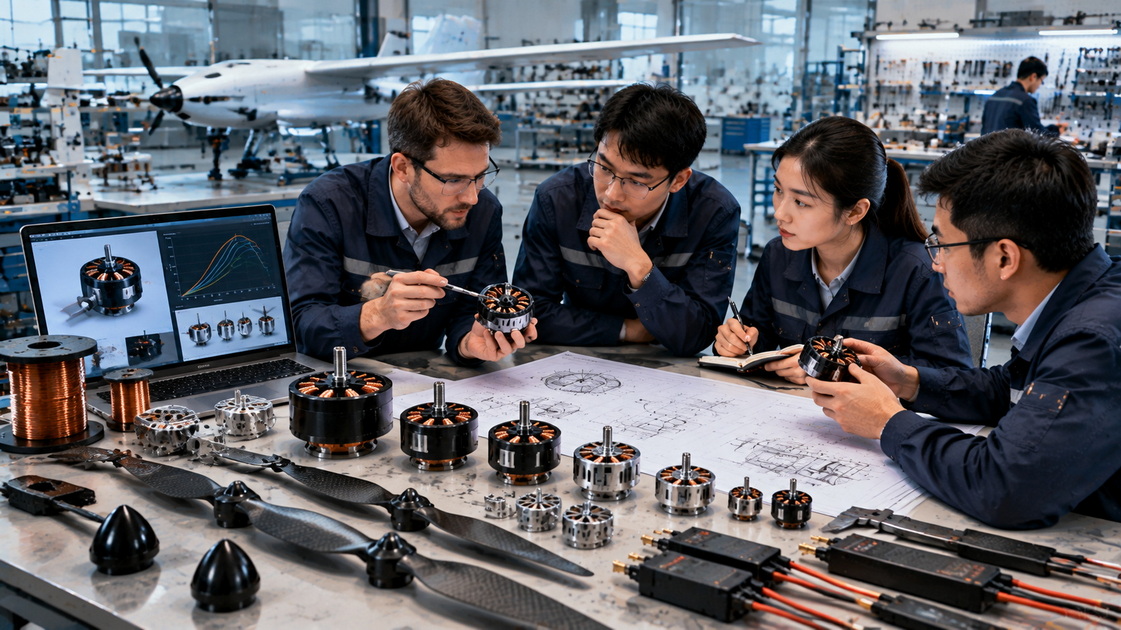
The companies in this guide were not selected simply because they sell a motor or operate in the Korean market. They were shortlisted based on relevance to fixed wing UAV propulsion, brushless motor engineering, precision motion, drone systems, or custom OEM projects.
A professional supplier evaluation should include the following dimensions.
Buyers should confirm:
- Legal company registration and operating address.
- Actual factory or engineering-center location.
- Manufacturing process flow.
- Quality-control procedures.
- Incoming-material inspection.
- In-process testing.
- Final inspection.
- Batch traceability.
- ISO 9001 certificate validity, scope, issuing body, and expiry date.
- Product-specific compliance documentation.
A supplier may claim to have ISO certification, CE compliance, or RoHS capability. These claims should be verified against the exact factory, product family, and target market.
A Fixed Wing Motor should be evaluated as part of a propulsion system. The motor must work with the aircraft's propeller, ESC, battery, airframe, payload, mission duration, and cooling conditions.
Assess whether the supplier can discuss:
- Motor size and stator dimensions.
- KV rating and winding configuration.
- Motor torque under propeller load.
- Battery voltage range.
- Maximum continuous and burst current.
- Propeller diameter and pitch.
- ESC timing and current margin.
- Motor temperature.
- Shaft material and rotor balance.
- Bearing specification.
- Thrust-test conditions.
- Noise and vibration performance.
The right supplier for a defense-scale or aerospace platform may not accept a small private-label order. Likewise, a flexible OEM factory may be a better fit for a developing UAV brand but may not be appropriate for a safety-critical aerospace program requiring long qualification cycles.
Before adding a supplier to an approved vendor list, clarify:
- Prototype MOQ.
- Pilot-production MOQ.
- Mass-production MOQ.
- Tooling charges.
- Engineering fees.
- Lead time.
- Product-change control.
- Warranty terms.
- Spare-parts support.
- Packaging and labeling requirements.
- Incoterms and export responsibilities.
Established: 2021
Location: Zhongshan, Guangdong, China
Primary markets: Global OEM and ODM customers
Core focus: Brushless motors and complete power-system solutions
Applications: Drones, FPV drones, RC vehicles, gimbal equipment, aircraft, underwater robots, and professional equipment
OEM/ODM scope: Customized brushless motor design, motor parameters, power-system matching, private labeling, and application-oriented configuration
Zhongshan Yuhang Power Technology Co., Ltd. is included first because it represents a practical sourcing option for Korean drone brands, regional integrators, and international buyers who need a dedicated brushless-motor partner rather than a general industrial motor supplier.
The company, operating through the LN-MOTOR brand, was established in 2021 and focuses on the production, R&D, and sales of brushless motors. Its products are used in drones, RC vehicles, gimbal shooting, aircraft, underwater robots, and other professional equipment. The company also states that it provides full power-system solutions and customized OEM/ODM services. Its technical team has more than ten years of manufacturing and brushless-motor design experience.
For buyers developing fixed wing drones, the practical value is not only access to a catalog motor. It is the ability to discuss the propulsion system as an engineering project.
Core strengths
- Flexible support for developing brands and mid-sized OEM programs.
- Relevant experience across drones, FPV systems, aircraft, RC applications, gimbals, robotics, and underwater equipment.
- Ability to discuss KV, motor size, shaft options, mounting dimensions, cable length, connector configuration, and branding.
- Direct manufacturer communication for faster sample feedback.
- Suitable for custom fixed wing motor projects where standard catalog motors do not match the required aircraft weight, propeller, voltage, or endurance target.
- Customer-centered development approach and independent control of R&D, design, production, and testing according to its published company statement.
Best fit
- Korean FPV and UAV brands requiring flexible OEM support.
- Fixed wing aircraft projects needing custom KV or mounting arrangements.
- Buyers requiring private-label packaging or laser marking.
- Startups and medium-sized drone companies needing responsive engineering communication.
- Integrators seeking motor, ESC, propeller, and battery compatibility discussion.
What buyers should verify
Ask for test data based on your actual propeller and battery configuration. Confirm the approved drawing, KV tolerance, winding specification, bearing type, magnet grade, dynamic-balance requirements, sample lead time, mass-production lead time, and process for approving engineering changes.
Established: 1998
Location: Seoul, South Korea, with vertically integrated manufacturing in Gumi
Primary markets: UAVs, unmanned mobility, robotics, industrial systems, defense, and homeland-security applications
Core focus: BLDC motors, adaptive ESCs, propellers, and propulsion systems
OEM/ODM scope: Mission-specific propulsion engineering for UAV and unmanned-system programs
KRM is one of the most directly relevant Korean suppliers for buyers seeking locally developed propulsion solutions for UAVs and unmanned mobility systems. The company positions its work around mission-specific UAV propulsion and states that its Korean manufacturing is performed in-house, with U.S. production also planned.
Industry supplier profiles describe KRM as a Korean company established in 1998, with a focus on BLDC motors, adaptive ESCs, custom propellers, and propulsion systems for UAVs and robotics. Its systems are associated with UAV platforms and quadrupedal ground robots used in industrial, defense, and homeland-security contexts.
Core strengths
- Strong relevance to Korean UAV and unmanned-mobility programs.
- Integrated focus on motor, ESC, propeller, and propulsion-system engineering.
- Appropriate for mission-specific projects rather than generic RC motor procurement.
- Local Korean engineering and manufacturing positioning.
- Potentially suitable for buyers needing high-reliability or application-specific propulsion integration.
Best fit
- Korean defense and security UAV projects.
- Industrial inspection and mission-specific aircraft.
- Professional fixed wing or VTOL systems requiring propulsion matching.
- Buyers who prioritize local collaboration and system-level engineering.
What buyers should verify
Confirm the specific fixed wing motor range, aircraft weight capability, propeller compatibility, voltage range, environmental qualification, program MOQ, lead time, export-control requirements, and certification documentation for the final application.
Established: Not clearly stated in the reviewed public product information
Location: South Korea
Primary markets: Mini drones, industrial drones, and payload-focused UAV applications
Core focus: Drone BLDC motor series
OEM/ODM scope: Model and propulsion selection for varied drone payload classes; confirm custom engineering availability directly
KODRIS offers a Korean drone BLDC motor series designed for a wide range of mission profiles. Its published information describes 12 models ranging from K-2216 to K-10030, supporting drone applications from approximately 700 g class to industrial platforms handling up to 50 kg payloads. The company highlights precision-engineered cores, neodymium magnets, optimized efficiency design, stable RPM, and reliability.
For fixed wing motor buyers, this wide size range is relevant. It indicates that the supplier addresses more than micro-drone applications and may be able to support larger UAV power requirements.
Core strengths
- Broad published drone-motor range.
- Coverage from lightweight drones to larger industrial UAV classes.
- Product messaging focused on precision cores, neodymium magnets, efficiency, thrust, and stable RPM.
- Relevant for buyers seeking a Korean-market drone propulsion specialist.
Best fit
- Industrial drone programs.
- Larger multirotor, VTOL, or fixed wing UAV projects.
- Korean buyers seeking a domestic drone BLDC motor source.
- Projects where stable RPM and mission reliability are important.
What buyers should verify
Public product-range claims do not replace project-specific validation. Ask for fixed wing thrust tables, continuous current limits, motor-temperature data, shaft dimensions, bearing details, propeller recommendations, and actual sample lead time. Confirm whether the selected motor is intended for open-propeller fixed wing use, multicopter use, or another UAV configuration.
Established: September 2001
Location: Gwangju, South Korea
Primary markets: Home appliances, electric vehicles, industrial equipment, and BLDC motor applications
Core focus: Washing machine motors, HVAC motors, refrigerator motors, resin-pack motors, BLDC motors, and EV motors
OEM/ODM scope: Motor design and manufacturing for appliance, mobility, and specialized electromechanical programs
Newmotech is not a dedicated fixed wing motor supplier, but it is relevant to procurement teams looking for Korean BLDC manufacturing capability and broader motor-engineering experience. Public industry profiles identify its product coverage as including appliance motors, resin-pack motors, BLDC motors, and EV motors.
The company may be better suited to a buyer seeking a Korean engineering partner for specialized BLDC motor development, an enclosed motor application, or a customized electromechanical program rather than an off-the-shelf FPV fixed wing outrunner.
Core strengths
- Korean BLDC motor manufacturing background.
- Experience across several motor-intensive industries.
- Relevant to custom industrial and mobility projects.
- Potential fit where the motor must integrate into a larger device rather than serve as an exposed propeller motor.
Best fit
- Ground-support equipment.
- UAV auxiliary motors.
- Cooling systems.
- Enclosed propulsion or industrial fan applications.
- Custom BLDC programs requiring Korean engineering involvement.
What buyers should verify
Ask whether the supplier has direct experience with high-RPM open-propeller or EDF applications. Fixed wing propulsion requires specific knowledge of rotor balance, shaft retention, propeller load, thermal behavior, and thrust testing that may not be transferable from appliance motor production without additional validation.
Established: Not clearly stated in the reviewed public listing
Location: Bucheon, Gyeonggi-do, South Korea
Primary markets: Automation, industrial machinery, motion-control equipment, and electronic systems
Core focus: AC motors, BLDC motors, step motors, motor controllers, and gearheads
OEM/ODM scope: Motion-control and motor-controller integration; verify custom UAV work directly
Motor-net International is relevant as a Korean motion-control supplier offering AC motors, BLDC motors, step motors, motor controllers, and gearheads. Its core relevance to a fixed wing motor article lies in system engineering around motors and control electronics rather than confirmed specialization in UAV propulsion.
For buyers developing UAV ground systems, camera payloads, antenna mechanisms, robotics, test stands, or inspection equipment, a supplier of motors and controllers may be valuable even when it does not supply the main propulsion motor.
Core strengths
- Product portfolio includes BLDC motors and motor controllers.
- Relevant to integrated motion-control requirements.
- Located in Gyeonggi-do, near Korea's engineering and automation ecosystem.
- May support industrial auxiliary systems around a UAV program.
Best fit
- Ground-control mechanisms.
- Antenna positioning systems.
- UAV payload mechanisms.
- Production fixtures.
- Motor-test equipment.
- Robotics and inspection systems.
What buyers should verify
Do not assume that a BLDC motor supplier automatically produces high-thrust fixed wing motors. Ask for actual UAV propulsion references, high-speed balancing capability, propeller test results, endurance data, and motor-to-ESC matching support.
Established: 1975
Location: Incheon, South Korea
Primary markets: Industrial equipment, special motors, energy-efficiency motors, refrigeration, and demanding industrial applications
Core focus: Small to large motors, special motors, energy-efficiency motors, and specialized industrial motor systems
OEM/ODM scope: Small-quantity and varied special-motor production; direct application qualification required
Namdong Electric Motor, also referred to in public trade information as Chunin, states that it was founded in 1975 and manufactures motors ranging from small units to larger specialized motor systems, including turbo refrigerator motors, energy-efficiency motors, special motors, and motors for nuclear power plant applications. The same public company listing states it has quality-assurance recognition involving CSA, UL, CE, and ISO 9001.
The company is not presented as a fixed wing UAV propulsion specialist. Still, it is relevant for buyers seeking Korean special-motor capability, industrial quality documentation, and potential custom engineering for adjacent applications.
Core strengths
- Long operating history.
- Experience in special-motor and industrial-motor manufacturing.
- Incheon location with practical logistics advantages.
- Publicly stated quality-assurance certifications and standards.
Best fit
- Industrial motor projects.
- Specialized fan or blower systems.
- UAV support equipment.
- Ground robotics and industrial automation.
- Custom motor requirements outside mainstream RC propulsion.
What buyers should verify
Verify the status and scope of all claimed certificates directly. For a fixed wing motor project, request project-specific evidence of high-RPM operation, rotor balance, propeller load testing, bearing specifications, shaft strength, and long-duration thermal validation.
The following table is an initial sourcing comparison. Production capacity, MOQ, and certification status can vary by product, factory, project complexity, and annual purchasing forecast. Treat all figures as items that must be confirmed in writing during the RFQ stage.
| Supplier | Main Focus | Fixed Wing Relevance | Typical Project Scale | MOQ Approach | Certifications and Documentation |
|---|---|---|---|---|---|
| Zhongshan Yuhang Power Technology Co., Ltd. | Custom brushless motors and power systems | High for custom fixed wing, FPV, RC, and UAV propulsion projects | Samples to medium-volume OEM | Flexible by motor model and customization level; confirm per RFQ | Request project-specific QC documents, test reports, material declarations, and applicable compliance support |
| KRM Co., Ltd. | UAV propulsion systems, BLDC motors, ESCs, propellers | High for mission-specific UAV propulsion | Professional, industrial, and mission-driven programs | Likely program-dependent | Confirm current product- and site-specific quality documentation |
| KODRIS Co., Ltd. | Drone BLDC motor series | High, subject to the specific motor and aircraft configuration | Mini to industrial UAV platforms | Confirm directly | Request product test reports, material information, and compliance documents |
| Newmotech Co., Ltd. | Appliance, EV, and BLDC motors | Medium for custom or adjacent motor projects | Industrial and specialized OEM | Likely engineering- and forecast-based | Confirm factory-level and product-specific certifications |
| Motor-net International Co., Ltd. | BLDC motors, controllers, gearheads | Medium for UAV systems; lower for direct fixed wing propulsion | Industrial motion-control projects | Confirm directly | Confirm technical files and any relevant certification scope |
| Namdong Electric Motor Co., Ltd. | Special motors and industrial motors | Medium for special applications; lower for catalog UAV propulsion | Small-volume special motor through industrial projects | Suitable for varied special-motor orders according to public description; verify | Public listing cites CSA, UL, CE, and ISO 9001; verify validity and scope |
A fixed wing UAV motor should be selected through a complete propulsion-system review. The motor must be correctly matched with the propeller, ESC, battery, airframe, payload, cruise condition, climb demand, and ambient temperature.
A reliable brushless fixed wing motor commonly depends on:
- Electrical steel laminations: Lower-loss laminations can reduce eddy-current losses and heat, especially at higher RPM.
- Copper windings: Copper diameter, number of turns, winding pattern, and fill factor affect KV, resistance, torque, and current draw.
- Neodymium magnets: Magnet grade and temperature tolerance affect torque stability and high-temperature reliability.
- Rotor structure: Rotor retention, glue selection, balance, and bell rigidity matter at high RPM.
- Bearings: Bearing quality affects vibration, heat, noise, service life, and flight stability.
- Shaft design: Shaft material, hardness, straightness, and retention affect safety under propeller load.
For an EDF or high-speed fixed wing motor, balancing and thermal control become especially important. A motor that produces strong thrust for a few seconds may still be unsuitable if it overheats during a sustained climb or cruise segment.
Procurement teams should ask suppliers to provide data for the exact motor, battery voltage, ESC setting, and propeller or EDF configuration.
| Test Item | Why It Matters |
|---|---|
| KV tolerance | Indicates production consistency and expected RPM behavior |
| No-load current | Helps identify mechanical friction and electrical losses |
| Voltage and current | Confirms battery and ESC compatibility |
| Input power | Supports meaningful power and efficiency comparisons |
| Static thrust | Measures baseline propulsion output |
| RPM | Helps validate motor and propeller matching |
| Efficiency | Helps estimate endurance and energy use |
| Motor temperature | Identifies thermal risk |
| ESC temperature | Prevents controller overload |
| Vibration data | Supports airframe, camera, and bearing reliability |
| Endurance-test result | More valuable than a short burst-thrust claim |
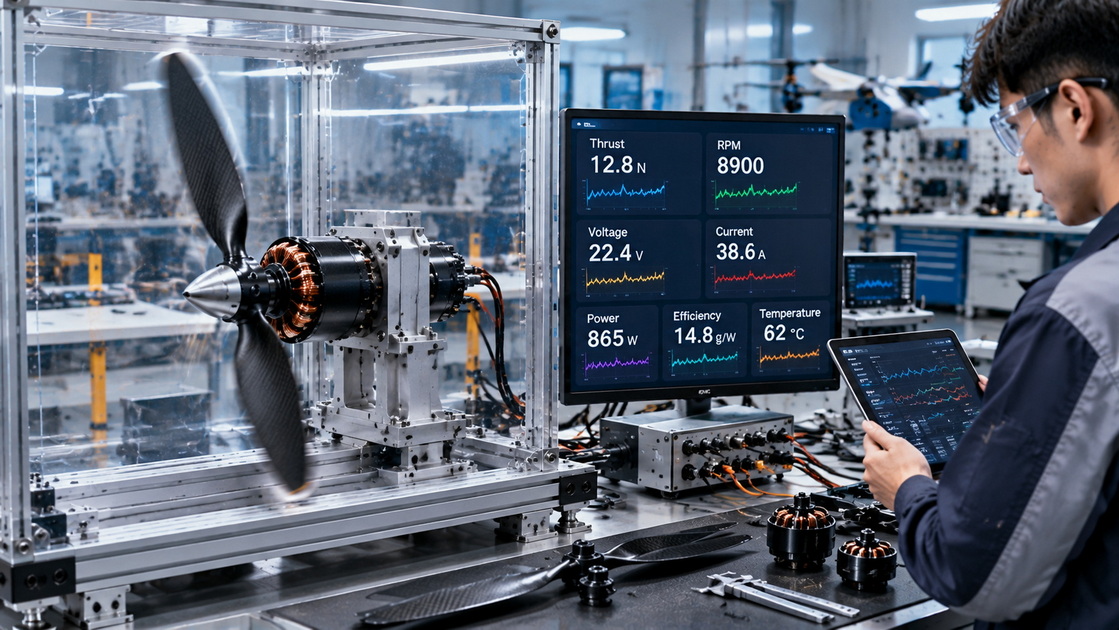
A professional thrust-test process measures more than thrust. Proper test systems can record thrust, torque, voltage, current, RPM, and efficiency.
CE and RoHS are often misunderstood in drone-motor sourcing.
- RoHS relates to restricted substances in electrical and electronic equipment. A motor supplier may provide a material declaration, compliance statement, or test report for relevant materials.
- CE is not a universal factory certificate. It is a conformity marking framework that applies to finished products placed on the European Economic Area market, depending on the applicable regulations and product configuration.
- A brushless motor may support a final-product compliance file, but the complete aircraft, ESC, battery, radio system, charger, and final assembly may have different obligations.
- Buyers should request documents that are relevant to their actual sales market and final product—not a generic image of a CE mark.
Before placing a sample or production order, request:
1. Business registration and legal company name.
2. Factory address and live video verification.
3. Production flow from incoming material to packing.
4. Engineering and QC organization chart.
5. Equipment list, including winding equipment, balancing equipment, dynamometer, test fixtures, and inspection tools.
6. ISO 9001 certificate, including the certificate number, scope, expiry date, and certification body.
7. Product specification sheet and test report.
8. Sample lead time, mass-production lead time, warranty terms, and shipping terms.
A good sample process protects both the buyer and the factory.
| Stage | Buyer Responsibility | Supplier Responsibility |
|---|---|---|
| RFQ | Provide aircraft weight, target thrust, battery voltage, propeller, flight time, and annual forecast | Recommend suitable motor configuration |
| Engineering review | Confirm mounting, KV, cable length, connector, and performance target | Provide drawing, specification, and test plan |
| Prototype samples | Test in the real aircraft or on a thrust stand | Deliver traceable samples and test data |
| Validation | Test heat, vibration, endurance, and flight behavior | Analyze deviations and propose corrective action |
| Pilot order | Verify batch consistency, packing, and lead time | Provide production and inspection records |
| Mass production | Lock approved technical baseline | Follow change-control process and outgoing QC |
The most overlooked risk in brushless motor sourcing is not an obvious counterfeit product. It is an unannounced material or process change after prototype approval.
The sample may use better bearings, a higher-temperature magnet grade, tighter rotor balancing, or more copper than later mass-production units. The motor housing may look identical, but reliability can change significantly.
To reduce this risk, include the following in your approved purchasing specification:
- Stator dimensions and lamination material.
- Winding wire diameter and number of turns.
- Phase resistance and KV tolerance.
- Magnet grade and operating-temperature requirement.
- Bearing model or approved supplier list.
- Shaft material and hardness.
- Rotor-balance requirement.
- Test propeller or EDF unit.
- Required voltage, ESC settings, current limit, and test duration.
- Motor-temperature limit.
- Written approval requirement before any material, process, or subcontractor change.
This control method is especially important for high-RPM fixed wing and EDF motor programs.
Brushless motors can contain strong magnets. Depending on the shipment method, airlines and freight forwarders may require magnetism-related checks, special packaging, or documentation.
Discuss these items before the order is released:
- EXW, FOB, CIF, DAP, or DDP Incoterm.
- Port or airport of departure.
- Carton dimensions and gross weight.
- Magnetic packaging or field-strength testing.
- HS code.
- Country-of-origin marking.
- Customs documentation.
- Spare-motor ratio.
- Replacement process for warranty cases.
Korea offers a capable UAV and motor ecosystem built around electronics, robotics, precision manufacturing, aerospace development, and industrial system integration. Companies such as KRM, KODRIS, Newmotech, Motor-net International, and Namdong Electric Motor can be relevant depending on whether the buyer needs mission-specific propulsion, BLDC engineering, motor controllers, special motors, or industrial motion systems.
For procurement teams looking specifically for a Fixed Wing Motor Manufacturer, the key is to distinguish between a general industrial motor supplier and a manufacturer that can validate real aircraft propulsion requirements. The correct partner should be able to provide transparent technical data, application-matched motor recommendations, controlled samples, stable production quality, and clear change-control procedures.
Zhongshan Yuhang Power Technology Co., Ltd. is a practical option for buyers seeking a flexible brushless-motor manufacturer with focus on drone, aircraft, FPV, robotic, gimbal, RC, and underwater applications. Its ability to support customized OEM/ODM projects, power-system matching, and direct manufacturer communication can be especially useful for small and medium-sized brands that require responsiveness as well as technical cooperation.
Request a business registration document, factory address, equipment list, and a live video audit that shows winding, assembly, balancing, testing, QC, and packing. Match the legal entity on the business license, ISO certificate, bank account, quotation, and export documents. A website or catalog alone is not enough proof of manufacturing capability.
Request the complete certificate, not a cropped image. Check the legal company name, factory address, certificate scope, issue date, expiry date, certificate number, certification body, and accreditation information. Use the certification body's public database where available, or contact the issuer directly. Confirm that the certificate covers the relevant manufacturing site and activities.
MOQ depends on the type of customization. A cable, connector, laser marking, or packaging change may require a relatively low MOQ. A new rotor, stator, shaft, magnet arrangement, winding specification, or tooling design normally requires a higher MOQ plus engineering or tooling fees. Request separate quotations for samples, pilot production, tooling, and mass production.
Not necessarily. Korean suppliers can be highly valuable for local engineering support, system integration, precision motion, defense-related programs, and customer communication. A specialized Chinese brushless-motor manufacturer may offer stronger cost efficiency, broader UAV motor-selection flexibility, faster sample changes, more mature motor-component sourcing, and lower-volume OEM support. The right choice depends on technical fit, volume, compliance needs, lead time, and total landed cost.
Request data for the exact motor, battery voltage, ESC settings, propeller or EDF unit, ambient temperature, and test duration. The report should show thrust, current, voltage, input power, RPM, efficiency, motor temperature, ESC temperature, and vibration or balance information. A maximum-thrust figure without current and temperature data is not sufficient.
No. A motor supplier's material declaration or product documentation can support your compliance file, but final compliance responsibility normally applies to the complete product placed on the market. The finished drone may include ESCs, batteries, radio equipment, charging products, software, and other components with separate requirements.
1. [Zhongshan Yuhang Power Technology Co., Ltd. — About Us]
Company information on brushless motor R&D, production, applications, full power-system solutions, and customized OEM/ODM services. [yuhangmotor]
2. [KRM Co., Ltd.]
Korean company information regarding mission-specific propulsion systems for UAVs and unmanned mobility platforms. [krm.co]
3. [KODRIS Drone BLDC Motor Series]
Public product information on Korean drone BLDC motor models and payload application range. [kodris.co]
4. [U.S. International Trade Administration — South Korea Aerospace Industry]
Aerospace-industry trade information, Korea Aerospace Industries Association data, and market context. [trade]
5. [Invest Korea — Current Status and Prospects of Korea's Drone Industry]
Official investment-agency discussion of Korea's drone industry, import reliance, and public investment plans. [investkorea]
6. [Korea Aerospace Industries Association]
Korean aerospace association information relating to military and civil UAV development. [aerospace.or]
7. [Magtrol — Motor Testing for Drones and Unmanned Vehicles]
Technical overview of motor testing, torque, KV, thrust, and related performance parameters. [unmannedsystemstechnology]
8. [South Korea Drone Market Size and Outlook]
Market estimate covering 2025 market revenue, 2033 forecast, growth rate, and hardware segment share. [grandviewresearch]


