Language


Views: 245 Author: Yuhang Power Publish Time: 2026-09-29 Origin: Site
Content Menu
● What Does FPV Motor KV Actually Mean?
● 1950KV vs 2450KV: Side-by-Side
>> The Comparison Most Buyers Miss
● How 4S and 6S Change the Build
● Thrust, Torque, and Heat Beyond KV
● Practical Scenario: One Frame, Two Plans
>> Three Questions for the Test Report
● Can You Use Either KV on Another Battery?
● FAQ
>> 1. Is 2450KV always faster than 1950KV?
>> 2. Which KV suits a 5-inch 6S drone?
>> 3. Is 2450KV suitable for 4S racing?
>> 4. Will 1950KV increase flight time?
>> 5. Does lower KV automatically mean more torque?
Choosing between a 1950KV vs 2450KV FPV motor is not simply a choice between "slow" and "fast." For a typical 5-inch FPV drone, a 1950KV motor is often considered for a 6S build, while a 2450KV motor is often considered for 4S. That changes the voltage, battery, ESC requirements, propeller load, and potentially the cost of the complete power system. These are starting points, not universal compatibility ratings for every motor.
If you already own batteries, start with their cell count. If you are designing a new aircraft, start with its all-up weight, propeller, and flying style. Then compare model-specific thrust and current data before buying. Neither KV rating guarantees better torque, longer flight time, or higher speed by itself.
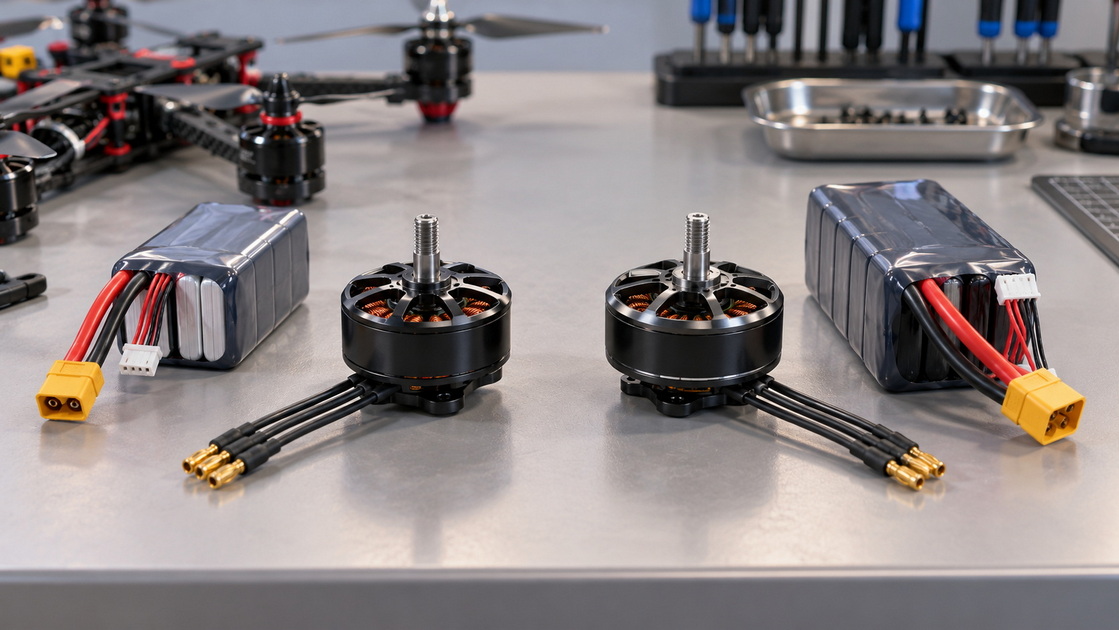
- Choose a 1950KV candidate if you are building a compatible 5-inch 6S freestyle or racing quad and want to evaluate that voltage class.
- Choose a 2450KV candidate if you are building a compatible 5-inch 4S quad and want to evaluate a higher-KV option for that system.
- Choose neither yet if you have not decided on battery voltage, propeller, all-up weight, or ESC. Those decisions determine whether either motor belongs on your shortlist.
These recommendations reflect common 5-inch build ranges, not test results for two particular products. A manufacturer's voltage guidance and propeller-specific test report take priority over a general KV rule.
Motor KV approximates unloaded revolutions per minute per volt. It does not mean kilovolts. Multiply KV by battery voltage to estimate theoretical no-load RPM. Once you attach a propeller, actual RPM falls because the motor must drive a load through the air. Battery sag, propeller design, motor construction, ESC behavior, and temperature further affect the result.
KV is therefore one specification within a propulsion system, not a quality score. A 2207 motor and a 2306 motor with the same KV can behave differently. So can two 2207 motors with different windings, magnets, bearings, or cooling designs. For a useful comparison, keep the motor family and test conditions as similar as possible.
Propellers matter just as much. Increasing diameter, pitch, or blade load can raise the torque and current required. A setup that works well with a light propeller may run hot with an aggressive tri-blade. Always evaluate the motor and propeller as a pair.
| Decision factor | 1950KV FPV motor | 2450KV FPV motor |
|---|---|---|
| Common 5-inch starting point | A compatible 6S build | A compatible 4S build |
| Battery’s nominal voltage | 22.2 V on standard 6S LiPo | 14.8 V on standard 4S LiPo |
| Battery’s full-charge voltage | 25.2 V | 16.8 V |
| Calculated no-load RPM at nominal voltage | 43,290 RPM | 36,260 RPM |
| Calculated no-load RPM at full charge | 49,140 RPM | 41,160 RPM |
| Main selection question | Does this exact motor-and-prop combination perform safely on 6S? | Does this exact motor-and-prop combination meet the build’s goals on 4S? |
| Mistake to avoid | Assuming lower KV means low performance | Assuming higher KV guarantees more speed or thrust |
Reading the table: The voltage figures describe standard 4S and 6S LiPo packs; the RPM figures are calculations using KV × voltage. They are not measured propeller RPM, thrust, or airspeed. The battery pairings are typical starting points for 5-inch aircraft, subject to each model's specifications.
At the same voltage, 2450KV has about 25.6% more theoretical unloaded RPM than 1950KV. But buyers usually compare complete builds at different voltages. At nominal voltage:
- 1950KV × 22.2 V on 6S = 43,290 RPM
- 2450KV × 14.8 V on 4S = 36,260 RPM
In that example, the lower-KV 6S pairing has about 19.4% more theoretical unloaded RPM. This does not establish that its drone will fly 19.4% faster. Propeller pitch, aerodynamic drag, voltage under load, and sustained motor output all affect flight speed. The calculation exposes a purchasing mistake: comparing KV labels while ignoring battery voltage.
For another perspective, matching the theoretical nominal-voltage RPM of 2450KV on 4S would require approximately 1633KV on 6S. That is a mathematical comparison, not a recommendation that every 6S drone should use 1633KV. Desired throttle feel, propeller load, and available thrust still need testing.
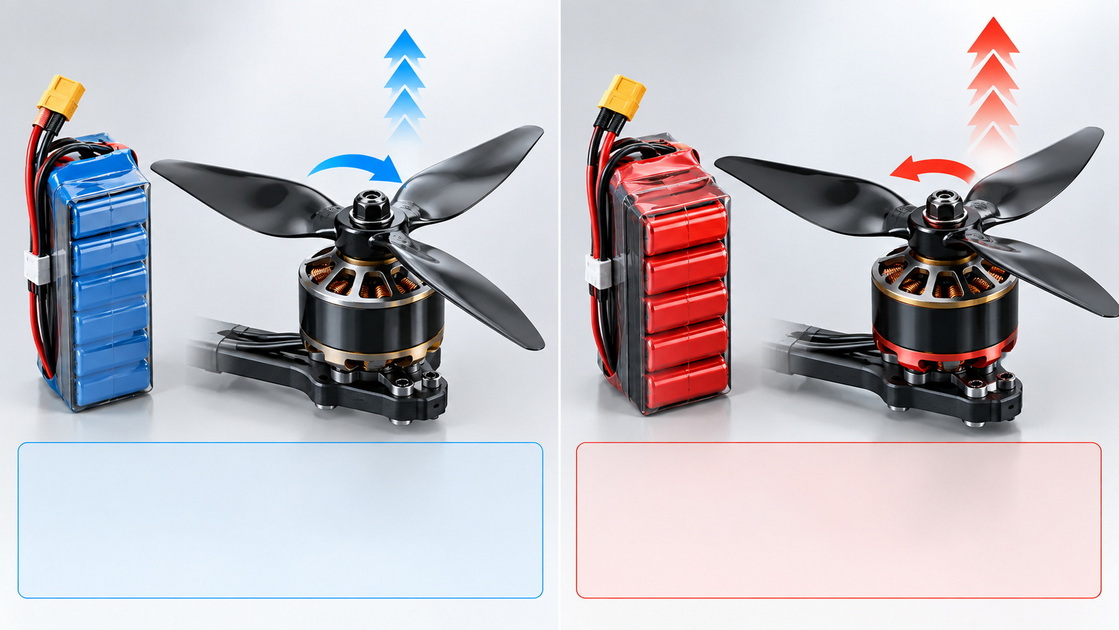
A standard 4S LiPo reaches 16.8 V when fully charged; a standard 6S reaches 25.2 V. Your ESC, flight controller, and any accessories powered from the battery must support the voltage of the pack you intend to install. Check the complete system, not just the motor listing.
At equal electrical power, the simple relationship \(P = V \times I\) implies that a higher-voltage system draws less battery-side current. That may help reduce losses in suitably designed wiring and connectors. It does not mean every 6S drone is automatically more efficient or flies longer. Pack energy, weight, resistance, propeller, and flying style remain important.
Do not compare endurance by mAh alone. For example, a 4S 1500 mAh pack contains about 22.2 Wh at nominal voltage; a 6S 1500 mAh pack contains about 33.3 Wh. The 6S pack has more nominal energy, but it may also weigh more. A fairer flight-time comparison records usable energy, complete aircraft weight, and actual flight conditions.
Existing equipment can make the choice practical rather than theoretical. If your fleet already uses suitable 4S packs and electronics, a 2450KV candidate may avoid an unnecessary system change. If you are standardizing new kits around 6S, a suitably specified 1950KV candidate may fit that plan. In both cases, validate the exact product variant.
A motor spins the propeller; the propeller produces thrust. KV estimates unloaded speed, but it does not state how much thrust a motor-and-propeller combination will produce at a given voltage or current. To answer that question, request test curves showing thrust, voltage, current, power, and ideally RPM at several operating points.
Avoid the shortcut "lower KV always means more torque." In otherwise comparable motors, winding choices affect the torque constant. Yet usable torque and response also depend on stator size, magnetic design, allowable current, propeller inertia, and heat dissipation. A motor with a different stator cannot be ranked by KV alone.
Match the evidence to your use case:
- Racing: Examine RPM recovery, high-load current, and temperature after repeated acceleration.
- Freestyle: Compare mid-throttle control and response during recoveries, not only peak thrust.
- Camera-carrying builds: Calculate complete takeoff weight and confirm adequate thrust reserve.
- Endurance-focused builds: Compare grams of thrust per watt near the aircraft's usual operating thrust.
Efficiency at maximum throttle may be less relevant to flight time than efficiency where the aircraft spends most of its flight. Likewise, peak thrust is of limited use if the battery, ESC, or motor cannot tolerate the associated load.
If a 2450KV setup runs hot, a lighter or lower-load propeller may be worth testing before changing other settings. A 1950KV setup can also overheat when paired with an unsuitable prop. Neither KV is a substitute for a current and temperature check.
Consider a 5-inch freestyle frame carrying an action camera. Its owner already has suitable 4S batteries, a compatible ESC, and no reason to replace the charging setup. A 2450KV 2207-class motor could be a shortlist candidate. The next decision is not "Which prop looks fastest?" It is which propeller gives the required thrust without excessive current or heat.
Now consider a manufacturer developing a new 6S kit and seeking consistent battery specifications across a product range. A 1950KV 2207-class motor is a reasonable candidate to evaluate. The final bill of materials should still depend on propeller test curves, ESC ratings, motor weight, mounting geometry, and flight validation.
"2207" describes a stator approximately 22 mm in diameter and 7 mm high; it is not a performance guarantee. Both scenarios are design illustrations, not a side-by-side trial conducted for this article. No measured speed, endurance, or thrust advantage between particular 1950KV and 2450KV models is claimed here.
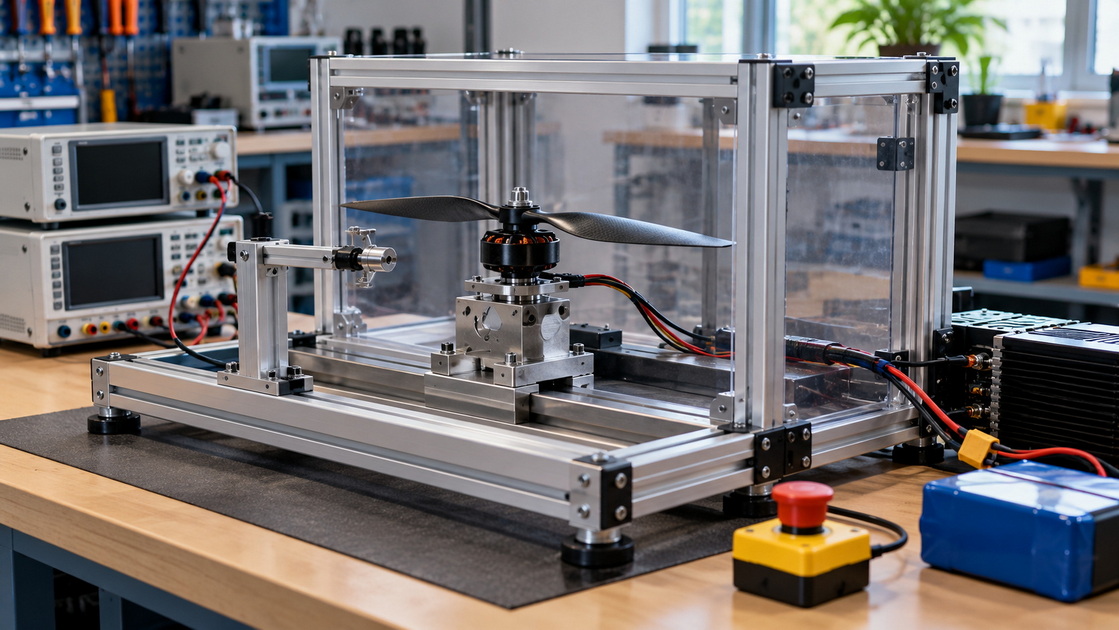
A trustworthy supplier comparison needs more than a maximum-thrust figure. Ideally, request measurements for both KV options within the same motor family. Keep the propeller, controlled voltage, ESC setup, test intervals, and environmental conditions consistent. Compare performance at equivalent thrust as well as at full output.
1. Define the aircraft. Record frame clearance, all-up weight, payload, propeller, battery cell count, and intended flying style.
2. Verify electrical compatibility. Check the battery's full-charge voltage against the ESC, flight controller, and connected accessories.
3. Request a test curve. Ask for thrust, measured voltage, input current, watts, RPM, and temperature at multiple operating points—not one headline number.
4. Compare equal-thrust efficiency. Calculate grams of thrust per watt at the lift your aircraft actually needs.
5. Check repeatability. Repeat runs under consistent conditions and record variation instead of selecting only the best result.
6. Validate the aircraft in flight. Log battery sag, flight duration, motor temperature, and handling. Change one variable at a time.
For illustration, a 700 g quad in steady, level hover requires roughly 175 g of thrust per motor if its four motors share the load equally. This is only a reference point. Maneuvers, wind, and control authority require thrust reserve. Ask for efficiency near the expected working region and sufficient performance above it.
Safety matters: Remove propellers before using a flight controller's motor-test controls. A professional thrust stand running an installed propeller needs containment and an emergency stop. An unloaded spin does not establish that a motor will remain cool under propeller load.
A buyer reviewing OEM or ODM data should ask where the measurement came from:
- Was current measured at the DC supply input or in the motor phases?
- Does the reported wattage include ESC losses, and what voltage was present under load?
- How long was the motor held at each point, and what were its starting and ending temperatures?
These details help explain why two apparently similar thrust charts may not be directly comparable. A repeatable protocol and the exact propeller model give purchasing teams a stronger basis for decisions than a single peak figure.
Do not assume 2450KV on 6S is safe simply because a listing mentions a broad cell-count range. At full charge, its theoretical unloaded speed is 61,740 RPM on 6S, versus 41,160 RPM on 4S. Whether a particular setup is acceptable depends on its specific motor, propeller, ESC, current, and thermal behavior. Check the manufacturer's guidance for the exact variant.
Betaflight motor-output limiting can reduce commanded output, but it does not physically change the motor's KV or turn an unverified combination into a certified one. A throttle-stick limit is not the same safeguard as limiting the motor's maximum commanded output. For a new build, selecting a motor specified for the intended battery and propeller is the clearer path.
A compatible 1950KV motor may also run on 4S, but its theoretical unloaded RPM will be lower than on 6S. It may feel less forceful on the same airframe. Whether that is acceptable depends on the build's purpose and measured performance; software cannot increase motor output beyond the available electrical system.
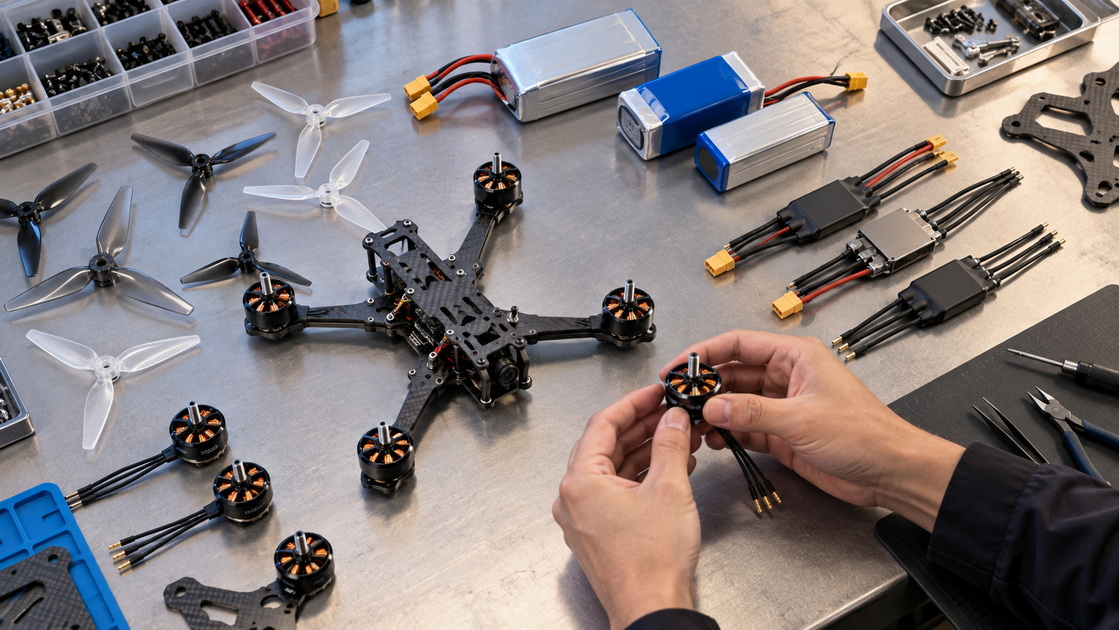
For an individual hobby build, a model-specific datasheet can help create a shortlist. A commercial FPV kit needs additional consistency controls. Alongside nominal KV, specify KV tolerance and test method, compatible voltage, stator dimensions, motor mass, winding-resistance measurement, shaft and mounting pattern, and wire or connector requirements.
Request a test matrix covering each proposed battery and propeller combination. Record the ESC used, current-measurement location, test duration, cooling conditions, and product revision. For a 4-in-1 ESC, clarify how its stated current rating applies to each channel and under what cooling conditions. These steps make later production batches easier to evaluate against the approved design.
Zhongshan Yuhang Power Technology Co., Ltd. develops and manufactures brushless motors and power-system solutions, including FPV applications. For an OEM or ODM discussion, share your frame size, target all-up weight, propeller, battery, ESC, required thrust, and priority between response and efficiency. That gives the engineering team a useful brief for evaluating a 1950KV or 2450KV candidate—and a validation plan—without promising results that have not been tested.
No. At the same voltage, it has higher theoretical unloaded RPM. In the common comparison of 2450KV on 4S and 1950KV on 6S, the 1950KV pairing has the higher calculated unloaded RPM. Loaded RPM and aircraft speed require measurement.
1950KV falls within a commonly discussed range for 5-inch 6S builds, including assertive freestyle and racing. Confirm the exact motor's recommendations, then check current and temperature with your intended propeller.
It can be a practical starting point for a compatible 5-inch 4S build. Its suitability depends on the motor design, propeller, ESC, battery, and measured heat—not KV alone.
Not automatically. Compare usable battery energy, complete aircraft weight, and propulsion efficiency at your usual thrust. A different propeller or flying style can change endurance more than the KV label suggests.
No. KV relates to a motor's winding characteristics, but usable torque also depends on motor construction, current, and cooling. Compare matched motors driving the actual propeller rather than treating KV as a standalone torque rating.
1. Oscar Liang, "[How to Choose FPV Drone Motors]." Used for KV, motor geometry, propeller loading, efficiency considerations, and common 5-inch voltage/KV ranges. [oscarliang]
2. Zhongshan Yuhang Power Technology Co., Ltd. / MEPSKING, "[How to Choose FPV Drone Motor: A Detailed Guide 2026]." Company-published guidance on 4S and 6S selection and system matching; not treated as independent comparative test evidence. [mepsking]
3. FPV Freedom Coalition, "[Beginners Guide to LiPo Batteries for FPV Drones]." Used for standard LiPo cell and full-charge voltage context. [fpvfc]
4. Mini Quad Test Bench, "[Motor Data Explorer]." An example of propeller-specific motor curves and comparative test data. [miniquadtestbench]
5. SOLO Motor Controllers, "[Drone Motor Testing: Thrust and Efficiency Bench]." Used for measurement methods, repeatability, efficiency, and guarded bench-test safety. [solomotorcontrollers]
6. Betaflight, "[Motors Tab]." Used for the instruction to remove propellers before flight-controller motor testing. [betaflight]
7. Oscar Liang, "[You Can Use Both 4S and 6S LiPo on the Same Motors]." Used for the limitations and risks of motor-output limiting; not a blanket compatibility endorsement. [oscarliang]
8. Google Search Central, "[Creating Helpful, Reliable, People-First Content]." Editorial basis for transparent sourcing, useful original analysis, and accurate attribution. [developers.google]


