Language


Views: 251 Author: Yuhang Power Publish Time: 2026-09-25 Origin: Site
Content Menu
● Does a 3115 Motor Generate More Thrust?
● 3115 Drone Motor vs 2812 Drone Motor Comparison
● What the Numbers 3115 and 2812 Mean
● Why a 3115 Motor Usually Produces More Thrust
>> Larger Stator Volume Supports More Torque
>> Larger Propellers Can Improve Low-Speed Efficiency
>> Higher Thermal Headroom Can Support Sustained Load
● When a 2812 Drone Motor Is the Better Choice
● KV Rating Can Change the Result
● Real-World Example: Why Test Conditions Matter
● How to Compare 3115 and 2812 Motors Correctly
● The Hidden Procurement Risk: Sample Performance vs Mass Production
● Which Motor Should You Choose?
● Request a Matched Motor Solution
● FAQ
>> 1. Does a 3115 drone motor always produce more thrust than a 2812 drone motor?
>> 2. Is a 3115 motor too large for a 7-inch FPV drone?
>> 3. What KV should I select for a 3115 drone motor?
>> 4. Can a 2812 motor run a 10-inch propeller?
>> 5. How should I compare supplier thrust data?
Choosing between a 3115 drone motor and a 2812 drone motor is not simply a question of choosing the larger stator. In most comparable FPV, heavy-lift, long-range, or large-propeller builds, a 3115 motor has the potential to generate more thrust because it has a larger stator volume and can generally handle more torque-producing copper and magnetic material. However, the real result depends on KV rating, battery voltage, propeller size, ESC capability, motor efficiency, cooling, and the specific test setup.
For professional drone brands, system integrators, and OEM buyers, the correct question is not only "Which motor produces more maximum thrust?" It is also: Which motor produces the required thrust with acceptable heat, current draw, weight, endurance, and production consistency?
At Zhongshan Yuhang Power Technology Co., Ltd., we work with brushless motor applications across FPV drones, UAVs, RC vehicles, fixed-wing aircraft, gimbal systems, underwater robots, high-speed fans, and other professional equipment. From an engineering and manufacturing perspective, motor selection should always be based on the full propulsion system rather than a single motor-size number.
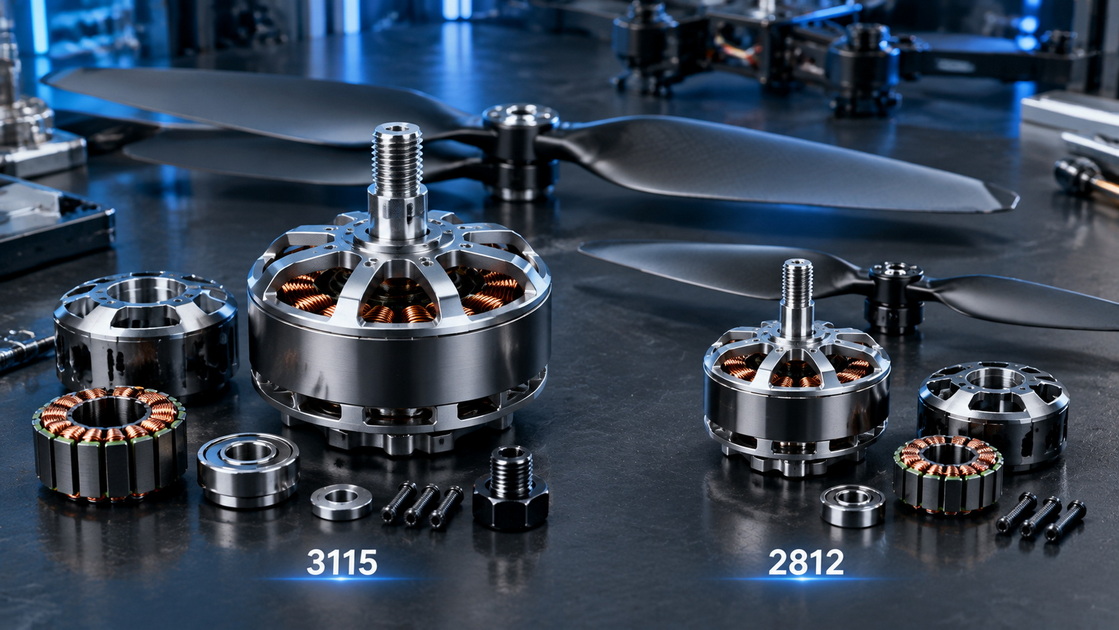
Usually, yes—when the 3115 and 2812 drone motors are compared under appropriate, application-matched conditions.
A 3115 motor has a stator diameter of approximately 31 mm and a stator height of approximately 15 mm. A 2812 motor has a stator diameter of approximately 28 mm and a stator height of approximately 12 mm.
That difference may appear modest, but the approximate stator volume is significantly different:
Stator Volume∝Diameter2×Height
Using the nominal dimensions:
- 3115 motor index: 312×15=14,415
- 2812 motor index: 282×12=9,408
On this simplified stator-volume comparison, the 3115 is approximately 53% larger than the 2812.
This does not mean every 3115 motor will automatically produce 53% more thrust. It means the 3115 platform usually gives motor designers more room for:
- Copper windings
- Magnetic flux
- Torque production
- Thermal capacity
- Larger propeller compatibility
- Higher sustained electrical loading
A well-designed 3115 drone motor is therefore often the stronger choice for large propellers, heavier airframes, long-range FPV platforms, X-class builds, cargo-capable multirotors, and professional UAV propulsion systems.
| Specification | 3115 Drone Motor | 2812 Drone Motor | Purchasing Implication |
|---|---|---|---|
| Nominal stator size | 31 mm × 15 mm | 28 mm × 12 mm | 3115 has a larger electromagnetic platform |
| Approximate stator-volume index | 14,415 | 9,408 | 3115 is about 53% larger by nominal geometry |
| Typical propeller range | 9–12 inches, depending on KV and voltage | 7–10 inches, depending on KV and voltage | 3115 normally supports more propeller load |
| Typical battery range | 6S–12S, model dependent | 4S–8S, model dependent | 3115 is often selected for higher-voltage systems |
| Torque capability | Usually higher | Usually moderate | 3115 is better suited to demanding loads |
| Weight | Higher | Lower | 2812 can improve lightweight builds |
| Cooling requirement | Important at high power | Important but usually lower total thermal load | Both require proper airflow and current control |
| Best-fit platforms | Long range, X-class, heavy lift, 9–12 inch UAVs | Mid-sized FPV, 7–10 inch builds, lighter utility drones | Select by mission rather than motor size alone |
The 2812 motor is not "weak." It is often the more efficient and better-balanced option for medium-sized aircraft where weight, flight time, and system cost matter more than maximum static thrust.
The four-digit motor code refers to stator dimensions:
- 31 in 3115 means approximately 31 mm stator diameter.
- 15 in 3115 means approximately 15 mm stator height.
- 28 in 2812 means approximately 28 mm stator diameter.
- 12 in 2812 means approximately 12 mm stator height.
The stator is the stationary laminated steel core wrapped with copper windings. It is the core of the motor's electromagnetic system.
A larger stator normally allows more copper, more magnetic interaction, and higher torque potential. That is why a 3115 motor can usually spin a larger propeller or maintain stronger thrust under load compared with a 2812 motor of similar design quality.
However, stator size is only one part of the motor equation.
Two motors with similar stator dimensions can still perform very differently because of:
- KV selection
- Winding turns
- Copper fill rate
- Magnet grade
- Magnet arc and air gap
- Stator lamination quality
- Bearing quality
- Rotor balance
- ESC timing
- Propeller stiffness
- Battery voltage sag
- Thermal management
This is why B2B buyers should never approve a motor based only on a product title such as "High Thrust 3115 Motor."
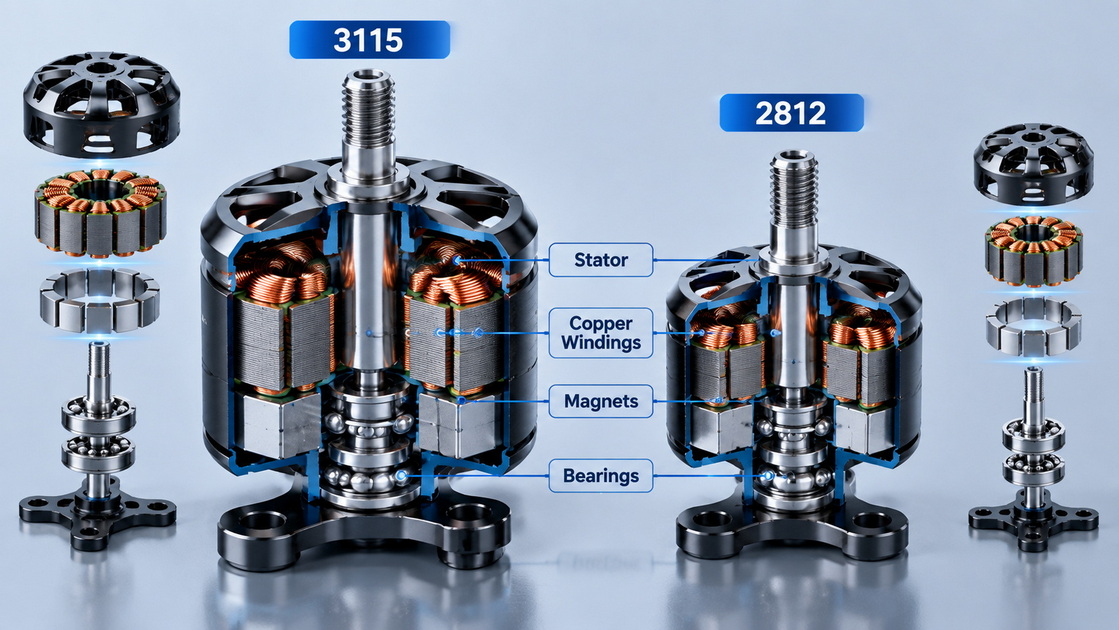
Motor torque is closely related to magnetic flux, winding design, current, and effective stator geometry. A larger stator gives the designer more room to optimize these variables.
A 3115 motor can often support:
- Thicker or longer copper windings
- Lower phase resistance
- Higher continuous current
- Greater torque at lower KV
- Larger-diameter propellers
- More stable thrust under heavy aerodynamic load
This makes the 3115 motor suitable for a drone that needs to carry more payload or operate with a larger propeller disk.
For example, a 10-inch or 11-inch propeller can move a larger volume of air than a smaller propeller when the propulsion system is properly matched. That larger propeller load requires torque. A 3115 motor is generally better positioned to provide it.
For long-range and utility UAVs, propulsion efficiency is often more important than extreme top speed.
A larger propeller can generate the required thrust at a lower disk loading. In practical terms, this can improve cruise efficiency when the motor, propeller, battery, frame, and flight profile are properly engineered.
A lower-KV 3115 motor paired with a larger propeller and higher-voltage battery may be a strong solution for:
- 10-inch long-range FPV drones
- Inspection drones
- Mapping platforms
- Light cargo UAVs
- Professional video platforms
- Large freestyle or X-class aircraft
Current FPV motor-selection guidance commonly places motors in the 2810–3115 range in the 9–10 inch X-class and heavy-lift category, where high torque and higher-voltage systems are typical.
Static thrust is useful, but sustained thermal performance is more important for commercial projects.
A motor that generates high thrust for five seconds but overheats during a two-minute climb is not suitable for many professional UAV applications.
A 3115 motor may have better thermal capacity because of its larger mass, stator size, and heat-dissipation area. But this depends on material selection and motor construction.
Ask a motor supplier about:
- Winding insulation class
- Magnet temperature rating
- Maximum continuous current
- Maximum burst current
- Motor temperature after a sustained test
- Test duration
- Ambient temperature
- Propeller or EDF configuration
- ESC timing and PWM settings
For reference, one publicly listed 3115 motor platform from Hobbywing is offered in 900KV and 1050KV versions for 4–6S use, with stated maximum thrust values of 5,177 g and 4,420 g respectively under its published test conditions. The same listing shows that even within one 3115 motor family, KV selection changes the maximum current, rated power, and maximum thrust result.
That is a clear reminder that a 3115 motor is a size category, not a guaranteed thrust number.
A 2812 drone motor can be the better choice when the aircraft does not need the mass, torque, or current capacity of a 3115.
Choose a 2812 motor when your priority is:
- Lower motor weight
- Smaller propellers
- Moderate payload
- Reduced total power consumption
- Compact frame geometry
- Lower system cost
- More agile handling
- Mid-sized FPV or utility drone performance
For a 7-inch or lighter 8-inch drone, a properly matched 2812 motor may produce enough thrust while keeping the total takeoff weight lower. Adding unnecessarily large motors can reduce flight efficiency because the aircraft must carry extra motor mass.
A practical engineering rule is:
The best motor is not the one with the highest maximum thrust. It is the one that meets the aircraft's required thrust at the best balance of weight, efficiency, temperature, durability, and cost.
If a 2812 motor provides enough thrust reserve and operates within safe current and thermal limits, upgrading to a 3115 motor may not improve the finished drone.
KV means the approximate unloaded RPM a motor produces per volt. A 900KV motor theoretically turns faster than a 500KV motor at the same voltage when there is no propeller attached.
However, high KV does not automatically mean high thrust.
Thrust depends on the complete system:
Thrust=f(Motor Torque,KV,Voltage,Propeller,Current,RPM,Air Density)
A low-KV motor generally has a higher torque constant and is more suitable for larger propellers. A high-KV motor tends to suit smaller propellers and higher-RPM applications.
For example:
| Build Type | Typical Motor Direction | Common Propeller Approach |
|---|---|---|
| 7-inch FPV long-range drone | 2812 or 2810, lower KV | 7–8 inch efficient propeller |
| 9-inch FPV UAV | 2812 or 3115, lower KV | 9-inch propeller |
| 10-inch long-range UAV | 3115, lower KV | 10-inch propeller |
| 12-inch heavy-lift platform | 3115 or larger, low KV | 11–12 inch propeller |
| High-speed FPV configuration | Higher-KV motor matched to smaller propeller | Smaller diameter and higher RPM |
Motor-selection references commonly describe KV as no-load RPM per volt and emphasize that KV must be matched with voltage and propeller load. A mismatch can create excessive current draw, poor thrust, or thermal failure.
Imagine two motors:
- Motor A: 3115 700KV on 6S with a 10-inch propeller.
- Motor B: 2812 1100KV on 6S with an 8-inch propeller.
Motor A will likely produce more peak static thrust because it can generate more torque and turn a larger propeller. But it may also weigh more and need a larger ESC.
Motor B may produce lower maximum thrust, but it may be more suitable for a lighter airframe with faster throttle response and lower total propulsion-system mass.
Now change the conditions:
- Install a 12-inch propeller on the 2812.
- Keep the same 6S battery.
- Use full throttle.
The 2812 may draw excessive current, run hot, lose efficiency, damage the ESC, or fail during sustained use. The issue is not that the motor is "bad." The propeller load simply exceeds the motor's practical torque and thermal capacity.
Industry thrust-test guidance warns that an oversized propeller can reach a motor's continuous torque limit at low speeds and low commanded voltage, while larger propellers often require lower voltage because of their loading effect.
For OEM buyers, do not compare a supplier's 3115 and 2812 motors using different props, battery packs, test stands, or throttle points. Require a controlled comparison.
1. Define the aircraft mission.
State the all-up weight, target flight time, payload, cruise speed, climb requirement, operating temperature, and propeller diameter limit.
2. Choose a common battery platform.
Use the same 6S, 8S, or other voltage system for both motors unless the purpose is specifically to compare different voltage architectures.
3. Use compatible propellers.
Each motor should use a propeller within its recommended operating range. Do not force the same propeller on both motors if it creates an unsafe load.
4. Use the same ESC quality level.
The ESC must support the required current, voltage, timing, and firmware protocol. A common safety rule is to select an ESC with at least a 20–30% current margin above the motor's expected continuous current.
5. Measure performance at multiple throttle points.
Record data at 25%, 50%, 75%, and 100% throttle.
6. Measure more than thrust.
Record thrust, voltage, current, watts, RPM, efficiency in g/W, motor temperature, ESC temperature, and vibration.
7. Run a sustained-load test.
A 30-second or 60-second thermal test is often more valuable than a single maximum-thrust figure.
8. Repeat the test across multiple samples.
One motor may be excellent. Production consistency is what matters for a B2B order.
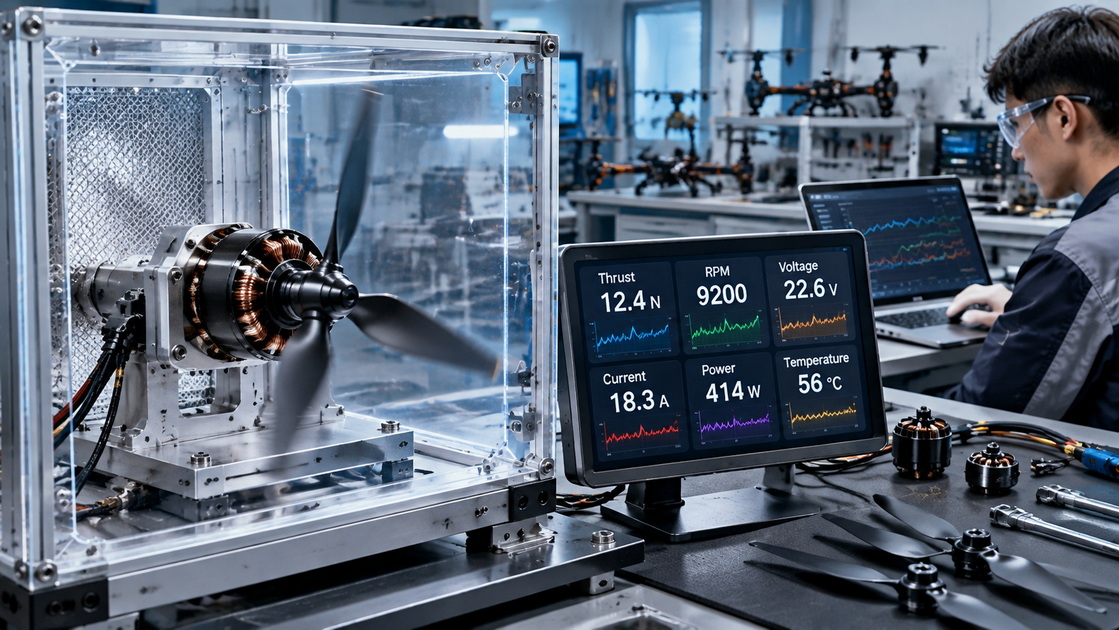
A professional thrust stand can measure thrust, torque, voltage, current, RPM, and efficiency. This type of multi-variable test is more meaningful than judging the motor from a single advertised thrust figure.
One of the most important sourcing risks is not always visible in a specification sheet.
A supplier may provide excellent prototype samples but use different materials after the buyer approves the design. Possible unannounced changes can include:
- Lower-grade bearings.
- Lower-temperature magnets.
- Different winding wire.
- Reduced copper fill.
- Less accurate rotor balancing.
- Different adhesive.
- Lower-cost shafts.
- Changed stator laminations.
The motor may look identical from the outside while its heat generation, vibration level, efficiency, and lifespan change significantly.
To protect your procurement program, include the following in the approved technical specification:
| Control Item | What to Lock in the Specification |
|---|---|
| Stator | Diameter, height, lamination type, and lamination thickness |
| Windings | Wire diameter, turns, insulation class, phase resistance |
| Magnets | Grade, temperature rating, magnet size, retention method |
| Bearings | Brand, model, tolerance, lubrication, and approved substitute rules |
| Shaft | Material, hardness, diameter, and runout tolerance |
| Performance | KV tolerance, no-load current, thrust test configuration, current limit |
| Balance | Rotor dynamic-balance requirement |
| Thermal limit | Maximum motor temperature after a defined test |
| Change control | Written buyer approval before changing materials or process |
At Zhongshan Yuhang Power Technology Co., Ltd., our approach to customized brushless motors is centered on application requirements rather than a one-size-fits-all catalog format. The company supports full power-system solutions and customized OEM/ODM services for customers using motors in drones, FPV aircraft, RC vehicles, gimbal equipment, airplanes, underwater robots, and other professional equipment.
For buyers, the practical advantage of working with an engineering-oriented motor manufacturer is the ability to discuss the entire system: motor size, KV, propeller load, battery voltage, ESC current, cable configuration, mounting pattern, cooling conditions, and production target.
Choose a 3115 drone motor if your project requires:
- Higher maximum thrust
- Larger propellers
- Heavier payload capacity
- Long-range 9-inch to 12-inch platforms
- Higher-voltage power systems
- More torque under load
- Better suitability for sustained heavy-duty operation
Choose a 2812 drone motor if your project requires:
- Lower motor weight
- Medium-sized 7-inch to 9-inch platforms
- Reasonable thrust without excessive propulsion mass
- A more compact and economical design
- A balanced mix of agility, endurance, and cost
- Moderate propeller loading
For a commercial drone product, select the motor after calculating required total thrust.
A practical target for many multirotors is to provide sufficient thrust reserve for takeoff, maneuvering, wind resistance, payload changes, and battery voltage drop. The right thrust-to-weight ratio varies by mission. An inspection drone, racing FPV platform, cinematic aircraft, and heavy-lift UAV should not use the same rule.
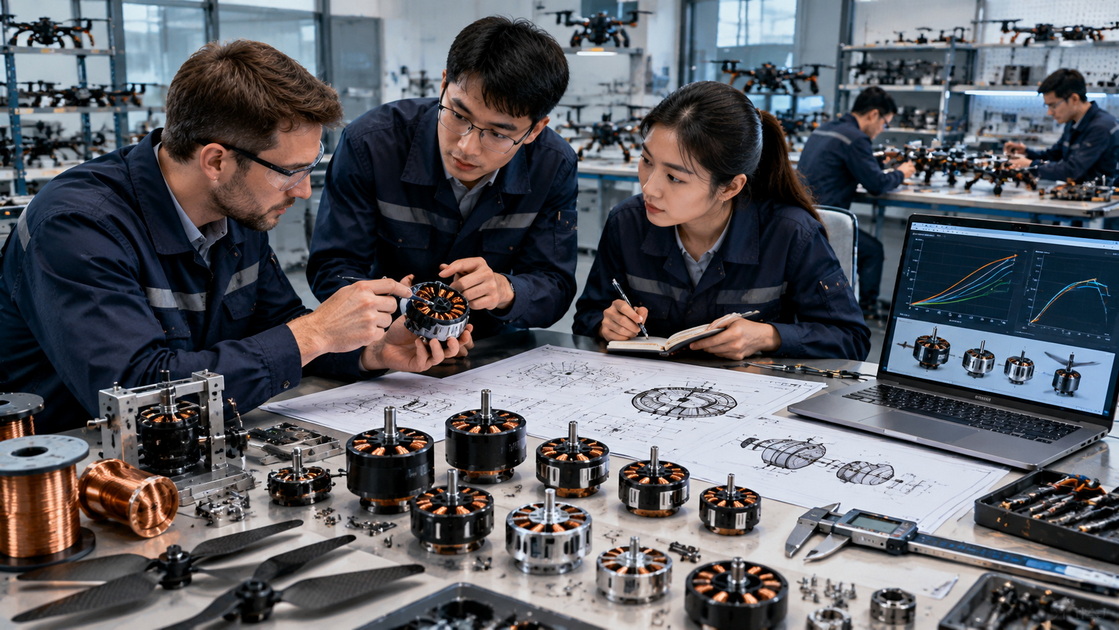
A 3115 motor will usually generate more thrust than a 2812 motor when both are designed well and used with appropriate voltage and propeller combinations. But maximum thrust alone should not decide your project.
The better motor is the one that delivers stable thrust, manageable temperature, appropriate flight time, reliable production quality, and a suitable cost structure for your target drone.
If you are developing an FPV drone, long-range UAV, RC aircraft, heavy-lift platform, or custom brushless propulsion system, send Zhongshan Yuhang Power Technology Co., Ltd. your aircraft weight, battery voltage, propeller size, target thrust, flight-time target, and expected annual quantity. Our team can help evaluate a suitable 3115 drone motor, 2812 drone motor, KV option, ESC requirement, and OEM/ODM customization path.
No. A 3115 motor usually has greater torque and thrust potential because of its larger stator, but an actual thrust result depends on KV, battery voltage, propeller size, motor construction, ESC settings, and test conditions. A poorly matched 3115 can perform worse than a well-matched 2812.
It may be oversized for many 7-inch builds, depending on the target weight and flight style. A 2812 or similar-sized motor can often be more appropriate for a lightweight 7-inch long-range drone. A 3115 becomes more relevant when the aircraft requires higher torque, larger props, extra payload capacity, or stronger sustained power.
The correct KV depends on battery voltage, propeller diameter, pitch, payload, and target flight profile. Lower-KV versions are generally better suited to larger propellers and higher-voltage setups. Do not select KV based only on online recommendations; validate the final motor-propeller-battery combination on a thrust stand.
Some 2812 motors can run a 10-inch propeller, but suitability depends on KV, battery voltage, prop pitch, motor current limit, and cooling. Running an oversized propeller can cause excessive current draw and overheating. Request the manufacturer's recommended propeller range and test data before finalizing the design.
Only compare data when the motors are tested with the same or equivalently suitable propeller, battery voltage, ESC setting, ambient temperature, test duration, and measuring equipment. Ask for current, power, RPM, temperature, and efficiency data—not only maximum thrust.
1. [Zhongshan Yuhang Power Technology Co., Ltd. — About Us]
Company information covering brushless motor R&D, production, applications, full power-system solutions, and OEM/ODM customization.
2. [Hobbywing XRotor 3115 Drone Motor]
Published specifications for 3115-class motors, including 900KV and 1050KV variants, current, power, thrust, motor size, and insulation-class information.
3. [Unmanned Systems Technology — Thrust Testing Procedures for Drone Propulsion Systems]
Technical discussion of propeller loading, torque limits, and thrust-testing considerations.
4. [Unmanned Systems Technology — How Brushless Motors Work and How to Test Them]
Overview of BLDC motor principles, KV, and test measurements including thrust, torque, voltage, current, RPM, and efficiency.
5. [T-Motor — UAV Propulsion System Motor ESC and Propeller Matching]
Guidance on matching motor KV, voltage, ESCs, and propellers in UAV power systems.
6. [Magtrol — Motor Testing for Drones and Unmanned Vehicles]
Engineering explanation of torque, KV, and motor-test parameters for unmanned-vehicle applications.
7. [FPV Drone Motor Selection Guide 2026]
Industry-oriented overview of stator sizes, motor selection, KV, thrust, and common FPV drone application ranges.


