Language


Views: 222 Author: Yuhang Power Publish Time: 2026-05-07 Origin: Site
Nothing is more stressful for an FPV pilot than sudden signal loss or heavy interference right when you are locked into a line or flying long range. As a Chinese manufacturer specializing in FPV drone motors and power systems for drones, RC cars, gimbals, and robots, we see every day how RF noise, wiring choices, and component selection can make the difference between a clean link and a lost quad. [blog.uavmodel]
In this guide, I will walk you through the real causes of FPV signal loss, how to diagnose them step by step, and what upgrades and habits actually work in 2026—based on both pilot feedback and our own engineering tests. [getfpv]
Before you can fix FPV drone signal loss, you need to understand what is really happening between your radio, video transmitter (VTX), and drone. [mepsking]
In practice, you are dealing with three main links:
- The control link between your radio transmitter and receiver.
- The video link between your VTX and goggles or ground station.
- The telemetry link that sends back data such as RSSI, link quality, and battery voltage. [mepsking]
Signal loss means one of these links drops below a usable level. Interference means other signals or electrical noise are corrupting your link so that it becomes unstable or noisy even before you hit full range. [blog.uavmodel]

From both the original article and broader industry experience, the main causes of FPV drone signal loss fall into a few clear categories. [getfpv]
Radio signals weaken with distance, and every system has a limited usable range. Even before you reach the absolute limit, flying behind buildings, hills, dense trees, or concrete structures can cause severe signal drop. [mepsking]
Key factors:
- Higher frequency bands (like 5.8 GHz video) are more affected by obstacles than lower bands. [mepsking]
- Flying below the horizon or behind large metal structures increases multipath and reflection. [blog.uavmodel]
- Long‑range flights without clear line of sight are high risk for both control and video links. [mepsking]
In cities and crowded parks, FPV pilots are competing with Wi‑Fi routers, Bluetooth devices, and other 2.4 GHz traffic. This is especially visible: [oscarliang]
- On 2.4 GHz control links in dense apartment areas. [blog.uavmodel]
- On analog video when nearby routers leak into your band. [oscarliang]
Scanning for clean channels and avoiding the most crowded frequencies is essential in these environments. [oscarliang]
High‑voltage power lines and large metal structures generate strong electromagnetic fields and reflections that can distort FPV signals. Flying too close can cause: [mepsking]
- Sudden control dropouts.
- Heavy video noise or rolling images. [getfpv]
- Unpredictable failsafes near towers or industrial sites. [blog.uavmodel]
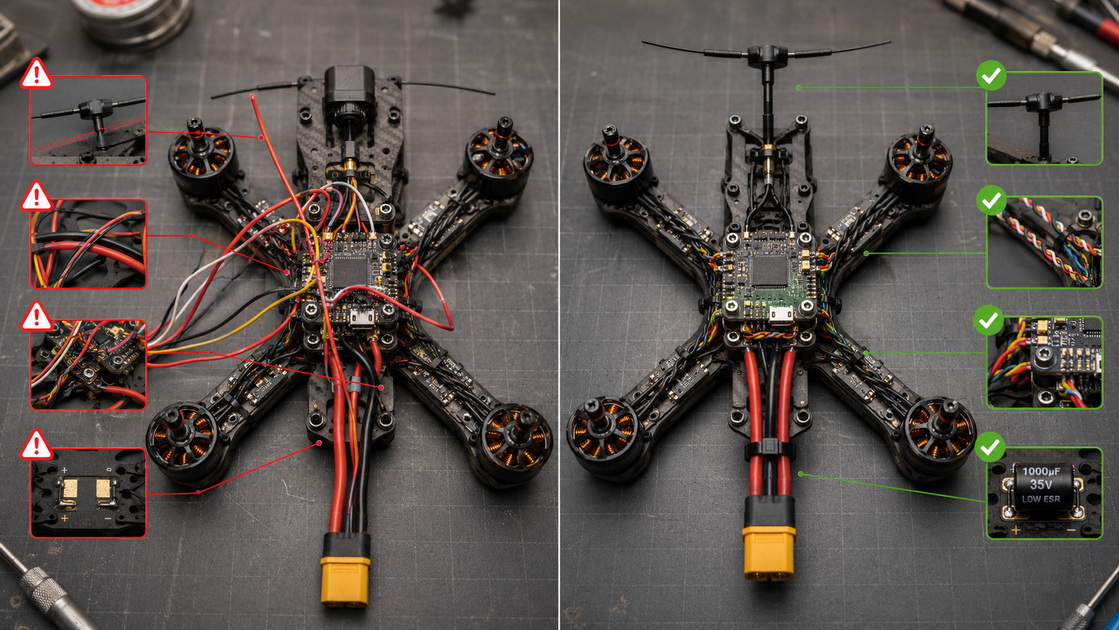
Not all interference comes from outside. Poor wiring layouts, noisy ESCs, or bad power filtering can feed electrical noise directly into your video system. [getfpv]
Common internal noise sources:
- ESC and motor switching spikes reaching the VTX and camera. [oscarliang]
- No or undersized low ESR capacitor on the main battery pads. [getfpv]
- Long, unshielded video signal wires running near power components. [oscarliang]
Even with good hardware, a wrong antenna setup can ruin your link. [blog.uavmodel]
Typical issues:
- Mismatched polarization (e.g., RHCP on VTX and LHCP on goggles). [oscarliang]
- Antennas mounted too close to carbon or batteries. [blog.uavmodel]
- Damaged SMA/U.FL connectors or broken coax cables. [getfpv]
When your FPV signal suddenly drops, follow a simple field checklist to narrow down the cause. [mepsking]
1. Check basic antenna alignment
Make sure your VTX and goggles antennas are not blocked by your body, car, or buildings and are roughly facing each other. [oscarliang]
2. Confirm channels and bands match
Double‑check that your VTX channel and goggles channel are truly the same, especially on crowded racebands. [mepsking]
3. Review VTX power setting
Ensure that power is high enough for your environment (e.g., 25 mW indoors, 400–800 mW in open fields, higher for long range where legal). [mepsking]
4. Look at OSD warnings
Watch for RSSI, LQ, or low‑voltage warnings just before the dropout, which can hint at power or link issues. [mepsking]
5. Test hover near yourself
Arm and hover close by. If the video is noisy even near you, the problem is likely wiring, antennas, or power noise, not range. [getfpv]
This simple workflow is something we recommend all pilots practice until it becomes instinctive. [getfpv]

Different flying spots require different RF strategies. Below is a practical table you can use before each session. [blog.uavmodel]
| Environment | Main Risks | Recommended Actions |
|---|---|---|
| Urban park / city | Wi‑Fi, Bluetooth, buildings | Scan for clean channels, avoid busiest 2.4 GHz bands, fly higher for better line of sight. (mepsking) |
| Industrial area | Power lines, metal, machinery | Stay clear of high‑voltage lines, avoid flying behind big metal structures, use higher power VTX where legal. (mepsking) |
| Forest or mountains | Trees, terrain blocking | Keep line of sight by flying above tree line, do not dive behind cliffs without understanding link limits. (blog.uavmodel) |
| Race events / many pilots | Channel overlap | Coordinate channels, use raceband, follow event frequency chart and power limits. (blog.uavmodel) |
| Long‑range spots | Range limits | Use directional antennas, verify fail‑safe behavior, perform range tests before pushing distance. (blog.uavmodel) |
From our perspective as a motor and power system manufacturer, many signal problems are actually build quality problems. [oscarliang]
A cheap or damaged antenna can cost you far more in lost gear than the small savings up front. [blog.uavmodel]
- Use reputable RHCP or LHCP antennas on both VTX and goggles, and always match polarization. [oscarliang]
- For long range, pair a circular patch antenna on the ground with an omnidirectional on the quad. [mepsking]
- Replace bent, cracked, or loose antennas as soon as you notice damage. [getfpv]
Electrical noise from ESCs and motors can create horizontal lines, rolling images, or random breakup in analog video. [getfpv]
- Solder a low ESR capacitor (e.g., 470–1000 µF, 25–35 V) directly to the battery input pads of your ESC or power distribution. [oscarliang]
- For very noisy builds, add smaller capacitors on 5 V / 12 V lines powering VTX and camera. [getfpv]
This simple change often cleans up video and protects sensitive electronics from voltage spikes. [oscarliang]
Good wiring layout is a silent signal booster. [getfpv]
- Keep video signal and camera wires twisted with ground and away from ESC and motor leads. [oscarliang]
- Avoid looping signal wires over power inductors or regulators on your flight controller. [oscarliang]
- Use soft‑mounts and grommets to avoid vibration loosening connectors over time. [getfpv]
Choosing the right band and power level is still one of the most effective ways to prevent signal loss. [mepsking]
- 2.4 GHz control links offer a good balance of range and latency but suffer in dense Wi‑Fi environments. [blog.uavmodel]
- 900 MHz or similar sub‑GHz links penetrate obstacles better and are often used by long‑range pilots. [mepsking]
Use lower frequency control links if you frequently fly long range behind trees or terrain, and keep them clear from your chosen video band. [mepsking]
- 5.8 GHz is standard for FPV and works best with clear line of sight. [mepsking]
- 2.4 GHz and 1.3 GHz can offer better penetration at the cost of larger antennas and possible interference with control links. [blog.uavmodel]
Always respect local regulations and avoid band overlap with your control system. [blog.uavmodel]
More power is not always better. [blog.uavmodel]
- Use 25 mW for indoor or close‑range racing to reduce mutual interference. [mepsking]
- Use 400–800 mW for open fields where more range is needed. [mepsking]
- Use higher power only for long‑range flights where legal, and watch for overheating. [mepsking]
When we design power system recommendations for OEM customers, we follow a clear build checklist to minimize RF issues. [mepsking]
1. Plan antenna placement from the start
Place VTX and receiver antennas far from motors, ESCs, and carbon plates if possible. [blog.uavmodel]
2. Reserve clean power for video system
Power the camera and VTX from a filtered BEC or 9–12 V regulator, not directly from noisy battery pads. [getfpv]
3. Add capacitors before first power‑up
Install low ESR capacitors on the main battery input as part of your standard build, not as a later fix. [oscarliang]
4. Document channel plans for fleets
When you manage multiple drones for professional work, keep a channel and power matrix to avoid internal interference.
5. Log failures and near misses
Treat every unexpected failsafe or sudden video loss as a data point, not "just a glitch". Over time you will see patterns that guide better hardware choices. [mepsking]
Even the best build will slowly degrade without maintenance. [mepsking]
- Inspect U.FL and SMA connectors for looseness or corrosion every 3–6 months. [mepsking]
- Replace coax pigtails that show kinks, cuts, or discoloration. [getfpv]
- Monitor VTX temperatures; overheating modules often reduce output power or shut down. [mepsking]
- Keep your radio, receiver, and flight controller firmware up to date for improved link algorithms and bug fixes. [mepsking]
- If possible, measure VTX output power with an RF power meter to confirm you are getting what the label claims. [blog.uavmodel]
A customer came to us with a 5‑inch freestyle build experiencing heavy video noise whenever throttling up, to the point where tree gaps became unsafe. This pattern matches many community reports. [reddit]
By applying the principles above:
- We added a 1000 µF low ESR capacitor to the main battery pads. [oscarliang]
- We rerouted the video signal wire away from ESC leads and twisted it with the ground wire. [oscarliang]
- We replaced a damaged u.FL pigtail and upgraded both antennas to matched RHCP units. [blog.uavmodel]
The result was a dramatically cleaner image and stable video even at full throttle, with no further dropouts reported. [getfpv]
Solving FPV drone signal loss and interference is not just about goggles and VTX choices. It is about designing a complete, well‑balanced power and RF system, from motors and ESCs to wiring and antennas. [mepsking]
As a manufacturer focused on FPV drone motors and other brushless solutions, we can help you:
- Design OEM and ODM power system packages optimized for your target flying environment.
- Match motor characteristics, ESC noise behavior, and RF layout for racing, freestyle, or industrial drones.
- Provide long‑term, stable supply for production projects along with ongoing technical support.
If you are planning a new FPV platform or need to upgrade a fleet suffering from reliability issues, contact our engineering team to discuss your requirements and create a tailored power and signal plan.

1. Why do I lose video but still have full control?
Your video link and control link are separate systems. If only video drops, you may have a VTX, antenna, or power noise issue while the control radio is still healthy. [mepsking]
2. How can I safely test my maximum FPV range?
Perform a gradual range test: fly out in one direction while watching RSSI/LQ and video quality, and set a conservative turn‑back point well before failsafe. Always maintain line of sight and follow local regulations. [mepsking]
3. Does weather really affect FPV signals?
Yes, humidity, rain, and fog can slightly weaken RF transmission and reduce range, especially for high‑frequency bands like 5.8 GHz. Always test your link in similar conditions before pushing distance. [mepsking]
4. What is the fastest way to improve a noisy analog video feed?
In many cases, adding a low ESR capacitor to the main battery pads and checking that camera and VTX share a solid common ground dramatically cleans up the signal. Replacing poor antennas is often the next biggest gain. [blog.uavmodel]
5. How do I handle interference when flying with many other pilots?
Coordinate channels and power levels before arming, use raceband where possible, and avoid overlapping frequencies. Lowering VTX power in tight spaces can actually reduce interference for everyone and improve overall image quality. [oscarliang]
1. Mepsking, "How To Handle FPV Drone Signal Loss And Interference?" [Link] [mepsking]
2. UAVModel, "VTX Range Issues: How to Maximize FPV Video Transmission Distance." [Link] [blog.uavmodel]
3. GetFPV, "Diagnosing and Fixing Bad FPV Video." [Link] [getfpv]
4. Oscar Liang, "How to Fix Analog FPV Video Issues: Noise, Scrolling…" [Link] [oscarliang]
5. Mepsking, "Understanding and Extending FPV Drone Range." [Link] [mepsking]
6. Reddit r/fpv threads on video interference and signal loss. [Examples] [reddit]


