Language


Views: 275 Author: Yuhang Power Publish Time: 2026-07-21 Origin: Site


Content Menu
● From Balloons and Kites to Intelligent Flight
● War, Mapping, and the Professionalization of Aerial Imaging
● From Orbit to Everyday Drones
● Why FPV Drone Motors Changed the Game
● Inside a Modern FPV Power System
● Beyond Drones: Motors for Robots, Gimbals, and Specialized Devices
● How High‑Quality Motors Improve Aerial and Drone Photography
● Expert Guidance on Selecting FPV Drone Motors
● The Importance of OEM and ODM Motor Solutions
● Practical Recommendations for Aerial Creators and Product Teams
● Summarizing the Journey and Looking Ahead
From kites and hot‑air balloons to FPV drones racing through stadiums, aerial photography has always been about pushing the limits of perspective and control. Today, that control depends as much on specialized FPV drone motors and power systems as it does on cameras and flight controllers. As an experienced brushless motor manufacturer in Zhongshan, China, I've watched first‑hand how better motors have transformed both cinematic drone shots and industrial imaging workflows.
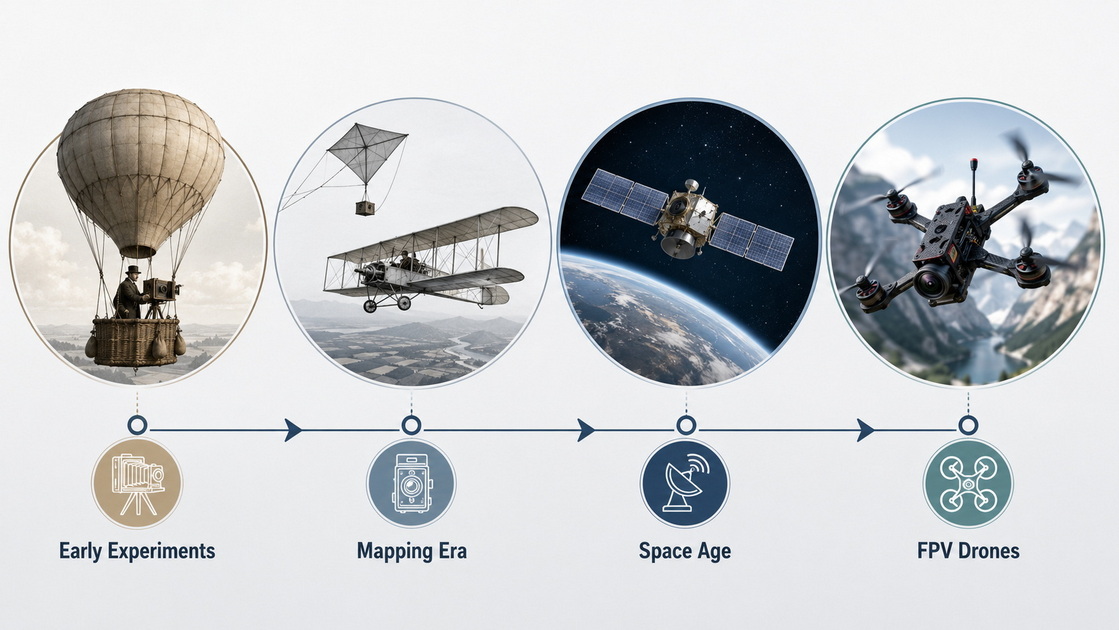
Early aerial photography demanded huge effort and serious risk. Balloons, kites, rockets, and even pigeons were used simply to get a camera off the ground. One of the earliest surviving aerial photographs was captured from a balloon high above Boston in the 19th century, showing a new way to look at the city from the sky.
By the late 19th and early 20th century, pioneers began experimenting with more inventive platforms:
- Kites equipped with cameras and timed triggers gave photographers a way to capture landscapes without aircraft.
- Pigeon cameras, strapped to messenger birds, provided improvised reconnaissance long before lightweight aerial cameras became standard.
These early solutions were ingenious but unreliable. Photographers had limited control over angle, timing, and stability, and each shot involved a degree of unpredictability that modern aerial creators would find unthinkable.
The world wars turned aerial photography from a curiosity into a critical military and mapping technology. Reconnaissance aircraft carried increasingly specialized cameras, producing overlapping images that could be stitched into accurate battle maps and terrain models. Precision and repeatability became vital, and aerial cameras were refined for clarity, coverage, and altitude.
After the wars, aerial imaging moved into civilian use:
- Dedicated aerial survey companies started mapping cities, farmlands, and coastlines.
- Overlapping film photos were used in photogrammetry to build detailed topographic maps and support infrastructure planning.
This period laid the groundwork for modern remote sensing. The emphasis shifted from experimental shots to data‑driven imaging, where resolution, stability, and consistency mattered just as much as artistic composition.
By the mid‑20th century, rockets and satellites pushed aerial imaging into space. Suborbital flights produced dramatic images of Earth's curvature, and later missions delivered views from orbit and beyond. These pictures of our planet shaped public perception of the environment and inspired generations of engineers and photographers.
In recent decades, the emergence of accessible drone technology has been just as transformative. High‑resolution satellite cameras remain key for broad coverage, but consumer and professional drones have brought aerial imaging into everyday workflows. Filmmakers, surveyors, inspectors, and hobbyists can now deploy small unmanned aircraft with sophisticated cameras in minutes.
In this environment, drones are no longer simply flying cameras. They have become precision platforms, and their performance depends heavily on the design of motors and power systems that keep them stable, responsive, and reliable.
Traditional aerial imaging drones were built primarily for slow, stable, GPS‑assisted hovering. Their goal was smooth footage and simple control. FPV (First‑Person View) drones introduced a fundamentally different concept: high‑speed, low‑latency flight where the pilot feels as though they are inside the aircraft.
From an engineering perspective, this required a new generation of motors:
- Higher torque‑to‑weight ratios to deliver rapid throttle response and sharp directional changes.
- Carefully controlled KV (RPM per volt) values for predictable performance across propeller sizes and battery voltages.
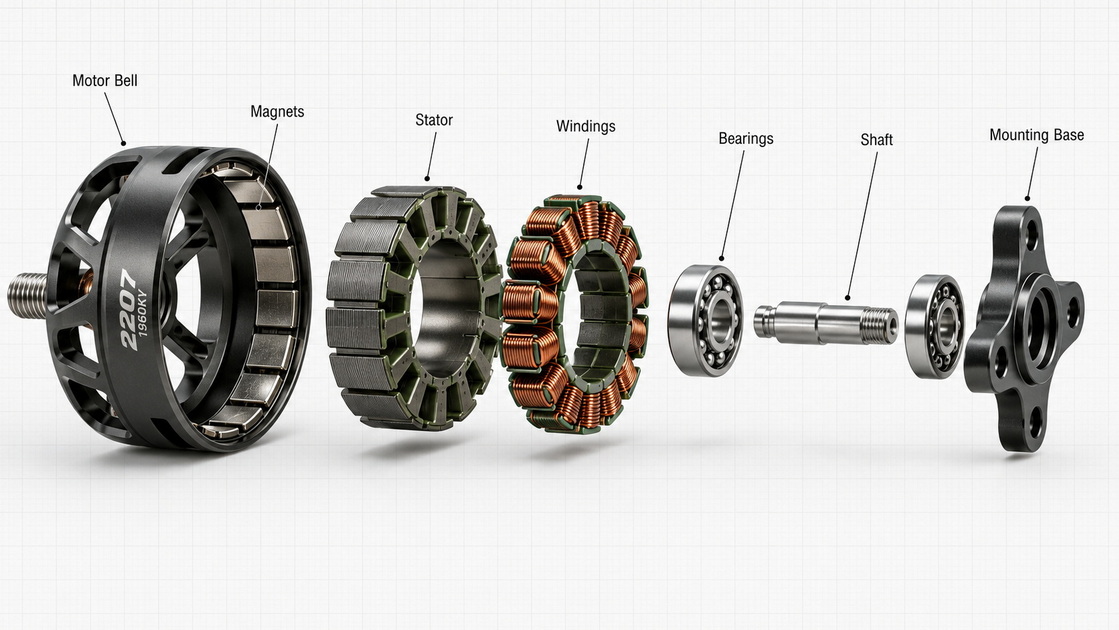
- Robust bearings and stator designs to survive crashes, high‑G turns, and continuous aggressive maneuvers.
Pilots quickly learned to judge motors not only by peak thrust numbers but by "feel" in the air. Throttle linearity, braking strength, temperature behavior, and durability under repeated impact became critical. As manufacturers, we had to design motors that perform consistently at the limit, while still providing the fine control that aerial creators need for precise lines and smooth shots.
A modern FPV drone used for cinematic flying or racing combines several interdependent components:
- Brushless FPV motors optimized for specific prop sizes, cell counts, and flight styles.
- ESCs (Electronic Speed Controllers) with high refresh rates and advanced firmware to ensure smooth control and strong braking.
- High‑discharge batteries tuned to the motor's current draw to avoid voltage sag under load.
A practical way to explain this relationship is to treat the motor as the "muscle," the ESC as the "nervous system," and the battery as the "heart." All three must be balanced. If any part is mismatched, the drone may lose responsiveness, generate excessive heat, or become unstable in demanding conditions.
Recent trends include integrated motor‑ESC units that simplify wiring and improve cooling around the motor bell, as well as more efficient stator geometries that balance torque and efficiency. For manufacturers, these developments mean designing motors as part of a complete system rather than as standalone parts.
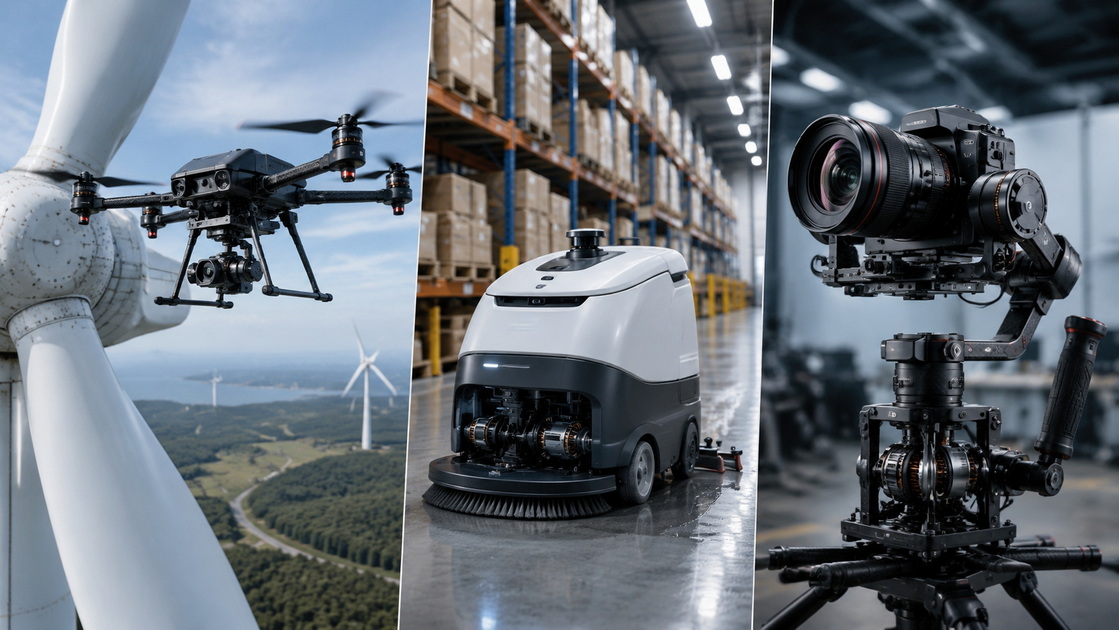
The same technologies that make FPV motors so capable in the air now power an expanding range of devices on land and underwater. High‑performance brushless motors are used in:
- RC cars and high‑output fans, where torque and durability are essential.
- Gimbal systems, which demand extremely smooth, low‑vibration rotation and precise speed control.
- Autonomous cleaning robots and underwater vehicles, which need custom shaft designs, waterproof housings, and defined torque curves.
In many of these applications, customers require tailored solutions. OEM and ODM projects often involve custom winding schemes, unique shaft lengths, specialized mounting patterns, and non‑standard connectors. Experience gained from FPV flight is invaluable here, because extreme aerial use quickly reveals weaknesses in bearings, laminations, and heat management that can also affect industrial and robotic devices.
From the perspective of a photographer or pilot, the benefits of a well‑engineered motor are obvious in every flight:
- Footage becomes more stable because motors respond consistently to tiny corrections from the flight controller.
- Vibrations are reduced, protecting gimbal performance and minimizing "jello" artifacts in the image.
- Reliability improves, lowering the risk of power‑train failures during remote flights or complex shoots.
When aerial creators transition from conventional camera drones to FPV platforms for dynamic shots—through stadium tunnels, urban architecture, or dense forests—the motor becomes a central creative tool. Predictable throttle response allows pilots to fly close to obstacles while preserving shot framing and avoiding dangerous prop wash.
For industrial users, improved motors support more accurate survey flights, with consistent speed and altitude that enhance data quality. Fine control over acceleration and braking allows heavier sensor payloads without sacrificing flight time or safety.

Based on engineering experience and feedback from pilots and industrial clients, motor selection should always start from the intended application instead of generic performance claims.
Key considerations include:
1. Flight Style and Purpose
- Cinematic FPV calls for smooth throttle behavior, moderate KV values, and low vibration.
- Racing benefits from higher KV, light motor bells, and aggressive cooling strategies.
- Industrial imaging demands efficiency, durability, and, in some cases, redundancy.
2. Propeller and Battery Matching
- KV must align with propeller diameter and pitch for the chosen battery voltage.
- Oversized props or mismatched voltage can push motors beyond their safe operating range.
3. Thermal Performance
- Motors need ventilation paths and winding insulation that withstand continuous heat.
- True thermal performance is proven in long flights, not only in short bench tests.
4. Data and Testing
- Thrust tables, efficiency curves, and durability reports are more valuable than simple marketing figures.
- Real‑world testing with heavy loads and repeated impacts reveals whether a motor will hold up over time.
The most successful FPV motors are not always the most powerful. They are the ones that remain predictable after hundreds of flights, occasional crashes, and shifts in weather and altitude.
As drone and robotics markets mature, more brands rely on custom power solutions instead of generic components. Off‑the‑shelf motors can be adequate for prototypes or small runs, but volume production often requires deeper integration.
Common development demands include:
- Custom winding layouts tuned for specific operating profiles, such as hover flight or sustained high‑speed travel.
- Unique shaft dimensions and mounting structures that fit proprietary frames or protective housings.
- Cable routing and connector choices optimized for assembly efficiency and maintenance.
Working directly with motor specialists gives product teams a chance to shape flight characteristics to match user expectations. For FPV systems, this might mean motors that feel "locked‑in" on racing tracks or that deliver smooth arcs for cinematic routes. For industrial robots, it might mean motors that achieve precise speed control under heavy loads.
Early collaboration also helps brands minimize redesign cycles, ensuring that structural frames, power electronics, and sensor payloads evolve together. This leads to more reliable products and a more consistent user experience.
For individual aerial creators exploring FPV platforms:
- Begin with medium‑KV motors that prioritize control and efficiency over raw speed.
- Pair motors with balanced propellers and high‑quality ESCs to unlock stable flight and clean footage.
- Test new configurations in open, low‑risk environments before flying close to structures or crowds.
For drone and robotics product teams:
- Define torque, speed, and efficiency targets early in the design process.
- Validate candidate motors under realistic operating conditions, including continuous flight, temperature extremes, and mechanical shock.
- Consider long‑term serviceability, including ease of replacement and availability of spare units.
Approaching power‑train design in this structured way allows teams to deliver platforms that feel refined, safe, and trustworthy from the first flight or deployment.
The story of aerial photography is a story of continuous innovation. Early experimenters lifted cameras with balloons and kites, military engineers refined imaging for mapping and reconnaissance, and space programs pushed the vantage point into orbit. Today, FPV drones and advanced brushless motors have brought agile, immersive flight within reach of individual creators and industrial teams alike.
By treating motors, ESCs, and batteries as integrated systems, manufacturers can deliver flying platforms that feel responsive, stable, and dependable. As applications expand—from cinematic filming and inspection to autonomous robots and underwater vehicles—the quality of the power system will remain a decisive factor in performance.
For organizations that design or deploy drones and robotic devices, working closely with experienced motor specialists unlocks a path toward safer flights, higher‑quality imagery, and more capable machines that keep pushing the boundaries of what can be seen and done from above.
1. What makes FPV drone motors different from standard camera drone motors?
FPV motors are designed for rapid throttle response, high current handling, and frequent aggressive maneuvers, while standard camera drone motors mainly emphasize efficiency and stable hovering for smooth footage.
2. How should KV be selected for an FPV build?
KV should be chosen according to battery voltage and propeller size. Higher KV values typically suit racing and short, powerful flights, whereas lower KV values support efficiency, smoother control, and longer airtime for cinematic or industrial roles.
3. Why does motor quality matter so much for aerial imaging?
Low‑quality or inconsistent motors introduce vibration, reduce flight stability, and increase the risk of in‑air failures. These factors directly affect image clarity, gimbal performance, and operational safety during complex missions.
4. What types of customization are available in OEM and ODM motor projects?
Customizations often include winding design, shaft geometry, mounting interfaces, cable length and routing, connector options, and in some cases integrated control electronics to match specific platforms and workflows.
5. Can one motor platform serve drones, robots, and gimbals equally well?
Core technologies such as stators, magnets, and bearings can be shared, but each application usually requires adapted windings, housings, and mechanical interfaces to meet different load profiles, duty cycles, and environmental constraints.
1. KDE Direct – "The Evolution of Aerial and Drone Photography"
https://www.kdedirect.com/blogs/news/evolution-of-aerial-and-drone-photography
2. Hartzell Propeller – "From Balloons to Drones: The History of Aerial Photography"
https://hartzellprop.com/the-history-of-aerial-photography/
3. Remote sensing overview – "History of Aerial Photography (Remote Sensing)"
https://www.youtube.com/watch?v=YxDXmUfjAtw
4. Vice – "A Brief History of Pre-Drone Vintage Aerial Photography"
https://www.vice.com/en/article/a-brief-history-of-pre-drone-vintage-aerial-photography/
5. UAV Model – "Best FPV Drone Motors: The Ultimate 2026 Buyer Guide"
https://blog.uavmodel.com/best-fpv-drone-motors-the-ultimate-2026-buyer-guide/
6. CES 2026 coverage – "The Future of Drones"


