Language


Views: 288 Author: Yuhang Power Publish Time: 2026-07-17 Origin: Site
Content Menu
● How Motor Size Actually Affects Your FPV Drone
>> Motor Size Means Stator Dimensions, Not Just A Name
>> Rotor, Stator And Why Brushless Matters
● Key Factors That Decide FPV Drone Motor Size
>> 1. Frame Wheelbase And Prop Size
>> 2. All‑Up Weight And Flight Style
● FPV Drone Motor Size Chart By Frame And Prop Class
● Recommended FPV Motor Sizes By Build Type
>> TinyWhoops And Micro Quads (65–85 mm)
>> Toothpicks And 2–2.5 Inch Builds
>> 3–3.5 Inch Freestyle And Large Micros
>> 4–4.5 Inch Lightweight Freestyle
>> 5 Inch FPV Drones (Freestyle And Racing)
>> 6–7–8 Inch Long‑Range And Heavy Lift
● 2207 Vs 2306: A Real‑World Comparison For 5 Inch
● Common FPV Motor Size Mistakes (And How To Avoid Them)
● A Pilot's Step‑By‑Step Workflow For Choosing Motor Size
● How Professional Motor Manufacturers Support Better Sizing Decisions
Choosing the right FPV drone motor size is one of the most important decisions you make in any quad build, whether it's a 65 mm whoop, a 5‑inch freestyle rig, or a 7‑inch long‑range platform. The correct motor size is the one that matches your propeller, all‑up weight, battery voltage, and flight style—not the biggest stator you can afford or whatever a parts list video recommends. [blog.uavmodel]
Over the past decade I've built and tuned everything from tiny brushed whoops to heavy 7‑inch brushless long‑range quads, and the pattern is always the same: when motor size is wrong, no amount of PID tuning or prop swapping fully fixes the build. [qyresearch]
In FPV, a motor size such as 2207 or 2306 describes the stator, not the outer bell. [qyresearch]
- First two digits → stator diameter in millimetres (e.g. 22 mm).
- Last two digits → stator height in millimetres (e.g. 07 mm). [qyresearch]
The stator is where the copper windings and magnetic interaction live, so it largely determines torque, prop control, and how the motor behaves under load. [oscarliang]
From a pilot's perspective, motor size affects:
- Throttle feel and response.
- Recovery from dives and corner exit speed.
- Prop wash handling and tracking through lines.
- Cruising efficiency and motor temperature after hard packs. [blog.uavmodel]
Every FPV brushless motor has two core parts: [qyresearch]
- Rotor – the rotating bell with permanent magnets.
- Stator – the fixed core with radial electromagnets and copper windings.
Control electronics (the ESC) sequence current through the windings to create a rotating magnetic field that drives the rotor. Because there are no brushes or mechanical commutators, brushless motors offer higher efficiency and much better longevity than brushed motors—critical for high‑power FPV use. [oscarliang]
Your frame wheelbase (motor‑to‑motor diagonal) defines the maximum prop size, and that prop size sets the torque demand. Typical pairings include: [qyresearch]
- 65–85 mm tinywhoop frames → 31–40 mm props.
- 120–140 mm frames → 3‑inch props.
- 210–225 mm frames → 5‑inch props.
- 280 mm+ frames → 7–10 inch long‑range builds. [blog.uavmodel]
Frame, prop and motor must work as a matched set—undersized motors overheat, oversized motors waste weight and feel dull. [qyresearch]
Two quads with the same prop size can need very different motors because of weight and flight style. [qyresearch]
- Light 5‑inch analog freestyle build → less torque required, can use lighter stators.
- Heavy HD 5‑inch with GoPro → needs more torque reserve for recovery and prop wash handling. [blog.uavmodel]
Flight style drives motor choice:
- Freestyle → predictable response, strong recovery, good low‑end control.
- Racing → instant acceleration, high burst current capability.
- Long range → efficiency and cool running over long throttle holds.
- Cinewhoop → smoothness, low noise, and heat control under payload. [oscarliang]
Motor KV (RPM per volt, unloaded) shapes how aggressive a given stator feels at a specific voltage. [qyresearch]
General rules:
- Smaller props → smaller stators, higher KV (e.g. whoops and toothpicks). [qyresearch]
- Medium props (5‑inch) → mid‑size stators, mid KV, balanced torque/response. [blog.uavmodel]
- Large props (7–10 inch) → larger stators, lower KV for sustained torque. [qyresearch]
Typical 5‑inch pairings:
- 4S → roughly 2300–2600 KV for freestyle/racing.
- 6S → roughly 1700–1950 KV, now the common "meta". [blog.uavmodel]
If KV does not match battery voltage and prop load, motors come down hot, efficiency collapses, and ESCs are pushed beyond their comfort zone. [blog.uavmodel]
Below is a practical motor size chart that aligns frame wheelbase, prop diameter, motor stator size, and typical KV ranges. [oscarliang]
| Frame wheelbase | Prop size | Motor stator size | Typical KV range | Battery cells |
|---|---|---|---|---|
| 65–85 mm | 31–40 mm (1.2–1.6″) | 06xx–08xx | 18,000–25,000 KV | 1S |
| 85–120 mm | 2–2.5″ | 11xx–14xx | 8,000–12,000 KV | 2S–3S |
| 120–140 mm | 3″ | 14xx–15xx | 3,500–6,000 KV | 3S–4S |
| 155–180 mm | 4″ | 16xx–20xx | 3,000–4,500 KV | 4S |
| 195–225 mm | 5″ | 22xx–23xx | 1,700–2,800 KV | 4S–6S |
| 250–270 mm | 6″ | 23xx–25xx | 1,500–1,900 KV | 4S–6S |
| 300–330 mm | 7″ | 25xx–28xx | 1,200–1,800 KV | 6S |
| 360–390 mm | 8″ | 28xx–30xx | 900–1,200 KV | 6S–8S |
| 400–500 mm | 9–10″ | 30xx–35xx | 800–1,000 KV | 6S–8S |
Treat this chart as a starting map, not a rigid rulebook. Refine choices based on actual quad weight, prop pitch, battery type, and flight goals. [oscarliang]
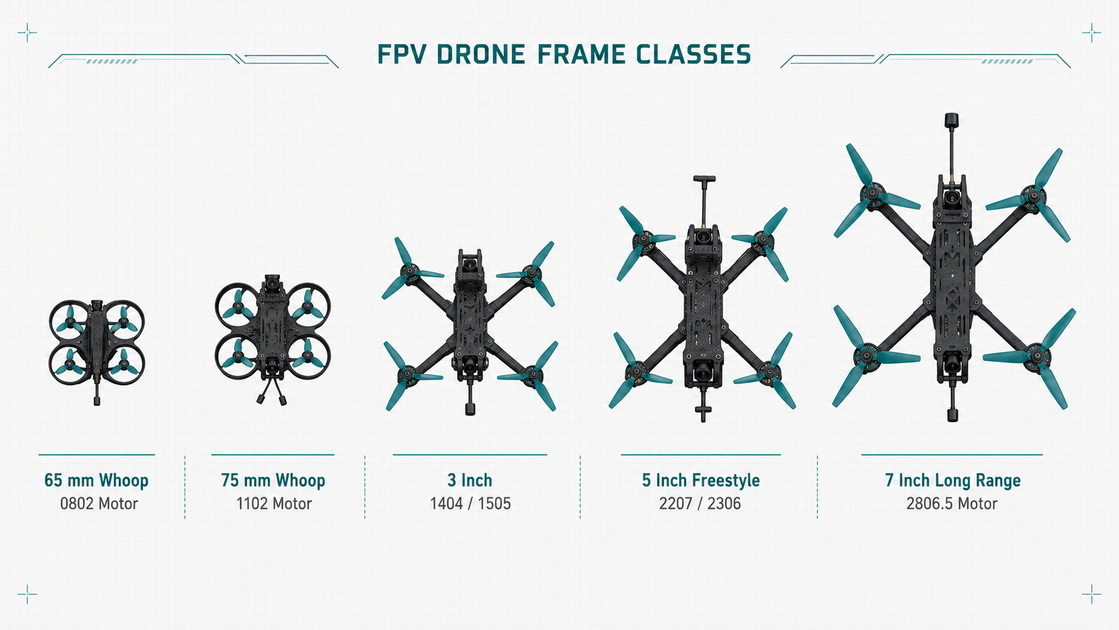
- Motor sizes: 0702, 0802, 1002. [qyresearch]
- KV ranges: 19,000–30,000 KV on 1S, slightly lower on 2S. [qyresearch]
- Use cases: indoor FPV, tight racing tracks, lightweight freestyle.
Smaller stators and high KV keep builds responsive and light, but heat and efficiency must be watched closely. [ligpower]
- Motor sizes: 1002–1003 for ultra‑light 2″, 1203–1403–1104 for 2.5″. [qyresearch]
- KV ranges: around 10,000–22,000 KV depending on 2S vs 3S. [qyresearch]
These builds reward clean, efficient brushless motors with tight tolerances and well‑balanced rotors; a poor motor shows up immediately as vibration in HD footage. [oscarliang]
- 3″ motor sizes: 1104, 1204, 1304. [qyresearch]
- 3.5″ motor sizes: 1404, 1504. [qyresearch]
- KV ranges: roughly 3,000–7,000 KV on 3S–6S, depending on aggressiveness. [blog.uavmodel]
These setups bridge micro and full‑size behavior; they need enough torque for outdoor wind and diving, but still benefit from keeping rotor mass modest. [qyresearch]
- Motor sizes: 2205, 2304.5. [qyresearch]
- KV ranges: about 2,200–3,500 KV on 4S–6S. [qyresearch]
Here, stator volume should be sized for power‑to‑weight, not brute thrust. Oversizing motors often makes the quad feel less alive than a carefully matched, slightly smaller stator. [blog.uavmodel]
For most pilots, the key question is 2207 vs 2306. [blog.uavmodel]
- 2207 – taller stator, more torque per amp, snappier transient response, stronger control in hard racing lines. [blog.uavmodel]
- 2306 – slightly wider and shallower, smoother power delivery, better cooling surface, often more efficient in longer flights. [blog.uavmodel]
Common recommendations:
- 5″ racing → 2207 or similar, 4S 2,500–3,000 KV, 6S 1,900–2,300 KV. [blog.uavmodel]
- 5″ freestyle → 2207 or 2306/2306.5, 4S 2,300–2,700 KV, 6S 1,700–2,100 KV. [blog.uavmodel]
Real test data on modern 2306 motors shows over 1,000 W peak power and substantial efficiency improvements when paired with appropriate 5‑inch props, confirming why this stator class remains a staple for freestyle and cinematic builds. [qyresearch]
For long‑range and payload‑oriented builds, you shift from "feel" to efficiency and sustained torque. [shop.tmotor]
- 6″: 2308 class motors, KV roughly 1,300–1,800 on 6S. [qyresearch]
- 7″: 2408, 2508, 2806.5, KV 1,000–1,900 depending on 4S vs 6S. [blog.uavmodel]
- 8–10″: 2808, 3110, 3214 and similar heavy‑lift stators, KV 350–1,200 on 6S–12S. [shop.tmotor]
Low KV, high‑torque designs are essential for keeping currents manageable and flight times long when driving large diameter props under camera or industrial payloads. [shop.tmotor]
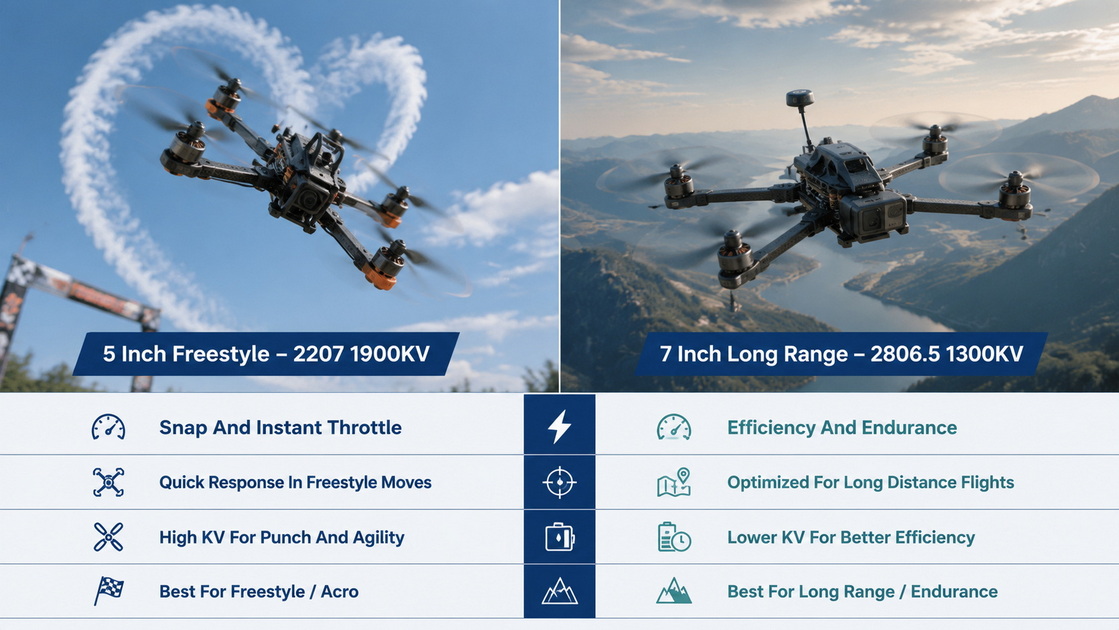
From repeated builds and community data, the practical comparison looks like this: [oscarliang]
2207 characteristics
- Stronger torque per amp.
- Faster transient throttle response.
- Better for tight tracks and aggressive lines.
2306 characteristics
- Smoother power delivery and low‑end control.
- Often cooler running at similar thrust.
- Preferred for freestyle and cinematic, especially with heavier cameras.
Neither size is universally "better". The rest of the build—prop, weight, voltage, and ESC capacity—decides which stator makes more sense. For most 5‑inch pilots who are unsure, 2207 or 2306 remains the safest short list. [oscarliang]
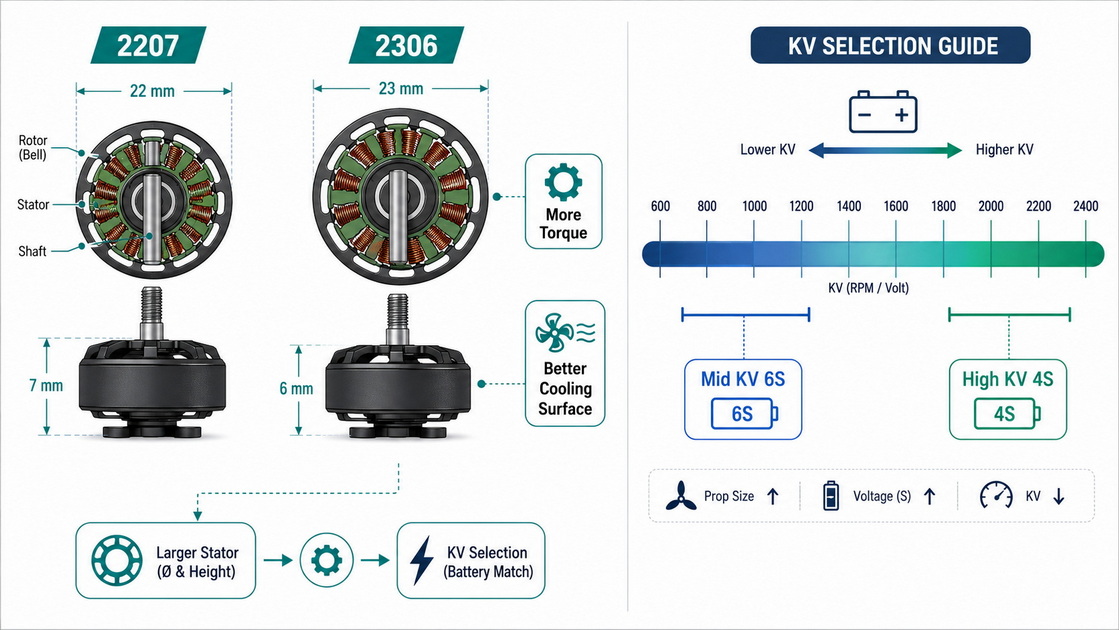
Drawing on pilot feedback and QC data from brushless motor manufacturing, the same sizing errors appear again and again: [blog.uavmodel]
- Choosing motors by KV only, ignoring stator volume.
- Running heavy, high‑pitch props on undersized stators and burning motors.
- Assuming bigger stator = better without matching prop and voltage.
- Ignoring all‑up weight and payload when copying someone's race setup.
- Using long‑range motor sizes on light freestyle builds and losing responsiveness. [qyresearch]
The most reliable way to avoid these mistakes is to start from a thrust‑to‑weight target (for example, 4:1 for relaxed cruising, 6:1 or more for racing) and work backwards through prop, stator size and KV. Whenever possible, review manufacturer thrust test data and temperature readings, not just headline numbers. [blog.uavmodel]
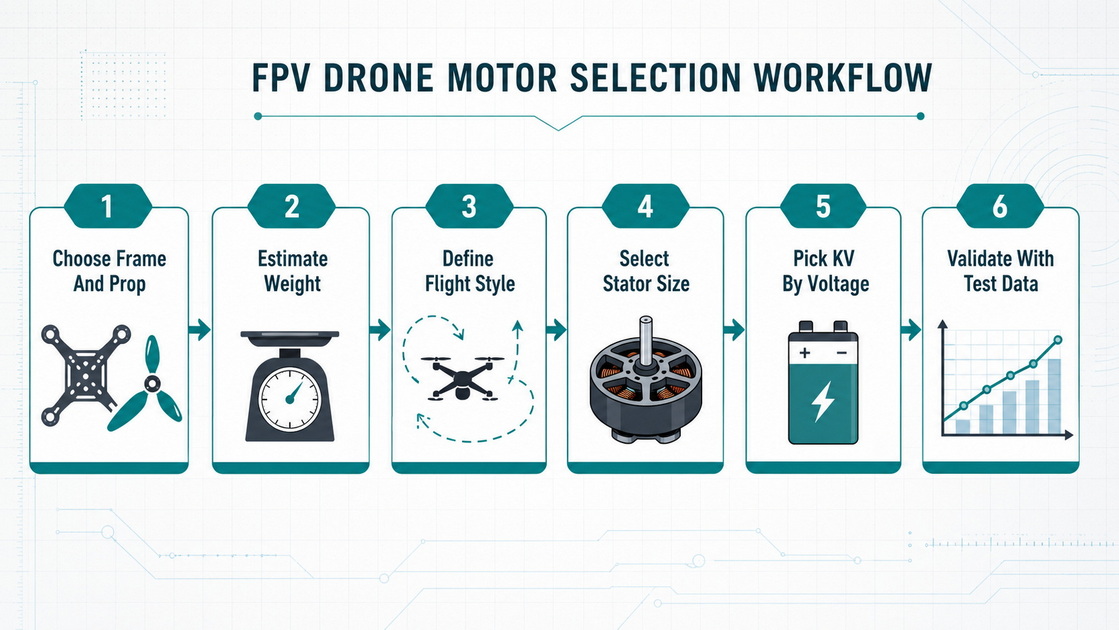
Here is a concise selection workflow that aligns with both field experience and engineering fundamentals: [blog.uavmodel]
1. Fix the frame size
Decide your wheelbase and intended prop diameter first. This sets the physical limits.
2. Match propeller size and type
Choose blades and pitch appropriate for your flying style and environment (indoor vs outdoor, racing vs cinematic).
3. Estimate all‑up weight
Include frame, electronics, battery, camera and payload. Use realistic expected weight, not idealized numbers.
4. Define flight style and thrust‑to‑weight target
For racing, aim higher thrust; for long range, prioritize efficiency and cool motors.
5. Select stator size from chart range
Start from the recommended stator class for your prop/frame, then lean larger for heavy builds, smaller for light builds.
6. Pick KV matched to battery voltage and props
Use known KV "bands" for 4S, 6S or higher voltage setups and adjust down slightly if using aggressive prop pitch.
7. Verify with test data and sample motors
When possible, check vendor thrust tables, current draw and motor temperature across multiple throttle points, then fly real packs to confirm behavior. [qyresearch]
As a brushless motor manufacturer supplying FPV drone motors, gimbal motors, RC car motors, high‑power fans and underwater robots, the most successful customer projects follow a collaborative process rather than buying motors purely off a static spec sheet. [qyresearch]
From a factory perspective, reliable builds share a few habits:
- Providing clear application details: frame size, prop type, battery, target AUW, and flight style.
- Requesting motor recommendations within stator families (e.g. "5‑inch freestyle, 6S, 2207 vs 2306 suggestions").
- Reviewing QC and thrust test reports before locking in models.
- Starting with small pilot batches and iterating on stator/KV combinations based on real flight feedback. [qyresearch]
This approach reduces false starts, limits overheating issues, and builds a stronger baseline for later OEM/ODM customization such as custom shaft lengths, specific mounting patterns, or special winding schemes for niche builds. [qyresearch]
1. Is a bigger FPV motor always better for my quad?
No. Oversized motors add weight, often reduce efficiency on smaller props, and can make a light quad feel sluggish. Bigger motors only make sense when prop load, battery voltage and build weight justify the extra torque. [blog.uavmodel]
2. How can I tell if my current motors are undersized or oversized?
Undersized motors run hot, struggle to maintain RPM on aggressive props, and may cause ESC over‑current cutoffs. Oversized motors tend to land cool but give a dull, heavy feel and poor efficiency compared with more appropriate stator sizes. [blog.uavmodel]
3. Why do pilots still debate 2207 vs 2306 for 5‑inch after so many years?
Because both stators sit in a sweet spot for 5‑inch: one leans toward torque and racing, the other toward smooth freestyle and efficiency. Differences are subtle but noticeable once you fly both in similar builds. [oscarliang]
4. How important is manufacturer test data in choosing motor size?
Test data on thrust, current draw and temperature at various throttle points provides a quantitative check of sizing decisions. It helps confirm that a motor/prop/voltage combination delivers the expected performance without pushing the motor beyond safe limits. [blog.uavmodel]
5. Can I reuse the same motor size across different builds to save cost?
You can standardize around a favorite stator (for example 2207 for multiple 5‑inch builds), but each new frame, prop and battery combination should still be evaluated. Re‑using motors blindly across very different setups is a common source of heat and performance issues. [oscarliang]
1. MEPSKING. "What FPV Motor Sizes Do I Need for My Quad?" [qyresearch]
2. MEPSKING. "How To Choose FPV Drone Motor A Detailed Guide 2026." [mepsking]
3. UAVModel. "FPV Motor Sizing Guide: Stator Volume, KV Selection, and Thrust-to-Weight Ratio — 2026 Guide." [blog.uavmodel]
4. UAVModel. "FPV Drone Motor Selection Guide 2026." [blog.uavmodel]
5. Ligpower. "FPV Drone Motor Sizes Guide: Learn in Minutes." [ligpower]
6. Oscar Liang. "How to Choose FPV Drone Motors." [oscarliang]
7. Oscar Liang. "Motor & Prop Sizes, KV, Battery Cell Count, and Weight for FPV Drone." [oscarliang]
8. T‑Motor. "Drone Motor Size Chart & Selection Guide for UAVs." [shop.tmotor]
9. Zhongshan Yuhang Power Technology Co., Ltd. "Home – Yuhang Power Brushless Motors." [yuhangmotor]
10. Zhongshan Yuhang Power Technology Co., Ltd. "Brushless Motor Applications In FPV Drones And Industrial OEM Solutions." [yuhangmotor]


