Language


Views: 222 Author: Yuhang Power Publish Time: 2026-06-09 Origin: Site
Content Menu
● Why Brushless Motors Power Today's Critical Systems
● Aerospace and Defense: When Failure Is Not an Option
● Manufacturing and Industrial Automation: Reliability at Scale
● Marine and Underwater Robotics: From Surface Vessels to ROVs
● Medical Devices: Quiet, Clean and Precisely Controlled
● Robotics and Automation: Agility Meets Power Density
● Transportation and Personal Mobility: From E‑Bikes to RC Models
● FPV Drone Motors: What Really Matters in the Air
● Beyond Drones: Gimbals, "Violent Fans," and Smart Devices
● Why Custom Brushless Solutions Matter
● How to Choose the Right Brushless Motor (Practical Checklist)
● Call to Action: Build Your Next Power System With Us
● FAQ
>> 1. What is the main advantage of brushless motors over brushed motors?
>> 2. Why are brushless motors preferred in FPV drones?
>> 3. Can brushless motors be used underwater?
>> 4. Are brushless motors suitable for medical devices?
>> 5. How do I start an OEM/ODM project for a brushless motor?
Brushless motors have quietly become the backbone of modern motion systems—from FPV drones and gimbals to medical devices and underwater robots—and choosing the right motor platform can make or break your product. In this guide, I'll walk through the most important brushless motor applications, then share how we design and manufacture FPV drone motors and custom BLDC solutions that solve real engineering problems in the field. [netdriven]
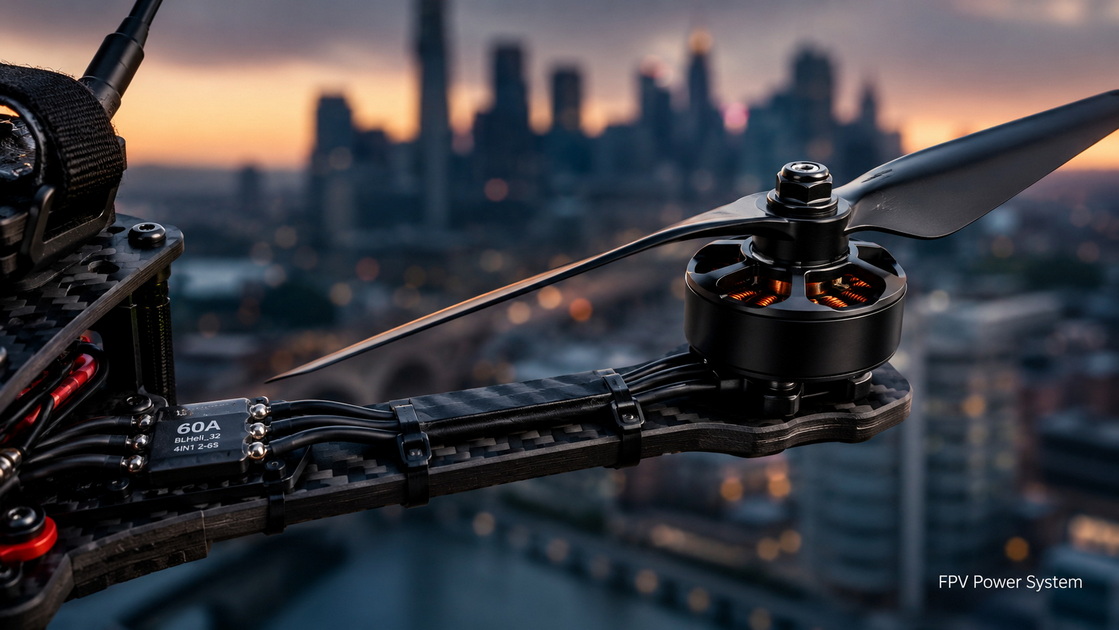
As someone who has spent years working with engineering teams in UAVs, robotics, and industrial automation, I've seen one pattern repeat: once a system moves from prototype to production, brushed motors rarely survive the requirements review. [netdriven]
Brushless DC motors (BLDC) deliver a combination of high efficiency, long service life, and precise control that makes them ideal wherever uptime, reliability, and smooth performance matter. [netdriven]
Key advantages engineers consistently care about:
- Longer lifespan thanks to the absence of brushes and commutators, which reduces mechanical wear and maintenance. [netdriven]
- Higher efficiency and torque density, enabling smaller, lighter powertrains—crucial in drones, gimbals, and mobile robots. [netdriven]
- Stable operation in harsh environments, including vacuum, underwater, and dusty industrial facilities. [netdriven]
- Low electrical noise and low acoustic noise, which is critical in medical and imaging applications. [semrush]
In our own work at Zhongshan Yuhang Power Technology Co., Ltd., we've seen how a well‑matched BLDC motor and ESC combination can extend flight time, reduce thermal issues, and cut total cost of ownership over years of operation. (More on specific FPV and robotics use cases below.)
The aerospace industry embraced brushless motors early because mission-critical systems simply cannot tolerate brush wear, arcing, or unpredictable maintenance intervals. [netdriven]
Historic programs such as NASA's Apollo missions used brushless motors in life support blowers and oxygen circulation systems precisely because they withstand extreme temperatures, vacuum, and vibration better than brushed designs. [netdriven]
Today, aerospace and defense engineers deploy BLDC motors in:
- UAV propulsion systems (fixed‑wing drones, multirotors, VTOL platforms). [netdriven]
- Actuation systems for control surfaces, landing gear, and payload release mechanisms. [netdriven]
- Space applications, where lubrication, off‑gassing, and vacuum behavior make brushed systems unacceptable. [netdriven]
From an engineering perspective, the predictable torque constant, high power‑to‑weight ratio, and low maintenance profile of BLDC motors allow designers to simplify redundancy strategies and reduce scheduled downtime. [netdriven]
For FPV and commercial UAV customers we work with, this translates into:
- More consistent thrust curves for flight controller tuning.
- Lower risk of in‑flight motor failure due to brush wear.
- Better performance margins in high‑altitude or high‑temperature missions.
In industrial and manufacturing environments, the value of a brushless motor is measured less in seconds of acceleration and more in years of continuous operation. [netdriven]
Well‑designed BLDC motors can run thousands of hours with minimal maintenance, making them ideal for: [netdriven]
- Conveyor and material handling systems. [netdriven]
- Actuators in packaging, pick‑and‑place, and CNC machinery. [netdriven]
- Power generation auxiliaries, vacuum systems, and process equipment (plastics, steel, etc.). [netdriven]
Because BLDC motors support precise speed and position control with modern controllers, industrial teams often use them in:
- High‑precision positioning tasks (e.g., camera inspection stages, small indexing tables).
- Servo‑like applications where repeatability and closed‑loop feedback are mandatory.
From a total cost of ownership perspective, the combination of long life, predictable performance, and energy efficiency often justifies upgrading legacy brushed systems even before end of life. [fireandspark]
At Zhongshan Yuhang, we support OEM customers with:
- Custom shaft lengths, mounting flanges, and winding configurations.
- Matched ESC and controller recommendations for existing PLC or industrial network interfaces.
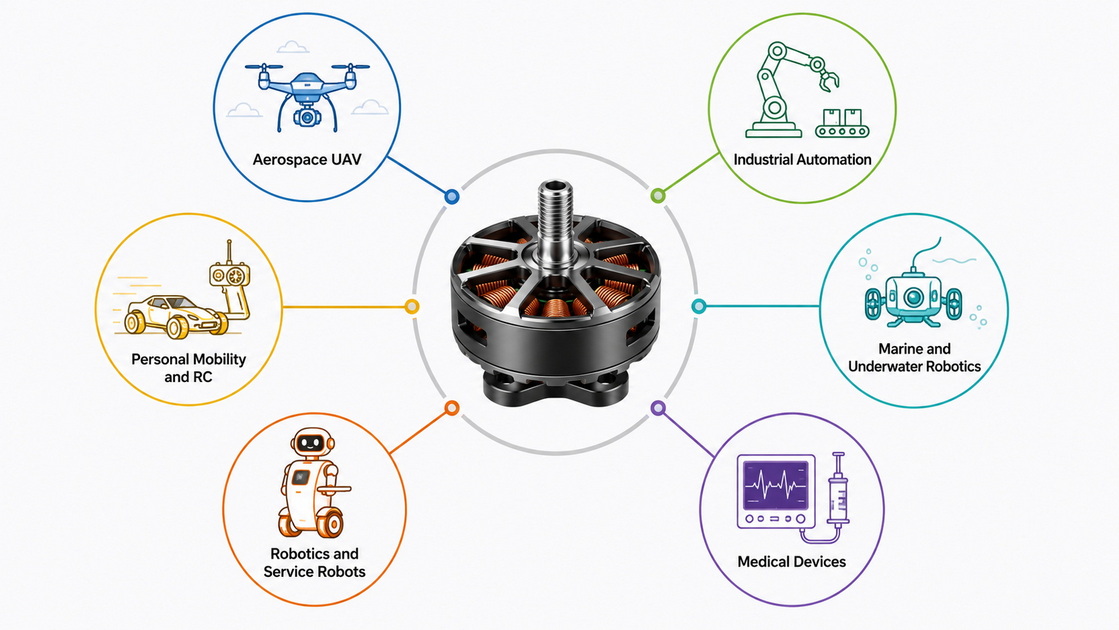
Brushless motors are an excellent fit for marine systems because they can be engineered to operate reliably in high‑humidity or fully submerged environments when paired with appropriate sealing and an IP66 or higher protection rating. [netdriven]
In the marine sector, BLDC motors power:
- Underwater drones and ROVs used for inspection, mapping, and research. [netdriven]
- Electric boat thrusters and jet drives for small craft and personal watercraft. [netdriven]
- Aquaculture and aquarium systems, such as automatic fish feeders and tank cleaners. [netdriven]
For underwater vehicles, engineers care deeply about:
- Corrosion‑resistant materials (stainless steel shafts, coated stators).
- Efficient hydrodynamic propeller–motor pairs to maximize battery life.
- Reliable sealing and pressure resistance, especially beyond recreational depths.
We've supported customers building compact underwater robots by providing custom‑wound FPV‑style motors with waterproofing treatments, enabling high thrust at low RPM for direct‑drive propellers in confined hulls.
Medical environments place unique demands on motion systems: low noise, no sparking, high reliability, and compact form factor. [netdriven]
Brushless motors meet these requirements because they eliminate brush arcing, generate minimal electromagnetic interference, and can be packaged into extremely small housings. [netdriven]
Common medical uses include: [netdriven]
- PAP/CPAP respirators, where silent, precise airflow is essential for patient comfort and compliance.
- Portable pumps and ventilators, which demand high reliability in compact, battery‑powered form factors.
- Dental tools, where motors may be no larger than a fingernail but must deliver very high speeds with minimal vibration.
In these applications, designers emphasize:
- Low acoustic noise, so clinicians and patients are not distracted by whirring motors.
- Long life at high RPM, minimizing downtime for maintenance and sterilization cycles.
- Stable torque at controlled speeds, often under closed‑loop control.
If you are engineering medical equipment, partnering with a motor manufacturer that understands regulatory, EMC, and sterilization constraints can significantly shorten your path to market.
In robotics, every gram matters and every watt counts. Removing brushes is not just about durability; it allows the motor to spin faster, handle higher peak currents, and deliver more torque for a given size and weight. [netdriven]
Because of this, BLDC motors are now standard in: [netdriven]
- Service robots and mobile platforms, where efficient drive systems extend runtime.
- Prosthetic limbs, where compact, high‑torque actuators enable more natural movement.
- Research robots and competition robots (e.g., BattleBots) that push motors to their thermal and mechanical limits.
For our robotics and RC car customers, we typically optimize around:
- High torque density for aggressive acceleration and climbing.
- Precise throttle response with low latency between command and motion.
- Thermal management, including stator design and cooling strategies for repeated peak loads.
Many modern transportation platforms rely on brushless motors for their high efficiency and torque‑to‑weight ratio. [netdriven]
Typical applications include: [netdriven]
- Electric bicycles and scooters, where hub motors integrate stators into the axle and rotor magnets into the wheel itself.
- Hoverboards and self‑balancing transporters, which demand instantaneous torque and fine control to maintain balance.
- RC cars, boats, and aircraft, where BLDC motors deliver explosive acceleration and extended run times compared to brushed setups.
In these systems, engineers and hobbyists look for:
- High peak current capability for quick starts and hill climbs.
- High efficiency across a wide RPM range, especially for users who mix commuting and recreational riding.
- Robustness to shock and vibration, particularly in off‑road RC vehicles.
In our own FPV motor projects, many design principles—such as lightweight rotor design, low cogging torque, and excellent cooling—translate directly to e‑bike hubs, small electric vehicles, and performance‑oriented RC models.
While brushless motors power many industries, FPV drone motors are their own world. The right motor can be the difference between a locked‑in freestyle rig and a twitchy build you never fully trust.
From our experience manufacturing FPV motors, here are the factors that advanced pilots and professional operators care about most:
- Thrust‑to‑weight ratio: Enough instant power for punch‑outs, but not so heavy that it kills agility.
- KV and voltage pairing: Matching KV to 4S, 6S, or higher voltage packs and propeller size for the desired flying style.
- Stator size and design: Larger stators (e.g., 22xx, 23xx) can deliver more torque, but need careful weight and heat management.
- Bearing and shaft quality: Directly impacts smoothness, durability, and noise.
- Thermal performance: Efficient copper fill, lamination quality, and rotor ventilation to survive full‑throttle runs.
As a Chinese manufacturer focused on FPV drone motors, UAV propulsion, and custom BLDC solutions, we frequently help customers balance:
- Racing vs. freestyle tuning (snappy vs. smooth).
- Endurance vs. peak power for long‑range, cinematic, or mapping missions.
- Noise profiles when drones must operate near people or on film sets.
Our brushless motor platforms are also widely used in gimbal stabilization, high‑performance fans, and smart home or service devices.
Popular use cases among our customers include:
- Camera gimbals and pan‑tilt units, where low cogging torque and smooth, precise control enable cinematic footage.
- High‑power "violent fans" and blowers, where BLDC motors deliver strong airflow with better efficiency and longer life than brushed alternatives.
- Sweepers and cleaning robots, which combine high‑torque drive motors with efficient fan motors for suction.
- Underwater and ground robots, where compact motors fit into tight mechanical envelopes.
The common thread across these applications is the need for customized mechanical interfaces (mounting, shafts, connectors) and tuned electrical characteristics (winding, KV, ESC pairing) to match real‑world loads.
Generic off‑the‑shelf motors are fine for prototypes. But as projects scale, most serious teams eventually need OEM or ODM customization to hit their performance, cost, and reliability targets.
Typical customization we provide for global customers includes:
- Custom KV and winding design for specific battery voltages, prop sizes, or gear ratios.
- Mechanical customization, such as shaft length and diameter, special mounting patterns, or integrated connectors.
- Environmental adaptations, including waterproofing, conformal coatings, or dust‑resistant designs.
- System‑level optimization, pairing motors with ESCs and recommending complete power system configurations.
An OEM/ODM partnership also supports:
- Consistent quality across production batches with documented testing and traceability.
- Application‑specific performance testing, including thrust stands (for UAV), load rigs (for robotics), and life‑cycle testing.
If your team is developing UAVs, RC systems, robots, or smart appliances, collaborating early with your motor supplier can prevent expensive redesigns and unlock better performance envelopes.
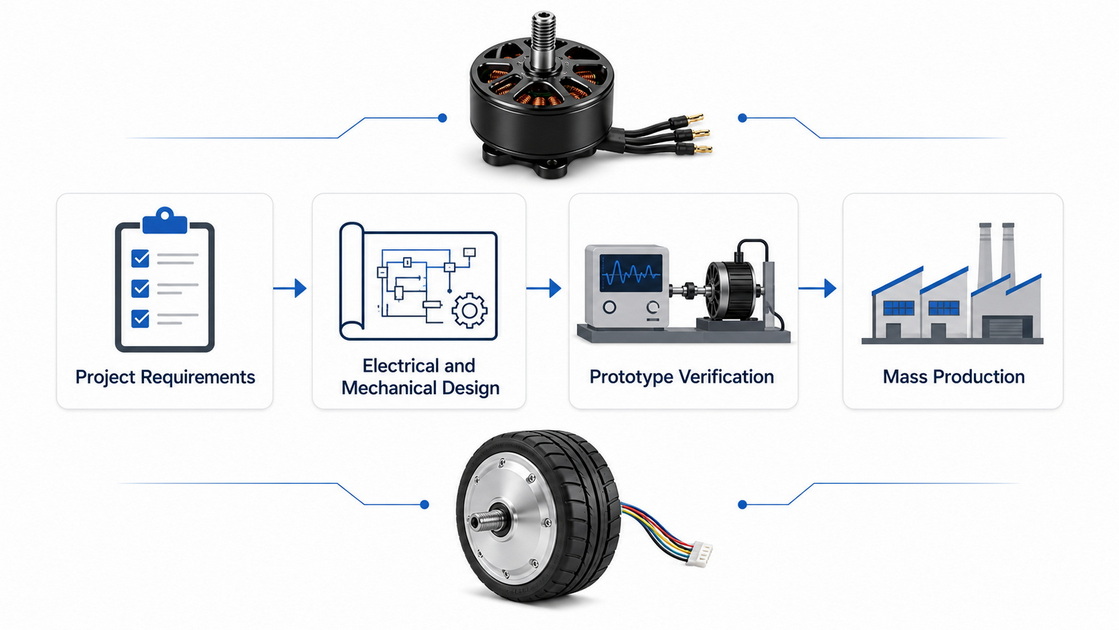
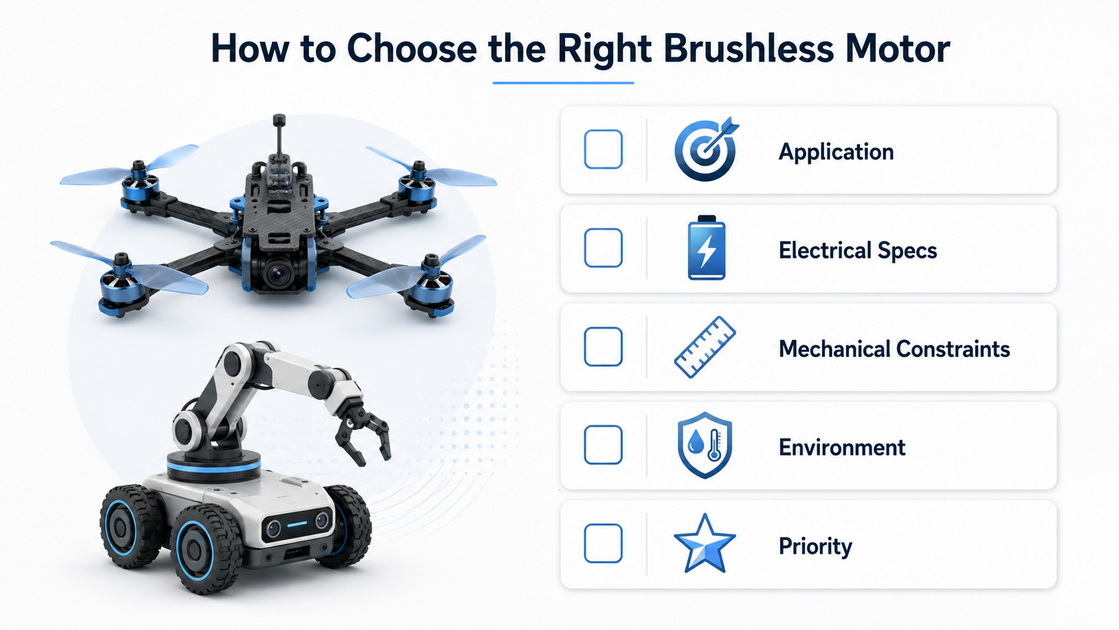
To make this guide more actionable, here is a concise process we use with customers to narrow down the right motor platform:
1. Define the application and constraints.
- UAV, FPV drone, RC car, fan, gimbal, robot, or other.
- Size, weight, and power or thrust requirements.
2. Clarify electrical parameters.
- Battery voltage (e.g., 3S–6S LiPo for FPV, 24–48 V for robots).
- Target current and power limits (ESC, wiring, thermal envelope).
3. Specify mechanical requirements.
- Mounting pattern, shaft diameter/length, available space.
- Type of coupling (direct drive, gear, belt, propeller).
4. Define environment and duty cycle.
- Indoor vs. outdoor, dust, water, or chemical exposure.
- Intermittent bursts vs. continuous heavy loads.
5. Set priorities.
- Is the main goal maximum performance, long life and reliability, low noise, or cost efficiency?
Once these questions are clear, our engineering team can usually propose 2–3 candidate motor families and, if needed, develop a customized variant for OEM/ODM programs.
If you are designing FPV drones, UAVs, robots, RC systems, gimbals, or other professional equipment and need a dependable brushless motor partner, our team at Zhongshan Yuhang Power Technology Co., Ltd. can support you from concept to mass production.
The key advantages are longer lifespan, higher efficiency, better reliability, and lower maintenance because there are no brushes or commutators to wear out or create electrical noise. [netdriven]
FPV drones need high power‑to‑weight ratio, instant throttle response, and high efficiency, all of which BLDC motors deliver, especially when properly matched with propellers and ESCs.
Yes, when designed with appropriate sealing and high IP ratings (e.g., IP66 or above), brushless motors can safely operate in marine and underwater applications such as ROVs and thrusters. [netdriven]
Brushless motors are widely used in respirators, pumps, and dental tools because they operate quietly, produce minimal electromagnetic interference, and can be built in very compact sizes. [netdriven]
Begin by sharing your application details, electrical specs, mechanical constraints, and target performance with the motor manufacturer; from there, an engineering team can propose suitable platforms and customization options.
1. KDE Direct – "Top 6 Industry Applications of Brushless Motors"
https://www.kdedirect.com/blogs/news/6-industry-applications-brushless-motors [netdriven]
2. Semrush – "What It Is & How It Affects SEO"
https://www.semrush.com/blog/eeat/ [semrush]
3. Orbit Media – "Blogging SEO: How to Optimize Your Blog Post to Rank"
https://www.orbitmedia.com/blog/blog-optimization/ [orbitmedia]
4. MarketMuse – "Enhancing Your Content Strategy with SEO Best Practices"
https://blog.marketmuse.com/enhancing-your-content-strategy-with-seo-best-practices/ [blog.marketmuse]
5. Fire&Spark – "SEO Content Marketing: Integrating SEO Into Your Content"
https://www.fireandspark.com/blog/writing-for-seocrafting-content-for-search-engines/ [fireandspark]
6. Yoast – "Tips and Tricks to Write SEO‑Friendly Blog Posts in the AI Era"
https://yoast.com/seo-friendly-blog-post/ [yoast]
7. Infomedia – "Rank Better with EEAT: Unique Content Is Key to Blogging"
https://infomedia.com/blog/eeat-unique-blog-content/ [infomedia]


