Language


Views: 266 Author: Yuhang Power Publish Time: 2026-08-23 Origin: Site


Content Menu
● What Does KV Mean in an FPV Motor?
>> KV Is Not the Same as Motor Power
● High KV vs Low KV FPV Motors at a Glance
● When a High KV FPV Motor Is Better
>> Best Applications for High KV Motors
>> Limitations of High KV Motors
● When a Low KV FPV Motor Is Better
>> Best Applications for Low KV Motors
>> Limitations of Low KV Motors
● How Battery Voltage Changes the Right KV Range
>> 4S and 6S 5-Inch FPV Builds
● Propeller Size and Pitch Change Everything
>> Understanding Thrust Efficiency
● How to Choose the Right FPV Motor KV
>> Step 1: Define the Aircraft's Purpose
>> Step 2: Choose Battery Voltage and Propeller Size
>> Step 3: Match the Motor Stator to the Propeller Load
>> Step 4: Review Thrust-Test Data
● Test Motor Temperature and Power Headroom
● High KV vs Low KV FPV Motor: Final Verdict
● FAQ
>> 1. What does KV mean on an FPV motor?
>> 2. Is a higher KV motor always faster?
>> 3. Can I use a 4S high-KV motor with a 6S battery?
>> 4. What KV is suitable for a 5-inch FPV drone?
>> 5. What KV is suitable for a 7-inch long-range FPV drone?
Choosing between a high KV and low KV FPV motor is one of the most important decisions when building an FPV drone. KV affects RPM potential, propeller compatibility, current draw, heat, flight time, throttle response, and the overall feel of the aircraft.
However, there is no single "best" KV rating for every FPV build. A high KV motor may be ideal for a lightweight 4S racing quad, while a lower KV motor can be a better match for a 6S freestyle drone, 7-inch long-range platform, cinewhoop, or payload-carrying aircraft.
The right choice comes from matching the motor to the complete power system: battery voltage, propeller size, propeller pitch, motor stator size, ESC capability, aircraft weight, and intended flight style.
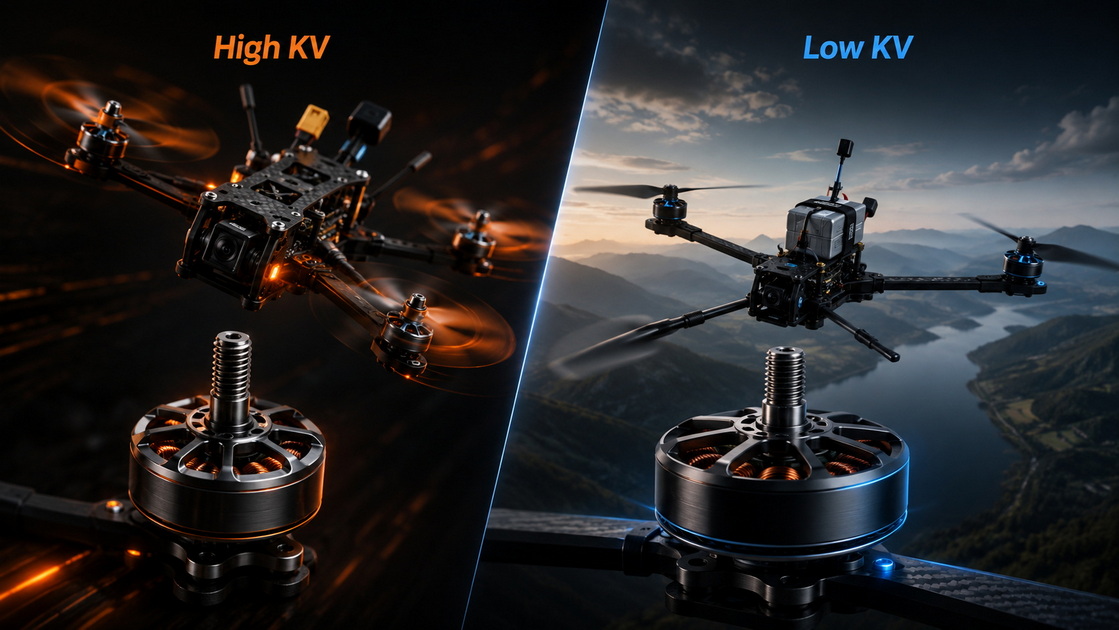
KV is the motor velocity constant. It indicates the approximate no-load RPM a brushless motor can reach for every volt applied.
No-load RPM=KV×Voltage
For example, a 2300KV motor powered by a fully charged 3S LiPo battery at 12.6V has an approximate no-load speed of:
2300×12.6=28,980 RPM
This number is only a starting point. Once a propeller is installed, the motor must work against aerodynamic resistance. Actual RPM changes according to propeller diameter, pitch, blade count, throttle position, battery voltage sag, ESC settings, airflow, and motor temperature.
A common mistake is to assume that a higher KV number means a more powerful motor. In reality, KV describes speed potential, not total output capability.
A motor's usable performance also depends on:
- Stator diameter and stator height
- Magnet strength and magnetic circuit design
- Copper winding configuration
- Motor resistance
- Propeller size and blade design
- Battery voltage and discharge rate
- ESC current capacity
- Aircraft weight and payload
- Cooling conditions during flight
A high-KV motor with a small stator may spin rapidly but struggle with a larger propeller. A lower-KV motor with a larger stator may produce stronger usable torque and maintain better efficiency with a larger, heavier propeller.
| Factor | High KV FPV Motor | Low KV FPV Motor |
|---|---|---|
| RPM at the same voltage | Higher | Lower |
| Typical battery pairing | Lower-voltage packs | Higher-voltage packs |
| Common propeller pairing | Smaller or lighter props | Larger or more heavily loaded props |
| Throttle response | Fast and aggressive | Smooth and progressive |
| Current draw risk | Higher when over-propped | Lower when properly matched |
| Heat risk | Higher if voltage or prop load is excessive | More controlled in a matched system |
| Flight style | Racing, lightweight freestyle, micro FPV | Long-range, cinematic, heavy-lift, efficient cruising |
| Typical design priority | Instant acceleration | Controlled power and endurance |
The table above is a useful guide, but it does not replace system-level matching. Two motors with the same KV can perform very differently if their stator dimensions, windings, magnet quality, bearings, or intended propeller range are different.
A high KV FPV motor is often the better option when the aircraft uses a lower-voltage battery, smaller propellers, and needs fast throttle response.
High-KV motors are widely used in compact FPV builds because small propellers require fast rotational speed to generate useful thrust.
High KV brushless motors are commonly used in:
- 1S and 2S tiny whoops
- 2-inch to 4-inch micro FPV drones
- Lightweight 4S freestyle drones
- 4S racing quads
- Small propeller ducted-fan systems
- Compact RC vehicles
- High-speed experimental platforms
For example, a typical 5-inch drone running a 4S battery may use a motor in the 2300KV to 2800KV range. The lower voltage of a 4S battery means the motor needs more KV to reach a suitable RPM range for a 5-inch propeller.
High KV motors can offer several advantages when they are matched correctly.
- Quick spool-up: The motor can accelerate rapidly, creating a responsive and direct flight feel.
- Strong punch-out performance: Lightweight racing and freestyle builds can achieve sharp bursts of acceleration.
- Good performance on lower voltage: Higher KV helps a motor reach useful RPM when using 1S, 2S, 3S, or 4S batteries.
- Suitable for compact props: Small propellers often need more RPM to generate enough thrust.
- Aggressive control response: Pilots who prefer fast flips, rolls, dives, and rapid direction changes may prefer this feel.
A high-KV motor can become inefficient or unsafe if it is paired with a battery voltage or propeller load that is too demanding.
Potential issues include:
- High current spikes
- Motor overheating
- ESC overheating
- Battery voltage sag
- Shorter flight time
- Reduced efficiency during cruise
- Increased propeller noise
- Premature wear on electronic components
For example, a motor designed for a 4S 5-inch configuration may overheat quickly if it is moved to a 6S battery with the same aggressive propeller. The added voltage raises the potential RPM significantly and may push the motor, ESC, and battery beyond their preferred operating range.
A low KV FPV motor is generally a better match for higher-voltage batteries, larger propellers, heavier aircraft, longer flight times, and applications that need stable, predictable thrust.
Rather than relying on extremely high RPM, a low-KV system often uses voltage, stator size, and propeller area more efficiently.
Low KV FPV motors are often suitable for:
- 6S 5-inch freestyle drones
- 6-inch and 7-inch long-range FPV drones
- Cinewhoops
- Camera-carrying drones
- Heavy-lift multirotors
- Inspection and survey UAVs
- Large RC aircraft
- Underwater robotic propulsion systems
- Custom industrial power systems
A typical 6S 5-inch FPV drone often uses a motor around 1600KV to 2100KV. For a 7-inch long-range drone on 6S, the range may be closer to 1300KV to 1600KV, depending on the propeller, aircraft weight, target cruising speed, and required payload capacity.
A low-KV motor can provide important advantages in larger or higher-voltage builds.
- Better compatibility with 6S and higher voltage systems
- More controlled RPM with larger propellers
- Improved cruising efficiency when properly matched
- Lower heat risk under sustained load
- Smoother throttle behavior
- More predictable camera movement
- Better suitability for payload-carrying platforms
- Greater potential for long-range flight stability
Low KV is especially useful when the aircraft must fly for extended periods rather than repeatedly accelerate at full throttle. This includes long-range exploration, cinematic filming, inspection work, mapping, delivery experiments, and other specialized applications.
A low-KV motor can also be the wrong choice if it does not provide enough RPM or thrust for the specific build.
When KV is too low, the aircraft may experience:
- Slower throttle response
- Weak acceleration
- Limited recovery power
- Poor wind resistance
- Reduced maximum speed
- Insufficient thrust for added payload
- A soft or underpowered flight feel
The correct solution is not always to increase KV. A larger stator, different winding, different propeller, lighter frame, or higher battery voltage may be more effective.
Battery voltage is one of the biggest factors in motor selection.
A higher-voltage battery supplies more voltage to the motor. Since RPM is approximately related to KV multiplied by voltage, higher voltage generally requires lower KV to stay within an appropriate operating range.
| Build Type | Typical Battery | Typical KV Direction | Primary Goal |
|---|---|---|---|
| Tiny whoop | 1S–2S | Very high KV | Useful RPM at low voltage |
| Small micro FPV drone | 2S–4S | Medium to high KV | Fast response and lightweight power |
| 5-inch FPV drone | 4S | Higher KV | Racing and aggressive freestyle |
| 5-inch FPV drone | 6S | Lower KV | Balanced power and controlled current |
| 6-inch to 7-inch drone | 6S | Lower KV | Efficient cruise and larger propeller control |
| Heavy-lift UAV | 6S–12S or higher | Low KV | Torque, endurance, and payload stability |
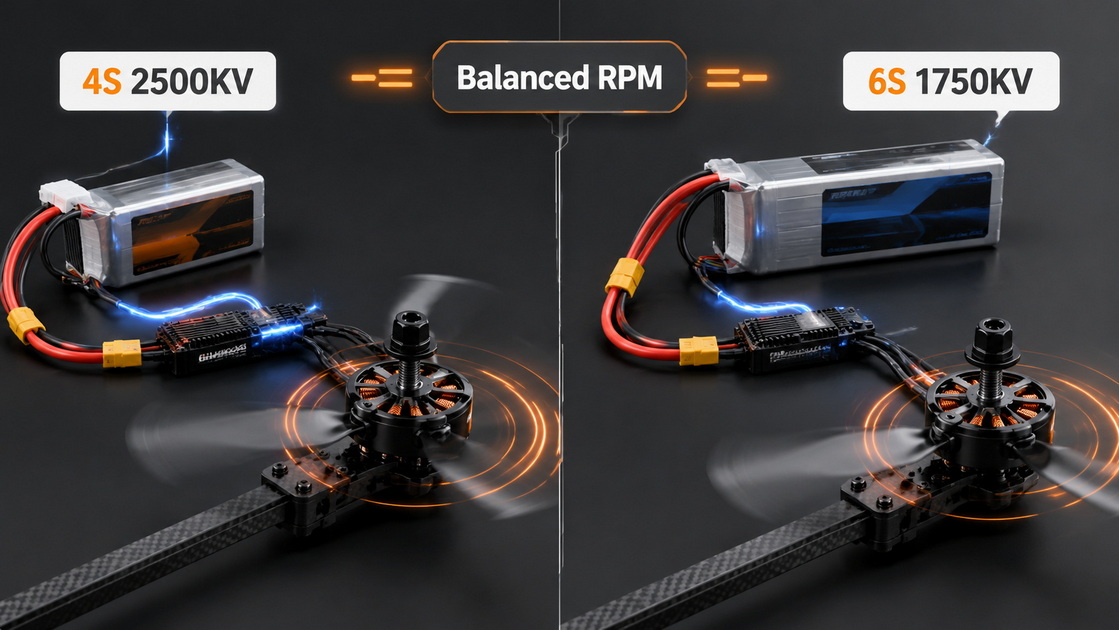
A 4S 5-inch build may use a 2500KV motor, while a 6S 5-inch build may use a 1750KV motor.
| Setup | Motor KV | Fully Charged Battery Voltage | Approximate No-Load RPM |
|---|---|---|---|
| 4S 5-inch FPV build | 2500KV | 16.8V | 42,000 RPM |
| 6S 5-inch FPV build | 1750KV | 25.2V | 44,100 RPM |
These figures show why a lower KV motor is normally used with 6S batteries. Although the KV ratings are different, the RPM potential remains within a similar operating area.
Actual flight performance will still vary because propeller loading, motor construction, battery health, ESC settings, air density, and flying style all influence the final result.
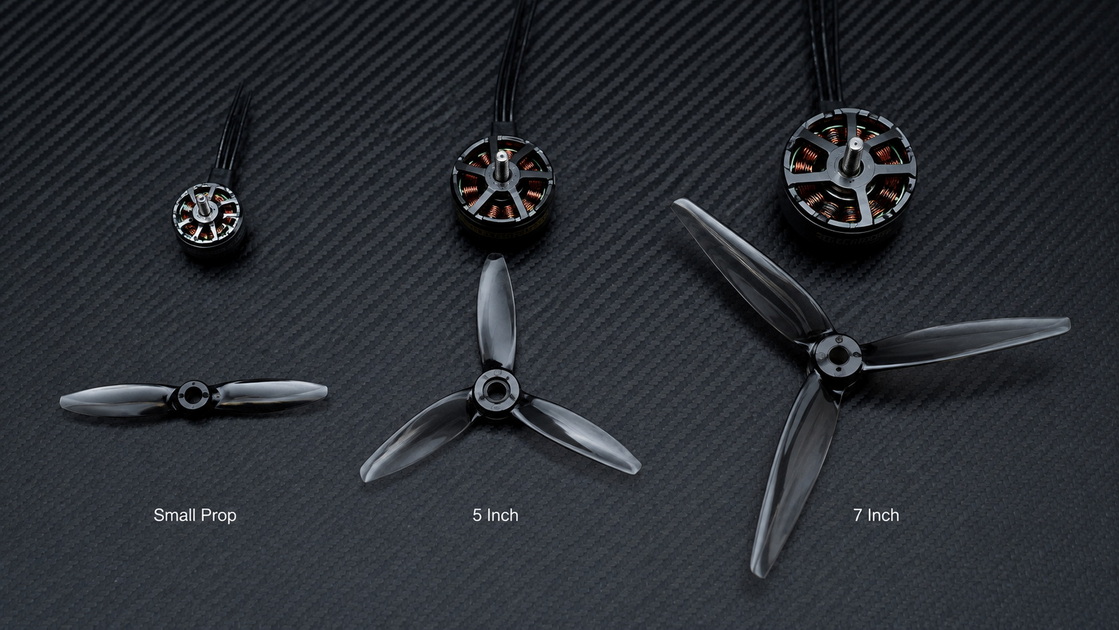
The propeller creates the working load for the motor. A motor cannot be selected correctly without considering propeller diameter, pitch, blade count, blade profile, and material stiffness.
A larger, higher-pitch, or multi-blade propeller generally requires more torque and more current.
- Diameter: Larger diameters usually increase the load on the motor and generate more disc area.
- Pitch: Higher pitch can increase forward-speed potential but usually demands more power.
- Blade count: More blades can provide stronger grip and smoother handling, but often increase current draw.
- Blade profile: Blade shape affects efficiency, noise, response, and airflow characteristics.
- Material stiffness: A rigid propeller may respond differently from a flexible propeller under heavy load.
A motor that works well with a 5-inch bi-blade propeller may run much hotter with a high-pitch tri-blade propeller. This is why propeller changes should be treated as power-system changes, not simple accessory changes.
Motor and propeller performance should be judged by more than maximum thrust.
One useful metric is grams of thrust produced per watt of power consumed:
Efficiency=Thrust (g)/Power (W)
A higher grams-per-watt result indicates that the propulsion system produces more thrust for each watt consumed.
For long-range, camera, and industrial applications, a slightly lower maximum-thrust setup may be preferable if it produces much better efficiency and lower operating temperatures.
The best way to select an FPV motor is to start with the aircraft's mission, then build the propulsion system around that mission.
First, identify what the aircraft needs to do.
- Racing
- Freestyle
- Long-range flight
- Cinematic filming
- Indoor flying
- Heavy lifting
- Inspection
- Mapping
- Underwater propulsion
- Custom robotics
A racing drone needs instant response and high thrust-to-weight ratio. A long-range aircraft needs low cruising current, stable handling, and a comfortable thermal margin. A camera platform needs smooth throttle behavior and reliable payload support.
Battery voltage and propeller size should be decided before finalizing motor KV.
A practical starting point is:
| Propeller and Battery Setup | Common Motor Direction |
|---|---|
| 1.6-inch to 2-inch prop with 1S battery | Very high KV |
| 3-inch to 4-inch prop with 3S or 4S battery | Medium to high KV |
| 5-inch prop with 4S battery | Higher KV |
| 5-inch prop with 6S battery | Lower KV |
| 6-inch to 7-inch prop with 6S battery | Lower KV with larger stator |
| Large propeller industrial system | Low KV with high-torque motor design |
These are starting points rather than fixed rules. The final motor choice should always consider the total aircraft weight and the required thrust reserve.
KV does not replace motor size.
A larger propeller, heavier drone, or higher payload requires a motor with sufficient stator volume and torque capability. A low-KV motor with an undersized stator can still struggle. Likewise, a high-KV motor with a large stator may generate substantial power but can create excessive current demand if it is incorrectly paired.
For multirotor aircraft, the total maximum thrust should generally be at least twice the all-up weight. Racing and acrobatic builds often require a higher thrust-to-weight ratio for rapid recovery, sharp maneuvers, and reliable handling in wind.
Before finalizing a motor-propeller combination, compare test results using the closest available setup.
Review:
- Battery voltage
- Propeller model
- Throttle position
- Current draw
- Power consumption
- Maximum thrust
- Efficiency
- Motor temperature
- ESC temperature
- Recommended operating range
Maximum thrust is useful, but it should not be the only decision factor. A motor that produces the highest peak thrust may consume too much current for the target flight time, battery size, or thermal requirements.
A successful first flight does not always prove that a propulsion system is correctly matched. A build may fly normally for a short period while still operating close to its electrical or thermal limits.
After a controlled hover and a few moderate punch-outs, inspect the system carefully.
1. Land and disarm the aircraft.
2. Check motor temperature with an infrared thermometer when possible.
3. Inspect the ESC and battery for abnormal heat.
4. Review current data or blackbox logs if available.
5. Check for excessive battery voltage sag.
6. Inspect propellers for damage, flex, cracks, or imbalance.
7. Confirm that the aircraft still has enough throttle reserve for recovery maneuvers.
Warning signs include very hot motors, hot ESCs, burnt odor, unusually short flight time, severe battery sag, vibration, oscillation, or reduced throttle response.
When these signs appear, reduce the propeller load, select a lower pitch propeller, revise the KV rating, use a better-matched battery voltage, or upgrade the motor and ESC system.

A high KV FPV motor is usually better for lower-voltage systems, lightweight builds, smaller propellers, and pilots who want fast throttle response. It is especially common in tiny whoops, micro FPV drones, 4S racing quads, and aggressive freestyle builds.
A low KV FPV motor is generally better for higher-voltage batteries, larger propellers, longer flight times, heavier payloads, and smooth sustained flight. It is often the preferred direction for 6S 5-inch builds, 7-inch long-range drones, cinewhoops, industrial UAVs, RC aircraft, and specialized robotic systems.
The most reliable choice comes from viewing the motor as part of a complete power system:
Motor stator + KV + battery voltage + propeller + ESC + aircraft weight + intended application.
Zhongshan Yuhang Power Technology Co., Ltd. develops and manufactures brushless motor solutions for FPV drones, RC vehicles, high-speed fans, gimbal cameras, aircraft, robotic vacuum systems, underwater robots, and other specialized equipment. Custom OEM and ODM motor development can include KV selection, stator dimensions, winding design, shaft configuration, cable requirements, propeller compatibility, and application-specific testing.
KV indicates the approximate no-load RPM that a motor can reach for each volt applied. A 2000KV motor has an approximate no-load speed of 2,000 RPM per volt.
No. Higher KV increases RPM potential at the same voltage, but top speed depends on propeller choice, battery voltage, motor torque, aircraft weight, aerodynamic drag, and tuning.
It is generally not recommended unless the motor manufacturer specifically approves the exact motor, propeller, and battery combination. The higher voltage can cause excessive RPM, current draw, motor heat, and ESC stress.
A common starting range is approximately 2300KV to 2800KV for 4S 5-inch builds and 1600KV to 2100KV for 6S 5-inch builds. The final choice should account for motor size, propeller pitch, aircraft weight, and flight style.
Many 6S 7-inch long-range builds use approximately 1300KV to 1600KV. A larger stator motor is often needed because a 7-inch propeller produces a much higher load than a 5-inch propeller.
1. Oscar Liang. [How to Choose FPV Drone Motors]
2. Pyrodrone. [Choosing the Right KV for Your Drone]
3. UAV Model. [FPV Motor Thrust Testing and Selection Guide]
4. LIGPOWER. [The Ultimate FPV Drone Motors Guide]
5. LIGPOWER. [FPV Motors KV Rating Explained: What It Means and How to Choose]
6. UAV Model. [Stator Volume, KV Selection, and Thrust-to-Weight Ratio]
7. DroneVibes. [Motor and Propeller Efficiency Testing With a Dynamometer]


