Language


Views: 208 Author: Yuhang Power Publish Time: 2026-08-17 Origin: Site
Content Menu
● FPV Freestyle Motor vs Cinematic Motor: The Core Difference
● How FPV Drone Motor Specifications Influence Flight Performance
>> Stator Size Determines Motor Character
>> KV Rating Matches Motor Speed to Voltage
>> Propeller Choice Changes Motor Performance
● FPV Freestyle Motors: Power for Dynamic Flying
>> What a Freestyle FPV Motor Should Deliver
● Cinematic FPV Motors: Smooth Power for Better Footage
>> What a Cinematic FPV Motor Should Deliver
● Thrust-to-Weight Ratio: A Practical Motor Selection Tool
● How to Choose the Right FPV Motor
>> Step 1: Define the Aircraft Mission
>> Step 2: Review Motor Test Data Carefully
>> Step 3: Match the Entire Power System
● Common FPV Motor Selection Mistakes
>> Choosing the Highest KV Available
>> Focusing Only on Maximum Thrust
>> Selecting Motors Before Calculating Payload
● Which FPV Motor Fits Your Flying Style?
● Build a Motor System Around Real Flight Requirements
● FAQ
>> 1. What is the main difference between a freestyle FPV motor and a cinematic FPV motor?
>> 2. Can a freestyle motor be used for cinematic FPV flying?
>> 3. Is a lower KV motor always better for cinematic drones?
>> 4. What motor size is common for a 5-inch freestyle FPV drone?
>> 5. Why does a cinematic drone need enough thrust reserve?
Choosing between an FPV freestyle motor and a cinematic drone motor is not simply about selecting a KV rating or choosing the largest stator that fits your frame. The right brushless motor affects throttle response, dive recovery, camera stability, flight time, motor temperature, and the overall feeling of the aircraft.
For pilots, the correct choice creates a more confident and enjoyable flight experience. For drone brands and product developers, motor selection affects system safety, product reliability, production consistency, and customer satisfaction.
At Zhongshan Yuhang Power Technology Co., Ltd., we develop and manufacture brushless motors and propulsion solutions for FPV drones, RC vehicles, high-speed fans, camera gimbals, aircraft, cleaning robots, underwater robots, and other professional equipment. This guide explains the practical differences between freestyle FPV motors and cinematic FPV motors, helping you build a propulsion system around your real application.
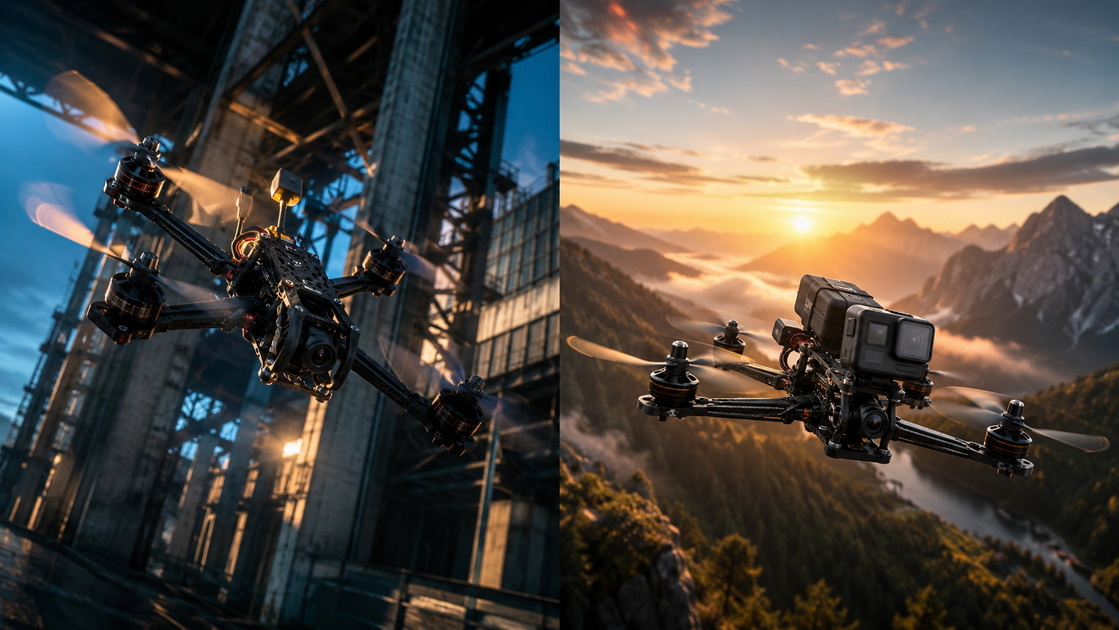
An FPV freestyle motor is designed for rapid response. It supports fast acceleration, hard punch-outs, quick direction changes, flips, rolls, power loops, and strong recovery after dives.
A cinematic FPV motor is selected for smooth control. It should provide stable lift, predictable throttle response, efficient cruising, and practical support for action cameras or other payloads.
Neither motor type is automatically better. The correct choice depends on how the drone will fly.
| Selection Factor | FPV Freestyle Motor | Cinematic FPV Motor |
|---|---|---|
| Primary purpose | Tricks, dives, power loops, and proximity flying | Smooth footage, stable tracking shots, and camera carrying |
| Flight feel | Aggressive, quick, and direct | Controlled, progressive, and predictable |
| Throttle response | Fast and powerful | Smooth and easy to modulate |
| Power priority | Strong peak thrust and fast recovery | Stable usable thrust and efficiency |
| Typical propeller style | Tri-blade, higher pitch, stronger grip | Lower-pitch tri-blade, bi-blade, or smoother prop profile |
| Common operating load | High and variable | More stable and sustained |
| Main motor focus | Torque, durability, and response | Efficiency, stability, and vibration control |
| Best for | Freestyle pilots and dynamic flight | Filmmakers, content creators, and long smooth flight paths |
A motor's behavior is always influenced by the complete aircraft setup. The same motor may feel powerful and aggressive on one build, but smooth and controlled on another build with a different propeller, battery, flight controller tune, and payload.
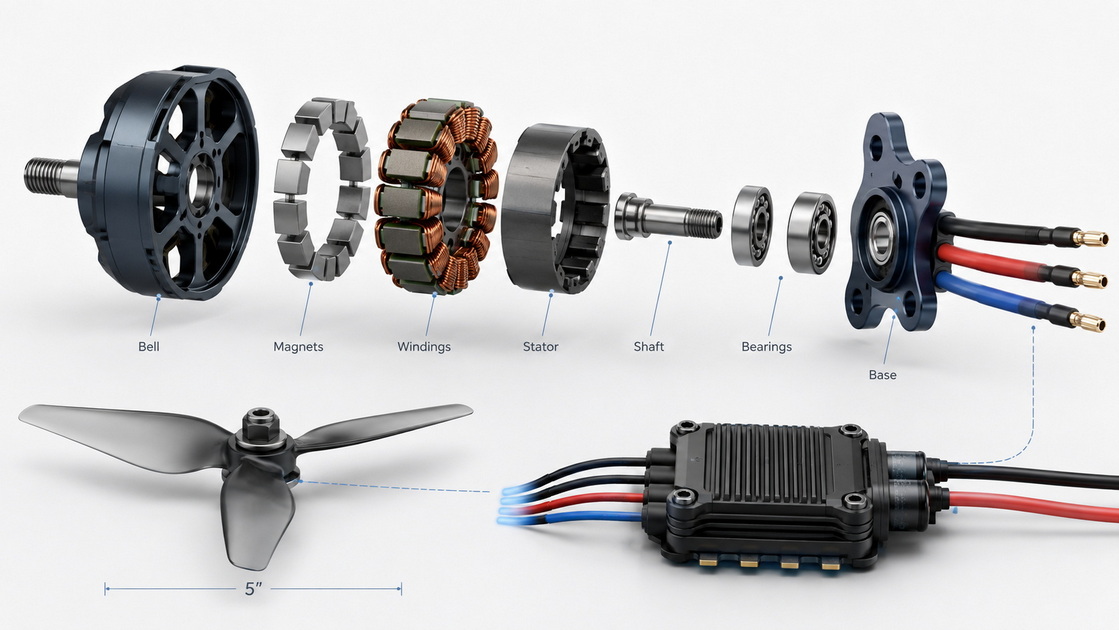
FPV motor naming usually refers to stator dimensions.
For example:
- 2207 means a 22 mm stator diameter and 7 mm stator height
- 2306 means a 23 mm stator diameter and 6 mm stator height
- 2004 means a 20 mm stator diameter and 4 mm stator height
A larger stator generally creates more torque potential. This is useful when a propeller needs to accelerate rapidly or when the drone carries additional weight.
For a 5-inch freestyle drone, 2207 and 2306 motor formats are widely used because they offer a strong balance of power, agility, and durability.
For cinematic drones, stator size should match the loaded weight of the aircraft. A lightweight 4-inch cinematic drone may benefit from a smaller and more efficient motor. A heavier 6-inch or 7-inch drone carrying an action camera, GPS, prop guards, and a larger battery may require more torque.
The most important rule is simple: select motor size according to the complete aircraft weight, propeller size, battery voltage, and payload requirement.
KV indicates the theoretical no-load RPM a motor can produce for each volt supplied. It is a useful selection parameter, but it should never be evaluated alone.
A higher KV motor can spin faster at the same voltage. This may create stronger initial acceleration, but it can also increase current draw and motor temperature if the propeller load is too high.
A lower KV motor is often suitable for:
- Higher-voltage battery systems
- Larger propellers
- Heavier aircraft
- Longer flight profiles
- Camera-carrying applications
- More controlled throttle behavior
For many 5-inch 6S freestyle drones, a KV range around 1700KV to 2000KV is a practical starting point. For many 4S 5-inch builds, pilots often consider approximately 2450KV to 2750KV.
These ranges are not fixed rules. The right KV depends on propeller pitch, propeller blade count, motor design, aircraft weight, ESC settings, battery condition, and the desired flight style.
The propeller is one of the most important parts of the power system.
A high-pitch tri-blade propeller can provide strong grip and rapid acceleration. It can also place greater load on the motor, increase current draw, and reduce flight time.
A lighter or lower-pitch propeller can reduce load. This often improves smoothness and efficiency, which is valuable for cinematic flights where stable movement matters more than explosive punch-outs.
Before choosing a motor, confirm these requirements:
1. Propeller diameter
2. Number of propeller blades
3. Propeller pitch
4. Battery voltage
5. Expected all-up weight
6. Payload weight
7. Target flight duration
8. Desired throttle behavior
A motor should never be selected without considering the propeller it will drive.
Freestyle flying is highly demanding. A pilot may rapidly descend through a gap, recover from a dive, reverse direction, perform a power loop, or accelerate immediately after a roll.
This requires a motor with strong usable torque, fast propeller response, thermal reliability, and mechanical strength.
A well-matched freestyle motor should provide:
- Strong low-end torque
- Fast throttle response
- Rapid propeller acceleration
- Reliable dive recovery
- High peak thrust
- Stable operation during high-current bursts
- Durable shaft and bearing construction
- Good rotor balance
For many 5-inch freestyle builds, 2207 and 2306 motors remain popular formats. A 2207 design often provides a more torque-focused feel, while a 2306 design can offer a balanced combination of response, efficiency, and smooth control.
However, the final result depends heavily on the propeller and battery setup.
Freestyle-oriented motor systems can offer:
- Strong punch-outs
- Better recovery after fast dives
- More confident handling in wind
- Fast direction changes
- A more direct stick feel
- More power reserve for demanding maneuvers
More power can also create additional demands on the aircraft.
- Aggressive acceleration increases current draw
- High-pitch props may increase motor temperature
- Larger stators can increase motor weight
- Higher power consumption may reduce flight time
- Poor motor-propeller matching can increase vibration
- Excessive KV may overload the battery and ESC
The best freestyle system is not the most powerful possible setup. It is the setup that produces reliable, controllable power for the intended frame and flying style.
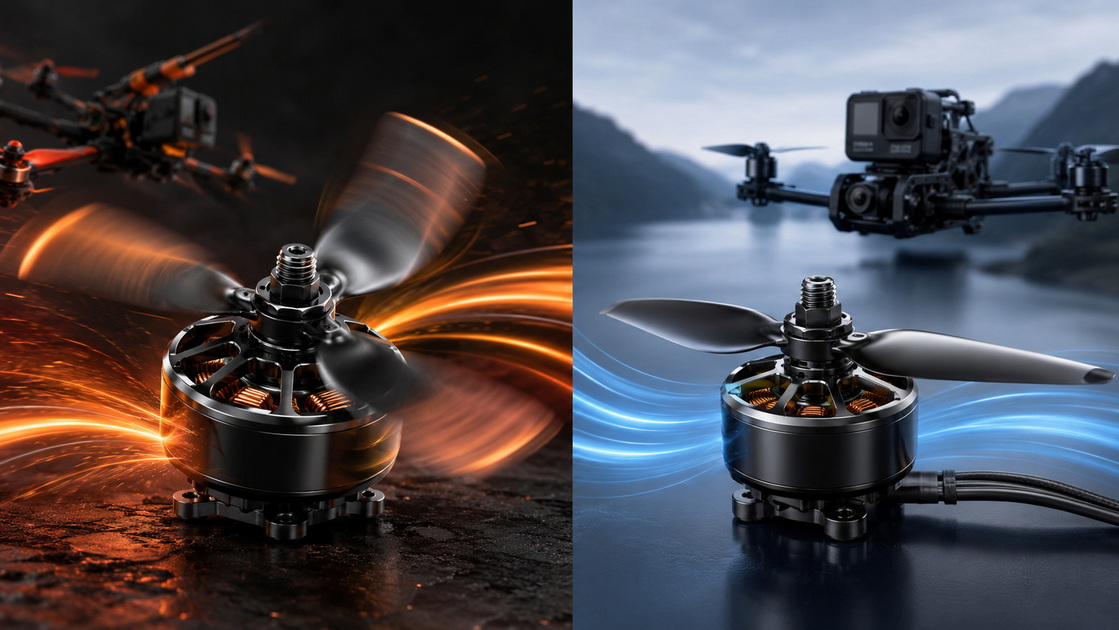
Cinematic FPV flying focuses on movement quality. The pilot may follow a vehicle, fly through a forest, track an athlete, orbit a building, or create a low and smooth reveal shot.
The motor needs to provide predictable power during normal flight, especially at low and mid-throttle positions.
A cinematic drone should not feel overly sensitive. It should feel stable, controllable, and smooth.
A well-matched cinematic FPV motor should provide:
- Smooth throttle resolution
- Stable mid-throttle performance
- Practical cruise efficiency
- Consistent lift with camera payloads
- Low vibration potential
- Reasonable flight time
- Controlled acceleration
- Reliable wind recovery
For cinematic work, motor performance at 30% to 50% throttle can be more important than maximum full-throttle thrust. This is where many camera flights spend most of their time.
A cinematic-oriented motor system can offer:
- Smoother movement during tracking shots
- Better control for slow flying
- More efficient cruise performance
- Stable lift with an action camera
- Lower risk of abrupt throttle changes
- Better potential for clean HD footage
A highly efficient cinematic setup may not feel as explosive as a dedicated freestyle build.
- Lower KV may reduce aggressive punch-out performance
- Lighter propellers may offer less grip during hard maneuvers
- Heavy payloads reduce available thrust reserve
- Low-power configurations may struggle in strong wind
- Overly soft response can make fast recovery more difficult
A cinematic drone still needs sufficient power reserve. The aircraft should not hover close to maximum throttle with its normal camera and battery installed.
The most useful performance question is not, "How much thrust does one motor make?"
The better question is, "How much total thrust does the complete aircraft produce compared with its ready-to-fly weight?"
Use this formula:
A higher thrust-to-weight ratio provides more reserve power. This allows the drone to accelerate, recover from a dive, compensate for wind, and carry payloads more confidently.
| Flight Goal | Suggested Thrust-to-Weight Range |
|---|---|
| Indoor micro drone | Around 2:1 or higher |
| Smooth cinematic cruising | Around 2.5:1 to 4:1 |
| Camera-carrying freestyle | Around 4:1 or higher |
| Aggressive freestyle | Around 6:1 to 10:1 or more |
| Racing-focused build | Around 8:1 to 12:1 |
These figures should be treated as planning references. Actual performance is affected by battery voltage sag, ambient temperature, altitude, propeller condition, wind, aircraft tune, and pilot skill.
Start with the real purpose of the drone.
Ask the following questions:
- Will the drone perform tricks or capture smooth footage?
- Will it carry a naked action camera or a full-size action camera?
- Is flight time more important than maximum power?
- Will the aircraft use 4S or 6S batteries?
- What propeller size and pitch will be installed?
- Will it fly indoors, outdoors, in wind, or at high altitude?
- What is the expected ready-to-fly weight?
A 5-inch freestyle drone and a 7-inch cinematic drone may use very different motor designs, even if both are built around FPV flight.
Do not compare motors by maximum thrust alone.
A complete test report should include:
- Battery voltage
- Propeller model
- Throttle percentage
- Thrust output
- Current draw
- Input power
- Efficiency
- Motor temperature when available
This data helps determine whether the motor operates efficiently across the throttle range that matters for the intended application.
For freestyle, pay close attention to high-throttle thrust and thermal behavior.
For cinematic flight, pay close attention to mid-throttle efficiency, stable lift, and smooth response.
The motor must work correctly with the ESC, battery, propeller, flight controller, and payload.
A reliable development process includes:
1. Define thrust and flight-time targets
2. Select stator size and winding configuration
3. Choose the appropriate KV range
4. Match the propeller profile
5. Verify ESC current capacity
6. Perform bench thrust testing
7. Check thermal performance
8. Validate real-world flight behavior
9. Confirm production consistency
This system-level process is especially important for OEM and ODM drone projects. A strong motor design cannot deliver its full value if it is paired with an unsuitable propeller, battery, or ESC.
Higher KV does not always create better flight performance. If the KV is too high for the selected battery voltage and propeller, the motor may draw excessive current and generate unnecessary heat.
Maximum thrust is important for punch-outs and recovery. But it does not show how smooth, efficient, or stable the setup will be during normal flight.
A larger motor may provide more power, but it also adds weight. Extra weight affects agility, battery consumption, crash energy, and hover throttle.
A drone that flies well as a bare frame may behave very differently after adding an HD camera, GPS module, buzzer, prop guards, landing gear, and a full-size battery.
Always calculate the expected all-up weight before making the final motor decision.
A motor that performs well during a short bench test may overheat during repeated hard flights in warm weather. Check the entire system after real flight tests, including motors, ESCs, battery connectors, and wires.
Choose an FPV freestyle motor if you want:
- Strong punch-outs
- Fast flips and rolls
- Quick direction changes
- Confident dive recovery
- High-energy proximity flying
- More aggressive throttle response
- Extra reserve power for advanced maneuvers
Choose a cinematic FPV motor if you want:
- Smooth camera movement
- Controlled low-throttle behavior
- Stable tracking shots
- Efficient cruising
- Practical flight time
- Consistent lift with a camera payload
- Better potential for lower-vibration footage
Choose a hybrid setup if you want one drone to capture smooth content and still perform occasional freestyle maneuvers. In this case, choose a balanced motor size, moderate KV, matched propeller profile, and enough thrust reserve for the fully loaded aircraft.
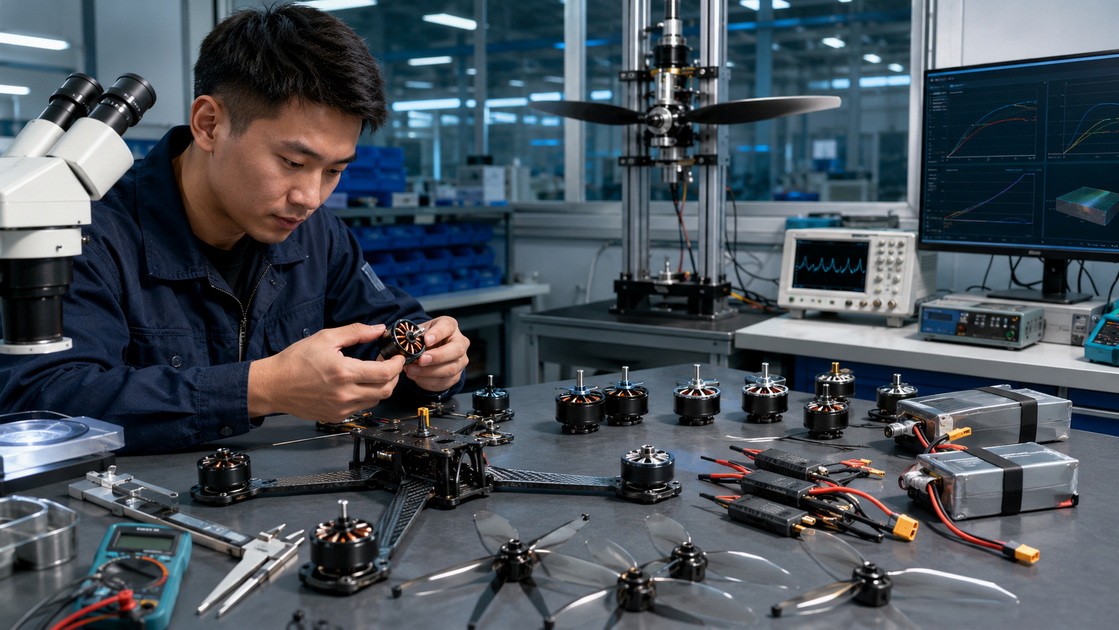
The ideal FPV drone motor is not defined by a single specification. It is defined by how well it works within the complete aircraft.
A successful motor selection considers the frame, propeller, battery, ESC, payload, target flight time, wind conditions, and expected pilot behavior.
Zhongshan Yuhang Power Technology Co., Ltd. provides brushless motor manufacturing, propulsion matching, and customized OEM and ODM solutions for FPV drones and professional equipment. By aligning motor design with your real application requirements, you can build a more reliable, efficient, and differentiated product platform.
A freestyle motor prioritizes fast response, high thrust, and strong recovery during aggressive maneuvers. A cinematic motor prioritizes smooth throttle behavior, stable lift, efficient cruising, and camera-friendly flight characteristics.
Yes. A balanced freestyle motor can support cinematic flying when it is paired with an appropriate propeller, battery, payload, and tune. However, a dedicated cinematic configuration may provide smoother throttle control and better flight efficiency.
No. Lower KV is often suitable for larger propellers, higher-voltage batteries, and heavier payloads. However, the correct KV depends on the entire propulsion system, including battery voltage, propeller load, aircraft weight, and flight goal.
2207 and 2306 are common motor formats for 5-inch freestyle FPV drones. They provide a strong balance between torque, response, durability, and manageable weight.
A cinematic drone needs reserve power to maintain stable flight in wind, carry camera equipment, recover safely from sudden altitude loss, and avoid operating near full throttle during normal flight.
1. Oscar Liang. [How to Choose FPV Drone Motors]
2. UAV Model. [FPV Drone Motor Sizing Guide: Stator Volume, KV Selection and Thrust-to-Weight Ratio]
3. UAV Model. [FPV Drone Motor Selection Guide 2026: Stator Size, KV, Thrust Testing and Timing]
4. UAV Model. [FPV Motor Thrust Testing and Selection Guide]
5. LIGPOWER. [The Ultimate FPV Drone Motors Guide]
6. Mepsking. [How to Choose FPV Drone Motor: A Detailed Guide]


