Language


Views: 213 Author: Yuhang Power Publish Time: 2026-08-14 Origin: Site
Content Menu
● What Is the Difference Between Brushed and Brushless Drone Motors?
● Brushed Motors: A Simple Starting Point
>> Limitations of Brushed Motors
● FPV Brushless Motors: The Standard for Modern Performance
>> Benefits of Brushless FPV Drone Motors
● Brushed vs Brushless Motor Performance for Beginners
>> Battery Efficiency and Flight Time
>> Durability and Crash Resistance
● The True Cost: Initial Price vs Long-Term Value
● How Beginners Should Choose an FPV Motor Setup
>> Match Motor Size to Frame Size
>> Understand KV Before Buying
● A Practical Beginner Motor Checklist
● Expert Insight: A Motor Is Only One Part of the System
● Safety and Compliance Before Your First Flight
● Final Verdict: Should Beginners Buy Brushless or Brushed Motors?
>> 1. Is a brushless motor always better than a brushed motor?
>> 2. Can a complete beginner fly a brushless FPV drone?
>> 3. Why do brushed drone motors wear out faster?
>> 4. Do brushless FPV motors need maintenance?
>> 5. What does KV mean on an FPV brushless motor?
Choosing between an FPV brushless motor and a brushed motor affects much more than the price of your first drone. It influences flight control, repair frequency, battery use, durability, learning speed, and your future upgrade options.
For most new FPV pilots, a brushless FPV drone motor is the better long-term choice. A brushed motor can still be suitable for very small, low-cost indoor drones. The right option depends on where you fly, how often you practice, your budget, and whether you plan to move into freestyle, racing, cinematic FPV, or custom drone building.
Choose a brushed motor for low-cost, gentle indoor practice. Choose a brushless motor for stronger performance, more precise control, longer service life, and a better path for skill development.
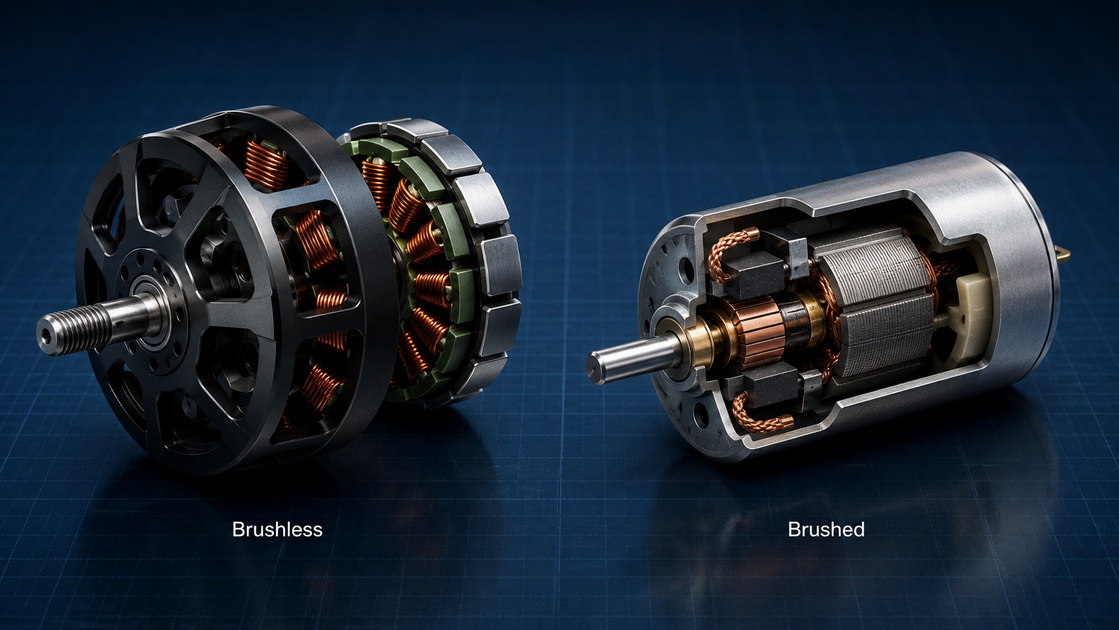
Both motor types turn battery power into propeller rotation. The main difference is how they switch electrical current to keep the rotor moving.
A brushed motor uses physical carbon brushes and a commutator. The brushes touch moving components inside the motor. As the rotor spins, this mechanical contact changes the current direction.
A brushless motor, also known as a BLDC motor, removes the brushes and commutator. Instead, an electronic speed controller, or ESC, sends timed electrical pulses to the motor windings. The ESC works with the flight controller to manage motor speed with high precision.
This structural difference has a major effect on power, efficiency, lifespan, and overall flight performance.
| Feature | Brushed Drone Motor | FPV Brushless Motor |
|---|---|---|
| Commutation method | Physical brushes and commutator | Electronic switching through an ESC |
| Initial drone cost | Lower | Higher |
| Power output | Lower | High to very high |
| Throttle response | Softer and less precise | Fast and highly controllable |
| Efficiency | Lower due to friction and heat | Generally higher |
| Motor lifespan | Limited by brush wear | Longer with proper care |
| Maintenance | Frequent motor replacement may be needed | Inspection and bearing maintenance |
| Common use | Toy drones and basic micro drones | FPV freestyle, racing, cinewhoops, and professional UAVs |
| Best suited for | Casual indoor beginners | Beginners who plan to progress |
Brushed motors are still widely used in small, lightweight, and affordable drones. They are common in toy-grade quadcopters, educational kits, tiny indoor drones, and entry-level products where low cost is the main priority.
Their biggest advantage is simplicity. A brushed drone usually has fewer technical settings, lower initial power, and a less aggressive flight feel. For someone learning basic orientation and hover control in a small indoor space, this can be useful.
- Lower purchase cost for a first drone
- Simple structure and basic operation
- Gentle power delivery on many small models
- Lightweight design for compact frames
- Low replacement cost for common coreless motors
- Suitable for indoor practice in calm environments
A brushed micro drone can help a complete beginner understand the relationship between stick input and drone movement. It can also provide a less intimidating introduction before moving to a more capable FPV system.
The low retail price does not always mean the lowest long-term ownership cost.
Brushed motors contain physical contact points. The brushes gradually wear as the motor operates. This wear can reduce performance over time, even if the drone has not experienced a major crash.
Common signs of a worn brushed motor include:
- Reduced lift and weaker throttle response
- Shorter flight time
- Inconsistent motor speed
- Excessive heat
- Difficulty holding altitude
- Uneven flight behavior
- Increased noise during operation
Brushed motors also provide limited power. They are less suitable for outdoor flying, windy conditions, camera payloads, aggressive maneuvering, or long-term freestyle and racing development.
For many pilots, a brushed drone becomes too limited soon after they master basic flight control.
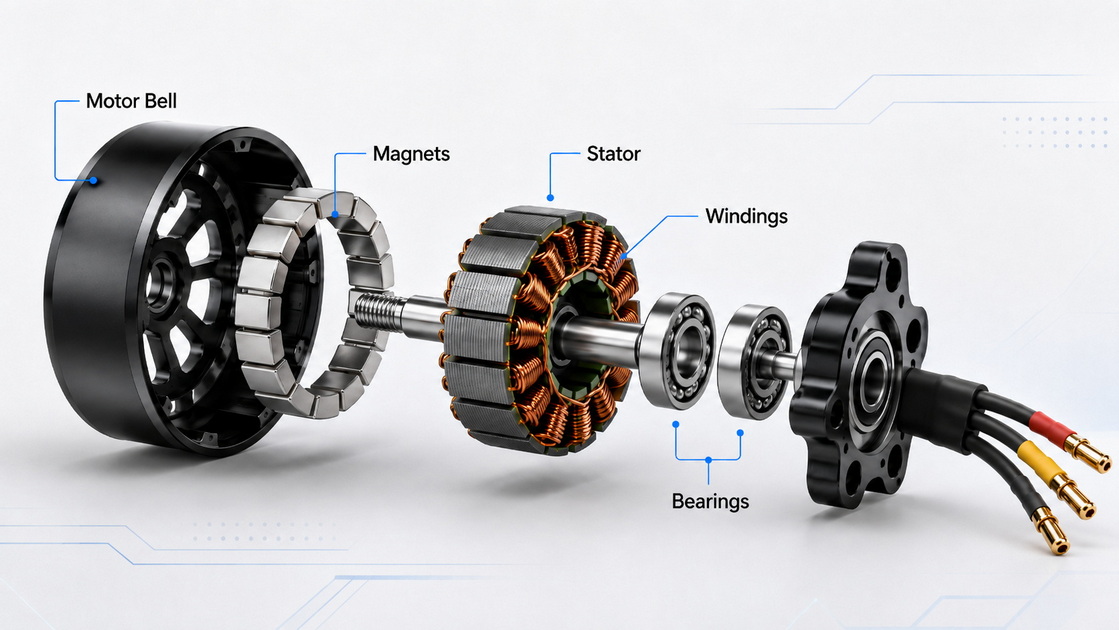
A brushless FPV motor typically uses a stationary stator with copper windings and a rotating bell containing permanent magnets. The ESC energizes the motor coils in a controlled sequence, creating the magnetic force needed to rotate the motor.
This design provides better control of speed, torque, and responsiveness.
Brushless drone motors are available in a wide range of stator sizes, KV ratings, mounting patterns, and power profiles. This allows builders and manufacturers to match a motor to a drone frame, propeller size, battery voltage, payload requirement, and intended flight style.
- Higher power output for stronger lift and faster acceleration
- Better efficiency when paired with suitable propellers and batteries
- Fast throttle response for precise flight control
- Higher torque for propeller acceleration and recovery
- Longer operating life because there are no carbon brushes
- Better performance consistency across repeated flights
- Wide range of configurations for different drone sizes
- Strong upgrade potential for experienced users and custom builders
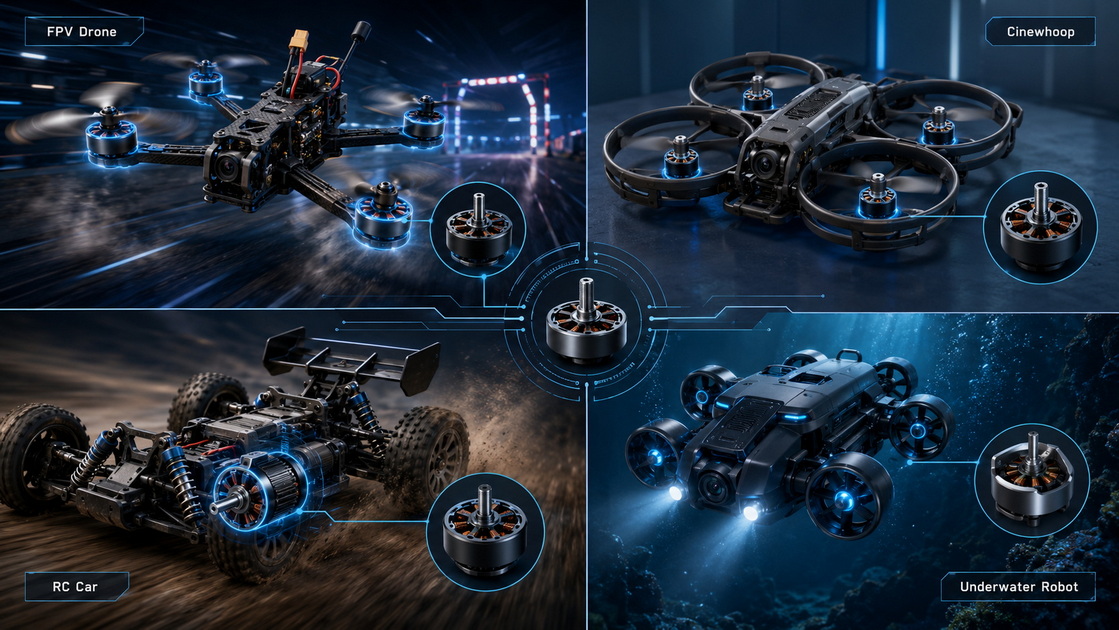
Brushless motors are widely used in FPV racing drones, freestyle quads, cinewhoops, long-range drones, camera platforms, RC vehicles, robotics, gimbal systems, underwater equipment, and other demanding applications.
For a beginner, the strongest advantage is not simply speed. It is the ability to start with a manageable configuration and continue using the same platform as skills improve.
The best motor type is not only about maximum thrust. It is about which system provides a better learning experience.
Brushed drones usually provide enough thrust for gentle indoor flight. However, they have limited reserve power. A beginner may struggle when flying outdoors, dealing with wind, climbing quickly, or recovering from a sudden drop.
Brushless FPV motors deliver higher torque and faster response to throttle changes. At first, this can feel more sensitive. However, flight settings can be adjusted to make a brushless drone more beginner-friendly.
For example, pilots can use:
- Lower throttle limits
- Softer stick rates
- Stabilized flight modes
- Reduced camera angle
- Smaller and lighter propellers
- Low-power battery configurations
These settings allow a brushless drone to remain manageable while preserving its long-term capability.
Brushed motors lose energy through friction between the brushes and commutator. This creates heat and reduces the amount of battery power converted into useful thrust.
Brushless motors generally operate more efficiently because they eliminate this mechanical brush contact. A properly matched brushless power system can provide better battery use, more stable performance, and more usable thrust throughout a flight.
However, brushless motors do not automatically guarantee longer flight time.
Flight time also depends on:
- Motor KV rating
- Propeller size and pitch
- Battery voltage and capacity
- Drone weight
- Pilot throttle habits
- Wind conditions
- Flight style
- ESC settings
A powerful racing drone can consume battery power very quickly. A carefully matched brushless cruising or cinematic drone may fly much more efficiently.
Crashes are a normal part of FPV learning. New pilots should expect to hit grass, branches, gates, walls, and occasionally the ground.
Brushless motors generally offer better long-term durability because they do not contain brushes that wear through normal operation. However, they can still be damaged by heavy impacts.
After a hard crash, inspect for:
- Bent shafts
- Damaged bearings
- Loose magnets
- Deformed motor bells
- Cut motor wires
- Loose mounting screws
- Damaged windings
- Unusual motor vibration
Brushed motors are often inexpensive to replace, but they can lose performance through ordinary use. Brushless motors cost more initially, yet they usually deliver stronger long-term value for pilots who fly regularly.
Both motor types generate noise. Brushed motors may create additional electrical noise because of the contact between brushes and the commutator. Brushless systems generally operate more smoothly, although propellers, frame vibration, ESC settings, and flight conditions also influence sound.
Motor temperature should always be monitored.
A warm motor after a normal flight is common. A motor that becomes extremely hot may indicate an overloaded propeller, unsuitable KV rating, damaged bearing, bent motor bell, poor ESC configuration, or incorrect power-system matching.
After a short test flight, carefully check motor temperature. If a motor is too hot to touch comfortably, stop flying and inspect the power system before continuing.
A beginner should compare total ownership cost rather than only the purchase price.
| Cost Factor | Brushed Setup | Brushless Setup |
|---|---|---|
| Initial drone price | Usually lower | Usually higher |
| Motor replacement cost | Lower per motor | Higher per motor |
| Replacement frequency | Often higher | Usually lower |
| Performance lifespan | Limited by brush wear | Longer with proper maintenance |
| Upgrade potential | Limited | Broad |
| Reuse of components | Lower | Higher |
| Long-term learning value | Basic | Strong |
A very cheap brushed drone can be an enjoyable first experience. But if the motors need repeated replacement and the drone is quickly outgrown, the total cost may become higher than starting with a compact brushless platform.
For many beginners, a small brushless whoop or compact cinewhoop provides a practical balance. It is less intimidating than a high-power 5-inch drone but still offers authentic FPV flight characteristics.
Do not choose a motor only because it has a high KV rating or looks powerful. Start with your intended flight environment and the type of drone you want to build or buy.
A brushed micro drone may be suitable if you plan to fly:
- Inside a small home
- In a classroom or training room
- In a calm indoor environment
- For basic hover and orientation practice
- With a very limited budget
A brushless FPV drone is usually better if you plan to fly:
- Outdoors in open areas
- In light wind
- With FPV goggles and a live camera feed
- For freestyle or racing practice
- For cinematic drone footage
- For long-term skill development
- More than occasionally
Brushless motor sizes are commonly written as four digits, such as 2207.
The first two digits represent the stator diameter. The last two digits represent the stator height.
Common examples include:
| Motor Size | Typical Application |
|---|---|
| 0802 or 1002 | Tiny whoops and ultra-light micro FPV drones |
| 1103 or 1204 | Small 2-inch to 3-inch builds |
| 1404 or 1505 | Lightweight 3-inch to 4-inch drones |
| 2207 or 2306 | Popular 5-inch freestyle and racing drones |
| 2507 and larger | Larger propellers, long-range, and heavier payloads |
The largest motor is not always the best motor. Oversized motors add weight and may reduce efficiency. Undersized motors may overheat or feel underpowered.
KV describes the approximate no-load RPM a motor produces for each volt applied. It is not a measurement of motor quality.
In general:
- Higher KV is often paired with smaller propellers and lower-voltage battery systems.
- Lower KV is often paired with larger propellers and higher-voltage battery systems.
- Balanced KV selection helps control motor temperature, current draw, and flight efficiency.
A motor, propeller, battery, ESC, and frame must work together as one system.
Using a high-KV motor with an unsuitable battery voltage or aggressive propeller can create excessive current draw, high motor temperature, poor flight time, and potential component damage.
Before choosing a brushless FPV motor or complete drone power system, confirm the following points:
1. Frame compatibility: Check the motor mounting-hole pattern and propeller clearance.
2. Battery voltage: Confirm whether the motor is intended for 1S, 2S, 4S, 6S, or another battery configuration.
3. ESC current rating: Ensure the ESC can safely support the motor's expected current draw.
4. Propeller compatibility: Begin with the recommended propeller size and pitch range.
5. Flight purpose: Choose a motor profile for indoor flying, freestyle, racing, cinematic flight, or payload work.
6. Drone weight: Match the motor to the target takeoff weight.
7. Replacement availability: Select components with stable supply and consistent specifications.
8. Build quality: Review bearing quality, winding consistency, shaft strength, magnet bonding, and dynamic balance.
9. Testing capability: For product development, confirm thrust, current, temperature, vibration, and endurance testing.
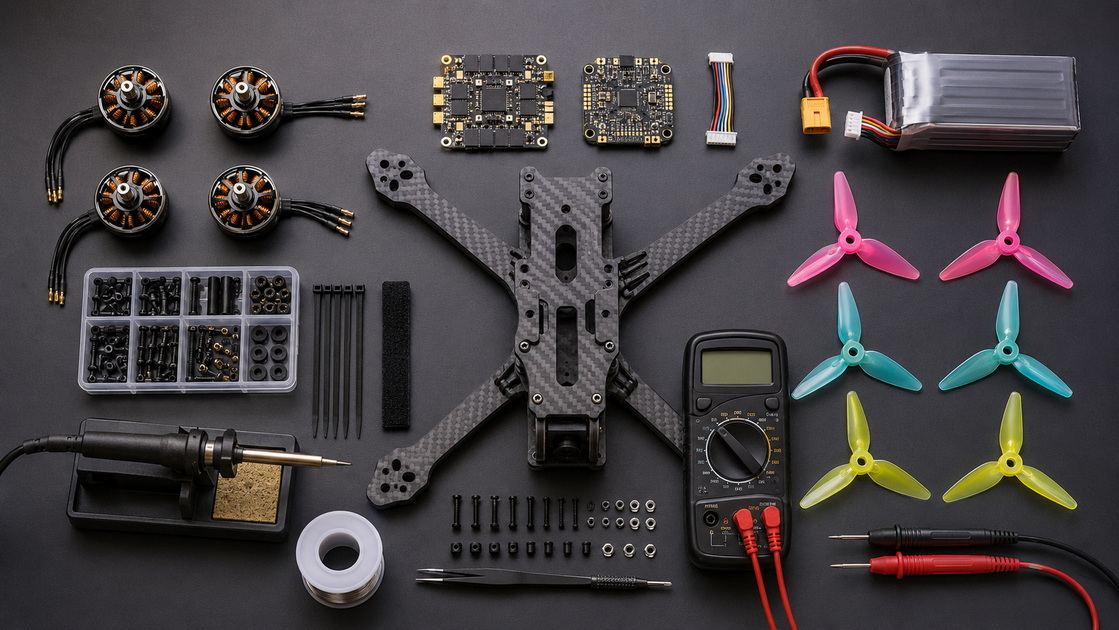
A common beginner mistake is treating the motor as an independent component.
In real FPV flight, performance comes from the combined effect of the complete power system:
- Motor stator size and KV
- Propeller diameter, pitch, and blade count
- Battery voltage, capacity, and discharge capability
- ESC current capacity and firmware settings
- Frame stiffness and total drone weight
- Flight controller configuration
- Motor filtering and tuning
- Pilot throttle management
A premium brushless motor can still perform poorly when paired with the wrong propeller or battery. In the same way, a well-matched system can make a small drone feel smooth, stable, efficient, and predictable.
For drone manufacturers and equipment developers, the goal should not be maximum RPM alone. The real target is reliable usable performance.
This requires testing thrust output, current draw, motor temperature, vibration, flight time, durability, and consistency across production batches.
Motor performance is only one part of responsible FPV flying.
Before flying, check the local drone regulations that apply to your location and intended use. Requirements may vary based on aircraft weight, flying environment, registration status, visual line-of-sight rules, and whether the activity is recreational or commercial.
Follow these basic safety practices:
- Inspect propellers before every flight
- Check motor screws and wiring
- Keep people and animals away from the launch area
- Remove loose objects near the propellers
- Use a safe open space for outdoor practice
- Never arm the drone close to your hands
- Disconnect the battery before working on the drone
- Stop immediately if you notice unusual vibration, sound, or heat
A brushless FPV motor can produce significant thrust within seconds. Always treat a powered drone as a serious machine.
A brushed drone is a reasonable option for low-cost indoor practice and basic flight orientation. It is simple, lightweight, and approachable for short-term use.
For most beginners who want to build real FPV skills, a brushless FPV motor setup is the stronger choice. It offers better power, faster response, greater durability, broader upgrade options, and more consistent long-term performance.
Start with a compact, durable brushless drone rather than a large high-power build. Use conservative settings, practice in a safe environment, and improve one skill at a time.
Zhongshan Yuhang Power Technology Co., Ltd. supports brushless motor selection, power-system development, prototype testing, and customized OEM/ODM solutions for FPV drones, RC vehicles, gimbals, robotics, underwater equipment, sweeping robots, high-speed fans, aircraft, and other professional applications. Discuss your project requirements with an experienced motor engineering team to identify a power solution that matches your performance, durability, and production goals.
Not always. A brushed motor can be suitable for very low-cost, lightweight, and simple indoor drones. However, brushless motors are generally better for performance, efficiency, durability, and long-term FPV development.
Yes. A beginner can fly a brushless FPV drone when the platform is appropriately sized and the flight settings are configured conservatively. A small brushless whoop or compact cinewhoop is often more manageable than a powerful 5-inch freestyle drone.
Brushed motors use carbon brushes that physically contact a rotating commutator. This creates friction, heat, and gradual material wear. As the brushes wear down, the motor can lose efficiency and performance.
Yes. Brushless motors need periodic inspection, especially after crashes. Check the motor bell, shaft, bearings, screws, wires, magnets, and windings. Remove debris and replace damaged parts when necessary.
KV indicates the approximate no-load RPM a motor attempts to produce for each volt applied. It helps determine suitable battery voltage and propeller range, but it should always be considered with the complete power-system configuration.
1. [Maxon Group — Brushed vs. Brushless DC Motors]
2. [Monolithic Power Systems — Brushless vs. Brushed DC Motors]
3. [T-Motor — Brushless vs. Brushed Drone Motors]
4. [LIGPOWER — Brushed vs. Brushless Motors for Drones]
5. [Federal Aviation Administration — Recreational Flyers and Community-Based Organizations]
6. [Federal Aviation Administration — How to Register Your Drone]
7. [European Union Aviation Safety Agency — Drones and UAS FAQs]


