Language


Views: 234 Author: Yuhang Power Publish Time: 2026-08-25 Origin: Site
Content Menu
● Why Russia's Supply Chain Matters
● Leading Fixed Wing Motor Supply Options
>> 1. Zhongshan Yuhang Power Technology Co., Ltd. / LN-MOTOR
>> 2. T-MOTOR
>> 6. Aeronext Ecosystem Participants
● Capacity, MOQ and Certification Comparison
>> Why "MOQ" is often misunderstood
● Fixed Wing Motor Technical Checklist
>> Performance metrics to request
>> 1. Magnet-grade substitution
>> 2. Copper quantity reduction
>> 3. "Same KV, different performance" problem
>> 4. Catalog data tested under favorable conditions
>> 5. Sample quality does not match mass production
● Buyer's Guide for Russia-Focused Procurement
>> Step 1: Define the mission profile
>> Step 2: Shortlist by evidence
>> Step 3: Order a controlled sample set
>> Step 4: Run acceptance tests
>> Step 5: Control mass production
>> Step 6: Plan compliant logistics
● FAQ
>> 1. How can I verify whether a supplier's ISO 9001 certificate has expired?
>> 2. Is a CE mark enough to prove that a Fixed Wing Motor is compliant?
>> 3. What sample quantity is sufficient before placing a production order?
>> 4. How should I compare two motors with the same KV rating?
>> 5. How can I ensure mass-production motors match the approved sample?
Russia's UAV sector is expanding, but procurement teams looking for Fixed Wing Motor suppliers should distinguish between complete-UAV assemblers, local component integrators, and specialized motor manufacturers. For brushless fixed-wing propulsion, international sourcing—particularly from established Chinese motor-production clusters—remains important because motor manufacturing requires consistent magnet materials, winding processes, balancing capability, test equipment, and repeatable quality control.
Market-research estimates place Russia's UAV propulsion market at USD 274.6 million in 2025, with a projected value of USD 420.9 million by 2030. Fixed-wing VTOL UAV demand is also expected to grow globally, supported by surveying, inspection, mapping, agriculture, and long-endurance missions.
Buyers must independently screen every transaction, end use, end user, product classification, shipping route, and payment arrangement against applicable export controls, sanctions, transport restrictions, and local laws. This article is intended for lawful civilian and commercial procurement only.
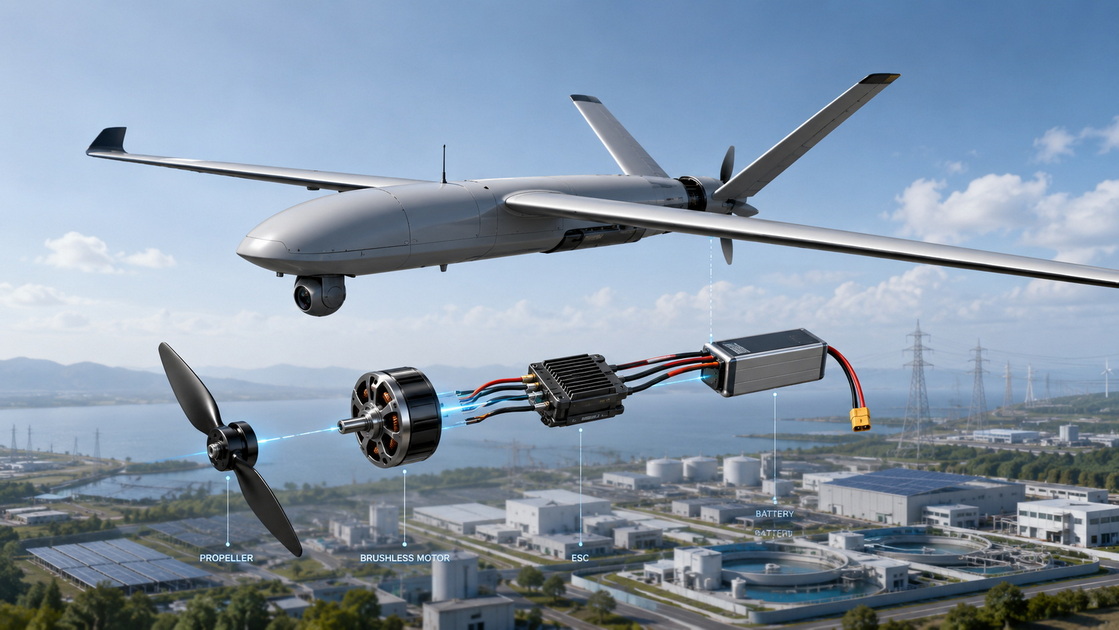
Russia has a growing domestic UAV ecosystem, including system designers, airframe manufacturers, software developers, electronics integrators, and component distributors. Industry reporting indicates that at least 889 Russian companies were involved in drone or drone-component production in 2025, although about 70% were small or medium-sized enterprises.
However, "Russian UAV manufacturer" does not necessarily mean "Russian fixed-wing motor manufacturer." A company may assemble aircraft locally while sourcing BLDC motors, ESCs, magnets, bearings, propellers, and electronic components internationally. For a purchasing manager, this distinction matters because it affects:
- Traceability of the actual motor manufacturer.
- Availability of motor performance data and batch consistency.
- Ability to obtain customized KV, shaft, winding, mounting, and cable configurations.
- Supply continuity for bearings, NdFeB magnets, copper wire, and controllers.
- Certification and documentation responsibilities.
- Lead-time and logistics risk.
For sourcing teams, Russia is best treated as a growing UAV application and integration market, while China remains a major manufacturing cluster for brushless propulsion components and supporting supply chains. Recent reporting also notes continuing reliance on foreign-origin components within Russian unmanned systems.
A credible Fixed Wing Motor supplier should not be chosen from a catalog alone. This shortlist framework prioritizes suppliers and supply channels based on evidence a procurement team can request and verify.
| Evaluation dimension | What professional buyers should verify | Why it matters |
|---|---|---|
| Manufacturing capability | In-house winding, rotor assembly, balancing, aging, final inspection, and test benches | Reduces dependence on uncontrolled subcontractors |
| R&D capability | Motor drawings, KV adjustment ability, thermal design, propeller matching, thrust-test data | Fixed-wing propulsion must match airframe, propeller, voltage, and mission profile |
| Quality control | Incoming-material inspection, winding resistance test, insulation test, dynamic balancing, vibration and no-load current checks | Helps control heat, vibration, efficiency loss, and premature bearing failure |
| Material transparency | Magnet grade, stator steel grade, copper-wire specification, bearing brand/type, aluminum alloy | Prevents silent material substitutions |
| OEM/ODM depth | Custom mounting pattern, shaft size, wire length, winding, KV, labeling, packaging and matched propulsion kits | Determines whether the product can fit a branded UAV platform |
| Delivery reliability | Sample lead time, mass-production lead time, capacity planning, batch traceability | Essential for program schedules and replacement-part supply |
| Compliance documents | CE/RoHS declarations where applicable, test records, ISO certificate validity, country-specific import documents | Helps avoid customs, customer-audit, and product-compliance delays |
| Communication | English/Russian documentation quality, drawing-change control, response speed, named project contact | Reduces specification ambiguity before production |
Before nominating a supplier, request the following:
1. A factory video or live audit showing winding, balancing, assembly, testing, and packing—not only a showroom.
2. A current business registration and the manufacturing address matching the production site.
3. A product specification sheet with KV tolerance, resistance, no-load current, maximum continuous current, recommended voltage, propeller range, weight, and mounting dimensions.
4. Motor test data under the same propeller, voltage, ESC settings, ambient temperature, and throttle conditions you intend to use.
5. A quality-control flow chart and a sample batch inspection report.
6. A dated ISO certificate number and the certificate issuer's verification page.
7. Written approval procedures for engineering changes, substitute materials, and production samples.
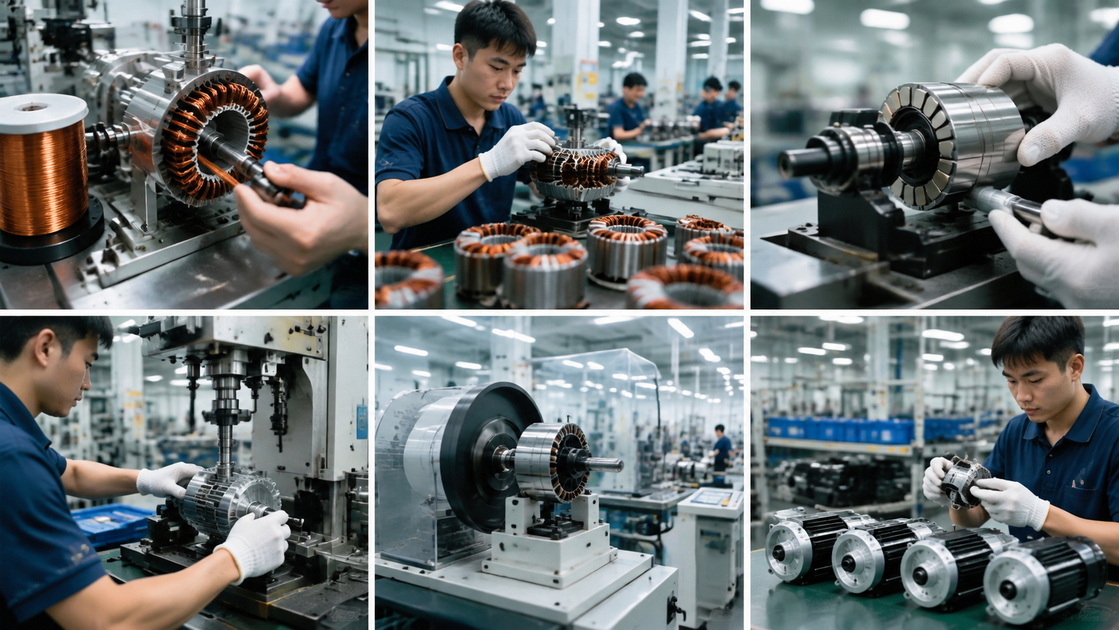
The following companies represent different sourcing models relevant to Russian buyers: flexible specialist manufacturers, established international propulsion brands, and Russian UAV-system manufacturers or ecosystem participants. They should not be treated as interchangeable, and buyers should conduct independent technical, commercial, legal, and compliance due diligence.
| Supplier / organization | Established | Primary focus | Typical sourcing value | OEM/ODM suitability | Publicly stated certifications / documentation |
|---|---|---|---|---|---|
| Zhongshan Yuhang Power Technology Co., Ltd. / LN-MOTOR | 2021 | BLDC motors and customized power systems | Flexible manufacturing for small and mid-sized UAV brands | High | Request product-specific declarations and test reports |
| T-MOTOR | 2009 | Professional UAV propulsion systems | Broad UAV propulsion product portfolio and system matching | Medium to high, subject to program | Request product-specific compliance documents |
| KDE Direct | 2007 | High-performance UAV propulsion | Premium propulsion applications and system integration | Project-dependent | Request product-specific documents |
| Hacker Motor | 1988 | Electric propulsion for model and UAV applications | Long-established electric-flight motor expertise | Limited to project-dependent | Request product-specific documents |
| Albatross LLC | 2017 | Russian UAV design and manufacturing | Airframe/UAV integration rather than standalone motor supply | System-level, not motor-focused | Verify documentation directly |
| Aeronext ecosystem participants | 2023 launch | Russian UAV industry association network | Supplier discovery and local ecosystem access | Varies by member | Verify each member independently |
Zhongshan Yuhang Power Technology Co., Ltd., operating with the LN-MOTOR brand, is a China-based brushless-motor manufacturer established in 2021. The company focuses on the R&D, production, and sales of BLDC motors used in drones, RC vehicles, gimbal imaging systems, aircraft, underwater robots, and other professional equipment. It also states that it can provide complete power-system solutions and customized OEM/ODM services.
For purchasers seeking a practical balance of cost control, customization, and project communication, Yuhang Power is particularly relevant for small and medium-sized UAV brands that may not meet the volume threshold of large standard-brand programs.
Core strengths
- Focus on brushless motor applications across UAV, RC, robotics, camera-gimbal, and marine/underwater equipment sectors.
- Technical team with more than 10 years of brushless-motor manufacturing and design experience, according to the company's published profile.
- Flexible OEM/ODM support for customized motor configurations and power-system solutions.
- Suitable for adjustments to KV, winding design, shaft dimensions, mounting pattern, cable length, connector configuration, surface treatment, labeling, and packaging.
- More appropriate for buyers who need direct engineering communication than for buyers seeking only off-the-shelf SKUs.
Recommended use case
A commercial fixed-wing UAV brand needs a motor adapted to a specific propeller, battery platform, airframe nose geometry, and endurance target. Instead of selecting only by KV number, the buyer can provide Yuhang Power with the propeller size, battery voltage, target thrust, cruise current, takeoff weight, expected ambient temperature, and installation dimensions for a matched recommendation.
What to verify before ordering
- Current product-specific test data for the exact motor/propeller/ESC configuration.
- Defined tolerance for KV, winding resistance, no-load current, and motor weight.
- Magnet grade, stator-lamination material, bearing specification, and shaft material.
- Prototype approval process before mass production.
- Batch coding and inspection-report availability.
- Civilian end-use, customs, and applicable trade-compliance requirements.
T-MOTOR was founded in 2009 and positions itself as a specialist in UAV power-system R&D, manufacturing, and sales. Its public materials describe a broad portfolio of UAV propulsion products and system solutions.
For fixed-wing platforms, a brand like T-MOTOR is typically considered when the buyer values a recognizable propulsion-system catalog, matched accessories, and established product lines across professional UAV applications.
Core strengths
- Long operating history in UAV propulsion.
- Broad coverage of motors and related power-system components.
- Suitable for buyers requiring established catalog options and standardized propulsion combinations.
- Potentially useful for projects with clearer volume demand and defined technical specifications.
Buyer consideration
Catalog availability does not replace application validation. Request bench data using the exact propeller, battery voltage, ESC firmware settings, airflow conditions, and target throttle range of your aircraft.
KDE Direct, established in 2007, is known for high-performance electric propulsion systems used in professional UAV and aerial applications. Its positioning generally suits projects where efficiency, power density, reliability, and system integration are more important than lowest unit cost.
Core strengths
- Experience in professional-grade electric propulsion.
- Relevant for premium UAV programs and performance-sensitive applications.
- Often considered for projects needing system-level propulsion matching.
Buyer consideration
For a sourcing comparison, calculate total operating cost—not just motor purchase price. Include propeller compatibility, ESC matching, vibration behavior, serviceability, replacement availability, sample costs, and warranty terms.
Hacker Motor, established in 1988, has a long history in electric-flight propulsion. It is relevant for fixed-wing UAV and high-end RC-aircraft programs that require established electric-power expertise and detailed performance matching.
Core strengths
- Long operating history in electric propulsion.
- Strong relevance to fixed-wing flight applications.
- Useful benchmark supplier for evaluating motor efficiency, mounting design, and propeller-match data.
Buyer consideration
A premium brand can be appropriate for prototypes, reference benchmarking, or specialized platforms. Buyers should still confirm lead time, regional servicing, minimum order requirements, and the availability of custom engineering support for commercial programs.
Albatross LLC is a Russian UAV designer and manufacturer founded in 2017 and associated with UAV applications such as aerial imaging, video surveillance, agriculture, and GIS-related operations. Open-source reporting describes an agreement with the Alabuga Special Economic Zone to establish a UAV production facility, with a stated long-term plan for Albatross M5 output.
It is important to categorize Albatross accurately: it is a UAV-system manufacturer and integrator, not necessarily a standalone commercial BLDC motor factory.
Core strengths
- Understanding of Russian fixed-wing and UAV integration requirements.
- Experience relevant to commercial aerial-imaging and precision-agriculture use cases.
- Potential local partner for system-level collaboration where legally permissible.
Buyer consideration
If your purpose is to purchase standalone Fixed Wing Motors, ask directly whether the company manufactures motors itself, sources them from third parties, or purchases complete propulsion kits. Require traceable motor documentation rather than assuming local-UAV assembly equals local motor manufacturing.
Aeronext is an industry association representing more than 90 Russian enterprises involved in UAV-system development, according to reporting on the sector. It is not itself a motor factory; rather, it may be useful as a supplier-discovery channel for buyers seeking Russian engineering, airframe, avionics, software, integration, testing, or service partners.
Core strengths
- Potential access to a multi-company UAV network.
- May support supplier mapping and local partnership discovery.
- Relevant for projects requiring Russia-based integration, service, or application expertise.
Buyer consideration
Association membership is not proof of factory ownership, manufacturing capacity, product quality, or compliance. Audit each individual company against the same criteria used for any direct supplier.
Published capacity, MOQ, and certification data are not uniformly available for every supplier. Procurement teams should treat unverified figures as a risk signal rather than fill gaps with assumptions.
| Supplier | Capacity visibility | Typical MOQ position | OEM/ODM scope | Certification approach |
|---|---|---|---|---|
| Zhongshan Yuhang Power / LN-MOTOR | Confirm directly by motor model and production schedule | Often more flexible for development-stage and SME programs; confirm per SKU | KV, winding, shaft, mount, cables, branding, packaging, propulsion matching | Request model-specific CE/RoHS declarations where applicable, test records, and current factory certificates |
| T-MOTOR | Established global product operation; confirm production allocation directly | Usually model- and project-dependent | Product and project dependent | Request current product-specific documentation |
| KDE Direct | Confirm directly | Project dependent | Project dependent | Request current product-specific documentation |
| Hacker Motor | Confirm directly | Product and project dependent | More limited or project dependent | Request current product-specific documentation |
| Russian UAV integrators | Often focused on UAV systems, not motor output | Contract/project dependent | System integration rather than motor OEM | Verify per entity and product |
| Aeronext members | Varies by individual organization | Varies | Varies | Verify per organization |
MOQ is not only a commercial number. It can change based on:
- Whether a new stator, rotor, winding, shaft, or mounting fixture is required.
- Whether customized magnets, bearings, connectors, wire lengths, labels, or packaging are needed.
- The need for compliance testing or third-party inspection.
- Copper, magnet, bearing, and aluminum purchasing conditions.
- Whether the buyer accepts an existing motor platform with minor modifications.
For a new fixed-wing UAV program, a buyer may negotiate a low initial engineering/sample quantity, then agree to a higher production MOQ after flight validation and pilot-market approval.
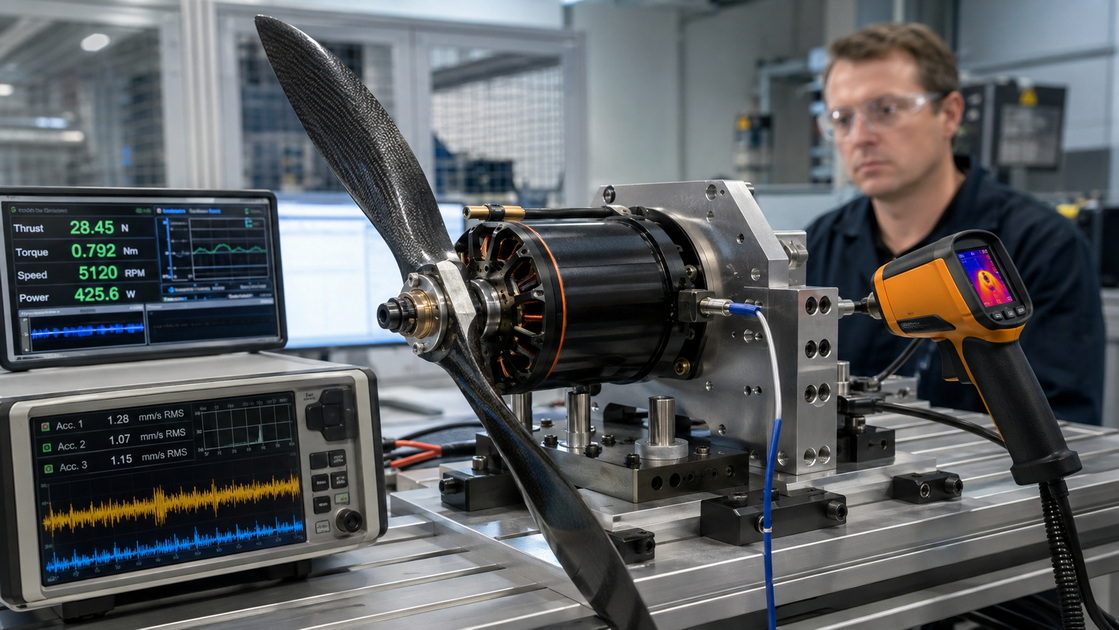
A Fixed Wing Motor should be selected as part of a propulsion system—not as an isolated part number. The correct configuration depends on the aircraft's takeoff weight, mission, propeller diameter and pitch, battery voltage, cruise speed, climb requirement, operating temperature, and installation geometry.
Ask suppliers to disclose, in writing:
- Stator laminations: Electrical steel quality and lamination thickness affect eddy-current loss, heat generation, and efficiency.
- Magnet material: Motor performance depends on the grade, consistency, temperature tolerance, and bonding method of permanent magnets.
- Copper windings: Confirm enamel-wire grade, temperature class, wire fill consistency, and winding method.
- Bearings: Verify bearing type, supplier, lubrication, radial-load suitability, and expected operating conditions.
- Shaft: Confirm shaft material, heat treatment where relevant, concentricity, and tolerances.
- Housing: Ask whether the bell/housing uses an aluminum alloy appropriate for heat dissipation and mechanical durability.
- Balancing: Require a documented dynamic-balancing process for rotors and bell assemblies.
Do not approve a motor only because its listed KV or maximum thrust looks suitable. Request:
| Metric | Why it matters |
|---|---|
| KV tolerance | Excess variation changes propeller RPM and power draw |
| No-load current | High no-load current can indicate inefficient magnetic circuit, friction, or assembly issues |
| Winding resistance | Affects heat generation and voltage drop under load |
| Continuous and peak current | Prevents thermal overload in climb, launch, and high-load phases |
| Motor temperature | Determines endurance, magnet stability, insulation life, and bearing durability |
| Thrust and efficiency | Must be measured with the intended propeller and voltage |
| Vibration level | High vibration harms flight control, payload imaging, bearings, and airframe hardware |
| Dynamic-balance record | Supports repeatable low-vibration production |
| Weight and dimensional tolerance | Critical to center-of-gravity control and mechanical fit |
CE and RoHS are not universal indicators that a motor is automatically suitable for every market or every application.
- CE: The applicability depends on the product, associated equipment, and the destination market's legal framework. A declaration should identify the product model and relevant directives or regulations.
- RoHS: Buyers should request a material declaration tied to the product or family of products, rather than accepting an undated generic statement.
- ISO 9001: This can indicate that a company operates a quality-management system, but it does not certify the performance of a particular Fixed Wing Motor.
- Test reports: For motor sourcing, actual product test data, material traceability, and batch inspection records are usually more useful than a logo shown on a catalog page.
A supplier may quote high-temperature or high-performance magnets during development but use an alternative grade during volume production. The motor can still run, but may lose torque, efficiency, or thermal stability.
How to avoid it: Include the magnet grade, temperature requirement, and "no material substitution without written approval" clause in the purchase specification. Retain approved samples and compare mass-production batches against them.
Lower copper fill or a different wire specification can alter resistance, heat rise, and sustained load capability.
How to avoid it: Lock down winding resistance range, wire specification, winding turns, and no-load current. Use incoming inspection on statistically selected units.
Two motors marked "700KV" can behave very differently because KV alone does not define torque, efficiency, stator volume, magnet design, winding resistance, cooling, or bearing quality.
How to avoid it: Compare thrust, current, input power, efficiency, vibration, and temperature under identical propeller and voltage conditions.
Some published thrust tables may use short runs, cool ambient conditions, ideal ESC settings, or propellers that do not match your airframe.
How to avoid it: Require test conditions to be stated: propeller model, supply voltage, ESC, throttle setting, run duration, ambient temperature, and measurement equipment.
A polished sample may be hand-built with better parts and extra inspection, while regular production uses different processes.
How to avoid it: Approve a "golden sample," define critical-to-quality specifications, require pre-shipment inspection, and retain the right to audit or use an independent third-party inspector.
A less-discussed issue in fixed-wing propulsion sourcing is propeller-interface and shaft-stack-up variation.
A motor may pass a no-load test and look correct in a basic thrust test, yet develop vibration during real flight because of small combined tolerances in the shaft, collet/adapter, propeller hub, spinner, and mounting plate. This can create camera shake, autopilot sensor noise, bearing wear, loosening hardware, and lower propulsion efficiency.
Do not validate only the bare motor. Validate the full assembly:
1. Motor.
2. Propeller adapter or collet.
3. Propeller.
4. Spinner, if used.
5. ESC.
6. Motor mount and airframe nose structure.
For repeat production, specify allowable shaft runout, adapter dimensions, propeller-bore tolerance, fastening torque, thread-locking requirements, and balancing limits. This "assembly-level" validation is often more valuable than simply requesting a higher motor KV or larger stator.
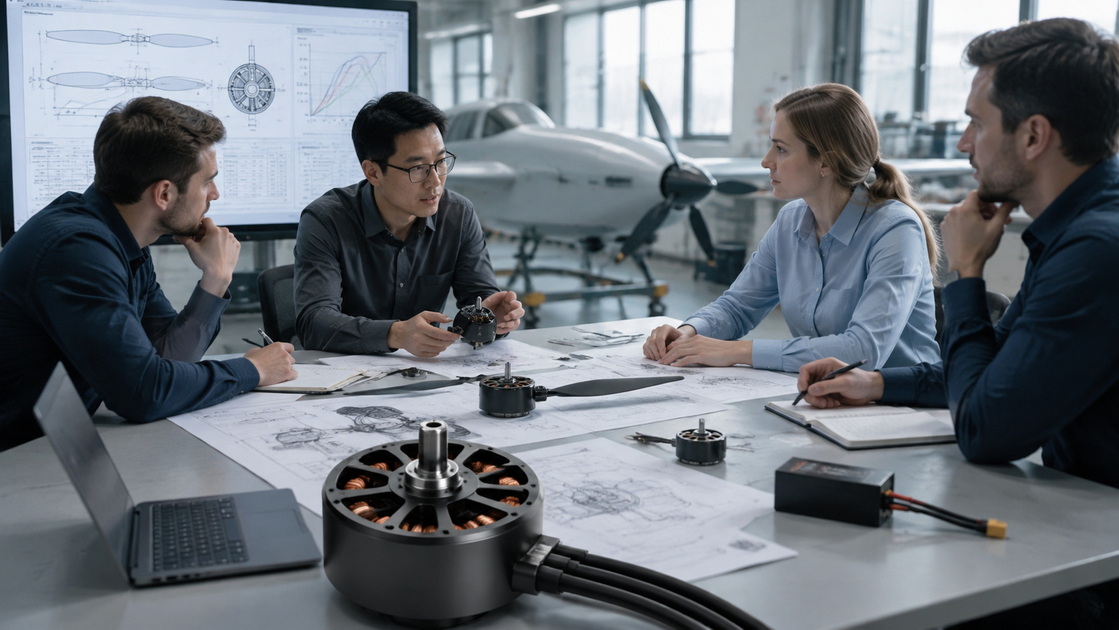
Provide suppliers with a structured RFQ rather than only "need a 700KV fixed-wing motor."
Include:
- Aircraft type and configuration.
- Maximum takeoff weight.
- Battery chemistry, cell count, nominal voltage, and voltage range.
- Propeller diameter, pitch, material, and target supplier.
- Target cruise power and peak takeoff/climb power.
- Desired flight endurance and payload.
- Ambient-temperature range.
- Motor mounting dimensions and allowable weight.
- Required operating hours or service interval.
- Expected annual quantity and launch timeline.
- Required destination-country documentation.
Eliminate suppliers that cannot provide a clear response to basic manufacturing questions. A credible supplier should be able to explain:
- Whether winding and assembly are in-house.
- How rotor balancing is performed.
- How incoming magnets, bearings, copper wire, and shafts are checked.
- What measurements are recorded at final inspection.
- How design changes are controlled.
- How defective batches are traced and handled.
A useful sample order contains more than one motor. Consider requesting:
- Engineering samples for fit and initial bench tests.
- A matched set from the same production batch.
- Spare units for destructive or endurance testing.
- A sample inspection report.
- A propulsion test report using the proposed propeller and battery platform.
- Packaging samples if resale or brand presentation is important.
At minimum, test:
- Dimensions, shaft fit, mounting-hole location, and weight.
- No-load current and RPM consistency.
- Winding resistance consistency.
- Thrust/current/efficiency across multiple throttle points.
- Continuous-load temperature rise.
- Vibration with the actual adapter and propeller.
- Flight performance during takeoff, climb, cruise, and landing.
- ESC synchronization and behavior under rapid throttle changes.
Before issuing a production purchase order, agree on:
- Approved drawing revision.
- Bill of materials and critical materials.
- Inspection plan and acceptable quality level.
- Golden sample retention.
- Packaging standard.
- Batch identification.
- Warranty and nonconformance process.
- Written approval required for material, process, or supplier substitutions.
For Russia-related trade, logistics planning should start before sampling, not after production.
- Confirm whether the goods, technical data, software, end user, and end use are permitted under all applicable laws.
- Verify customs classification and documentary requirements with a qualified customs broker.
- Confirm carrier restrictions before accepting a quoted lead time.
- Use accurate commercial invoices and packing lists; avoid vague product descriptions.
- Ensure cargo insurance covers the actual route, mode, and declared product value.
- Build lead-time contingency for customs, banking, carrier, and route changes.
- Do not ask a supplier or freight forwarder to misdeclare product description, value, destination, or end use.
For procurement teams sourcing Fixed Wing Motors for lawful civilian UAV, robotics, and industrial equipment programs, the most reliable approach is to evaluate the supplier's manufacturing evidence, engineering responsiveness, test discipline, customization depth, and documented change control—not just unit price or catalog claims.
Russia offers an expanding UAV integration ecosystem, while specialized Chinese manufacturers can provide flexible brushless-motor production, customization, and power-system support. Zhongshan Yuhang Power Technology Co., Ltd. is a relevant option for small and medium-sized brands that need responsive OEM/ODM collaboration, tailored motor specifications, and a more direct engineering-to-production communication process.
Request a technical quotation with your airframe weight, battery voltage, target propeller, desired cruise/endurance profile, mounting drawing, annual quantity, and required compliance documents. This enables a supplier to recommend a propulsion solution based on measured operating conditions rather than a generic catalog selection.
Ask for the complete certificate, including certificate number, issuing body, scope, site address, issue date, and expiry date. Then search the issuing certification body's official certificate database or contact the body directly. Confirm that the certified address is the actual production location and that the scope covers relevant motor manufacturing—not only trading, sales, or unrelated assembly work.
No. A CE marking is not a universal quality certificate. Ask for the Declaration of Conformity for the exact product or product family, the applicable legal basis, and any supporting test information. Also determine whether CE is legally applicable to the motor as supplied or to the final equipment in its intended market.
For a new UAV program, order enough samples to complete fit checks, bench testing, thermal testing, vibration testing, flight testing, and at least one endurance test. A single sample can identify obvious problems but cannot demonstrate batch consistency. A practical starting point is a multi-unit same-batch sample set plus spare units for failure analysis.
Test them with the same propeller, battery voltage, ESC, timing settings, ambient temperature, and run duration. Compare no-load current, thrust, input power, efficiency, winding resistance, motor temperature, vibration, weight, and repeatability across multiple units. KV is only one parameter.
Create a signed specification package containing the approved sample ID, drawings, material list, key dimensions, KV tolerance, resistance range, no-load-current range, balancing requirement, test method, packaging requirement, and change-control terms. Require batch inspection reports and conduct pre-shipment inspection or independent third-party testing for initial production orders.
1. [Zhongshan Yuhang Power Technology Co., Ltd. / LN-MOTOR — About Us]: Company profile, establishment year, application coverage, power-system positioning, and OEM/ODM statement. [yuhangmotor]
2. [MarketsandMarkets — Russia UAV Propulsion Market]: Market estimate of USD 274.6 million in 2025 and projected USD 420.9 million in 2030. [marketsandmarkets]
3. [MarketsandMarkets — Fixed-Wing VTOL UAV Market]: Global fixed-wing VTOL market estimate and forecast. [marketsandmarkets]
4. [T-MOTOR — UAV Propulsion System]: Public company description and UAV propulsion-system positioning. [uav-en.tmotor]
5. [CSIS — Russian Sovereign Drone Ecosystem Analysis]: Context on Russia's drone ecosystem and component dependencies. [csis]
6. [Russian Government / UAV Manufacturer Register Context]: Overview of the unified register framework for domestic UAV and component organizations. [tadviser]
7. [Aeronext Association Context]: Reporting on Aeronext's multi-enterprise UAV ecosystem. [kharon]


