Language


Views: 273 Author: Yuhang Power Publish Time: 2026-07-13 Origin: Site
Content Menu
● What Is a Brushless FPV Drone Motor?
● Key Components of a Drone Motor (High-Level Overview)
● Inside the Stator: Laminations, Windings, and KV
>> Stator Laminations: Why Thickness Matters
>> Motor Windings, Wire Gauge, and KV
>> Silver‑Plated Copper Wires: Premium Conductivity
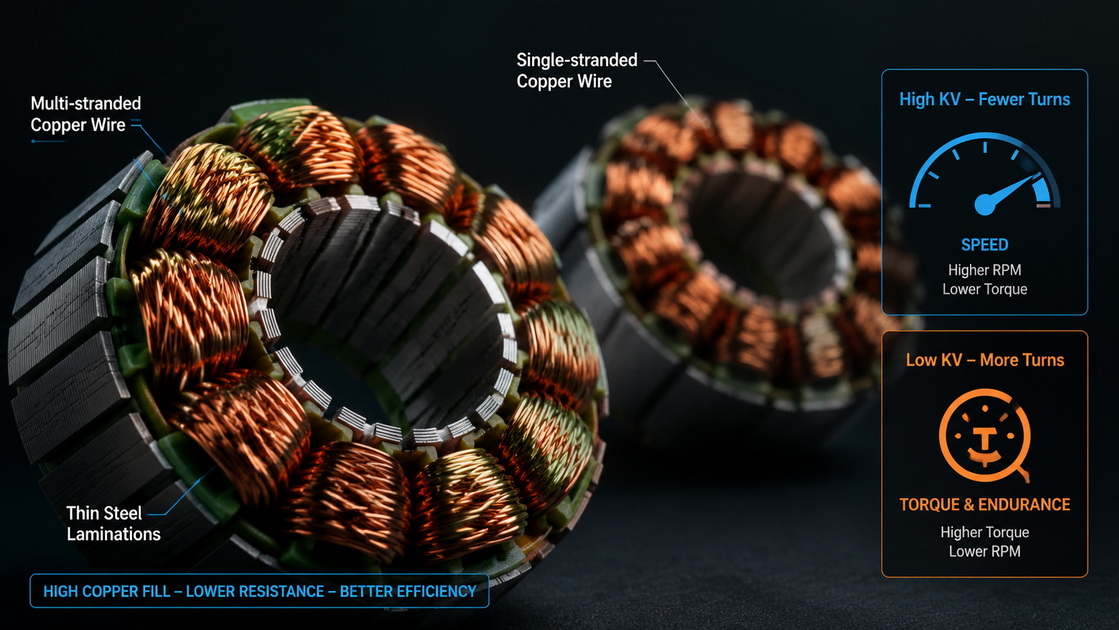
>> Multi‑Stranded vs Single‑Stranded Windings
● Rotor and Bell Design: Materials, Durability, and Crash Resistance
>> Aluminum Alloys: 6082 vs 7075
>> Two‑Piece vs Unibell Rotor Designs
● Poles, Magnets, and Magnetic Field Design
>> Magnet Type and Grade (N52, N54, etc.)
● Bearings: Smoothness, Noise, and Longevity
● Motor Shaft Design: Hollow vs Solid
● Mounting Patterns and Frame Compatibility
● How Motor Structure Affects Real-World Performance
● Choosing the Right FPV Drone Motor: A Practical Checklist
● OEM and ODM Motor Customization: Turning Structure into Competitive Advantage
● Recommended FPV Drone Motor Specs Table
● Partner with a Motor Manufacturer That Understands Your Application
● FAQ
When you fly an FPV quad or design a new UAV platform, the drone motor structure is one of the biggest levers you have on performance, reliability, and maintenance cost. As a brushless motor manufacturer working with FPV racers, aerial filmmakers, and OEM/ODM clients in robotics and RC industries, I have seen firsthand how small design choices inside the motor translate into very visible differences in the air. [quickcreator]
In this guide, I will walk you through the structure of an FPV drone motor, explain what each component does, and share practical insights from real projects and customer feedback. You will learn how stator design, magnets, rotor bells, bearings, and shafts all interact, and how to make smarter choices whether you are buying off-the-shelf motors or co-developing a custom power system with a factory partner. [quickcreator]
At its core, an FPV drone motor is a three‑phase brushless DC motor that converts electrical energy from your ESC and LiPo battery into mechanical rotation to spin the propellers. Unlike brushed motors, FPV drone motors use electromagnets in the stator and permanent magnets in the rotor, with no physical brushes touching a commutator. [quickcreator]
This design offers:
- Higher efficiency
- Better throttle response
- Much longer service life
- Lower maintenance needs
For FPV pilots, this means crisper stick feel, more predictable PID tuning, and fewer failures mid‑flight, especially under high current loads in racing and freestyle use. [mtsoln]
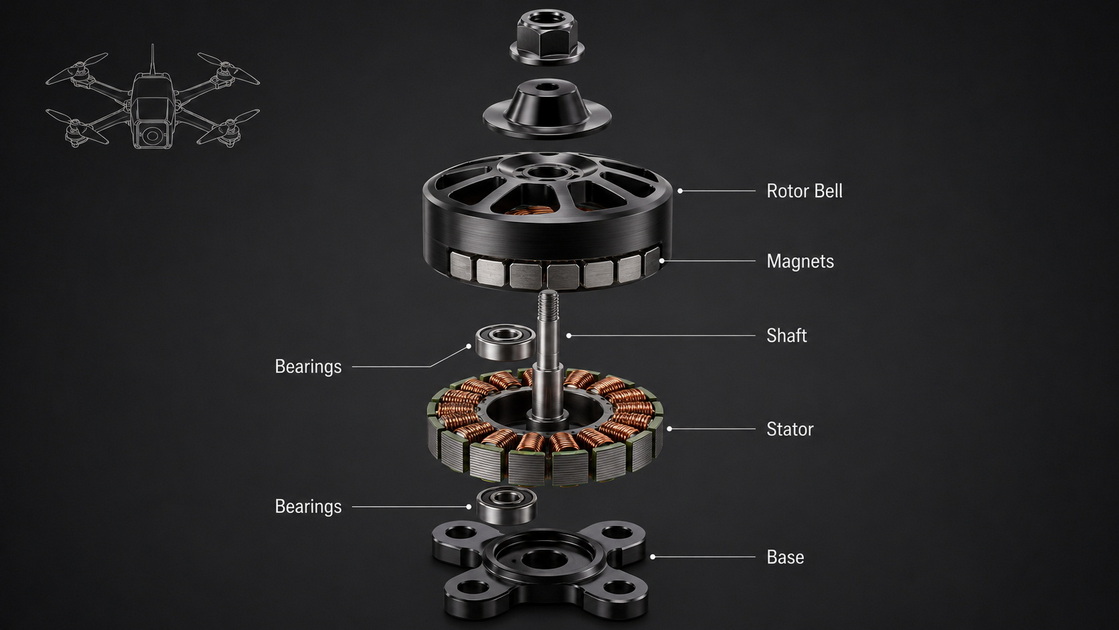
Before we go deep, here is the macro view of drone motor structure: [quickcreator]
- Stator – The fixed part with laminated steel teeth and copper windings that generate the electromagnetic field.
- Rotor (bell) – The rotating shell with magnets, connected to the shaft and propeller.
- Magnets & poles – The permanent magnets inside the bell and the number of stator poles that define smoothness and torque behavior.
- Bearings – Precision components that let the rotor spin smoothly under load.
- Motor shaft – The central shaft that connects the rotor to the propeller and frame.
- Mounting base & pattern – The interface to your frame, typically 16×16 mm or 16×19 mm for 5‑inch FPV quads. [quickcreator]
For OEM customers, each of these elements can be tuned: from stator size and lamination thickness to magnet grade and bearing brand, to match specific use cases such as drones, RC cars, gimbals, UAV fans, or underwater robots. [quickcreator]
The stator is the stationary part of the motor and contains multiple metal teeth wrapped with insulated copper windings. When current flows through these windings in a controlled three‑phase pattern, a rotating magnetic field is created, pulling the rotor around. [quickcreator]
For FPV drones, stator design directly influences torque, response, efficiency, and heat generation. [quickcreator]
Stator laminations are the thin steel sheets stacked to form the stator core. Thinner laminations: [quickcreator]
- Reduce eddy current losses in changing magnetic fields
- Lower heat build‑up at high RPM
- Improve overall efficiency and power output
High‑performance FPV motors typically use thinner laminations than budget models, which is one reason premium motors stay cooler and deliver more thrust per watt in demanding racing or long‑range flights. [quickcreator]
The windings are copper wires wrapped around each stator tooth. Their configuration defines: [quickcreator]
- KV rating (RPM per volt, no load)
- Torque output
- Throttle feel and efficiency
Key factors:
- Wire gauge: Thicker wire can carry more current but is harder to pack tightly.
- Number of turns: Fewer turns generally means higher KV (more RPM, less torque), while more turns produce lower KV with higher torque. [quickcreator]
In real‑world terms:
- High KV motor (with fewer turns) is great for light 5″ racing builds that need explosive punch and top speed.
- Lower KV motor (with more turns) suits heavier cinewhoops, long‑range rigs, or payload‑carrying UAVs where smooth thrust and efficiency matter more than raw speed. [quickcreator]
When we work with OEMs—for example, on a gimbal or a specialized robotic platform—we often adjust winding patterns and KV to fit exact voltage, load, and duty cycle requirements, rather than relying on generic FPV configurations. [quickcreator]
Some high‑end motors use silver‑plated copper windings. Silver is an even better conductor than copper, so plating can: [quickcreator]
- Reduce electrical resistance
- Improve heat dissipation
- Provide slightly higher efficiency and more consistent performance under extreme current loads
Because silver plating increases cost, you will usually only see it in performance‑oriented motors or custom OEM projects where reliability and consistency under high current are critical, such as industrial drones or high‑power ducted fan applications. [mtsoln]
FPV motors typically use either:
- Single‑stranded windings – One thicker wire per turn
- Multi‑stranded windings – Several thinner wires bundled per turn
Each approach has trade‑offs: [quickcreator]
- Single‑stranded:
- Better mechanical strength at high temperatures
- Good for high‑voltage, high‑load scenarios
- Multi‑stranded:
- Can be packed more tightly around stator teeth
- Often yields stronger magnetic fields and higher peak power
- Slightly more sensitive to overheating and physical damage if poorly manufactured
From our manufacturing experience, we often recommend multi‑stranded windings for performance FPV builds and single‑stranded for long‑life industrial motors that run continuously at high temperatures. [quickcreator]
The rotor (or motor bell) is the rotating shell that houses the permanent magnets and connects to the shaft and propeller. It plays a huge role in crash resilience and rotational balance. [quickcreator]
Most FPV motor bells are made from aluminum alloy, typically 6082 or 7075. [quickcreator]
- 6082 aluminum: More formable and ductile, used more commonly in earlier FPV motors.
- 7075 aluminum: Harder and more impact‑resistant, now widely used in modern FPV motors because it better survives high‑speed crashes.
For aggressive FPV flying or professional UAVs operating in rough environments, we strongly prefer 7075 for bell and base construction to reduce deformation and keep motors running true after impacts. [mtsoln]
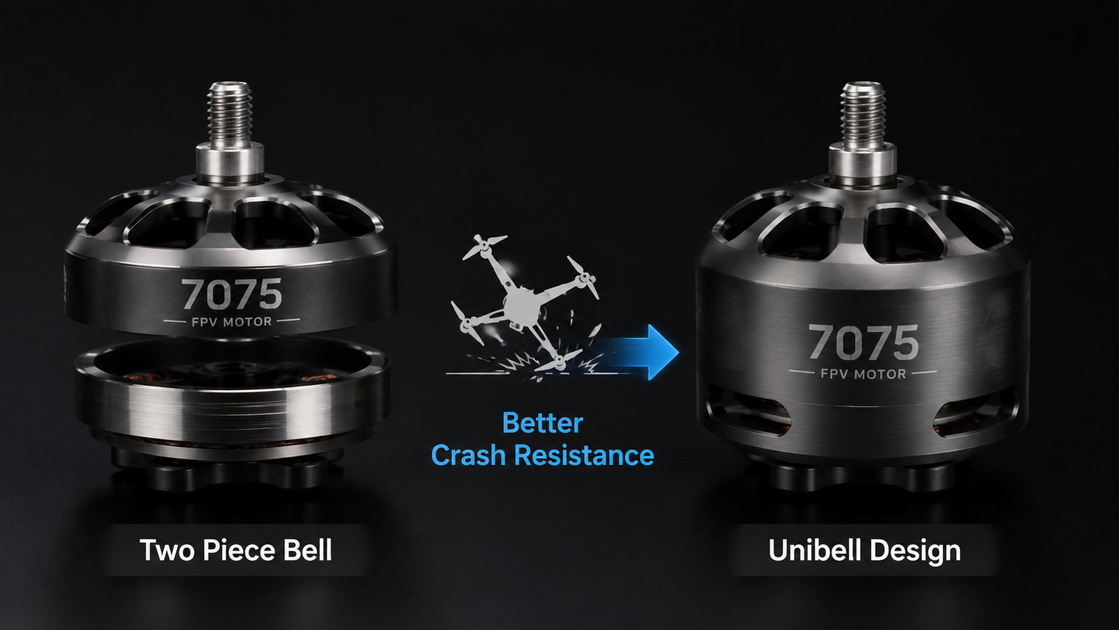
There are two main bell architectures: [quickcreator]
- Two‑piece bell:
- Machined aluminum top
- Steel flux ring bonded underneath
- Lightweight and cost‑effective
- Unibell (one‑piece) design:
- Aluminum bell extends down over the steel flux ring like a protective sheath
- Slightly heavier but significantly more durable
The Unibell design greatly reduces the risk of the flux ring separating from the bell in a hard crash, a failure mode we have seen in some older two‑piece designs. In our internal testing and in feedback from FPV pilots, the small weight penalty is almost always justified by the extra crash resistance. [seoexpert]
A typical 22xx or 23xx FPV motor uses 12 stator poles and 14 rotor magnets, often denoted as 12P14N. [quickcreator]
Motor behavior is influenced by this relationship:
- Fewer poles can allow more iron in the stator, increasing potential power but sometimes making torque ripple more noticeable.
- More poles tend to produce smoother rotation and finer control at low throttle, which is important for cinematic flying and precise maneuvering. [quickcreator]
The quality and shape of the magnets are critical for thrust and efficiency. [quickcreator]
- Budget motors use weaker magnets, which reduces maximum thrust and responsiveness.
- Premium FPV motors may use curved magnets that follow the rotor's inner circumference and minimize air gaps, improving magnetic coupling.
- Magnet grades such as N52 or N54 indicate stronger magnetic fields as the number increases, leading to higher torque density. [quickcreator]
In practice, stronger and better‑shaped magnets improve punch‑out performance and low‑throttle control, but they must be balanced with stator design and ESC tuning to avoid excessive cogging or overheating. [quickcreator]
Bearings support the rotor and allow it to spin with minimal friction. Their design impacts: [quickcreator]
- Motor noise and smoothness
- Vibration levels
- Long‑term durability at high RPM
Key aspects:
- The difference between outer and inner diameters determines bearing size and ball size.
- Smaller balls – Better smoothness and precision at very high RPM.
- Larger balls – Higher durability and crash resistance. [quickcreator]
Some motors use ceramic bearings, replacing steel balls with ceramic:
- Smoother feel and lower friction
- Potentially higher performance but often more fragile and sensitive to contamination
Common bearing brands in quality FPV motors include NSK, NMB, and EZO, with EZO often cited as a premium option, though differences can be subtle in real‑world use if the rest of the motor is not equally well engineered. [quickcreator]
From a manufacturer perspective, we carefully match bearing choice to the application: ceramic for high‑end, low‑dust environments (e.g., indoor racing, gimbals), and robust steel bearings for dusty, wet, or crash‑prone use such as outdoor FPV freestyle or field robotics. [quickcreator]
The motor shaft connects the rotor to the propeller and is one of the most stressed parts during a crash. Modern FPV motors often use hollow shafts to reduce weight, which can slightly improve responsiveness and efficiency. [quickcreator]
Trade‑offs:
- Hollow shafts:
- Lighter
- Better for ultra‑light builds and when every gram matters
- Less resistant to severe impacts
- Shaft failure usually requires replacing the entire rotor assembly
- Solid shafts:
- Heavier
- Much more robust in crashes
- Preferred for budget‑conscious builders or heavy‑duty drones where reliability is prioritized over minimum weight
For OEM and industrial clients—such as cleaning robots, underwater vehicles, or long‑life fans—we often recommend solid or reinforced shafts to minimize unplanned downtime and maintenance. [quickcreator]
Even the best motor is useless if it does not mount securely to your frame. Most modern 5″ FPV quads use 2205 to 2407 size motors with mounting patterns of 16×16 mm or 16×19 mm. [quickcreator]
Practical tips:
- Check that your frame supports the motor mounting pattern you plan to use.
- Standard FPV motors use M3 screws; choose screw length about 2 mm longer than arm thickness (e.g., 7 mm screws for 5 mm arms, 8 mm for 6 mm arms). [quickcreator]
For OEM designs where you control both frame and motor, aligning mounting patterns, wiring exit paths, and cooling airflow early in the design phase greatly simplifies assembly and improves reliability and serviceability. [weboin]
From years of testing and customer feedback across drones, RC cars, violent fans, gimbals, aircraft, and robots, we consistently see the same patterns: [quickcreator]
- High‑quality laminations + optimized windings → Cooler operation, longer flight time, more consistent performance under repeated punches.
- Premium magnets + well‑balanced rotor → Sharper response and smoother video, easier PID tuning, less jello in footage.
- Robust bell material and design → Fewer bent shafts and broken bells, especially for racing and freestyle.
- Correct bearings and shaft configuration → Lower maintenance, reduced noise, longer service intervals.
For example, one FPV racing team we supply switched from a budget motor to a 7075 Unibell design with thinner laminations and higher grade magnets. They reported noticeably stronger throttle response, 10–15% fewer motor failures over a season, and more predictable handling in high‑G maneuvers. [medium]
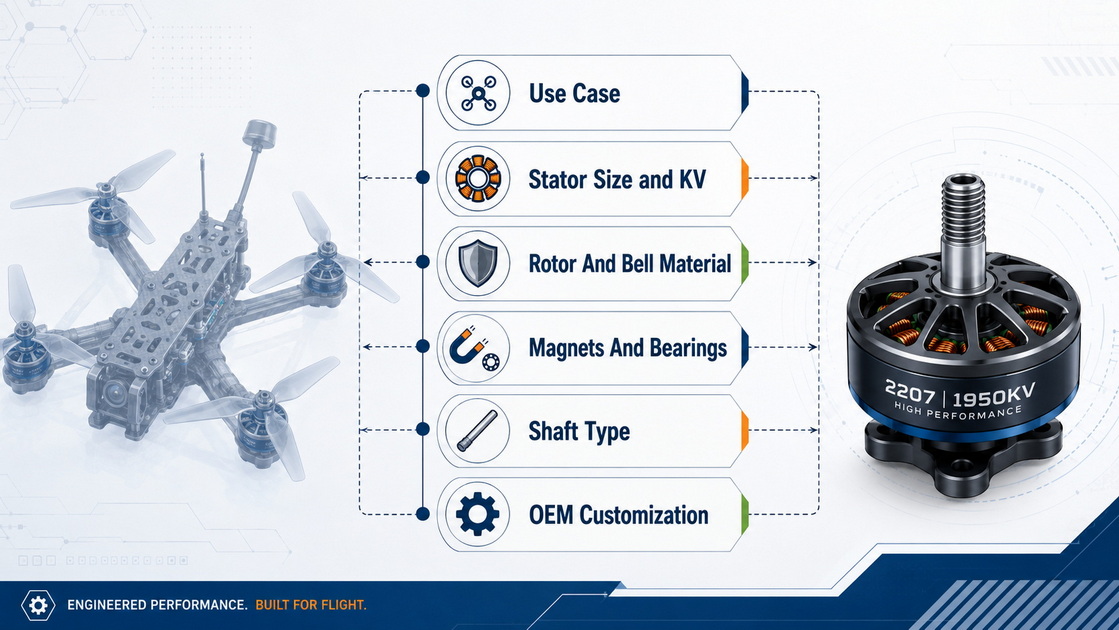
When selecting motors for your quad or for an OEM application, consider these structure‑driven criteria:
1. Use case and payload
- Lightweight FPV racing
- Long‑range cruising
- Professional cinematography
- Robotics, fans, or industrial applications
2. Stator size and KV
- Match KV to battery voltage, prop size, and target thrust.
- Larger stator = more torque; smaller stator = lighter and more agile. [quickcreator]
3. Materials and design
- 7075 bell and base for crash‑prone use.
- Unibell design for extra durability.
4. Magnets and bearings
- Higher grade magnets (N52/N54) for high thrust and fast response.
- Reputable bearing brands for smoother, quieter operation. [quickcreator]
5. Thermal and efficiency considerations
- Thin laminations and optimized winding patterns for cooler running and longer life.
- Silver‑plated copper windings for extreme cases where marginal gains matter.
By aligning motor structure with your real operating conditions, you avoid over‑spec'ing (and over‑paying) while still protecting critical performance and reliability metrics. [quickcreator]
As a Chinese brushless motor manufacturer, we work not only with FPV pilots but also with companies building drones, RC cars, high‑power fans, gimbals, aircraft, vacuum and cleaning robots, and underwater robots. For these OEM and ODM clients, motor structure is a powerful way to differentiate products. [quickcreator]
Typical customization options include:
- Custom KV and winding patterns to match your voltage, prop, and duty cycle.
- Stator size and lamination thickness tuned for continuous or intermittent use.
- Rotor and bell design optimized for durability, weight, and branding.
- Magnet grade and shape adjusted for torque profile and efficiency.
- Bearing and shaft configuration chosen for lifetime requirements and environmental conditions (dust, moisture, vibration). [mtsoln]
When we co‑design a power system early in your product development cycle, we can often reduce total system cost by optimizing motor, ESC, propeller, and thermal design together instead of over‑engineering a single component. [quickcreator]
Below is an illustrative table for a 5″ FPV freestyle motor configuration and a long‑range setup, showing how structural choices map to performance.
| Use case | Stator size | KV | Bell material | Rotor design | Magnet grade | Bearing type | Shaft type | Notes |
|---|---|---|---|---|---|---|---|---|
| 5″ freestyle / racing | 2207 | 1900–2100 KV | 7075 aluminum | Unibell | N52 curved | NMB steel | Hollow | High punch, good crash resistance (quickcreator) |
| 7″ long‑range | 2507 | 1200–1500 KV | 7075 aluminum | Two‑piece or Unibell | N52 | NSK steel | Solid | Efficiency and torque for heavier builds (quickcreator) |
You can adjust these starting points based on your specific props, battery voltage, and AUW, or collaborate with a manufacturer to fine‑tune a custom variant.
If you are an FPV pilot, system integrator, or OEM buyer, you should not have to guess which motor structure is right for your platform. By working directly with a brushless motor manufacturer that designs and tests motors for FPV drones, RC vehicles, fans, gimbals, aircraft, and robotics, you can translate high‑level requirements into concrete design parameters and test data.
If you are planning a new UAV, robotics, or FPV product line and want to explore custom FPV drone motors or complete power system solutions, reach out to our engineering team with your target weight, voltage, propeller size, and mission profile, and we can propose a tuned motor solution rather than a generic spec sheet.
1. What is the most important part of a drone motor for performance?
For most FPV applications, the combination of stator design (size, laminations, windings) and magnet quality has the biggest impact on thrust, efficiency, and throttle feel. The rotor and bearings then fine‑tune durability and smoothness. [quickcreator]
2. Why do high‑end FPV motors cost more than budget motors?
Premium motors typically use thinner laminations, higher grade magnets, better bearings, and stronger aluminum alloys, and they undergo tighter quality control for balancing and assembly. These factors increase manufacturing cost but reduce failures and improve performance. [quickcreator]
3. Is a higher KV motor always better for FPV?
No. Higher KV means more RPM at a given voltage but less torque per amp, which suits light racing builds but can be inefficient or unstable on heavy quads. For long‑range or cinematic rigs, lower KV motors with larger props often perform better. [quickcreator]
4. Do ceramic bearings make a big difference?
Ceramic bearings can feel smoother and reduce friction at high RPM, but they may be more fragile and less tolerant of dirt or impacts. For most outdoor FPV use, high‑quality steel bearings usually offer a better balance of performance and reliability. [quickcreator]
5. When should I consider a custom OEM or ODM motor instead of an off‑the‑shelf FPV motor?
If your application has non‑standard voltage, continuous high‑load operation, unusual environmental conditions, or strict lifetime requirements, a custom motor with tailored stator, winding, magnet, and bearing choices can reduce total system cost and deliver more predictable performance. [mtsoln]
1. Mepsking Shop – "What is the Structure of Drone Motor?" (original article content and component descriptions). [quickcreator]
2. Semrush – "Google E‑E‑A‑T: What it is & how it affects SEO" (E‑E‑A‑T framework and quality guidelines). [semrush]
3. QuickCreator – "E‑E‑A‑T for Technical Content: 2025 Best Practice Guide" (technical content depth, trust signals, and author authority). [quickcreator]
4. MTSoln – "E‑E‑A‑T Optimized Blog Posts: A Step‑by‑Step Guide" (experience‑driven writing and expert tone). [mtsoln]
5. Medium – "Techniques to Follow EEAT in Blogs and Rank Better" (use of personal experience, case studies, and references to build trust). [medium]
6. Weboin – "How to Structure a Blog for Better SEO Rankings in 2025" (heading hierarchy and UX formatting best practices). [weboin]


