Language


Views: 222 Author: Yuhang Power Publish Time: 2026-05-06 Origin: Site
Keeping your FPV drone motors clean is one of the simplest ways to extend their life, avoid mid‑air failures, and keep your quad flying smoothly. As a brushless FPV drone motor manufacturer that also flies and tests motors every day, we have seen exactly how dust, grass, sand, and even saltwater can destroy motors long before their time. [getfpv]
Brushless FPV motors spin at extremely high RPM and tolerate very little imbalance or contamination. [ligpower]
If you ignore cleaning:
- Fine dust builds up on the stator and magnets, increasing friction and heat. [noirfpv]
- Sand and gravel scratch bearings and magnet surfaces, causing rough, noisy operation. [dronevibes]
- Moisture and salt corrode bearings and windings, leading to sudden failure in flight. [mepsking]
- Loose screws and debris can cause desyncs, power loss, and even fire in extreme cases. [robocraze]
From both customer returns and our in‑house test data, we consistently see that pilots who follow a simple cleaning routine get noticeably longer motor life and more consistent performance. [getfpv]
You do not need to fully strip your motors after every casual flight, but you should have clear triggers for maintenance. [ligpower]
Clean your motors immediately if:
- You hear abnormal grinding, scraping, or squealing when motors spin. [robocraze]
- The motor bell does not spin freely and feels "notchy" or rough by hand. [getfpv]
- You crashed into mud, sand, or gravel. [noirfpv]
- Your quad touched saltwater or flew in heavy salt mist near the sea. [mepsking]
Do a light cleaning after:
- Flying in tall grass or dusty construction sites. [store.potensic]
- Every 3–5 flights in normal outdoor conditions. [ligpower]
Do a deeper inspection and cleaning:
- Every 10–20 flights, or once per month, especially for long‑range and cinematic rigs. [getfpv]
You do not need a full workshop to clean FPV BLDC motors safely, but using the right tools prevents damage. [noirfpv]
Recommended tools:
- Hex driver set (for motor screws and bell screws). [noirfpv]
- Tweezers (for removing larger debris or hair). [mepsking]
- Soft brush or old toothbrush (for stator and bell cleaning). [mepsking]
- Compressed air (canned air or compressor with low pressure). [reddit]
- Isopropyl alcohol (IPA) 90%+ or similar rubbing alcohol. [noirfpv]
- High‑quality bearing oil designed for high‑speed applications. [getfpv]
- Lint‑free cloth or paper (for drying). [noirfpv]
Optional but useful:
- Blue tack / cleaning gel for pulling out fine dust. [reddit]
- Ultrasonic cleaner just for loose bearings (not for whole motors). [getfpv]
What you should avoid:
- Household detergents, aggressive solvents, or generic lubricants. [mepsking]
- High‑pressure water jets that can force dirt deeper into the bearings. [getfpv]
- Thick oils and greases that attract more dirt and slow the motor. [robocraze]

Before you begin cleaning, follow this pre‑flight safety checklist to protect yourself and your gear. [mepsking]
1. Remove the battery from your quad and keep it away from your work area. [mepsking]
2. Remove the propellers from all motors you will work on. [getfpv]
3. Work on a clean, dry, static‑free surface with good lighting. [mepsking]
4. Avoid wearing loose jewelry or clothing that can catch on components.
5. Keep liquids away from your flight controller and receiver area. [getfpv]
Never work on motors while the quad is connected to a powered battery, even just "for a second" to test. [robocraze]
When you fly in relatively clean environments and only see light dust or grass, a quick clean is often enough. [ligpower]
1. Visual check
Look around the motor bell, base, and wiring for obvious grass, threads, or hair. [getfpv]
2. Spin test by hand
Rotate the bell with your fingers. It should feel smooth and free‑spinning, with no scraping. [ligpower]
3. Blow out dust
Use compressed air from the top and bottom of the motor to blow out loose debris. [facebook]
4. Brush the exterior
Use a soft brush or toothbrush to gently scrub dust from the bell and base, avoiding the bearings. [noirfpv]
5. Re‑check smoothness
Spin the bell again. If it feels clean and quiet, you can stop here. [robocraze]
This routine takes only a few minutes per quad but significantly reduces the amount of dirt that ever reaches the bearings and magnets. [ligpower]

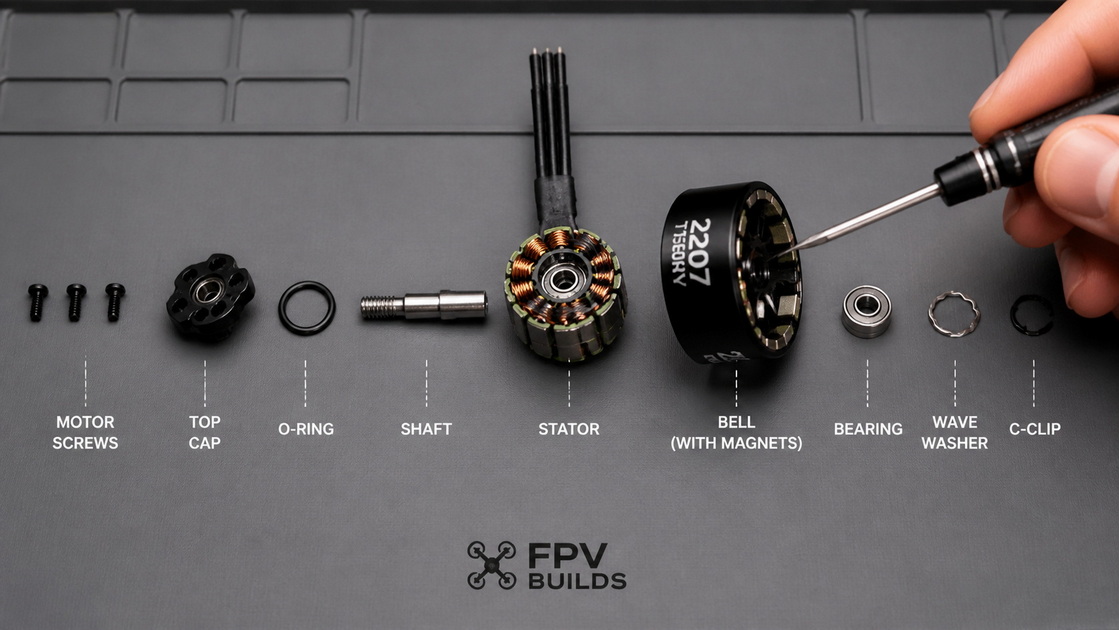
If your drone plows into the ground, flies through fine sand, or you feel grinding inside the motor, you need a deep clean with disassembly. [dronevibes]
1. Remove props and disconnect battery
Props and power should already be off before any disassembly. [mepsking]
2. Unscrew the motor from the frame (optional but recommended)
Use a hex driver to remove the four motor screws and lift the motor off the arm for easier access. [noirfpv]
3. Remove the bell
- Flip the motor and locate the bell screw or C‑clip on the shaft. [dronevibes]
- Carefully remove the screw or clip (do this over a tray so it does not fly away). [dronevibes]
- Gently pull the bell off the stator, keeping it straight to avoid chipping magnets. [dronevibes]
4. Clean the stator and windings
- Dip a toothbrush in isopropyl alcohol. [noirfpv]
- Gently scrub windings and stator surfaces to remove mud, sand, or dust. [noirfpv]
- Use tweezers to pick out larger particles stuck between windings. [mepsking]
5. Clean the bell and magnets
- Use the same alcohol‑soaked brush to clean inside the bell and between the magnets. [noirfpv]
- Pay special attention to the gap between magnets and stator path, which must remain free of debris. [noirfpv]
6. Dry thoroughly
- Wipe off excess alcohol with a lint‑free cloth. [noirfpv]
- Use compressed air to blow out remaining alcohol and particles. [facebook]
7. Inspect for damage
Check for cracked magnets, burnt windings, or warped shafts. Damaged motors should be replaced rather than forced back into service. [ligpower]
8. Lubricate bearings
- Apply one very small drop of high‑speed bearing oil to each bearing. [getfpv]
- Spin gently by hand to distribute the oil. [getfpv]
9. Reassemble the motor
- Carefully slide the bell back onto the stator.
- Re‑install the bell screw or C‑clip securely. [dronevibes]
- Mount the motor back on the arm with screws and use medium threadlocker if needed. [ligpower]
10. Final smoothness check
Spin the motor by hand; it should feel smoother than before, with no grinding. [robocraze]
If a motor still feels rough or noisy after proper cleaning, the bearings may be permanently damaged and need replacement or the motor should be retired. [ligpower]
From an engineering standpoint, saltwater is the worst enemy of FPV motors. It accelerates corrosion, attacks bearings, and can cause motors to lock up within hours if not treated correctly. [mepsking]
1. Rinse with fresh water
Counterintuitive but critical: quickly rinsing motors with fresh water helps remove salt crystals. [mepsking]
2. Soak in isopropyl alcohol
Submerge the motor (or at least the bell and stator area) in 90%+ IPA for 3–5 minutes to displace water. [mepsking]
3. Blow dry
Use compressed air from different angles to push out alcohol and remaining water. [getfpv]
4. Disassemble and deep clean
Follow the deep cleaning steps above for stator, bell, and bearings. [noirfpv]
5. Oil bearings generously (but not excessively)
After drying, apply bearing oil and spin by hand. [getfpv]
6. Monitor over the next few flights
If motors become noisy or rough again, replace bearings or the motor, as corrosion may have already started. [ligpower]
In our lab and customer service cases, motors that were rinsed and cleaned quickly often survived saltwater crashes, while those left wet typically failed within a few days. [mepsking]

Based on our internal testing and broader industry guidelines, the table below summarizes a practical maintenance schedule for most FPV pilots. [robocraze]
Maintenance Item | Recommended Frequency | What to Do | Notes |
Basic visual & spin check | Before each flight | Spin bells by hand, look for obvious damage | Stop if you feel grinding or hear scraping (getfpv) |
Dust removal | Every 3–5 flights | Blow out motors with air, brush externals | Essential after dusty or grassy flights (getfpv) |
Deep cleaning (disassembly) | Every 10–20 flights or after crashes | Remove bell, clean stator and magnets with IPA | Mandatory after mud, sand, or saltwater (mepsking) |
Bearing lubrication | Every 20–30 flight hours | Add 1 small drop of bearing oil | Over‑oiling attracts dust (getfpv) |
Full inspection (wear & damage) | Monthly | Inspect magnets, windings, shafts, wires | Replace if windings are burnt or magnets are cracked (getfpv) |
Post‑rain / wet grass care | After each wet session | Dry motors, remove grass, perform quick clean | Avoid storage while still damp (getfpv) |
Following this schedule has proven in our test fleet to reduce unplanned motor failures and extend usable motor life significantly, especially for long‑range and professional rigs. [robocraze]

From both community feedback and RMA analysis, we repeatedly see the same preventable mistakes. [robocraze]
Avoid:
- Running motors in water to "self‑clean" – this forces dirt into bearings and risks ESC damage. [intofpv]
- Spraying motors with aggressive cleaners or WD‑40 and leaving them un‑oiled afterward (temporary freedom but long‑term damage). [robocraze]
- Using too much oil, which traps dirt and creates a sticky sludge around bearings. [ligpower]
- Ignoring early signs of grinding or squealing and continuing to fly. [robocraze]
- Disassembling motors carelessly, chipping magnets or losing C‑clips and screws. [dronevibes]
Treat your motors like precision components, not consumable toys. This mindset alone dramatically improves reliability.
Because we design and test FPV BLDC motors for drones, RC cars, gimbals, and even underwater robots, we see how different environments affect motor lifespan. [ligpower]
Here are some manufacturer‑level insights:
- Listen to your motors after every flight. A subtle change in noise usually appears before a failure. [robocraze]
- Match cleaning aggressiveness to motor value: premium race motors or cinematic rigs deserve careful deep cleaning, while very cheap practice motors may be cheaper to replace. [ligpower]
- For FPV drones used professionally (cinema, inspection, mapping), log flight hours and add motor checks to your standard pre‑job checklist. [store.potensic]
- If you often fly by the sea or in dusty locations, consider keeping two sets of motors—one "dirty environment" set and one for clean, critical shots.
These habits come directly from real‑world pilot feedback and our own engineering test benches, not just theory. [robocraze]
Clean motors are only one part of a reliable FPV power system. If you are building or upgrading drones, RC cars, or other brushless platforms and need consistent performance with strong after‑sales technical support, partnering directly with a specialized motor manufacturer gives you a clear advantage. [ligpower]
As a Chinese manufacturer focused on FPV drone motors and other BLDC solutions, we can:
- Provide optimised FPV motor lines for freestyle, racing, and long‑range use. [ligpower]
- Offer custom KV, winding, and shaft options for OEM and ODM projects. [ligpower]
- Deliver complete power system solutions, including motors, ESC recommendations, and matching prop data. [ligpower]
If you are planning a new drone platform or want stable long‑term supply for your production line, reach out to our engineering team to discuss your application requirements and motor roadmap.
1. Can I use water to clean FPV motors?
You should avoid cleaning motors with running tap water unless you are dealing with saltwater contamination, where a quick fresh‑water rinse is necessary to remove salt. Always follow with isopropyl alcohol, drying, and lubrication to prevent rust. [intofpv]
2. How often should I oil FPV motor bearings?
For most pilots, lubricating bearings every 20–30 flight hours, or when you notice increased noise or resistance, is a good balance. Over‑oiling is as harmful as not oiling, so use only a very small drop per bearing. [getfpv]
3. Is WD‑40 safe for FPV motors?
WD‑40 can temporarily free stuck bearings but is not a long‑term lubricant for high‑speed FPV motors. If you use it for cleaning, you must follow up with proper bearing oil and ensure all residue is removed from windings and magnets. [robocraze]
4. Do I really need to remove the motor bell for cleaning?
For light dust, external brushing and compressed air are often enough. For sand, mud, or grinding noises, removing the motor bell is strongly recommended to avoid hidden damage and premature failure. [dronevibes]
5. What are the signs my FPV motor should be replaced instead of cleaned?
Replace the motor if you see cracked magnets, burnt or darkened windings, a bent shaft, excessive play in the bell, or persistent roughness after proper cleaning and lubrication. In these cases, continued use risks ESC damage and in‑flight failure. [robocraze]
1. Mepsking, "How to Clean Drone Motors: Step‑by‑Step Guide." [Link] [mepsking]
2. GetFPV, "FPV Drone Maintenance and Cleaning Guide." [Link] [getfpv]
3. NoirFPV, "The Best Way to Clean FPV Drone Motors (in 7 Simple Steps)." [Link] [noirfpv]
4. Ligpower, "The Ultimate FPV Drone Motors Guide 2025." [Link] [ligpower]
5. Robocraze, "Drone Motor Maintenance: Tips to Keep Your Motors Running." [Link] [robocraze]
6. Reddit r/fpv, "Best Way to Clean Motors." [Link] [reddit]
7. IntoFPV, "How to Wash Your Brushless Motors." [Link] [intofpv]
8. Dronevibes Forum, "Cleaning Dirt Out of Brushless Motors." [Link] [dronevibes]
9. Potensic, "Drone Maintenance Guide: Clean & Protect for Longevity." [Link] [store.potensic]


