Language


Views: 222 Author: Yuhang Power Publish Time: 2026-05-30 Origin: Site
Content Menu
● FPV Drone vs Normal Drone: A Quick Overview
● What Is a Normal Drone? Design, Experience, and Use Cases
>> How Normal Drones Are Designed to Fly "For You"
>> Typical Applications of Normal Drones
● What Is an FPV Drone? Flight Modes, Feel, and Freedom
>> FPV Flying: From Stabilized to Full Manual (Acro)
>> Typical FPV Drone Use Cases
● Hardware Comparison: FPV Drone vs Normal Drone (At a Glance)
● Flight Experience: Stability vs Adrenaline
>> What Flying a Normal Drone Feels Like
>> What Flying an FPV Drone Feels Like
● Power Systems and Motors: Why They Differ So Much
● Ease of Use, Setup, and Maintenance
>> Normal Drones: Turn On and Fly
>> FPV Drones: Build, Tune, Repair
● Pros and Cons: FPV Drones vs Normal Drones
>> Advantages of Normal Drones
>> Disadvantages of Normal Drones
>> Disadvantages of FPV Drones
● 2026 Market Trends: Where FPV and Normal Drones Are Heading
● How To Choose: FPV Drone or Normal Drone?
● Call To Action: Build the Right Power System for Your Platform
● FAQ
>> 1. Can one drone be both FPV and normal?
>> 2. Are FPV drones only for racing?
>> 3. Which motors are better for FPV drones?
>> 4. Do I need to build my own FPV drone?
>> 5. What about regulations for FPV flying?
When people ask me whether they should buy an FPV drone or a normal camera drone, they are really asking two different questions: what kind of flying experience do I want—and what hardware ecosystem will support me long term? As a manufacturer of FPV drone motors and brushless power systems, we see both sides every day: pilots who just want stable 4K footage, and pilots who tune every KV and prop size to squeeze out one more percent of performance. [grepow]
At the highest level, normal drones (often called camera drones or GPS drones) are designed for stability, automation, and image quality. FPV drones (First‑Person View) are built for immersion, speed, and manual control. [reddit]
You can think of it this way:
- A normal drone is like a gimbal‑mounted camera that just happens to fly.
- An FPV drone is like a lightweight racing machine that just happens to carry a camera. [facebook]
From a power‑system perspective, this difference shapes everything: frame design, motor KV, propeller choice, battery type, and even ESC firmware are all matched to either smooth endurance flights or aggressive high‑G maneuvers. [retekmotion]
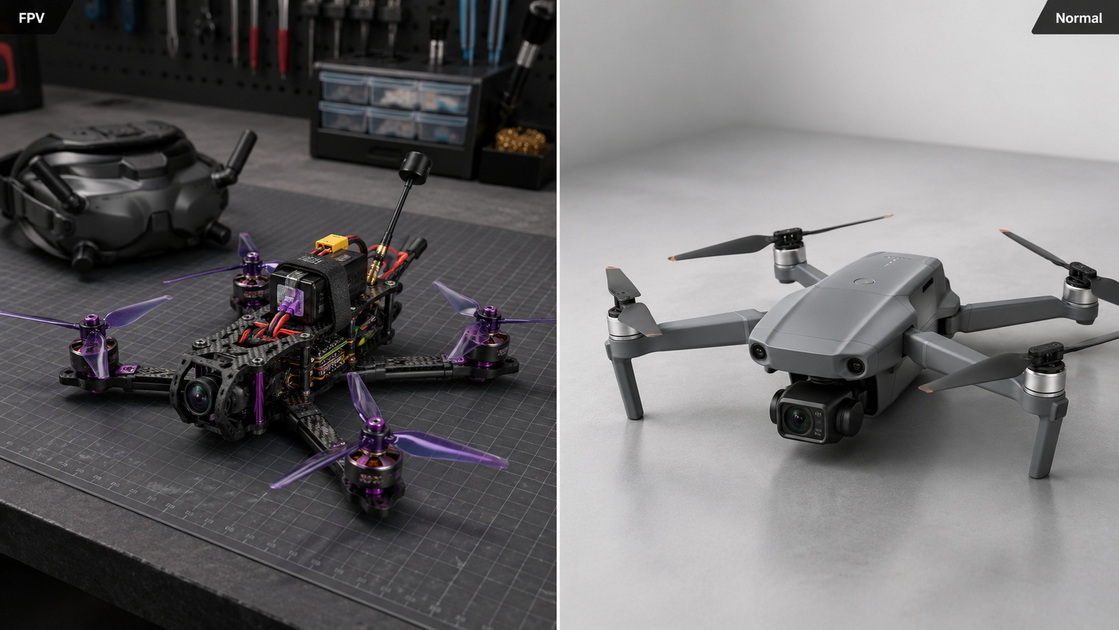
A normal drone uses GPS, multiple sensors, and advanced flight controllers to keep itself level and stable. If you release the sticks, a typical camera drone simply hovers in place. [grepow]
Common characteristics:
- GPS‑assisted stability with automatic hovering and Return‑to‑Home.
- High‑resolution camera on a gimbal for smooth 4K–8K video and detailed photos. [space]
- Intelligent flight modes such as Follow Me, Orbit, Waypoints, MasterShots, and QuickShots.
- Optimized flight time (often 20–45 minutes per pack, depending on model). [newayprecision]
Well‑known examples are DJI Mavic, DJI Air, and Autel EVO series, which focus on delivering cinematic footage with minimal pilot workload. [space]
Normal drones dominate scenarios where image quality and reliability matter more than maneuverability:
- Travel vlogging and tourism content.
- Real estate, construction progress, and infrastructure inspection.
- Surveying, mapping, and photogrammetry.
- Agriculture (spraying and monitoring) and environmental monitoring. [360automation.com]
In these workflows, the power system is tuned for efficiency rather than raw thrust: lower‑KV motors, larger props, and high‑capacity LiPo or Li‑ion packs are the norm. [retekmotion]
An FPV drone sends a real‑time video feed from its onboard camera to FPV goggles, putting the pilot "inside" the aircraft. These drones usually support three main modes: [grepow]
- Angle (stabilized) – limits tilt; the drone self‑levels when sticks are released.
- Horizon – mostly stabilized but allows mild flips or rolls.
- Acro (full manual) – no self‑level; the pilot controls pitch, roll, and yaw entirely. [reddit]
In Acro mode, the drone will not return to level automatically when you let go of the sticks. That is exactly what allows spectacular dives, close‑proximity lines, and racing turns—but it also means a steep learning curve. [reddit]
FPV drones shine where agility and immersion are key:
- Drone racing on organized tracks or informal circuits.
- Freestyle flying in parks, bando spots, or open fields.
- Cinematic FPV for "through‑the‑gap" shots, car chases, and dynamic commercials. [facebook]
- Emerging industrial and defense applications that need fast, precise low‑level flight. [forbes]
These roles demand high power‑to‑weight, fast throttle response, and robust frames—and that's where specialized FPV motors and ESCs become critical. [tmotorhobby]
| Aspect | FPV Drone | Normal Drone |
|---|---|---|
| Flight view | FPV goggles, first‑person, low latency (grepow) | Phone/RC screen, stabilized third‑person view (grepow) |
| Flight control | Manual or semi‑manual, Acro mode possible (grepow) | GPS stabilized, assisted, automated modes (grepow) |
| Camera | FPV feed + optional action cam (GoPro, etc.) | Integrated gimbal camera (4K–8K) (space) |
| Maneuverability | Extremely agile, can do flips, rolls, tight gaps (grepow) | Limited to smooth movements and safety limits |
| Flight time | Shorter (3–8 minutes racing, 10–20 cinematic) | Longer (20–45 minutes typical) (newayprecision) |
| Durability | Often very durable, designed to survive crashes | More fragile; harder and costlier to repair |
| Learning curve | Steep; simulators recommended | Gentle; suitable for beginners (grepow) |
| Typical motors | High KV FPV motors optimized for thrust | Lower KV efficiency‑oriented motors |
For a first‑time pilot, a normal drone feels reassuring. The aircraft:
- Locks its position with GPS.
- Holds altitude with barometers and vision sensors.
- Gently corrects your mistakes in wind or turbulence. [ahxisim]
Most of your attention goes into framing the shot using the gimbal, not fighting the air. That's why many professionals treat camera drones as aerial tripods rather than sports machines.
Flying FPV in Acro mode is the opposite: imagine sitting on the nose of a racing quad, reacting in real time to every tree, gap, and building edge. Your goggles show every tilt and roll directly; your hands control every degree of motion. [facebook]
Because there is no automatic leveling, every mistake is yours—but so is every perfectly linked line. That intense connection is exactly why many racers and freestyle pilots never go back to purely GPS‑based flying. [grepow]
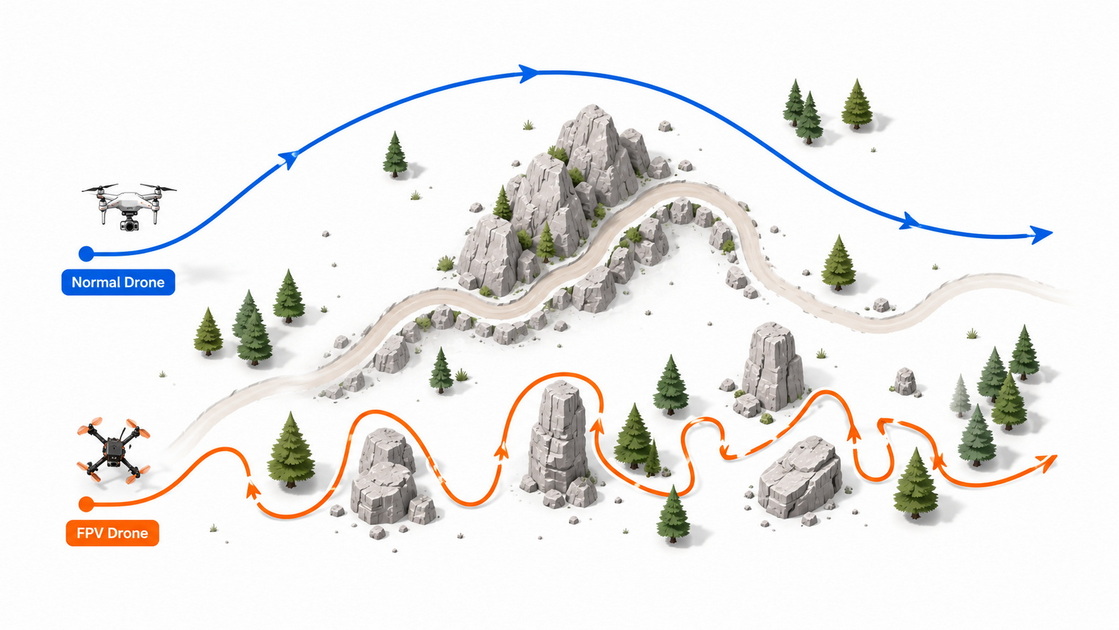
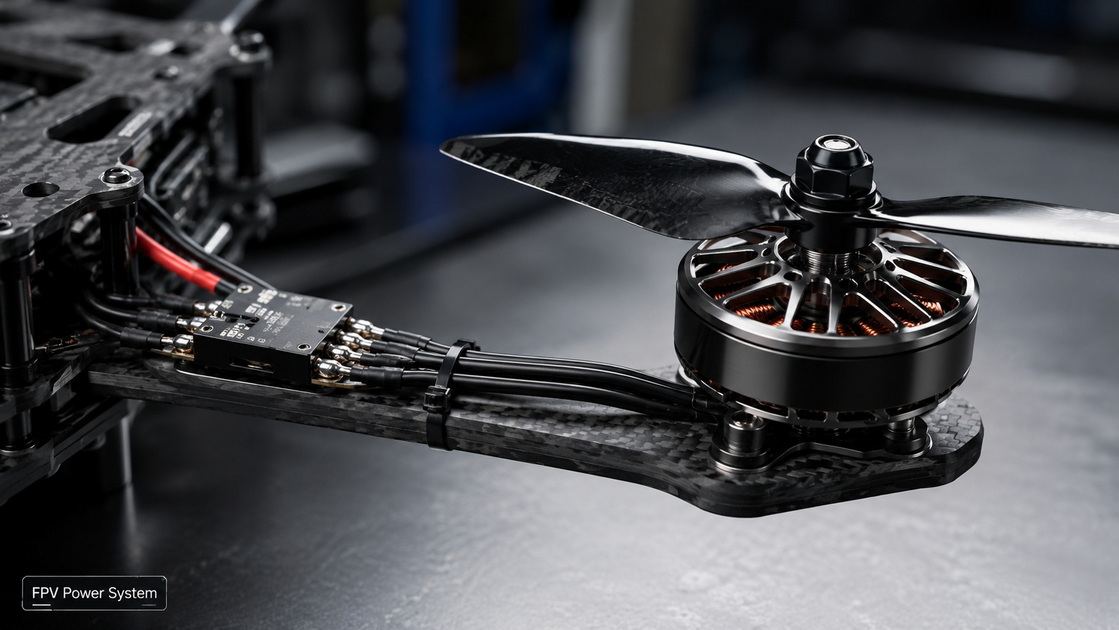
As a brushless motor manufacturer for FPV and robotics, we see a clear technical divide between power systems for FPV drones and normal drones.
FPV builds usually favor:
- High‑KV motors for strong punch‑out and instant throttle response.
- Stiff, often three‑blade or four‑blade props for grip and control.
- High‑discharge LiPo packs to sustain aggressive bursts. [tmotorhobby]
The goal is thrust‑to‑weight and responsiveness, not maximum minutes in the air. For example, a 5‑inch FPV quad running 2207‑class motors is tuned to accelerate hard, recover from dives, and maintain authority in sharp turns.
Camera drones prioritize:
- Lower‑KV, high‑efficiency motors.
- Larger, slow‑spinning props for quiet, stable lift.
- Smart batteries focused on capacity, safety, and telemetry.
Here, the goal is smoothness, noise reduction, and long flight time for stable video and professional operations. [newayprecision]
For OEM and ODM customers, we often design custom motor KV, stator size, and winding configurations around their specific platform's weight, prop, and mission profile, whether that's a long‑range mapping drone or a high‑thrust FPV cinewhoop. [fpvprokit]
A normal drone typically arrives as a closed ecosystem:
- Aircraft, smart batteries, RC, app, and charger are all integrated.
- Firmware updates, geofencing, and safety limits are handled by the manufacturer.
- Hardware repairs are often done through official service centers. [space]
For businesses needing predictable operations and minimal downtime, this plug‑and‑play model is attractive—even though it limits customization.
FPV drones come in three main forms:
- DIY kits you build and solder yourself.
- BNF (Bind‑and‑Fly) quads that ship almost ready, needing just radio binding.
- RTF (Ready‑to‑Fly) sets with radio and goggles included. [grepow]
Maintaining an FPV fleet usually means:
- Soldering motors, ESCs, and connectors.
- Flashing firmware and tuning PID parameters.
- Replacing arms, frames, and props after crashes. [bestsheetmetalmachine]
The upside is full control: you can spec motors, props, and even custom waterproof or high‑temperature designs for special environments like cineboats, inspection drones, or FPV robotics. [retekmotion]
- Very easy to fly with GPS, obstacle avoidance, and auto‑return.
- Long flight times suited for commercial jobs.
- Integrated camera and gimbal with proven image pipelines.
- Ideal for pilots who prioritize results over tinkering. [space]
- Limited maneuverability and speed; hard to do aggressive lines.
- Closed ecosystems make repairs and upgrades more expensive and restricted.
- Less suitable for flying in tight indoor spaces or complex 3D tracks. [reddit]
- Full manual control for racing, freestyle, and cinematic proximity.
- High durability; many frames are designed to survive hard crashes.
- Strong customization: you can choose motors, props, ESCs, cameras, and frames to match your style and mission.
- Perfect for pilots and companies who want unique, high‑energy footage or specialized maneuvers. [retekmotion]
- Steep learning curve; simulator practice is highly recommended.
- Shorter flight time, especially on racing setups.
- Requires technical knowledge of electronics, firmware, and RF systems.
- Regulatory constraints can be tighter due to line‑of‑sight rules and FPV goggles. [bestsheetmetalmachine]
Regulation and innovation are reshaping the drone market:
- Camera drones continue to focus on higher image quality, better obstacle avoidance, and longer range, but some regions face tighter import and certification rules for new models. [youtube]
- FPV drones are seeing rising adoption not only in hobby and cinema but also in defense and industrial applications, due to their agility and low‑cost customization. [forbes]
- Power‑system suppliers and motor manufacturers are investing in more efficient FPV motors, better cooling, and corrosion resistance for use in harsh environments and robotics. [tmotorhobby]
For OEM and ODM clients, this means there is growing demand for application‑specific power solutions rather than one‑size‑fits‑all motors.
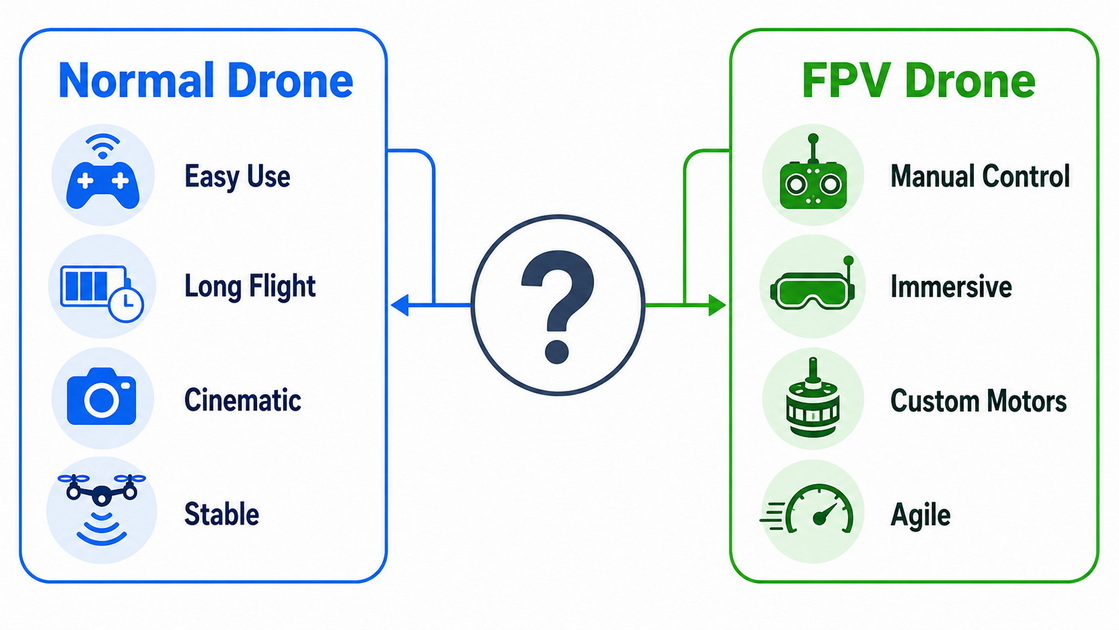
To help both hobbyists and B2B buyers, I usually ask four simple questions:
1. What is your primary goal?
- Stable professional footage → normal drone.
- Immersive racing/freestyle/cinematic action → FPV. [grepow]
2. How much time can you invest in learning and maintenance?
- Minimal time → normal drone.
- Ready to learn electronics and simulators → FPV. [bestsheetmetalmachine]
3. Do you need customization at the motor and power‑system level?
- No, standard platform is fine → normal drone.
- Yes, unique frames, prop sizes, or payloads → FPV or custom platform. [tmotorhobby]
4. Is your priority flight time or dynamic performance?
- Longer missions → camera drone‑style power system.
- Maximum agility → FPV‑style motors and ESCs. [newayprecision]
For many organizations, the most effective approach is mixed fleets: normal drones for mapping and documentation, FPV platforms (often using custom motors) for dynamic inspection, marketing shots, or training.
Whether you choose FPV drones, normal drones, or a hybrid fleet, your brushless power system will determine real‑world performance, reliability, and lifetime cost. As a dedicated FPV drone motor and brushless motor manufacturer, Zhongshan Yuhang Power Technology Co., Ltd. can help you:
- Select the right motor KV, stator size, and prop combination for your platform.
- Design custom OEM and ODM power solutions for FPV quads, gimbal drones, RC cars, industrial fans, gimbals, sweepers, underwater ROVs, and more. [fpvprokit]
- Optimize your system for thrust, efficiency, or endurance depending on your mission.
If you share your target weight, prop size, voltage, and use case, we can propose a complete power‑system solution that matches your chosen drone type and business goals.
Yes. Some platforms combine FPV systems with GPS stabilization and gimbals, but there are trade‑offs in weight, complexity, and tuning. [space]
No. FPV drones are widely used for freestyle, cinematic work, and increasingly for training, inspection, and defense, where agile manual flight is valuable. [forbes]
FPV builds typically use high‑KV, high‑response motors matched to prop size and battery voltage. Choosing the right motor is critical for throttle feel, efficiency, and durability. [retekmotion]
Not necessarily. You can start with BNF or RTF quads, then move into DIY as your skills grow. Many pilots eventually build custom setups to match their style. [bestsheetmetalmachine]
Many countries require visual line‑of‑sight and registration of certain drone types. FPV often needs a spotter or special authorization. Always check local rules before flying. [forbes]
1. MEPSKING, "What is the difference between FPV drone and normal drones." [grepow]
2. Grepow, "What's The Difference between FPV and Camera Drone." [grepow]
3. Space.com, "Best FPV Drones 2026: Get a stunning bird's eye view of the world." [space]
4. Forbes, "8 Insights Into How FPV Drones Are Shaping The Future Of Warfare." [forbes]
5. Suzhou Retek Electric, "Custom FPV Racing Drone Motors Manufacturers." [retekmotion]
6. FPVProKit, "Professional OEM & ODM Customization Service Process." [fpvprokit]
7. T‑Motor, "Customized BLDC Solutions." [tmotorhobby]
8. Reddit, "What's the difference between a normal drone and a fpv drone?" [reddit]
9. Neway Precision, "What tolerances can be achieved through precision metal bending." (cited for power/efficiency analogies in drone context.) [newayprecision]


