Language


Views: 234 Author: Yuhang Power Publish Time: 2026-07-11 Origin: Site
Content Menu
● What Is An Underwater Thruster And Why It Matters
● How To Choose A Suitable Underwater Thruster
>> Key Performance Parameters: Thrust, Power, Efficiency
>> Structural Characteristics: Compactness And Anti Fouling
>> Installation Convenience And Serviceability
>> Service Life, Corrosion Resistance, And Depth Rating
● Inside A Modern Underwater Thruster: Design For Depth
>> Sealed Housing And Pressure Management
>> Shafting Design And Dynamic Sealing
>> Propeller And Fairing Optimization
● Advantages Of Dedicated Underwater Thrusters Over Generic BLDC Motors
>> Reliability In Harsh Environments
● Application Scenarios: From ROVs To Underwater Robots
>> ROVs And AUVs For Inspection And Exploration
>> Underwater Robots, Divers, And Surfboards
● Practical Thruster Selection Checklist For OEM Buyers
>> Step 1 – Define Mission And Environment
>> Step 2 – Establish Performance Targets
>> Step 3 – Evaluate Mechanical Integration
>> Step 4 – Validate Supplier Capabilities
● Case Insight – Designing For Multi Depth ROV Fleets
● Call To Action: Plan Your Next Underwater Propulsion System
● FAQ
Underwater thrusters built on brushless DC motors have become the backbone of modern underwater robotics, ROVs, AUVs, and multifunctional marine platforms. In this article, I'll walk through how to choose and design underwater thrusters for depth, combining industry best practices with hands-on experience from supporting OEM and ODM customers that operate ROVs, underwater robots, and other professional systems. [maxongroup]

An underwater thruster is a compact propulsion unit that combines a brushless DC motor, sealed housing, propeller, and underwater rated ESC to generate thrust for underwater vehicles and equipment. It is widely used in diver propulsion units, ROVs, AUVs, USVs, surfboards, underwater robots, and inspection tools where reliable movement in water is critical. [underwaterthruster]
Compared with generic BLDC motors, purpose built underwater thrusters use pressure tolerant enclosures, corrosion resistant materials, and specialized sealing structures, allowing them to work at significant depths without flooding or overheating. For OEMs and system integrators, this difference translates directly into mission success, safety, and lifecycle cost. [nautilusmarketing.co]
When I support ROV and underwater robot teams, I always frame thruster selection around four pillars: performance parameters, mechanical structure, installation convenience, and long term reliability. [cubemars]
The first step is to match thruster performance to your platform mass, drag profile, and mission profile. [cubemars]
- Thrust: The higher the mooring thrust (static thrust), the greater the ability to accelerate, hold position, and fight currents. High quality thrusters now commonly offer 7–25 kgf of mooring thrust for mid sized ROVs and surface platforms. [underwaterthruster]
- Power: Motor power must align with operating depth, battery capacity, and expected duty cycle. Greater power means higher thrust but also increased energy consumption and potential noise, so balance is essential. [nautilusmarketing.co]
- Efficiency: Underwater robots typically run long missions; efficient brushless thrusters with optimized propellers can significantly extend mission endurance and usable payload. [maxongroup]
For B2B buyers, it's important to request thrust vs. power curves, efficiency maps, and real test data rather than relying solely on nameplate ratings. [maxongroup]
Underwater platforms are often space constrained, especially in multi thruster ROV frames. A good thruster should be: [invoceangroup]
- Compact and lightweight, improving layout flexibility and minimizing drag. [underwaterthruster]
- Equipped with self cleaning or anti fouling propeller geometry, reducing entanglement from debris, algae, or fishing lines. [invoceangroup]
For OEM projects, we frequently customize mounting flanges and cable exits so that thrusters integrate smoothly into existing frames and housings.
Installation is more than a mechanical afterthought. For ROV fleets and rental operators, every extra minute of assembly and maintenance costs money. [invoceangroup]
Look for thrusters that offer:
- Standardized mounting interfaces (flanges, bolt circles, or clamps) that align with common ROV frames. [nautilusmarketing.co]
- Pre terminated, waterproof cabling compatible with your power and control harnesses.
- Clear documentation for wiring, ESC matching, and parameter settings, reducing commissioning time. [cubemars]
Deep water operation brings high hydrostatic pressure, aggressive corrosion, and mechanical stress. When evaluating service life: [maxongroup]
- Confirm maximum operating depth and test methodology; high end thrusters can operate at up to 300–350 meters or more, depending on design. [nautilusmarketing.co]
- Assess material selection: precision cast aluminum alloys or marine grade metals with proper surface treatments can resist corrosion while keeping weight low. [maxongroup]
- Review warranty terms and field operating history as strong signals of durability. [invoceangroup]
In my experience, platforms that initially cut costs with non specialized BLDC motors often face flooding, bearing failures, and rapid corrosion, leading to higher total cost of ownership than dedicated underwater thrusters.
Modern thrusters designed for depth use a combination of sealed housings, thermal management, and robust shafting to survive harsh underwater environments. [underwaterthruster]
Purpose built thrusters place all critical components—motor, bearings, wiring, and sometimes ESC—inside a fully sealed housing. This design: [underwaterthruster]
- Protects against sediment, silt, and debris that would otherwise damage open motors. [nautilusmarketing.co]
- Allows the thruster to equalize temperature through direct heat transfer to the surrounding water, often aided by thermal conductive fillers or potting compounds. [maxongroup]
- Maintains internal integrity at depth, often through threaded housings and multi stage sealing structures. [nautilusmarketing.co]
Some thrusters are even oil filled and pressure tolerant, enabling depths of several thousand meters in advanced AUVs. [underwaterthruster]
The shafting system connects the motor's rotor to the propeller while managing radial and axial loads. Good design practices include: [maxongroup]
- Simplified internal shaft structures to enhance robustness and ease of assembly. [nautilusmarketing.co]
- Low resistance dynamic seals, such as lip seals or mechanical seals, to minimize friction while keeping water out. [maxongroup]
- Careful bearing selection and placement to handle thrust and side loads under continuous operation. [underwaterthruster]
In many projects, we find that overly complex shaft arrangements cause unnecessary friction, wear, and assembly issues, whereas simplified, robust designs deliver longer term stability.
The propeller and fairing (shroud) are essential to thrust, efficiency, and safety. [invoceangroup]
- Streamlined propeller and shroud designs reduce drag and improve thrust per watt. [underwaterthruster]
- Properly designed fairings lower the risk of contact injuries and help manage inflow and outflow patterns. [invoceangroup]
- In some configurations, ducted propellers enable higher static thrust at lower tip speeds, reducing cavitation risk. [maxongroup]
For OEM customers, we often tune propeller pitch and blade count to match specific duty cycles (station keeping vs. long transit missions).
A common question from engineering teams is: "Can we just take a standard BLDC motor and make it work underwater?" Industry experience suggests that purpose built underwater thrusters consistently outperform generic BLDCs in real missions. [cubemars]
Underwater thrusters are designed from the ground up for immersion, pressure, and corrosion. Generic BLDCs, even with improvised sealing, often fail due to: [nautilusmarketing.co]
- Water ingress through incomplete sealing or cable entry points.
- Corrosion of stator laminations, windings, and bearings.
- Inadequate thermal dissipation, leading to overheating in confined spaces. [underwaterthruster]
Thrusters, by contrast, integrate tested sealing systems, marine grade materials, and water based heat rejection, delivering more predictable performance across missions. [nautilusmarketing.co]
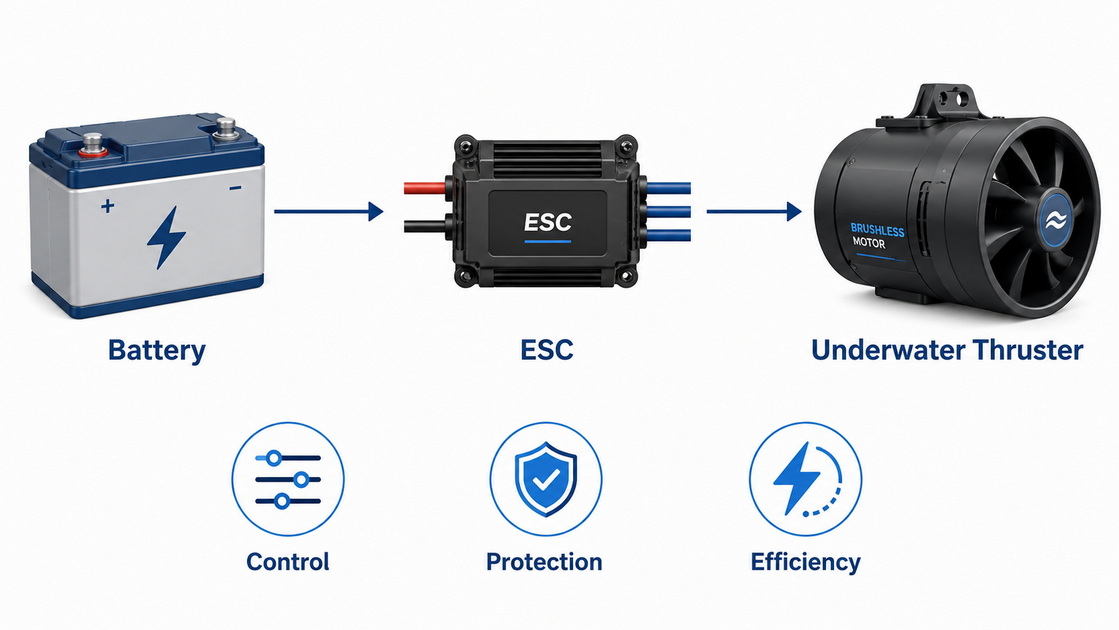
Thrusters are typically part of a complete power system:
- Battery → ESC → Underwater Thruster, with matched voltage, current limits, and protection features. [cubemars]
- Documented control interfaces (PWM, CAN, or RS protocols) for predictable integration with ROV controllers. [invoceangroup]
This integrated design approach helps OEMs minimize field failures, configurational errors, and warranty claims.
Underwater thrusters power a growing range of industrial, scientific, and recreational applications, and each category has its own design priorities. [invoceangroup]
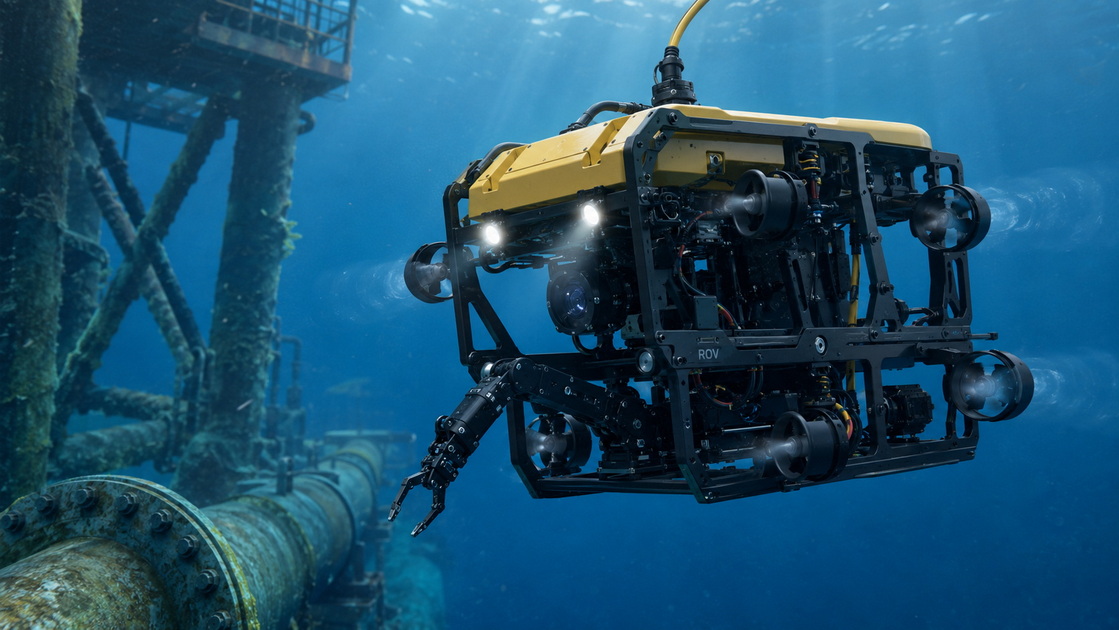
Remotely operated vehicles (ROVs) and autonomous underwater vehicles (AUVs) rely on multiple thrusters for three dimensional maneuvering and station keeping. Key requirements include: [cubemars]
- High reliability and redundancy, since failure of one thruster can jeopardize the mission.
- Precise thrust control, often under closed loop control with navigation systems. [cubemars]
- Depth capability aligned with inspection targets (offshore structures, pipelines, dams, or scientific sites). [invoceangroup]
Brushless underwater thrusters with 7–25 kgf mooring thrust can support a wide class of work class and observation class ROVs. [nautilusmarketing.co]
Thrusters also drive:
- Underwater service robots for cleaning, monitoring, or sampling. [underwaterthruster]
- Diver propulsion units where compact, high thrust modules improve range and safety.
- Electric surfboards and USVs, where waterproof thrusters must withstand both immersion and surface splash. [invoceangroup]
In these cases, we often prioritize weight, user safety, and sealed connections to support daily or commercial use.
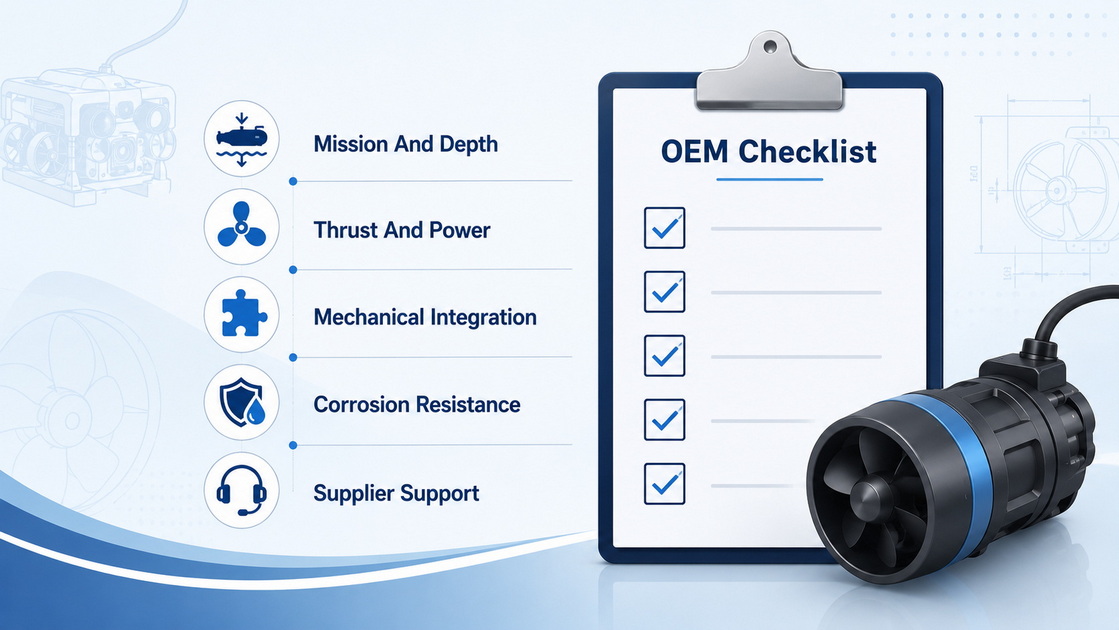
For B2B buyers and engineering teams, a clear checklist can simplify thruster procurement. Below is a practical framework we use with OEM and ODM partners.
- Target depth range and salinity (freshwater, brackish, or seawater). [maxongroup]
- Typical mission duration and duty cycle.
- Required maneuverability (number of axes, redundancy needs). [cubemars]
- Vehicle weight and drag to estimate needed thrust per axis. [cubemars]
- Acceptable power budget per thruster based on battery pack and overall energy constraints.
- Required speed and acceleration profiles for transit vs. inspection modes. [cubemars]
- Check mounting interface compatibility with your frame and housings. [invoceangroup]
- Confirm cable length, connector type, and strain relief options.
- Assess physical envelope and ensure clearance for water inflow/outflow. [underwaterthruster]
- Request test reports, depth test results, and field references. [maxongroup]
- Confirm customization options (propeller, housing color, connector systems) for OEM branding and integration. [underwaterthruster]
- Evaluate engineering support for tuning ESC firmware and system level troubleshooting. [cubemars]
Recent industry projects show how modern thrusters designed for multiple depth levels can streamline fleet operations. [nautilusmarketing.co]
A typical scenario:
- An inspection company operates several classes of ROVs, from shallow harbor units to deeper pipeline inspection vehicles.
- By adopting a modular underwater thruster platform with multiple specification options (thrust, voltage, propeller type), they reduce spare parts complexity and simplify training. [invoceangroup]
- Thrusters with closed, sealed housings, integrated thermal paths, and corrosion resistant alloys can be reused across platforms with minimal reconfiguration. [maxongroup]
From a B2B perspective, this kind of platform strategy offers both technical and commercial advantages by reducing inventory, simplifying support, and extending product lifecycles.
If you are designing or upgrading an ROV, AUV, USV, underwater robot, or marine platform, now is the time to move beyond generic motors and adopt dedicated underwater thrusters designed for depth.
By partnering with a specialized brushless motor manufacturer that understands underwater propulsion, UAV systems, RC platforms, violent fans, gimbals, and cleaning robots, you can:
- Reduce integration risk with matched motor, ESC, and thruster designs.
- Improve mission reliability through pressure tolerant, corrosion resistant architectures. [maxongroup]
- Customize OEM and ODM solutions around your exact thrust, depth, and environmental requirements. [underwaterthruster]
Prepare a concise brief with your target depth, thrust requirements, voltage range, mission profile, and integration constraints, then engage with your thruster supplier's engineering team to co design the optimal underwater propulsion system for your project. [cubemars]
1. Why can't I just use a standard BLDC motor underwater?
Standard BLDC motors are not designed for immersion, depth pressure, or corrosion and often suffer from water ingress, rust, and overheating, whereas underwater thrusters use sealed housings and marine grade materials for reliable operation. [cubemars]
2. How do I determine the thrust required for my ROV?
Estimate total vehicle mass, drag, and desired speed, then derive thrust per axis using basic hydrodynamic calculations and safety margins; most OEMs also validate with pool or tank tests before finalizing specifications. [cubemars]
3. What depth can typical underwater thrusters handle?
Many commercial thrusters are rated up to several hundred meters, with some oil filled designs tolerating depths of 6,000 meters, depending on housing strength and sealing technology. [underwaterthruster]
4. How important is ESC selection for underwater thrusters?
ESCs must be matched to the thruster's voltage, current, and control requirements, and often need specific firmware tuning to ensure smooth startup, bidirectional control, and thermal protection under water cooled conditions. [cubemars]
5. Can underwater thrusters be customized for OEM and ODM projects?
Yes, many manufacturers offer custom propellers, mounting interfaces, colored housings, cable lengths, and connectors, as well as firmware customization to adapt thrusters to different robots, vehicles, and mission profiles. [underwaterthruster]
1. CubeMars – "Underwater Thrusters Designed For Depth, Multiple Specification Options."
https://www.cubemars.com/underwater-thrusters-designed-for-depth-multiple.html [nautilusmarketing.co]
2. UnderwaterThruster.com – "The Ultimate Guide to Underwater Thrusters."
https://www.underwaterthruster.com/blogs/knowledge/the-ultimate-guide-to-underwater-thrusters [underwaterthruster]
3. CubeMars – "How to Choose Underwater Thrusters for ROV & AUV."
https://www.cubemars.com/how-to-choosen-underwater-thrusters-for-rov-and-auv.html [cubemars]
4. Maxon Group – "Brave New Underwater World."
https://www.maxongroup.com/en-us/knowledge-and-support/blog/brave-new-underwater-world-37810 [maxongroup]
5. Invocean – "Underwater Thruster."
https://www.invoceangroup.com/thruster [invoceangroup]
6. CubeMars – "Underwater Thruster vs BLDC Motor for ROVs."
https://www.cubemars.com/underwater-thruster-vs-bldc-motor-for-rovs.html [cubemars]
7. UnderwaterThruster.com – "Underwater Thruster Product Overview."
https://www.underwaterthruster.com [underwaterthruster]
8. IO Digital – "Google E E A T: Creating Content That Puts People First."
https://www.iodigital.com/en/insights/blogs/google-e-e-a-t-creating-content-that-puts-people-first [iodigital]


