Language


Views: 222 Author: Yuhang Power Publish Time: 2026-05-24 Origin: Site
Selecting the right hybrid motor position sensor is a design decision that quietly determines whether your motion system feels precise and reliable or unpredictable and fragile. As a manufacturer of FPV drone motors and other BLDC solutions, we see again and again that the weakest link is not the motor torque, but the feedback quality you get from your position sensor. [soarskyrc]
Below is a deeply reworked, application‑oriented guide based on NMB Technologies' article plus additional industry insights for engineers and technical buyers. [blog.airlinehyd]
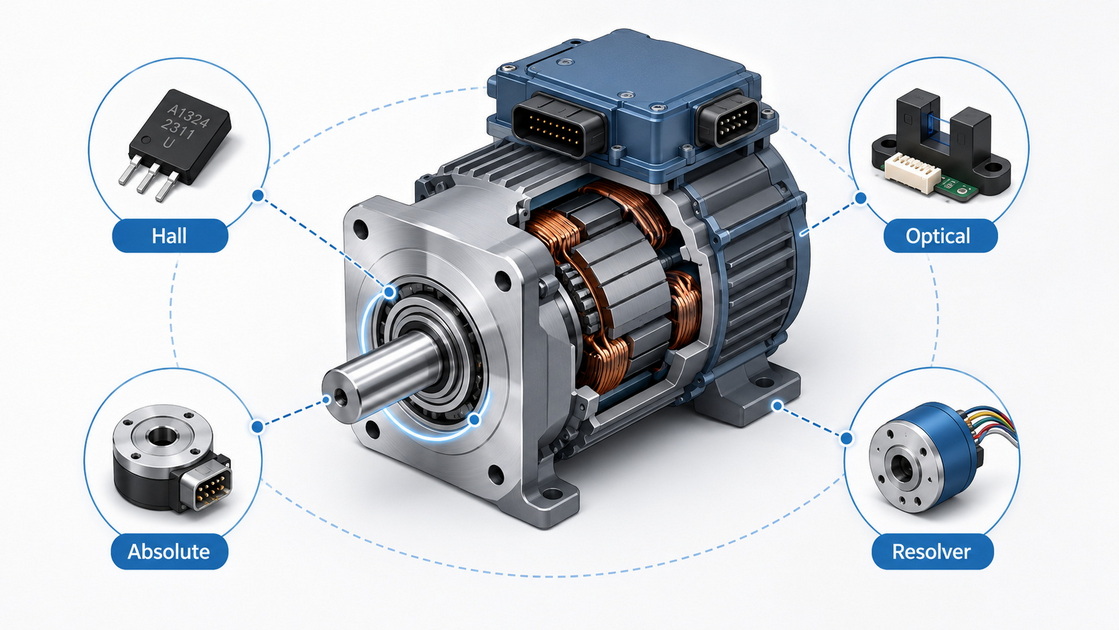
Hybrid stepper and hybrid BLDC motors are everywhere: pick‑and‑place machines, medical pumps, gimbal axes, collaborative robots, and increasingly, hybrid powertrains and actuators in UAVs. [unmannedsystemstechnology]
Without a position sensor, a hybrid motor is effectively "blind" once it loses steps due to overload, shock, or unexpected friction. A well‑chosen hybrid motor position sensor gives you: [dandreavisual]
- Real‑time position feedback (closed‑loop control). [blog.airlinehyd]
- Stall detection and recovery instead of silent failure. [dandreavisual]
- Higher effective torque utilization and smoother motion profiles. [blog.airlinehyd]
In FPV and UAV‑related systems, similar principles apply: gimbals, camera sliders, landing gear, or pan‑tilt units benefit directly from robust position feedback, especially in vibration‑ and shock‑rich environments. [calbryant]
Before discussing sensor types, it helps to define the selection criteria you should document in your spec. [nmbtc]
- Presence of dust, oil mist, moisture, or cleaning agents.
- Expected vibration levels and mechanical shock (e.g., vehicle or drone‑mounted vs clean lab automation). [dandreavisual]
- Operating temperature range and any thermal cycling.
Sensors with exposed optics or delicate code disks will behave differently from fully enclosed transformer‑based devices in harsh environments. [dandreavisual]
- Minimum step size and positional accuracy required by the application.
- Whether you need high‑resolution interpolation (e.g., micro‑stepping) or coarse positioning is sufficient. [blog.airlinehyd]
If you overspec resolution, you pay in complexity and cost; if you underspec it, you lose productivity, print quality, or image stability.
- Open‑loop vs closed‑loop control and how the controller will ingest feedback (incremental pulses vs absolute position words). [blog.airlinehyd]
- Available interfaces (A/B quadrature, SPI, SSI, CAN, etc.).
Absolute encoders that can report human‑meaningful positions (e.g., "pour position") can simplify software and diagnostics in complex machines. [dandreavisual]
- Balance between unit price and downtime risk: cheaper sensors may fail early in difficult environments. [acecoretechnologies]
- Consider total system cost: a more capable encoder can reduce software complexity, commissioning time, and field maintenance. [blog.airlinehyd]
With these criteria documented, you can meaningfully compare the main sensor families.
Hall sensors are among the most common hybrid motor position sensors, especially in industrial automation and medical equipment. [dandreavisual]
How they work:
Magnets on or near the motor shaft pass over a magnetic array, and the sensor interpolates the changes in magnetic field to determine position. [dandreavisual]
Pros: [blog.airlinehyd]
- Highly resistant to vibration and shock.
- Simple, rugged construction with low cost.
- Versatile for many hybrid stepping motor applications where ultra‑high resolution is not required.
Cons: [dandreavisual]
- Lower resolution and precision compared to encoders.
- Not ideal for applications demanding very fine positioning or smooth micro‑stepping at high speeds.
Typical uses include pumps, basic actuators, and medium‑precision motion where durability and cost matter more than micrometer‑level accuracy. [dandreavisual]
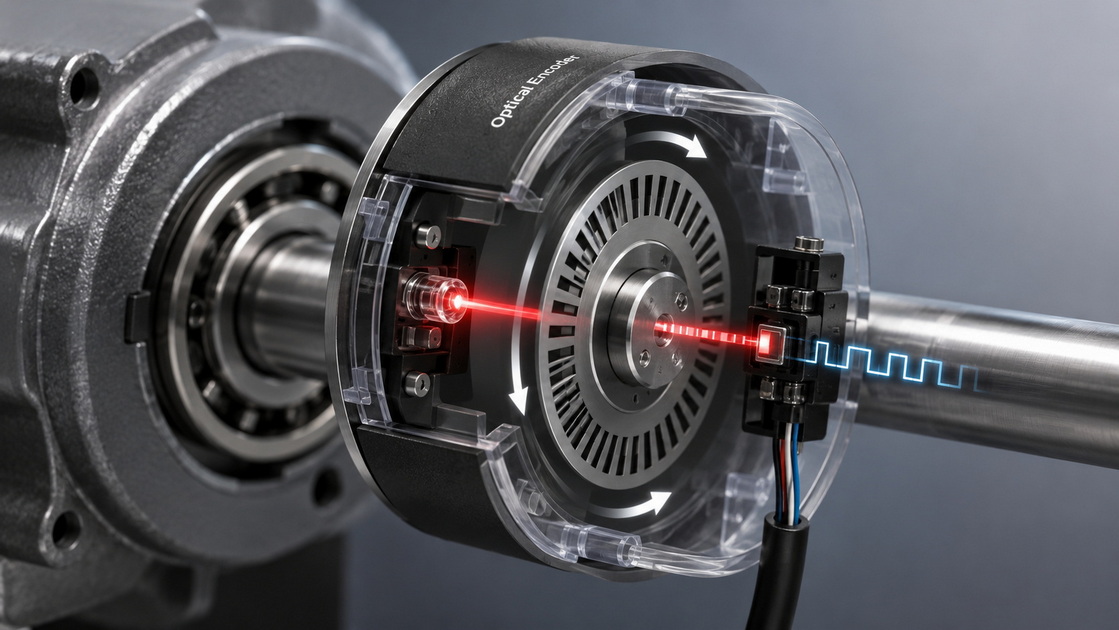
Optical encoders are widely used when you need better resolution, accuracy, and repeatability at a reasonable cost. [dandreavisual]
How they work:
A light source shines through (or reflects off) a coded disk attached to the shaft, and a photosensor detects patterns of light and dark to measure motion. [dandreavisual]
Pros: [dandreavisual]
- High resolution and very good repeatability.
- Mature, cost‑effective technology for many industrial and medical systems.
Cons: [dandreavisual]
- Sensitive to contamination; dust or oil on the code disk can cause miscounts.
- After a power loss, the system usually must "home" and recalibrate, which costs time and may require additional sensors or hard stops. [dandreavisual]
Optical encoders are often a good balance for laboratory or clean factory settings where maintenance and environmental control are manageable. [blog.airlinehyd]
Absolute encoders represent a newer class of hybrid motor position sensors that provide more information and easier recovery after power loss. [nmbtc]
Key characteristics: [dandreavisual]
- Retain position information after power loss; no need to re‑home on every startup.
- Provide absolute position words (e.g., "pour position") rather than just incremental counts.
- Often more compact than traditional incremental encoders and can also deliver velocity and acceleration data.
Advantages: [blog.airlinehyd]
- Faster startup and recovery after emergency stops or power cuts.
- Simplified control software, since the system always "knows" where it is.
- Better support for safety‑critical or high‑throughput operations where re‑homing is costly.
Trade‑offs: [dandreavisual]
- Higher unit cost compared with basic encoders or Hall sensors.
- Requires more careful integration of communication protocols and data handling.
In complex automation cells or hybrid UAV power systems where downtime is expensive, absolute encoders can reduce overall system cost despite higher component price. [unmannedsystemstechnology]
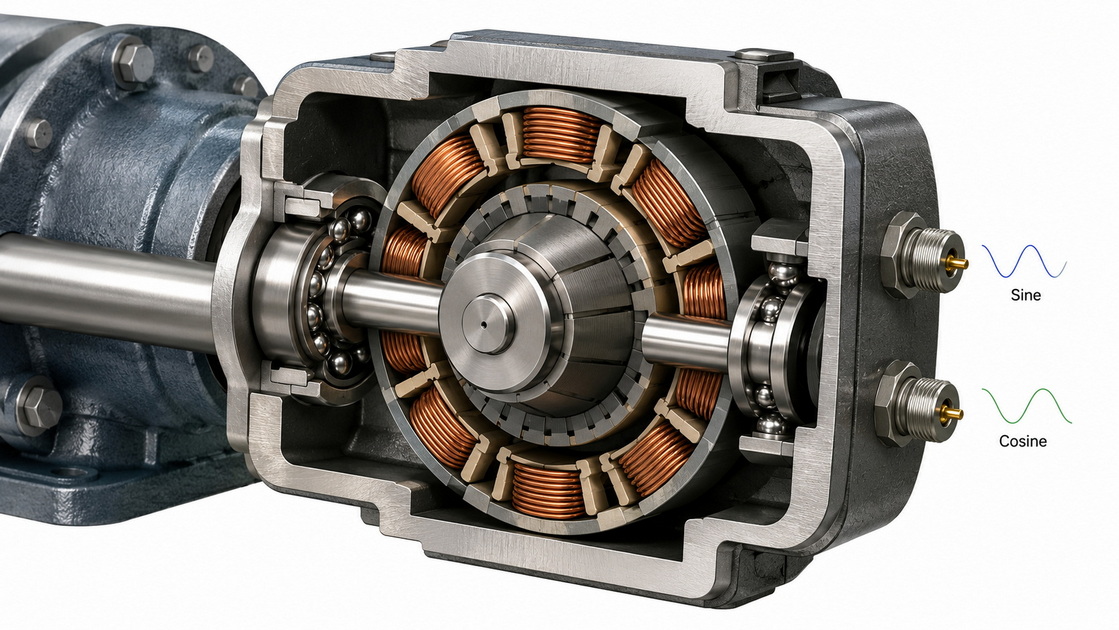
Resolver position sensors provide some of the highest robustness and resolution available for hybrid motor applications. [dandreavisual]
How they work:
A resolver is essentially a rotary transformer: a stationary stator and rotating rotor with copper windings. As the rotor spins within the stator, induced voltages give continuous analog information about angle. [dandreavisual]
Pros: [dandreavisual]
- Very high resolution, often up to the equivalent of 200,000 pulses per revolution.
- Excellent resistance to contamination, vibration, and shock due to enclosed, rugged construction.
- Well suited to harsh environments such as automotive, heavy industrial automation, and aerospace.
Cons: [acecoretechnologies]
- Heavier and more expensive than other sensor options.
- Requires dedicated resolver‑to‑digital electronics and careful analog design.
Resolvers are the sensor of choice when you need maximum reliability over decades and can justify the added cost and integration effort—typical in automotive actuation, off‑highway vehicles, and mission‑critical industrial systems. [dandreavisual]
To move beyond theory, it helps to map each sensor type to practical scenarios.
| Application Scenario | Typical Environment | Recommended Sensor Type | Rationale |
|---|---|---|---|
| Clean lab automation, pick‑and‑place | Clean, low vibration | Optical or Absolute Encoder (dandreavisual) | High accuracy, fast cycling, easy integration |
| Medical pumps, diagnostic equipment | Clean but safety critical | Hall or Absolute Encoder (dandreavisual) | Robustness, predictable feedback, minimal maintenance |
| Automotive / harsh industrial actuators | Dust, oil, shock | Resolver Position Sensor (dandreavisual) | Maximum durability and high resolution |
| General factory automation with dust risk | Moderate contamination | Hall or Resolver (dandreavisual) | Better tolerance to dirt than open optical disks |
| UAV / hybrid engine actuators, gimbals | Vibration, varying temp | Robust Encoder or Resolver (engineering.oregonstate) |
This kind of mapping helps teams quickly shortlist sensor families before they dive into vendor‑specific details. [unmannedsystemstechnology]
Drawing on both the NMB guide and field experience, you can follow this practical process. [nmbtc]
- Required absolute or relative positioning accuracy.
- Maximum speed and acceleration.
- Safety implications of lost position (e.g., risk to operator, product damage). [blog.airlinehyd]
- Identify contamination sources and vibration levels.
- Decide acceptable maintenance intervals (can you clean optics regularly or not?). [dandreavisual]
- Clean, precise → Optical or Absolute Encoder. [dandreavisual]
- Harsh or safety‑critical → Resolver. [acecoretechnologies]
- Cost‑driven, moderate precision → Hall sensor or basic encoder. [dandreavisual]
- Check available encoder/feedback interfaces on your existing drives. [blog.airlinehyd]
- Validate closed‑loop control algorithms and any required resolver‑to‑digital or absolute encoder support.
- Build a test axis with representative load and duty cycle.
- Validate positioning under thermal variation, vibration, and power cycling (including intentional power cuts to evaluate recovery behavior). [unmannedsystemstechnology]
Within the industry, engineers discuss several failure patterns that rarely appear in marketing brochures.
It is common to receive excellent pre‑production samples and then see a subtle drop in sensor quality at volume—such as lower grade bearings or less careful optical assembly.
Mitigation:
- Define clear incoming inspection tests (resolution, noise, repeatability) for every batch.
- For critical sensors, occasionally send units for third‑party analysis or cross‑testing. [blog.airlinehyd]
In practice, emergency stops and intermittent power loss are frequent. Relying solely on incremental encoders without a robust homing strategy can lead to hidden misalignment.
Mitigation:
- Test sensor behavior under repeated power cycling and emergency stops.
- Consider absolute encoders or resolvers where re‑homing time is unacceptable. [unmannedsystemstechnology]
Switching from Hall feedback to absolute encoders or resolvers can demand deeper firmware changes than anticipated.
Mitigation:
- Involve drive/controller engineers early when choosing the sensor type.
- Prototype communication and control loops before committing to large volumes. [nmbtc]
Hybrid motor position sensor selection should be driven by application engineering, not by catalog browsing alone. For many designs, the right solution is a tightly integrated motor plus sensor package tested as a system under real load profiles. [nmbtc]
As a BLDC and FPV drone motor manufacturer, Zhongshan Yuhang Power Technology Co., Ltd. can work alongside sensor suppliers and your engineering team to:
- Define motion and environmental requirements based on real UAV, robotics, or industrial use cases. [soarskyrc]
- Recommend motor‑sensor combinations that balance resolution, durability, and cost.
- Support OEM/ODM customization, from mechanical interfaces to cable harnesses and connector selection, so that the final power system drops into your platform cleanly. [chinese.alibaba]
If you share your axis specifications, environment, and safety requirements, we can help you shortlist appropriate hybrid motor position sensor technologies and plan a focused test program.
1. How do I decide between an incremental optical encoder and an absolute encoder?
If your application can tolerate re‑homing on startup and occasional recalibration, an incremental optical encoder may be sufficient and cost‑effective. If downtime is costly, access is difficult, or you need instant position after power loss, an absolute encoder is often the better long‑term choice. [nmbtc]
2. When is a resolver worth the extra cost and integration effort?
Resolvers make sense in harsh, safety‑critical environments (automotive, heavy industrial, aerospace) where contamination, vibration, and shock are severe and long‑term reliability is more important than minimizing component price. Their durability and very high resolution justify the added electronics and cost. [acecoretechnologies]
3. What is the minimum information I should request from a sensor supplier?
Ask for resolution, absolute vs incremental type, interface, environmental ratings (temperature, IP rating if applicable), expected lifetime, and test data for vibration, shock, and MTBF. Also confirm how the sensor behaves under power loss and restart. [nmbtc]
4. How can I verify real‑world performance beyond the datasheet?
Build a representative test setup with your actual motor, load, and controller. Measure positioning accuracy, repeatability, and stability over temperature and under vibration. Simulate stalls and power losses to confirm the system's ability to recover and maintain alignment. [beyondsky]
5. Can one sensor type cover both my factory automation and UAV platforms?
Generally, it is better to treat these as separate design problems. Factory axes may prioritize precision and clean‑room compatibility, while UAVs face vibration, temperature extremes, and weight constraints. The underlying technology might be similar, but the packaging, environmental sealing, and interface requirements can differ significantly. [calbryant]
1. NMB Technologies, "How to Select a Hybrid Motor Position Sensor."[dandreavisual]
2. NMB Technologies, "Hybrid Motor Position Sensor Selection Guide."[nmbtc]
3. Airline Hydraulics, "The Art of Motor Selection: When to Use Stepper Motors, Servo Motors, and Hybrid Solutions."[blog.airlinehyd]
4. Oregon State University, "With Longer Flight Times, a New Hybrid Drone Engine Could Save Lives."[engineering.oregonstate]
5. Acecore Technologies, "Hybrid Drones Advantages and Disadvantages."[acecoretechnologies]
6. Unmanned Systems Technology, "Hybrid UAV Engines."[unmannedsystemstechnology]
7. Cal Bryant, "A Comprehensive Guide to FPV Drone Technology."[calbryant]
8. Beyondsky, "The Complete Guide to Drone Thrust Stands and Testing Tools."[beyondsky]
9. DroneVibes Forum, "[Tutorial] Motor and Propeller Efficiency Testing with a Dynamometer."[dronevibes]
10. SoarSky, "Understanding and How to Choose the Right FPV Motor."[soarskyrc]


