Language


Views: 222 Author: Yuhang Power Publish Time: 2026-06-05 Origin: Site
Content Menu
● What Is a Motor Resolver and Why It Matters for Brushless Motors?
● How a Variable Reluctance (VR) Resolver Works
● Why Closed-Loop Control Needs Accurate Position Feedback
● Motor Resolver vs. Hall Sensors vs. Encoders
>> Hall sensors
>> Encoders
>> Variable Reluctance resolvers
● Key Benefits of VR Resolvers for High-Performance Motors
● Practical Motor Resolver Selection Criteria
>> 1. Electrical specifications
>> 3. Environmental performance
>> 4. Reliability and lifecycle
● Case Insight: How High-Quality Coils Improve Resolver Performance
● Where Motor Resolvers Fit in Next-Generation Brushless Systems
● When to Consider Resolvers in Your Next Motor Project
● Call to Action: Design Your Next High-Efficiency Drive with Resolver Feedback
● FAQ
>> 1. What is the main role of a motor resolver in a brushless motor system?
>> 2. How does a VR resolver differ from a standard position sensor?
>> 3. Why would I choose a resolver instead of Hall sensors?
>> 4. Can resolvers lose their position information when power is removed?
>> 5. What industries commonly use motor resolvers today?
Resolvers quietly do for brushless drone motors what fuel injection did for combustion engines: they feed the control system with precise position data so every amp of current turns into controlled thrust instead of wasted heat. As an FPV motor manufacturer working with demanding OEM and ODM partners, I've seen first-hand how choosing the right motor resolver can be the difference between a drone that feels "locked in" and one that constantly fights the pilot. [blog.uavmodel]
A motor resolver is a rugged rotary position sensor that converts the mechanical angle of a shaft into electrical signals, usually sine and cosine outputs. The motor controller uses this information to determine rotor position and speed in real time, enabling precise commutation and torque control for brushless motors.
Resolvers are built much like small electric machines: they have a rotor and stator with carefully wound coils, and they work by monitoring changes in a magnetic field as the rotor turns. In high-performance applications—whether in EV traction motors or FPV drone and gimbal motors—this translates directly into smoother rotation, better efficiency, and more consistent response under varying loads. [shop.tmotor]
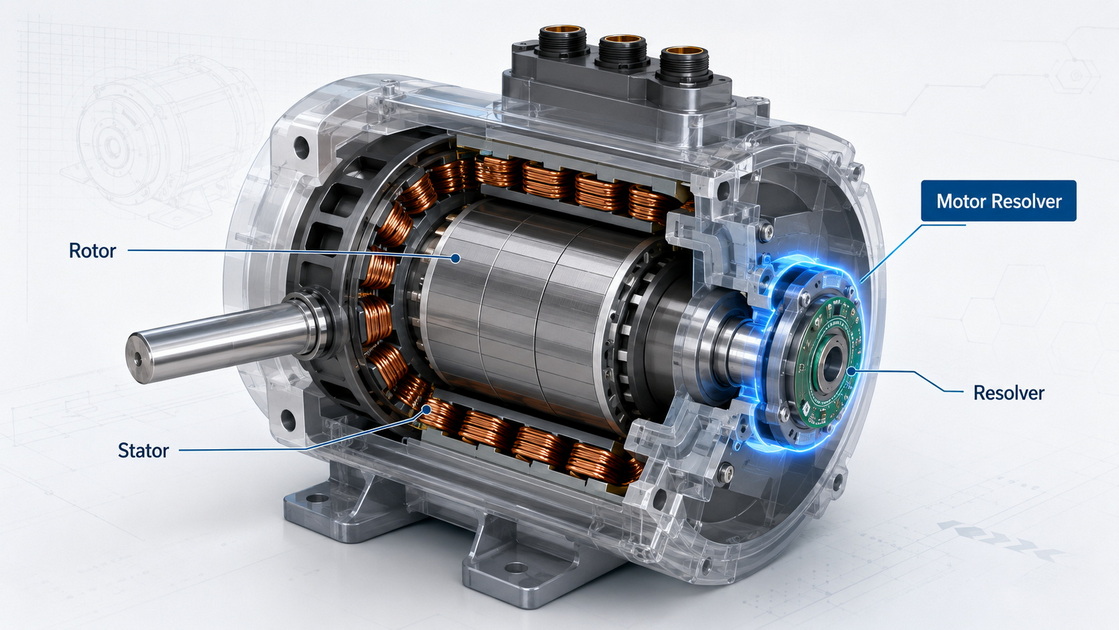
In many modern designs, especially in automotive and industrial drives, engineers favor the Variable Reluctance (VR) resolver for its combination of accuracy and robustness.
- Reluctance is the magnetic equivalent of electrical resistance—it describes how strongly a material opposes magnetic flux.
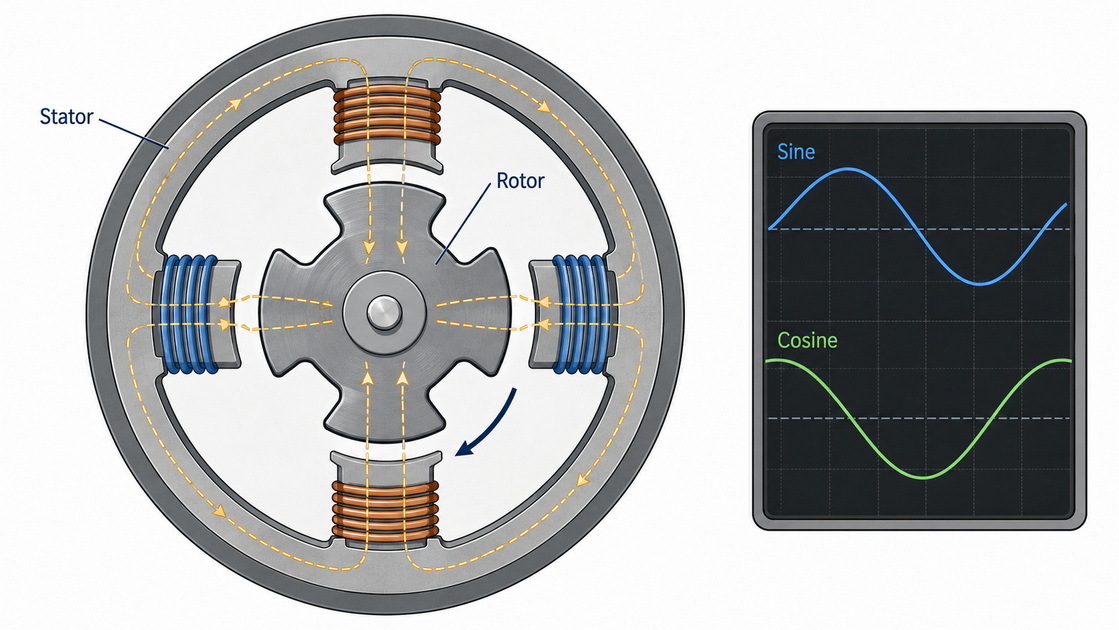
- In a VR resolver, the primary coils are supplied with AC, which creates a rotating magnetic field in the stator.
- The rotor is shaped with lobes or cams; as it turns, the air gap between rotor and stator coils changes, so the reluctance changes.
- These changes in reluctance generate fluctuating voltages in the secondary coils, which are processed into sine and cosine signals proportional to shaft angle.
Because the output is continuous and analog, the control unit can interpolate rotor position very precisely, even at high speeds or under heavy vibration. For brushless motors that need ultra-smooth low-speed performance—such as FPV camera gimbals, inspection drones, and underwater ROVs—this level of feedback is critical. [blog.uavmodel]
Every efficient brushless drive, whether in an EV or a racing quad, depends on closed-loop control of the motor.
The controller needs to know:
- Rotor electrical angle
- Rotor mechanical speed and acceleration
- Direction of rotation
With that data, it can precisely time how current is applied to the stator windings, much like electronic fuel injection precisely times fuel delivery in combustion engines. In EV motors, this maximizes range; in FPV and robotics, it maximizes thrust per watt, responsiveness, and stability under fast throttle changes. [ligpower]
When the resolver feeds high-quality position information into the controller:
- Torque ripple is reduced, which improves smoothness.
- Efficiency improves, extending battery life or vehicle range.
- The system maintains control even during aggressive maneuvers or sudden load changes. [blog.uavmodel]
For OEMs building high-end drones, gimbals, or mobile robots, this is often the difference between a "consumer-grade feel" and a professional, predictable platform.
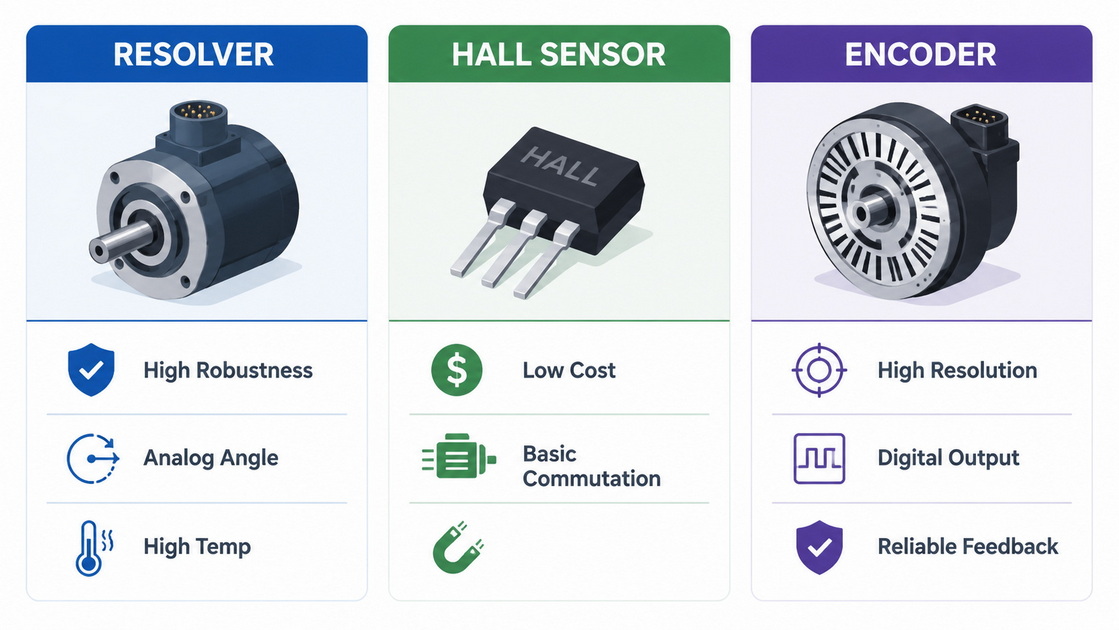
Resolvers compete primarily with Hall effect sensors and encoders for rotor position feedback, and each has strengths and weaknesses.
Hall sensors use magnetic field sensing to detect rotor position with discrete transitions, often in three steps per electrical cycle.
- Advantages: low cost, simple integration, suitable for basic commutation.
- Limitations: relatively low resolution, more electrical noise, and reduced accuracy at high speeds or under high-temperature conditions. [dronedoctor]
For basic RC motors or budget drones, Hall sensors can be sufficient, but they become a bottleneck when you need ultra-smooth throttle response or precise low-speed positioning.
Encoders (optical or magnetic) produce digital pulses or absolute codes that correspond to rotor position.
- Advantages: high resolution, easy digital interface, widely used in industrial servo systems.
- Limitations: more sensitive to contamination, shock, and vibration; some types can lose position if power is cut or if reference indexing is required. [shop.tmotor]
In harsh environments like FPV racing, industrial drones, or outdoor robots, encoders can require extra mechanical protection and careful mounting.
VR resolvers are often preferred where robustness and environmental resistance are crucial.
- Strong immunity to high temperatures and vibration.
- Excellent long-term stability and accuracy in real-world conditions.
- Do not lose position information when power is turned off, because they rely on their mechanical geometry and magnetic properties rather than stored electronic state.
This makes them especially attractive for EV traction motors and other mission-critical drives, where a loss of position feedback could cause unsafe behavior.
From an engineering and product-management standpoint, VR resolvers offer a set of advantages that align well with demanding applications such as EVs, industrial drives, and high-end robotic systems. [dronedoctor]
- Accuracy under real conditions
VR resolvers maintain angular accuracy even at high speeds and across varying temperatures, which keeps torque output predictable and motor control stable.
- Mechanical robustness
With no delicate optical discs or exposed sensors, a resolver can tolerate dust, shock, and vibration that would challenge many encoder designs.
- No position loss on power-off
The system can quickly re-establish correct rotor position on power-up without lengthy homing routines, which is valuable for vehicles and robots that must be ready to move immediately.
- Long service life
Their construction and lack of fragile optical components often result in long-term reliability, crucial for automotive and industrial qualification.
For manufacturers integrating power systems into drones, gimbals, cleaning robots, or underwater vehicles, these properties translate into fewer failures in the field and more predictable maintenance intervals.
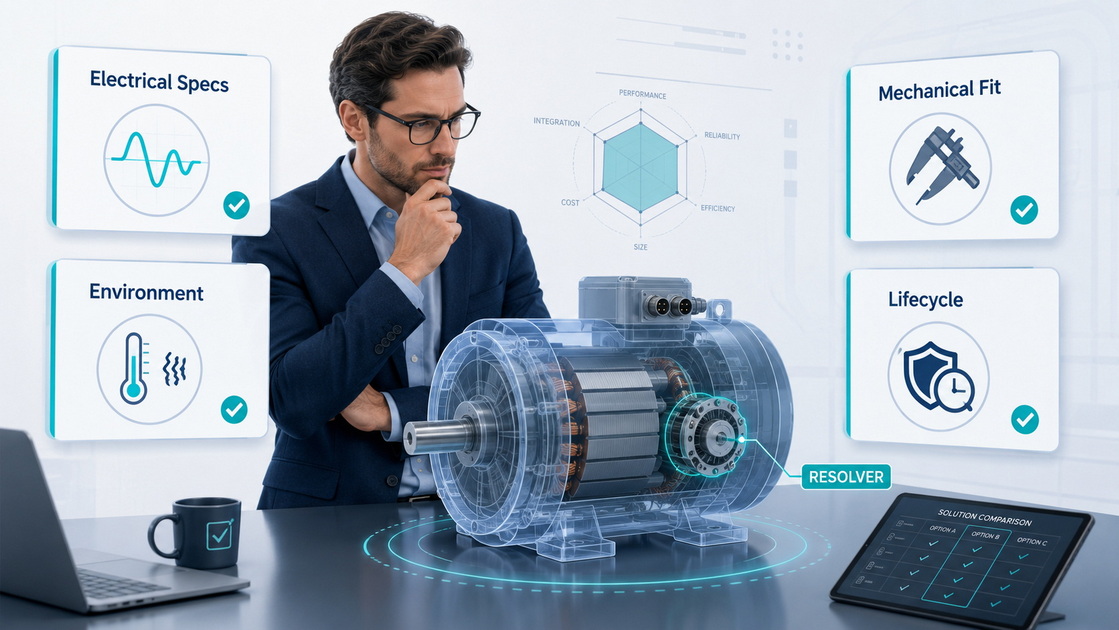
When engineers specify a resolver for a new motor platform—whether EV traction or compact brushless drives—they typically evaluate several technical dimensions.
- Excitation voltage and frequency: must match the motor control unit's resolver interface.
- Output signal level and impedance: ensure compatibility with the front-end electronics for sine and cosine channels.
- Accuracy and linearity: must meet the required commutation precision over the full speed range.
- Shaft size and mounting configuration: must fit the motor design without introducing additional imbalance or misalignment.
- Overall size and weight: especially critical when integrating resolvers into compact motors for airborne or mobile applications. [shop.tmotor]
- Operating temperature range: must accommodate worst-case ambient and self-heating conditions.
- Resistance to shock, vibration, and contaminants: critical for automotive, aerospace, and outdoor robotics. [dronedoctor]
- Proven track record in similar applications and duty cycles.
- Availability of automotive-grade or industrial-grade qualification if required.
By aligning these criteria with your application (range, payload, flight time, duty cycle), you ensure the resolver enhances the system instead of becoming a new risk point.
Manufacturers with deep coil-winding experience in motor production are in a strong position when it comes to building consistent, high-performance resolvers.
For example, the same precision coil-winding processes used in advanced electric motors can be applied to resolver stators:
- High-density, uniform coils produce cleaner, more linear signals, which in turn improve angle calculation accuracy.
- Tight process control and inspection on coil geometry reduce phase imbalance and noise, enhancing stability across temperature and speed ranges.
In practice, this means a resolver from a supplier with strong coil expertise will deliver more repeatable outputs over the lifetime of the vehicle or device, helping engineering teams hit efficiency and performance targets.
Although the reference article focuses on EV motors, many of the same principles apply to high-end brushless systems in drones, robotics, and industrial automation. [blog.uavmodel]
Examples where resolver-level feedback can be relevant include:
- Heavy-lift drones or VTOL platforms with safety-critical power systems.
- Gimbal motors where ultra-smooth, jitter-free motion is required.
- Autonomous cleaning robots or AGVs operating in dirty, high-vibration environments.
- Underwater drones and ROVs where moisture and pressure rule out delicate position sensors. [dronedoctor]
For OEM and ODM customers, specifying resolver-ready motor platforms can future-proof designs for more advanced control algorithms, including high-bandwidth FOC (Field-Oriented Control) and sensor fusion with IMUs and GPS.
From an industry expert perspective, I usually recommend engineering teams consider motor resolvers seriously when:
- The application is safety-critical or mission-critical (EVs, industrial robots, inspection drones).
- Operating conditions involve high temperatures, vibration, or contamination that might challenge optical encoders.
- You need precise control at both very low and very high speeds, with minimal torque ripple.
- The project lifecycle justifies the higher component cost in exchange for reduced failures and better efficiency. [dronedoctor]
During early concept and specification phases, it pays to involve a resolver-capable motor supplier who can co-design the mechanical and electrical interfaces together with the controller team.
If you are planning a new brushless motor project—whether for EVs, advanced drones, robots, or industrial equipment—now is the ideal time to benchmark resolver-based feedback against your current Hall- or encoder-based designs. [blog.uavmodel]
Share your target torque, speed range, environment, and control architecture with a motor and sensor partner that understands both coil winding and resolver integration, and ask for a proposal that balances accuracy, robustness, and cost for your exact use case. By making motor resolver selection part of your system-level design, you can unlock higher efficiency, smoother control, and more reliable operation across the entire lifecycle of your product.
A motor resolver provides continuous, analog position feedback (sine and cosine signals) that the controller uses to determine rotor angle and speed for precise, closed-loop commutation and torque control.
A VR resolver uses changing magnetic reluctance between a lobed rotor and stator coils to generate angle-dependent voltages, offering high accuracy, robustness, and strong immunity to temperature, vibration, and electrical noise.
Hall sensors are cost-effective and simple but offer relatively low resolution and can suffer from noise and accuracy issues at high speed and temperature, while resolvers provide more precise, stable position feedback for demanding applications. [dronedoctor]
Resolvers do not lose position when power is turned off because their operation depends on their physical geometry and magnetic characteristics, not stored digital state, so they can report accurate angle again as soon as excitation is restored.
Resolvers are widely used in electric vehicles, industrial servo and drive systems, aerospace actuators, and other mission-critical machines where accuracy, robustness, and long-term reliability are essential. [dronedoctor]
1. NMB Technologies. "Motor Resolvers Drive High-efficiency EV Motors." (2023). [resolver]
2. UAVMODEL Insights. "FPV Motor Thrust Testing and Selection Guide." (2026). [https://blog.uavmodel.com/fpv-motor-thrust-testing-and-selection-guide/] [blog.uavmodel]
3. Ligpower. "FPV Drone Motor Sizes Guide: Learn in Minutes." (2025). [https://www.ligpower.com/blog/fpv-drone-motor-sizes-guide.html] [ligpower]
4. T-Motor. "Drone Motor Size Chart & Selection Guide for UAVs." (2025). [https://shop.tmotor.com/blog/drone-motor-size-chart] [shop.tmotor]
5. DroneDoctor. "Drone Motors for Sale: The Ultimate 2026 Guide to Power and Performance." (2026). [https://dronedoctor.com/blogs/news/drone-motors-for-sale-the-ultimate-2026-guide-to-power-and-performance] [dronedoctor]


