Language


Views: 273 Author: Yuhang Power Publish Time: 2026-09-07 Origin: Site
Content Menu
● What Do 2207 and 2306 Mean on an FPV Motor?
● 2207 vs 2306 Stator Volume and Torque
>> How Geometry Changes Flight Feel
● 2207 vs 2306 FPV Motor Performance Comparison
● Thrust, KV, and Propeller Compatibility
>> Recommended Starting Points
>> Expert Test Method: Compare Complete Power Systems
● Which Motor Is Better for FPV Freestyle?
● Which Motor Is Better for FPV Racing?
● Efficiency, Flight Time, and Motor Temperature
>> Factors That Influence Efficiency
● OEM and ODM Considerations for Brushless Motors
>> 1. Is a 2207 motor more powerful than a 2306 motor?
>> 2. Are 2207 and 2306 motors suitable for 5-inch FPV drones?
>> 3. Should I use 4S or 6S batteries with a 2207 or 2306 motor?
>> 4. What KV should I choose for a 2207 FPV motor on 6S?
>> 5. What KV should I choose for a 2306 FPV motor on 6S?
Choosing between a 2207 FPV motor and a 2306 FPV motor is one of the most common decisions in 5-inch FPV drone builds. Both brushless motor sizes are proven choices for freestyle, racing, cinematic action flying, and customized UAV power systems. Yet they do not produce exactly the same flight feel.
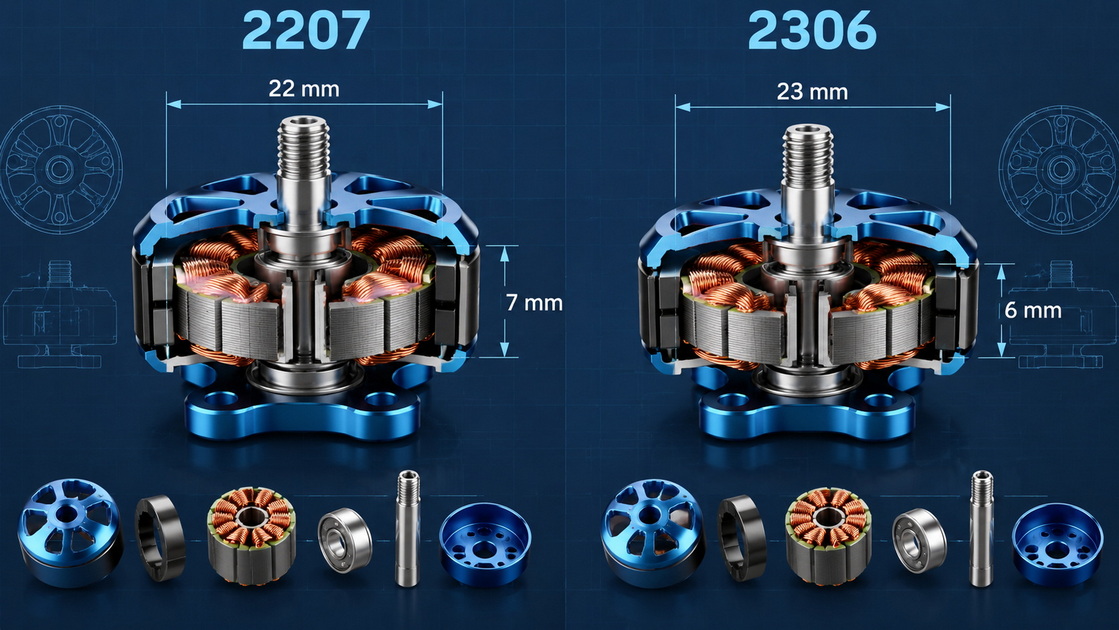
A 2207 motor has a 22 mm stator diameter and a 7 mm stator height. A 2306 motor has a 23 mm stator diameter and a 6 mm stator height. The difference may appear small, but stator geometry affects torque delivery, cooling behavior, propeller matching, throttle response, motor weight, efficiency, current draw, and the overall handling character of an FPV quadcopter.
From our perspective as a brushless motor manufacturer, Zhongshan Yuhang Power Technology Co., Ltd. recommends avoiding the oversimplified question, "Which motor is more powerful?" Instead, ask: Which 2207 or 2306 FPV motor best matches the propeller, battery voltage, ESC, frame, all-up weight, and flying style of the aircraft?
Quick answer: A 2207 FPV motor is often preferred for aggressive freestyle, powerful punch-outs, and high-RPM responsiveness. A 2306 FPV motor is often chosen for a smoother, broader torque feel, good cooling, and versatile 5-inch freestyle or racing configurations. Neither is universally better; the correct choice depends on the full power system.
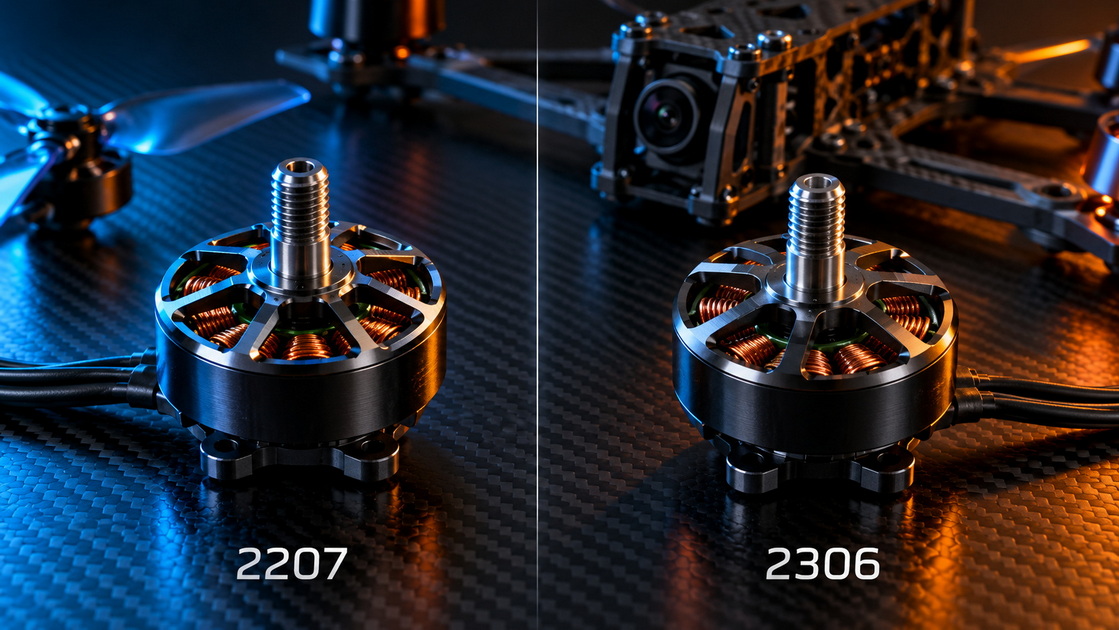
FPV motor names use a four-digit stator-size convention. The first two digits identify the approximate stator diameter in millimeters, while the last two digits show stator height in millimeters.
| FPV Motor Size | Stator Diameter | Stator Height | Typical FPV Category |
|---|---|---|---|
| 2207 | 22 mm | 7 mm | 5-inch freestyle, racing, and performance builds |
| 2306 | 23 mm | 6 mm | 5-inch freestyle, racing, and general-purpose performance builds |
Therefore:
- 2207 means a 22 mm stator diameter and 7 mm stator height.
- 2306 means a 23 mm stator diameter and 6 mm stator height.
These dimensions refer to the stator, the stationary laminated metal core around which copper windings are installed. The stator works with the rotor bell and magnets to create the electromagnetic force that spins the propeller.
Motor size does not tell the full story. Two motors marked 2207 can perform differently due to magnet type, magnet arc, winding turns, copper fill, stator lamination thickness, bearing quality, bell design, shaft material, wire gauge, KV rating, firmware settings, and propeller selection.
Still, stator geometry provides a useful starting point for comparing 2207 vs 2306 FPV motors. FPV motor selection resources consistently define motor size through stator diameter and height, and identify both 2207 and 2306 as mainstream options for 5-inch FPV drones.
Stator volume is not the only measure of motor performance, but it offers a useful comparison of the magnetic working area available in each motor.
The simplified cylinder-volume calculation is:
Stator Volume=π×r2×h
For a 2207 motor:
π×112×7≈2,660 mm3
For a 2306 motor:
π×11.52×6≈2,492 mm3
This calculation suggests that a 2207 stator has approximately 6.7% more theoretical stator volume than a 2306 stator. A commonly cited comparison likewise estimates that the 2207 has around 6.3% more stator volume than the 2306.
That additional stator height can contribute to strong torque delivery, especially under higher RPM and rapid throttle changes. This is one reason many pilots associate 2207 motors with a punchy, energetic, and responsive flight character.
However, volume alone does not guarantee more real-world thrust. A high-quality 2306 with efficient windings, strong magnets, a good bell design, and an appropriate propeller can outperform a lower-quality 2207. Static thrust figures must always be evaluated with the exact battery voltage, propeller, ESC, and test method used.
A simplified way to understand the difference is:
- 2207: Narrower and taller stator profile; often associated with strong high-RPM torque and sharp throttle response.
- 2306: Wider and shorter stator profile; often associated with a broad torque feel, good heat dissipation, and smooth handling.
One FPV motor-sizing guide describes the 2207 as having more high-RPM torque potential because of its taller stator, while the wider 2306 layout can provide more cooling surface and a slightly different low-RPM torque characteristic. It also emphasizes that the practical difference is subtle when motors are well designed.
Important: Do not select a motor based on stator volume alone. Match the motor to the propeller load, battery voltage, ESC current capacity, aircraft weight, and required flight style.
The following table provides a practical comparison for standard 5-inch FPV drone applications. Individual motor results may vary significantly by brand, KV rating, propeller, battery, and build configuration.
| Performance Factor | 2207 FPV Motor | 2306 FPV Motor |
|---|---|---|
| Stator dimensions | 22 mm × 7 mm | 23 mm × 6 mm |
| Theoretical stator volume | Approximately 2,660 mm³ | Approximately 2,492 mm³ |
| Typical flight character | Punchy, direct, powerful, responsive | Smooth, broad, balanced, versatile |
| High-RPM response | Often very strong | Strong, depending on KV and propeller |
| Low-to-mid throttle feel | Controlled and powerful | Often smooth and linear |
| Heat dissipation | Depends on bell, airflow, magnets, and windings | Wider stator geometry may support heat shedding |
| Typical 5-inch use | Aggressive freestyle and racing | Freestyle, racing, and general 5-inch performance |
| Recommended propeller category | 5-inch two-blade or three-blade props | 5-inch two-blade or three-blade props |
| Typical 6S KV range | Approximately 1,700–1,950 KV | Approximately 1,700–1,950 KV |
| Typical 4S KV range | Approximately 2,300–2,700 KV | Approximately 2,300–2,700 KV |
| Main selection priority | Fast throttle changes and high-energy flying | Smooth power delivery and balanced versatility |
For modern 5-inch FPV builds, published motor guides commonly place both 2207 and 2306 motors in the approximate 1,700–2,000 KV range for 6S setups and approximately 2,300–2,800 KV for 4S configurations. These ranges are not fixed rules; actual KV must be selected around propeller pitch, target speed, pilot skill, aircraft weight, and battery capability.
A motor's KV rating describes its approximate no-load RPM per volt. A 1,900 KV motor supplied by a fully charged 6S LiPo battery at 25.2 V has a theoretical no-load speed of:
1,900×25.2=47,880 RPM
In flight, the real propeller speed is lower because the propeller applies aerodynamic load and the battery voltage falls under current demand. This is why KV should never be viewed as a direct measure of thrust.
Thrust depends on the entire power system:
- Motor stator size
- KV rating
- Motor winding design
- Magnet strength and arc
- Propeller diameter
- Propeller pitch
- Blade count
- Battery voltage
- Battery internal resistance
- ESC current capacity
- Aircraft weight
- Airflow and motor cooling
- Flight environment and throttle behavior
The following configurations provide useful starting ranges for many 5-inch FPV drones. They are not a substitute for bench testing or manufacturer thrust data.
| Build Type | Motor Option | Typical Battery | Practical KV Starting Range | Propeller Direction |
|---|---|---|---|---|
| 5-inch freestyle | 2207 or 2306 | 6S LiPo | 1,700–1,950 KV | 5-inch tri-blade, moderate pitch |
| 5-inch racing | 2207 or 2306 | 6S LiPo | 1,850–2,050 KV | 5-inch tri-blade, higher pitch if current allows |
| 5-inch 4S build | 2207 or 2306 | 4S LiPo | 2,300–2,700 KV | 5-inch bi-blade or tri-blade |
| Smooth freestyle | 2306 | 6S LiPo | 1,700–1,850 KV | Moderate-pitch tri-blade |
| Aggressive freestyle | 2207 | 6S LiPo | 1,750–1,950 KV | Higher-grip tri-blade with ESC margin |
| Lightweight racer | 2207 or 2306 | 6S LiPo | 1,850–2,050 KV | Low-mass, responsive race prop |
Higher-pitch and higher-blade-count propellers can increase grip and thrust, but they also raise motor load, current draw, and heat. A motor that feels excellent with a low-pitch propeller may become inefficient or hot with a more aggressive prop.
FPV motor-selection guides advise evaluating static thrust, full-throttle current draw, battery capability, and the point at which increased KV produces diminishing speed gains due to voltage sag.
When developing a custom FPV motor or selecting an OEM brushless motor, do not compare motors using only an unloaded spin test.
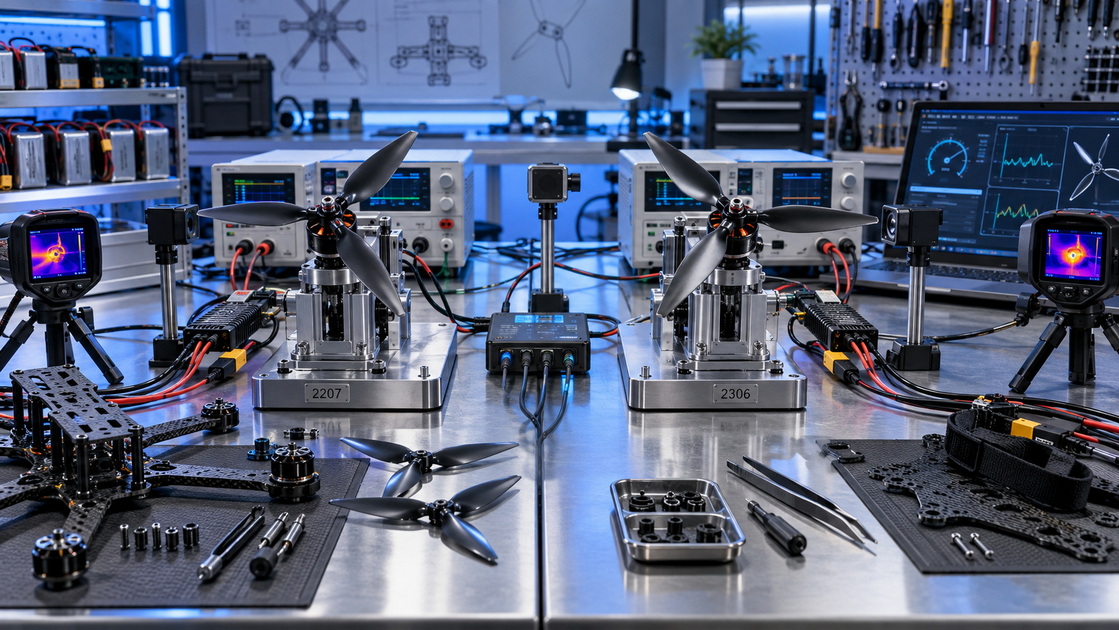
Use a controlled test plan:
1. Select the intended battery type and voltage.
2. Fit the exact propeller model planned for production.
3. Use the target ESC and firmware configuration.
4. Measure thrust at multiple throttle points.
5. Record voltage, current, wattage, RPM, motor temperature, and ESC temperature.
6. Repeat the test with the alternative motor size.
7. Compare efficiency in grams of thrust per watt.
8. Conduct short real-flight tests for handling, recovery response, and thermal stability.
This process provides a more meaningful answer than simply comparing the motor label.
For aggressive freestyle, both 2207 and 2306 motors are capable choices. The decision comes down to how the pilot wants the drone to respond.
Choose a 2207 FPV motor if you prioritize:
- Fast punch-outs
- Strong throttle authority
- Quick recovery after dives
- Crisp direction changes
- High-energy freestyle maneuvers
- A more direct and powerful feel
- Propellers that need strong high-RPM torque support
Choose a 2306 FPV motor if you prioritize:
- Smooth throttle control
- Balanced freestyle performance
- Predictable low-to-mid throttle handling
- Sustained flying with good motor cooling
- A versatile motor platform for different 5-inch builds
- A refined feel for cinematic freestyle and flowing lines
Neither option replaces proper tune configuration. PID tuning, filtering, rates, propeller selection, frame stiffness, center of gravity, and battery condition can significantly change the way a drone feels in flight.
A pilot moving from a poorly tuned 2207 setup to a carefully tuned 2306 setup may prefer the 2306. The reverse can also be true. Motor selection should support the build, but it cannot correct an unsuitable frame, damaged propellers, weak battery, or overheating ESC.
For FPV racing, many pilots value acceleration, top-end speed, fast propeller recovery, and consistent performance during repeated high-throttle bursts.
A 2207 motor is commonly selected for racing because the taller stator profile can support a responsive high-RPM feel. It can be a strong match for pilots who fly open courses, use aggressive propellers, and need rapid throttle response out of turns.
A 2306 motor can also be highly competitive for racing. Its broader stator geometry and smooth torque delivery may appeal to pilots who want predictable corner exits, controlled throttle modulation, and thermal stability over repeated laps.
Before specifying a 2207 or 2306 racing motor, verify:
- Frame size and motor mounting pattern
- Propeller clearance
- Battery voltage
- ESC continuous and burst-current rating
- ESC cooling airflow
- Motor-wire length and gauge
- Target motor KV
- Propeller pitch and blade count
- Total aircraft weight
- Racecourse style
- Local racing rules and safety requirements
For 5-inch racing, guides commonly list 2207-sized motors in higher 4S KV ranges or moderate 6S KV ranges, paired with 5-inch tri-blade propellers. Full-throttle current can be substantial, so the ESC and battery must be sized with suitable margin.
A frequent misconception is that one motor size is always more efficient. In reality, efficiency depends on the operating point.
A 2207 motor may be efficient when matched to a suitable propeller and flown within its intended load range. A 2306 motor may be efficient when its wider stator, winding design, cooling, and propeller selection suit sustained throttle operation.
- Propeller load: High-pitch props increase aerodynamic load.
- KV selection: Excessive KV can increase current demand and motor heat.
- Battery voltage: A properly matched 6S setup may deliver similar power at lower current than a comparable 4S setup.
- Battery condition: Voltage sag reduces performance and increases system stress.
- Motor temperature: Heat indicates electrical and mechanical losses.
- Airflow: Enclosed or ducted installations require special thermal consideration.
- Drone weight: Heavy payloads require more thrust and reduce flight time.
- Pilot behavior: Repeated full-throttle bursts consume far more energy than smooth cruising.
After a test flight, carefully check motor temperature. The motor should be warm but not excessively hot. If motors are too hot to touch briefly, reduce propeller load, lower KV, improve airflow, review PID tuning, inspect bearings, or evaluate the ESC settings.
Safety note: Always remove propellers before performing motor-direction tests, ESC calibration, configuration work, or bench diagnostics. A powered FPV propeller can cause serious injury.
For brands, drone manufacturers, robotics companies, and system integrators, the choice between a 2207 and 2306 motor should be part of a broader power-system engineering discussion.
At Zhongshan Yuhang Power Technology Co., Ltd., customized brushless motor development can consider:
- Required stator dimensions
- Custom KV range
- Motor winding turns
- Motor cable length
- Connector type
- Shaft dimensions
- Bell design
- Bearing specification
- Magnet grade and arc
- Mounting-hole pattern
- Propeller-mounting interface
- Waterproofing or corrosion resistance
- Thermal-management needs
- Packaging and private labeling
- Target application and environmental requirements
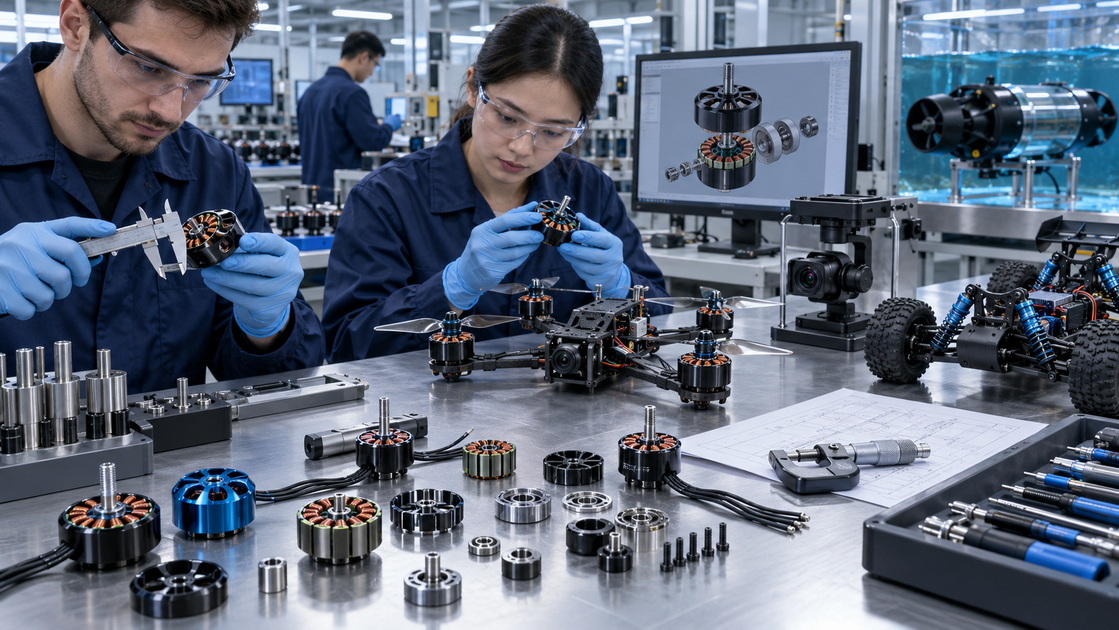
While 2207 and 2306 motors are closely associated with 5-inch FPV drones, brushless motor design principles also apply to RC cars, high-speed fans, gimbal systems, model aircraft, cleaning robots, underwater robots, and specialized electric power equipment.
For example, an underwater robot motor may prioritize sealing, corrosion resistance, low-speed torque, and thermal transfer rather than the rapid throttle response desired in an FPV racing drone. A gimbal motor may prioritize smooth low-speed rotation and vibration control. The "best" motor is always application-specific.
Choose a 2207 FPV motor if your priority is powerful throttle response, rapid RPM change, aggressive freestyle performance, and racing-oriented punch. Its taller 7 mm stator gives it slightly more theoretical stator volume than a 2306 motor, which can support a strong and energetic flight character when combined with the correct KV, propeller, battery, and ESC.
Choose a 2306 FPV motor if you want a smooth, well-balanced 5-inch power system with a wider stator geometry, versatile propeller compatibility, and potentially favorable thermal behavior during sustained flying. It is an excellent option for pilots and manufacturers building refined freestyle quads, versatile performance drones, and customized 5-inch systems.
The key takeaway is simple: 2207 and 2306 are both high-performance 5-inch FPV motor sizes. The better option is not determined by a single stator dimension. It is determined by how well the complete power system works together.
Not necessarily in every configuration. A 2207 has slightly higher theoretical stator volume than a 2306, which can support strong torque characteristics. However, real output depends on KV, windings, magnets, propeller, voltage, ESC, cooling, and overall motor design.
Yes. Both are widely used for 5-inch FPV freestyle and racing drones. Common setup guidance places these motor sizes in the 5-inch category, with many 6S builds using approximately 1,700–2,000 KV and many 4S builds using approximately 2,300–2,800 KV.
Both battery formats can work. A 4S setup generally uses a higher-KV motor, while a 6S setup generally uses a lower-KV motor. The correct selection depends on propeller load, aircraft weight, desired throttle feel, ESC rating, and battery performance. For modern 5-inch builds, 6S is widely used because it can provide power with lower current than a comparable lower-voltage setup when correctly configured.
A practical 6S starting range for many 5-inch 2207 builds is approximately 1,700–1,950 KV. Use the lower end for smoother, more efficient setups or more aggressive propeller loads; use the upper end only when the propeller, ESC, battery, cooling, and flying style can support it.
Many 5-inch 2306 FPV builds use approximately 1,700–1,950 KV on 6S batteries. The correct KV depends on whether the goal is smooth freestyle, racing, top speed, flight time, or propeller compatibility. Begin with manufacturer thrust data and validate the configuration through controlled testing.
1. Oscar Liang. "How to Choose FPV Drone Motors." Explains FPV motor-size naming, common 5-inch motor size ranges, KV guidance, motor efficiency, and power-system selection factors. [Read the guide]. [oscarliang]
2. Oscar Liang. "2306 vs. 2207: Which Motor Stator Size Is Better?" Provides stator-dimension definitions and a theoretical stator-volume comparison between 2207 and 2306 FPV motors. [Read the article]. [oscarliang]
3. UAV Model. "FPV Motor Sizing Guide: Stator Volume, KV Selection, and Thrust-to-Weight Ratio." Discusses how stator geometry, propeller loading, cooling, KV, and build type influence motor choice. [Read the guide]. [blog.uavmodel]
4. UAV Model. "FPV Drone Motor Selection Guide: KV, Stator Size, and Thrust Explained." Covers 5-inch FPV motor size ranges, 4S and 6S KV selection, and the relationship between stator size, torque, and propeller size. [Read the guide]. [blog.uavmodel]
5. LIGPOWER. "2207 Motors vs. 2306 Motors: Which Is Best for Your 5-Inch FPV?" Reviews 2207 and 2306 stator dimensions and flight-performance differences for 5-inch FPV applications. [Read the article]. [ligpower]
6. LIGPOWER. "FPV Drone Motor Sizes Guide." Explains motor-size notation, stator dimensions, propeller matching, KV selection, and the use of 2207 and 2306 motors in 5-inch FPV builds. [Read the guide]. [ligpower]
7. Yohorc. "FPV Drone Motors: How to Choose the Right Size, Shape, and KV." Offers practical recommendations for evaluating static thrust, current draw, voltage sag, and motor-propeller matching. [Read the guide]. [yohorc]


