Language


Views: 266 Author: Yuhang Power Publish Time: 2026-09-08 Origin: Site
Content Menu
● How We Evaluated U.S. Drone Manufacturers
● The U.S. Drone Market in 2026
● Top U.S. Drone Manufacturers and Ecosystem Suppliers
● 4. Kratos Defense and Security Solutions
● FPV Drone Motor Selection: The Expert Checklist
>> Match Motor KV to Voltage and Propeller Size
>> Evaluate Continuous Current, Not Peak Current Only
>> Check Mechanical Integration Details
>> Risk 1: Thrust Data Uses an Unrealistic Test Setup
>> Risk 2: The Quoted Motor Does Not Match the Production Motor
>> Risk 3: Heat Is Ignored During OEM Development
● Zhongshan Yuhang Power Technology Co., Ltd.
>> 1. What is the difference between an FPV drone motor and an industrial UAV motor?
>> 2. How do I select the right KV for an FPV drone motor?
>> 3. Can a brushless motor be customized for an OEM drone project?
>> 4. What motor test data should I request from a supplier?
>> 5. Why does my FPV drone motor get hot?
The U.S. drone market in 2026 is shaped by defense modernization, public-safety demand, industrial inspection, precision agriculture, and a growing need for secure supply chains. For buyers, evaluating top U.S. drone manufacturers requires more than comparing aircraft specifications: it means assessing mission fit, regulatory readiness, support capacity, component traceability, and the long-term availability of repair parts.
For builders of FPV drones, enterprise multicopters, robotics platforms, remote-controlled vehicles, gimbals, underwater robots, and high-power cooling products, the propulsion system remains a foundational purchasing decision. A brushless motor must be matched to propeller size, battery voltage, electronic speed controller limits, payload, duty cycle, cooling conditions, and desired flight or operating profile.
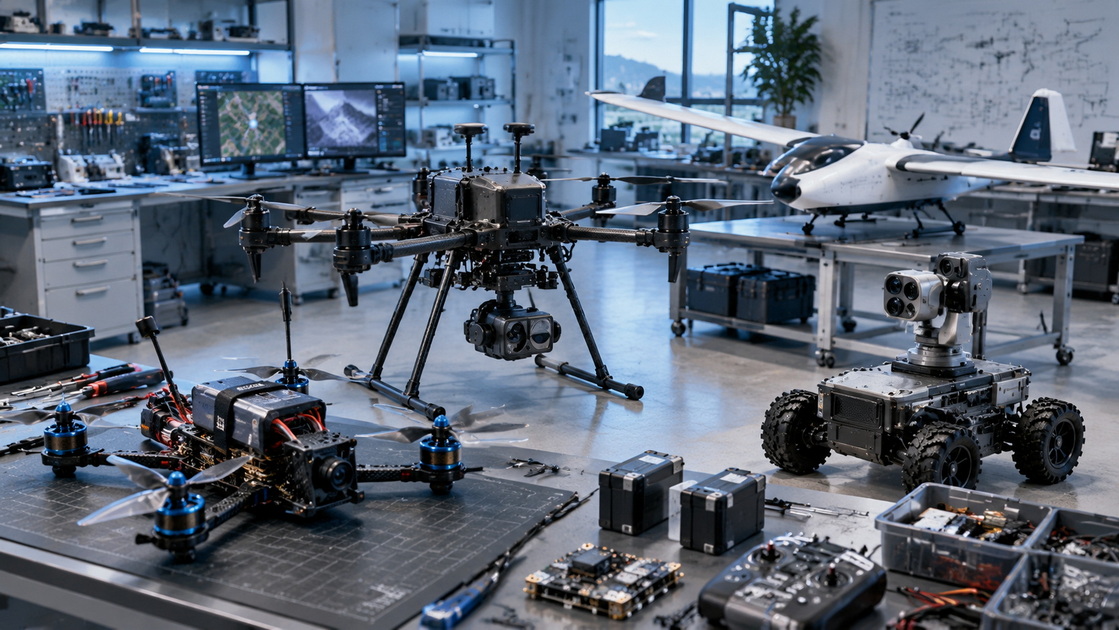
This guide is intended for procurement managers, systems integrators, operators, and product-development teams. The companies are grouped according to their public market position, product focus, industry relevance, and role in the broader U.S. unmanned aircraft ecosystem.
Evaluation factors include:
- Platform capability: Aircraft performance, payload capacity, endurance, autonomy, and mission suitability.
- Market focus: Defense, public safety, industrial inspection, cinematography, FPV, enterprise operations, or component supply.
- Compliance readiness: U.S. procurement restrictions, data-security needs, Remote ID, registration, and Part 107 operating requirements.
- Production and support: Availability of field service, spares, repairs, training, documentation, and lifecycle support.
- Technology depth: Autonomy, computer vision, flight control, propulsion, GNSS navigation, communications, and payload integration.
- Component strategy: Ability to source qualified motors, ESCs, flight controllers, frames, antennas, batteries, cameras, and gimbal systems.
- Customization potential: Support for OEM, ODM, application-specific integration, private labeling, and non-standard power-system requirements.
The Federal Aviation Administration requires registration for drones operated under Part 107, while Part 107 registration is $5 per aircraft and valid for three years.
The U.S. drone market includes very different buyer categories. Defense and public-safety agencies often prioritize secure supply chains, procurement eligibility, autonomy, encryption, mission reliability, and service support. Commercial operators may prioritize payload flexibility, operational cost, data quality, ease of training, and regulatory approval.
The FAA's BEYOND program illustrates the continuing shift toward more complex unmanned operations. During Phase 1, program participants logged more than 70,000 flights, including more than 48,000 beyond-visual-line-of-sight operations. The FAA states that the program produced operational and safety data intended to support a future performance-based BVLOS regulatory approach.
For component buyers, this market expansion increases demand for more specialized brushless motors. A high-speed FPV racing motor, for example, should not be selected with the same criteria as a low-KV propulsion motor for a heavy-lift inspection drone or a sealed motor for an underwater robotic platform.
| Company | Headquarters | Primary Focus | Typical Buyer | Key Public Market Position |
|---|---|---|---|---|
| Skydio | Hayward, California | Autonomous drones for defense, public safety, and enterprise | Government, public safety, industrial users | AI autonomy and obstacle avoidance |
| AeroVironment | Arlington, Virginia | Tactical UAS, loitering munitions, and autonomous systems | Defense and government buyers | Established UAS and defense supplier |
| Anduril Industries | Costa Mesa, California | Autonomous defense technology and counter-UAS systems | Defense and national-security programs | Integrated autonomous defense systems |
| Kratos Defense | San Diego, California | Tactical jet drones and attritable aircraft | Defense programs and aerospace integrators | High-performance unmanned aircraft |
| Insitu, A Boeing Company | Bingen, Washington | Long-endurance fixed-wing UAS | ISR and maritime operations | ScanEagle and Integrator platforms |
| Freefly Systems | Woodinville, Washington | Professional multirotor and cinema drones | Film, inspection, public-safety users | Heavy-lift and professional aerial platforms |
| KDE Direct | Oregon | Industrial brushless motors and UAS propulsion | Enterprise drone builders and integrators | Industrial propulsion systems |
| Lumenier | Florida | FPV motors, frames, electronics, and components | FPV builders and professional pilots | FPV component ecosystem |
| Auterion | San Francisco, California | Drone software, autopilot systems, and fleet control | Drone OEMs and enterprise operators | Open software and avionics ecosystem |
| Garmin | Olathe, Kansas | Navigation, GNSS, and aviation electronics | OEMs, integrators, and aviation users | GNSS and navigation technology |
Skydio develops autonomous drones for defense, public-safety, and enterprise applications. The company is known for vision-based autonomy and obstacle-avoidance technology intended to support operations in complex environments.
For buyers, Skydio is relevant when the mission requires:
- Autonomous navigation.
- Obstacle avoidance.
- Indoor or GPS-challenged operations.
- Public-safety response.
- Infrastructure inspection.
- Defense reconnaissance.
- Secure enterprise drone workflows.
The primary procurement question is not only aircraft flight time. It is whether the aircraft, software, data-management workflow, payload, and service model fit the intended operating environment.
AeroVironment is an established U.S. defense technology supplier with unmanned aircraft systems, loitering munitions, high-altitude pseudo-satellite systems, and related autonomous technologies.
In its fiscal 2025 annual filing, AeroVironment reported revenue of USD 820.6 million, compared with USD 716.7 million in fiscal 2024—an increase of 14%. It stated that approximately 75% of fiscal 2025 revenue came from U.S. government sales, including prime and subcontractor arrangements and foreign military sales.
AeroVironment is primarily relevant for:
- Military tactical UAS.
- Government procurement.
- Surveillance and reconnaissance.
- Loitering munition programs.
- Long-term logistics and support requirements.
- Defense-grade systems integration.
Its business model differs significantly from consumer or standard commercial drone brands. Buyers should expect a stronger emphasis on mission assurance, regulated procurement, support infrastructure, and program-level contracts.
Anduril Industries develops autonomous defense systems. Its portfolio spans autonomous air vehicles, counter-UAS systems, surveillance technologies, sensors, software, and command-and-control platforms.
The company is relevant for defense and national-security buyers that need integrated autonomous systems rather than a standalone commercial drone. Typical procurement topics include sensor integration, software interoperability, communications, mission planning, cybersecurity, and long-term field support.
For component manufacturers, companies in this segment also illustrate an important market direction: defense and enterprise drone systems increasingly require traceable, documented, and application-specific power systems rather than generic hobby-grade motors.
Kratos Defense and Security Solutions develops unmanned systems for military and aerospace applications. It is known for jet-powered, tactical, and attritable unmanned aircraft concepts.
This supplier category is relevant for:
- Aerospace defense programs.
- High-speed unmanned aircraft.
- Tactical mission systems.
- Government development contracts.
- Advanced propulsion and airframe integration.
- Attritable aircraft concepts.
The purchasing model for this segment is typically long-cycle and specification-intensive. Suppliers are often assessed on qualification procedures, production scalability, engineering documentation, quality systems, configuration control, and delivery reliability.
Insitu, a Boeing company, is known for fixed-wing unmanned aircraft used in intelligence, surveillance, reconnaissance, and long-endurance missions. Its ScanEagle and Integrator aircraft families are widely associated with maritime, defense, and industrial operations.
Insitu may be considered by buyers requiring:
- Long-endurance fixed-wing missions.
- Maritime surveillance.
- Remote-area operations.
- Persistent data collection.
- Government and defense integration.
- Established aviation support infrastructure.
Fixed-wing UAS procurement requires a different technical mindset than multicopter procurement. Buyers should compare launch and recovery method, endurance, payload type, data link, environmental operating limits, repair cycle, and field deployment requirements.
Freefly Systems is a Washington-based manufacturer known for professional multirotor platforms and camera-stabilization technology. Its products are used in cinema, industrial inspection, public safety, mapping, and specialist aerial operations.
Freefly is relevant when buyers prioritize:
- Professional camera payloads.
- Heavy-lift multicopter capability.
- Stable flight for film production.
- Custom payload integration.
- Mapping and inspection operations.
- Professional operator workflows.
For aerial cinematography, motor performance affects more than thrust. Smoothness, vibration behavior, bearing quality, thermal stability, propeller balance, and ESC calibration can directly influence gimbal footage quality.
KDE Direct is an American supplier of brushless motors and propulsion systems for industrial, enterprise, and heavy-lift UAS applications. It is widely associated with high-power motors designed for demanding multicopter and professional drone use.
Its relevance to procurement teams includes:
- Industrial multirotor propulsion.
- Heavy payload systems.
- Professional-grade brushless motors.
- High-reliability drone power systems.
- Custom aircraft integration.
- Long-duration operating profiles.
When comparing industrial motors, buyers should examine thrust data at the target voltage and propeller size, not only KV rating. A motor may produce impressive peak thrust but operate inefficiently or overheat during continuous payload flights.
Lumenier is a U.S. FPV component brand offering motors, frames, flight electronics, antennas, and accessories. It is particularly relevant to FPV builders, racing pilots, content creators, and commercial teams using compact high-performance FPV platforms.
Lumenier may be appropriate for:
- FPV racing.
- Freestyle FPV builds.
- Cinematic FPV applications.
- Custom quadcopter assembly.
- Small unmanned platform prototypes.
- FPV repair and upgrade projects.
For FPV systems, motor choice must match the intended battery configuration, usually expressed as cell count, propeller size, frame geometry, target weight, and required throttle response. A high-KV motor can produce fast response with a smaller propeller and appropriate voltage, while lower-KV configurations are often more appropriate for larger propellers, higher voltage systems, or endurance-focused applications.
Auterion develops software, autopilot, flight-management, and data-management tools for unmanned systems. Its ecosystem is relevant to manufacturers and operators looking to standardize aircraft control, payload integration, fleet management, and mission workflows.
Auterion may be relevant for:
- OEM drone manufacturers.
- Enterprise drone fleets.
- Autonomous inspection systems.
- Government and public-safety operations.
- Payload and avionics integration.
- Open-architecture system development.
For an OEM buyer, flight-control software is not independent from motor performance. The controller, ESC protocol, motor response, propeller inertia, battery discharge capability, and payload must be tuned as one system.
Garmin supplies GPS, GNSS, aviation navigation, sensors, and related electronics that are used across aviation and unmanned applications. For drone OEMs and integrators, accurate positioning and sensor fusion are important for navigation, stability, mapping, return-to-home functions, and autonomous flight.
Garmin is relevant for:
- GNSS navigation.
- Aviation-grade electronics.
- Sensor integration.
- Mapping and positioning.
- OEM flight-system design.
- Industrial UAS operations.
A robust navigation system cannot fully compensate for an unstable propulsion system. Vibration from poorly balanced propellers, damaged bearings, unsuitable motors, or flexible arms can degrade sensor performance and influence flight-controller tuning.
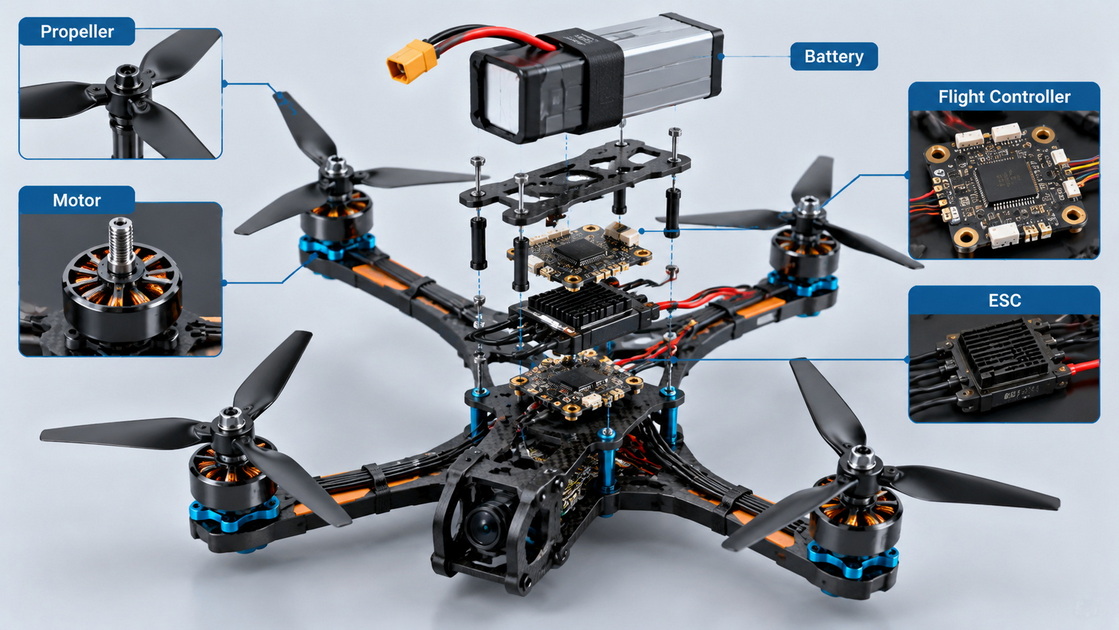
The original manufacturer list is useful for understanding the U.S. drone ecosystem, but component selection deserves deeper attention. In our work with brushless propulsion projects, the most expensive mistakes often occur when buyers select motors by KV number alone.
A motor must be evaluated as part of the complete propulsion system.
KV describes the motor's approximate no-load revolutions per minute per volt. It does not represent thrust, torque, efficiency, or quality on its own.
Use KV together with:
- Battery voltage.
- Propeller diameter.
- Propeller pitch.
- Frame size.
- All-up weight.
- Required payload.
- ESC current capacity.
- Desired flight duration.
- Expected throttle profile.
- Ambient temperature.
A simplified relationship is:
No-Load RPM≈KV×Battery Voltage
Real flight RPM is lower because of propeller load, battery voltage sag, ESC behavior, and aerodynamic resistance.
A motor may survive a brief peak-throttle test but fail during continuous high-load operation. This is especially important for:
- Agricultural drones.
- Heavy-lift inspection drones.
- Tethered aircraft.
- Large RC vehicles.
- High-pressure ducted fans.
- Gimbal and camera platforms.
- Underwater robots.
- Long-duration robotics systems.
Ask for test data that shows:
- Propeller model.
- Battery voltage.
- Throttle point.
- Current draw.
- Thrust.
- Input power.
- Efficiency.
- Test duration.
- Ambient temperature.
- Motor temperature after sustained operation.
Before confirming an FPV drone motor order, verify:
- Stator dimensions.
- KV rating.
- Shaft diameter.
- Mounting-hole pattern.
- Motor height.
- Propeller-mount standard.
- Bell material.
- Magnet grade.
- Bearing type.
- Wire length.
- Wire gauge.
- Waterproofing requirement.
- Rotation direction.
- ESC protocol and current rating.
A motor that performs well electrically can still cause production delays if the mounting pattern, shaft, wires, or propeller interface are incompatible with the frame.
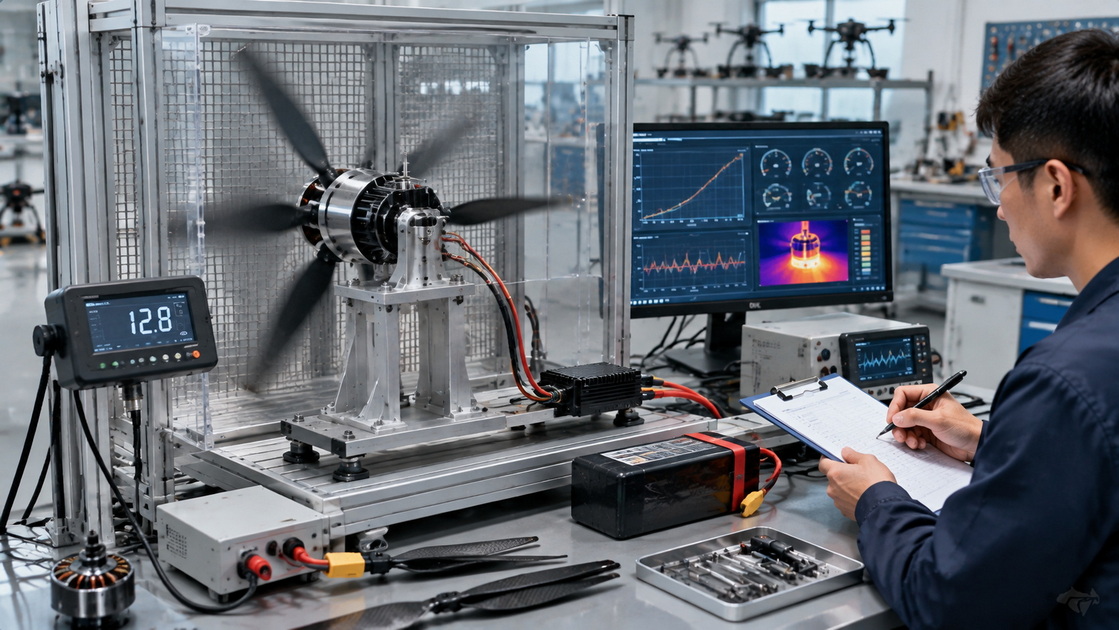
A supplier may provide thrust data using a brief static test, a high-discharge battery, a propeller not used in your application, or conditions that do not represent the required duty cycle.
How to avoid it: Require data using your target propeller, battery voltage, payload condition, and intended operating duration.
The first sample may use one bearing, magnet, winding configuration, bell thickness, or wire specification. The production batch may use lower-cost alternatives.
How to avoid it: Freeze the approved bill of materials. Define stator size, KV tolerance, magnet grade, bearing brand or specification, wire gauge, shaft material, coating, connector, packaging, labeling, and test requirements in the purchase agreement.
Heat is one of the fastest indicators of an unsuitable motor-and-propeller combination. Motors used in hot climates, enclosed airframes, heavy-lift platforms, or high-duty-cycle applications need stronger thermal validation than motors used in short FPV flights.
How to avoid it: Run a sustained-load test, record motor temperature, inspect windings, and evaluate efficiency rather than only maximum thrust.

Zhongshan Yuhang Power Technology Co., Ltd. develops, manufactures, and supplies FPV drone motors and brushless power systems for a broad set of professional and hobbyist applications.
The company supports power-system solutions for:
- FPV drones and racing drones.
- Multirotor UAVs.
- Remote-controlled cars.
- High-power fans.
- Gimbal camera systems.
- Fixed-wing aircraft.
- Robotic vacuum systems.
- Underwater robots.
- Other specialized electric-drive equipment.
For OEM and ODM projects, Zhongshan Yuhang Power Technology Co., Ltd. can support customized motor development based on KV, stator size, winding requirements, shaft and mounting design, wire length, connector type, target voltage, environmental requirements, packaging, and branding needs.
A productive OEM inquiry should include the propeller size, battery configuration, required thrust, aircraft weight, expected continuous operating time, ESC limit, environmental conditions, target price, annual volume, and compliance needs. This allows the engineering team to recommend a motor specification that is practical for the full system rather than only attractive in a catalog.
The U.S. drone industry includes autonomous-drone manufacturers, defense system integrators, fixed-wing UAS specialists, professional multicopter suppliers, navigation providers, software developers, and component brands. Each serves a different buyer need.
For aircraft procurement, assess mission fit, regulatory requirements, service support, payload capability, and operational cost. For drone-component procurement, treat the brushless motor as part of an integrated system involving the propeller, battery, ESC, flight controller, frame, payload, and duty cycle.
FPV drone motors are often optimized for rapid throttle response, compact size, high power-to-weight ratio, and short high-performance flights. Industrial UAV motors are typically selected for payload capacity, efficiency, thermal stability, endurance, reliability, and continuous-duty performance.
Select KV based on battery voltage, propeller size and pitch, frame size, aircraft weight, desired flight style, and ESC capability. Higher KV generally produces higher no-load RPM at a given voltage, but it must be matched carefully to the propeller and battery to avoid excessive current and heat.
Yes. OEM customization can include stator dimensions, KV rating, winding configuration, shaft design, bell material, magnet grade, bearing specification, motor wires, connectors, mounting-hole pattern, color, laser marking, packaging, and performance targets.
Request test data showing the motor model, KV, battery voltage, propeller model, throttle percentage, current draw, input power, thrust, efficiency, test duration, motor temperature, ambient temperature, and the ESC used in the test.
Motor heat can result from an overly aggressive propeller, KV that is too high for the battery voltage, excessive aircraft weight, poor airflow, damaged bearings, incorrect ESC timing, propeller imbalance, winding damage, or sustained high-throttle operation.
1. [YRDROne: 2026 Top U.S. Drone Manufacturers in USA] — Original article reviewed for its U.S. drone manufacturer list, market framing, and named company context. [yrdrone]
2. [Federal Aviation Administration: Small UAS Regulations Under Part 107] — Official guidance on Part 107 registration requirements. [faa]
3. [Federal Aviation Administration: How to Register Your Drone] — Official registration fee and registration-validity information. [faa]
4. [Federal Aviation Administration: BEYOND Program Expansion] — Official program information and reported BVLOS flight activity. [faa]
5. [AeroVironment Form 10-K for Fiscal Year Ended April 30, 2025] — Fiscal 2025 revenue, year-on-year growth, and U.S. government-sales disclosures. [sec]
6. [AeroVironment Investor Relations] — Current annual-report and financial-information access. [investor.avinc]


