Language


Views: 239 Author: Yuhang Power Publish Time: 2026-09-04 Origin: Site
Content Menu
● The Short Answer: Does Shaft Material Matter?
● What Does an FPV Motor Shaft Do?
● Titanium Shaft vs Steel Shaft FPV Motor Comparison
● Titanium Shaft Benefits in FPV Motors
>> Lower Weight and Reduced Rotating Mass
>> Strong Strength-to-Weight Potential
● Steel Shaft Benefits in FPV Motors
>> Higher Stiffness at Equal Geometry
>> Established Wear and Surface-Finish Options
● Why "Titanium Is Stronger" Is an Oversimplification
● Shaft Diameter Often Matters More Than Material
● Hollow Titanium Shafts and Hybrid Designs
● The Less-Discussed Issue: Titanium Wear and Galling
>> Questions to Ask About Titanium Shaft Surface Control
● Titanium Shaft vs Steel Shaft for Different FPV Uses
● A Buyer's Checklist for FPV Motor Shaft Quality
>> Required Technical Information
● Practical OEM and ODM Considerations
● FAQ
>> 1. Are titanium FPV motor shafts always stronger than steel shafts?
>> 2. How much weight can a titanium shaft save in an FPV motor?
>> 3. Does a titanium shaft improve FPV motor efficiency?
>> 4. Is steel better for FPV freestyle crashes?
>> 5. What is more important than shaft material when choosing an FPV motor?
Titanium shaft vs steel shaft FPV motor is a meaningful comparison, but shaft material alone does not determine whether a motor is fast, efficient, or durable. Titanium can reduce weight and improve corrosion resistance, while hardened steel generally provides greater stiffness, easier machining, and lower cost. The correct choice depends on flight style, propeller size, crash exposure, motor geometry, bearing arrangement, and the quality of the complete motor assembly.
For FPV racing, freestyle, cinewhoops, long-range platforms, RC cars, and specialized brushless systems, the shaft is a small component with an outsized mechanical role. It transfers motor torque, supports the bell or propeller interface, maintains rotor alignment, and helps determine how the motor behaves after a prop strike or hard crash.
At Zhongshan Yuhang Power Technology Co., Ltd., we work with brushless motor configurations for FPV drones, RC cars, high-speed fans, gimbal cameras, aircraft, cleaning robots, and underwater robots. When buyers ask whether titanium shafts are "better," the practical answer is: better for which duty cycle, impact scenario, weight target, and budget?
Yes. Shaft material matters, especially in compact high-RPM motors where bending, runout, bearing alignment, and rotor balance affect vibration and service life.
However, a titanium shaft does not automatically make an FPV motor superior.
A well-designed motor with a straight, hardened steel shaft, high-quality bearings, accurate rotor balancing, controlled air gap, and reliable bell construction may outperform a titanium-shaft motor with weak bearings, poor concentricity, or inconsistent production tolerances.
The shaft should be evaluated as part of a complete system:
- Shaft material and alloy grade
- Shaft diameter
- Solid or hollow construction
- Heat treatment
- Surface finish
- Bearing fit
- Bell interface
- Propeller mounting method
- Rotor balance
- Motor bell stiffness
- Crash load path
- Propeller size and RPM range
Material is important. Engineering execution is more important.
An FPV drone motor shaft is the central rotating component that links the motor bell, bearings, stator assembly, and propeller mounting point.
Depending on motor design, the shaft may be:
- Press-fitted into the motor bell
- Integrated with the bell
- Retained by a C-clip, screw, or fastener
- Hollow to reduce mass
- Solid for increased stiffness
- Threaded for propeller retention
- Designed with a propeller adapter interface
- Supported by one or two bearings
The shaft must remain straight under repeated acceleration, deceleration, vibration, propeller imbalance, and crash loads.
When a shaft bends, even slightly, several problems can appear:
- Propeller wobble
- Motor vibration
- Increased bearing wear
- Higher no-load current
- ESC noise or instability
- Reduced video quality from vibration
- Higher motor temperature
- Lower motor efficiency
- Premature bearing failure
- Rotor bell contact with the stator
For an FPV pilot, the visible symptom may simply be a motor that "sounds rough" after a crash. For an OEM buyer, the same issue can become a return-rate, quality-control, and brand-reputation problem.
| Factor | Titanium Shaft | Steel Shaft |
|---|---|---|
| Density | Lower; titanium alloys are about 4.4–4.5 g/cm³ | Higher; steel is typically about 7.8–8.0 g/cm³ |
| Weight impact | Can reduce rotating mass and total motor weight | Adds more mass at the same dimensions |
| Stiffness | Lower elastic modulus; tends to flex more at equal geometry | Higher elastic modulus; generally resists bending more at equal geometry |
| Strength-to-weight ratio | Strong for a lightweight material | Can be excellent, especially with high-strength or hardened steels |
| Corrosion resistance | Very strong natural corrosion resistance | Depends on steel grade, coating, and storage conditions |
| Wear behavior | Requires careful surface and contact design | Often favorable when hardened and properly finished |
| Machining cost | Higher | Usually lower and easier to machine |
| Material availability | More specialized | Widely available |
| Best use case | Weight-sensitive performance builds | Cost-sensitive, stiffness-focused, or high-volume projects |
| Key risk | Assuming “titanium” automatically means crash-proof | Assuming all steel shafts have the same hardness and quality |
Titanium alloys have a density of approximately 4.4 g/cm³, about half that of steel and nickel-based superalloys. By comparison, steel is generally around 7.8 to 8.0 g/cm³, while titanium is around 4.51 g/cm³.
That density advantage is real. But density is only one part of the engineering decision.
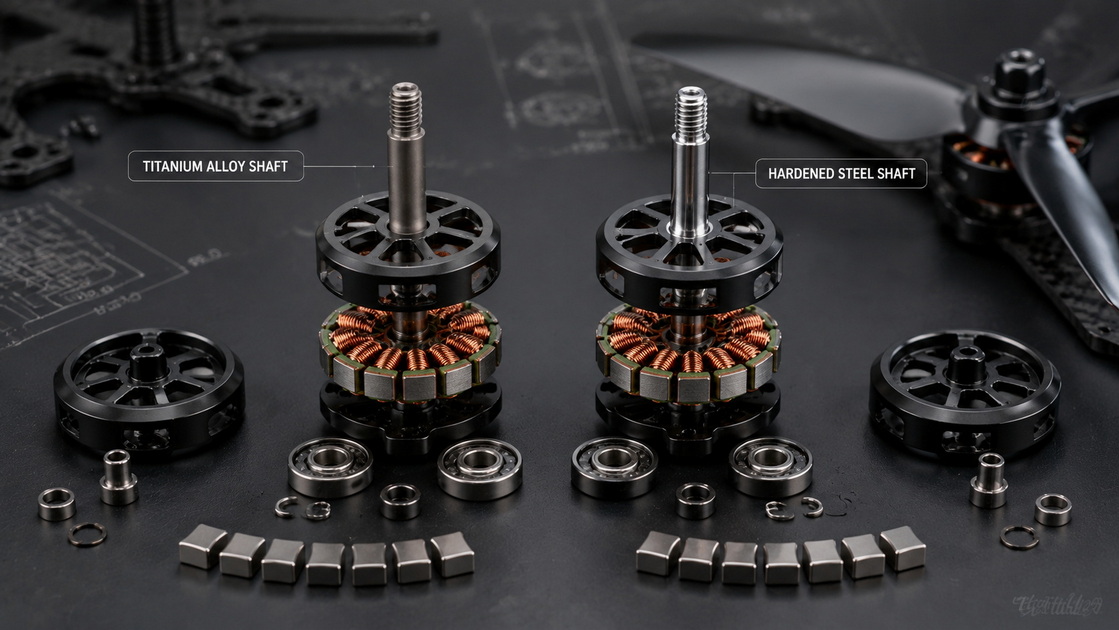
Titanium's most obvious advantage is lower density. A titanium shaft can reduce weight compared with a same-size steel shaft.
In premium FPV motor designs, titanium shafts may save approximately 1 to 1.5 grams per motor depending on motor size and shaft geometry.
For a 5-inch quad using four motors, that may represent several grams removed from the propulsion system. That may matter in:
- Competitive racing
- Lightweight freestyle builds
- Sub-250 g aircraft targets
- Long-range builds where payload efficiency matters
- Compact cinewhoops with tight weight budgets
- High-performance builds using larger stators
Weight savings are most valuable when they reduce rotating mass, not just static mass. Lower rotational inertia can help a motor change RPM more quickly, although the real effect depends on the full rotating assembly, including bell, magnets, propeller, and shaft geometry.
Titanium naturally forms a protective oxide layer. This makes it attractive for equipment exposed to moisture, sweat, humid storage, coastal conditions, or certain outdoor applications.
For FPV drones, corrosion resistance is not usually the top purchase driver. But it can be beneficial for:
- Coastal flying
- High-humidity storage
- Wet grass and damp field conditions
- Marine inspection equipment
- Underwater or splash-prone robotic systems
- Long-term warehouse storage in uncontrolled conditions
A properly selected titanium alloy can provide a favorable strength-to-weight ratio. Ti-6Al-4V, often referred to as Grade 5 titanium, is widely used in high-performance applications because of its useful strength and fatigue properties.
However, buyers should never approve a shaft simply because it is described as "titanium alloy." The supplier should identify:
- Exact alloy designation
- Shaft diameter
- Solid or hollow construction
- Heat-treatment condition
- Surface treatment
- Straightness tolerance
- Shaft runout specification
- Bearing-seat tolerance
- Pull-out or press-fit requirement
A generic "titanium shaft" claim without these details is not sufficient for an OEM specification.
Steel generally has a significantly higher elastic modulus than titanium. Typical published values are approximately 200 GPa for steel and about 116 GPa for titanium.
This means that, when shaft diameter and geometry are the same, steel usually resists elastic bending more effectively.
That matters when a motor experiences:
- Propeller strikes
- Side impacts
- High thrust loads
- Large propeller inertia
- Bent or damaged propeller hubs
- Aggressive crash recovery
- High-torque RC car drivetrains
- Long shafts with large unsupported lengths
A stiffer shaft can help keep the rotor bell aligned with the stator and reduce the risk of runout after impact.
Steel is generally easier and less expensive to source and machine than titanium. For standard FPV motors, RC motors, and high-volume OEM programs, this can support better cost control.
A hardened steel shaft may be a rational choice when:
- The target market is price-sensitive.
- The motor uses a compact shaft with limited mass difference.
- The drone is not tightly weight constrained.
- The motor requires high stiffness.
- The buyer needs predictable high-volume supply.
- The intended use includes frequent crashes and rough field operation.
Steel shafts can be hardened, ground, polished, coated, or treated to achieve a suitable bearing interface and wear performance.
This is particularly important because the shaft does not operate in isolation. The shaft surface interacts with bearings, clips, press-fit areas, screws, and propeller hardware. A good steel shaft surface finish can support reliable fit and repeatable assembly.
A common online claim is that titanium is "stronger than steel." This statement is incomplete.
Strength depends on:
- The specific titanium alloy
- The specific steel alloy
- Heat treatment
- Shaft diameter
- Shaft wall thickness
- Surface condition
- Manufacturing defects
- Load direction
- Stress concentration
- Test method
- Operating temperature
- Fatigue cycle count
Some high-strength steels can exceed the yield strength of many titanium alloys. General published comparisons show titanium yield strength can range widely by alloy and condition, while steel can range from around 350 MPa to 1,800 MPa depending on grade and heat treatment.
For FPV motor sourcing, the useful question is not "Which material is stronger?"
Ask instead:
Which shaft design provides the required bending resistance, fatigue life, shaft straightness, bearing fit, and crash durability at the required weight and cost?
That is the question an experienced motor engineer should answer.
A small increase in shaft diameter can have a large influence on bending stiffness. For a round shaft, resistance to bending changes strongly with diameter.
In simplified beam behavior, the area moment of inertia for a solid circular shaft is:
I=πd4/64
This means stiffness-related resistance rises with the fourth power of shaft diameter.
For example, increasing a shaft diameter from 4 mm to 5 mm increases the geometric term by:
(5/4)4≈2.44
So, a 5 mm shaft can have more than twice the bending-resistance contribution from geometry compared with a 4 mm shaft, assuming the same material and unsupported length.
This is why a well-designed steel shaft with a sensible diameter can be more durable in a crash than a thin titanium shaft. It is also why a hollow titanium shaft may need careful wall-thickness and reinforcement design.
Do not compare shaft materials without comparing shaft geometry.
Many premium FPV motors use hollow-shaft designs to reduce weight. A hollow shaft removes material from the center, where it contributes less to bending resistance than material near the outer surface.
This can create a useful balance between weight and stiffness.
However, hollow construction introduces manufacturing requirements:
- Consistent wall thickness
- Controlled concentricity
- Accurate internal bore
- Clean end finishing
- Reliable press fit into the bell
- No stress risers near holes or transitions
- Proper fatigue testing
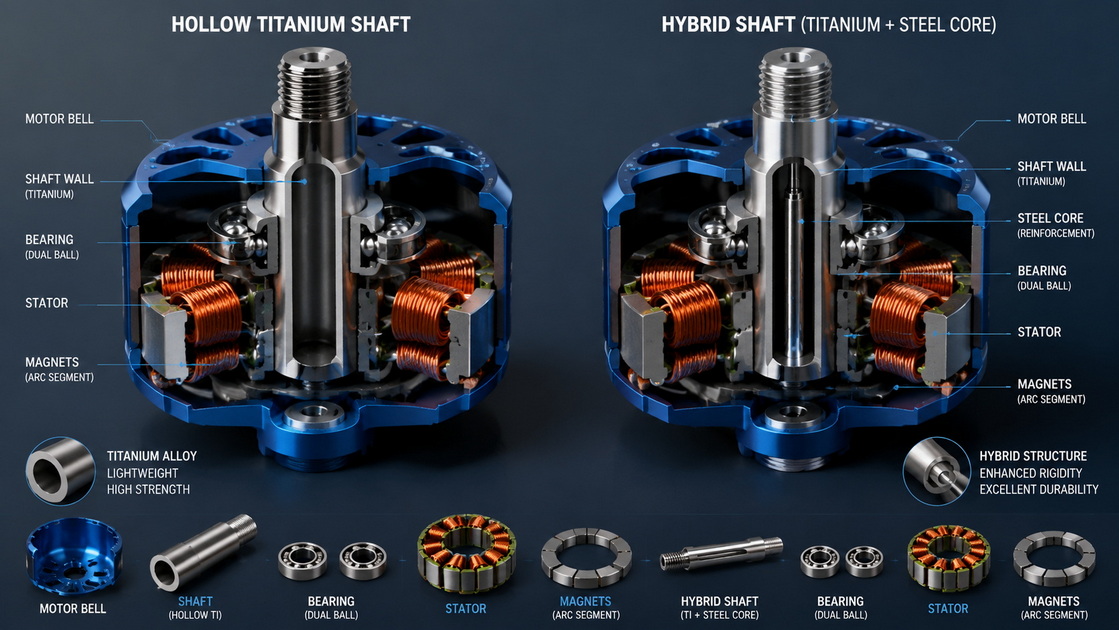
Some manufacturers use hybrid shaft designs that combine titanium and steel. One approach uses a steel core or rod inside a hollow titanium shaft to improve stiffness while retaining part of titanium's weight advantage.
For buyers, hybrid designs should be evaluated carefully. They can be technically valid, but they also add assembly complexity and require good control of fit, bonding or retention, thermal expansion, and concentricity.
The most overlooked titanium-shaft issue is not weight or strength. It is surface interaction.
Titanium is known to have challenging tribological behavior. It can show a relatively high coefficient of friction and poor sliding and adhesive-wear resistance against many structural metals unless surface conditions are controlled.
Galling is a form of adhesive wear in which material transfers or roughens at contact surfaces.
In an FPV motor, this does not mean a titanium shaft will automatically fail. A properly designed shaft can work very well. But it means buyers should ask how the shaft is finished and how it interfaces with bearings and hardware.
- Is the shaft polished, ground, coated, nitrided, or otherwise surface treated?
- What is the shaft surface roughness at the bearing seat?
- What is the bearing-seat tolerance?
- What bearing material and lubrication system are used?
- Is the shaft tested for wear after repeated thermal cycles?
- Does the shaft contact aluminum, steel, brass, or another titanium component?
- Is there a risk of metal-on-metal fretting at the bell or prop interface?
- How is corrosion managed at mixed-metal joints?
- Has the supplier tested the shaft after crash loading and repeated propeller installation?
A titanium shaft is not a "fit and forget" premium feature. It requires correct material specification and interface design.
| Application | Practical Shaft Priority | Recommended Direction |
|---|---|---|
| 5-Inch FPV Racing | Low weight, fast throttle response, crash recovery | Titanium or hollow/hybrid designs can be valuable if quality is verified |
| Freestyle FPV | Impact resilience, vibration control, repair cost | High-quality steel is often highly practical; titanium can suit premium builds |
| Long-Range FPV | Efficiency, low weight, reliability | Weight savings can matter, but complete motor efficiency and bearings matter more |
| Cinewhoop | Low vibration, controlled flight, payload balance | Select based on motor smoothness, bearing quality, and total system mass |
| Micro FPV | Every gram matters | Titanium may be attractive, but the absolute benefit depends on motor size |
| RC Car | Torque, shaft stiffness, gear interface durability | Hardened steel often remains the practical choice |
| Fixed-Wing RC Aircraft | Weight, propeller mounting, sustained efficiency | Titanium can be useful; confirm fatigue and prop-adapter interface |
| Gimbal Systems | Smoothness, low vibration, precision | Shaft runout and bearing quality matter more than material label |
| Underwater Robotics | Corrosion resistance, sealing, reliability | Titanium can be relevant, but full material compatibility is essential |
When sourcing FPV drone motors, request a shaft specification rather than accepting a marketing description.
- Material grade or alloy designation
- Shaft diameter and tolerance
- Shaft length and unsupported length
- Solid, hollow, or hybrid construction
- Shaft weight
- Surface roughness requirement
- Hardness or heat-treatment condition
- Straightness and total indicated runout
- Bearing-seat dimensions and tolerance
- Bell press-fit or retention method
- Propeller mount interface
- Corrosion-protection method
- Dynamic-balance standard
- Pull-out force requirement
- Post-crash inspection method
1. No-load current test
Measure current at a specified voltage. A rise after impact can indicate bearing misalignment, shaft bending, or rotor rub.
2. Runout measurement
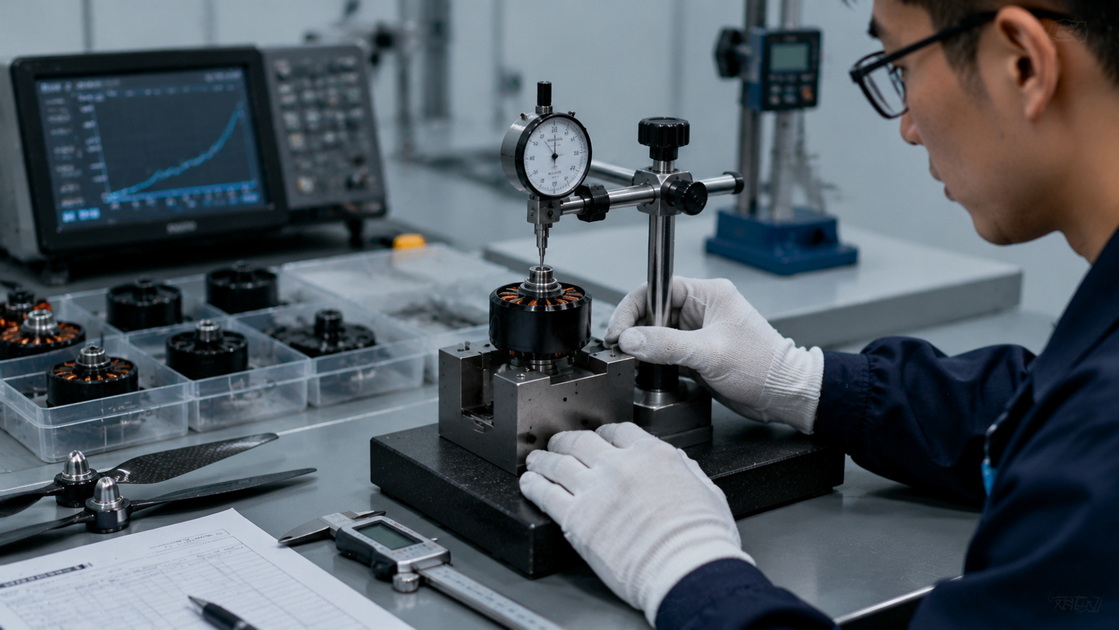
Use a dial indicator to measure shaft and bell runout before and after impact testing.
3. Dynamic-balance test
Check vibration across the intended operating RPM range.
4. Propeller-load test
Run the motor with the intended propeller, ESC, battery voltage, and throttle profile.
5. Thermal test
Measure winding, bearing, and bell temperature during sustained operation.
6. Crash or side-load test
Define a repeatable side-load or impact simulation relevant to the application.
7. Bearing wear test
Inspect the shaft and bearing interface after defined operating cycles.
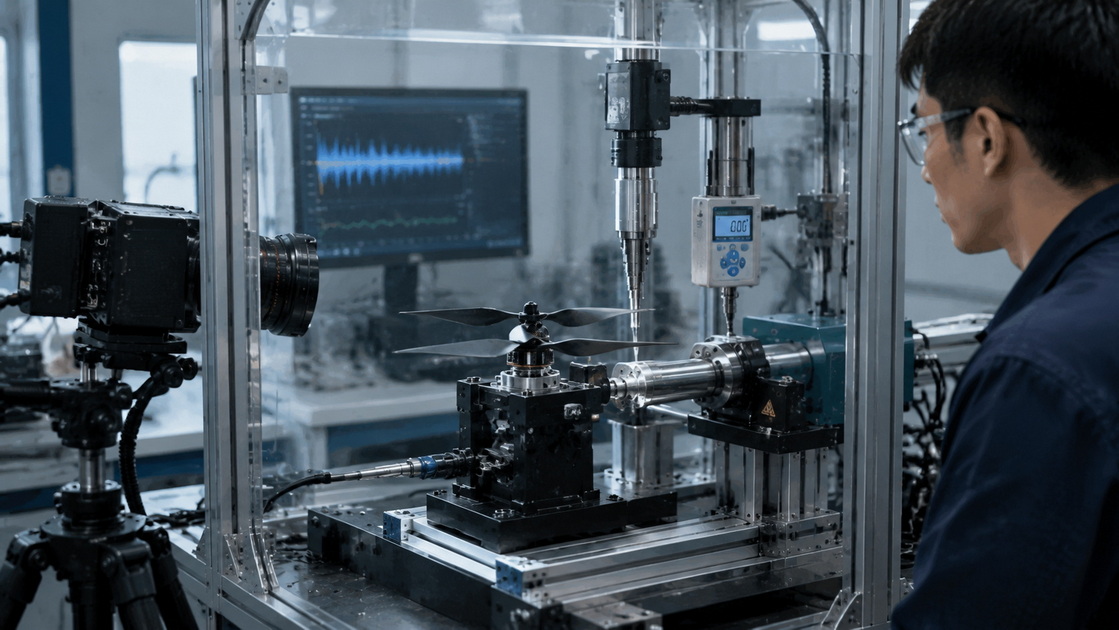
For OEM or ODM motor development, shaft choice should be decided early because it affects the bell, bearing arrangement, machining process, tooling, balancing, packaging, and cost structure.
At Zhongshan Yuhang Power Technology Co., Ltd., customized brushless-motor projects can be evaluated around more than KV and stator size. Buyers should provide their actual application information, including propeller dimensions, battery voltage, target thrust, temperature environment, desired motor weight, crash exposure, expected annual quantity, and destination-market requirements.
Possible customization discussions can include:
- Steel, titanium, hollow, or hybrid shaft design
- Custom shaft length and diameter
- Propeller mounting format
- Custom KV and winding configuration
- Motor-bell material and finish
- Magnet grade
- Bearing selection
- Wire length and connector type
- Mounting-hole pattern
- Motor color, logo, and packaging
- Matched ESC and propulsion-system selection
The goal is to specify the shaft as part of a complete reliable power system rather than treat it as an isolated upgrade.
Titanium and steel shafts both have valid roles in FPV motors.
Choose a titanium shaft when weight reduction, corrosion resistance, and premium strength-to-weight performance justify the added material and manufacturing cost. This can be especially attractive for racing, lightweight freestyle, compact cinewhoops, and weight-sensitive aircraft.
Choose a hardened steel shaft when stiffness, predictable wear behavior, repair practicality, and cost control are the higher priorities. Steel remains a strong option for many FPV motors, RC cars, fixed-wing applications, and high-volume motor programs.
The most important buying decision is not whether the shaft is titanium or steel. It is whether the shaft design, geometry, bearing fit, balance, material control, and test data match your application.
No. The result depends on the specific titanium alloy, steel grade, heat treatment, shaft diameter, wall thickness, and loading condition. Many high-strength steels are stiffer and may provide greater bending resistance at the same shaft geometry.
The saving depends on shaft size and design. Some premium FPV motor designs report approximately 1 to 1.5 grams of weight reduction per motor when using titanium alloy shafts. The actual system benefit depends on the rest of the rotating assembly.
Not automatically. A lower-mass shaft may reduce rotational inertia, but motor efficiency is mainly influenced by winding design, stator laminations, magnets, air gap, bearings, ESC tuning, propeller match, and operating load.
High-quality hardened steel can be highly practical for freestyle because it offers strong stiffness, familiar wear behavior, and lower replacement cost. A well-engineered titanium shaft can also perform well, but buyers should verify runout, impact performance, and bearing-interface quality.
Key priorities include correct stator size, KV, magnet quality, winding consistency, bearing quality, rotor balance, shaft diameter, bell construction, thermal performance, and real thrust-and-current data with the intended propeller and battery voltage.
1. [Titanium Alloys — ASM International Digital Library]
Reference for titanium-alloy density and general lightweight-material properties.
2. [Steel vs Titanium Strength, Properties, and Uses — Thomas]
Comparative reference for density, elastic modulus, strength ranges, and material behavior.
3. [Titanium Alloys Physical Properties — AZoM]
Reference for titanium-alloy modulus, strength ranges, fatigue-related properties, and physical characteristics.
4. [FPV Drone Motors Comparison 2207 vs 2306 vs 2505 — UAVModel]
Industry discussion of FPV motor configurations, titanium shafts, and reported per-motor weight savings.
5. [How to Choose FPV Drone Motors — Oscar Liang]
Practitioner resource discussing FPV motor shaft designs, hollow shafts, titanium shafts, and hybrid shaft concepts.
6. [Enhancing Titanium Friction and Wear Properties — Solar Atmospheres]
Technical background on titanium friction, adhesive wear, and galling considerations.
7. [FPV Drone Motors for Racing and Freestyle — LIGPOWER]
Application-oriented discussion of titanium and steel shaft selection for FPV platforms.


