Language


Views: 237 Author: Yuhang Power Publish Time: 2026-09-01 Origin: Site
Content Menu
● Lightweight vs High Torque FPV Motor Comparison
● What "Faster" Really Means in FPV
>> Top Speed
>> Acceleration and Punch-Out Performance
>> Corner Exit and Propwash Recovery
● Lightweight FPV Motors: Strengths and Limits
>> Advantages of Lightweight Motors
>> Limitations of Lightweight Motors
● High Torque FPV Motors: Strengths and Limits
>> Advantages of High Torque Motors
>> Limitations of High Torque Motors
● KV, Torque, and Propeller Load
● How to Choose the Faster Setup
>> 1. Define the Drone's All-Up Weight
>> 2. Set a Realistic Thrust-to-Weight Target
>> 3. Start With the Propeller
>> 4. Match KV to Battery Voltage
>> 5. Validate With Bench Testing
● Real-World Selection Examples
>> Example 1: 3-Inch Ultralight Racing Quad
>> Example 2: 5-Inch Freestyle Drone With Action Camera
>> Example 3: 7-Inch Long-Range FPV Drone
● OEM and ODM Motor Development Considerations
● FAQ
>> 1. Is a lightweight FPV motor always faster?
>> 2. Does a larger stator always mean more speed?
>> 3. What does motor torque do for an FPV drone?
>> 4. Is high KV better for FPV drone speed?
>> 5. Which motor is better for a 5-inch FPV freestyle drone?
When pilots ask whether a lightweight FPV motor or a high torque FPV motor is faster, the correct answer is: neither motor category is automatically faster on every FPV drone. A lightweight motor can make a properly designed racing or ultralight build accelerate faster because it reduces all-up weight. A high torque FPV motor can be faster in demanding real-world conditions because it spins larger or more aggressive propellers with less RPM sag during punch-outs, turns, and propwash recovery.
From an engineering and manufacturing perspective, "fast" should not mean only top speed. For FPV drones, speed also includes throttle response, acceleration, sustained thrust, corner exit performance, and how consistently the power system performs under load. The right choice depends on your frame size, battery voltage, propeller, flight style, payload, target flight time, and desired thrust-to-weight ratio.
For OEM brands, drone integrators, and professional FPV builders, the best approach is to select the motor as part of a complete propulsion system—not as an isolated component. At Zhongshan Yuhang Power Technology Co., Ltd., we develop brushless power solutions for FPV drones, RC vehicles, ducted fans, gimbal cameras, aircraft, robotic cleaners, underwater robots, and other professional equipment. This practical experience reinforces one key principle: motor speed potential only becomes useful when the motor, propeller, ESC, battery, and airframe are correctly matched.
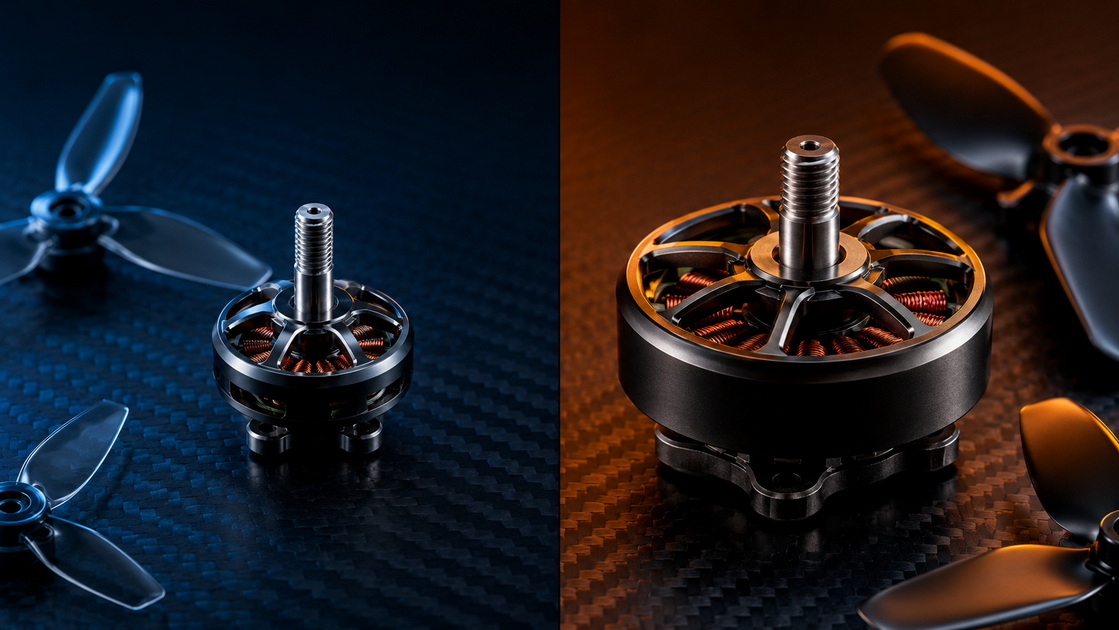
A lightweight FPV motor is often faster for ultralight racing builds, small drones, and efficiency-oriented platforms because lower motor mass helps reduce total aircraft weight. With a high-KV setup and a suitable small propeller, the drone can achieve sharp acceleration and a strong power-to-weight ratio.
A high torque FPV motor is often faster for 5-inch freestyle drones, heavier racers, cinewhoops, long-range platforms, payload-capable drones, and builds using aggressive propellers. Its larger stator volume and stronger torque reserve help maintain propeller RPM when aerodynamic load rises.
The deciding factor is not simply motor weight or torque. It is the total system result:
Real-world FPV speed=thrust+response+weight balance+propeller matching+battery/ESC performance
A motor that looks powerful on a specification sheet may feel slow if it is paired with the wrong KV, battery voltage, propeller pitch, or frame. Similarly, a lighter motor may reduce build weight but become inefficient or overheat if the propeller load exceeds its torque capability.
Practical rule: Choose lightweight FPV motors when minimizing mass is the primary performance lever. Choose high torque FPV motors when maintaining propeller authority under high load is the primary performance lever.
| Factor | Lightweight FPV Motor | High Torque FPV Motor |
|---|---|---|
| Primary design goal | Low mass and high power-to-weight ratio | Strong propeller control under load |
| Typical stator direction | Smaller stator volume | Larger diameter and/or taller stator |
| Best propeller range | Smaller, lighter, lower-load props | Larger, higher-pitch, or heavier props |
| Flight character | Agile, quick, low-inertia feeling | Controlled, powerful, stable under load |
| Acceleration potential | Excellent on ultralight builds | Excellent on medium/heavy and aggressive builds |
| Peak thrust potential | Limited by stator volume and thermal capacity | Usually higher with a matched propeller and voltage |
| Efficiency at cruise | Often strong in low-load applications | Can be efficient, but may add unnecessary mass on small builds |
| Response in propwash | Can be less authoritative if overloaded | Usually stronger because torque recovers prop RPM faster |
| Common applications | Tinywhoops, toothpicks, lightweight 3-inch and racing drones | 5-inch freestyle, 6-inch endurance, cinewhoops, heavy racing, payload drones |
| Key risk | Insufficient torque, overheating, weak prop control | Excess build weight, excess current draw, reduced efficiency on undersized frames |
Motor stator naming provides useful initial context. For example, a 2207 motor generally indicates a stator approximately 22 mm in diameter and 7 mm in height. Stator dimensions influence how much magnetic material and copper winding area are available, which affects torque, current handling, heat generation, and propeller compatibility. Larger stators generally support greater torque and higher load capability, while smaller stators help reduce motor weight.
However, stator size alone does not determine speed. A 2306 motor with an unsuitable KV or over-pitched propeller may perform worse than a lighter 2205 motor in a well-optimized racing setup. This is why professional motor selection requires a complete propulsion-system review.

For an FPV pilot, "faster" can describe several different flight characteristics. A useful motor comparison should separate these variables rather than treating them as the same thing.
Top speed depends heavily on:
- Motor KV and battery voltage
- Propeller diameter and pitch
- Aerodynamic drag
- Total drone mass
- Battery voltage sag
- ESC timing and current capability
- Frame geometry and camera angle
A high-KV lightweight motor may produce excellent top speed on a low-drag ultralight quad. But a high torque motor may hold RPM more effectively with a high-pitch propeller, allowing a larger 5-inch or 6-inch platform to retain speed in loaded flight.
Acceleration depends on how quickly the propulsion system generates thrust relative to the drone's all-up weight.
Reducing motor weight can materially improve this relationship in a lightweight build. For example, saving 4 g per motor saves 16 g on a quadcopter before considering lighter hardware, wiring, and battery choices. On a compact 3-inch platform, that reduction can be meaningful.
However, a lightweight motor only helps if it still delivers adequate torque for the selected propeller. If the propeller creates too much resistance, the motor may lose RPM rapidly during throttle transitions. The drone can then feel less responsive despite its lower weight.
This is where high torque FPV motors often show their advantage.
During a hard turn, a dive recovery, or a rapid throttle change, airflow around the propeller becomes unstable. The motor must restore propeller RPM quickly. A high torque motor is generally better able to resist speed loss and re-accelerate the propeller after an aerodynamic disturbance.
For freestyle pilots, this often feels like:
- Cleaner recovery after dives
- More locked-in control during rapid direction changes
- Stronger "pop" during throttle punches
- Better authority with high-pitch propellers
- Reduced feeling of motor bogging under aggressive throttle input
This does not mean every freestyle drone needs the largest available motor. Oversizing the motor can increase mass, current draw, and rotational inertia. The target is enough torque reserve, not maximum stator size at any cost.
A lightweight FPV motor is engineered to reduce rotating-system and overall aircraft mass while delivering enough thrust for a specific propeller range. These motors are especially valuable when the entire drone is designed around low weight.
Typical use cases include:
- 1S to 2S tinywhoops
- 2-inch to 3-inch micro FPV drones
- Toothpick quads
- Ultralight 3-inch racers
- Lightweight 4-inch long-range builds
- Compact RC aircraft and micro robotics
Smaller motor classes such as 1103, 1105, 1204, 1303, 1404, and 1505 are commonly used on smaller platforms, where every gram has a visible effect on handling and flight efficiency. Current motor-selection guides typically place 1204–1404 motors in ultralight 3-inch applications and 1505–1507 motors in lightweight 3-inch to 4-inch configurations, although the ideal combination still depends on KV, battery, and propeller choice.
- Lower all-up weight: Less mass can improve agility, braking, efficiency, and power-to-weight ratio.
- Quick handling: Compact builds often feel more direct and responsive in tight racing environments.
- Lower current demand: When correctly paired with a moderate propeller, small motors can support efficient flight.
- Better for compact frames: Lightweight motors help maintain the purpose of a micro or ultralight FPV platform.
- Potentially lower cost: Smaller motors may use less material, though design quality and magnet grade still affect pricing.
- Lower torque reserve: They can struggle with high-pitch or heavy propellers.
- More heat risk under overload: Excess current can increase winding temperature and reduce motor life.
- Lower peak thrust ceiling: There is a physical limit to what a small stator can deliver.
- Less suitable for heavy payloads: Action cameras, HD systems, ducts, and large batteries can quickly change the motor requirement.
- Potential RPM sag: Under sharp throttle changes, an undersized motor may not maintain propeller speed as effectively.
A lightweight motor is therefore not a "weaker" motor by definition. It is a motor optimized for a narrower performance window. When used inside that window, it can make an FPV drone feel exceptionally fast.
A high torque FPV motor is designed to turn a propeller more forcefully under load. It usually uses a larger stator diameter, greater stator height, optimized magnetic circuit, appropriate winding configuration, and higher thermal capacity.
High torque motors are commonly used for:
- 5-inch freestyle FPV drones
- Heavy 5-inch racing drones
- 6-inch and 7-inch long-range drones
- Cinewhoops with ducts and HD cameras
- FPV drones carrying action cameras
- Industrial inspection drones
- Heavy-lift or payload-focused UAV platforms
- Larger RC vehicles and electric propulsion systems
Industry guidance commonly identifies 2207–2306 as versatile 5-inch motor classes and 2506–2806.5 as more torque-focused choices for larger 6-inch and 7-inch platforms. Wider stators are generally associated with greater torque capability, while stator height can support higher power handling and peak-output potential.
- Stronger propeller authority: Better control of larger and more aggressive propellers.
- More consistent performance under load: Helps prevent excessive RPM drop during aggressive flight.
- Better for heavier drones: Supports higher all-up weight, payloads, ducts, and larger batteries.
- Improved freestyle feel: Often delivers more confident recovery, punch-outs, and corner exits.
- Greater thermal headroom: A larger motor may dissipate heat more effectively when correctly designed.
- Higher motor mass: Four larger motors can add substantial weight to the aircraft.
- Potentially higher current draw: Aggressive propeller combinations can stress batteries and ESCs.
- Not always efficient on small frames: A high torque motor can be excessive for a lightweight 3-inch build.
- May require stronger components: The frame, ESC, battery, wiring, and flight controller mounting must handle the resulting power and vibration.
- Can reduce flight time: If extra torque is used with a high-load propeller and high throttle demand, energy consumption rises.
The best high torque motor is not necessarily the one with the largest stator. It is the motor that provides the needed torque while maintaining acceptable efficiency, temperature, weight, and reliability.
One of the most common selection mistakes is assuming that a higher KV motor always means a faster FPV drone. KV refers to the approximate no-load RPM per volt. It is useful, but it is not a direct measure of torque, thrust, or real-world speed.
A high-KV motor may spin faster under light load, but it can also draw excessive current or lose efficiency if paired with an oversized propeller. A lower-KV high torque motor may produce better usable thrust with a larger propeller, especially on higher-voltage systems such as 6S.
For example:
- A lightweight 3-inch racing quad may use a relatively high-KV motor with a 3S or 4S battery and a lightweight propeller.
- A 5-inch 6S freestyle quad may use a lower-KV but larger 2207 or 2306 motor to maintain torque with a durable, higher-load 5-inch propeller.
- A 7-inch long-range drone may need a larger, lower-KV motor with efficient bi-blade or tri-blade propellers to produce dependable cruising thrust without overloading the battery.
The motor, propeller, and battery must be considered as one system. Thrust-test databases commonly report motor performance together with a specific propeller, voltage, ESC setup, thrust figure, RPM, power, torque, and efficiency—not as a motor-only result.
Use this practical selection process before choosing between a lightweight FPV motor and a high torque FPV motor.
Calculate the real ready-to-fly mass, including:
- Frame and hardware
- Four motors
- Flight controller and ESC
- Receiver and antennas
- FPV camera and VTX
- HD camera or action camera
- Propellers
- Battery
- GPS, buzzer, LEDs, and accessories
Do not select motors based only on the dry frame weight. A lightweight frame can become a heavy build after an HD system, larger battery, and action camera are added.
For basic flight, a total maximum thrust of around 2:1 relative to drone weight is commonly considered a baseline. More aggressive freestyle and racing builds typically benefit from substantially more thrust reserve. Some FPV selection guides use approximately 4:1 as a minimum target for enjoyable acro performance, while higher-performance builds may target much more depending on flying style.
Use the formula:
Thrust-to-weight ratio=Total maximum thrust from four motors/All-up weight
Example: If a drone weighs 700 g and each motor-propeller unit produces 1,400 g of thrust, total thrust is 5,600 g.
5,600/700=8:1
That setup has strong theoretical thrust reserve. But its actual flight performance will still depend on battery sag, propeller selection, motor temperature, tune quality, and aerodynamic drag.
The propeller determines much of the motor's torque requirement.
Choose based on:
- Propeller diameter
- Blade count
- Pitch
- Blade thickness and material
- Desired flight style
- Noise constraints
- Ducted or open-propeller configuration
A higher-pitch or heavier propeller increases aerodynamic load. If your selected prop is aggressive, a high torque motor is usually the safer and more responsive choice.
In simplified terms:
- Lower voltage setups often use higher KV.
- Higher voltage setups often use lower KV.
- Larger propellers generally require lower KV and greater torque.
- Smaller props can use higher KV, provided current and heat remain controlled.
Final KV selection must always be verified with actual thrust data and current limits. Avoid copying a motor KV from another build unless the frame, propeller, battery, weight, and flying objective are genuinely comparable.
For serious product development, OEM projects, or fleet deployments, bench testing is essential. A proper thrust stand can measure thrust, current, voltage, RPM, torque, power, and efficiency. Reliable testing requires a stable fixture, calibrated load measurement, controlled test increments, and adequate safety procedures.
A practical validation sequence is:
1. Test multiple propellers on the same motor and battery voltage.
2. Record thrust, current, input power, RPM, and motor temperature.
3. Compare efficiency at hover-relevant and cruise-relevant throttle ranges—not only full throttle.
4. Repeat tests after cooling to reduce thermal bias.
5. Flight-test the preferred combinations under the real aircraft weight and PID tune.
6. Inspect motor temperature, ESC temperature, battery voltage sag, and blackbox data after flight.

A 3-inch racing drone has a low all-up weight, compact frame, lightweight electronics, and small propellers. In this case, heavy high torque motors may add unnecessary mass and reduce the advantage of the ultralight platform.
A lightweight motor with suitable KV can be faster because:
- The quad has less mass to accelerate.
- The smaller propellers require less torque.
- Lower inertia supports rapid directional changes.
- Battery energy can be used more efficiently.
Recommended direction: Prioritize lightweight motors, efficient windings, high-quality magnets, and propellers that do not overload the motor.
A typical freestyle drone may carry a digital FPV system, a 6S battery, durable tri-blade propellers, and an action camera. These factors increase mass and propeller load.
A high torque motor is usually faster in practical flying because:
- It maintains propeller RPM during fast throttle transitions.
- It supports heavier propellers and aggressive pitch.
- It provides stronger recovery after dives and power loops.
- It improves punch-out authority with a camera installed.
Recommended direction: Prioritize a balanced 2207, 2306, or similar motor class, then refine KV according to battery voltage and propeller load.
A long-range drone may use a larger battery, GPS, antennas, a high-definition video system, and larger propellers. Its goal is not only raw speed; it needs efficient cruising, stable control, and safe reserve thrust.
A high torque motor is typically the better choice because the larger propeller demands torque. However, selecting an excessively high KV or aggressive propeller can hurt endurance and battery health.
Recommended direction: Choose a larger, efficient motor with torque reserve, lower KV appropriate for the battery voltage, and propellers optimized for cruise efficiency rather than maximum full-throttle thrust.
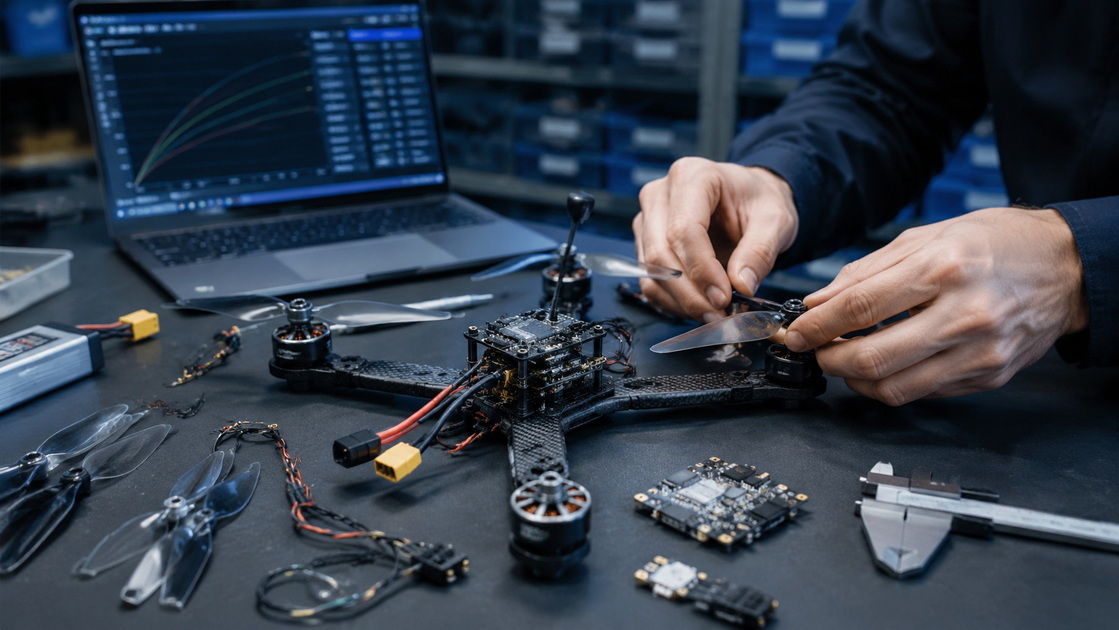
For drone brands and equipment manufacturers, an FPV motor should not be selected only from a catalog. The optimal motor can be customized around the final platform.
A professional OEM or ODM FPV motor project may include:
- Customized stator size and lamination design
- KV winding optimization
- Magnet grade and magnet arc adjustment
- Bell design and material selection
- Shaft diameter and mounting pattern customization
- Bearing selection for durability and smoothness
- Wire length, connector, and solder-pad configuration
- Propeller mounting method
- Surface color, laser marking, logo, and packaging customization
- Thrust-test validation with customer-selected propellers and battery voltage
- Performance tuning for drones, RC cars, ducted fans, gimbals, underwater robots, and specialized equipment
For example, a cinewhoop manufacturer may prioritize smooth low-throttle control, low vibration, and thermal stability. A racing-drone brand may prioritize burst output, rapid response, lightweight construction, and high thrust-to-weight ratio. An industrial drone manufacturer may prioritize durability, repeatability, traceability, and stable continuous-load operation.
The right question is not simply, "Which motor is faster?" The stronger product-development question is:
"Which motor delivers the best combination of thrust, response, efficiency, thermal reliability, and weight for this exact aircraft and mission?"
A lightweight FPV motor is faster when low aircraft mass and rapid agility matter most. It is often the best option for small FPV drones, ultralight racers, toothpick builds, and compact platforms using smaller propellers.
A high torque FPV motor is faster when the drone needs to drive larger or more aggressive propellers under load. It is usually the better choice for 5-inch freestyle drones, heavier racers, cinewhoops, long-range FPV aircraft, and payload-capable platforms.
The fastest setup is rarely the lightest motor or the largest motor. It is the best-matched FPV propulsion system.
If you are developing an FPV drone, RC vehicle, ducted-fan product, robotic platform, or custom electric-power application, Zhongshan Yuhang Power Technology Co., Ltd. can support OEM and ODM brushless motor development—from motor concept selection and KV matching to prototype testing, customized branding, and production-scale delivery.
No. A lightweight FPV motor can make an ultralight drone faster because it reduces all-up weight. But if the motor lacks sufficient torque for the chosen propeller, it may bog down, overheat, or provide weaker recovery during aggressive maneuvers.
No. A larger stator generally provides more torque and power-handling potential, but it also increases motor weight. Larger motors can improve loaded performance, but they may be inefficient or unnecessarily heavy on a small FPV frame.
Torque helps the motor accelerate and maintain propeller RPM under aerodynamic load. Higher torque is valuable for larger propellers, high-pitch props, heavy drones, aggressive freestyle moves, and fast recovery from propwash.
Not by itself. Higher KV can increase unloaded RPM potential, but it must match the battery voltage, propeller, ESC current rating, and motor size. An excessively high-KV motor can draw too much current, generate heat, and reduce real-world efficiency.
A balanced high torque motor is generally the better choice for a 5-inch freestyle build, particularly when using 6S batteries, durable tri-blade props, a digital FPV system, or an action camera. Common starting points often include 2207 and 2306 classes, but the final selection depends on KV, propeller load, and all-up weight.
1. AIAA ARC. "[Designing and Testing a Test Stand to Evaluate the Performance of a Brushless Motor]." Discusses calibrated load-cell measurement for brushless-motor thrust testing. [arc.aiaa]
2. Tyto Robotics. "[How to Test a Brushless Motor with a Thrust Stand]." Explains step, sweep/ramp, and settling-time approaches for motor and propeller testing. [tytorobotics]
3. Tyto Robotics. "[Database of Drone Motors, Propellers & ESCs]." Describes performance metrics such as thrust, torque, RPM, power, efficiency, KV, and motor weight. [tytorobotics]
4. RSL FPV. "[Understanding FPV Drone Motors: Types, Specifications, and Choosing the Right One]." Covers KV, stator dimensions, motor classes, and thrust-to-weight selection principles. [rslfpv]
5. Wing Flying Tech. "[How to Measure Brushless Motor and Propeller Efficiency]." Outlines measurement of voltage, current, torque, thrust, and RPM, plus safety and stabilization guidance for testing. [wingflyingtech]
6. UAV Model Blog. "[FPV Drone Motor Selection Guide 2026: Stator Size, KV, Thrust Testing and Timing]." Provides motor-size ranges and application examples, plus notes on thrust-to-weight calculations and bench testing. [blog.uavmodel]
7. UAV Model Blog. "[FPV Drone Motor Selection Guide: Size, KV, and Thrust Explained]." Explains stator naming, torque implications, and thrust-to-weight examples for FPV aircraft. [blog.uavmodel]


