Language


Views: 247 Author: Yuhang Power Publish Time: 2026-09-02 Origin: Site
Content Menu
● Can You Bring a Drone on a Plane?
● Why Drone Batteries Are Regulated on Flights
>> Why Spare Batteries Must Stay in Carry-On Baggage
● Drone Battery Watt-Hour Limits Explained
>> How to Calculate Drone Battery Watt-Hours
>> Airline Battery Thresholds at a Glance
● Carry-On vs Checked Baggage for Drones
● How to Pack an FPV Drone for Air Travel
>> Step 1: Inspect Every Battery Before Departure
>> Step 2: Confirm Wh Labels Are Visible
>> Step 3: Protect Battery Terminals
>> Step 4: Store Batteries at a Travel-Appropriate Charge
>> Step 5: Prepare the Drone Body
● Airport Security Tips for Drone Travelers
>> Use a Separate Drone Compartment
>> Keep Proof Ready for Large Batteries
>> Expect Extra Questions for FPV Equipment
● International Connections: Follow the Strictest Rule
>> International Travel Checklist
● Special Advice for FPV Pilots and Drone Businesses
>> For OEM, ODM, and B2B Teams
● Common Mistakes That Can Delay Your Flight
● Can You Take Drones on a Plane?
● FAQ
>> 1. Can I bring an FPV drone in my carry-on bag?
>> 2. Can drone batteries go in checked luggage?
>> 3. Can I take a 6S LiPo battery on a plane?
>> 4. How many drone batteries can I take on a plane?
>> 5. Do I need to put FPV LiPo batteries in a LiPo-safe bag?
Can You Take Drones on a Plane? Yes, you can usually take a drone on a plane—but lithium battery rules, airline approval requirements, and country-specific security procedures determine whether your trip goes smoothly. For most travelers, the safest approach is to carry the drone and all removable drone batteries in cabin baggage, with every battery clearly labeled, individually protected, and within the airline's watt-hour limits.
As a manufacturer of FPV drone motors and customized brushless propulsion systems, we regularly work with drone brands, FPV pilots, distributors, and professional equipment developers. One recurring lesson is clear: the aircraft itself is rarely the main airport problem. Lithium polymer and lithium-ion batteries are the critical item. If your batteries are loose, swollen, unmarked, damaged, oversized, or packed incorrectly, they can be rejected even when the drone body is allowed.
This guide explains how to travel with an FPV drone, camera drone, cinewhoop, or professional UAV safely. It covers drone battery watt-hour calculations, carry-on versus checked baggage, airline approval, security screening, international connections, and a practical packing checklist for pilots and B2B equipment teams.
Important: Airline and airport policies can differ by route, aircraft type, country, and security officer. Always confirm the policy with every operating airline before departure, especially for FPV LiPo batteries, batteries above 100 Wh, commercial sample shipments, or international transit itineraries.
In most cases, yes. Drones are generally permitted in carry-on or checked baggage, subject to airline size limits and dangerous-goods rules. However, rules become stricter when lithium batteries are involved.
The practical rule for most travelers is simple:
- Carry the drone body in your hand luggage whenever possible.
- Carry spare FPV drone batteries in hand luggage only.
- Never put spare lithium batteries or power banks in checked baggage.
- Remove batteries from the drone before packing whenever practical.
- Protect every battery terminal against short circuits.
- Check your airline's drone and battery policy before every flight.
The U.S. Transportation Security Administration does not provide a blanket "yes" or "no" rule for drones; it advises travelers to check directly with their airline because lithium batteries, fuel cells, and certain drone components may be restricted in baggage.
For most consumer drones, the removable battery is below 100 Wh. This usually makes cabin transport straightforward, provided the battery is protected and the quantity is reasonable for personal use. The underlying global framework is broadly aligned with International Air Transport Association guidance, but the final decision remains with the airline and airport security staff.
Lithium batteries store a large amount of energy in a compact package. If they are crushed, punctured, internally damaged, short-circuited, overheated, or improperly manufactured, they can enter thermal runaway.
Thermal runaway is a self-heating chain reaction that can release flammable gases, heat, smoke, and fire. It is difficult to control, especially if the battery is inside a bag or hidden in a cargo compartment.
This is why aviation rules distinguish between batteries carried in the cabin and those placed in the aircraft hold.
Cabin crews can identify and respond to smoke or fire more quickly when batteries remain with passengers. In contrast, a fire involving a loose lithium battery in checked baggage may be harder to detect and manage.
The FAA states that spare, uninstalled lithium-ion and lithium-metal batteries—including power banks and charging cases—must be carried in carry-on baggage only. If a carry-on bag is checked at the gate, these spare batteries must be removed and kept with the passenger in the cabin.
For drone travelers, this includes:
- Spare DJI-style intelligent flight batteries
- FPV LiPo battery packs
- Li-ion packs for long-range FPV drones
- Portable power banks
- External battery chargers with built-in cells
- Detached camera, goggle, radio, and receiver batteries
Safety priority: Treat every removable drone battery as a spare battery unless your airline explicitly confirms another packing method.
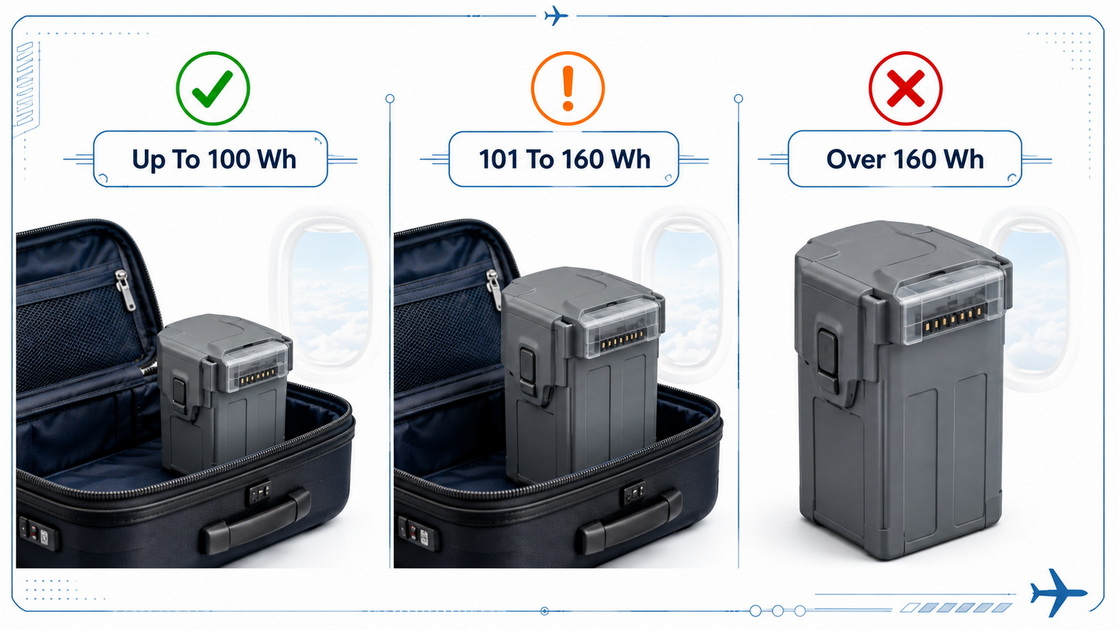
The key measurement for airline battery rules is watt-hours, abbreviated as Wh. Watt-hours describe the total energy capacity of the battery.
Many batteries display their Wh rating directly on the label. If it is missing, faded, or unclear, calculate it before traveling and prepare proof of the result.
Use this formula:
Watt-hours (Wh)=Nominal voltage (V)×Capacity (Ah)
If capacity is listed in milliamp-hours, divide by 1,000 first:
Wh=V×mAh/1,000
Example 1: Common FPV 6S LiPo battery
A 6S LiPo has a nominal voltage of 22.2 V. If capacity is 1,300 mAh:
22.2×1,300/1,000=28.86 Wh
This battery is below 100 Wh and usually fits within the standard carry-on category, subject to the airline's quantity and packaging rules.
Example 2: Larger 6S LiPo battery
A 6S LiPo has a nominal voltage of 22.2 V. If capacity is 5,000 mAh:
22.2×5,000/1,000=111 Wh
This battery falls into the 101–160 Wh range. It may require airline approval and is commonly limited to two spare batteries per traveler.
| Battery Capacity | Typical Passenger-Aircraft Rule | What Drone Travelers Should Do |
|---|---|---|
| Up to 100 Wh | Usually allowed in carry-on baggage | Keep batteries in cabin baggage and protect terminals |
| 101–160 Wh | May be allowed only with airline approval | Contact the airline before booking or departure; normally no more than two spare batteries |
| More than 160 Wh | Generally not permitted on passenger aircraft | Use a compliant cargo-shipping method or select a different power solution |
| Any spare lithium battery | Carry-on only | Do not place it in checked baggage |
| Damaged, swollen, leaking, or recalled battery | May be refused | Do not travel with it; replace or safely dispose of it |
The FAA allows rechargeable lithium-ion batteries rated from 0 to 100 Wh on passenger aircraft. Batteries from 101 to 160 Wh require air-carrier approval, and passengers may carry a maximum of two spare batteries in that range. Batteries above 160 Wh are prohibited on passenger aircraft.
IATA similarly states that batteries up to 100 Wh are generally allowed in carry-on baggage; 100–160 Wh batteries may be accepted with airline approval; and batteries above 160 Wh are usually not permitted on passenger aircraft.
The drone airframe and the battery should be treated differently. The table below provides the safest practical approach for most passenger flights.
| Item | Carry-On Baggage | Checked Baggage | Best Practice |
|---|---|---|---|
| Drone body without battery | Usually permitted if it meets cabin-bag size limits | Often permitted, subject to airline policy | Carry it on to reduce damage, loss, and theft risk |
| Spare LiPo or lithium-ion drone batteries | Permitted if within limits and protected | Not permitted | Carry on only |
| Battery installed in drone | Airline-dependent | Airline-dependent | Remove it and carry it on unless the airline gives clear written confirmation |
| FPV goggles with internal battery | Usually permitted | Often allowed if protected and powered off | Carry on when possible |
| Radio transmitter battery | Usually permitted | Airline-dependent | Carry on and prevent accidental activation |
| Battery charger without internal battery | Usually permitted | Usually permitted | Pack securely and check airline restrictions |
| Power bank | Carry-on only | Not permitted | Keep in cabin baggage |
| Drone propellers | Usually permitted | Usually permitted | Remove from drone and protect from bending |
| Tools, hex keys, cutters, soldering equipment | Airline- and country-dependent | Usually safer in checked baggage | Review TSA and local security rules before travel |
The FAA notes that devices containing lithium batteries may be placed in checked baggage only when they are fully switched off, protected from accidental activation, and protected from damage. However, spare batteries remain prohibited in checked baggage.
For this reason, a detachable-battery drone should generally travel with the battery removed. This reduces ambiguity at security, helps prevent accidental activation, and keeps the highest-risk component in the cabin where it can be monitored.
Good packing is not only about passing security. It also protects expensive components such as carbon-fiber frames, camera systems, FPV antennas, flight controllers, brushless motors, and propellers.
Do not take batteries that show visible damage or abnormal behavior.
Check for:
- Swelling or puffing
- Torn shrink wrap
- Damaged balance leads
- Exposed wire
- Corroded terminals
- Cracked plastic housing
- Burn marks
- Water exposure
- Missing or unreadable capacity labels
A swollen LiPo battery can be refused by airport security or an airline even when its watt-hour rating is compliant. More importantly, it presents a genuine safety hazard. Do not attempt to "hide" or transport a questionable battery.
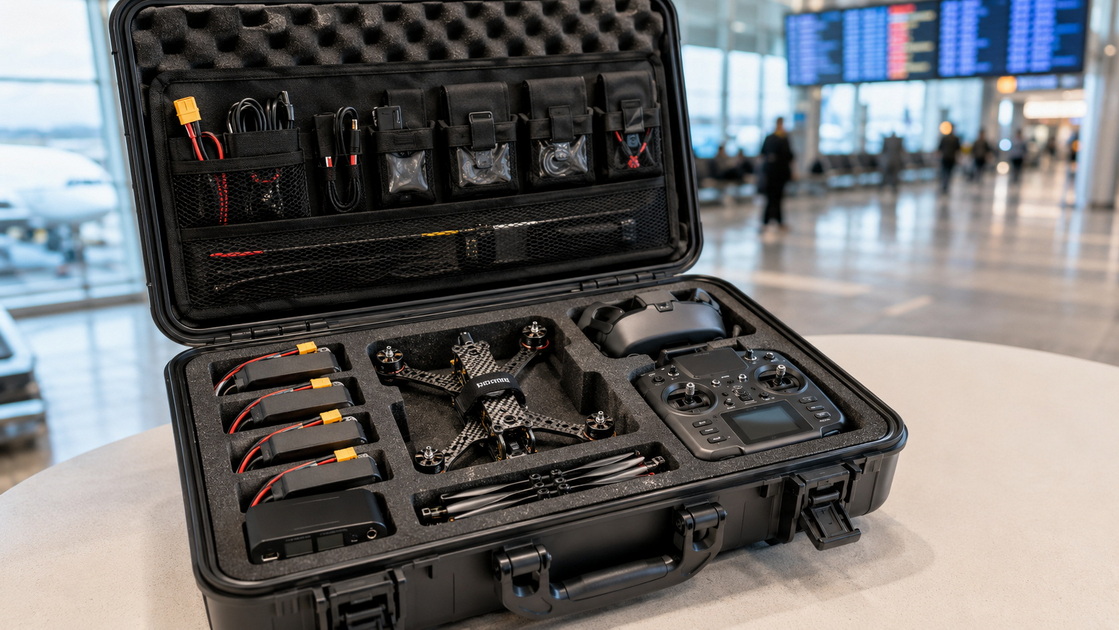
The battery's voltage, capacity, and watt-hour rating should be easy to read. If Wh is not printed, create a simple label showing:
- Battery type
- Nominal voltage
- Capacity in mAh
- Watt-hour calculation
- Your contact information, if appropriate
For example:
6S LiPo Battery
Nominal Voltage: 22.2 V
Capacity: 1,300 mAh
Energy: 28.86 Wh
This label does not replace airline approval for larger batteries. It simply helps security personnel quickly verify the capacity of the pack.
Each battery must be protected against short circuits. Use one or more of the following methods:
- Original battery packaging
- Individual plastic battery cases
- LiPo-safe bags
- Separate plastic zip bags
- Terminal covers
- Electrical tape over exposed connectors
- Protective caps for XT30, XT60, XT90, and balance connectors
IATA recommends individually protecting spare batteries from short circuits by using original retail packaging, insulating exposed terminals with tape, or placing each battery in a separate plastic bag or protective pouch. Spare batteries must travel in carry-on baggage only.
For FPV pilots, connector protection matters. An exposed XT60 connector can contact keys, tools, spare screws, metal zippers, or another battery connector inside a bag. A simple protective cap or insulated pouch reduces that risk.
For LiPo batteries, avoid traveling with fully charged packs unless the battery manufacturer and airline procedure clearly support it. A common conservative practice among FPV users is to store packs near storage voltage, often around 3.7–3.85 V per cell.
For a typical 6S LiPo battery, that means approximately:
6×3.7=22.2 V
to
6×3.85=23.1 V
This is not a replacement for airline rules. It is a battery-care practice intended to reduce unnecessary stress during transport and storage.
Before placing the aircraft in a hard case or carry-on backpack:
1. Remove the flight battery.
2. Remove propellers, especially on FPV drones with exposed motors.
3. Install a gimbal clamp if your drone uses a stabilized camera.
4. Secure antennas to prevent bending.
5. Cushion the airframe with foam or a fitted case.
6. Lock or tape switches only if necessary to prevent accidental activation.
7. Keep a basic component list or invoice for high-value professional equipment.
For custom-built FPV drones, consider using a labeled equipment card that identifies the drone as a "Remote-Controlled Unmanned Aircraft" and lists the battery Wh rating. This can be useful for international travel, equipment demonstrations, and B2B business trips.
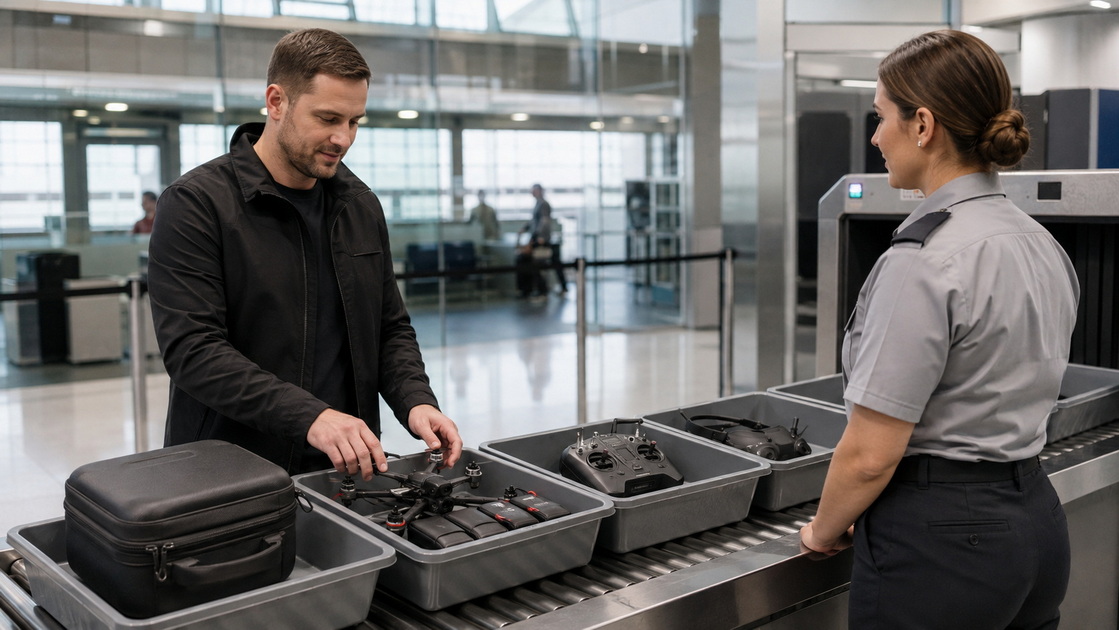
Airport screening is easier when your equipment is organized, visible, and easy to explain.
Keep your drone body, batteries, radio, goggles, and charger in dedicated sections. Do not bury loose batteries beneath cables, tools, or clothing.
A security officer may ask you to remove:
- The drone
- Battery pouches
- Radio transmitter
- FPV goggles
- Power banks
- Larger electronic devices
Being able to show each item quickly creates a better security experience and reduces the likelihood of accidental damage during inspection.
If you carry a battery from 101–160 Wh, prepare:
- Written airline approval
- A copy of the airline's battery policy
- The original battery specification sheet
- A visible Wh label
- A clear explanation of whether the battery is installed or spare
Do not rely on verbal approval alone. If customer service provides permission by email, keep a saved copy on your phone and a printed copy in the case.
FPV systems can look unfamiliar to security staff. A compact carbon-fiber racing drone, multiple LiPo pouches, antennas, a radio controller, and FPV goggles may require additional screening.
Remain calm and explain clearly:
"This is a recreational or professional FPV drone. These are individually protected lithium batteries, each below the permitted watt-hour limit. The batteries are in my carry-on baggage."
Avoid technical jargon unless requested. Clear, simple language is more useful than discussing ESC protocols, motor KV, flight-controller firmware, or video-transmission frequencies.
A major information gap in many drone travel guides is the assumption that one airline's policy applies to the entire journey. It does not.
A multi-leg itinerary can involve:
- A domestic carrier
- An international carrier
- A codeshare partner
- A regional airline
- Transit airport security
- A destination country with different dangerous-goods enforcement
When policies differ, follow the strictest applicable rule across your entire itinerary.
For example, an airline may permit a certain quantity of batteries below 100 Wh, while a connecting carrier may accept only a smaller number without advance approval. If a transit airport conducts security screening again, that airport may apply its own interpretation of battery-label and packaging requirements.
- Confirm the battery policy of every operating airline, not only the airline that sold the ticket.
- Check the rules of transit airports if you change terminals or collect baggage.
- Verify destination-country drone registration, import, and flight restrictions separately.
- Carry all batteries in cabin baggage.
- Use clearly marked, individually protected battery pouches.
- Pack only the quantity necessary for the trip.
- Print or save airline approval for 101–160 Wh batteries.
- Avoid carrying damaged, unmarked, modified, or prototype battery packs unless you have proper transport documentation.
Drone transport permission does not equal permission to fly at your destination. Many countries require registration, operator certification, insurance, remote identification, flight authorization, or local approval. Always check the civil aviation authority for your destination before operating the drone.
FPV drone batteries deserve additional care because many are LiPo packs with exposed high-current connectors and balance leads. Unlike sealed consumer-drone batteries, custom FPV batteries may require more deliberate protection.
- Use individual LiPo-safe pouches or nonconductive battery cases.
- Cover XT30, XT60, XT90, and balance connectors.
- Do not pack tools with batteries.
- Travel with only the packs needed for the planned flights.
- Bring a compact battery checker if appropriate, but do not bring damaged charging equipment.
- Remove propellers from your FPV drone to prevent damage and reduce inspection concerns.
- Check local restrictions before flying near airports, urban areas, landmarks, government facilities, or critical infrastructure.
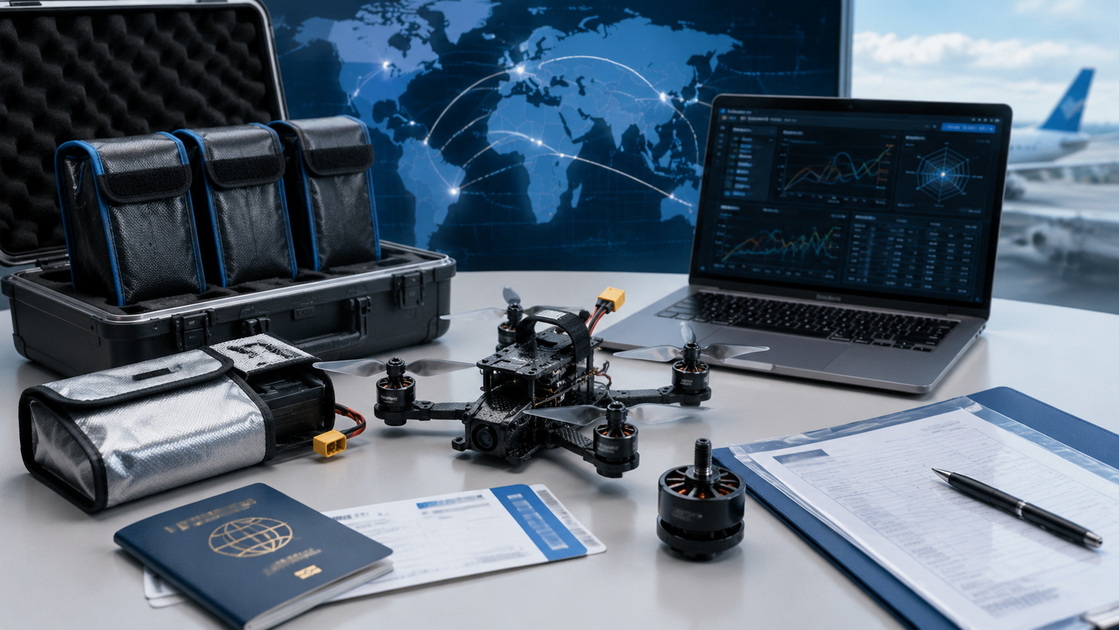
If you are traveling with drone prototypes, motor samples, custom battery packs, or commercial demonstration equipment, prepare more documentation than a recreational traveler.
Useful documents may include:
- Product specification sheet
- Battery Wh calculation sheet
- Manufacturer declaration, when applicable
- Safety Data Sheet or battery transport documentation
- Commercial invoice or pro forma invoice
- Packing list
- Airline approval confirmation
- Contact information for the manufacturer or importer
- Destination-country import and customs documents
For companies sourcing FPV motors, brushless motors, ESCs, or drone propulsion systems from China, distinguish between personal passenger transport and commercial battery shipping. Passenger luggage rules do not authorize commercial lithium-battery shipping. Commercial shipments may require dangerous-goods packaging, testing documentation, proper labels, and carrier acceptance procedures.
At Zhongshan Yuhang Power Technology Co., Ltd., we support OEM and ODM brushless motor projects for FPV drones, RC vehicles, high-speed ducted fans, gimbal systems, aircraft, robotic cleaners, underwater robots, and professional power equipment. When customers travel with prototype drone systems, we recommend confirming the battery transport plan early—especially if the project uses high-capacity packs, customized battery configurations, or multiple samples.
Avoid these common drone travel mistakes:
- Packing spare drone batteries in checked baggage
- Leaving LiPo batteries loose inside a backpack
- Traveling with swollen or damaged battery packs
- Carrying batteries with unreadable labels
- Assuming battery quantity rules are identical across airlines
- Forgetting to request approval for 101–160 Wh batteries
- Packing a drone with props attached and no protective case
- Failing to remove spare batteries when a carry-on bag is gate-checked
- Confusing drone transport rules with destination flight regulations
- Carrying unprotected metal tools beside LiPo connectors
- Using a large custom battery pack without confirming its Wh rating
- Assuming a lithium battery is permitted because it "looks small"
You can usually take a drone on a plane, but the safest method is to keep the drone body in carry-on baggage and place every spare drone battery in a separate, protected carry-on pouch.
For most FPV and consumer drone batteries below 100 Wh, travel is generally straightforward. For batteries from 101–160 Wh, obtain airline approval before departure and expect a two-spare-battery limit. Batteries above 160 Wh are generally not allowed on passenger aircraft.
The most effective pre-flight routine is simple:
1. Calculate and verify each battery's Wh rating.
2. Remove batteries from the drone.
3. Inspect packs for swelling, damage, and readable labels.
4. Protect terminals and balance leads against short circuits.
5. Put spare batteries in carry-on baggage only.
6. Confirm rules with every operating airline.
7. Research destination drone-flying rules separately.
Need a custom FPV propulsion solution for a drone brand, equipment project, or industrial application? Zhongshan Yuhang Power Technology Co., Ltd. provides brushless motor research, manufacturing, and customized OEM/ODM services for FPV drones, UAVs, RC cars, ducted fans, gimbal cameras, aircraft, cleaning robots, and underwater robots. Contact our team to discuss motor size, KV, stator configuration, thrust targets, efficiency requirements, mounting design, and production needs.
Usually, yes. Carrying the drone in cabin baggage is often the safest option because it protects the aircraft from impact, loss, and theft. You must still comply with airline size limits and battery restrictions. The airline makes the final decision.
Spare drone batteries should not go in checked luggage. FAA guidance requires spare lithium batteries to travel in carry-on baggage only, with protection against damage and short circuits.
Yes, if its watt-hour capacity is within the airline's permitted range and it is properly packed. A typical 6S 1,300 mAh LiPo is about 28.86 Wh, while a 6S 5,000 mAh LiPo is about 111 Wh and may require airline approval.
It depends on battery capacity and the airline's policy. Batteries up to 100 Wh are generally permitted in reasonable quantities for personal use. For spare batteries from 101–160 Wh, FAA guidance allows up to two per person with airline approval.
Not every airline explicitly requires a LiPo-safe bag. However, every spare battery must be protected from short circuits. Individual protective pouches, original packaging, terminal caps, taped terminals, or separate plastic bags can meet this goal when used correctly. IATA specifically recommends individually protecting spare batteries and insulating exposed terminals.
1. Federal Aviation Administration. "[Airline Passengers and Batteries]." Explains passenger-aircraft limits for lithium-ion batteries: up to 100 Wh, 101–160 Wh with airline approval, and a two-spare-battery limit for the larger range. [faa]
2. Federal Aviation Administration. "[Lithium Batteries in Baggage]." States that spare lithium batteries, power banks, and portable chargers must be carried in the cabin and cannot be packed in checked baggage. [faa]
3. Federal Aviation Administration. "[PackSafe: Lithium Batteries]." Provides carry-on-only requirements and short-circuit protection guidance for spare lithium batteries. [faa]
4. Transportation Security Administration. "[Drones, Unmanned Aircraft Systems (UAS)]." Advises travelers to check with the airline because drones with lithium batteries and related components may be restricted in baggage. [tsa]
5. International Air Transport Association. "[Safe Travel with Lithium Batteries]." Summarizes passenger guidance for batteries up to 100 Wh, 100–160 Wh batteries requiring possible airline approval, and batteries over 160 Wh. [iata]
6. International Air Transport Association. "[Passengers Travelling with Lithium Batteries]." Recommends individual battery protection through retail packaging, taped terminals, separate bags, or protective pouches. [iata]


