Language


Views: 222 Author: Yuhang Power Publish Time: 2026-06-03 Origin: Site
Content Menu
● What Is A Brushless DC Motor (BLDC) And Why It Dominates FPV And Robotics
● How Brushless DC Motors Work: From Magnetic Fields To Thrust
● Key Components Of A BLDC Motor (With FPV Relevance)
● Main Types Of Brushless DC Motors (And Where FPV Motors Fit)
● Why Brushless DC Motors Are Preferred In Modern FPV And Robotics
● Where Brushless DC Motors Are Used Today
● FPV Drone Motor Selection Checklist (Kv, Torque, And Reliability)
>> 1. Match Kv to prop size and voltage
>> 2. Check continuous and burst current ratings
>> 3. Evaluate stator size, magnet quality, and cooling
>> 4. Consider durability and manufacturing quality
● Custom OEM And ODM BLDC Solutions For FPV And Robotics
● How To Choose A Brushless DC Motor: A Step‑By‑Step Engineer's Workflow
● Call To Action: Work With A Motor Partner, Not Just A Motor Seller
● FAQ
>> 1. How do I know if a BLDC motor is suitable for high‑G FPV racing?
>> 2. What is the difference between a generic BLDC motor and an FPV‑optimized motor?
>> 3. Should I choose sensored or sensorless motors for my build?
>> 4. How can I avoid ESC desyncs with high‑Kv FPV motors?
>> 5. What is the most reliable way to compare motors from different manufacturers?
When you spec an FPV drone motor or any brushless DC motor for demanding robotics, you are not just buying a component—you are defining how your entire system will feel in the air, on the ground, or underwater. Over the past decade working with FPV racers, UAV system integrators, and OEMs, I have seen well‑engineered BLDC motors deliver quieter thrust, tighter control, and dramatically longer service life compared with "spec sheet only" choices that look good but fail early under real loads. [maximizemarketresearch]
A brushless DC motor uses permanent magnets on the rotor and electronically controlled windings on the stator to generate torque, eliminating mechanical brushes and commutators. Instead of physical contact, an electronic controller switches current in the coils based on rotor position feedback, creating a rotating magnetic field that pulls the rotor around. [acim.nidec]
For FPV drones, gimbals, RC cars, and service robots, this design matters because:
- No brushes means less wear and lower electrical noise, essential for high‑RPM FPV motors and precision gimbal axes. [anaheimautomation]
- Electronic commutation enables fine torque and speed control, which translates into more responsive flight and better throttle resolution.
- Higher efficiency and power density allow you to keep systems lighter, cooler, and quieter—critical for racing drones, cinewhoops, and battery‑powered robots. [oneplusdisplay]
The same electromagnetic principles apply whether you are flying a 5‑inch racing quad or driving a large cleaning robot; what changes is how the motor is optimized.
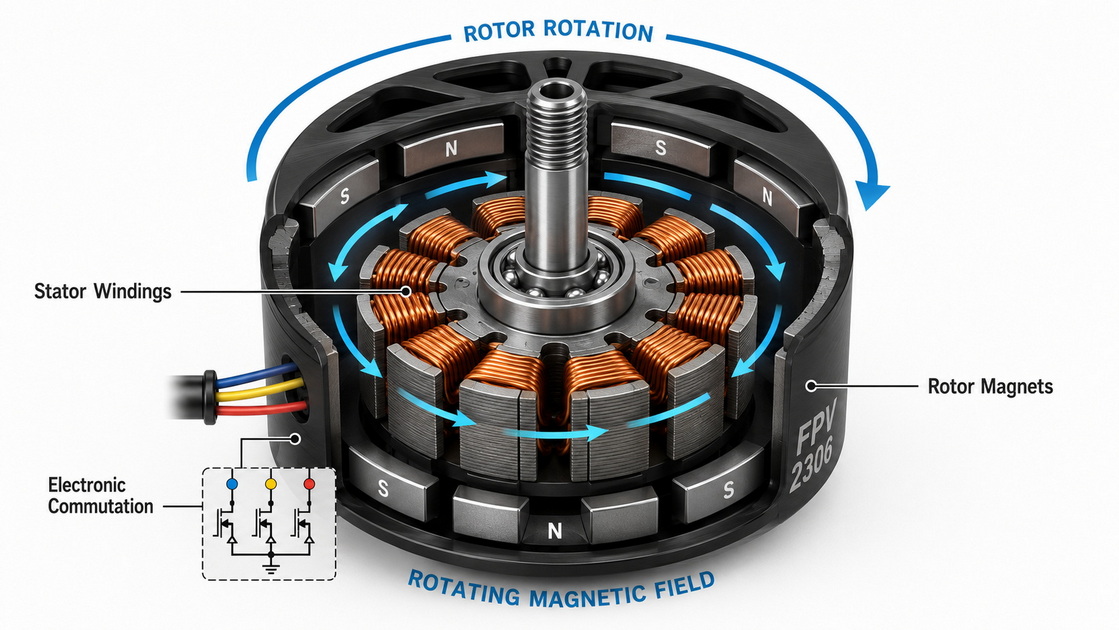
At a high level, every BLDC motor follows the same three stages. [oneplusdisplay]
1. Magnetic interaction between stator and rotor
- The rotor carries permanent magnets.
- The stator hosts multiple copper windings.
- When current flows in the windings, a magnetic field forms and interacts with the magnets, generating torque.
2. Electronic commutation via a controller (ESC)
- A controller uses Hall sensors or back‑EMF detection to estimate rotor position.
- It sequentially energizes phases to keep the magnetic field rotating, pulling the rotor smoothly and continuously.
3. Closed‑loop feedback for precision
- In gimbals, robotic joints, or high‑end FPV systems, sensors and firmware monitor speed and position.
- Control algorithms (often PWM‑based) adjust current in real time to maintain stable RPM, torque and response. [acim.nidec]
For FPV pilots, the result is instant throttle punch, predictable braking, and consistent feel across packs—assuming the motor and controller have been matched correctly.
Every brushless DC motor—whether for a racing quad, a gimbal, or a robot vacuum—includes three critical elements. [oneplusdisplay]
- Rotor
- Usually a bell carrying high‑grade permanent magnets, shaped and balanced for smooth high‑speed rotation.
- In FPV drone motors, magnet grade, arc shape, and rotor design directly influence torque, efficiency, and how "snappy" the motor feels.
- Stator
- A laminated iron core with copper windings.
- Slot count, winding pattern, and wire gauge determine Kv, torque constant, and heat behavior. Higher slot counts and tight tolerances help reduce cogging and improve throttle smoothness. [oneplusdisplay]
- Electronic controller (ESC or integrated driver)
- Power MOSFETs, microcontroller, and control firmware handle commutation and current regulation.
- For FPV, the ESC's firmware (e.g., BLHeli‑based) and current capability are as important as the motor itself for preventing desyncs and burnt windings. [anaheimautomation]
When evaluating motors, treat these as one integrated system rather than isolated parts.
BLDC motors can be classified in several practical ways. [oneplusdisplay]
- Outrunner motor
- Rotor (bell) outside, stator inside.
- Offers high torque at relatively low RPM, ideal for propeller‑driven loads like FPV drones, fixed‑wing aircraft, and cooling fans.
- Inrunner motor
- Rotor inside, stator outside.
- Supports higher RPM with smaller diameter, commonly used in high‑speed RC cars, pumps, and small blowers. [oneplusdisplay]
Most FPV drone motors are outrunners, optimized for torque and responsiveness with minimal rotational inertia.
- Star (Y) wound
- Balanced current, smoother operation, generally lower starting current.
- Favored in general robotics and industrial BLDC motors. [oneplusdisplay]
- Delta (Δ) wound
- Higher phase current and potentially higher torque at similar voltage.
- Suitable for high‑load or high‑performance applications that can handle added thermal stress. [oneplusdisplay]
- Sensored BLDC motors
- Use Hall sensors or encoders, enabling accurate low‑speed control and position holding.
- Essential for gimbals, robot joints, precise drive systems.
- Sensorless BLDC motors
- Rely on back‑EMF; simpler and cost‑effective but less precise at very low speeds. [oneplusdisplay]
- Standard choice for FPV drone motors and most propulsion tasks.
BLDC motors bring several decisive advantages over brushed motors and lower‑end alternatives. [acim.nidec]
- High power‑to‑weight ratio
This is crucial in FPV racing, where every gram matters, and in drones carrying heavy payloads or gimbals.
- High efficiency and longer runtime
Less power wasted as heat translates into longer flight time, fewer thermal issues, and more stable performance across packs. [maximizemarketresearch]
- Smooth operation and low noise
No brushes means less vibration and electrical noise, which improves gyro performance and sensor reliability on flight controllers and robots. [anaheimautomation]
- Precise control and responsiveness
Electronic commutation combined with modern ESC firmware enables fine control over torque and RPM, which FPV pilots feel as linear throttle and predictable handling. [anaheimautomation]
- Reduced maintenance
Eliminating brushes removes a major wear point, which is vital for professional platforms such as inspection UAVs, industrial gimbals, and autonomous robots.
The BLDC platform is now standard in multiple fast‑growing markets. [idtechex]
- FPV drones and racing quads
FPV is one of the fastest‑growing drone segments, with some studies projecting the FPV drone market to grow at over 20% CAGR through 2032, reaching several billion dollars in value. BLDC motors are at the heart of this growth, enabling agile acrobatics and high‑speed racing. [stellarmr]
- Cinematography drones and aerial platforms
High‑efficiency BLDC motors help stabilize flight for long‑take shots, mapping missions, and delivery drones where smooth thrust and low noise are mandatory. [idtechex]
- Gimbals and camera stabilization
High‑pole, low‑cogging motors allow micro‑adjustments at very low speeds, keeping footage stable even in turbulent conditions. [oneplusdisplay]
- Ground and service robots
From robot vacuums to warehouse AMRs, BLDC motors provide reliable, quiet drive power and auxiliary motion.

This is where generic BLDC theory becomes practical for FPV pilots and OEM customers.
- Kv indicates how many RPM per volt the motor produces with no load.
- Higher Kv = more RPM but less torque at the same voltage; lower Kv = more torque and better control with heavier props.
- For a typical 5‑inch racing quad on 6S, 1900–2100 Kv outrunners are a common sweet spot; cinematic and long‑range builds often use lower Kv for larger props. [maximizemarketresearch]
- The motor must handle sustained current at your typical throttle range and short bursts during full‑throttle punches or rapid braking.
- Pair FPV motors with ESCs that have sufficient headroom to avoid desyncs and burnt windings. [anaheimautomation]
- Larger stator volumes (e.g., 2207 vs 2205) usually provide higher torque and better heat dissipation.
- High‑temperature magnets and quality laminations help prevent demagnetization and efficiency loss under hard use.
- Look for open, airflow‑friendly bell designs that shed heat quickly.
- FPV motors are abused: crashes, sand, water, and high‑g loads.
- Check for tight tolerances, balanced rotors, robust bearings, and solid shaft retention, all of which extend motor life significantly. [oneplusdisplay]

For drone brands, system integrators, and robotics OEMs, off‑the‑shelf motors are not always enough. This is where custom FPV drone motor and BLDC solutions become strategic. [holrymotor]
- Custom Kv and winding
Tailor motor Kv, winding pattern, and copper fill to your prop, voltage, and flight/drive profile for optimal efficiency and feel.
- Mechanical customization
Shaft diameter, mounting hole pattern, cooling features, and weight optimization can all be tuned for a specific frame or enclosure.
- System‑level matching
Matching motors with ESCs, props, gearboxes, and control firmware yields significant real‑world gains in responsiveness and battery life.
As a specialized BLDC manufacturer, Zhongshan Yuhang Power Technology Co., Ltd. can support OEM and ODM projects across FPV drones, RC cars, violent fans, gimbals, aircraft, cleaning robots, and underwater robots by providing complete power system solutions rather than just individual motors. [creativedisplaysnow]

The original CubeMars article outlines a sound process; below is a condensed, field‑tested version. [oneplusdisplay]
1. Define load and duty cycle
- Required continuous and peak torque.
- Typical operating profile (racing bursts vs. long‑range cruise vs. 24/7 robot use).
2. Set speed range and resolution needs
- Minimum, nominal, and maximum RPM.
- Required response time to throttle or control inputs.
3. Specify electrical constraints
- System voltage range (e.g., 4S–6S LiPo for FPV, 12–48 V for robotics).
- Available current and thermal budget.
4. Select sensing and control approach
- Sensorless for FPV and general propulsion.
- Sensored with encoders for precise robotics and gimbals. [oneplusdisplay]
5. Define mechanical envelope
- Maximum diameter and length, mounting pattern, shaft type, and allowable mass.
6. Plan thermal management
- Whether airflow, heatsinks, or active cooling will be present.
- Safety margins for high‑ambient or high‑altitude operation. [oneplusdisplay]
7. Prototype, test, and iterate
- Build test setups and log current, temperature, thrust, and response.
- Adjust Kv, timing, and ESC settings to finalize the spec. [oneplusdisplay]
If you are building FPV drones, RC platforms, industrial robots, or specialized devices like underwater ROVs and cleaning robots, your choice of brushless motor directly impacts performance, reliability, and customer satisfaction. [idtechex]
As a Chinese manufacturer focused on FPV drone motors and BLDC systems, Zhongshan Yuhang Power Technology Co., Ltd. can support you with:
- Application‑specific motor recommendations based on your frame, payload, and mission profile
- Custom Kv, winding, and mechanical designs for OEM and ODM projects
- Complete power system solutions, from motors and ESCs to matching propellers or drive components [creativedisplaysnow]
You can contact our engineering team to review your current setup, discuss performance targets, and co‑design a motor solution tuned to your project's real operating conditions.
Check the stator size, bearing quality, rotor balance, and continuous current rating, then test under your heaviest planned loads while monitoring temperature and ESC logs. Motors that stay within safe thermal limits and maintain smooth response during repeated hard maneuvers are better suited to high‑G racing. [maximizemarketresearch]
FPV motors prioritize high torque density, fast transient response, and effective cooling, with stator and rotor designs tuned for propeller loads and rapid throttle changes. Generic BLDC motors may meet torque specs but often lack the thermal and mechanical robustness needed for aggressive flying. [anaheimautomation]
For propulsion tasks such as FPV drones and RC cars, sensorless BLDC motors are typically sufficient and more cost‑effective. For gimbals, robot joints, and applications requiring precise low‑speed control or position holding, sensored BLDC motors with encoders or Hall sensors are recommended. [acim.nidec]
Use ESCs with adequate current margin, updated firmware, and correct motor timing; keep wiring short and well‑soldered; and avoid overly aggressive settings that push the system beyond its safe electrical and thermal envelope. Field testing under worst‑case conditions is essential. [anaheimautomation]
Beyond Kv and size, compare thrust vs. current curves, efficiency at your target throttle range, temperature rise under load, and long‑term durability tests. Ask for independent test data or run your own controlled benchmarks using the same propellers, ESCs, and batteries. [acim.nidec]
1. CubeMars. "Brushless DC Motors: A Comprehensive Overview." (Accessed 2026).
[https://www.cubemars.com/brushless-dc-motors-comprehensive-overview.html]
2. Maximize Market Research. "FPV Drone Market: Global Industry Analysis and Forecast." 2026.
[https://www.maximizemarketresearch.com/market-report/fpv-drone-market/211053/]
3. Stellar Market Research. "FPV Drone Market Industry Analysis and Forecast." 2020.
[https://www.stellarmr.com/report/fpv-drone-market/2350]
4. IDTechEx. "Drones Market 2026–2036: Technologies, Markets, and Forecasts." 2025.
[https://www.idtechex.com/en/research-report/drones-market/1142]
5. US MOTORS. "Brushless DC Motors BLDC | Custom OEM 50–120mm Solutions." 2025.
[https://acim.nidec.com/motors/usmotors/Products-And-Services/DC-Motors/Brushless-DC-Motors-BLDC]
6. Anaheim Automation. "Smart Solutions: Integrated Motors For OEM Designs." 2025.
[https://anaheimautomation.com/blog/post/smart-solutions-integrated-motors-for-oem-designs]
7. Holry Motor. "Customized Brushless DC Motor Types." 2024.
[https://www.holrymotor.com/customized-brushless-dc-motor-types.html]


